BlackRock: The Secretive Company that owns the World, Hakluyt & Starmer have Scotland in their sights

Blackrock exposed:

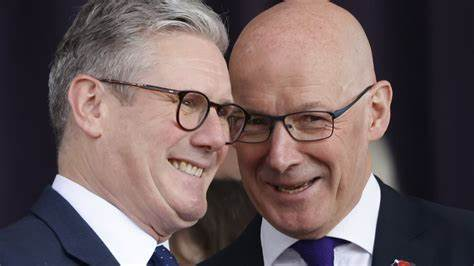
Starmer saved Labour from ‘extremism’ under ‘Marxist leader’, says BlackRock CEO

Keir Starmer has been backed by one of the world’s most influential financiers, Larry Fink, the chairman and CEO of BlackRock, the world’s largest asset manager, as he said the Labour leader now offers a “measurement of hope” by showing “real strength” in bringing Labour back to the centre ground of politics.

Hakluyt: Masters of the Great Game

Globalisation and cross-border mergers are increasing demand for Hakluyt’s brand of intelligence, Years after leaving MI6, Christopher James, is still involved in “the great game”, still savouring the whiff of romance and still at the centre of a global web.

Former spies are supposed to retire into oblivion, carrying their secret cargo of knowledge to the grave. Not him. The idea was to do for industry what we had done for the government,” he says. “In the services, you get to understand a great deal about the people who make things work. I felt what we provided might have some commercial value. You could say it was intuition about the ending of the Cold War.”

James, who served in the Special Air Service before MI6, founded Hakluyt & Company in April 1995 along with Christopher Wilkins, a former Welsh Guards officer and businessman.

Mike Reynolds, an ex-MI6 colleague, and Jeremy Connell, a former diplomat and business development manager for a law firm, became directors in 1995.

Michael Maclay, a former journalist, diplomat and special adviser to Douglas Hurd, former foreign secretary, and Carl Bildt, UN high representative in Bosnia, joined in 1997.

Wilkins retired in 1996.

So far Hakluyt has provided intelligence for 26 FTSE 100 companies and has a growing number of US and European clients.

Operating by word of mouth, the company sells information of a singular and sensitive kind. James describes what they produce as “the truth”. “The chairman of a company may be under immense pressure from senior managers to approve a contract, but a voice in the back of his head tells him something is not quite right. That is where we come in. We give focused, timely intelligence – we fill in the gaps.” Maclay adds: “We are there to answer specific questions – what the real agenda is, who is in whose pocket and what is the role of certain people.”

Maclay gives an example of an assignment. In 1997 a British company was tempted by a lucrative joint venture in the former Soviet Union when strategic mineral resources were privatised in an obscure republic. The slick Russian frontmen turned out to be ex-KGB agents with direct links to an international drugs cartel laundering money in the Caribbean. The company was advised to pull out.

Raising a china teacup at Hakluyt’s West End offices, James, managing director, reflects: “It would not be Hakluyt if there was no whiff of romance about it.”

It might be thought that his former masters would have been uneasy about former staff going corporate. But Sir David Spedding, then head of MI6, wished him luck with his venture as he does with everyone who leaves the service, says James. “Once you’re in, you’re in. And once you’re out, you’re out. There are absolutely no ties.” He is sure MI6 is not interested in Hakluyt’s activities. “They have far more important things to worry about.”

Support has come from a roll-call of establishment grandees – a clue to the contacts Hakluyt can muster.

Former foreign secretary Malcolm Rifkind is supportive of the project; so too is Ian Lang, former secretary of state at the Department of Trade and Industry. Earl Jellicoe, president of the SAS Association provided early encouragement, as did the late Brigadier Sir Fitzroy Maclean, Winston Churchill’s personal envoy to Marshall Tito during the second world war. The current DTI “likes the idea”, according to James.

The Hakluyt Foundation

The company’s equivalent of a board, contains more eminent names:

Sir Peter Holmes, the foundation’s president and former chairman of Royal Dutch Shell Group.

Sir Brian Cubbon, former permanent under-secretary of state at the Home Office.
.
Sir Peter Cazalet, chairman of the company and the foundation, former deputy chairman of BP and member of the top salaries review board.

Sir William Purves, former chairman of HSBC.

Lord Inge, former chief of defence staff.

Lord Trotman, former chairman and chief executive of Ford and a director of the New York Stock Exchange.

Baroness Smith of Gilmorehill, widow of John Smith, the former Labour party leader who was himself was a Steering Committee Member of the Bilderberg Group.

Lord Renwick, chairman of Robert Fleming, the investment bank is a special adviser.

Strategic Associations

To cap all these connections, Hakluyt formed a strategic agreement with Henry Kissinger. The former US secretary of state, guru of realpolitik, Nobel peace prize-winner and darling of the lecture circuit runs his own strategic consultancy, Kissinger Associates.

Kissinger’s company facilitates top-level introductions for Hakluyt and both will refer clients and cooperate on individual projects. It is almost a privatised version of “the special relationship”.

James said, “Kissinger is a statesman who has been at the very heart of American politics and I am extremely flattered. The Hakluyt Foundation has a vital role. It provides “reassurance we are not just a tearaway bunch of ex-government officials. It ensures Hakluyt abides by a code of practice, which has an absolute ban on doing anything illegal, any dirty tricks.”

Asked if this might disappoint some clients James was firm: “We just don’t do it.”

McClay added, “Nor does Hakluyt operate by tip fees for information. We talk to the high-ups, not the hard-ups.”

Hakluyt, like the services, regards paid-for information as less reliable than information given freely. The company has over 100 “associates” on its books some based in London, others at stations worldwide, formed by personal contacts, whose judgement the directors trust absolutely. They might be investigative journalists, diplomats’ wives, senior business people, former diplomats or consultants. They are “intuitive, determined, highly intelligent” and have intimate knowledge of the country in which they operate. Associates are free to turn down assignments and are expected to use their judgment about dangerous situations.

McClay said, “When Hakluyt receives an assignment, it calls up to five associates back to London to be briefed and then deploys them. The work essentially involves talking to the right people. It’s all about people, and following up contacts. Each associate is given different questions and works independently. The associates might well come back with contradictory information. When this happens, the directors make a careful judgement of the material in London before submitting a final report. We can’t just say: ‘On the one hand, and on the other’, we have to give answers.”

McClay added, “Hakluyt pays good professional rates although some associates prefer a case of claret. The company will not disclose its rates to clients. Given the nature of the work, fees are not insubstantial, and vary widely although not as much as a top law firm.”

Much of Hakluyt’s work has been concentrated in the former Soviet Union and China, but the company has carried out jobs in 57 countries, including Indonesia, India, Latin America, Korea, the Middle East and, lately, in Europe.

McClay said, “Globalisation and the rise in cross-border mergers have led to a growing demand for accurate and well-sourced information. Privatisations worldwide and resulting joint ventures form its core business and organisations need “someone to refine a complicated world and provide answers. Hakluyt has been helped by the management trend of outsourcing: “In the old days, companies would have had someone who would know the situation in a particular market, but they have outsourced so many requirements.”

And the significance of the name?

In 1582 Richard Hakluyt argued for the colonisation of north America as a base for discovering the Orient. Centuries later it was said of him: “He is the silent man, seated in the dark corner, who is content to listen and remember”. Is Hakluyt attempting to recapture a fading imperial grandeur? “When we set up, it was to help British companies stay ahead of the competition,” said James. “We now have international clients, but there is still something in staying ahead of the game, of expansion in our message.”

Click to access FTandTheScotsmanHakluytarticles.pdf

The 2014 Independence Referendum and Project Fear’s war against democracy in Scotland

The revelation that “Better Together” was financed by wealthy supporters and commercial conmen is not surprising since dodgy financial funding is a well-practised trait of the Party.

But the active involvement of former MI6 agents and other characters with a background in ‘intelligence’ and ‘ex-military’ is of great concern to Scots since the threat to Scottish democracy in 2023 is as powerful as before with the introduction to Scotland of the shady “John Smith Foundation” fronted by former MI6 and Hakluyt official, Lady Smith.

The undernoted donated significant funds to the “Better Together” campaign

Christopher Wilkins, ex MI6: The former Welsh Guards officer who read for the bar and attended the school of Military Intelligence became the founding chairman and architect of the intelligence-gathering organisation that he named “Hakluyt” which continues to flourish.

Currently, he is chairman of a renewable energy company and lives in London and the Scottish Borders. He was a member of the Scottish Economic Council for ten years.

Hakluyt, which continues to employ ex-spies, was later found to have infiltrated and spied on Greenpeace on behalf of Shell and BP. And, working for Hilary Clinton, it actively undermined Donald Trump’s campaign for the Presidency of the United States of America by providing false evidence in a report that he was working against the interests of his country with President Putin.

Sir Keith Craig, ex MI6: The ‘army veteran’ is a managing director of Hakluyt.

Simon Crane: The CEO of Edinburgh International (EI), a private military contractor (founded in Baghdad in 2003).

It provides security staff and associated services to governments worldwide.

The security industry is valued at over £100 million annually. The United States and Great Britain account for over 70% of the world’s market.

The organisation’s regional headquarters is located in the United Arab Emirates and is described as the “prime operational, administrative and financial centre for the group activities outside of the UK and USA.”

Other offices are located in London and Guernsey (UK), Washington D.C. (US) Baghdad (Iraq), Kabul (Afghanistan), Khartoum (Sudan) and Dubai (United Arab Emirates) with “affiliate” offices in Kentucky, North Carolina, Florida in the US.

It also has “representative” offices in the British Virgin Islands, Fiji, New York, Ankara (Turkey), Amman (Jordan), Perth (Australia) and Nepal.

Edinburgh International (EI) was bought over and its assets were absorbed by Blackrock!!

BlackRock was born in the late 1980s, as a subsidiary of The Blackstone Group, a multinational private equity firm. Larry Fink was made director and CEO, despite having just all but ruined his reputation on Wall Street after costing his previous employer, investment firm First Boston, $100 million by making incorrect predictions about interest rates.

The Ghostbusters of Wall Street

The collapse of the Lehman Brothers boosted BlackRock’s business. Fink and his managers were specialists in analyzing portfolios of mortgage-backed securities which came in handy at a moment when investors and bankers were trying their best to limit damage. In no time, the team, working out of a backroom office, became known as the “Ghostbusters of Wall Street,” and soon, they received regular calls from the Federal Reserve whose Secretary, the US treasurer, Timothy Geithner, was on a first-name basis with the BlackRock boss.

Ten Facts about Blackrock

1. BlackRock oversees $10 trillion, making it the largest money manager in the world.

As of December 2021, BlackRock manages a staggering $10 trillion of other people’s money. That’s more than the gross domestic product of every country in the world, except for the US and China. 

For its largesse in investment management, it’s a new firm by Wall Street institution standards. BlackRock was founded in 1988 by Fink, who also serves as the chairman, and seven others, including BlackRock President Robert Kapito and senior advisor Barbara Novick.

BlackRock’s makes most of its money handling investments for outside clients, mostly institutions like public pension plans, endowments, and foundations. 

Nearly 60% of its overall assets under management are for institutional investors, most of which are products linked to stock markets. It also has a sprawling alternative investments business that oversaw some $265 billion in assets under management as of December, managing products across private equity, private credit, and hedge funds.

2. It runs a massive technology platform that oversees at least $21.6 trillion in assets.

In 1999, BlackRock started selling Aladdin, which analyses and tracks investors’ portfolios and can help professional money managers spot risks. Today, it is a juggernaut widely used in the money management industry and beyond.

One of the definitive descriptions of Aladdin and all its connections, a February 2020 report in the Financial Times, detailed its sheer scale:

“Vanguard and State Street Global Advisors, the largest fund managers after BlackRock, are users, as are half the top 10 insurers by assets, as well as Japan’s $1.5tn government pension fund, the world’s largest. Apple, Microsoft, and Google’s parent firm, Alphabet — the three biggest US public companies — all rely on the system to steward hundreds of billions of dollars in their corporate treasury investment portfolios.”

The report found some $21.6 trillion in assets sat on the platform from just a third of its 240 clients, the FT reported, citing public documents verified with the companies and first-hand accounts. 

3. BlackRock has hired many former government officials into senior roles.  

By the time Deese and Adeyemo got to BlackRock, they already had experience working in government. Deese was previously a senior advisor to President Barack Obama and served as deputy director of the National Economic Council, which he now leads under Biden. 

Adeyemo, who was appointed as deputy Treasury secretary in the Biden administration, had previously worked as Obama’s senior international economics advisor. While at BlackRock, one of his roles was Fink’s interim chief of staff.

Pyle, who has worked as BlackRock’s global chief investment strategist, had also previously worked in Obama’s administration by the time he started at the asset manager.

He was a special assistant to the president on economic policy matters and also worked in the Treasury Department and the Office of Management and Budget.

Thomas Donilon, who is now chairman of the asset manager’s research arm, previously served as national security advisor to Obama. (Donilon’s brother, Mike, was Biden’s chief strategist during his presidential campaign). 

BlackRock has hired other former policy-makers and regulators. Dalia Blass, a longtime former Securities and Exchange Commission official who most recently ran the SEC’s investment management division, joined the firm this week to lead external affairs.

Blass now oversees the firm’s global public policy group and social impact and corporate sustainability teams, along with a new group formed to research stakeholder capitalism, according to BlackRock. 

Coryann Stefansson, who previously worked on bank supervision matters at the Federal Reserve Board and held senior positions at the Federal Reserve Bank of New York, joined BlackRock’s Financial Markets Advisory (FMA) unit in 2016. She left in 2019, according to LinkedIn. 

4. The firm played a significant role in aiding the Federal Reserve in early 2020. 

The FMA unit, which is effectively BlackRock’s consulting arm, separate from its investment management operations, had a significant role to play in the US government’s coronavirus pandemic response. 

In March 2020, the Federal Reserve picked FMA to handle an emergency asset-purchasing program. There was no process where other asset managers could have bid for the job, according to a Wall Street Journal report.

After an analyst said on an April earnings call that investors viewed BlackRock’s mandate as a “bailout” for his firm or the exchange-traded fund industry broadly, Fink called the question “insulting.”

5. The Federal Reserve tapped BlackRock during the last financial crisis, too. 

The investment manager had been there before, defending its connection to the Federal Reserve. During the global financial crisis of 2007-2009, the Federal Reserve Bank of New York asked BlackRock’s FMA division to handle assets of Bear Stearns and AIG, both on the verge of collapsing. 

“They have access to information when the Federal Reserve will try to sell securities, and what price they will accept. And they have intricate financial relations with people across the globe,” Republican Senator Chuck Grassley told the New York Times at the time. “The potential for a conflict of interest is great and it is just very difficult to police.”

BlackRock has emphasized that the division handling Fed mandates, the FMA, is distinct from its core money management business to prevent conflicts. 

6. Fink has been vocal on matters of climate change, urging other companies’ leaders to consider the associated risks. 

“Climate change has become a defining factor in companies’ long-term prospects,” he wrote in his open letter to chief executives in January. 

“Disclosure should be a means to achieving a more sustainable and inclusive capitalism. Companies must be deliberate and committed to embracing purpose and serving all stakeholders — your shareholders, customers, employees, and the communities where you operate,” he said. 

The firm rolled out related initiatives, like exiting investments that carry sustainability-related risks and launching new products that screen for exposure to fossil fuels. 

7. But his firm has been scrutinized for its record of supporting shareholder requests for climate-related disclosures.

Morningstar, a firm that analyzes fund information, said in a September 2020 report that it found support for those type of requests rose at Fidelity, State Street Global Advisors, and Vanguard — but fell at BlackRock compared to the year prior.

“While 2020’s results mark a higher level of support than BlackRock had given such proposals from 2016 through 2018 — when its backing never made it to double digits — the 2020 level of ‘for’ votes was down to 14% from 25% in 2019,” analysts wrote of the 14 climate-related resolutions shareholders requested last year.

But BlackRock has wielded its power as a major shareholder more aggressively. As the second-largest institutional investor in oil giant Exxon, BlackRock made a splash in 2021 when it voted in support of three new directors supported by investment firm Engine No. 1 over Exxon’s approach to addressing climate change. 

8. It has long been rumoured that Fink himself could head to DC. 

Fink was reportedly under consideration by 2016 presidential candidate Hillary Clinton to run the Treasury Department. He was also rumoured to be under consideration for Biden’s administration.

But he has squashed that chatter. In 2020, private equity founder David Rubenstein asked Fink during Bloomberg’s virtual New Economy Forum how he would respond to a request from Biden to serve in his cabinet. 

“Thank you for that honour, but I’m very happy at BlackRock. I’ve committed to my employees to my board and my family already. I’m staying in New York for the time being,” he said, according to a transcript of the event. 

9. BlackRock has made lots of acquisitions. 

Think of BlackRock as a firm that has gobbled up lots of competitors in its path over the years. The firm has purchased legacy businesses and fintech start-ups, looking to keep an edge as traditional money management isn’t as profitable or unique as it once was.

In 2020, the firm said it would acquire a California-based investment provider called Aperio for approximately $1 billion in cash. In 2019, BlackRock acquired eFront, a French start-up that runs alternative investment management software, for $1.3 billion. 

In 2009, BlackRock acquired Barclays Global Investors in a deal that included Barclays’ iShares ETF business. Three years before that, the firm acquired Merrill Lynch Investment Management.

Blackrock and Scotland

Edinburgh Airport was purchased by Blackrock from Global Infrastructure Partners (GIP) for 9.43 billion

Aberdeen Asset Management  tracker trust merged with BlackRock Income Strategies trust (BIST).

Scottish Widows invested £2 billion in a new fund from Black Rock which is expected to support the transition to a new low-carbon economy.

Wheatley Group secured £100 million of new private investment as it drives forward Scotland’s largest house-building programme.

The debt funding deal with investment firm BlackRock Real Assets follows days after Wheatley’s financial outlook was revised upward.

In its annual review, S&P Global Ratings revised its forecast to “stable” from “negative”, while retaining Wheatley’s A+ credit rating for its £300 million public bond, issued in November 2014.

The housing, care and property management group, which owns or manages 83,000 homes, will use the debt financing to help develop around 3500 new social and mid-market rented homes.

23 Mar 2014: Scottish independence: Blackrock warned of post-Yes risks for the UK and Scotland:

Blackrock office in New York

The world’s biggest investment fund manager said Scottish independence would bring “major uncertainties, costs and risks”.

Blackrock’s assessment was that those risks would be “mostly for Scotland, but also for the remaining UK”.

The report comes as an academic analysis strongly disputed the UK Treasury’s rejection of a currency union post-Yes.

Blackrock said a currency union between an independent Scotland and the rest of the UK “looks infeasible” and would “bring risks to both countries”.

The asset managers believed the “best of the few choices” Scotland had would be to launch its own currency.

The company said oil and gas were critical to Scotland’s finances but fiscal spending based on specific oil revenue projections was “uncertain and probably unwise”.

It said that banks and insurers would face pressure to move headquarters to a “stronger fiscal state with a more certain regulatory backdrop”.

However, the report added: “A wholesale exodus of staff and operations would be unlikely, given Scotland’s cost advantage over London and other locations.”

Blackrock also said that fears an independent Scotland would become a “bastion of anti-business sentiment were unfounded. It said: “The Scottish government would likely go out of its way to accommodate the oil industry in particular. Why risk killing the Scottish grouse that lays the golden egg?”

It recognised the UK position that in March 2014 Scotland received a third of UK subsidies for renewable energy, although it represented less than a tenth of the UK’s population.

It also recognised the pro-independence position that Scotland would no longer need to help fund the UK’s nuclear programme. (Subsidies were slashed by Westminster not long after the referendum to fund England’s nuclear renewable energy development programme)

A section of the BP Eastern Trough Area Project (ETAP) oil platform is seen in the North Sea

Blackrock’s assessment came as Leslie Young, professor of economics at a university in Beijing, claimed the Westminster Treasury’s currency position did not stand up to scrutiny.

He was commissioned by businessman Sir Tom Hunter’s new institute to assess the case against a currency union between an independent Scotland and the rest of the UK.

Sir Tom funded academic reports, research and polling in a bid to help people better understand the issues in the referendum, while he said he was undecided on his vote.

Currency view differences

A Scottish government spokesman responded to the Blackrock report by saying: “The Fiscal Commission Working Group, which comprises economic experts and including two Nobel Laureates, has considered a range of currency options in its detailed report published a year ago, and concluded that it is in the interests of both Scotland and the UK to continue to retain Sterling in a formal monetary union, and that is the policy the Scottish Government proposes.

“A currency union is in the UK’s overwhelming economic interests due to the vast contribution Scotland makes to the Sterling Area, including its valuable contribution to the UK’s balance of payments.

“Standard & Poor’s published analysis showing that Scotland has a rich and diversified economy, with wealth levels comparable to those of AAA rated countries and that Scotland would qualify for their highest economic assessment.”

Peter Murrell’s influenced the outcome of the 2014 in-fighting within Business for Scotland (BfS)

Michelle Thomson, the SNP MP whose property deals were at the centre of a police probe had her consultancy services terminated by the business group set up to campaign for independence.

Amid clashes with the body’s chief executive her salary as managing director of Business for Scotland (BfS) was axed months before the referendum but she was permitted to continue using the MD title and to carry out media work to avoid damaging press coverage.

Thomson, who was the SNP MP for Edinburgh West and the party’s business spokesperson at Westminster was withheld the party whip after it emerged her former solicitor had been struck off for his role in property deals linked to her.

In one case, her former business partner Frank Gilbride bought a house from a cancer patient for £64,000, and sold it to Thomson on the same day for £95,000. Thomson then received “cashback” from Gilbride of £28,181.80.

A tranche of BfS board-level emails revealed the body’s purpose of explaining the economic case to voters was undermined by internal rows.

A key issue was that Thomson and board member Ivan McKee were overtly critical of chief executive Gordon MacIntyre-Kemp.

The perception was that Thomson and McKee were being give a disproportionate share of prized television slots by BfS press officer Alison Balharry.

The tensions came to a head in March when Banks emailed senior BfS figures with a quote from an anonymous board member: “I thought we were on the same side – if this were a company I would want out – too much fighting – not pulling in the same direction – impossible to be fully effective.”

Banks issued a unity plea: “As from today, I think people need to take a long hard look at themselves and their behaviours. Life is about compromises and we need to look at the big picture here and put all our egos to the side. There is far too much energy getting wasted on nonsense and we are losing effectiveness because of it.”

Two options were considered for Thomson: ask her to resign; or stop her MD consultancy payments of thousands of pounds a month, but allow her to use the title and do unpaid media appearances for BfS.

The latter option was chosen and she was presented to voters during the referendum campaign as “managing director”.

Banks made the decision clear in a brutal email to her and others in BfS: “The fact is BfS cannot afford to fund your position and we will not be funding the position going forward, even if we have funds.”

He added that SNP chief executive Peter Murrell – described as “PM” in emails – believed there was duplication in the MacIntyre-Kemp and Thomson roles: “There have been remarks made by PM regarding having both of you and the fact both of you should have been fundraising over the last few months. He does not think we need both of you.”

MacIntyre-Kemp followed up with an email to Thomson and others: “Just to be completely sure of no further misunderstandings please do not attend the office today or seek to hold a team meeting.”

He added that “you could keep the title MD as that would help with debates and media”.

Balharry was also replaced. The restructuring angered Thomson and MacIntyre-Kemp. But Thomson, despite having her paid services dispensed with, then informed board members she had pulled in a £5,000 donation.

Banks responded to the news: “Well done Michelle, it goes to show that it is never too late for board members to assist with fundraising and it is nice to see that happen, at last … in true Tesco manner ‘every little helps’.”

Another row erupted over whether MacIntyre-Kemp or the outgoing Balharry should liaise with broadcaster Lesley Riddoch on a project.

In an email, McKee blasted MacIntyre-Kemp: “Sorry Gordon, what bit of ‘Lesley only wants to deal with Alison’ do you not understand? Lesley is a well connector [sic] serious player and her 1st 2nd and 3rd impression of BfS is of a chaotic shambles.”

McKee also criticised the decision to lose Balharry: “Gordon has taken that decision as CEO, and he will sink or swim based on how good a decision that was … I have asked Alison to continue to work with me directly on supporting my media work so we can maintain that effort.”

In an attempt to resist the changes, Thomson and McKee wanted to air their grievances at an April board meeting, but not enough members were around to make a quorum. In May, McKee queried whether the make-up of the board was complying with its Articles of Association and floated the idea of directly electing member directors.

In an email to the board, Banks agreed there were problems with governance, but pointed the finger at Thomson: “Our governance, even though I thought MT had it covered, has been less than what it should be.”

Thomson hit back at Banks: “I should appreciate if in future you desist from inflammatory and unprofessional emails. Frankly, I expect better from the chair of a professional business organisation.”

Former SNP Minister Jim Mather used the next board meeting to criticise McKee and Thomson. “Michelle was shaking,” said one person who was in the room.

By August, with Yes trailing in the polls on the economy, Thomson complained about being a managing director in public but having no actual responsibilities. In an email to senior BfS figures, she wrote: “I do feel insulted … and am fed up with being forced to carry the can for situations over which I have no control and yet, to the outside world, still bear the accountability for.”

Senior Yes figures believed the BfS internal problems should be part of a post-mortem on the overall campaign, especially if there was to be a second referendum. One said: “It is vital that whichever pro-business body campaigns for Yes is credible and united. That was not the case.”

A Thomson spokesperson said: “Michelle was very proud of the work BFS did throughout the Independence campaign. Like any organisation and political campaign there were areas of disagreement – but all were pushed to one side to focus on the much more important job of looking at the business and economic case for Independence and persuading business of the benefits of it. Any attempt to stir up division now can only be viewed as mischief making.”

Operation Branchform, launched in July 2021 finally hit the skids and failed to bring any charges The Crown Office has told the police to start again, from scratch. I fear another burning issue might need to be referred to the Met

Jan 2019: A burning issue: The FBI modelled crime-fighting agency once known as Scotland’s “untouchables” was shut down amid allegations of corruption and graft.

The Met reviewed the work of the agency and found that Police Scotland had most likely compromised investigations after piles of confidential files were incinerated in the car park of the former agency.

Officers at SCDEA were ordered to buy a garden incinerator and petrol to destroy paperwork after the unit managing Scotland’s undercover operations was exposed as a chaotic and potentially criminal shambles in 2011.

After the incineration of sensitive and secret documents had been revealed, Livingstone ordered a review, called “Operation Towering”, which concluded there was nothing more to investigate because the SCDEA no longer existed and Police Scotland managed covert operations differently.

However, critics say the force ignored allegations that senior officers ordered the immediate and extraordinary destruction of paperwork to conceal the chaos before the Crown Office could decide if fraud or any other crimes had been committed.

A Met Police review of “Operation Towering” did not share Livingstone’s conclusion that the burning of documents, against all standard operating procedures, was not a cover-up.

The Met review said: “The timely manner of the incineration, its closeness in time to a professional standards investigation into the SOU [Special Operations Unit] and the lack of any audit or record of destruction, throws sufficient doubt that this can be the only conclusion.”

The report was presented to the Scottish Police Authority board, responsible for holding Livingstone to account. One board member, Tom Halpin, said Livingstone must dispel any perception that he: “marked his own homework”.

A shadowy Zionist cabal led by Scots controls the political direction of the Tory Government

Dougie Smith

Nadine Dorries, the former Tory MP and culture secretary has written a book called The Plot: The Political Assassination. In it, she claims a shadowy cabal called ‘The Movement’ has controlled the Tory Party for the past 20 years.

A number of its members have links to Scotland including the Aberdonian Levelling Up Secretary Michael Gove, Edinburgh-born Dougie Smith, and former spin doctor and Brexit mastermind Dominic Cummings.

As well as ousting Boris, she claims they “brought down Iain Duncan Smith as party leader and created havoc for Theresa May and undermined Liz Truss”.

Smith is credited with advising the Government to take a much tougher stance on woke issues and he was highly influential in the Tory Government blocking Sturgeon’s Gender Recognition Reform Bill.

Dougie Smith delivered Brexit for the Tory Party

Smith first surfaced in Scottish politics when he was appointed Chief of Staff for the Tory branch Office leader Michael Forsyth.

His tenure did not last long as he was deposed by the St Andrews University mafia who brought about the near-death of the Tories in Scotland.

Smiths licked his wounds before moving to London where he established himself as a key member of the Tory elite.

He became vice-chairman of the controversial Federation of Conservative Students and was an adviser and speechwriter for several senior right-wing political figures and leading Conservative MPs.

Smith campaigned for Sir James Goldsmith’s Referendum Party. In the 1997 general election. He also became great mates with Sir Jimmy’s son Zac whom he later recruited to the Tory party.

He forged the morally focused back-to-basics policies of the Tory government of the ill-advised John Major. Following this he took on the role of political adviser and principal speechwriter to David Cameron the leader of the Tory Party.

He also wrote speeches for several leading Conservative MPs including the former party leader Michael Howard and headed the political section of “Conservative Intelligence.”

He was subsequently employed by London Mayor, Boris Johnson and was the principal speechwriter to the leader of the Conservative Party, David Cameron.

He was the co-ordinator of the influential Tory think tank Conservatives for Change (C.change) spearheaded by Tory modernisers and set up by party chairman Francis Maude and headed the political section of the secretive “Conservative Intelligence unit.”

Special Adviser to Prime Minister Boris Johnson

He was appointed senior political adviser to Dominic Cummings at the start of Boris Johnson’s spell as Prime Minister.

It’s never the crime that gets them, it’s always the cover-up. That’s the saying in politics, and while there’s no hint whatsoever of any misdemeanour associated with Smith, there was a whiff of intrigue hanging around Boris Johnson’s senior aide.

When questioned the Prime Minister’s official spokesperson said Smith was a Special Advisor who reported to the Prime Minister’s Chief of Staff.

But when asked why he hadn’t been on the official list of Special Advisors as of 2020 there was no immediate answer.

Smith had a desk in No.10 and was part of the set-up but appeared not to have been on the books.

But no one got selected as a Tory candidate for the 2019 general election without their name first going in front of “Dougie.”

A fact the 1922 Committee Executive were increasingly interested in. But it was possible that the secrecy, to do with who paid Smith, and what they paid him, was a coincidence.

The Fever Club Orgies

Smith also devoted a deal of his attention to coordinating the activities of the “Fever Club” which enjoyed a reputed 2,500 worldwide membership including captains of industry, celebrities and multi-millionaire tycoons.

Orgies for the ultra-rich and politically influential were hosted twice yearly in London and Manchester and other parties were held over the summer in New York and Ibiza. The club received over 400 applications for each party and was launched in January 1998 with a debauched event in a Central London penthouse. Events saw couples swapping partners and taking part in bizarre sexual combinations.

According to Fever’s website, the parties were the most “exclusive and sizzling sex parties” going. They were held at glitzy locations including a townhouse in London’s Mayfair, luxury villas in Ibiza and a country mansion near Manchester.

Summer parties attracted couples from all over England and couples also flew in from Grenada, the Netherlands, the South of France and Iceland.

The parties had strict entry rules – people had to be under 40, good looking, and prepared to leave any inhibitions at the door.

Guests were asked to make a financial contribution, usually no less than £500 per person. Couples were lavished with free drinks and party bosses boasted of their reputation for attracting stunning couples to their events.

Links for those who wish to dig a bit deeper:

https://www.mirror.co.uk/news/politics/boris-johnson-hands-number-10-21683722
https://caltonjock.com/2015/08/13/crime-sex-orgies-politics-the-forces-that-drive-westminster-part-2-ultra-right-wing-top-tory-orgy-organiser/
https://www.thefreelibrary.com/EXCLUSIVE%3A+BIGGEST+EVER+FILTHY-RICH+ORGY%3A+UPPER+CRUST+ORGANISERS+AND…-a0130542282
https://www.dailymail.co.uk/debate/article-2140061/BLACK-DOG-Dougie-Smith-tangled-web-Tory-official-internet-porn-crackdown-used-run-exotic-parties.html?
https://www.express.co.uk/news/politics/1831051/dougie-smith-sex-parties-downing-street

Munira Mirza, Boris Johnson’s adviser

Mirza is married to Dougie Smith. Aged just 30, after nearly a decade spent in academia and with little relevant work experience, she was appointed as an art adviser by Boris Johnson. Only a year later she was promoted to the post of Deputy Mayor for education and culture.

Never having had a proper job she was now a paid-up member of the Tory establishment. Privilege is a fitting term. No need to fill in online applications for jobs, just get a friend to whisper in Boris’s ear and before long you might be selected to be an MP and enjoy the perk of renting out your second home etc. (total politics)

Mirza’s resignation

Mirza who had worked for Boris Johnson for 14 years, resigned as head of Downing Street’s policy unit after he failed to apologise for falsely accusing Sir Keir Starmer of failing to charge Jimmy Savile when he was Director of the Crown Prosecution Service.

Before the event, other than her husband Dougie Smith, there was no closer confidant to the Prime Minister than Mirza.

The Oldham-born daughter of Pakistani immigrants, Mirza worked with Johnson throughout his eight-year reign as Mayor of London and her departure harmed Johnson more than any aide resigning or MP filing a letter of no confidence. Here is the full letter of resignation:

“Dear Prime Minister, It is with great regret that I am writing to resign as your Head of Policy. You are aware of the reason for my decision: I believe it was wrong for you to imply this week that Keir Starmer was personally responsible for allowing Jimmy Savile to escape justice. There was no fair or reasonable basis for that assertion. This was not the normal cut-and-thrust of politics; it was an inappropriate and partisan reference to a horrendous case of child sex abuse. You tried to clarify your position today but, despite my urging, you did not apologise for the misleading impression you gave. I have served you for fourteen years and it has been a privilege to do so. You have achieved many important things both as Prime Minister and, before that, as Mayor of London. You are a man of extraordinary abilities with a unique talent for connecting with people. You are a better man than many of your detractors will ever understand which is why it is desperately sad that you let yourself down by making a scurrilous accusation against the Leader of the Opposition. Even now, I hope you find it in yourself to apologise for a grave error of judgement made under huge pressure. I appreciate that our political culture is not forgiving when people say sorry, but regardless, it is the right thing to do. It is not too late for you but, I’m sorry to say, it is too late for me. Yours sincerely, Munira.”

Boris Johnson had signed his death warrant

Not long after, according to press leaks, Smith, a close friend and supporter of former Chancellor Rishi Sunak and potential Party leader, telephoned Boris Johnson and demanded he step down from office immediately.

A senior political source said: ‘The call was aggressive, threatening, bullying. Boris was totally shaken by the venom in the threat. Smith told Boris to resign and if he refused they would get him any way. That was February. It took until July but they did get him in the end.’

Ben Elliot

Ben Elliot, yet another Brexiteer entered politics

A nephew of Queen Camilla, Elliot masterminded the growth of the top concierge service Quintessentially.

An excellent well-connected networker, he was appointed co-chairman of the Conservative Party by Boris Johnson in July 2019.

A regular fixture at charity events and openings he was often pictured alongside celebrities. He found his relaxation at high-stakes weekly poker tournaments at Aspinall’s in the company of Dougie Smith, Boris Johnson and fellow old Etonian Zac (now Lord Goldsmith courtesy of Boris Johnson) who asked Elliot to join his failed campaign to become London mayor in 2016.

As campaign treasurer, the role gave Elliot his first introduction to the world of political fundraising.

It took nearly 20 years to achieve but Boris Johnson and his political allies completed the work of Sir James Goldsmith, (deceased) who founded the Referendum Party with the intent of removing the UK from the European Community.

My next article will feature Zac Goldsmith’s father

Zac Goldsmith and a peerage from his pal Boris

The introduction by Westminster politicians of Inverness and Cromarty Firth Green Freeport and Forth Green Freeport is driven by a determination to disable campaigns for Scottish independence. But there are better options

An analysis, of the outcome of the 2014 independence referendum suggests that Alex Salmond employed the wrong strategy.

He should have insisted that any unitary council area that voted “Yes” to independence would be permitted to leave the UK.

In other words, the secession movement should have been decentralist and piecemeal.

Consider the following:

The referendum question posed to voters was: “Should Scotland be an independent country?”

The term “Scotland” was defined to include the existing Scottish territorial and maritime boundaries.

The final vote result was “Yes” at 44.7%, and “No” at 55.3% with 3.6 million votes cast.

As required by the Scottish Independence Referendum Act 2013, those votes were cast and counted within 32 unitary council areas around Scotland.

With all 32 of 32 council areas declared, the results showed that four council areas (Glasgow, Dundee City, North Lanarkshire, and West Dunbartonshire) voted for independence.

Voter turnout in those three areas ranged from 75% to 88%.

The “No” vote prevailed in eight other council areas with slim majorities that ranged from 51% to 54%.

Voter turnout in those eight areas ranged from 84 per cent. to 89 per cent.

The final vote results revealed the impossibility for “Yes” Scotland to obtain a majority vote for independence from 3.6 million voters spread across all of Scotland, and illustrates why the push should have been for the secession of Scottish cities/territories. A situation that remains unchanged in 2024.

But there is a way to employ progressive secession that ensures success and minimises conflict with the Westminster government. Alba and “Yes” Scotland should adopt a strategy which:

  1. Recognizes the fact that the potential for a “Yes” vote for unitary independence is distributed unevenly across Scotland. A piecemeal strategy renders secession less threatening politically, socially and economically.
  2. Pursuing this strategy at several locations throughout Scotland would render it difficult for the Westminster Government to organise public opinion to oppose popular support for the committed secessionists.
  3. Implementation of “free territories” would be negotiated with the Westminster Government and whilst its right to future taxation and legislation concerning anyone and anything within this territory would be removed it would be assured of its property rights over its buildings, land, etc.
  4. The authorities of the newly formed “free territories” would inform their voters about the economic success histories of small and independent city-states like Hong Kong, Liechtenstein, Monaco, San Marino and others which adopted free-trade policies to thrive.

Summary

De-centralized and localized secession would bring far greater prospects for both political and economic success throughout Scotland, both in the short term and long term.

http://mises.org/daily/6508/How-to-Fight-the-Modern-State

https://mises.org/library/scotland-and-hoppean-blueprint-secession

http://store.mises.org/Democracy-The-God-That-Failed-P240.aspx

Hoppe suggests a means of employing secession to minimize conflict with central governments and maximize success.

A Brief Insight of the Political Career of MI6 Spymaster and Tory Insider Andrew Fulton and Tales of Espionage, Fraud, Murder and Attempted Regime Change in Putin’s Russia

9 February 2008: Former spy in line for top Scottish Tory job

Former high ranking MI6 intelligence officer, Prof Andrew Fulton. A spy who served behind the Iron Curtain at the height of the Cold War is in line to become chairman of the Scottish Conservative Party in a surprise move agreed by David Cameron and Annabel Goldie, the Scottish leader.

Fulton, whose last posting was “head of station” in Washington, has emerged as one of the favourites for the post that fell vacant when Peter Duncan, the former MP for Dumfries, stood down last summer.

The appointment of the former intelligence officer, will be seen as an attempt by senior Tories to inject fresh blood and new thinking into the Scottish party, which has struggled to recover from its 1997 wipe-out when it lost all its Scottish MPs.

Last year, he became the first high-profile former spy to join a listed British company when he was appointed as an adviser to the Armor Group, a firm that provides security services to national governments and large corporations. Its non-executive chairman is the Tory grandee Sir Malcolm Rifkind.

He was unmasked as a former spy in 2000 when he was forced to step down as a member of the Lockerbie Trial Briefing Unit which provided media briefings on the trial in Holland of the two Libyans accused of the Lockerbie bombing. His cover was blown soon after he was included in a list of 116 MI6 officers published on the internet by a disaffected agent in 1999. The revelation raised concerns that he may have been in a position to influence the way the Lockerbie trial was being reported to ensure the minimum of criticism of the British and American intelligence services.

In his MI6 days, Fulton reportedly had been posted in East Berlin, Saigon, and New York. He had served as “head of station” in Washington, D.C., and at the peak of his career he was the sixth-most powerful official in the organization. In 1992, Fulton became the security officer who headed up European operations: “He was one of the MI6 chiefs handed the plans to kill Serb President Slobodan Milosevic.”

http://www.telegraph.co.uk/news/politics/conservative/1578128/Former-spy-in-line-for-top-Scottish-Tory-job.html

 
After-note: In 2008 the growth in nationalist support in Scotland alarmed the US and Westminster. The Labour Party was in meltdown and it was entirely possible an SNP government would be in place in 2009.

This would bring with it calls for Scottish independence and a referendum. There were also on-going problems within the Scottish Tory Party, which had suffered yet another bad election defeat.

Voices within the Party in Scotland had begun to raise the spectre of a split from Westminster control so that the Party in Scotland would be able to decide upon policy. A strategy, designed to deal with the potential problems would need to be put in place.

Fulton was identified as the most effective “agent for change” available and it was agreed he would apply himself and his extensive resources to the tasks of completing a root and branch reorganisation of the party in Scotland, removing any person, (no matter how senior) who did not fully commit to Westminster Party ideals.

He would also design a long term strategy undermining the SNP government ensuring any referendum for independence would fail. It was believed that the SNP would fall apart in the aftermath of a failure to gain independence.

About Andrew Fulton

Born in Glasgow in 1944, Andrew Fulton grew up on the Isle of Bute and attended Rothesay Academy Rothesay. He went on to study Law at the Glasgow University, graduating MA, LLB (1962–1967).

Employment history:

Diplomat: HM Diplomatic Service: (MI6) July 1968 – January 1999 (30 years 7 months): postings in Saigon, Rome, East Berlin, Oslo, the United Nations in New York and finally Washington DC.

President, (Founding Chairman): Scottish North American Business Council, (part of the British American Business network): January 1999 – Present (17 years 4 months)

Chairman: Global Scot World Wide Network (GPW): January 2001 – Present (16 years 4 months): global leaders in business intelligence, corporate investigations, dispute resolution, support and political risk management.

Senior Non Executive Director, IndigoVision: January 2011 – Present (5 years 4 months): United Kingdom based company engaged in the design, development, manufacture and sale of networked video security systems. The Company’s segments include Europe, the Middle East and Africa; North America, Latin America and Asia Pacific. Its cameras, encoders, network video recorders and software are designed both internally and with technology partners and manufactured in Asia and Europe. The Company’s end to end Internet protocol (IP) video security systems allow full motion video to be transmitted around the world, in real time, with digital quality and security, over local or other area networks, wireless links or the Internet, using market compression technology to minimize the usage of network bandwidth.

Appointed to the international advisory board of International Street Papers (INSP). 2012: https://en.wikipedia.org/wiki/Andrew_Fulton_%28Party_chairman%29

Senior adviser (All-Party Parliamentary MENA* Group at Westminster): 2013 – Present: *The term MENA is an English-language acronym referring to an extensive region, extending from Morocco to Iran, including all Middle Eastern and Maghreb countries.

https://en.wikipedia.org/wiki/MENA

Michael Forsyth (ex Scottish Secretary)

5 October 2009: Fools Believe in James Bond

There is of course a very long history of ‘ex’ (but are they really ever, ‘ex’?) intelligence officers and associated assets moving into overt, democratic politics. Apart from Paddy Ashdown, it also has been alleged that Andrew Fulton, Margaret (‘Meta’) Ramsey and Pauline Neville-Jones were SIS officers, to name but three of the more prominent contemporary figures who hold or have held key positions of influence/ gate-keeping in major political parties and national institutions (eg. the BBC).

Andrew Fulton

24 June 2009: Is Andrew Fulton, Tory Chairman still an MI6 Spy or Asset?

Let’s remember the Tories, in particular MI6 Station Chief, currently Chairman of the Tories in Scotland, Andrew Fulton. Fulton is also involved in the Scottish North American Business Council and listed as an advisor to various organisations involved in intelligence matters.

Fulton was placed in the Glasgow University Lockerbie Briefing Unit until his cover was blown. His title of Visiting Professor was allowed to be given to him by then Glasgow University Principal Graeme Davis, Davis was also a member of the Scottish North American Business Council (SNABC).*

The unusual thing about Fulton’s Professorship was that he had never worked in the legal profession in any capacity, had never taught classes and did no research at Glasgow University. So how was he suitable to be a Visiting Professor of Law? It is probable that Graham Davis permitted MI6 to plant Fulton in the Media unit.

The American ambassador Philip Lader was also a member of the (SNABC) at the same time. So this may have been used as a front organisation to allow Fulton and Lader to meet without drawing attention to them and talk about Lockerbie and how to handle the press to steer them away from the Americans.

http://glasgowunihumanrights.blogspot.co.uk/2009/06/is-andrew-fulton-tory-chairman-still.html
* The (SNABC) is a little known but well connected Atlanticist body aimed at fostering closer relations between business in Scotland and the US. It is the Scottish chapter of the British-American Business Council. It has interesting intelligence connections. The current Chairman is former MI6 man Andrew Fulton, who was exposed as having been a former MI6 agent whilst working inside Glasgow University based Lockerbie Commission. The former US ambassador to the UK Philip Lader (also chair of the board of spin conglomerate WPP) is also on board. The Council retains Media House International for PR and its executive chairman Jack Irvine is a former board member.

http://powerbase.info/index.php/Scottish_North_American_Business_Council

Sergei Magnitsky

 
2007: The Magnitsky case

This Involved the theft of US$ 230 million from the Russian Treasury and is one of the largest tax fraud cases in Putin’s Russia. The crime was uncovered in 2007 by Magnitsky, a Russian lawyer who was working for Hermitage Capital Management, then the biggest foreign investor in Russia.

Magnitsky was arrested by the same police officers whom he accused of covering up the fraud. He was thrown into jail, where he died of mistreatment and inadequate medical care. Despite his death, the government of Russia continued to prosecute him.

https://www.occrp.org/en/panamapapers/russia-the-cellist-and-the-lawyer

 
2012: The United States passed legislation named for the dead tax attorney that cited the “Magnitsky List” of implicated Russian state officials.

Until the Ukraine and Syria crises, even during the so-called reset period, the Sergei Magnitsky Rule of Law Accountability Act constituted the Putin government’s single biggest grievance with Washington.

More diplomatic energy was spent by Moscow on efforts to block or penalize passage of the bill than on any other part of bilateral relations with the United States. Russia, for instance, passed its own “counter-Magnitsky” suite of sanctions on U.S. officials. But the core of the Putin strategy was to shift the blame completely. The Kremlin accused Browder of orchestrating both the tax fraud and Magnitsky’s murder.

In “The Browder Effect” film, Browder is depicted as no longer just a cynical accomplice to a crime against the Russian people, but now a shadowy agent of Cold War-style intrigue, and it would seem to be the CIA, rather than Russian authorities, that somehow denied Magnitsky life-saving medical treatment in prison.

Of course, this stands in marked contrast to what Russia’s own Presidential Council on Human Rights concluded. But the Rossiya-1 documentary is not bothered by such details. The human-rights group wrote that Magnitsky’s “requests for the routine physician’s visit were denied; medications delivered by Magnitsky’s mother were not accepted or even sent to another cell. These and many other facts discovered by the public inquiry suggest not only the negligence of medical personnel of the Butyrka prison, but criminal failure to provide aid to the detainee, i.e., violation of the right to life.”

The film also contained the accusation that, Browder, codenamed “Solomon,” had been working for MI6 since 1995.

In 2006, he supposedly recruited Navalny, codenamed “Freedom,” and proceeded to disburse upwards of $1.5 million to him.

With that slush fund, Navalny was supposed to engage in minority shareholder activism to expose graft in state-owned companies such as the energy giant Gazprom.

Navalny was also supposed to focus on Russian officials, such as General Prosecutor Yuri Chaika.

Towards this, Navalny’s Anti-Corruption Foundation had suggested, in a “YouTube” video exposé that went viral that the General Prosecutor had accumulated a vast family fortune.

https://en.wikipedia.org/wiki/Magnitsky_Act

William Browder (CEO Hermitage Hedge Fund Capital) 


5 January 2016: He once was a leading spymaster in MI6, Britain’s foreign intelligence service. But Andrew Fulton has new clients.

He Works for Team Putin and a Mobbed-Up Russian Lawyer

A Russian prime time news programme presented by the senior journalist of Russia’s informational broadcasting resources, Dmitry Kiselyov, showed excerpts from a documentary film about Alexey Navalny and his mentor, or handler, William F. Browder:

The film, entitled “The Browder Effect,” was assembled by the channel’s investigative reporter and presenter in his own right, Yevgeni Popov.

The full version of “The Browder Effect” was aired on Russia’s flagship network, Pervyi Kanal. It was sensational material .

It claimed that William Browder, (the CEO of Hermitage Hedge Fund) had been recruited by MI6 in 1995. His long-term mission was to destabilize the Russian government.

Navalny came to the attention of MI6 because Browder determined he was “the most suitable candidate for future political leader” given his creativity, new media mastery and speaking skills on politics, law and economics. Navalny was subsequently recruited to MI6 in 2006.

Alexey Navalny  (elected, Russian Progress Party Chairman)

That’s where Fulton comes on stage:

In the film “The Browder Effect” the key source lending ostensible credibility to the allegations is named as Andrew Fulton, a former high-ranking MI6 spy once implicated in a plot to assassinate Slobodan Milosevic.

His opinion was presented on air as that of an independent analyst who verified the authenticity of these dubious documents.

In fact, email correspondence leaked online and independently verified, shows that Fulton had been working as a private investigator for Andrey Pavlov, the lawyer for the alleged Russian mafia types accused of committing the crimes the television channel is trying to pin on U.S. and British intelligence.

“So that you understand,” Sokolov says about an hour into a panel discussion following the showing of “The Browder Effect” documentary, “We have a forensic study… that was performed for me by an agency headed by Andrew Fulton.

He is a well-known British specialist who for a long time headed the analytical department of MI6. This person, more professionally than you or me, knows how documents are written. I have a written study report signed personally by him that the documents are authentic.” Fulton currently chairs GPW & Co., a private investigations firm based in London.

Unmentioned by Sokolov or any other media outlets covering The Browder Effect is the fact that GPW & Co. also has been subcontracted by the American white-shoe law firm Debevoise & Plimpton on behalf of its client Andrey Pavlov.

Pavlov is none other than the lawyer of the Klyuev Group. He has spent a small fortune in the United Kingdom waging a PR counter offensive against accusations made by Browder against him, mainly to keep his name off any impending Magnitsky legislation in Europe.

So far, he’s had little success: a non-binding European parliamentary resolution, urging the EU’s Council of Minister—the policy-making body in Brussels—to sanction Klyuev Group members including Pavlov, was passed in April 2014.

Email correspondence between Pavlov and Debevoise, which was leaked on the Internet, contains a “letter of engagement” between GPW and the London office of the U.S. law firm.

It is dated Sept. 26, 2014, and signed by Andrew Wordsworth, a founding partner of GPW. “We will need to conduct an in-depth investigation of the schemes, the legal proceedings surrounding [the allegations made against Pavlov] and the involvement and make-up of the so-called ‘Klyuev Organised Criminal Group,’ of which your client is accused of being a part,” Wordsworth writes.

He further explains that he will oversee the Pavlov investigation while also drawing on “the experience of my Partners and Chairman Andrew Fulton.”

To date, Fulton has not publicly acknowledged any role whatsoever in vetting or confirming Sokolov’s documents, nor has Fulton made it clear whether this was in conjunction with his compensated work on behalf of Pavlov.

When reached for comment he replied “Thank you very much for your questions. It is not our policy to comment on speculation regarding the identity of our clients, or our projects. I’m sorry not to be more helpful.”

http://www.thedailybeast.com/articles/2016/04/24/former-top-u-k-spy-now-works-for-team-putin-and-a-mobbed-up-russian-lawyer.html

Andrew Fulton’s mission (in the couple of year’s he was in Scotland) included defeating the SNP in the 2014 Referendum. He did as he was tasked.

But the projected meltdown of the SNP following on from defeat failed to materialise.

Sturgeon Intervened and Destroyed Her Friend Claire Mitchell KC, Supreme Court Submission Arguing Scotland’s Right to Hold a Second Independence Referendum in 2023. Nasty!!!

Nicola Sturgeon and Claire Mitchell KC

Nicola Sturgeon and Claire Mitchell established a friendship while studying law at the University of Glasgow School of Law. Both successfully graduated and went on to gainful employment in the legal field. Sturgeon’s career was not successful and she abandoned the profession taking up politics with the SNP.

Mitchell found it hard to gain an opening but persevered and triumphed over adversity when she was appointed a King’s Counsel. She has been instructed in many first-instance trials over the past 10 years and has a particular interest in health and safety cases. She has built up a strong Appeal Court practice, with an emphasis on constitutional, human rights and sentencing questions. She has attended the Privy Council and Supreme Court on several occasions about cases of general public importance to the law of Scotland. At the 2013 Law Awards of Scotland, she received a “Special Recognition Award” for her contribution to legal thinking over the past decade.

27 Nov 2023: Witches of Scotland Legislation Put on Hold

The witch-hunting craze in Scotland, fueled by the 1563 act, peaked in 1590 and saw approximately 4,000 Scots, mainly women, accused of conspiring with the “Devil.” and being tortured and executed. Various factors, including the widespread use of judicial torture, contributed to the witch hunts, which finally came to an end in 1736 with the repeal of the Witchcraft Act.

SNP MSP Natalie Don, introduced a private member’s bill in 2022 aimed at pardoning all individuals convicted under the Witchcraft Act 1563 and had the support of feminist groups and the Scottish government.

Following Don’s appointment as minister for children in Humza Yousaf’s administration, and voter concerns about different priorities and taxpayer expenditure the bill quietly fell and the Scottish government, indicated no plans to legislate. Supporters of the bill would need to be satisfied with Sturgeon’s apology to the women accused of witchcraft, acknowledging the historic injustice driven by misogyny.

The Scottish Women’s Rights Centre emphasized the importance of public understanding to combat present-day misogyny and applauded the symbolic act of pardon.

Claire Mitchell KC leader of the Witches of Scotland campaign, which received cross-party support for the legislation, is actively seeking a new sponsor for the bill.

The UK Supreme Court and Indyref2 – UK – V- Scottish Government

Extraction and summary from: (https://www.craigmurray.org.uk/archives/2022/09/dorothy-bain-incompetent-or-corrupt/)

The dispute settled on a case that could allow the Scottish Parliament to legislate for another independence referendum. UK law officers argued that the constitution was reserved for Westminster. The Scottish Government argued that the referendum would be “advisory” and have no legal effect on the union.

In seeking to refer the question of the Scottish Parliament’s competence to hold a referendum to the Supreme Court, the Scottish Government’s Lord Advocate advanced arguments both for and against. But her submission omitted the most powerful and most obvious arguments.

The SNP had to intervene and supplement Bain’s pathetic unionist-biased drivel with a proper brief. Quoting a rule of the court, which states that “any official body or non-governmental organisation seeking to make submissions in the public interest” may apply to intervene the SNP, presented its case to the court through Claire Mitchell KC who argued that – as a public body – it would be “fair, just and reasonable” for the SNP to make arguments to the Court. Her submission raised genuine, powerful and internationally accepted legal arguments which Bain had omitted, including the party’s past manifesto commitments, which were made before the elections which it won. It also argued the right to self-determination was “fundamental and inalienable”.

In his article of 30 July 2022. (https://www.craigmurray.org.uk/archives/2022/07/independence-justice-and-the-unionist-lord-advocate), he described Bain as “spectacularly wrong”, writing that:

“The right to self-determination emerges again in Bain’s conclusion. Here she makes her view crystal clear, that self-determination is part of the “political context” and not a legal matter, it has no legal effect.”

This explains why Bain nowhere mentions self-determination as a legal argument justifying Scotland’s right to hold a referendum.

An explanation: The Independence of a country is not a matter of domestic law it is a matter of international law. The right of the Scottish Parliament to declare Independence may not be restricted by UK domestic law or by purported limitations on the powers of the Scottish Parliament. The legal position is set out very clearly here:

5.5 Consistent with this general approach, international law has not treated the legality of the act of secession under the internal law of the predecessor State as determining the effect of that act on the international plane. In most cases of secession, of course, the predecessor
State”s law will not have been complied with: that is true almost as a matter of definition.

5.6 Nor is compliance with the law of the predecessor State a condition for the declaration of independence to be recognised by third States if other conditions for recognition are fulfilled. The conditions do not include compliance with the internal legal requirements of the predecessor State. Otherwise, the international legality of secession would be
predetermined by the very system of internal law called into question by the circumstances in which the secession is occurring.

5.7 For the same reason, the constitutional authority of the seceding entity to proclaim independence within the predecessor State is not determined as a matter of international law. In most cases, provincial or regional authorities will lack the constitutional authority to secede. The act of secession is not thereby excluded. Moreover, representative
institutions may legitimately act, and seek to reflect the views of their constituents, beyond the scope of already conferred power.

That is a commendably concise and accurate description of the legal position. Of major relevance, it is the legal opinion of the Government of the United Kingdom, as submitted to the International Court of Justice in the Kosovo case. The International Court of Justice endorsed this view, so it is both established law and follows from the stated legal opinion of the British Government that the Scottish Government has the right to declare Independence without the agreement or permission of London and completely irrespective of the London Supreme Court.

The SNP brief argues as Bain failed to argue, that:

“The right to self-determination is a fundamental and inalienable right, among the most fundamental of all rights.”

The SNP brief used many of the same sources in its argument – the UN judgement, the UK submission to the International Court of Justice on Kosovo, and the Supreme Court of Canada on Quebec – that Craig used in his article and has been using to argue the case for the last ten years.

The SNP brief and Claire Mitchell KC did not use the same arguments and even the same sources that Craig used because they were following him, or because he is especially brilliant. The fact is that any experienced diplomat and any public international lawyer would be expected to know exactly the law, arguments and cases which apply.

What Claire Mitchell KC produced for the SNP is precisely what any decent lawyer or any good diplomat would produce to support the case for Scotland’s self-determination.

So why did Lord Advocate Dorothy Bain fail to produce it? Well, there are several possibilities. Dorothy Bain could be a truly, spectacularly, ignorant, stupid and incompetent lawyer. Or, she could have been cleverly and deliberately failing the Scottish Government on whose behalf she was supposed to be acting, which would be an act of dreadful professional wrongdoing. Or she could have been asked by Sturgeon to present a case to the Supreme Court that was sure to fail.

Questions arise. Namely:

The Lord Advocate is a ministerial position in Scotland which makes it a political appointment. Why did Nicola Sturgeon appoint the unionist Dorothy Bain to the position?

At the time of her appointment last year, it was already known that the certification of the Referendum Bill as legal would be a crucial task for the new Lord Advocate.

Nicola Sturgeon’s failure to appoint a nationalist-leaning person provides evidence that she was much more interested in identity politics than in Independence.

    Bain’s mission is to guide the justice system through the under noted changes all of which are the highest priority on Sturgeon’s agenda:

    1) Abolition of jury trials in sex assault cases
    2) Establishment of misogyny as a hate crime and prosecution of sexist speech as a criminal offence
    3) Reform of the Gender Recognition Act
    4) Abolition of “Not proven” verdict and conforming Scottish system to the English model
    5) Continued clampdown prosecutions on “extremist” independence supporters and republicans, using a breach of the peace, harassment, threatening communication, contempt etc etc.

    The second question is how it happened that the SNP came to decide to put in an amicus brief to the Supreme Court to try to make up for Bain’s glaring omissions. Here there are reasons to be a little hopeful. Some worms are finally turning. Senior lawyers in the SNP were outraged at Bain’s fake attempt, and there was a near-open revolt among some Westminster MPs. At least 20 were outraged.

    It is possibly not chance that the only senior SNP figure who put out the SNP’s brief to the public was Joanna Cherry. It is still her pinned tweet. This revolt caused angst in Casa Murrell. For once Sturgeon was forced to give some ground.

    The compromise agreed upon was that Sturgeon accepted that the SNP could submit a brief arguing for the universal right of self-determination, but Sturgeon only agreed on the condition that it was made explicit the SNP was not arguing that Scotland could secede without Westminster’s permission. The SNP brief therefore contained this disclaimer:

    2.3. The Intervener emphasises that it is not advocating for a direct exercise or implementation of the right to self-determination in these proceedings.

    Notes the “emphasises”. This is daft because it contradicts the entire meaning of the Kosovo and Chagos judgments which it goes on to quote. Nicola Sturgeon’s position remains however that Scotland can only become independent with Westminster agreement.

    Sturgeon’s representative on earth is her election agent, constituency minder and long-term confidante Mhairi Hunter who recently spelt the position out very clearly indeed:

    This gives an absolute and unequivocal veto to Westminster on Scottish independence and reveals Sturgeon’s “plebiscitary election” as a total fraud.

    It explains why Bain submitted her reference to the Supreme Court dismissing Scotland’s international right to self-determination as of no legal force, and why the SNP brief undermines all the sources it quotes by stating it is not making a case for the right to implement self-determination.

    The British Establishment will never willingly surrender Scotland’s massive resources. Those who believe Westminster should have a veto, are against Independence, whatever lies they spout.

    Scottish COVID Inquiry

    A statutory inquiry chaired by Lord Brailsford is investigating the devolved Scottish government’s strategic response to the pandemic.

    The Scottish Covid Bereaved (SCB) group, is represented by lead solicitors Aamer Anwar and Dr Claire Mitchell KC who attend all evidence sessions and actively participate in proceedings asking questions, and raising matters directly related to their remit.

    One such question was asked of Humza Yousaf by Claire Mitchell KC, who referred to a document which highlighted excessive care home transmission during the pandemic and asked him to identify when he knew a symptomatic transfer of COVID was possible.

    Answering Yousaf said it was known as a possibility early on from international academic journals and he believed that testing of those going from hospital into care homes should have started earlier. A damming admission which might yet lead to criminal charges of corporate manslaughter.

    The “Business For Scotland” Independence Campaign Group Operated Independently of Similar Groups in 2014. Their go-it-alone approach weakened the message of Scottish Independence and we Lost. Its replacement “Believe in Scotland” is Ploughing the Same Course.

    Business for Scotland

    Was first registered on 23 August 2012 by its sole director Gordon MacIntyre-Kemp. It was registered as a private, limited by guarantee, company, with no shareholdings.

    It spent £143,027 campaigning at the independence referendum making it the largest spender of all the registered participant groups.

    After the referendum, it was revealed that Business for Scotland received a £100,000 donation from Stagecoach founder Brain Souter.

    Many people in Scotland believed that the “Business for Scotland ” group was an independent politically neutral organisation and could be trusted to publish unbiased articles. However, it was exposed by the media as a propaganda front for the SNP.

    Gordon McIntyre Kemp, its chief executive and founder with a background in marketing was gifted with the ability to sell ice cream to the Eskimos, the hard sell, an ideal person to front the SNP campaign.

    But he failed to inspire success and the SNP lost the 2014 independence referendum. (Intelligise Limited), his registered business was wound up in February 2016 when it became insolvent with net assets under £600 and liabilities well in excess of that figure.

    The Herald commented: Gordon Macintyre-Kemp, who still calls himself @theintelligiser on Twitter, told The Herald:

    “I decided to change my career from running Intelligise to becoming a full-time campaigner for independence, and as a direct result of that the business did not carry on. Asked if the Intelligise losses undermined his credibility to speak for business, he said: No. Had I not switched to Business for Scotland, I don’t believe there would have been any issues. I would probably still be running Intelligise, and it would still be trading just now. If I were to look at how much I lost, in terms of moving from being a consultant to running this, then it would be a significant amount of money, but I don’t regret it one little bit. We continue to be an influential and important business network and a key participant in the “Business for Scotland Indyref2 Crowdfunder campaign for a second referendum.

    Afternote: The crowdfunding raised approximately £16000 but there was no second referendum. What happened to the finance collected for the specific purpose of a second Independence referendum?

    Kevin Hague took a closer look at the enterprise’s management and membership. His article is revealing and worth a read. See here: (http://chokkablog.blogspot.co.uk/2016/05/business-for-scotland-where-are-they-now.html)

    More on Kemp here: http://rwbblog.blogspot.co.uk/2017/01/hail-mary.html

    Claims of impartiality and independence from other campaigning groups is nonsense – The SNP ran the show – A few members and their fate

    Ian Blackford: became an MP in the 2015 GE, (http://ianblackford.com). He was criticised in the media after it emerged his financial Interests outside Westminster showed the then SNP Westminster leader received £270,735 from outside earnings since he was elected to Westminster.

    A company he was linked with was monitored by the Information Commissioner’s Office after allegations of harassment.(https://www.pressandjournal.co.uk/fp/news/politics/815411/snp-mp-branded-a-hypocrite)

    He was accused of hounding the late Charles Kennedy, MP. See: (http://www.dailymail.co.uk/news/article-3112992/Hounded-SNP-hate-mob-weeks-lonely-death-Charles-Kennedy-endured-vile-campaign-bullying-abuse-separatist-fanatics-deeply-wounded-vulnerable-man.html)

    When SNP Welfare Spokesman at Westminster he accepted a £3000 donation from a Tory Millionaire!! (http://www.heraldscotland.com/news/13894423.SNP_welfare_spokesman_took_3000_donation_from_Tory_millionaire/?ref=ar)

    Richard Arkless: became an MP in the 2015 GE. He lost his seat in the 2017 GE to Alistair Jack and failed to be elected, again running and failing against Jack in 2019. He then retired from politics. Of note was his action adding his wife, who was at the time a full-time director of a warehousing company, to the Westminster payroll as his Office assistant. Busy lady.

    Michelle Thomson: became an MP in the 2015 GE. Her career stalled due to accusations of mortgage fraud being levelled against her. She was forced to operate at Westminster as an “independent” after losing the SNP whip. Of note was Thomson’s publically stated admiration for Margaret Thatcher and her “Right to Buy” policy which the SNP rejected. More here: (https://ahdinnaeken.wordpress.com/2015/10/02/sturgeon-sincere-or-sleekit-you-decide/
    and here: ( http://www.scotsman.com/news/politics/serious-crime-squad-knew-of-michelle-thomson-deals-1-3913060)

    Ivan McKee: who was a senior post holder became an MSP in the Holyrood elections in May 2016.

    Millionaire Tony Banks: who was a senior post holder, is chairman and founder of Balhousie Care Group, Scotland’s largest private residential care home provider.

    What happened next?

    Kemp, founded a new independence campaign group “Believe in Scotland” (BiS), and with the backing of the SNP Party and Government expanded its reach by recruiting SNP branch members and many LGBTQ activists.

    Group executives arrange campaigns and public rallies on dates conflicting with arrangements put in place beforehand by other longer-established independence campaigning groups which weakens the efforts of all since division fosters failure. More on Kemp’s new group in my next blog.

    A bit off-topic but the address of the Scottish Labour Party (Sycamore House, 290 Bath Street, Glasgow, G2 4JR) is also where Gordon MacIntyre-Kemp’s Believe in Scotland, Business for Scotland and several others are registered

    Scotland in Union -Boasts That it is not Affiliated to any Political Party – “That is a Porky Pie” and its “Twittering,” & “Facebook,” “Bots,” keep churning them out

    Scotland in Union is a private limited company registered office address 272 Bath Street, Glasgow, G2 4JR. It is valued at around £ 1.5 million and is reputedly heavily financed by wealthy Unionist supporters based in England.

    Current Directors:
    CAMERON, Alastair James: b1970. From 28 Nov 2014. Management Consultant
    CANNELL, Sheila Elizabeth: b1951. From 20 Jul 2015. Librarian, Edinburgh University. Retired
    FORD, Carole Louise: July 1953. From 20 Jan 2020. Retired
    HARKNESS, Patrick, Dr: 1980. From 27 Sep 2016. Ulster born: Lecturer. Glasgow University
    MCNEILL, James Walker: b1952. From 22 Mar 2023. Retired
    BAXTER, Johanna: b1979. From 21 Apr 2020. Nominated as Labour’s candidate for Paisley and Renfrewshire South. She is a member of Labour’s ruling National Executive Committee (NEC) and served as NEC chair from 2022 to 2023. She also sits on Labour’s Scottish executive committee. She serves as UNISON Scotland’s head of local government.

    https://caltonjock.com/2018/12/13/scotland-in-union-intent-on-keeping-scotland-prisoners-of-an-enforced-union-further-revelations-to-ponder/ Alistair Cameron

    Former Directors:
    KANE, Felicity: From 28 Nov 2014 to 13 Jan 2015. Accountant
    PEARSON, Graeme James: From 14 Aug 2017 to 17 Jun 2019. Retired
    SANDS, David: From 3 Dec 2019 to 15 Dec 2022. Entrepreneur
    SKINNER, Andrew: From 28 Nov 2014 to 14 Jan 2015. Student?
    YOUNG, Jennifer: From 7 Jul 2015 to 6 Nov 2017. Freelance Writer

    Revealing the Maleficence of the SNP Government – the dangers inherent in nepotism and the influence of Senior Civil Servant Mum Mary McAllan and her daughter Mairi.

    The McAllan’s

    Senior Civil Servant – Mary McAllan –

    Mary’s civil service career began in 1993 when she joined the then-Scottish Office. has developed across a range of areas. Her first post was in health where she was involved in the market reforms of the early 1990s moving thereafter to food safety and the creation of the Food Standards Agency.

    Since the 1998 Scotland Act and Devolution Mary has worked in rural affairs (including the 2001 Foot and Mouth Outbreak), business and economic development, public service reform, fisheries management, HR and organisational development as well as the Principal Private Secretary to the the First Minister. Her annual salary is around £120,000.

    She is married to SNP activist, Biggar resident and retired policeman, Ian McAllan. They have three daughters: Mairi: An excellent Scottish songstress. A Cabinet member of the SNP Scottish Government. Kathryn: Recently completed her MA (Hons) in Fine Art at Edinburgh University. A gifted artist she was selected by the Federation of British Artists (FBA) to exhibit her work at the Mall Galleries, London. Eilidh: Talented photographer. She is attending Glasgow University.

    After retiring from the police force Ian worked for Clydesdale MSP, Aileen Campbell who was to become involved in a resignation controversy when the MSP and cabinet minister took a new post as Chief Executive Officer of Scottish Women’s Football in July 2021 and received a £75,000 “golden goodbye” from her MSP role to help adjust to life after politics despite already lining up a new job while still in government. She was also paid a resettlement grant of £64,470 after quitting as an MSP, plus £12,112 for the loss of her ministerial office.

    Ian was appointed Provost of South Lanarkshire Council SNP-led administration, shortly after his election as a councillor in 2017. In 2022, despite having again been returned as the largest party, the outgoing SNP administration was replaced by a coalition of Labour, Liberal Democrat and independent councillors, with Conservative support. Outgoing Provost Ian McAllan stood down but retained his Councillor post.

    The estimated gross annual expenditure charged to the Scottish taxpayer for supporting the McAllans is between £450,000 – £500,000.

    The many roles of Senior Civil Servant Mary McAllan

    Glasgow Community Planning Partners Group – Mary McAllan – SG

    Partners in Glasgow have a shared responsibility to deliver on the Single Outcome Agreement. Partners aim to improve outcomes by focusing on prevention, better targeting of resources, and joint working

    Care and Wellbeing Portfolio Board – Mary McAllan – SG.


    Improving population health.

    Public Service Reform Directorate – Mary McAllan – SG.

    Responsible for Covid Recovery Strategy development and implementation, alongside public service reform.

    Coronavirus (COVID-19) Learning and Evaluation Oversight Group – Mary McAllan SG. (Closed).

    The overarching aim of the group is to bring together evidence to inform Scotland’s recovery from COVID-19. The group will run for two years and includes a mix of internal and external members.

    Scottish Health and Industry Partnership Group (SHIP) – Mary McAllan SG. (Closed)

    Strengthening Scotland’s innovation activities in health and social care to solve real problems and improve the quality, efficiency and sustainability of healthcare.

    Ferry Scandal

    https://www.gov.scot/publications/foi-18-02245/ Ferries
    https://www.scotsman.com/news/politics/snp-accused-of-dodgy-deals-after-ps586m-value-of-lochaber-guarantee-revealed-3461772 Ferries
    https://greens.scot/sites/default/files/FoI_17_02598%20-%20Main%20Response%20Letter%20-%20Amended.pdf Military

    Ferguson Marine – The Ferry Scandal

    https://www.gov.scot/publications/ferguson-marine-key-documents-2016/
    https://www.gov.scot/publications/ferguson-marine-key-documents-2017/
    https://www.gov.scot/publications/ferguson-marine-key-documents-2018/
    https://www.gov.scot/publications/ferguson-marine-key-documents-2019/ Many docs.
    here.

    Leaked dossier suggests Scottish ferry deal may have been rigged

    https://www.bbc.co.uk/news/uk-scotland-glasgow-west-62986757
    https://www.thenational.scot/news/17832470.brief-history-ferguson-shipyard-controversy/

    https://cc.bingj.com/cache.aspx?q=The+Scottish+Enterprise+Board+scandals&d=4834084816424557&mkt=en-US&setlang=en-US&w=-k6XlDHXMz-WSafLNrOTSwOfQKU1wwxJ

    26 Dec 2023: Ferries ‘failure’ as compensation pay outs increase to more than £450,000

    Under the operator’s passenger rights commitment, CalMac can reimburse food costs, provide overnight accommodation, cover mileage if passengers have to travel to arrive at another port or provide compensation for a delay or cancellation relating to a technical fault. Ferry compensation pay outs have increased almost eightfold in the past six years. Government-owned CalMac paid out £454,165 in 2022-23. The figure has increased from £57,822 – almost eight times less – since 2017-18.

    Islands spokeswoman Rhoda Grant said: “Islanders are being failed by the SNP and taxpayers are footing the bill. “Years of failed planning and disastrous delays under the SNP has left us with a ferry fleet too old to function – and now islanders are stuck with chaos, cancellations and delays while taxpayers foot the bill. The SNP has no answers to the immediate crisis and no long-term plan to fix this shambles. We need urgent action to get services up and running again, and a national ferry building programme to support Scotland’s shipbuilding industry and deliver the ferries we need.”

    The Lochaber Debacle – Correspondence regarding Mary McAllan the Director of Economic Development.

    Information requested: Correspondence, including emails, letters, text messages, WhatsApp messages and internal memos sent or received or included via ‘cc’ing’ Mary McAllan, Director of Economic Development to or from Deloitte or employees of Deloitte and GFG Alliance or its subsidiaries.

    Documents supplied

    The value of Scottish taxpayers’ guarantee to metal magnate Gupta is £586 million

    The F.T. reported the Scottish Government provided a guarantee of £586 million to Sanjeev Gupta’s company GFG Alliance as part of the company’s purchase of the Lochaber smelter.

    The figure was made public for the first time after a two-year transparency battle.

    The Scottish Government now estimates the net present value of the remaining guaranteed payments at £285.9m.

    The revelation comes after ministers were slapped on the wrist for withholding the information from the public, with opposition leaders labelling it a “dodgy deal” and claiming the SNP was “desperate to avoid scrutiny”.

    Concerns over the deal were raised after meetings between then-rural economy secretary Fergus Ewing and GFG Alliance figures came to light.

    The agreement saw the Scottish Government guarantee 25 years of power purchases by Mr Gupta’s company from another business owned by his father, with the guarantee funding the purchase of the aluminium smelter.

    The guarantee allowed Greensill Capital to transform the guarantee into nearly £300m of debt with a credit rating equivalent to UK sovereign bonds to be created, funding the purchase.

    The deal with the Scottish Government was provided when the smelter in Lochaber was purchased by GFG Alliance alongside two hydropower plants from Rio Tinto in 2016.

    GFG Alliance also promised the construction of an alloy wheels factory near the smelter, which was scrapped last year in favour of a £94m recycled aluminium factory, which could have created 2,000 jobs. Earlier this year the government admitted just 50 additional jobs had been created by the deal.

    Gupta’s company hit financial difficulty earlier this year due to the collapse of Greensill Capital, which was partially blamed as Gupta’s company began to default on the more than $5bn (£3.7bn) of debt GFG Alliance had borrowed from Greensill.

    The guarantee was reportedly provided, covering annual amounts between £14m and £32m, in return for a fee initially valued at £21.4m, but later written down to zero with a £33m provision due to the potential exposure of the deal.

    GFG Alliance said: “The Lochaber aluminium smelter is a profitable operation, and GFG Alliance’s commitment to invest in a new recycling and aluminium billet plant there will secure the future of the operations, create new high-quality employment in the area and provide opportunities for the local supply chain.”

    Ministers were also criticised by Scotland’s information watchdog for failing to release the total value of the deal after they claimed their commercial interests would be harmed by its release.

    In a decision notice published in mid-October, Scottish Information Commissioner Daren Fitzhenry criticised the use of commercial interest as a defence, saying it was unlikely the release of the information would prejudice the negotiation of future guarantees. He said:

    “The ministers do not, in general, operate in a commercial environment and the commissioner does not consider them to be doing so simply because they are providing funding to, or guaranteeing the liabilities of, business.

    “They do not undertake such activities as participants in the market with the businesses concerned, in pursuit of profit, but rather to promote the economic and social well-being of the country, or parts of it, in furtherance of the wider public good.”

    “Nothing in the submissions offered here persuades the commissioner that the ministers’ interests should be regarded as especially ‘commercial’ here.

    “There might be prejudice to the public purse if the guarantee were to be called up, and disclosure might (although the commissioner considers this less likely) prejudice the negotiation of future guarantees, but neither of these considerations suggests an interest that should properly be considered commercial (as opposed to more widely economic, or social).”.

    A summary of an August 2017 meeting between First Minister Nicola Sturgeon, Mr Ewing, and Mary McAllan, the government’s director of economic development, warned the government had “reached the very limits of what was possible”.

    The briefing also noted “the potential to be overexposed to one company – a company that we know is on an aggressive expansion drive elsewhere”.

    Lobbying records also show Mr Ewing and representatives from GFG Alliance discussed the possibility of upsizing the projected output of GFG’s never-to-be-built alloy wheel factory from two million wheels a year to three million at a dinner in March 2018.

    Data Delivery Group (DDG) – Mary McAllan – Director of Business – SG. (Closed)

    Oversee the development, evolution and delivery of a high-level delivery plan for our data vision for Scotland that reflects the work being taken forward by partners across the country.

    Care and Wellbeing Portfolio Board-Mary McAllan – Covid Recovery Strategy – SG.

    Provide oversight and strategic direction to the delivery of the Care and Wellbeing Portfolio. lead the initiation, mobilisation and delivery of the SG’s ambitious Portfolio of Health and Social Care reform.

    Open Government Partnership Steering Group (OGPSG) – Mary McAllan SG.

    The Partnership brings together governments and civil society organisations as partners at both the national and international levels. The steering group provides governance and a mechanism for ongoing dialogue and collaboration between civil society and government representatives.

    European Structural and Investment Funds – Programme Monitoring Committee (PMC) -Mary McAllan – SG. (Closed)

    Responsible for ensuring EU-funded activity contributed to equality and sustainability and recommended changes to Operational Programmes where required.

    Ocean Energy Forum – Finance Committee – Mary McAllan – SG.

    Responsible for The Crown Estate’s Ocean Energy portfolio, comprising all the wave and tidal developments in UK waters. Also leads the Energy and Infrastructure portfolio in Scotland.

    Scottish Enterprise HQ in Glasgow

    The Scottish Enterprise Board – Mary McAllan – SG.

    Scottish Enterprise is Scotland’s national economic development agency and a non-departmental public body of the Scottish Government. It is tasked to deliver a significant, lasting effect on the Scottish economy, working with partners in the public and private sectors to find and exploit the best opportunities.

    The quango increased spending on external business consultants by almost 1000 per cent to £1.7million of taxpayers’ money before running out of funds.

    Scottish Enterprise (SE) hiked its outlay on international advisers Deloitte from £151,124 to £1,657,566 between 2018 and last year.

    The bill emerged months before its chief executive Steve Dunlop was forced to admit the Scottish Government-funded organisation faced a humiliating financial crisis.

    SE, which is supposed to help businesses manage their cashflows, said Deloitte was hired to provide advice on a range of services including “business modelling” and “due diligence reviews”.

    https://www.bbc.com/news/uk-scotland-scotland-business-54500354 A troubled leadership

    https://www.insider.co.uk/news/scottish-enterprise-wrote-131-million-23990044 incompetent

    https://www.insider.co.uk/news/scottish-enterprise-details-46-million-24876553 incompetent

    https://www.insider.co.uk/news/scottish-enterprise-failed-distribute-nearly-23018513

    https://www.parliament.scot/chamber-and-committees/committees/current-and-previous-committees/session-6-economy-and-fair-work-committee/correspondence/2021/response-from-scottish-enterprise

    https://www.transparency.org.uk/tackling-abuse-scottish-limited-partnerships-needs-uk-wide-money-laundering-reform

    https://www.scottish-enterprise.com/our-organisation/what-we-do

    Scottish National Investment Bank

    The Bank has so far made just a 2% return on the £460 million of taxpayers’ money that it has invested. Given that commercial banks are currently offering savings rates of 5% or more, this means the SNIB would have achieved stronger returns by simply leaving the cash in a bank account.

    The Bank has been on a public relations blitz in a bid to repair its image in light of all these failures – a blitz that taxpayers are also paying for. Taxpayers are set to pick up a bill of £360,000 as the Bank seeks to hire a public relations firm “to build the reputation of the Bank” after a year of scrutiny. Whether these efforts will prove to be successful as we head into the New Year is, of course, another question…Another no-mates Sturgeon brainwave and another an abject failure. Needs to be a public enquiry to find out where the money went. (Harry Clynch)

    Former Prime Minister Gordon Brown has criticised the Scottish National Investment Bank (SNIB) and other Scottish development agencies for “holding back the Scottish economy.”

    In a speech in Edinburgh, Brown noted that the multitude of regional development agencies that now operate in Scotland, as well financial institutions such as Scottish Enterprise and the SNIB, are replicating structures that already exist at a UK level. The lack of cooperation between Edinburgh and London could be costing the country up to £4 billion, he claimed.

    “It’s no wonder that businesses are confused – if you look at what needs to be done, we need coordination and cooperation, we need it at the regional as well as the national level,” Brown added.

    The network of different agencies which all have similar aims “is holding back the Scottish economy, because we don’t have people sitting around the table looking at these same issues in a way that uses funds to best effect.”

    Brown’s intervention comes at a time when the SNIB is coming under increased scrutiny in Holyrood over its handling of conflicts of interest and its lack of a legally mandated advisory board. (Harry Clynch)

    https://www.disruptionbanking.com/2023/12/29/snib-a-year-in-review/ An expose of incompetence and avarice

    https://www.disruptionbanking.com/2023/12/07/gordon-brown-slams-scotlands-confused-development-agencies/ An expose of incompetence and avarice