In 1581. The Dutch had been under Spanish rule for over ten years.
The Spanish King, Philip II, had conquered the Netherlands which was subsequently governed by the Duke of Alva, a Spanish nobleman. The Dutch suffered.
Their rights were taken from them, heavy taxes were imposed, some were enslaved, and they suffered hardship, torture and murder.
On the 26th of July 1581, the representatives of the seven northern provinces met and agreed upon the following statement:
“When a king does not obey his duties, but, instead of protecting his subjects, tries to oppress them as slaves, then he is no longer a king, but a tyrant. In that case, his subjects, have a right to denounce him and choose another leader.”
The first-ever statement also listed all the cruelties to the Dutch people, and the tyranny of Alva, and laid down the arguments for the far fetching decision.
It called upon the Dutch people to reclaim their rights.
The statement had made the case for human rights, sovereignty of the people and freedom of thought.
The Dutch declared themselves independent from Spanish rule and called for the inception of the first-ever republic in the world, eventually winning their battle for independence in 1648.
Container Transhipments and Demand for Container Terminal Capacity in Scotland
Scapa Flow in Orkney provides the best available deep water port in Europe with the potential to handle any amount of major transhipment of today’s mega-size container ships.
The container port market in Northern Europe is expected to continue its upward trend, demand more than doubled over the 2001-2015 and is expected to double again between 2015-2030.
With container traffic increasing faster than output, transhipment growth will be even more rapid as carriers, due to ship upsizing, reduce the number of direct port calls and move towards hub and bespoke services.
For the fast growing Russian, Chinese, Japanese, Australian, New Zealand, other Asian markets and existing European and North American Authorities, the efficiencies and economies will be matched by the opportunity to achieve through use of the Orkney facility, the secure gateways required.
Scotland, England, Wales and Ireland will benefit directly from economic spin-off, cheaper transport and a major stimulus to the development of sea and water-borne alternatives to the UK road network.
As the seas around Russia are released from the grip of the Arctic ice studies are projecting: “remarkable shifts in trade flows between Asia and Europe, diversion of trade within Europe, heavy shipping traffic in the Arctic and a substantial drop in Suez traffic.
Russia has not been slow to recognise the new opening for trade and is building nuclear powered ice-breaker ships well capable of keeping sea channels open to commercial traffic.
Cost savings achieved using a new “Northern Channel” are eye wateringly high and joint development, with Russia or China of a new trans container facility, at the southern end of the channel, in Orkney would bring significant benefits to participating countries.
Presently the channel is freely navigable in the summer and autumn months, ice breaker support is required over the winter period but a report by the Copenhagen Business School found that large-scale trans-Arctic shipping will become economically viable by 2040.
6 Sep 2017: The Northern Sea Route is completely ice-free and shipping thrives
As Russian Arctic ice shrinks to this year’s lowest, a big number of ships are moving in. In waters normally covered by thick ice, ships are today sailing easily and without escorts.
Ice data from Russia’s Arctic and Antarctic Research Institute show that the whole Northern Sea Route now is ice-free.
Even in the waters between the Kara Sea and the Bering Strait, normally a highly complex and ice-covered area, shipping appears smooth and easy.
The ice edge in the East Siberian Sea is now retreating to north of the 75th parallel and practically the whole Laptev Sea is ice-free.
There is only some scattered ice around the Vilkitsky Strait, the area separating the Kara Sea and the Laptev Sea.
Due to global warming, it will become viable to deliver goods from Europe to the Pacific throughout the Arctic as ice floes melt.
There is reason to believe that China would be interested in participating in the development of the NSR, as the waterway will save time and can help China find a way out of the Strait of Malacca dilemma that has long plagued importers and exporters.
Efforts to open up the NSR would help pump fresh investment into the country and would benefit the development of Russia’s Far East.
The NSR has the potential to become a significant new area for cooperation between China and Russia. It is expected that the Belt and Road initiative will create an opportunity for Russia’s NSR ambitions to turn into reality.
The Northern Sea Route, one of three Arctic shipping routes that connect East Asia and Europe along the Russian coastline, is now subject to more attention than ever before. The Northern Sea Route Administration notes that in 2016 traffic volume on the Northern Sea Route reached 7,265,700 tonnes – an increase of 35 percent in comparison with 2015.
As the world’s third largest ship-owner, China has a strong interest in Arctic shipping, especially in the Northern Sea Route. That was reflected in China’s decision to include the Arctic in its Belt and Road Initiative.
On June 20, 2017, China’s National Development and Reform Commission and State Oceanic Administration published the “Vision for Maritime Cooperation under the Belt and Road Initiative” (the Vision). The Vision officially incorporates the Arctic into China’s Belt and Road Initiative (BRI).
Moreover, before attending the G20 Summit in Hamburg, President Xi Jinping visited Russia and signed the “China-Russia Joint Declaration on Further Strengthening Comprehensive, Strategic and Cooperative Partnership” (Joint Declaration) on July 4, 2017.
Described as the Ice Silk Road, the development of the Northern Sea Route is a key area of cooperation between China and Russia.
The Ice Silk Road can be seen as a further step in shaping China’s Arctic policy. The three main pillars of this policy are: respect, cooperation, and sustainability.
Moreover, the BRI now officially extends to the Arctic, which could help achieve the objectives of China’s Arctic policy. It is now very clear that China is keen to play a role as a user of the Northern Sea Route.
As elaborated in the Vision:
China is willing to work with all parties in conducting scientific surveys of navigational routes, setting up land-based monitoring stations, carrying out research on climatic and environmental changes in the Arctic, as well as providing navigational forecasting services.
China supports efforts by countries bordering the Arctic in improving marine transportation conditions, and encourages Chinese enterprises to take part in the commercial use of the Arctic route.
So why is China keen to use the Northern Sea Route?
It is commonly known that the Northern Sea Route could shorten the distance of transportation between China and European ports.
China also sees the opportunity of resources development in the Russian Arctic. But perhaps more importantly, China believes that the Northern Sea Route is strategically important for its energy security.
China is facing the dilemma that energy from Africa and the Persian Gulf passes through waters dominated by strategic competitors (the United States and India), threatened by piracy, or bottle-necked at the Strait of Malacca. It would therefore be helpful to have an alternative shipping route along a politically stable area.
Military conquest and enforced colonisation of Scotland by England
English colonial rule was imposed on Scotland over 300 years ago achieved through military occupation and an embargo on Scottish trade with any other nation. The bastards starved our country into submission.
Support of many campaigns for Scotland’s relief from colonisation has never been supported by Nations whose economies are tied to the American dollar and any Scot harbouring thoughts of freedom from the corrupt Westminster system of government (which is) is destined to spend a lifetime living with hopes forlorn.
Scottish independence will never be gained through support of any political party purporting to be campaigning for it since their control systems, aims and ambitions are financed and controlled through rules imposed by Westminster.
Liberation Scotland is a notable exception since it entirely independent of any external political interference but it falls short in its ambitions because it includes an approach at some future date to the UN seeking Scotland’s recognition as an independent country. Something that may out with the control of that body.
But there is a way forward out of the colonisation which is strangling the life out of our population. Our time has come and no power in the world can stop Scots from regaining their freedom.
The Global market – North and South
The UK and Northern Ireland is a leading country functioning within the Global North but only virtue of its combination of the economies of England, Wales Scotland and Northern Ireland.
Any diminution of Westminster control would lead to the transfer of constituent countries, (except England) to the Global South, comprising around 200 nations, many ex colonies of England).
Liberation Scotland should submit its application for membership of the Global South and Non-aligned Movement. Now!
Supporting the Policy change
Quote: It is notable that other forums and institutions of the Global South are gaining weight. The BRICS forum – comprising Brazil, Russia, India, China and South Africa – was set up in 2009 as a counterpoint to the G7 club of nations, to criticism from some quarters that it was little more than ‘marketing’.
Yet, it is now clear that the BRICS is growing in clout. In 1980, the G7 accounted for about 50 per cent of the world’s GDP in purchasing power parity terms, while the BRICS countries – excluding Russia, then part of the Soviet Union – accounted for about 11 per cent.
Today, the G7 accounts for 30 per cent of the world’s GDP, while the BRICS countries account match it at around 30 per cent. Equally importantly, the membership of BRICS is growing dramatically, while the G7’s is stagnant.
Why is the Global South optimistic? Take the 3.5 billion population of China, India, and the Asean countries, for example. In 2000, only 150 million of these people enjoyed middle-class living standards. Today, the number has exploded to around 1.5 billion, double the total population of western countries. And it is predicted to grow to 3 billion by 2030. At this rate, the coming decades may belong to the Global South.
3 Sep 2003: Swinney’s leadership ambitions under the cosh after “stalking horse” candidate submitted nomination papers
Although Dr Bill Wilson stood little chance of winning, Swinney’s critics hoped that a “stalking horse” bid would provoke a serious challenge to a leader whose standing with Party members had been damaged further by the loss of 8 MSPs in the recent Scottish general election.
Critics had blamed the losses on Swinney’s style and his lack of charisma. His dictatorial style of leadership had alienated several MSP’s including former MSP, Dorothy-Grace Elder and legendary SNP, figure Margo McDonald both of whom had resigned from the Party. A senior party activist commented:
“This shows the widespread frustration among the grassroots. This was Labour’s worst election performance, but we could not capitalise on it. We lost eight seats and Swinney and others claimed it was a good campaign.”
10 Sep 2003: Swinney wins leadership battle
Marked by a low turnout and many abstentions an unhappy membership confirmed Swinney as Party Leader. Speaking just after the result was announced a relieved Swinney said:
“This has been an uncomfortable summer for the SNP. But we have emerged stronger. I have made it clear that I have listened to members’ concerns and will continue to listen. The row between the gradualist side of the party and those in favour of an independence referendum, and the fundamentalist wing, who want all or nothing, should now end. The door is shut on these arguments”.
MSP Campbell Martin, the most prominent of Dr Wilson’s supporters, said:
“Swinney will be pleased with the result. But he must now look over his shoulder. Bill took almost 20 per cent of the vote which means Swinney is effectively on probation until next year’s conference. Any danger to his leadership could now surface from people within his leadership clique, who could now see an opportunity for themselves.”
21 Sep 2003: Swinney talks to other Party leaders about an independence referendum
Swinney hoped the prospect of a referendum would quell rebellion in the Party after he discussed his proposals with the Green Party and other independence-supporting MSPs.
But Senior SNP figures, who believed victory at the ballot box was all that was required for independence, said that Swinney’s failure to grasp the nettle of independence by fudging the issue only confused voters. One senior fundamentalist said: “What we want is independence, not indecision”.
Swinney commented: “The choice for the SNP now is to follow a route into government and deliver independence through a referendum, or go into the political wilderness as we did in the 1980s, and that wasn’t a nice place for us. I’m prepared to talk to any political Party who supports independence”.
But a senior party figure questioned the wisdom of his plans to build such a coalition, saying: “This smacks of desperation. Swinney wants to reform the party believing an independence referendum is the way forward. But to announce a week before the leadership vote that he wants to do that along with the Greens and SSP makes us look like a fantasy party. If this is a ploy to silence the fundamentalists it won’t work. All it does is show that we don’t have full confidence in winning a majority in the Scottish Parliament”.
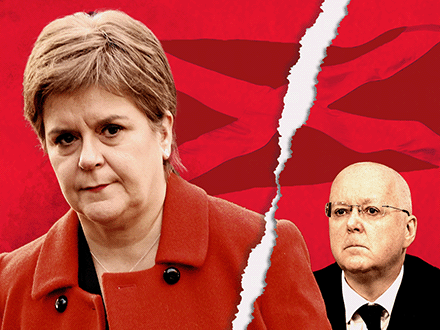
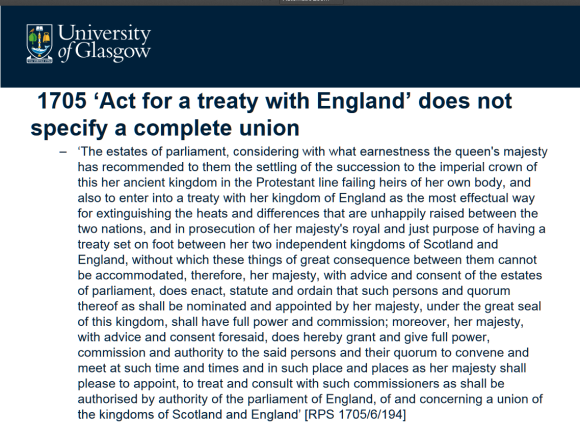
The Party nosedived after the GE of 2015 when Sturgeon turned her face away from the electorates’ instruction to notify the Unionists that the 1707 Treaty of Union was ending. Her decision to ignore the strongest mandate for independence ever handed to politicians in preference for retaining and indeed strengthening the Union was unforgivable but not unexpected since she did her best to scupper the 2014 independence campaign with her lacklustre leadership.
Her commitment to the SNP and the successful policies established under the leadership of Alex Salmond was always suspect and she confirmed this by dismantling the organisational structure of the Party replacing it with one reminiscent of the East German government with all power centred on herself and her trusted clique of similarly minded LGBTQ activists.
She then set about recruiting candidates for office in the 2015 GE personally restricting recruitment to those that fit the LGBTQ profile. Many who benefitted from her largess were wholly unfit for public office. She entertained her chums and presided over any modern electorate’s biggest financial rip-off.
Furthering her dream of taking LGBTQ ideals to the forefront of Scottish society she top-sliced many millions transferring to herself control of the allocation and distribution of large amounts of finance to recently formed LGBTQ organisations many of which claimed dubious charitable status
She further strengthened her position by adding Green MSPs supported by less than 2% of Scots to the Scottish Government, elevating some of them to ministerial office. Evidenced by their performance these Green champions were quite mad and damaged the SNP to the extent that the electorate questioned the fitness of the SNP for continued governance of the country.
The SNP is headed for oblivion in the 2024 GE and the 2026 Scottish elections but might yet be saved from oblivion with the wholesale abandonment of the Sturgeonista’s disastrous policies returning to the political agenda that persuaded Scots to support the Party when it was led by Alex Salmond.
The opportunistic posturing votes of no-confidence by the opposition parties at Holyrood will most likely fail and any fallout will be minor and temporary with Yousaf gaining confidence that his way is succeeding but this would be a false dawn to be fully exposed by the outcome of the 2024 GE in which the SNP might be decimated returning MPs in single figures.
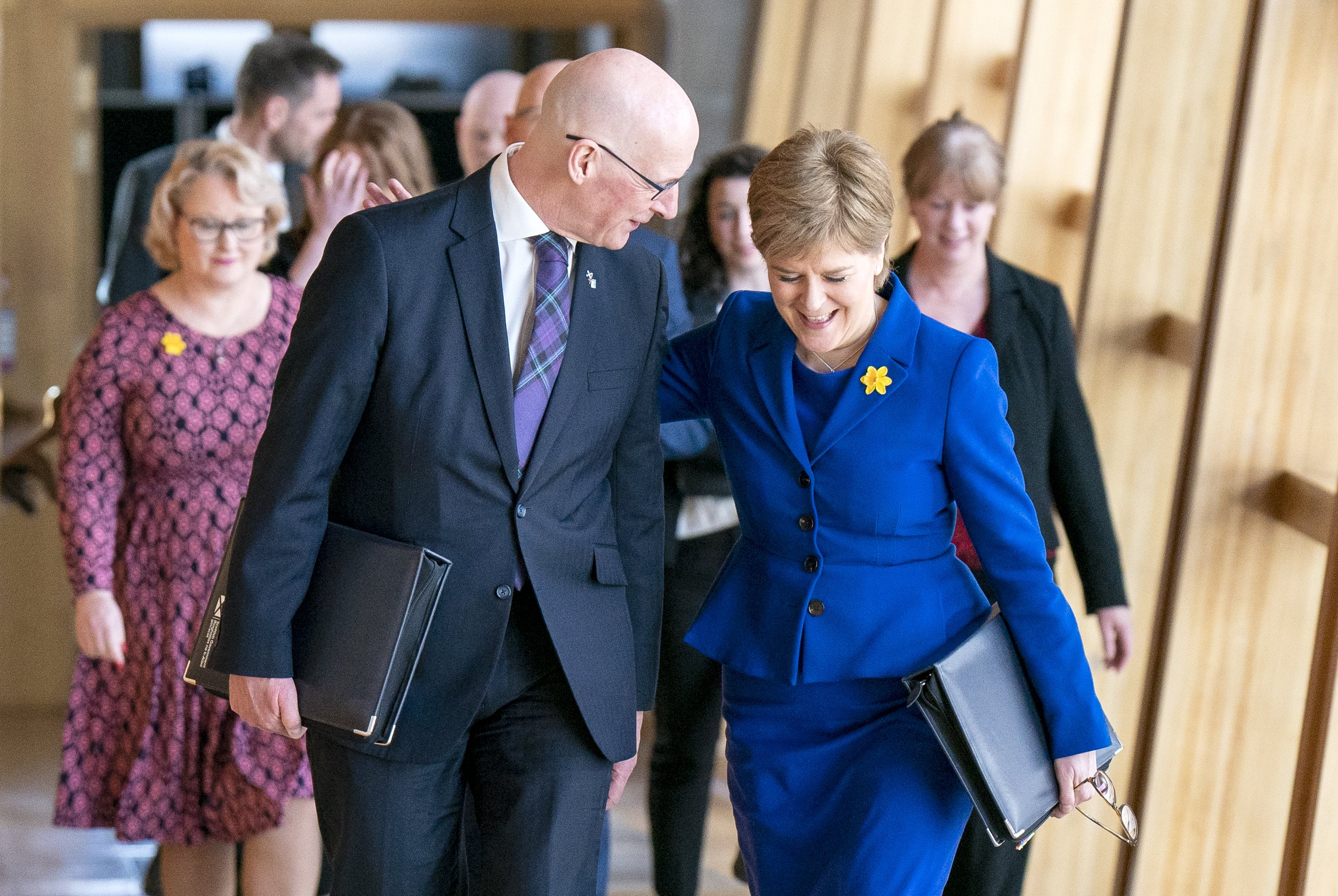
Swinney, a political numpty whose 25-year career (not yet at an end) has been blotted by blunders and abject failures wasting many millions of Scottish taxpayer’s hard-earned income tax contributions escapes the scrutiny of Scots.
A brief Introduction
Alex Salmond resigned from the SNP leadership in 2000 and Swinney was elected Leader.
The Party lost an MP in 2001 and 27 MSPs in 2003 despite having all the political advantages. His role as a leader was challenged but he stubbornly held on until he was forced to step down after a disappointing 2004 European Parliament election in which the Party lost further ground.
What went wrong?
Swinney lost the support of large swathes of SNP because he surrounded himself with a clique of MSPs and unelected advisers who shifted the party to the right. Their mantra: If you were not with them, then you were against them and fair game to be attacked and destroyed.
The return of Alex Salmond
2004: Alex Salmond returned as Party leader and reintroduced collegiate management. The Party went on to win the highest number of seats, (just short of a majority) in the Scottish Parliament in the 2007 election and he was appointed First Minister.
November 12 2013: How the USA used Sir Jeremy Heywood and Sir John Scarlett to bring an EU drone strike capability on anyone in the UK
US influence in Europe and the UK aims to construct a Federal model as in the US and USSR. In this model, Parliament will become a weakened part of the constitution required only to pay lip service to democratic principles whilst permitting unelected bureaucrats to create and implement policies.
The UK plays an active role in European drone construction without the full knowledge of the general population. Policies are imposed by the Cabinet Secretary, on the basis that they contribute to the EU mission.
There is a growing chorus in the political press that the Civil Service, of which the Cabinet Office is the top and the Cabinet Secretary shares the lead Civil Service role, has become politicized and its neutrality compromised.
The notion of the “politicization” of the Civil Service remains vague not having reference to any particular political party. The Civil Service has not yet favoured the political aims of one or other Party at Westminster.
It has, however, confirmed the political aims of the EU Commission in Brussels and the implementation of its political European projects in the UK, and in that sense, the Civil Service has both lost its neutrality.
It has become politicized by the actions of the Cabinet Secretary, which is a significant point in constitutional terms because the checks and balances of the unwritten UK constitution are now unbalanced mirroring the European model which is being imposed in an underhand and secretive way.
The scenario is set for EU-controlled drone warfare. In September 2002 the infamous Dodgy Dossier was released by the UK Government which became the justification for the invasion of Iraq in 2003.
Sir Jeremy Heywood was Principal Private Secretary to Tony Blair appointed in 1999. The dossier was flawed and made false allegations about the existence of WMD and nuclear programs in Iraq.
Sir John Scarlett was chair of JIC, the Joint Intelligence Committee and he wrote to Tony Blair’s foreign affairs adviser David Manning about, “the benefit of obscuring the fact that in terms of WMD Iraq is not that exceptional”.
In other words, the dossier was misleading about Iraq’s capabilities. Sir Richard Dearlove, as ‘C’ Head of MI6 said he was misquoted in the ‘Downing Street Memo’ of a meeting about Iraq on 23 July 2002 saying it was, ” a misquotation of what I said, and what I said is not in the public record.”
Sir Jeremy Heywood resigned from the Civil Service (and joined Morgan Stanley bank) in 2003. The Hutton Inquiry found that he had claimed not to minute meetings in the PM’s office concerning the scientist Dr David Kelly who died, (murder or suicide) on 17 July 2003 having been named as a source questioning the veracity of the Dodgy Dossier.
With so much confusion it is at least clear that the UK had been mobilized by the USA to justify George Bush’s desire to hit Saddam Hussein. Sir John Scarlett’s role in the Iraq affair emerged as being pro-US.
Sir Jeremy Heywood’s role was less clear until 2013. when reports surfaced that Sir Jeremy Heywood’s Cabinet Office was blocking the release of papers to the Iraq inquiry which were detailed conversations between Blair and Bush together with notes and cabinet meetings. This was assumed to be to protect UK-US relations.
Sir John Scarlett acting as consultant to Morgan Stanley Bank once again joined with Sir Jeremy Heywood (returned to the Civil Service from Morgan Stanley bank) in an attempt to sell the UK defence contractor BAE Systems to the European defence contractor EADS in November 2012. Morgan Stanley stood to profit from the sale and questions about Heywood’s conflict of interest were asked.
The deal fell through but it was a good indicator of Heywood’s position on UK defence. It is part of the European and USA strategy that the EU member states reduce their defence capabilities in favour of a federal EU force.
A direct consequence of the wars in Iraq and Afghanistan was the spread of the radicalization process controlled by Al Qaeda and sister Taliban groups which were originally CIA creations.
The CIA waged a drone war on its creations in Pakistan without any hindrance from other states. Drone strike technology was developed and refined in a theatre of war well away from Western shores.
In the summer of 2013, it was announced that the EU intended to operate its own drone air force as an intelligence gathering operation to counter the US activities.
Lady Ashton called for the use of military drones in Europe. So the war which Heywood helped to start in Iraq produced a drone nursery in Pakistan which technology the EU can use against its own citizens using, “threats” as an excuse.
Member states are weakened militarily and in intelligence terms resultant of policies implemented by the likes of Sir Jeremy Heywood and Sir John Scarlett that an EU drone-based air intelligence force is the only answer to, “threats”.
31 October 2014: France’s security fears over mysterious drones seen flying above nuclear plants
France launched an investigation into unidentified drones that were spotted over nuclear plants operated by state-owned utility EDF.
The French interior minister said that seven nuclear plants across the country were overflown by drones without any impact on the plants’ safety or functioning. The drone sightings renewed concerns about the safety of nuclear plants in France, the world’s most nuclear-reliant country with 58 reactors on 19 sites operated by EDF.
The head of Greenpeace’s anti-nuclear campaign said in a statement. ‘What is happening is very worrying,’ adding that France’s nuclear research institute CEA near Paris had also been flown over, citing unspecified sources.
The unmanned aircraft were spotted late in the evening, at night or very early in the morning, EDF said. It is prohibited to fly less than 1,000 meters above nuclear plants and within a 5-kilometre radius.
New York Police to introduce drone technology
New York police said they were concerned drones could become tools for terrorists, and were investigating ways to stop potential attacks. The NYPD said the technology has advanced enough that someone could use them to carry out an air assault using chemical weapons and firearms and they intended to develop drone technology which will allow them to take control of drones and scan the skies for them before major events.
This is a story unlike any previously published. The product of some 18 months of reporting, it tells the story of the catastrophe that fractured the Arab world since the invasion of Iraq, leading to the rise of ISIS and the global refugee crisis.
The geography of this catastrophe is broad and its causes are many, but its consequences — war and uncertainty throughout the world — are familiar to us all. The story gives the reader a visceral sense of how it all unfolded, through the eyes of six characters in Egypt, Libya, Syria, Iraq and Iraqi Kurdistan.
Accompanying the text are 10 portfolios by the photographer Paolo Pellegrin, drawn from his extensive travels across the region, as well as a landmark virtual-reality experience that embeds the viewer with the Iraqi fighting forces during the 2016 battle to retake Falluja.
It is unprecedented to focus so much energy and attention on a single story, but what follows is one of the most clear-eyed, powerful and human explanations of what went wrong in the region that you will ever read.
The Unionist Party “Child Poverty Act” of 2010 committed the Westminster political elite to completely eliminate poverty amongst children in the UK, by 2020.
But the reality for millions of Scottish children is an upbringing in poverty due to low-paid work and continued high unemployment levels which, due to welfare cutbacks will not be supplemented by the State.
“Save the Children”, took up the cause and produced a report, critical of politicians and their false promises “A Fair Start for Every Child”, warned that child poverty levels in 2014 were the “highest ever recorded in the UK” due to the poor getting poorer, the imposition of harsh welfare cuts and the increasing cost of every day essentials needed in support of children (decent clothing, footwear, balanced diets, medicines, heating etc.) http://www.savethechildren.org.uk/sites/default/files/images/A_Fair_Start_for_Every_Child.pdf
The usual Unionist government blandishments were issued stating that every effort, forming part of a long-term strategy, would be made to identify and resolve the root causes of the problems. But unless poor wages and poor welfare formed part of the response the future for children in poor families remained bleak.
Now the split in the consensus: The Labour Party went on the hunt, making mischief, blaming the Tory government for all the ills that UK society suffered, without mentioning that the legislation bringing forward measures dealing with the problems of the increasing numbers of the “underclass and their feral children” was placed on the statute in 2004 by Tony Blair, Gordon Brown and New Labour.
The Tory and Lib/Dems simply picked up the cudgel created for them by the Labour government and wielded it with gusto.
Beyond the general election, the Tory Party committed to the implementation of an austerity programme ensuring the elimination of a £1.6 trillion financial deficit, created by the Labour government and added to by the Tory Party.
The Labour Party sang from the same song sheet as the Tories committed to a similar programme of massive cuts “but to be applied with a human face”.
So child poverty would be increasing unless the “austerity measures” were binned in favour of an expansion of the economy, favoured by many informed financial experts.
The SNP argument
“The exchequer gathered billions to its coffers over the last 5 years and this should be released to families improving their lifestyles and the welfare of their children. The benefits are obvious. A fair-minded society means healthy children and a contented electorate who will work hard to increase tax revenues affording a faster reduction of the deficit.”