Prince Charles Enjoys Enormous Influence In the Westminster Corridors of Power – He Wields It In His Own Protection


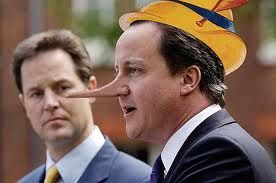
01.11.11: Steve Bell cartoon

Copyright ©Steve Bell 2011


25 June 2010 – Prince Charles opposition to development unwelcome says judge

A high court judge today dealt an unprecedented blow to the Prince of Wales’s ability to interfere in public life by describing his opposition to a major planning application in London as “unexpected and unwelcome”.

Mr Justice Vos ruled that Charles’s intervention in plans for the £3bn Chelsea barracks redevelopment in the capital placed the rulers of Quatar, who owned the site, in “an impossible position” and had an impact on the views of the elected politicians charged with deciding on the plans’ merits.

In a historic judgment, Vos found that Qatari Diar, a property development company wholly owned by Qatar’s royal family, changed its plans for the prime London site as a result of the prince’s direct complaint to the emir that he did not like the designs by the firm of Lord Rogers, a leading modernist architect with whom he has clashed on several occasions.

Charles had voiced opposition to the plan for more than 500 homes on the former Ministry of Defence site at a teatime meeting with the emir at Clarence House last spring, and also wrote to the prime minister of Qatar attacking the designs as part of a “gigantic experiment with the very soul of our capital city”. He said it should be scrapped in favour of something more “old-fashioned” like the buildings in “Bath or 18th-century Edinburgh”.

The judge ruled that by withdrawing the application shortly after his intervention, Qatari Diar breached its contract with co-developer CPC Group, owned by Monaco-based businessman Christian Candy, clearing the way for a claim for costs and damages.

However Vos did not support Candy’s claim for an early payout of £68.5m, which would have come if planning consent had been granted. He said that Qatari Diar was “caught between a rock and a hard place” as a result of Prince Charles’s impassioned demands for an alternative scheme and had been “doing the best it could in difficult circumstances” involving “diplomatic and political implications” to continue the planning process as normal.

The judgment exposed the prince’s powerful influence and how he was prepared to go to great lengths to lobby not only fellow royals but also to consider putting pressure on the mayor, Westminister city council and the media to ensure that the scheme would never be built.

Vos said both Qatari Diar and CPC Group “were faced with a very difficult position once the Prince of Wales intervened in the planning process in March 2009”. He said Qatari Diar executives had to try to “calm the political waters and prevent royal feathers being further ruffled”.

“Qatari Diar was in an impossible position,” Vos said. “It could not pretend that the Prince of Wales had not written to its chairman. It could not do nothing. It was, in modern parlance, caught between a rock and a hard place. If it did nothing, it would have risked exacerbating the position with the Prince of Wales, thereby risking that he might take his opposition further by contacting the mayor, the WCC or even the press.”

The case has raised serious questions over whether the prince overstepped his constitutional role by becoming involved in a democratic planning process, and today Ruth Reed, the president of the Royal Institute of British Architects, said Charles’s actions had been “an abuse of privileged position” and had “failed to engage with the planning process entirely openly and appropriately”.

“The UK has a democratic and properly constituted planning process: any citizen in this country is able to register their objections to proposed buildings with the appropriate local authority,” she said. “The message that this affair sends to overseas investors considering working on UK projects is very concerning.”

In his 98-page judgment, Vos said changes were already being negotiated on the scheme through the mayor’s office when the prince became involved because Boris Johnson objected to the repetitive design in one area, but not because he objected to its overall modernist premise. “This process was interrupted before it had reached its natural conclusion,” he said.

Clarence House declined to comment today. The prince’s spokesman, Paddy Harverson, has previously said: “The prince has every right to express an opinion privately, which he does with passion, because he cares.”

Vos said: “I formed the clear view that the intervention of the Prince of Wales was immediately recognised … as raising a serious political issue that needed to be dealt with at the highest level.”

He also ruled that even after the Qataris had decided to pursue an alternative scheme, the prince’s position continued to have an “impact on the views of the officers and politicians (but primarily the latter) at Westminster city council and the Greater London authority”.

The judge said what might have been regarded as a relatively simple dispute “appeared at times to be all-out war”. Both sides made “overblown” allegations of bad faith. He asked them to try to work together to achieve planning consent, but that seemed a dim prospect. A Qatari Diar statement said “CPC’s claims have been a complete waste of time” and that it had lost “a future business relationship with QD as a result of its conduct”.

A new design is being drawn up by Dixon Jones, architects of the Royal Opera House, fellow architects Squire & Partners, and Kim Wilkie, a landscape designer who has proposed a market garden, beehives and nut trees. Ben Bolgar, senior design director at the prince’s Foundation for the Built Environment, sat on the judging panel and  Prince Charles continues to be briefed on the design. Plans are due to be submitted to Westminster council next month.

http://www.theguardian.com/world/2010/jun/25/prince-charles-chelsea-barracks-planning


Artist's impression of Chelsea barracks proposal


25 June 2010 – Case exposes secret strategies used by ‘meddling prince’ to intervene in public affairs

The Chelsea barracks case has offered a rare glimpse into the otherwise secret strategies used by the Prince of Wales when he wants to interfere in public affairs.

From the typed letters on Clarence House notepaper underlined in his own hand, to the clever blend of courteousness and implied threat used in his own correspondence and by his righthand man, Sir Michael Peat, the case has revealed in detail how the prince wields his power.

The high court ruled today that the Qatari royal family’s property company breached its contract with a partner company when it withdrew a planning application for the £3bn Chelsea barracks development after the prince’s intervention. In describing the prince’s intervention as “unwelcome”, Mr Justice Vos said the Qatari royals immediately recognised that the prince’s complaint “raised a serious political issue that needed to be dealt with at the highest level”.

His verdict on what happened next sheds new light on how tea with the emir last March at Clarence House was conducted in a uniquely royal way, without any of the senior protagonists doing anything as gauche as issuing a demand or an instruction.

“I am sure that in their meeting, the Prince of Wales expressed his dislike for the Rogers Stirk Harbour Partnership’s design, and the emir politely concurred,” said Vos. “It seems likely to me that the emir would have said something more nuanced than that ‘he would have the plans changed’, but I am sure he gave the Prince of Wales and Sir Michael the impression that that would be the outcome.”

At a subsequent meeting between the emir and the chief executive of Qatari Diar, a company which at the time boasted a $40bn (£27bn) investment portfolio with 60 projects in 32 countries, there was no “blunt instruction” from the emir, but the judge said “he was not happy about upsetting the Prince of Wales and that he [the chief executive] should find alternatives to the existing design”.

For others though, the prince’s tactics may seem familiar. For almost three decades Charles has developed a reputation as, in his own words, “a meddling prince” who has waded into issues including farming, genetic modification, global warming, social deprivation, planning and architecture.

Given the inherently political nature of such topics, the prince has established a network of 20 charities as a key tactic for circumventing the convention that the royal family, especially the heir to the throne, should stay neutral. Some people have complained that they push the prince’s beliefs much too aggressively.

One of Charles’s most active charities has been the Prince’s Foundation for the Built Environment, which promotes his belief in more traditional forms of architecture and planning. In the Chelsea barracks case, the court heard how the prince, the charity’s president, encouraged the Qatari royal family to use his charity to make alternative plans.

Recent history shows the same charity also helped carry out the prince’s campaigns against other developments. It became involved in the redevelopment of Smithfield Market after Charles declared himself “confused and bewildered” by earlier plans and wrote about his worries to the then-chairman of English Heritage, a government body that advises on which historic buildings to protect.

Charles also offered the charity as an adviser to Francis Salway, the chief executive of Land Securities, one of the biggest developers in London, when he objected to the modernist design of its office scheme beside St Paul’s Cathedral.

In the controversial area of complementary medicine, the now defunct Prince’s Foundation for Integrated Health became involved in trying to change government policy. The charity was paid £1.1m by the Department of Health to advise on the regulation of massage, aromatherapy, reflexology and other complementary therapies as Prince Charles personally lobbied health ministers to use the treatments across the NHS.

It engaged in a public row with the professor of complementary medicine at Exeter University, Edzard Ernst, after Ernst attacked its draft guide to complementary medicines as “outrageous and deeply flawed”.

The Charity Commission was asked to launch an investigation into allegations that the foundation may have breached charity regulations by pursuing a “vendetta” against Ernst. A separate police investigation then saw the former finance director, George Gray, arrested and subsequently charged with theft, fraud and money laundering.

The trustees have now closed down the charity, a sign perhaps that the strategy of devolving the prince’s campaigns to his charities could be damaging his reputation.

The Chelsea barracks case also showed the prince’s use of hyperbole to make his case. In his letter to the Qatari prime minister, he called the designs “a gigantic experiment with the very soul of our capital city”.

Such extravagant claims will be familiar to the scheme’s architect, Richard Rogers, whose designs for the office development beside St Paul’s Cathedral in the 1980s were torpedoed when Charles implied in a public speech that the plans were more offensive than the rubble left by the Luftwaffe during the blitz.

Sometimes, the prince chooses to be more discreet. He was said to be “very unhappy” that his complaint to the Qataris had been leaked, perhaps because he knows how effective he can be pulling strings behind the scenes.

When Rogers, a frequent foe of the prince, was bidding to redesign the Royal Opera House, he believes the prince wrecked his chances using covert pressure.

“We got a phone call from the people at the Royal Opera House one evening, about 9pm saying ‘good scheme, but you’re too risky’,” Rogers has said. “I was basically told: ‘the prince does not like you.'”

Last year the Guardian used the Freedom of Information Act to find out that since 2006 Charles had written to ministers in at least eight Whitehall departments – Food and Rural Affairs, International Development, HM Treasury, Foreign Office, Work and Pensions, Education, Communities, and Culture, Media and Sport. The content of the letters was withheld, under laws which protect royal correspondence (see box).

The royal household insists that Charles will become far less involved in his causes if and when he becomes king, but sources suggest otherwise.

In late 2008, after the prince’s 60th birthday, it was reported that aides at Clarence House and Buckingham Palace had begun informally considering redefining the sovereign’s role to “allow King Charles III to speak out on matters of national and international importance in ways that at the moment would be unthinkable”.

The claim was made by Jonathan Dimbleby, the prince’s close friend and biographer, but Clarence House insisted no plans were being made for the prince’s accession to the throne.

http://www.theguardian.com/uk/2010/jun/25/chelsea-barracks-trial-prince-charles


Prince Charles visits a Duchy farm


30 October 2011 – Prince Charles and the ancient charter that calls for his consent to certain bills

The title and property of the Duchy of Cornwall were created in 1337 by Edward III, and were given by royal charter to his son, the Prince of Wales also known as the Black Prince.

Under the charter, the duchy always belongs to the sovereign’s eldest son who is the heir apparent. If the heir apparent dies without leaving children, the property of the duchy reverts to the crown. So although the duchy belongs to the Prince of Wales, who is also the Duke of Cornwall, there is a theoretical possibility that it could revert to the sovereign, who therefore has a contingent personal interest in matters that affect the property of the duchy.

Bills in parliament that would affect the sovereign’s private interests (or the royal prerogative) require the Queen’s consent; by extension, therefore, bills that would affect the duchy also require consent, and since the Prince of Wales administers the duchy he also performs the function of considering and granting relevant requests for consent.

Queen’s consent and prince’s consent are fundamentally different from royal assent. The consents are required as a matter of parliamentary procedure, as a method of protecting crown prerogative and private interests.

Royal assent is a feature of constitutional law rather than merely parliamentary procedure: it is the method by which a bill that has passed through parliament becomes an act, and it amounts to a formal assent given by the sovereign.

Apart from the special position of property belonging to the Duchy of Cornwall, the Duke of Cornwall has no special constitutional position; he is a subject of the crown like any other. The sovereign and the Prince of Wales are the only members of the royal family whose consent is required for bills that affect their private interests.

http://www.theguardian.com/uk/2011/oct/30/prince-charles-ancient-charter-consent


Prince Charles


30 October 2011 – Prince Charles has been offered a veto over 12 government bills since 2005

Ministers have been forced to seek permission from  Prince Charles to pass at least a dozen government bills, according to a Guardian investigation into a secretive constitutional loophole that gives him the right to veto legislation that might affect his private interests.

Since 2005, ministers from six departments have sought the Prince of Wales’ consent to draft bills on everything from road safety to gambling and the London Olympics, in an arrangement described by constitutional lawyers as a royal “nuclear deterrent” over public policy. Unlike royal assent to bills, which is exercised by the Queen as a matter of constitutional law, the prince’s power applies when a new bill might affect his own interests, in particular the Duchy of Cornwall, a private £700m property empire that last year provided him with an £18m income.

Neither the government nor Clarence House will reveal what, if any, alterations to legislation Charles has requested, or exactly why he was asked to grant consent to such a wide range of laws.

Correspondence seen by the Guardian reveals that one minister wrote to the prince’s office requesting his consent to a new bill about planning reform because it was “capable of applying to … [the] Prince of Wales’ private interests”.

In the last two parliamentary sessions Charles has been asked to consent to draft bills on wreck removals and co-operative societies, a freedom of information request to the House of Commons has revealed. Between 2007-09 he was consulted on bills relating to coroners, economic development and construction, marine and coastal access, housing and regeneration, energy and planning.

MPs and peers called for the immediate publication of details about the application of the prince’s powers which have fuelled concern over his alleged meddling in British politics. “If princes and paupers are to live as equals in a modern Britain, anyone who enjoys exceptional influence or veto should exercise it with complete transparency,” said Andrew George, Liberal Democrat MP for St Ives in Cornwall. “The duchy asserts that it is merely a private estate. Most people will be astonished to learn that it appears to have effective powers of veto over the government.”

“We should know why he is being asked and the government should publish the answers,” said Lord Berkeley, who was last month told to seek Charles’ consent on a marine navigation bill. “If he is given these powers purely because he owns land in Cornwall it is pretty stupid. What about the other landowners who must also be affected by changes to legislation?”

Revelations about Charles’ power of consent come amid continued concern that the heir to the throne may be overstepping his constitutional role by lobbying ministers directly and through his charities on pet concerns such as traditional architecture and the environment.

A spokesman for the Prince of Wales would not comment on whether the prince has ever withheld consent or demanded changes to legislation under the consent system. “Communications between the prince or his household and the government are confidential under a long-standing convention that protects the heir to the throne’s right to be instructed in the business of government in preparation for his future role as monarch,” he said. Daniel Greenberg, a former parliamentary counsel and now parliamentary lawyer at Berwin Leighton Paisner, said: “It is something of a nuclear-button option that everybody knows he is not likely to push. But like the nuclear deterrent, the fact that it is there, influences negotiations.”

Graham Smith, director of Republic, the campaign for an elected head of state, said it was “an affront to democratic values” that citizens had no right to know whether Charles was insisting on changes to bills. “We know Charles has been lobbying ministers, but this is evidence he has the power to instruct them to alter their plans and that gives him leverage,” he said.

http://www.theguardian.com/uk/2011/oct/30/prince-charles-offered-veto-legislation


What’s on your mind?: Prince Charles gets it off his chest. Photograph: Alastair Grant/AP


31 October 2011 – Reveal Prince Charles’s input on planning law, government urged

The government is facing growing pressure to reveal how the Prince of Wales has used his power of consent over draft legislation after it emerged ministers asked him to approve planning and construction laws because they might directly affect the private £700m property empire that provides his annual income.

Documents reveal that in 2008 Lady Andrews, a Labour communities minister, wrote to Sir Michael Peat, his private secretary, seeking Prince Charles’s consent to law changes that would “affect the interests of the Duchy of Cornwall” and were “capable of applying … [to the] Prince of Wales’ private interests”.  http://www.theguardian.com/uk/interactive/2011/oct/31/letter-prince-of-wales-consent

The draft local democracy, economic development and construction bill proposed to change laws about handling disputes and payments in building contracts and to introduce a new regional strategy for planning permissions. The duchy is a leading builder and has spent more than £18m on property development and improvements in the last two years, according to its accounts.

It also has large developments under way that require planning consent, including 500 new homes at Poundbury, Dorset.

Prince Charles relies on duchy profits to fund his lifestyle and work, and last year received £18m in profits from the estate. Charles has been granted the right to veto draft bills because they might affect his interests or those of the Duchy of Cornwall in what constitutional experts described as the equivalent of a royal “nuclear deterrent” over public policy. On Monday details emerged of five more bills to which the Prince has been asked to grant consent since 2005, bringing the total over the period to at least 17. They covered subjects such as marine navigation, retail development, company law and charities, parliamentary records show.

On Monday night Labour peer Lord Berkeley, who was ordered to seek the prince’s consent over a bill on marine navigation, formally called on the government to “publish all correspondence between the Prince of Wales and the Queen and ministers in connection with bills for which their consent is sought” and to say “whether any bill in the last five years has been altered as a result of comments from Prince Charles or the Queen, and in what way”.

Clarence House and Whitehall seemed to be divided over whether such transparency was a good idea. Clarence House declined to say how the Prince responded to the draft local democracy, economic development and construction bill. A spokesman for the Department for Communities said on Monday “no changes were requested and as such none were introduced”.

Asked if David Cameron – who last week agreed with Commonwealth states to change the rules on succession to the throne – had any plans to reform the system, the prime minister’s spokeswoman said: “I know of no plans at the moment to look into it.”

Clarence House insisted any correspondence was a “private matter” but said the convention was not about seeking the prince’s personal opinions. “Parliamentary procedure determines that the Prince of Wales in his capacity as the Duke of Cornwall may be required to give his consent to bills directly affecting the interests of the duchy,” the prince’s spokesman said. “This is not about seeking the personal views of the prince but rather it is a longstanding convention in relation to the Duchy of Cornwall, which would have applied equally to his predecessors.”

Graham Smith, director of Republic, the campaign for a directly elected head of state, said the loophole was fundamentally anti-democratic. “Charles is quite capable of doing the right thing by refusing to exploit his position for personal gain – yet he refuses to do so,” Smith said.

The government and Clarence House have repeatedly refused to disclose correspondence detailing the application of Charles’s power.

The justice, education and food and rural affairs departments are among those to invoke an exemption to freedom of information laws that allows correspondence between Charles and his aides and government to be kept secret, claiming that to do otherwise “would undermine the Prince of Wales’s privacy” and “could have a chilling effect on the way in which he or his representatives correspond with government ministers”.

In a rare exception, the Department for Communities agreed to release its letters to Prince Charles over the local democracy, economic development and construction bill, providing a unique insight into the application of the otherwise secretive protocol. Lady Andrews’s three-page consultation with Charles on draft planning and construction laws begins: “I write to formally request the consent of His Royal Highness the Prince of Wales to provisions to be included in the … bill.”

It includes 12 detailed paragraphs on how the new legislation will change laws on adjudication procedures in contractual disputes with builders and laws affecting how contractors must be paid.

Andrews explained: “Granted that these proposed changes … will apply to construction contracts entered into by or on behalf of the Duchy of Cornwall, we should be very grateful to receive the consent of the Prince of Wales.”

Turning to changes to regional planning law, she spelled out proposed new regional planning strategies and warned Charles that this section of the bill “is capable of applying to the Crown and the Queen and Prince of Wales’ private interests and therefore that consent is required”.

“They were trying to tell him in 2008 that, like everybody else, he will be subject to statutory development plans,” said David Lock, a former government planning adviser. “This was an attempt to make the crown estate and duchy subject to the same planning rules as everyone else, which means they would not get any privileges over any other land owner.” A Clarence House spokeswoman confirmed the duchy enjoys some exemptions from normal planning laws but “has chosen not to exercise these rights since the change in legislation”.

“Since 2006 the duchy has been subject to planning control in the same way as any other landowner and prior to that voluntarily complied with planning laws,” the spokeswoman said.

Labour has called for “complete transparency” about the views, if any, that Charles has expressed in the process of granting consent to bills.

“Most people will be taken aback by what  has been highlighted,” said Wayne David MP, Labour’s spokesman on constitutional reform. “There needs to be a mechanism so that the if the Prince of Wales is expressing a formal position he can do that an open way. We live in a democratic society so any views expressed should be disclosed and should be open to scrutiny and analysis.”

http://www.theguardian.com/uk/2011/oct/31/prince-charles-veto-planning-legislation


Prince Charles


31 October 2011 – Prince Charles’s veto: bad heir day

In many ways, Prince Charles has an unenviable public role. No one would actively seek out a 60-year career as understudy to a globally famous act, although the remuneration might be some compensation. It is to his credit that while his predecessors left a variety of examples of how to conduct himself, he has mostly avoided them. That makes it all the more extraordinary that letters like the one from the communities minister Baroness Andrews to Prince Charles’s private secretary Sir Michael Peat, seeking the prince’s consent to a change in the planning law, did not set off every warning bell in Clarence House. To almost every citizen in Britain, the idea that the Prince of Wales has the right to veto government legislation – even if it relates only to a handful of bills over a decade or more – is an astonishing discovery. But to those in the parallel universe occupied by communications between government and Prince Charles, it seems not to have been worth a second thought.

That speaks volumes about the magical realism of the relationship between crown and parliament. There is even a constitutional defence, weird it is true, but internally consistent with the vestiges of royal prerogative that thread through the law of the land. This is it: when there is no heir apparent, the Duchy of Cornwall – a large business that is the source of most of the prince’s income – reverts to the throne. Consequently, it retains the protection of royal prerogative and thus the right to be consulted, in areas that might affect its interests, on changes to the law. Those who came across this anomaly perhaps dismissed it as one of those quaint footnotes to our island story. Certainly the royal advisers failed to register that – after the public disquiet at mounting evidence of Prince Charles’s political activism, of the ministerial lobbying and the infamous letters in black spidery writing – disclosure of this meddling prince’s powers of veto would cause genuine alarm.

Or perhaps they thought no one would ever find out. Earlier this year, the information commissioner accepted that, in order to defend the constitutional fiction of his political neutrality when he becomes king, the prince’s correspondence with government should be exempt from Freedom of Information requests. There was talk of the “chilling effect” if correspondence could be published. Yet how much more chilling to the political processes, surely, that the prince can lobby ministers who know – even if he has never exercised it – he has the power of veto. Both Clarence House and Downing Street insist it is the merest constitutional accident. That is a relief. It should be easy to

http://www.theguardian.com/commentisfree/2011/oct/31/prince-charles-veto-editorial


The Queen and Prince Charles


31 October 2011 – Prince Charles in trouble Again? Two cheers for the Queen

Whenever Charlie Windsor gets into hot water, it reminds me of what a good job his old mum has been doing as she props up the monarchy almost single-handed against the odds.

The Prince of Wales’s cack-handed political interference,  serves to underline just how deft his mum has been in these near-60 years in keeping out of trouble – resolutely dutiful, cheerfully unfashionable, shrewd. It’s always a tightrope act: one bad slip and you’re gone.These are modernising days for the monarchy, no more immune than the rest of us from having to adapt (no need to feel too sorry for them), having to work well past 65 and, technically qualifying as a “fuel poverty” family because the senior Windsors spend more than 10% of their income heating all those draughty palaces and castles.

http://www.theguardian.com/uk/blog/2011/oct/31/prince-charles-trouble-the-queen


Prince Charles wrote to ministers about subjects from farming to herbal medicine


31 October 2011 – Prince Charles is not the people

The monarchy is probably more secure and popular than at any time in the past 25 years. Amid the cacophony of adulation, republicans cannot hope for a hearing, particularly now the Queen and her consort have reached the age where, even if they were found to be running a brothel at Windsor Castle, their status as national treasures would protect them from all but mild popular rebuke.


As disclosed on Monday, however, our elected representatives still need to beg consent from the Prince of Wales before passing legislation  deemed to affect his private interests. Which, given the amount he owns through the Duchy of Cornwall, encompasses a pretty wide range, including road safety, the environment, gambling, the London Olympics, and marine and coastal access. For example, consent was requested for changes in laws governing regional planning and contractual disputes with builders. Consent, please note, not assent: the latter (which the Queen gives to all legislation) being more of a formality. There could be no clearer illustration of the underlying truth about our country: we are subjects, not citizens.

The prince’s previously hidden veto might be a mere technicality if we didn’t know that Charles uses every ounce of influence and access to advance his views and interests, and that the deference of our political leaders virtually guarantees him a polite, if not always sympathetic, hearing. All other lobbyists and interest groups – from unions to animal welfare charities and arms manufacturers – compete for access, desperately hoping a minister will read their submissions or spare five minutes. Access is a precious commodity, causing companies and voluntary bodies to spend millions on professional lobbyists and sumptuous dinners.  Prince Charles gets privileged access to any minister’s ear. Automatically, gratis. Moreover, he gets it secretly, since correspondence between ministers and royals is exempt from freedom of information laws.

This is the tip of a very large iceberg. To an extent unprecedented since his great-uncle David (later Edward VIII) held the title Prince of Wales, Charles seeks an active role in public affairs. His private handwritten letters to ministers, known in some quarters as “black spiders”, have covered subjects as diverse as genetically modified food, the Royal Ballet, fire exits in old people’s homes and, inevitably, the countryside, particularly hunting.

His campaign against the redevelopment of Chelsea barracks was described by a judge last year as “unwelcome interference” in a planning application. His private secretary, Sir Michael Peat, responded that the prince’s duty was “to make sure the views of ordinary people that might not otherwise be heard receive some exposure”, which echoes the tyrant’s age-old claim that he embodies the will of the people. Not that Charles has any immediate prospect or even intention of becoming a tyrant, but you see the drift of his thinking.

The most egregious example of how he abuses his position rarely attracts comment. Since 2007 his Prince’s Teaching Institute has promoted “the importance of in-depth subject knowledge” in English, history, science, geography and maths. Schools are invited to show “a clear commitment to subject specialism”, to state “objectives” for improving provision, and to report on progress. Those that satisfy the institute – subject department heads attend a summer school and submit themselves, a year later, for interview – receive its “school programme mark”, allowing use of the Prince of Wales feathers on their notepaper and website. More than 100 schools have passed muster, with the institute’s website currently describing Bexley grammar school in Kent (a county that still has the 11-plus) as “school of the week”.

With schools competing fiercely for parental custom, such branding carries real value. Charles has set himself up as an accrediting body, giving him direct influence over the curriculum. Many educationists question the merits of heavily subject-based teaching, and even more would question the emphasis on traditional academic subjects rather than, say, design and technology or media studies.  Ther is no doubt what the prince was up to when the scheme was launched: it was “a fightback against trendy teaching”, and schools that wanted the royal imprimatur should “shun fashionable education theories”.

The prince’s views on education – he takes much of his advice from conservative figures such as the historian David Starkey and the journalist Melanie Phillips – may or may not reflect those of “ordinary people”. But it is hard to argue they are uncontroversial or lack “exposure”. The same can be said of his opinions on architecture, planning, the countryside and “green” issues generally. You may say his views can be ignored or dismissed as the ravings of an ageing and frustrated eccentric. But as well as access to ministers, all interest groups crave, and often buy, celebrity endorsement. Charles is among the biggest celebrities of all.

It is hard to blame him for trying to put the world to rights. Most of us would do the same if we had the chance and, through no fault of his own, Charles has very little else to do. Without a talent for sport, music, sculpture, scientific discovery or something of that sort (even bricklaying would do), an heir to the throne will be at a loose end, and Charles is not the first to attract criticism for how he occupies himself. But that is all the more reason for constraining him, and closing every little constitutional quirk that allows leeway. Republicanism might then finally triumph as future heirs decide to abdicate rather than die of boredom.

http://www.theguardian.com/commentisfree/2011/oct/31/prince-charles-voice-mel-phillips


BBC Intends To Retain and Gather Yet More Money To It’s Moneypit Through An Increased Licence Fee – The Joke Is On the Public – Nothing Changes


Graham NortonGraham Norton is on nearly £3million annually


9 May 2014 – BBC presenter Graham Norton earned £2.3m in fees and salary last year

BBC star Graham Norton earned £2.3m in fees and salary last year, for services including fronting BBC1’s The Graham Norton Show and BBC Radio 2’s Saturday morning programme.

Norton took home the payments for “presenter fees, production fees and royalties” from his production company So Television in the year to the end of July 2013. In total Norton received £2.33m, the year previous he received £2.61m.

He is also due a further £564,000 as a creditor of the company. So Television, which was acquired by ITV Studios two years ago in a deal worth up to £17m, made pre-tax profits of £1.8m. Revenues were £11.9m.

http://www.theguardian.com/media/2014/may/09/bbc-graham-norton-fees-pay


Ken MacQuarrie – Director BBC Scotland


10 September 2014 – Salaries of BBC’s senior management revealed

In an effort to increase transparency, the BBC has today published the salaries of its senior managers and their expenses for the period January to March 2014.

The report shows that many of the 116 senior managers on the list are paid more than £200,000, with the Corporation’s director general, Tony Hall, being paid £450,000. Helen Boaden, director of radio, receives total remuneration of £352,000, James Harding, director of news and current affairs, receives £340,000 and Danny Cohen, director of TV is on £327,800.

Other senior staff on six-figure salaries include Bal Samra, commercial director and managing director taking £322,800, James Purnell, director of strategy and digital, on £295,000 and Ben Stephenson, controller of drama commissioning, on £247,800.

http://www.bbc.co.uk/aboutthebbc/insidethebbc/managementstructure/biographies


Director General Lord Hall is paid £450,000 annually


3 December 2014 – Revealed: The 91 BBC executives who are paid more than the Prime Minister and 11 bosses get more than double his salary

The BBC pays 11 of its most senior bosses twice as much as the Prime Minister, it emerged yesterday. A further 80 executives take home more than David Cameron’s £142,500-a-year salary. The 91 bosses are taking home a combined £19million a year including bonuses. MPs said the figures would make hard-pressed families question the licence fee especially when programmes are facing the axe.

Top earners include Director-General Lord Hall, who earns £450,000, Anne Bulford, managing director of finance and operations, who is paid £395,000, and Peter Salmon, Director of England, who takes home £375,000. Those recruited to the top pay grade increased by almost 100, from 328 to 426 over the same timespan.


BBC 1 – Charlotte Moore, is on £240,000 


The figures do not cover on-air stars, 39 of whom are paid more than £250,000 a year. These include Graham Norton, who is reportedly paid £2.6million for presenting his BBC1 and Radio2 shows, and Match of the Day host Gary Lineker, who is said to take home as much as £2million. Even Paul Hollywood is paid a better wage than the Prime Minister, earning £300,000 for his work on The Great British Bake Off and its various spin-offs.

Tory MP Philip Davies said: ‘The BBC has recently said they have cut their senior management to the bone and there are no more savings to be made there but it’s only at the BBC where you could cut senior management to the bone and end up with more people paid more than the Prime Minister than before you started. ‘It’s just extraordinary and goes to show how much fat there is. ‘What the BBC should do is be cutting out all of these managers, most of who if they disappeared no one would notice, and start delivering some value for money to the licence fee payer.’


Head of radio, Helen Boaden,  is paid £352,900


Angie Bray, a Tory member of the Commons culture committee alongside Mr Davies, said: ‘It will be difficult for the BBC to continue to feel loved by the public if it continues to put licence payers’ money on salaries rather than on what people want them to spend the money on, which is good programming. ‘It does make it difficult for everybody to go on justifying this kind of funding if it’s just disappearing into managers’ pockets.’

An efficiency report published last week said the BBC has made savings of £1.1billion and would save a further £400million annually by 2016/17. Miss Bulford said no more savings could be made through cuts to pay, staff and property and that ‘tough choices’ would have to be made over which services were sacrificed. Through the licence fee, the BBC collected more than £3.762billion tax free last year, an increase of £70million from the previous 12 months.


F 

Managing director, finance and operations, Anne Bulford, earns £395,000-a-year

http://www.dailymail.co.uk/news/article-2856908/The-91-BBC-executives-paid-Prime-Minister-Eleven-including-Director-General-BBC-One-controller-head-radio-earn-100-000-Cameron.html


Graham Norton


15 July 2015 – BBC stars push wages bill close to £1bn

The BBC’s annual wage bill moved closer to the £1 billion mark last year, fuelled by a rise in staff numbers and salaries paid to its stars. Corporation bosses launched a counter-attack against government attempts to limit the BBC’s remit and funding yesterday, but it came as its annual report showed that the total salary bill increased from £955 million in 2013-14 to £976.5 million in 2014-15.

http://www.thetimes.co.uk/tto/news/medianews/article4498248.ece


Clockwise from top left: David Attenborough, Claudia Winkleman, Judi Dench, Chris Evans, Lenny Henry, Miranda Hart, Daniel Craig and J K Rowling


16 July 2015 – BBC organised celebrities’ protest letter

The BBC secretly helped to organise a celebrity letter warning David Cameron that plans to reform the corporation would damage Britain’s global standing, one of its top presenters has revealed. The BBC’s press office initially denied it had “anything to do” with the open letter, which was delivered to the prime minister on Tuesday and signed by stars including Dame Judi Dench and Sir David Attenborough. It warned “that a diminished BBC would mean a diminished UK” and was endorsed by over two dozen figures from the world of arts and entertainment including som of the BBC’s highest paid stars!

http://www.thetimes.co.uk/tto/news/medianews/article4499526.ece


Danny Cohen, the BBC’s director of television, with his wife, Noreena Hertz

Danny Cohen, the BBC’s director of television, with his wife, Noreena Hertz, is said to have orchestrated an open letter to David Cameron


18 July 2015 – All-star attack backfires on BBC

The starting pistol was fired this week on a debate over the BBC’s future, but the corporation’s “unusually aggressive” campaign of self-defence risks backfiring before the conversation has truly begun, experts have warned. MPs and media commentators, including voices within the corporation, have accused BBC executives of “over-reacting” to a green paper from John Whittingdale, the culture secretary, which this week set out the parameters for the government’s ten-yearly review of the BBC charter, which expires at the end of next year.

http://www.thetimes.co.uk/tto/news/medianews/article4501631.ece


Sir Tom Jones on The Voice Sir Tom Jones. Paid via an independent company


21 July 2015 – BBC ‘hid’ salaries of stars paid more than £500,000

The salaries of some of the highest-paid stars on the BBC, including Sir Tom Jones and James Nesbitt, were left out of the corporation’s annual accounts because they are paid by independent production companies or the BBC’s commercial arm, it emerged yesterday.

The BBC said in its 2014-15 annual report that only nine stars are paid between £500,000 and £5 million, but this includes only those paid directly by the BBC. Not included are people paid by independent companies commissioned and paid by the BBC, even though their salaries still ultimately come from the corporation’s coffers.

http://www.thetimes.co.uk/tto/news/medianews/article4503539.ece


BBC The BBC is happy to send between 50-100 people to jail each year.



16 August 2015 – Licence fee prosecutions overburden courts, argues Michael Gove

Michael Gove, the justice secretary, has raised concern that prosecutions for non-payment of the BBC licence are overburdening the courts. He has discussed the issue with John Whittingdale, the culture secretary, who is considering whether evasion of the licence fee should be decriminalised.

Before the election Whittingdale’s predecessor, Sajid Javid, set up a review to look into the potential impact of decriminalisation, and just after the election Downing Street indicated that it backed such a change, potentially replacing the offence with a civil fine. However, since then Whittingdale has had second thoughts over the possible impact on the BBC’s finances, after receiving the official review. The corporation has argued that it could lose up to £200m a year in extra non-payment.

In a sign of a possible cabinet split, it is understood that Gove has now made his case to Whittingdale about how decriminalisation could ease the caseload of magistrates courts. TV licence prosecutions account for 180,000 out of 1.5m magistrate cases each year. In evidence to the justice select committee in July, Gove said: “To what extent can we lift the burden on magistrates by taking some work out of court? One area which is a live area of debate is whether or not, at the bottom of the magistrates courts’ work, television licence non-payment should be decriminalised.”

No decision on whether to decriminalise the licence fee has yet been taken by Whittingdale. A spokesman for Gove declined to comment. But a BBC spokesman said: “The government’s own evidence-based review found that licence fee evasion should not be decriminalised and that the current system is broadly fair, proportionate and provides good value for both licence fee payers and taxpayers.”

http://www.theguardian.com/media/2015/aug/16/licence-fee-prosecutions-overburden-courts-michael-gove

Fun & Games in the Tory Party in Scotland – Scotland Does Not Need Nor Want Thatcher Mark2


pa-653x474

 
Oh Dear What Can The Matter Be??

In a previous article I advised that all was not well within the Scottish Branch of the Tory Party. The problem for Ruth Davidson is that she has wrapped the party in Scotland around her own personality, which is a strategy doomed to failure should the positive public perception of her show a reverse. There are divisions within the party partially attributed to her forced clear-out of, “deadwood” in favour of young SPADS with little or no political nor work experience outside politics. There is every chance she will be allowed to continue in office until after the 2016 election. But there might well be a bloodbath thereafter. It is noteworthy that her Chief of staff, Lindsay McCallum resigned last month resultant of a number of major policy and personality disagreements. See previous post’s:

https://caltonjock.com/2015/08/04/mundell-determined-to-lead-the-tories-in-scotland-ruth-davidsons-jacket-is-hanging-on-a-shoogly-peg/

https://caltonjock.com/2015/06/14/ruth-davidson-recruited-groomed-appointed-a-gerrymandered-leader-warts-n-all-information-for-use-in-the-2016-election/

https://caltonjock.com/2015/06/11/conservative-party-supporters-speak-out-in-favour-of-federalism-and-or-independence-for-scotland/


445946097


15 Sep 2011 Tory MSPs will be forced to stand down before the 2016 Scottish Elections

Long-serving Conservative MSPs will be forced to stand down from the Scottish Parliament at the next election if they fail to win a constituency seat, under a radical plan by a leadership candidate to introduce fresh blood into the party. They would only be able to serve three or four consecutive terms as list MSPs, who are elected using a complicated system of proportional representation to represent one of eight regions of Scotland. Significantly, Mr Jackson said he would apply the change retrospectively, meaning a series of the party’s most high-profile figures would have to win a constituency at the next election or step aside if a three-term limit was imposed.

They include Murdo Fraser, the bookies’ favourite in the contest to succeed Annabel Goldie as Tory leader, who is serving his third full term as a Mid Scotland and Fife regional MSP. Mr Fraser has not come close to unseating John Swinney in his Perthshire North seat, with the SNP Finance Minister increasing his majority in May to more than 10,000. Among the other long-serving Conservative MSPs who would be forced out are Alex Johnstone, Sir Jamie McGrigor and, should they not decide to retire, Nanette Milne and Miss Goldie herself.

The changes will apply in the 2016 election and be retrospective. Only three MSPs in the Conservative group at Holyrood have constituencies of their own, with the remainder relying on the regional list for their seats. Some have used the system to win re-election since devolution started in 1999.

http://www.telegraph.co.uk/news/uknews/scotland/8763612/Jackson-Carlaw-Tory-MSPs-will-be-forced-to-stand-down.html


4225676243.JPG
24 November 2012 – Scottish Conservatives launch Union Saltire logo

The Scottish Conservatives have launched a new party logo, which aims to reflect both the flag of Scotland and that of the United Kingdom. Scottish Tory leader Ruth Davidson said: “Our new Union Saltire logo is bold, fresh and easy to recognise.” She said it was “distinctly Scottish but with colours which clearly reflect our pride in the United Kingdom”.

Reacting to the change, SNP MSP Kenneth Gibson said: “There’s something strangely appropriate in the Tories choosing a ‘double-cross’ to represent whatever it is they stand for, but I’m not sure it’s the message they were aiming for. “The remnants of the Tories in Scotland might understandably want to distance themselves from their colleagues in Westminster, but the truth is a leopard can’t change its spots.” http://www.bbc.co.uk/news/uk-scotland-20475998


JS63584651


July 2014 – Tory Party Clearout Continues Unabated

The steady progression of Scottish Conservative MSPs announcing that they have decided to stand down at the coming Scottish Elections in May 2016 continues to escalate. Those standing down are nationally known names, who have carried senior roles in opposition at Holyrood and in public life. They are – in order of announcement to date:

Baroness Goldie – who led the party between 2005 to 2011, said “I will focus my efforts on the House of Lords” following her elevation to the peerage two years ago.

Gavin Brown – Lothians MSP and Finance spokesperson said “I will have served nine years by 2016 and would like to seek a fresh challenge going forward”. He is standing down with immediate effect as Finance spokesperson.

Nanette Milne – North East MSP and Public Health Spokeswoman said “As an MSP over the last 12 years, I am most proud of my behind-the-scenes work which I have undertaken as an MSP on behalf of my constituents.”

Alex Fergusson – Galloway and West Dumfries MSP and former Presiding Officer [the third] for four years from 2007-2011 who has served in the Scottish Parliament since its creation in 1999 said “Someone once said that a week is a long time in politics, but I have to say that the last 17 years have simply flown by.”

Mary Scanlon – Highlands and Islands MSP and Education and Lifelong Learning Spokeswoman and Deputy Convener of the Public Audit Committee said “I am proud of my working class background.” An MSP since 1999, she has previously held shadow posts for her party in Health and in Energy, Enterprise and Tourism.

Cameron Buchanan – Edinburgh and Lothians MSP and Local Government Spokesman “There’s a lot of new blood in the party and a new talent waiting in the wings, so it’s time to give others a chance. I’m also looking forward to spending more time with my family – if they’ll have me.” Buchanan has been an MSP only since 2013, standing for his party to fill the gap left by the sudden death of former Scottish Conservative Leader, David McLetchie.


4005146952
August (Summarised) 2015 – Ruth Davidson should resign if the Tories fail to improve in 2016

Many Tory party members are inclined to the view that if the Scottish Conservatives fail to improve their share of the vote in the 2016 Scottish elections, Ruth Davidson should remain as leader. She has injected much needed steel, into the backbone of a party, content to exist but not to thrive. Whilst resigning on her own terms or in electoral disgrace would be a devastating blow to the Scottish Conservatives. It would not be a fatal blow. The party has mastered hanging on when the electorate and even some of its own members and representatives keep trying to give it the final nudge.

The Scottish Tories are not alone. All polls are predicting a bloodletting from Scottish Labour to the SNP. That the ‘natural party of government’ in Scotland for the last fifty years represents a stark foreboding for the Scottish Conservatives.

Davidson has had longer to establish herself in the public consciousness, even completing a major policy u-turn grasping the English political zeitgeist with her zealous and sincere performance during the referendum.

It might well be political suicide for the Scottish Conservatives to get rid of Davidson. But, whilst she brought an energising zeal to bear on a party that desperately needed it, the party has not responded in step. Their logo has changed (the quickly jumped upon “double cross”) but there is little to suggest that there is a new intellectual reformation has taken grip to support the imagination that Davidson exudes. The party as a whole is still Thatcher-lite: there is little dissent and very few policy forums.

This begs the question as to who is carrying who. Are the Scottish Conservatives semi or totally autonomous from the Conservative Party down south? Are they one entity when it suits them and miles apart when they differ? Do the Scottish Conservatives wait to be told what to think by London, or is the Party in Scotland not giving Davidson the ideas and infrastructure support? Whatever the arrangement’s are Davidson evidently does not have the freedom to do as she pleases.

There’s a peculiarly Scottish dimension to her “Blue collar Conservatism” that makes her liked across the political spectrum, both north and south of the border and Cameron is giving out signals he is prepared to set aside his much vaunted One-Nation credentials in favour of welfare reform. But that sounds better on paper than in the reality. One wonders if the Scottish Conservatives had total autonomy with no accountability to London how they would position themselves.

_63392082_davidsonforsyth464

In years past former Deputy Leader Murdo Fraser flirted with the idea of a breakaway centre-right party to give the party a new chance at attracting voters. It’s not the first time this had been suggested. The Scottish Conservatives only formed out of a merger with the Unionist Party and the Conservative Party in 1965.

Fraser’s detractors considered the move as treacherous and a capitulation to circumstance, despite the proposals being met with enthussiasm by members, the public and other MSPs. The practicality of it was and is however more Ship of Theseus than anything else: if you change the name won’t the operations and members simply move across, and how would you create a brand truly different to launch a new membership intake? With Davidson’s selection, the debate went away.

Davidson has lead the party through the 2012 Scottish local council elections, the 2014 EU elections, the 2014 Scottish Referendum and the 2015 general election. There was no marked change the share of the vote received by her party. The fault should not be left at her doorstep. Yet four years and four elections is long enough time to consider that the game is up, if not for her then her party.

If, as polls predict, there is an SNP surge further reducing the number of MSP’s in Holyrood conclusive changes must be made rather than simply returning to sinply ticking along.

Her resignation might well be the catalyst turning once more to the innovation Murdo Fraser suggested and would at least pump some ntellectual action into the malaise that is disappointing members and depriving the electorate of a real alternative. http://darrow.org.uk/2015/04/26/ruth-davidson-should-resign-a-response-to-james-holloway/


16 August 2015 – Tory leader Davidson loses chief of staff as election looms

Tory leader Ruth Davidson has lost a key aide ahead of the 2016 elections. Chief of staff Lindsay McCallum unexpectedly quit amid a rumoured rift with her boss. The 29-year-old, considered a future party high-flier, had been in post less than a year. Her duties included giving Davidson strategic advice, writing briefings, and liaising with UK cabinet ministers, as well as managing Davidson’s diary. It is understood she left last month.

After a dry run at the general election, when she stood in the Ross, Skye and Lochaber seat, McCallum had been expected to run for Holyrood next May on the Highlands & Islands list. However, faced with the prospect of dedicating her 30s to life as an opposition MSP, she decided not to stand, ending a key reason for her to remain chief of staff. McCallum, who comes from a farming family in the Black Isle, where her mother is an independent Highland councillor, has now returned to London, where she spent three years in public affairs before taking the Scottish Tory job in August last year. “I heard there had been a furious bust-up with Ruth,” said one Tory MSP.

The loss of her chief of staff has added to Davidson’s recent problems as Tory leader. Despite high hopes, the Scottish Tories failed to make progress at the election, holding on to their single seat, as their vote share fell from 16.7 to 14.9 per cent. The Tories’ vote share in England was 41 per cent, and 36.9 per cent UK-wide.

Davidson, a Glasgow list MSP since 2011, has also been accused of “carpet-bagging” after announcing she would try to become a Lothian MSP next May. Glasgow has one Tory MSP, whereas Lothian has two, increasing her chances of election. An SNP spokesman said: “First Ruth Davidson gives up on Glasgow – with the prospect of the Tories failing to win any seats there next May – and now her chief of staff quits as a candidate. “It’s no surprise that even members of their own party are now running away from the Tories ahead of the Scottish election next year. “The truth is that the Tories have absolutely nothing to offer Scotland other than austerity and a narrow, negative agenda which will once again be roundly rejected at the ballot box in May.”

A LibDem source added: “It seems even the Tories are now refusing to buy Tory spin on their election prospects. After decades of calling for one last push they should start listening to the public and scrap their right-wing illiberal agenda.” McCallum said her decision to go had been a “personal choice”. She said: “I wish Ruth well. I hope that the party increases its MSPs next year. I think they have a good opportunity and Ruth is a good leader.”

http://www.heraldscotland.com/news/13599934.Tory_leader_Davidson_loses_chief_of_staff_as_election_looms/?ref=mr&lp=9


wtr80pmx8zxqb6391tozm9f0ih55jyimgexe.do


So you wanted to know the truth – Blair and regime change in Iraq – MI6 agent Sir John Scarlett – compiler of the dodgy dossier – appointed strategic adviser major Iraq oil job


Criticised: Sir John Scarlett has taken a job with Norwegian firm Statoil as a 'strategic adviser'Sir John McLeod Scarlett


20 May 2011 – The Spy Who came in For the Gold – Dodgy dossier’ helper Sir John Scarlett takes top Iraq oil job

Tony Blair’s former spy chief has been criticised for taking a job with a multi-national company which has won a lucrative contract to drill for oil in Iraq.

Sir John Scarlett, who helped draw up the so-called ‘dodgy dossier’ which accused Saddam Hussein of possessing weapons of mass destruction which could be deployed within 45 minutes, has been hired by Norwegian firm Statoil as a ‘strategic adviser’.

The 62-year-old former MI6 chief, right, who retired two years ago, was one of the intelligence officials most closely associated with the Allied invasion of Iraq in 2003. He was accused of being unduly influenced by Alastair Campbell, who was then No 10’s director of communications.

The 45-minute claim was one of the key assertions that convinced MPs to take Britain to war. Labour MP Paul Flynn said last night: “There is a bad smell about this, worse than oil. If senior officials are involved in a particular area during their professional lives, there should be no chance of working in that same area when they retire. This would avoid any danger of them being distracted by the prospect of retirement riches.”

Norwegian-owned Statoil is one of the world’s largest oil and gas suppliers. It is a leading member of a consortium awarded exploration rights in the vast West Qurna oil field, west of Basra, in December 2009. The field is expected to yield 150,000 barrels of oil a day by 2013, making it one of the most productive in the Middle East.

Despite the controversy over the ‘dodgy dossier’, Sir John was knighted in 2007.

Norwegian-owned Statoil is one of the world’s largest oil and gas suppliers. It is a leading member of a consortium awarded exploration rights in the vast West Qurna oil field, west of Basra, in December 2009. The field is expected to yield 150,000 barrels of oil a day by 2013, making it one of the most productive in the Middle East. The consortium of which Statoil is a member beat off several other bidders for the Iraqi government contract, including BP.

Statoil declined to say how much Sir John would be paid. A spokesman said: ‘He will be on an advisory board to help us understand the geopolitical context in which we operate.’

The appointment has been approved by the independent Advisory Committee on Business Appointments, which vets jobs taken by senior civil servants after they have left office to ensure there is no conflict of interest.

http://www.dailymail.co.uk/news/article-1389550/Dodgy-dossier-John-Scarlett-Iraq-oil-job.html


Alistair Campbell


Sir John McLeod Scarlett – His role in the decision to go to war in Iraq

Sir John McLeod Scarlett, is a retired British senior intelligence officer. He was Chief of the British Secret Intelligence Service (MI6) from 2004 to 2009. Prior to this appointment, he had chaired the Cabinet Office Joint Intelligence Committee (JIC).

The normally secretive intelligence services were thrust into the public gaze in the Summer of 2003 after the death of the eminent government weapons expert, Dr. David Kelly. Kelly had been found dead in the Oxfordshire countryside near his home, after being exposed as the source of allegations that the government had “sexed-up” intelligence regarding existence of weapons of mass destruction in Iraq prior to the 2003 invasion of Iraq.

The “classic case” was the claim that Iraq could launch Weapons of Mass Destruction “within 45 minutes of an order to do so” – Dr. Kelly had privately dismissed this as “risible”.

Scarlett gave evidence at the Hutton Inquiry into the circumstances surrounding Kelly’s death. It became clear that Scarlett had worked closely with Alastair Campbell, then the Prime Minister’s Director of Communications and Strategy, on the controversial September Dossier, with Campbell making drafting suggestions which the inquiry found may have “subconsciously influenced” Scarlett and the JIC.

This influence may have had deleterious effects on the quality of the assessments presented in the dossier. For instance, the Intelligence and Security Committee made several criticisms in their report “Iraqi Weapons of Mass Destruction — Intelligence and Assessments”:

“As the 45 minutes claim was new to its readers, the context of the intelligence and any assessment needed to be explained. The fact that it was assessed to refer to battlefield chemical and biological munitions and their movement on the battlefield, not to any other form of chemical or biological attack, should have been highlighted in the dossier. The omission of the context and assessment allowed speculation as to its exact meaning. This was unhelpful to an understanding of this issue.”

Scarlett became the head of SIS on 6 May 2004, before publication of the findings of the Butler Review. Although the review highlighted many failings in the intelligence behind the Iraq war and the workings of the Joint Intelligence Committee, it specifically stated that Scarlett should not resign as head of the Committee and SIS.

On 8 December 2009, Scarlett gave evidence to The Iraq Inquiry. He denied he was under any pressure to “firm up” the September Dossier, and claimed there was “no conscious intention” to mislead about Iraq’s weapons but it would have been “better” to have clarified battlefield munitions not missiles were meant.

On 26 June 2011, The Guardian reported on a memo from Scarlett to Blair’s foreign affairs adviser, released under the Freedom of Information Act, which referred to “the benefit of obscuring the fact that in terms of WMD Iraq is not that exceptional”. The memo has been described as one of the most significant documents on the September dossier yet published as it is considered a proposal to mislead the public.

On 28 January 2011, Scarlett was appointed to the board of Times Newspapers Ltd, part of Rupert Murdoch’s News International, which publishes The Times and The Sunday Times.

https://en.wikipedia.org/wiki/John_Scarlett


Image result for Sir John Scarlett images


31 December 2006 – The award of a knighthood to John Scarlett was described as “utterly astonishing” by MPs yesterday.

Sir John, who oversaw the production of the so-called “dodgy dossier” which claimed that Saddam Hussein could launch a missile attack in 45 minutes, is made a Knight Commander of the Order of St George in the New Year honours.

But Angus MacNeil, SNP MP for Na h-Eileanan An Iar, said Tony Blair had shown “breathtaking arrogance” in approving the award.

“John Scarlett has been awarded an honour for services to diplomacy. Services to creative writing might have been more appropriate,” he said.

Sir John’s role in the production of the infamous dossier was exposed in Lord Hutton’s inquiry into the death of the weapons scientist Dr David Kelly.

Lord Hutton said that he might have been “subconsciously influenced” by political pressure that caused him to strengthen the wording of the dossier.

The Conservatives, however, refused to be drawn on the knighthood for the man who is now head of the Secret Intelligence Service (MI6). David Cameron’s New Year message pledges to give “wholehearted backing” to measures to “enhance our security services”.

http://www.independent.co.uk/news/uk/politics/dodgy-dossier-knighthood-attacked-430339.html


Previous articles posted to my blog can be found here:
https://caltonjock.com/2015/05/30/the-iraq-war-was-based-on-lies-top-bush-era-cia-official-so-where-the-hell-is-the-chilcott-report/ (why is this taking so long?)

https://caltonjock.com/2015/01/23/the-chilcott-inquiry-failures-of-the-military-elite-promotion-or-death/ (the failures of the military elite)

https://caltonjock.com/2015/01/22/chilcott-inquiry-delays-the-cover-up-the-machiavellian-influence-of-sir-jeremy-heywood/ (Heywood the master or the servant?)

https://caltonjock.com/2015/03/07/top-civil-servant-sir-jeremy-heywood-and-david-cameron-in-battle-for-downing-street-supremacy/ (Who run’s Downing Street?)

https://caltonjock.com/2015/01/15/the-downing-street-memos-revealed/ (correspondence between US and UK. Damming evidence)

https://caltonjock.com/2014/08/30/the-chilcott-enquiry/


David Kelly


Crime, Sex Orgies, Politics, the Forces That Drive Westminster – Part 4 – High Society Lady Takes It All To A Higher level


Emma Sayle owns the Killing Kittens members-only sex club

Emma Sayle owns the Killing Kittens members-only sex club


17 February 2005 – The Poshest Swinger In Town

When it emerged that a Tory strategist led a double life as the organiser of upmarket sex parties, it caused members of polite society to choke on their gin and tonics.

But now, Dougie Smith, an adviser and speech-writer to senior MPs – has moved on to business pastures new, and his louche mantle has been picked up by another member of the Establishment.

Diplomat’s daughter Emma Sayle, 26, who went to Sloaney £21,660-a-year Downe House school, Berkshire, at the same time as Princess Michael of Kent’s daughter Gabriella, 23, is now organising the orgies.

Club Fever, for young, wealthy, “liberated couples and single women” costs about £500 a person per year to join.

Her role in the sordid world of swingers will no doubt come as a surprise to her more strait-laced friends and family.

Her Cambridge-educated father Guy, 58, was a colonel with the Welsh Guards, has an OBE, is a former fellow and bursar of his Alma Mater Magdalene College and was Britain’s defence attaché to Egypt and Kuwait.

Col Sayle – who lives in Berkshire with Emma’s mother, Malvin, head charity fundraiser at the Royal Marsden Hospital – was also the top liaison officer in Germany at the time of the fall of the Berlin Wall.

Emma, who is dating a hunky Australian, tells me, without a hint of irony, that her “private members’ sex club” will also include less salacious trips to the opera and sporting events.

However, her first project was a black-tie New Year’s Eve party at a mansion in grand Regent’s Park, London, which she describes as a “kaleidoscope of naked, writhing bodies”.

She claims she is now hoping to recruit some of her contemporaries at girls-only Downe House. “Gabriella Windsor is just the sort of girl we want to recruit,” she says. “I am sending her an invitation to join. “She was naughty at Downe House, definitely one of the ‘cool gang’.

I remember she got suspended for a week for smoking. “My best friend there, Amanda Cherry, ended up with the school politics teacher after she left. She was 19 and he was 41. “It was quite a scandal at the time but they are still together.

I don’t know what it is about Downe House that makes us so naughty – I guess we’re like caged animals.” She insists her parents are not bothered about her ‘work’.

She says: “They think what I do is absolutely hilarious. “They know I don’t get personally involved in the orgies.

I get pleasure from knowing other people are having a good time.” And, of course, she expects to turn in a substantial profit…


Risqué: Emma Sayle (left) pictured on Facebook with fellow Sisterhood member Natalie Sisson (right)


Upper Crust Organisers

Edward Davenport – Made first million in his teens organising the infamous Gatecrasher balls – now a property tycoon worth £133m.

Spends six months a year in Monaco as a tax exile sharing £200-a-night hotel suite with two women.

Shares £15million London pad with three more.

He was seen kissing and fondling a girl on the orgy bed last Saturday night.

He bought the venue, a former ambassador’s residence, from the Sierra Leone government in 2002 for the knock-down price of just £50,000.

David Russell Walters – By day  boss of Tory party anti-Europe Democracy Movement.

By night, orgy master tending to guests. Looked on as four girls, one a Dutch rowing champ, pleasured each other.

Jonathan Friedman – Brains behind Fever’s image. Spends hours “dressing” rooms with pink satin, chocolates, fruit, and jelly babies for energy. Seen canoodling on the bed with beautiful American blonde.

Emma Sayle – Diplomat’s daughter. Dad was colonel with the Welsh Guards and has an OBE. She is regarded as one of Britain’s best and most upmarket party organisers – didn’t join in the orgy.

James Hayter – Professional rugby player. Hayter, who is over 6ft tall and weighs 220 lb, was Hired as a bouncer but became overwhelmed with lust. Stripped off and joined in the night’s action.

Dougie Smith – Senior Conservative Party strategist, adviser and speech writer to senior MPs. Preached the John Major’s morally-focused back-to-basics policy.

http://www.dailymail.co.uk/columnists/article-338142/Shes-poshest-swinger-town.html


Kate MiddletonKate Middleton


24 July 2007 – Woman Training to Row Channel With Kate Middleton Runs Upper Class Orgy Club

It takes a racy sort of girl to relish the challenge of rowing across the English Channel.

But Kate Middleton may not have realised just how racy the company would be when she agreed to join the rowers in a glamorous all-girl team.

These spirited ladies may all be in the same boat but there the similarities most definitely end.

While Miss Middleton, 25, has made a name for herself as the elegant companion of Prince William, Emma Sayle, 29, has made a name for herself too – organising risqué parties for wealthy, attractive and broad-minded couples.

As whispers about her past refused to go away, the former public schoolgirl was keen to play down her role in Killing Kittens, the private club that blurs social and sex lives. Or to put it bluntly, organises orgies.

Miss Middleton has been training on the oars three times a week, said Miss Sayle, whose organisational skills made her a natural for team leader.

They will race across the Channel on August 25 against a male team to raise money for two charities.

Given Prince William’s mischievous sense of humour, he is likely to be as intrigued as anyone about Miss Sayle, the lively daughter of a diplomat.

She was at school with Princess Michael of Kent’s daughter, Gabriella, but they took somewhat different paths when Miss Sayle began working for Club Fever, a company organising orgies for “liberated couples and single women”.


Emma Sayle


She left to start her own company, Killing Kittens, which has a website advertising £120-a-couple sex parties at a private London residence for “strictly good looking couples and single girls only”.

Miss Sayle was rather coy about her orgy expertise. She said she had sold off part of Killing Kittens last year and no longer had a management role. “I still own some of it, I just don’t run it,” she explained.

“Now I’m trying to do something very amazing for two charities and organise 21 girls to get across the English Channel and Kate Middleton happens to be one of them.

“She’s a full team member. We’ve got two reserves and 19 in the boat and she’s one of the ones in the boat.


canoe

Kate Middleton


“She’s a general all-rounder and an amazing sportswoman. She’s a great team player. It’s quite funny but what I don’t want to happen is people to think it’s totally scandalous and say, ‘Look who Kate’s got involved with – a big sex party orgy organiser’. “She’s not stupid, she’s aware of it, it’s all very above-board, and I’ve never denied it. Everybody has got stuff they did in the past.”

But on the Killing Kittens website, Miss Sayle still has pride of place in a section entitled Our Founder.

She was never personally involved in the orgies, but is described as “one of the world’s leading sextrepreneurs”.

Miss Middleton was persuaded to join the rowing team – known as the Sisterhood – by Alicia Fox-Pitt, her friend from their days at Marlborough College in Wiltshire.

Miss Fox-Pitt said: “She’s been training with us. She is a very gifted sportswoman and we played a lot of sport together at school.” They are aiming to raise £100,000 for charities Babes In Arms, which sponsors research into newborn abnormalities, and the children’s hospice charity the CHASE Ben Hollioake Fund

http://www.dailymail.co.uk/news/article-470427/Woman-training-row-Channel-Kate-Middleton-runs-upper-class-orgy-club.html


25 July 2007 – Kate Middleton Recovers From Night of Partying With Early Morning Row

If her head was pounding, she didn’t show it.  Instead, Kate Middleton simply gritted her teeth and got down to some solid rowing. Or rather some expert hair billowing.

A few hours earlier Prince William’s girlfriend had been enjoying cocktails with friends at one of her favourite bars. She finally rolled home around midnight.

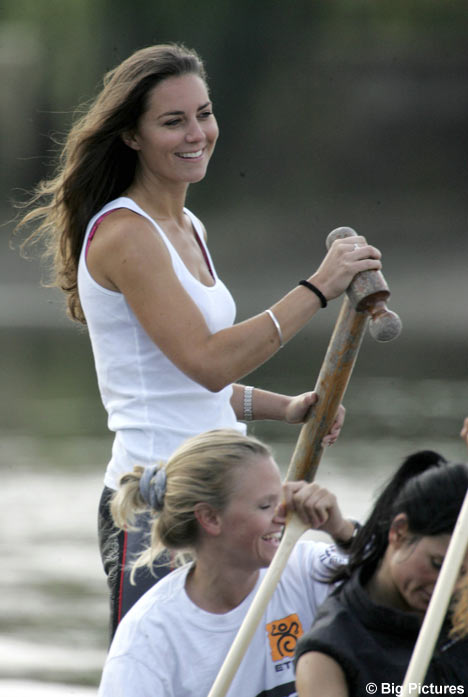
By 7am she was up again, ready to sweat it out on the Thames with a charity dragon boat team.

But unlike her red-faced, puffing teammates, Miss Middleton looked poised and perfectly polished, a picture of regal calm at the tiller. (Her full face of early-morning make-up no doubt helped somewhat).

And no utilitarian hair bands or pony tails for her. She left her hair loose to billow flatteringly in the morning breeze.

The 25-year-old fashion buyer is taking part in an all-woman record-breaking attempt next month to row across the Channel.


The team, known as The Sisterhood, will leave Dover in a fibre-glass Oriental- style boat and cross 21 nautical miles of open water to the Cap Gris Nez, close to Calais.

It will be a challenge by any stretch of the imagination, which is why Miss Middleton is training three times a week.

But knowing she had to man the boats the next morning wasn’t enough to put her off a session of a different kind with friends at Mahiki, the Mayfair bar that is a favourite of Prince William’s.

Within hours she was one of the girls again as she arrived at Chiswick, West London, for an hour long training session.

As the team glided down-river to Hammersmith, she was paddling hard at the back of the boat.


Kate midd


As they returned to base, however, she had possibly run out of puff, having the easier task of manning the tiller instead.

Also in the boat was team leader Emma Sayle who, as the Mail revealed this week, founded Killing Kittens, a firm that organises sex parties for wealthy couples.

Miss Middleton was persuaded to join the rowing team by Alicia Fox-Pitt, a friend from her days at Marlborough College in Wiltshire.

http://www.dailymail.co.uk/tvshowbiz/article-470820/Kate-Middleton-recovers-night-partying-early-morning-row.html


Lingerie for sale on the Killing Kittens website


27 July 2009 – Emma Sayle runs Killing Kittens, an upmarket and exclusive sex party night with an eye on empowering women. The former West Berkshire school girl explains why her business doesn’t contradict her Christian faith.

That Emma Sayle organises elite sex parties might raise a few eyebrows, but that she’s also a committed Christian will have all eyebrows lunging sky-high.

A former pupil at the exclusive Downe House school in West Berkshire, Emma is one of the world’s leading ‘sextrepreneurs’.

The 31-year-old has made her name as the top upmarket adult party organiser and runs a monthly sex party night called Killing Kittens.

Populist myth has it that every time a woman ‘sins’ by pleasuring herself, God in retribution kills a kitten.

Over time, the term ‘killing kittens’ has become slang for female masturbation.

Thus, Emma’s parties focuses on female empowerment where, for example, men aren’t allowed to approach women and only women can make or break the rules.

“It’s for couples and girls,” says Emma, a pal of Prince William’s Bucklebury-born girlfriend Kate Middleton, “it’s for good-looking people only, under the age of 45.

“These parties turn into mass orgies – they’re big sex parties – and it’s a case of 50 per cent of the people that come along do take clothes off, and the other 50 per cent just come along for a good party and keep their clothes on.”

Surely this sort of sexual freedom sits uneasily with 31-year-old Emma’s Christian faith? But she heartily disagrees. “This whole ‘I’m a Christian’ thing,” she says, “the way it’s been written about a lot of the time is as if I’m someone happy-clappy who’s just done an Alpha course. “But I’ve been going to church and Sunday school since I was little. It’s a private thing that is just my faith.”When it comes to religion – and it’s not me being defensive – people pick and choose.”When you look at the bible, people pick and choose which bits they choose to live by and which bits they don’t.

“I’ve had this conversation about sex before marriage a lot and it doesn’t actually say once in the bible that you can’t have sex before marriage.

That’s just the stigma that’s been attached to it. It gets misquoted. “These are couples who are genuinely together and they choose to do this as a life-style choice within the sanctity of their marriage.

“No one’s getting hurt, no one’s cheating on anyone. Who am I or you or whoever to say they can’t do it? “I always say: everyone’s happy, so what’s the big deal?”

http://www.bbc.co.uk/berkshire/content/articles/2009/07/27/emma_sayle_killing_kittens_sex_party_feature.shtml

http://royalinsight.net/forum/index.php?topic=40039.5;wap2

Link to Killing Kittens. (not recommended to anyone under the age of 18  http://www.killingkittens.com/homepage.htm


Kate Middleton's chum Emma Sayle and the sex party house

Kate Middleton and Emma Sayle


17 April 2010  – Kate Middleton’s chum Emma Sayle and the Sex Party House

Miss Sayle, who attended Downe House boarding school with Prince Michael of Kent’s daughter Gabriella Windsor, was the subject of a London council investigation earlier this year over claims her Killing Kittens firm used a £30million house for sex parties

The concern is of course, a private members club, where woman can be as sexually explicit as they want, is one thing, even if alleged orgies were happening, that’s her business, but the implication in the articles, is that the situation was being used for commercial purposes, and that it may have been something slightly different.

Even that some camera phone images might have gotten out, and that she is or was at one point being investigated.

Emma Sayle is also credited with starting a group called the sisterhood, she seems to be an interesting character. Some sort of charitable organization was mentioned as well in the article.

Sex parties, orgies, and other situations that are a little bit more mature are not my cup of tea, but they might be someone else’s, my other concern or question is, are the individuals that use to attend these parties, being investigated as well, either.

I mean if the sex parties, orgies, or killing kittens situation, turned out to be more commercial, then private, and I am sure the investigation clarified this, were the others implicated, in the happenings, either the men or the women?

Was there any threat of them being investigated also, or even charged, for participation into these sorts of situations?

http://www.telegraph.co.uk/news/uknews/theroyalfamily/7601823/Kate-Middletons-chum-Emma-Sayle-and-the-sex-party-house.html


Emma Sayle, 36, has written a book about the Killing Kittens sex club parties she organisesEmma Sayle


27 April 2014 – Kate Middleton’s friend: How I sneaked a Labour MP wearing a dog’s collar out of my sex party

Emma Sayle reveals how she organised orgies for the rich and famous. The 36-year-old attended same all-girls public school as Kate Middleton.

Miss Sayle arranged a 300-strong orgy in a Regent’s Park mansion in 2012.

She claims it was attended by two Labour MPs who were ‘polite, nice guys’.

One MP wore only underpants and a dog’s collar around his neck, she says.

Her shocking memoir about organising orgies for the rich and often famous has been on sale for less than a week.

Yet speculation over which stars attended Emma Sayle’s Killing Kittens sex club parties is at fever pitch in the upper echelons of society.

Miss Sayle, who went to Downe House, the all-girls public school in Berkshire where the Duchess of Cambridge was also briefly a pupil, is careful not to name any members of her sex club in the book, Behind The Mask.

But the 36-year-old blonde has exclusively revealed to The Mail on Sunday that two Labour MPs were among the guests at one of her parties, which was raided by the Metropolitan Police and officials from Westminster Council.


Kate Middleton, pictured with Emma Sayle standing behind her, during a training session for the Sisterhood Cross Channel Challenge in London in 2007

Kate Middleton, pictured with Emma Sayle standing behind her, during a training session for the Sisterhood Cross Channel Challenge in London in 2007


Miss Sayle had to show two policemen around the orgy after they received a tip-off about alleged underage sex.

After being satisfied this wasn’t the case, the police, along with council officials who had received a tip-off alleging that Miss Sayle was selling alcohol without a licence, went away.

But not before the MPs were smuggled out of a back door and the bemused policemen were accosted by two women who mistook their uniforms for fancy dress.

The 300-strong orgy took place on July 13, 2012 at a club member’s mansion overlooking Regent’s Park in northwest London.

Miss Sayle describes the MPs in question as ‘polite, nice guys’.

One came as the guest of his wife, who was already a member of the club.

The other, who wore only underpants and a dog’s collar around his neck, came with two female friends.

Miss Sayle said: ‘The MP with the dog’s collar was being led around the party by one of the two girls he arrived with. Each to their own. ‘You’d recognise him if you were interested in Labour politics, but the married MP is a well-known name.

“The wife signed up as a single lady and then emailed to say she was married and asked if she could bring her husband.’

Members must be ‘attractive’ and aged between 18 and 45 to attend the parties, which can cost £400 a time.

The two Labour MPs were middle-aged and apparently passed the attractiveness test with flying colours.

Miss Sayle said: ‘They were at the older end of the spectrum but the married MP was in good shape and his wife was glamorous.

The other MP was in good shape, too.


Emma Sayle went to Downe House - the all-girls public school in Berkshire, pictured, where Kate Middleton was also briefly a pupil

Emma Sayle went to Downe House – the all-girls public school in Berkshire, pictured, where Kate Middleton was also briefly a pupil


‘We have said no before to well-known people because they’re ugly and old.

We’ve turned away some very wealthy people. They’re the ones who get angry. They’ve offered me thousands of pounds, but while it would be great to have the money, I have still said no.’

Miss Sayle recalls seeing at least 30 people, including the married MP and his wife, writhing on four leather beds pushed together at the orgy in question.

But she said: ‘You’ll never get a name out of me. I’m a Tory supporter so don’t really care what happens to Labour, but I still won’t say who they are.

That said, I also know that the married MP wouldn’t mind me mentioning it. His wife has the book and they think that it’s hilarious.’ Miss Sayle also refused to reveal the MPs’ identities to a Westminster official who asked for the information. ‘There are worse things happening [at Westminster],’ she said. ‘It’s far worse when people are cheating on their wives with their PAs.

’Miss Sayle’s other notable enterprise was starting The Sisterhood, a charity fundraising group of 70 women that at one time included the Duchess of Cambridge. http://www.dailymail.co.uk/news/article-2614116/Kate-Middletons-friend-How-I-sneaked-Labour-MP-dogs-collar-sex-party.html


emma-sayle2.jpg


6 June 2014 – The Orgyniser How Killing Kittens Founder Emma Sayle Turned An Ibiza Shagfest Into A Sex Party Empire With 40,000 Clients

Nothing shocks me any more,” declares Emma Sayle, before listing some of the stranger parts of her work at Killing Kittens, the orgy organisers.

Currently, she’s searching for a Diana Vickers lookalike for a man who wants to be pretend-mugged while on a date, whereupon the Diana-double will morph into Super girl and save him.

Then there’s the judge who likes to be called “general” as he spanks women. Sayle has already revealed that a Labour MP once turned up at one of her sex parties, and wore only pants and a dog’s collar as a woman led him around the room.

Sayle founded Killing Kittens nine years ago.

Its 40,000 members are mostly “AB demographic, high-fliers and hedonists”.

Celebrity Big Brother’s Luisa Zissman is a fan, but Rhys Ifans was once turned away at the door “because he looked like a tramp”.

The USP for the parties is that women are in charge; men have to be invited to join in any intimate activities.

Killing Kittens now also arranges “experiences” to turn members’ sexual fantasies into reality — although Sayle recently refused a woman’s request for a rape scenario: “There’s a line we wouldn’t cross.”

Killing Kittens is now going global. Despite the stereotype of British reserve, Sayle is finding other places trickier than London. Ireland, where it launches in July, has been particularly tough. “I did Belfast radio shows and got annihilated. [People] called in, saying the devil was with me.”

Sayle remains undaunted. She thinks the strength of her empire lies in its being run by women: “We’re a team of girls and we can plan an event unemotionally, whereas the guys just want to get their rocks off.”

http://www.standard.co.uk/lifestyle/london-life/the-orgyniser-how-killing-kittens-founder-emma-sayle-turned-an-ibiza-shagfest-into-a-sex-party-9498650.html


Relevant Links for More Information

http://princessdianafriend.tumblr.com/post/27118547042/the-emma-sayle-and-kate-middleton-connectionthe

http://www.dailymail.co.uk/news/article-470427/Woman-training-row-Channel-Kate-Middleton-runs-upper-class-orgy-club.html

http://www.themortonreport.com/celebrity/royals/kate-middleton-bullied-at-downe-house-what-a-load-of-poo/

https://gangstalking.wordpress.com/2013/07/29/emma-sayle-killing-kittens/

http://www.mirror.co.uk/news/uk-news/killing-kittens-private-sex-club-5353438

http://nypost.com/2015/03/17/a-night-inside-killing-kittens-the-sex-club-hosted-by-kate-middletons-pal/

http://www.news.com.au/lifestyle/relationships/killing-kittens-nyc-my-night-inside-a-new-york-sex-club/story-fnet0gt3-1227267505967?from=public_rss

http://www.dailymail.co.uk/femail/article-3192183/Now-s-class-divide-social-media-High-society-shuns-Facebook-favour-online-cliques-cost-thousands-join-membership-invitation-only.html

http://www.telegraph.co.uk/news/uknews/kate-middleton/11547159/Kate-Middletons-friend-holds-orgies-in-Sharia-hotel.html

http://www.gigglefinger.com/killing-kittens-elite-casual-sex-london-real/

http://www.dailyrecord.co.uk/entertainment/celebrity/gerard-butler-parties-girlfriend-morgan-5379257

http://www.telegraph.co.uk/news/newstopics/howaboutthat/9710486/Sex-party-organiser-left-red-faced-after-email-glitch.html

http://metro.co.uk/2014/04/24/unmasked-the-saucy-secrets-of-kate-middletons-rowing-partner-emma-sayle-4706902/

http://www.dailymail.co.uk/news/article-1343017/Kate-Middletons-friend-cautioned-police-joke-shooting-illegal-immigrants.html


Emma Sayle and Kate Middleton lunching together in 2007


Crime, Sex Orgies, Politics, the Forces That Drive Westminster – Part 3 – Ultra Right Wing – A Second Top Tory Orgy Organiser and a Jock to Boot


heath_1662259cquote-unemployment-is-of-vital-importance-particularly-to-the-unemployed-edward-heath-71-11-23Thatcher and Heath the Look of Love


20 March 2005 – Douglas Smith – Tory Central Office Adviser and Fever Party Organiser

By day Dougie Smith, is the respectable co-ordinator of Conservatives for Change (Cchange), the influential Tory think tank whose board members include Theresa May, the Conservative party chairman.

It was founded last year by Francis Maude and supporters of Michael Portillo.

Archie Norman MP, the former Asda boss, also sits on its board.

By night he devotes his attention to coordinating the activities of the Fever club which he created and launched in January 1998 with a debauched party in a Central London penthouse.

The reputed 2,500 worldwide membership  includes captains of industry, celebrities and multi-millionaire tycoons.

Critics have accused the secretive organisation of being a sinister networking organisation.

Orgies for the ultra-rich and politically influential are hosted twice yearly in London and Manchester and other parties are held over the summer in New York and Ibiza.

Fever receives over 400 applications for each party and the vetting process is extremely strict.

The upper age limit of 35 was recently raised to 40 to take account of the advancing years of some of the organisers.


imagesagh


Smith who developed and preached the ill advised John Major Tory government morally-focused back-to-basics policies, has been forced to cut his links with Fever and is now an adviser and speech writer to senior MPs.

Smith was recently appointed principal speech-writer to David Cameron as leader of the Conservative Party and is a leading moderniser.

He is now Head of the Political Section of Conservative Intelligence.

Smith is a very well-known figure in Conservative circles.

He has acted as an adviser to several senior right-wing figures, including the late Sir James Goldsmith and has written speeches for a number of leading Conservative MPs including former party leader Michael Howard before taking up his latest post.

He is also a prominent member of the exclusive Aspinalls poker set that play for high stakes at the London casino.

After becoming involved in Conservative politics while at university, he became vice-chairman of the ever controversial Federation of Conservative Students.

He has also acted as a political adviser to Sir James Mancham, former president of the Seychelles and a well-known playboy.”


imagescggh


Smith, in his late thirties and politically active from his teens, compiled a damaging profile of the Conservative Party lamenting its ageing and narrow recruitment profile  arguing that “most Conservative MPs and candidates under 50 come across as soulless, selfish and smug” and that “because very few younger, more normal people become involved, those who remain are increasingly old and atypical”.

In the early Eighties he worked for the Adam Smith Institute, the free-market think tank, while pursuing a career in the Federation of Conservative Students as a prominent member of a Right-wing, libertarian faction. Indeed, he was elected in 1985 as an FCS vice-chairman.

It later transpired that his claim to be a student at Napier College was erroneous and his election was declared null and void by Conservative Central Office following an inquiry.

It was then revealed that Smith had been thrown out of Strathclyde University after failing his second year exams.

Smith’s later exploits included being arrested by the police for allegedly threatening to kill FCS member Toby Baxendale, although he was released after spending a night in the cells, and working for Right-wing millionaire David Hart‘s Committee for a Free Britain – not exactly proof of normality.

Even more disingenuously, Smith describes himself as “a Conservative party member since my teens”. Yet he appears to have overlooked the period before the 1997 general election when he joined that rather outlandish outfit, Sir James Goldsmith‘s Referendum Party.

http://powerbase.info/index.php/Dougie_Smith


Munira Mirza


What Londoners think of Munira Mirza’s £123,000  appointment

“At just 30, after almost a decade in academia and little relevant work experience, she was appointed as an arts adviser to Boris Johnson.
A Year later she was promoted to deputy mayor for education and culture.
Mirza is married to Dougie Smith, former speech writer for David Cameron now working at Central Office. So it’s who you know!!.
Vital observations for the working classes: Munira Mirza believes that all children should have access to a good education.
It is important to challenge the culture of low expectations, she says.
Who would have thought of that? So that’s why she earns so much. She has never had a proper job but is now a paid up member of the establishment.
That’s right, privilege is the correct term.
Now its jobs for the boys [and girls]. You don’t have to worry about filling in online applications for jobs, just have a whisper in Boris’s ear, you’ll be OK from now on and on and on.
Before long you’ll be applying to be an MP and renting out your second home etc.
1924386_1583245425294772_2404802118282311511_n
6 August 2006 –  Tory Dave’s Latest Aide … the Swingometer… His newly Appointed Speech-writer Ran Orgies

One of David Cameron’s closest aides used to run sex orgies for toffs.

Dougie Smith, 44, who has been promoted to the heart of the Conservative leader’s inner circle, organised lavish swingers’ parties for rich young couples at palatial homes.

Smith is the speech-writer for family man Cameron – who is desperate to shake off the sleazy image of previous Tory regimes.

He has played a pivotal role in a right-wing think-tank called Cchange, spearheaded by Tory modernisers and set up by party chairman Francis Maude.

A senior Tory source said: “Dougie is a very valued member of David Cameron’s team.  “He will continue to play an important role and I’m sure David is not worried by what he did in the past.”

Smith has claimed that he has “never made a secret” of his past involvement as a boss of London-based Fever, which ran the sex parties.

But visitors to the “five-star” events he organised have told of orgies with giant double beds heaving with writhing couples.

His key role has horrified senior Tories who want to promote Cameron as squeaky clean and a “new breed” of politician.

One said: “Do we really want someone like this involved with running our organisation?

These parties are filthy and disgusting. What kind of message does that send out about us?”

Entrepreneur Smith ran the sex parties for five years.

The events saw couples swapping partners and taking part in bizarre sexual combinations.

According to Fever’s website, the parties are the most “exclusive and sizzling sex parties” going.

They have been held at glitzy locations including a town-house in London’s Mayfair, luxury villas in Ibiza and a country mansion near Manchester.

This summer’s parties have attracted couples from all over England.

Couples also flew in from Grenada, the Netherlands, the South of France and Iceland.

The parties has strict entry rules – people must be under 40, good looking, and leave any inhibitions at the door.

Guests are asked to make a financial contribution, usually no less than pounds 500 per person.

Couples are lavished with free drinks and party bosses boast of their reputation for attracting stunning couples to their events.

Former Home Office minister Ann Widdecombe has said that she took a “dim view” of Smith’s enterprises.


http://www.thefreelibrary.com/TORY+DAVE’S+LATEST+AIDE..+THE+SWINGEROMETER%3b+EXCLUSIVE+Speechwriter…-a0149114583
  

33 Portland Place: Venue for the parties


1 January 2007 –  Federation of Conservative Students

According to David Cameron, the breakdown of family life led to the recent shootings in south London.

“I want to see couples stay together, and we know that the best way to ensure this is to support marriage.”

No doubt his chief speech-writer, Douglas Smith, would agree.

Until a couple of years ago he ran Fever Parties, an agency organising “five star orgies” for swingers, at which as many as 50 couples at a time would merrily have sex with complete strangers.

This is the same Dougie Smith who – clad in military fatigues – was a leading storm trooper of the loony-right faction that dominated the Federation of Conservative Students in the 1980s.

Elected as FCS Vice-Chairman in 1983, he was forced to resign when despite claiming to be a student at Napier College, he was nothing of the sort.

In April 1990 he was arrested by Hammersmith Police after allegedly threatening to kill a fellow FCS member, Toby Baxendale, who had won the affections of Smith’s ex-girlfriend.

After a night in the cells, however he was released. He then found employment at the shadowy Committee for a Free Britain, run by right-wing tycoon and Lord Lucan lookalike David Hart.

In the 1997 general election Dougie campaigned energetically for Sir Jammy Fishpaste’s Referendum Party, where he became great chums with Sir Jammy’s son Zac Goldsmith – whom he has since brought into Dave’s big tent.

The language of Smith’s speeches for Cameron is quite a contrast to his 1985 FCS publication Smash the Red Menace which advised Tories how to disrupt NUS conferences. “Always be provocative …eg. ‘You red fascist scum.’

A true master should be able to provoke self-righteous Leftists into a quarter of an hour orgy of chaos…Think about staging a mock fight at the side of the stage.”

If the Cameron’s fail to make the necessary breakthrough with their caring sharing approach, perhaps they should keep this in reserve as Plan B.”


The royal couple were guests of honour at the nuptials of multi-millionaire entrepreneur Ben Elliot, 35. The son of Camilla’s sister Annabel.


13 April 2007 – Camilla Parker Bowles’s Multi-Millionaire nephew, Ben Elliot, Friend of Dougie Smith could be heading for a career in politics

Just when you thought the Tory party couldn’t get any posher, another toff piles in.

Camilla Parker Bowles’s nephew Ben Elliot, the mastermind behind top concierge service Quintessentially, could be heading for a career in politics, according to a profile of the young entrepreneur in this month’s Vogue.

“At the weekly poker tournaments at Aspinall’s that he attends whenever he’s in town, he is always at the forefront of political discussions with such Tory affiliates as Zac Goldsmith and David Cameron’s speech writer Dougie Smith,” we’re told.

Zac Goldsmith recently became Conservative candidate for Richmond while Smith, once a speech-writer to Sir Jimmy Goldsmith, has become one of David Cameron’s most trusted confidants, despite previously running a top-end swingers agency, Fever.

As an Old Etonian, Elliot would certainly find himself at home on the Tory benches.

http://www.royalinsight.net/forum/index.php?topic=25728.0


9d222-cameronmustgoDavid Cameron


5 May 2012 –  Dougie Smith and His Tangled Web – Tory Official in Internet Porn Crackdown Used to Run Sex Orgies

One of the Tory officials involved in David Cameron’s internet porn crackdown, Dougie Smith, 49, could be described as  a poacher turned gamekeeper.

He once ran exotic parties where London’s fast set reportedly cavorted on four-poster beds heaving with bodies.

Exactly the kind of thing the PM does not want popping up  on family computer screens.

http://www.dailymail.co.uk/debate/article-2140061/BLACK-DOG-Dougie-Smith-tangled-web-Tory-official-internet-porn-crackdown-used-run-exotic-parties.html?ITO=1490


Crime, Sex Orgies, Politics, the Forces That Drive Westminster – Part 2 – Ultra Right Wing – Top Tory Orgy Organiser


David Russell Walters


David Russell Walters, 44 – Tory Senior Central Office Executive and boss of anti-Europe Democracy Movement.

By night, orgy master tending to guests. Looked on as four girls, one a Dutch rowing champ, pleasured each other.

Fever Club parties first became notorious when senior Conservative Party strategist Douglas Smith was exposed as a founding member in 2003.

The 42-year-old, who preached the Tories’ morally-focused back-to-basics policy, was forced to cut his links with Fever and is now an adviser and speech writer to senior MPs.

The club started in January 1998 with a debauched launch party in a Central London penthouse.

The 2,500 worldwide members include captains of industry, celebrities and multi-millionaire tycoons.

Critics have accused the secretive organisation of being a sinister networking organisation.

Orgies for the rich and beautiful are hosted twice yearly in London and Manchester but there are parties over the summer in New York and Ibiza.

Fever receives over 400 applications for each party and the vetting process is extremely strict.

But the upper age limit of 40 was recently raised from 35 to take account of the advancing years of some of the organisers.

http://www.bilderberg.org/apostasy.htm#orgy


Russell  Walters Was Chief of Staff to Adam Afriyie, MP for Windsor.

Russell joined the Party in the Glamorgan-shire valleys in 1976, and was a Y.C. and university branch Chairman and Chairman of South East Region F.C.S.

On graduating, he took a year’s sabbatical at the Adam Smith Institute, and became a Vice Chairman of the National Association of Conservative Graduates and researcher in the House of Commons.

He has worked in both the commercial and not-for-profit sectors, was a political adviser in Central Europe and Africa and has run several campaigns, most recently the cross-party, anti-euro Democracy Movement. Walters is a Trustee of Conservative Way Forward.

http://www.uclconservatives.co.uk/last-chance/


4 October 1989 – Forsyth Tightens Grip On Scots party – But Russell Walters is In Charge, He Runs the Show”

Moderate Tories are becoming increasingly alarmed as party chairman Mr Michael Forsyth completes his right-wing revolution at Scottish Conservative Party headquarters in Edinburgh.

Mr Forsyth’s grip on the party is now virtually total with the appointment to senior Central Office posts of a string of young men with a background on the ultra-right, libertarian wing of the party.

The party chief executive Mr John MacKay is on holiday but he will not be returning to his desk at Chester Street.

Although he is to retain the nominal title of chief executive, he has been marginalised as a force and the real administrative power within the Scottish Tory Party now lies with Mr Russell Walters, the man appointed by Mr Forsyth to be his chief of staff.

Mr MacKay’s departure places Russell Walters firmly in the political spotlight. A Chester Street insider said: “Make no mistake, Russell is in charge. He now runs the show.”

Mr Walters was the first appointment made by Mr Forsyth who was himself the personal choice of the Prime Minister.

She perceived him as the man with the qualifications to run the new-model Tory Party in promoted stories recommended to Scotland.

Mr Walters, a Welshman, was hired as part of Mr Forsyth’s campaign to cleanse the party of those not in tune with his philosophy that “politics is a battleground” and that many Scottish Tories had forgotten how to fight.

Two senior Chester Street men, organisational director Mr Bob Balfour and director of campaigns Mr Peter Smith, were soon seeking terms which would allow them to leave.

Meanwhile, right-wingers Mr Simon Turner and Mr Douglas Young, in the Walters-Forsyth mould with a political past on the libertarian right, are also to be part of Mr Forsyth’s team.

The chairman has surrounded himself with zealous young men whose background is in the controversial world of the disbanded Federation of Conservative Students and similarly rightist groupings.

The FCS was subject to an internal inquiry after a rowdy conference at Loughborough in 1985.


Scottish Secretary Mr Malcolm Rifkind, in an interview with the Scotsman today, reaffirmed his authority within the Scottish Tory Party and denied reports of a rift between him and Mr Forsyth.

“When we are in government the Secretary of State is at the top. Michael is a friend and a colleague and a very loyal junior Minister in my ministerial team,” he said. “We work extremely well as a team.

Power in Scotland rests with the Scottish Office and I am in charge of the Scottish Office.”

Mr Rifkind said Mr Forysth’s chairmanship did not signal any policy change and he described Mr Forsyth’s changes at headquarters as a long overdue conversion of the organisation into a “modern professional fighting organ.

Inevitably that can involve some elements of controversy, but I have no doubt that the thinking behind it is absolutely right and justified,” Mr Rifkind said.

Over the years the libertarian wing of the party, which has had a solid base in Scotland — Mr Forsyth was FCS chairman in the mid-seventies — has gloried in its image as the Blue Trots with more radical elements advocating legalisation of incest, hard drugs, and much else besides.

Conservative Central Office has been unusually reticent about discussing Mr Walters’s background, even to the extent of declining a request for a photograph.

Details of his employment history have trickled into the public domain. Initially it was revealed that he had come from the Adam Smith Institute.

In 1987 Mr Walters was an unsuccessful candidate for vice-chairmanship of the Young Conservative wing of the party and he has also been an office bearer with Greater London Young Conservatives.

In his 1987 campaign material Mr Walters described himself as having served as an officer with the Association for a Free Russia and the International Society for Human Rights.

He stated: “You may have been misled by one of the scandalous lies put into circulation about the Thatcherite team: that we support apartheid and legalisation of hard drugs. Discount such propaganda . . .we are not nutters or extremists.”


Image result for Greater London Young Conservatives images


The closed world which exists on the far right flank of the Conservative Party is a tangle of inter-connected organisations and personnel.

While Mr Walters was on the executive of the Greater London Young Conservatives a colleague and friend was one Mr Andrew Rossindell.

Mr Rossindell, 23, is a publisher who runs Britannia Press Features Ltd in Romford, Essex.

He has recently been admitted to the Scottish list of Conservative prospective parliamentary candidates.

Many of the pressure groups of the right, such as the Committee for a Free Britain, have links with individuals who were once active in the Federation of Conservative Students.

An indication of how inter-linked, casual or otherwise, this brotherhood of libertarians is can be gauged from the response to a telephone inquiry to the CFB office in London.

Asked if Mr Russell Walters was around, the man in the committee’s office first asked who was calling and then said: ”You won’t find Mr Walters here.

http://www.heraldscotland.com/news/11929045.Forsyth_tightens_gr_ip_on_Scots_party__apos_Make_no_mistake__Russell_apos_s_in_charge__he_runs_the_show_apos_/


06 December 2002 – Liberty and Conservatives warn Downing Street on EU arrest warrant dangers

On Monday afternoon, Parliament opens the debate on the Government’s Extradition Bill, which will include the incorporation into UK law of the EU Arrest Warrant.

On Monday morning (shortly after 10am), Oliver Letwin (Conservative shadow home secretary) and John Wadham (Director, Liberty) will deliver a letter to Downing Street highlighting the serious concerns that they and others have about the Extradition Bill.

From 10.30am-12 noon, there will be a rally at Parliament to oppose the Bill – with speakers including Oliver Letwin, John Wadham, Russell Walters (Director, Democracy Movement). John Burnett MP – the Liberal Democrat spokesman on the issue will also raise his party’s concerns about the Bill.

https://www.liberty-human-rights.org.uk/news/press-releases/liberty-and-conservatives-warn-downing-street-eu-arrest-warrant-dangers


https://i0.wp.com/www.ier.org.uk/sites/ier.org.uk/files/images/INDUSTRY%20Blacklist%20jpg%20from%20PA.jpg


Russell Walters Lead Researcher For the Right Wing Economic League

The London-based league is an organisation funded by business subscribers which compiles lists of so-called political agitators and trade union activists.

Subscribing companies use such information when recruiting.

Mr Walters was one of the senior operatives in the league’s intelligence gathering department.

Mr Michael Noar, the man who ran the league until this June, was unwilling to be interviewed.

However, he conceded that so far as he was aware Mr Walters had been with the organisation until mid-July.

“He was a much valued member of the research department,” said Mr Noar before concluding the conversation.

In April, 1988, Mr Walters was involved in a House of Commons row when it emerged that a list he was said to have compiled contained details of the alleged activities and affiliations of Labour MPs, including a number on the moderate wing of the party.

The Economic League was formed in 1919 to defend ”free enterprise, individual liberty, and parliamentary democracy.”

In addition to compiling lists of ”subversives”, it was also active in the propaganda war waged at the gates of strike-hit factories and saw it as its function to counter trade union and left wing literature with pamphlets of its own.

It achieved an unwelcome high-profile as a result of an investigative series by the World in Action TV programme.

Mr Walters also figured in this as the Granada team sought to highlight the link between the league and its activities and the Conservative party.

Mrs Maria Fyfe, Labour MP for Glasgow Maryhill, is concerned about Mr Walters’s involvement in the Economic League.

She has been a leading campaigner against the league and last year unsuccessfully proposed a Commons Bill which was intended to make its activities illegal.

She is astounded that Mr Forsyth should appoint one of the league’s principal research-intelligence officers to high office in the Scottish Tory Party.

She said, “Basically, we wanted to amend the Data Protection Act so that the Economic League could not keep card index files on individuals without their knowledge.

They have blacklisted thousands of people who know nothing whatever of it and they very often get things wrong.

”There are now 70 MPs who are members of our campaign.

We have representatives from all parties except the Tories. ”I suppose I shouldn’t be surprised that Michael Forsyth appoints someone like Russell Walters. They both belong to the hard right after all.

This will not go down well with the people of Scotland, though. Appointments such as these will backfire on the Tories because these people hold attitudes which are alien to most Scots.”

One Scot who has figured in the Economic League’s blacklists is Dalkeith High School history teacher Mr Derek Philips. He is an SNP activist and organiser of the party branch in Penicuik.

He appeared on the blacklist, wrongly, as a member of the anti-apartheid movement. He found out about it through the World in Action programme. Mr Philips said: ”As it happened, I wasn’t a member although I did once carry a Free Nelson Mandela banner during a miners’ strike march in Edinburgh.

I also wrote a letter about Nelson Mandela to the Scotsman.

I leave people to make up their own minds about how I then appear on an Economic League blacklist, not as an SNP activist, but as a supporter of the anti-apartheid movement.

It is sinister. ”I wish Russell Walters all the bad luck in the world as he begins his new job.”

https://undercoverinfo.wordpress.com/2015/07/28/blacklisters-named-extended-list-court-orders-firms-to-produce-blacklisting-docs/


23 October 2013 – Police Colluded In Secret Plan To Blacklist 3200 Building Workers

Police officers across the country supplied information on workers to a blacklist operation run by Britain’s biggest construction companies, the police watchdog has told lawyers representing victims.

The Independent Police Complaints Commission has informed those affected that a Scotland Yard inquiry into police collusion has identified that it is “likely that all special branches were involved in providing information” that kept certain individuals out of work.

The IPCC’s disclosure confirms suspicions voiced by the information commissioner’s office last year that the police had been involved in providing some of the information held on the files.

The admission has been welcomed by campaigners for the 3,200 workers whose names were on the blacklist that was run for construction companies as “absolute evidence” of a conspiracy between the state and industry that lasted for decades.

Dave Smith, an engineer who had a 36-page file under his name and was repeatedly victimised for highlighting safety hazards on sites, including the presence of asbestos, said he was delighted that the IPCC had revealed “the truth”.

He added: “For the past five years, when we have been saying the police were involved, we were told we were talking nonsense and it was a conspiracy theory. They wanted it to go away.

Now we have the absolute evidence and this is no longer about industrial relations but is a major human rights scandal involving a conspiracy between the police and the industry.”

The blacklist, run by a company called the Consulting Association, funded by 40 major firms in the construction industry including Balfour Beatty and Sir Robert McAlpine, was discovered in 2009 after a raid by the information commissioner’s office.

Since then, the victims have fought to find out who was providing information against them. The IPCC’s correspondence is regarded as a major breakthrough.

However, the watchdog’s disclosure has been disputed by a subsequent letter to the victims’ solicitors.

This was sent by a recently appointed senior investigating officer for the inquiry into the activities of undercover police officers, known as Operation Herne.

In a letter, detective inspector Steve Craddock insists that the IPCC’s statement is incorrect and that he has seen “no conclusive evidence” that Scotland Yard shared information with the blacklisters.

The IPCC is standing by its correspondence, which it says was informed by discussions with the Metropolitan Police and that “developments since that … are a matter for the Metropolitan Police”.

In response, a spokesman for Craddock said Operation Herne’s investigating officer was “aware of the apparent contradiction and is looking into how that may have arisen”.

She added: “Operation Herne will report on the ‘blacklisting’ matter to the Metropolitan Police commissioner in due course.”

The developments come as the group fighting for justice for the blacklisted workers has received confirmation of a meeting between undercover police officers and those running the blacklist in November 2008.

The information commissioner’s officers have confirmed in a freedom of information response that they hold notes from a meeting between the Consulting Association and officers from the police national extremism tactical co-ordination unit, which runs undercover officers.

The notes of the 2008 meeting are part of a haul of documents seized by the information commissioner’s office when it discovered the existence of the secret blacklist during a raid on an office in Droitwich, Worcestershire.

Sir Robert McAlpine, which was allegedly a major player in the establishment and funding of the blacklist, is currently being sued in the high court over an unlawful conspiracy to amass a database of information against thousands of people.

Last week, in a dramatic twist, eight major construction companies, including Sir Robert McAlpine, announced that they would compensate some of the 3,213 workers whose names had been on a blacklist.

A statement said: “The companies – Balfour Beatty, Carillion, Costain, Kier, Laing O’Rourke, Sir Robert McAlpine, Skanska UK and Vinci – all apologise for their involvement with the Consulting Association and the impact that its database may have had on any individual construction worker.”

Sean Curran, a solicitor representing 69 victims in the high court, said he cautiously welcomed the announcement but raised concerns over the involvement of the unions, which are also suspected of providing information to the blacklist operation in some cases.

He said: “We note that there has been reference to the consultation of Ucatt and Unite in the formulation of the proposed compensation scheme.

We express serious concern about the involvement of those organisations.

“We have seen evidence that implicates Amicus (which evolved into Unite) and Ucatt officials in the supply of negative commentary about the suitability of their members for employment.

That commentary frequently made its way onto the Consulting Association database and was no doubt one of the factors that led to denials of employment.

“It is also worthy of note that those unions refused to support their members in bringing a High Court claim so that they could seek redress for the hardship that they suffered.

Many of those that we represent are firm that they object to Unite or Ucatt playing any part in negotiations with the relevant companies for these reasons.”

Claire Windsor, solicitor for the victims in regard to the complaint over police collusion, said her clients had lost any faith in the ability of the police to investigate themselves and that the blacklist support group was now calling for a judge-led independent inquiry into blacklisting.

http://www.theguardian.com/business/2013/oct/12/police-blacklist-construction-workers-watchdog

Rickey Tomlinson and Des Warren


 10 December 2013 –  The Shrewsbury 24 Conspiracy

I apologise to you, Madam Deputy Speaker, and to the outside world if I sound somewhat repetitive, but I genuinely believe that the more people that say this and listen to it, the more likely we are eventually to get somewhere on the issue of transparency.

If we look at the Press Gallery, we see that there is very little interest in this issue from the press—apart from, of course, the regular and reliable Morning Star.

For some reason, other newspapers, apart from some in the Trinity Mirror group, are not covering it.

In a week when we have discussed the Transparency of Lobbying, Non-party Campaigning and Trade Union Administration Bill, we can see how difficult it is, when it comes to what happened 40 years ago, to get transparency from this coalition Government.

It is somewhat ironic that we are still discussing this issue in 2014.

To reflect on the Shrewsbury 24 issue, the conditions that existed in the building industry in the 1970s were a blight on our society.

Sites with hundreds of thousands of men were given two rat-infested, filthy toilets. There was nowhere to change, so if workers got soaked in the rain, they would either have to go home and lose their pay, or continue to work—sodden and freezing.

The health and safety conditions were appalling. In 1973 alone, there were 231 fatal accidents in construction.

When talking about this issue, I am reminded of why these people were victimised—it was because they were raising serious health and safety concerns to ensure that workers were safe in the workplace.

That is why the then employers turned against the trade unions—to make sure that health and safety issues were not raised at the appropriate time.

The employers’ agenda was not about looking after their workers.


“United We Stand”


We look on some of the working conditions in some countries with disgust, and we call on UK-based companies working in those other countries to look at their supply chains and improve their human rights records.

The Shrewsbury 24 were picketing in conditions that we would be horrified at today, so the calm and dignified protest they led is to be commended.

It was a difficult task—something that has not been repeated—trying to organise building workers who often moved to new temporary sites and it was a struggle to organise them on account of that.

The Shrewsbury 24 wanted to highlight the issues caused by colleagues “on the lump”, but they did not get violent and did nothing illegal.

At this stage, I am reminded of what the Scottish Affairs Select Committee is doing on the issue of blacklisting.

Only yesterday I listened to some of the evidence that the trade unions gave to that Select Committee.

Even today, trade union organisers are refused access to building sites, simply because they want to raise health and safety issues that the employer does not want to listen to. Ordinary trade unions are still struggling to get recognition.

The Shrewsbury 24 hired six coaches and picketed large sites around Shrewsbury, which were chosen because they were not as well organised as some places in the bigger cities.

It was peaceful—there were no cautions and no arrests. They had the permission of site owners. Chief Superintendent Meredith even shook the hand of Des Warren and thanked him for the co-operation of the UCATT and the then Transport and General Workers Union.

For that reason, when 24 men were arrested on conspiracy charges months later, they were shocked and confused.

Six were sent to jail, and over four decades later, the pickets still deny that they were guilty of any of the charges levelled against them.

The sentences had a devastating impact on these men. While in prison, Des Warren was regularly forced to drink “liquid cosh”, which has been blamed for his death from Parkinson’s disease in 2004. These men struggled to get work afterwards.

Let me finish by saying that if there were any sort of national security issue, it would never be viewed as acceptable in this day and age that information for which people are looking should be denied to them.


Ricky Tomlinson


Mr Tom Watson (West Bromwich East) (Lab): What lies behind this motion is a belief by many that there has been an abuse of state power and a subversion of the legal process.

Successive Governments have said repeatedly that there are just a handful of files relating to the Shrewsbury trials.

I would like to focus today on just one single file—PREM 15/2011, with which I hope the Minister can acquaint himself. It is described as “Woodrow Wyatt’s TV programme, ‘Red Under the Bed’”. On 27 August 2012, the National Archives website said that this file was “retained” by the Cabinet Office under section 3(4) of the Public Records Act 1958.

Why would such a file be kept back when it relates to a current affairs programme that was broadcast on ITV in November 1973?

Following a freedom of information request by the Shrewsbury 24 campaign’s incisive researcher in August 2013, the Cabinet Office finally conceded and released some of the papers.

Why is this file relevant? It is relevant because the film was broadcast on 13 November 1973, the day on which the prosecution completed its case against the pickets.

It was featured in the TV listing section of the local evening newspaper, the Shropshire Star, which would have been read by many of the jurors.

The film included a highly tendentious commentary by Woodrow Wyatt, interspersed with footage that showed the following: two of the six defendants, John Carpenter and Des Warren; Shrewsbury Crown Court, surrounded by police officers, with a group of demonstrators attending a meeting nearby; images of a march through Shrewsbury in which the defendants could be made out; violence and damage alleged to have been caused by pickets on building sites during the national building strike of 1972; and violence and damage alleged to have been caused by pickets during a recent coal strike and a recent dock strike.

The next day, the defence applied to the judge for the television company to be held in contempt.

The judge viewed the film and dismissed the application, even criticising the defence for raising the point.

The file shows that the film, which lasted for one hour, was followed by a studio discussion of 30 minutes.

Interestingly, the discussion was not broadcast in every ITV region—Granada, for example—but it was transmitted by ATV, the region covering Shrewsbury.

The final words of that discussion were from the then Conservative MP Geoffrey Stewart-Smith. He was asked by the studio chairman, the late Richard Whiteley:

“Can you give me one example in 1973 of blatant communist influence?”  Stewart-Smith replies “The violence in the building strike was called by a group, The Building Workers Charter, operating in defiance of the union leadership indulging in violence and flying pickets and this is an example of these people operating, opposing free trade unions”.

Can you imagine anything more blatantly prejudicial to a trial than that, Madam Deputy Speaker?

Imagine what the reaction would be today. Just think of any current high-profile trial, and what a defence team would say, and how that would be reported in the print media now.

We have to ask ourselves why that film was made, and why it was shown on that particular date.

It is my contention that the file reveals the highest level of collusion between the Government, the security services and the producers of the film.

The first document in the file is a memo from Mr Thomas Barker of the Information Research Department to a Mr Norman Reddaway.

For the benefit of younger Members, I should explain that the IRD was formed after the second world war as a covert anti-communist propaganda unit operating within the Foreign and Commonwealth Office, and was closed down in the late 1970s. Mr Barker boasts:

“We had a discreet but considerable hand in this programme….In general, this film, given national networking, can only have done good.”

He praises the studio discussion after the broadcast. The file contains more documents, including a note from the Prime Minister, Ted Heath, supporting the film after being sent a copy of the transcript by the Cabinet Secretary.

http://www.publications.parliament.uk/pa/cm201314/cmhansrd/cm140123/debtext/140123-0003.htm


The campaign at the Criminal Cases Review Commission


23 January 2014 – Who Was It Who Funded the Economic League’s Secret Committee?

Who was it who funded the Economic League’s secret committee—a secret committee in a secret organisation? Lord McAlpine.

Even I was put on a blacklist. Who put me on it?  I believe that it was one Russell Walters, who today works as Tory researcher, and who was chief of staff for that would-be Tory leader, the hon. Member for Windsor (Adam Afriyie).  He was working for the Economic League.

There was also a bloke called Ned Walsh, a liar, who said throughout these events that he worked for the unions.

In fact, during the 1960s and 1970s he was working for the Economic League, infiltrating the unions. That is the conspiracy.

http://www.publications.parliament.uk/pa/cm201314/cmhansrd/cm140123/debtext/140123-0003.htm

https://www.vice.com/en_uk/read/blacklisted-james-poulter-192

Blacklisting in Employment. Caprim Ltd. Jack Winder. https://www.youtube.com/watch?v=iI1mh2N7OOg  (90 minutes in parliament)

Multinational construction companies have been illegally blacklisting trade unionists in the UK building industry for years using the Consulting Association blacklist – the successor to the notorious Economic League.  https://www.youtube.com/watch?v=eRB9DjmhBHg

15 Apr 2013 -Union News reports on the findings of an interim report by MPs on the Scottish Affairs Select Committee into the practice of anti-union blacklisting in the construction industry. The MPs say “major construction firms caught in illegal blacklisting are still dodging responsibility” https://www.youtube.com/watch?v=6UGdffWtzEE
Published on 21 Feb 2014.  Police attend Victoria offices of Sir Robert McAlpine Ltd today as an arrest warrant is served on Cullum McAlpine for human rights violations relating to blacklist scandal. This weekend is 5th anniversary of the Information Commissioners Office raid on the Consulting Association, when files on over 3,214 construction workers and environmental activists were found. Sir Robert McAlpine Ltd. played a key role in setting up the Consulting Association to deny these workers employment, most of whom were simply raising concerns over health and safety.  https://www.youtube.com/watch?v=9KuR-QhUXes

Walters listed as the sole director, (from 2003) of  Second Circle Symposia Ltd, (a media company)

Walters listed as a director of the Democracy Movement (from 2006) A right wing Tory Think Tank

http://www.cbetta.com/director/david-russell-walters-3#ap98546900


Behind the heavy wooden doors of House of Commons committee room 10, a little-known group of young Tories gathered in private on Wednesday to rally their forces ahead of the general election.

The chintzy decor provided an incongruous backdrop for the Young Britons’ Foundation, which has begun to earn a reputation in Tory circles as “the Conservative madrasa”.

Evoking al-Qaida indoctrination, the name has stuck because the offshoot from Conservative Future, the party’s official youth wing, harbours an extremist edge.

The YBF’s leader, Donal Blaney, is on record expressing what could be viewed as extreme positions on everything from the NHS to waterboarding.

So what were leading members of David Cameron’s top team, including party chairman Eric Pickles and shadow defence secretary Liam Fox, doing at their annual gathering?

The answer may lie in the group’s influence within the Conservative party and its growing role in training young Tories and even some parliamentary candidates who will stand against some of Labour’s big guns at the election this spring, including the foreign secretary, David Miliband.

The organisation was formed in 2003 by Blaney, a Kent solicitor and former leader of Conservative Future, the party’s official youth wing.

Ideologically, his heroes are Margaret Thatcher and Ronald Reagan and he encourages his young charges to hark back to their free-market, libertarian, low-tax ideals.

He has managed to carve out a niche in the Conservative movement training young members and activists in handling the media and is now also offering training in right-wing policy issues.

With strong links with the American neo-conservative movement, the YBF regularly sends activists on subsidised trips to conferences in the US. “We go into schools and we proselytise conservatism and we get hold of the best kids and train them up,” Blaney has said. “We have been described as a Conservative madrasa, so we bring the next generation out to the States and bring them back radicalised.”

Blaney even takes his charges on firearms training courses. In 2008 he took activists and young Conservatives to the Blue Ridge Arsenal in Virginia, reporting that the feeling of “hot brass, gun recoil and smell of gunpowder was incredible”.

There are also partnerships with American right-wing think-tanks and foundations. The trips are all part of a plan to place “young radical free-market Anglosphere Conservatives in public life”.

Supporters stress the leadership’s own views are rarely directly espoused.

Michelle Donelan, 25, the Conservative parliamentary candidate for Wentworth, who has attended the YBF’s training weekends, said it would be wrong to characterise it as extreme and indoctrinating.

“What Donal says, he says,” she said. “I have never heard these kinds of views expressed at a YBF event. It is a wonderful organisation. It brings young people into politics and is a forum for discussion.”

Donellan said that contrary to Blaney’s position and that of the YBF’s executive director, Matthew Richardson, she is “wholeheartedly” in favour of the NHS.

The organisation has also won endorsement from Cameron’s top team.

Even though the audience was modest at this week’s conference, it revealed strong support from the Tory hierarchy. As well as Pickles and Fox, speakers included Cameron’s former chief of staff, Alex Deane, and Andrew Rosindell, MP for Romford.

But for all the credibility these speakers give the YBF, a closer look reveals that the views of its chief executive move quite dramatically off-message,.

Perhaps most shockingly for a man who claims responsibility for training young politicians in the UK, Blaney appears to suggest on his website, Blaney’s Blarney, that waterboarding is acceptable. He also argues that the UK should adopt America’s liberal gun ownership laws.

In another article headlined “Scrap the NHS, not just targets”, he asked: “Would it not now be better to say that the NHS – in its current incarnation – is finished?”

It is the exposure of such views that will worry Tory high command.

Former deputy prime minister John Prescott said: “It shows the conflict between the smiling, liberal face of Cameron and the real gut feeling that some Tories have,” he said.

Tory party officials repeatedly stress that the YBF is independent from the party.

But Blaney has secured a place close to the party’s power-base. The YBF claims to have trained 2,500 party activists and sources familiar with Conservative central office said there is an informal understanding that the YBF is the main provider of training for young Conservative activists.

But most significantly, at least 11 Tory parliamentary candidates have either been delegates or speakers at its courses since 2003.

With many in winnable seats, it seems the graduates of the “Conservative madrasa” could be about to take power.

http://www.theguardian.com/politics/2010/mar/06/radicalised-tories-young-britons-foundation

http://www.ybf.org.uk/about/speakers/


10 October 2009 – Political War games For Young Tory Activists – Russell Walters Now With Right Wing Conservative Way Forward in Attendance

This year’s YBF Conference will be much more interactive, with students working closely with mentors as they discuss how to handle a political war-game over the course of the weekend.

Students will also get the chance to devise campaign strategy and design campaign materials, debate issues with conservative movement leaders and hone campaigning skills in readiness for the general election next year.

All very useful stuff for any budding activist!

  • Eric Pickles MP, Conservative Party Chairman
  • Daniel Hannan MEP, Co-Author of The Plan
  • Rt Hon Lord Forsyth, Former Secretary of State for Scotland
  • Gerald Howarth MP, Shadow Defence Minister
  • Andrew Rosindell MP, Shadow Home Office Minister
  • Greg Hands MP, Shadow Treasury Minister
  • Paul Goodman MP, Shadow Local Government Minister
  • Douglas Carswell MP, Co-Author of The Plan
  • Paul Staines, Guido Fawkes
  • Iain Dale, Blogger & Publisher
  • Jonathan Isaby, Conservative Home
  • Nick Wood, Former CCHQ Head of Communications
  • Matthew Elliott, TaxPayers’ Alliance
  • Douglas Murray, Centre for Social Cohesion
  • Simon Richards, Freedom Association
  • Alan Mendoza, Henry Jackson Society
  • Russell Walters, Conservative Way Forward
  • Peter Whittle, New Culture Forum

http://bucf.co.uk/2009/10/14/ybf-6th-activist-training-conference/


£11.5Billion and Set to Rise Soon – A Laudable Cause – But Why is So Much Of It Misappropriated and wasted??


A-right-pair-of-cunts


David Cameron’s Proudest Achievement in Government

“£11bn foreign aid budget is my proudest achievement” says PM after amount given to poorer nations rockets by more than 30%. But there are many who believe foreign aid does nothing to help the poor and needy but instead benefits large international corporations supporting “sustainable Agenda 21 policies” so loved by the World’s financers.


April 2014 – Anti-poverty group World Development Movement attacks Government for ploughing £600m into project warning of ‘corporate scramble for Africa’

Millions of pounds of taxpayers’ cash will be funnelled into a “scandalous” scheme to help big businesses boost profits in Africa at the expense of local farmers, say campaigners.

Anti-poverty group the World Development Movement attacked the Government for ploughing £600m into a project it warns will fuel a ‘corporate scramble for Africa’. The money, part of Britain’s £11bn-a-year foreign aid budget, will be used to back the New Alliance for Food Security and Nutrition. The scheme, under the auspices of the G8, claims it will lift 50m people out of poverty by 2022 in countries such as Tanzania, Mozambique and Malawi.

But the World Development Movement said the true beneficiaries will be multinational companies such as food firm Unilever and controversial US genetically modified chemicals group Monsanto. This is because African countries that want to receive aid will have to change their laws, making it easier for corporations to buy up huge tracts of farmland, the WDM said. Countries taking part in the scheme will also have to earmark crop harvests for export, instead of using them to feed starving local people, it said.

WDM campaigners said the scheme would lead to increased land-grabbing by big firms, soaring costs for small-scale farmers and much-needed food being shipped out of impoverished countries. Nick Dearden, director of the WDM, said: ‘It’s scandalous that UK aid money is being used to carve up Africa in the interests of big business. This is the exact opposite of what is needed, which is support to small-scale farmers and fairer distribution of land and resources to give African countries more control over their food systems.

“Africa can produce enough food to feed its people. The problem is that our food system is geared to the luxury tastes of the richest, not the needs of ordinary people. Here the British government is using aid money to make the problem even worse.” http://www.thisismoney.co.uk/money/markets/article-2596266/600m-UK-aid-leave-African-farmers-worse-off.html


Justine Greening

The rating will come as a blow to Justine Greening, the international development secretary


May 2014 – Change to overseas aid ‘poor value for money’

A government drive to boost economic development overseas has been rated poor by the aid watchdog. The government has shifted the focus of the UK’s £10 billion aid programme towards helping countries to end their dependence on aid by encouraging business and growth. It plans to double its private-sector development aid to £1.8 billion by 2015-16.
A report by the Independent Commission for Aid Impact found that some initiatives made a positive impact, but it said that the programme had not “turned it’s high ambitions into clear guidance to develop a realistic well balanced and joined up programme http://www.thetimes.co.uk/tto/news/politics/article4090101.ece


International Development Secretary Justine Greening talking to Medics at RAF Brize Norton

Justine Greening, the international development secretary, has chosen to end Britain’s support to countries such as India


October 2014 – Corruption stops British aid from reaching poor

Britain’s efforts to tackle corruption overseas have had little success and are failing to meet the needs of the poor, the UK aid watchdog has warned. In a damning report, the Independent Commission for Aid Impact said that there was “little evidence” that taxpayer-funded programmes had reduced corruption levels. In at least one instance, a project not only failed to tackle bribery but actually increased the scope for it to occur. Nigerian police stations taking part in a scheme to reduce bribery were no more trusted – or less trusted – by the public than those outside their remit. http://www.thetimes.co.uk/tto/news/politics/article4253458.ece


British soldiers shift shelter kits for flood survivors

Britain spends almost three times more per head on aid than the United States
March 2015 – Britain is biggest spender on aid agencies overseas

Britain gives more taxpayer money to international aid agencies than any other country in the world, despite having virtually no control over how the cash is spent, it is revealed today. An investigation by the Commons international development committee suggests that the government is seeking to meet its target of spending 0.7 per cent of GDP by flooding agencies with cash. Britain spends almost three times more per head on aid than the US with £179 per person against £64. http://www.thetimes.co.uk/tto/news/politics/article4388880.ece

COM-1-in-10-older-people-are-suffering-from-or-are-at-risk-of-malnutrition-INFOGRAPHIC
March 2015 – The aid budget has become a byword for extravagance

I’m just off to Waitrose to get some food for the weekend. I shall consider it a successful trip if I manage to spend at least £250. That would, of course, be a ridiculous way to approach shopping. What most of us do is to decide what we want and then try to get it for the lowest price. So why, then, does the government define it’s success in overseas aid mostly in terms of how much it has managed to spend, not what it has achieved with the money. http://www.thetimes.co.uk/tto/opinion/thunderer/article4373763.ece


Somalia Women and children queuing for food aid

Somalians queue for food at a refugee camp in Mogadishu
March 2015 – Aid handouts ‘are a waste of money’

Officials at the Department for International Development have been criticised over their “weak management” and “poor supervision” of programmes for security and justice in developing countries. The department’s services are not effective and do not provide value for money, according to a report which is flagged amber-red by the overseas aid watchdog. The Independent Commission for Aid Impact criticised the department’s provision of police training, police stations and victim support services in unstable countries, claiming that it was not making enough of a difference to the lives of the poor. http://www.thetimes.co.uk/tto/news/uk/article4372477.ece


a UK aid label attached to a box


April 2015 – Overseas aid must rise by £1bn in next two years, says Europe

Spending on overseas aid is set to soar by an extra £1 billion over the next two years under new rules set by the European Union, it emerged yesterday. The Department for International Development (Dfid) is preparing to change accounting methods to bring Britain in line with EU countries which will make it much harder to meet the controversial aid target in the next parliament. The UK already spends more than any other country on international agencies and is the second largest aid donor in the World. http://www.thetimes.co.uk/tto/news/politics/article4401041.ece


April 2015 – Britain has no say how agencies use taxpayers’ £6bn

Britain’s decision to give more than half its £12 billion aid budget to international agencies with no control over how the money is spent is to be ­investigated by the overseas aid ­watchdog. The move follows concerns that Britain is “shovelling” at least £6 billion a year into agencies such as the EU, the UN and the World Bank because the government does not have the time or the resources to pick its own projects. Britain now spends more on these international agencies than any other country in the World,including the USA.  http://www.thetimes.co.uk/tto/news/politics/article4414083.ece


April 2015 – Mis-spent Money

One of the coalition’s woollier ambitions in 2010 was to make Britain a soft power superpower. To this end David Cameron set a goal of spending 0.7 per cent of gross domestic product on foreign aid. He has stuck to this goal even as GDP has grown. Indeed, his government has enshrined it in law with the support of every major party, even as defence spending slips below the level Britain needs. The result has been a rush to spend taxpayers’ money without due oversight, fuelling corruption in the developing world and lining consultants’ pockets at home. http://www.thetimes.co.uk/tto/opinion/leaders/article4413904.ece


Plane carrying aid


April 2015 – Revealed: scandal of squandered overseas aid

Britain is paying professional aid staff up to £1,000 a day to work in Africa and Asia as part of a spending frenzy to meet a government target. Spending on consultants has doubled in the past four years to £1.4 billion, with the bill for outside help now eating up more than 10 per cent of the aid budget. http://www.thetimes.co.uk/tto/news/politics/article4414250.ece


Afghan police men outside the walls of their checkpoint


April 2015 – Corruption claims halt police aid for Afghanistan

Britain has suspended payments to a multi-billion pound aid project in Afghanistan following allegations of corruption and mismanagement of a UN-led payroll contract. The government has already spent about £22 million of aid money over the past four years to help to fund a system to pay the 155,000 strong Afghan police force, vital to security after the withdrawal of British troops. It had also been planning to raise its contribution to 70M this month. http://www.thetimes.co.uk/tto/news/uk/article4414097.ece


Philip Hammond, the foreign secretary, has ordered yet another review


June 2015 – Foreign aid money being spent on ‘lonely fish and fashion shows’

Philip Hammond, the foreign secretary, has ordered a review into the use of the Foreign Office’s aid budget in response to reports that it has not been used effectively. An investigation by The Sun found that the aid money has funded projects including a £970 course in responsible Facebook use in Laos and a £3,400 programme to find female mates for endangered Madagascan fish. http://www.thetimes.co.uk/tto/news/politics/article4479725.ece


 Democratic Republic of Congo Fardc regular army soldiers


June 2015 – British aid ‘paying for foreign armies’

Billions of pounds of British overseas aid is helping to subsidise the defence budgets of developing countries, MPs have claimed. Research from the House of Commons Library found that defence spending had increased in some of the countries that were the biggest recipients of British aid. The figures suggest that the money could have helped at least four countries to keep their defence budgets above the international benchmark of 2 per cent of GDP. http://www.thetimes.co.uk/tto/news/politics/article4462323.ece

David Cameron – Selected For High Office in Government by a Cartel of Financial Backers – A Closer Look at His Family Background and Rise to the Top of Society


“There are so many Jews at the top of Britain’s Conservative party, that it should be known as the Torah party rather than the Tory party.” – Prime Minister David Cameron


“My values are Jewish values” – Prime Minister David Cameron


csd


David Cameron Levita – His Jewish Lineage

David Cameron’s Jewish family name, Levita is the Latin form of the name Levite, a Jew descended from the Tribe of Levi, the son of Jacob and one of the original twelve tribes of Israel. The leader of the Levites at the time of the exodus from Egypt was Moses, who was married with two sons.

Emile Levita, a German Jew, was related to the German-Jewish Goldsmid banking family, who came to Britain as a German immigrant in the 1850’s is Cameron’s great, great grandfather. Granted citizenship in 1871, he enjoyed considerable financial success, becoming a director of the Chartered Bank of India, Australia and China, which had offices in Thread-Needle Street in the City of London.

He took on all the trappings of an English gentleman – he hunted, owned a grouse moor in Wales, and started an educational tradition which has continued through to today’s Tory leader, by sending his four sons to Eton. Emile’s eldest son, Arthur, a stockbroker, married Steffie Cooper, a cousin of the Royal Family making Cameron William IV’s great-great-great-great-great grandson, which Debrett’s says makes him fifth cousin, twice removed, of the Queen.  http://en.metapedia.org/wiki/David_Cameron-Levita


images

King William iv

375px-CameronFamilyGroup


David Cameron’s Grandmother Father & Mother


225px-EnidLevita

Enit Levita


The Queen & David Cameron are cousins


The China Banking Syndrome & the Cameron’s

The Chartered Bank of India, Australia and China was founded in London in 1851 following the grant of a Royal Charter from Queen Victoria. It opened its first branches in 1858 in Calcutta and Bombay and then Shanghai. The Shanghai branch of Chartered bank began operation in August 1858. Initially, the bank’s business was in large volume discounting and re-discounting of opium and cotton bills.

Although opium cultivation gradually decreased in China, opium imports still increased by more than 50% between 1863 and 1888. Transactions in the opium trade generated substantial profits for the Chartered Bank and the Jews and Freemasons who controlled it.

Later, the Chartered Bank also became one of the principal foreign banknote-issuing institutions in Shanghai. In 1862, the bank was authorized to issue bank notes in Hong Kong, a privilege it continues to exercise to this day. Over the following decades, it printed bank notes in China and Malaya.


standard-chartered-bank-3-728


With the Rothschild’s’ opening of the Suez Canal in 1869 (Jewish Prime Minister Benjamin Disraeli was accused of undermining Britain’s constitutional system, due to his lack of consent from Parliament when purchasing the shares with funding from the Rothschild Jews), Chartered was well placed to expand and develop its dope-running and other rackets.

Besides usury, the bank also dealt in cotton from Bombay, indigo and tea from Calcutta, rice from Burma, sugar from Java, tobacco from Sumatra, hemp from Manila and silk from Yokohama. In 1912, Chartered Bank became the first foreign bank to receive a license to operate in New York.

In 1927, the bank acquired 75% of the P&O Bank, which had offices in Colombo, Shanghai, Hong Kong, Singapore, and Canton. P&O Bank also owned Allahabad Bank.

In 1957, the Chartered Bank acquired the Eastern Bank, giving it a network of branches in Aden, Bahrain, Beirut, Lebanon, Qatar and the UAE. It also bought the Ionian Bank’s Cyprus Branches.


2012-05-29_213157merger-and-acquisition-in-banking-sector-12-638


The Chartered Bank merged with the Standard Bank of South Africa in 1969, and the combined bank became the Standard Chartered Bank. It’s motto is “Here for Good”.

Chartered Bank Director, Emile Levita married Catherine Plumridge Rée, the daughter of Hermann Philipp Rée (from an prominent Danish Jewish family.) Their children were Arthur Levita, Cecil Levita and Enid Levita.

Arthur Levita of Panmure Gordon stockbrokers, together with Sir Ewen Cameron (London head of the Hong-Kong and Shanghai Bank, and member of the Council for Foreign Bondholders and the Committee for Chinese Bondholders) played key roles in arranging loans from the Rothschild syndicate, including Jacob Schiff, to the Japanese central banker (later Prime Minister) Takahashi Korekiyo to finance the Japanese war against Orthodox Christian Russia in 1905.  Cecil Levita was chairman of the London County Council.  The Jewess Enid Levita married Sir Ewen Cameron’s son.

Enid Levita is David Cameron’s paternal grandmother. His father, Ian Cameron, was a successful stockbroker, a partner at Panmure Gordon, like his father and grandfather.


The lover who charmed David Cameron’s grandfather


The Lover who charmed David Cameron’s grandfather

Marielen von Meiss-Teuffen’s wartime affair with Donald Cameron had repercussions that ricocheted down the generations, having a profound effect on the Prime Minister.

Behind the photograph of Marielen and Donald, taken in Copenhagen in 1947, lies a tale that scandalised high society, and led to what Mr Cameron this week characterised as the “hard work” ethic that his father, Ian, who died two years ago, impressed on his family.

The origins of Ian Cameron’s outlook on life, and his determination to be a better parent than his own father, came from the moment Donald abandoned his family for a woman with one broken marriage already behind her.

Donald Cameron was a stockbroker who married Enid Agnes Maud Levita in 1930, at the age of 24. Two years later Enid gave birth to their son, Ian. His legs were severely deformed below the knee, and by all accounts, his father coped badly. As Mr Cameron noted in his speech, the stigma of disability in the 1930s was profound. Just before Ian went to Eton, Donald announced that he wanted to marry his new lover.

Against his father’s judgment, Ian went on to join his firm, Panmure Gordon, and became extremely wealthy in his own right. Before his death aged 77, he spoke of his gratitude to his mother for pushing him beyond what he thought he was capable of doing.


In Britain, the link between private boarding education and leadership is gold-plated. If their parents can afford it, children are sent away from home to walk a well-trodden path that leads straight from boarding school through Oxbridge to high office in institutions such as the judiciary, the army, the City and, especially, government.

David Cameron was only seven when he was sent away to board at Heatherdown preparatory school in Berkshire. Like so many of the men who hold leadership roles in Britain, he learned to adapt his young character to survive both the loss of his family and the demands of boarding school culture.

The psychological impact of these formative experiences on Cameron and other boys who grow up to occupy positions of great power and responsibility cannot be overstated. It leaves them ill-prepared for relationships in the adult world and the nation with a cadre of leaders who perpetuate a culture of elitism, bullying and misogyny affecting the whole of society.

Nevertheless, this golden path is as sure today as it was 100 years ago, when men from such backgrounds led us into a disastrous war; it is familiar, sometimes mocked, but taken for granted. But it is less well known that costly, elite boarding consistently turns out people who appear much more competent than they actually are.They are particularly deficient in non-rational skills, such as those needed to sustain relationships, and are not, in fact, well-equipped to be leaders in today’s world.


eton372


With survival but not empathy on his school curriculum from age seven, Cameron is unlikely to make good decisions based on making relationships in Europe, as John Major could. He can talk of leading Europe, but not of belonging to it. Ex-boarder leaders cannot conceive of communal solutions, because they haven’t had enough belonging at home to understand what it means. Instead, they are limited to esprit de corps with their own kind. In order to boost his standing with the right-wingers in his party, Cameron still thinks he can bully for concessions, make more supposedly “robust” vetoes.

His European counterparts don’t operate like this. Angela Merkel has held multiple fragile coalitions together through difficult times by means of her skill in relationships and collaboration.

Though deadlocked at home, Barack Obama impressed both sides of British politics and in 2009 entered the hostile atmosphere of the Kremlin to befriend the then-president Dmitry Medvedev and make headway on a difficult disarmament treaty.

In a subsequent meeting with the real power behind the throne, Obama invited Vladimir Putin to expound for an hour on what hadn’t worked in recent Russian-American relationships, before responding.

Despite their elitist education, and because of it, our own “wounded leaders” can’t manage such statesmanship.

To change our politics, we’ll have to change our education system. Today, most senior clinicians recognise boarding syndrome, several of whom recently signed a letter to the Observer calling for the end of early boarding.

Its elitism ought to motivate the left. The Attlee government intended to disband the public schools, but not even Wilson’s dared to.

There’s a cash problem: boarding is worth billions and has a massive lobby.

Unlike most other European countries, our state does not contribute a per capita sum towards private education, so dismantling these schools, which still enjoy charitable status, (education is by result free of VAT which is not the case with state funded schools) would be costly. But can we really afford to sacrifice any more children for the sake of second-rate leadership?

http://www.theguardian.com/education/2014/jun/09/boarding-schools-bad-leaders-politicians-bullies-bumblers


article-0-09960455000005DC-916_468x434

From left:  Older brother  Alex Cameron – David Cameron and Prince Edward putting on a show


Heatherdown An Exclusive Preparatory School. One Of the Finest Feeder Schools For Eton

Describing Heatherdown, a former teacher said “it was exclusive and rarely catered to more than 80 pupils at a time. It was a charming little school with lovely well maintained grounds and a miniature steam railway the children could ride, and where little boys in blue suits and Wellington boots spent a lot of time building dens in the woods. I remember the lovely sports days and the fathers’ day race where lots of beetroot-faced colonels took part. Three separate lavatories were provided on sports days at the school: one for ladies, one for gentlemen and one for chauffeurs.

Cameron started at the school in 1974, at the age of seven.

During his time at Heatherdown, he rubbed shoulders with the rich and famous, including Prince Edward, (Earl of Wessex).

Other old boys at the exclusive 80-pupil boarding school include the Duke of York; James Ogilvy, son of the Queen’s cousin Princess Alexandra of Kent; and George Windsor, son of the Duke and Duchess of Kent.

Peter Getty, the grandson of oil billionaire John Paul Getty, was a school friend.

In 1977 Cameron and two others jetted to the U.S. to stay with the Getty family.

Their teacher chaperone, remembers them tucking into caviar, salmon and beef bordelaise on board Concorde. Cameron, then 11, turned to him and raised a glass of Dom Perignon ’69 and exclaimed: ‘Good health, Sir!’


Revealed: David Cameron was class dunce at elite Heatherdown prep school Second bottom in Geography and French. Worst overall performer in his class by the year-end. Must do better, schoolmasters would doubtless have harrumphed to his parents. And he did as he was told. David Cameron has come a long way since being class dunce at elite Heatherdown prep school in 1978 – revealed in previously unseen grading papers unearthed by the Mirror. But our revelations also shine a light on the life of extraordinary privilege the Tory leader, 44, was born into. All-male Heatherdown, near leafy Ascot, Berks, was Britain’s most exclusive preparatory school. Old boys include Princes Andrew and Edward; James Ogilvy, son of the Queen’s cousin Princess Alexandra of Kent; George Windsor, son of the Duke and Duchess of Kent; and James Turner, now Baron Netherthorpe. One ex-pupil at the boarding school – son of a mere MP – joked he was one of the few whose name did not change due to inheriting a title. Little surprise that its youngsters were expected to glide effortlessly into positions of power and influence in later life – almost regardless of academic performance. The young David Cameron, whose older brother Alex was also a pupil, was no exception. His five years at Heatherdown saw him repeat one term after poor grades. Yet he left in 1979, aged 12 for Eton and then Oxford. But even Heatherdown old boys have raised question marks over how well it equipped them to relate to millions of ordinary people in the outside world. One now admits: “I think parents thought it would be a good place for their sons to toughen up, but they were surrounded by so much privilege. “They were confined to school for a whole half-term and so had a very blinkered existence. “While they were at school, none of them mixed with children who didn’t have money, that’s for sure.” Instead they mixed with the likes of Peter Getty, grandson of billionaire John Paul and one of young David’s best chum
Revealed: David Cameron was class dunce at elite Heatherdown prep school


One of his teacher’s said of Cameron “Among all the titled children Cameron was a charming and bright pupil with a cheeky grin. One of the most normal, although, like any 10-year-old, he would get a bit out of line and need a metaphorical cuffing.”

At the age of 11, Cameron performed worst out of 13 classmates across eight different subjects.

The score sheet, for the summer term of 1978 indicates that he was bottom in Latin and maths, and second worst at geography and French.

The document, also reveals that the lacklustre result was not an isolated blip.

A zero next to his name in a column marked “New Order” suggests he had also languished in last place the previous term.

Even in his best subject – history – he was unable to break out of the bottom half of the pecking order.

He came 11th in his form in English and science, and had his second best result in scripture with a 10th place finish.

A late developer, he left the all-boys school in Ascot, Berks in 1979 after 5 years aged 12 having gained a place onto the automatic conveyor belt that transported many pupils to Eton.


article-1253749-08774873000005DC-645_634x3532581867B00000578-2942890-David_Cameron_as_a_schoolboy-a-16_1423753230994

Schoolboy: David Cameron


Cameron rarely speaks publicly about his prep school experiences but one time recollecting the period with friends he said “I was a bit tubby at the start but I lost a stone every term because the helpings were so small.

I was smacked with a clothes brush few times for stealing strawberries from the headmaster’s wife’s garden. The school was incredibly old-fashioned and strict in terms of discipline.”

http://www.dailymail.co.uk/news/article-1253749/Camerons-prep-school-report-reveals-class.html


David Cameron, back row second left, Prince Edward, third row fouth left, at his prep school Heatherdown Berkshire. Headmaster Andrew Sadler far right in grey jacket
David Cameron, back row second left, Prince Edward, third row fourth left, at his prep school Heatherdown Berkshire. Headmaster Andrew Sadler far right in grey jacket


Cameron’s Paedophile Teacher at Heatherdown – Andrew Sadler

Andrew Sadler, was a teacher at the school at the time Cameron was a pupil.

He taught French and Spanish and was one of the staff members charged with keeping an eye on boys during dormitory duty.

He was promoted to headteacher at the school not long before it closed in 1982.

He went on to teach French at the exclusive Abberley Hall in Worcestershire.

He was reported to police in 1995 and took ‘early retirement’ from the historic school, which counts Lord (Geoffrey) Howe among its former pupils.

Sadler was later exposed as the ‘quartermaster’ of PIE the notorious Paedophile Information Exchange (PIE) – a vile web of perverts that at one stage was linked to three of Labour’s most senior figures, including deputy leader Harriet Harman.

As “quartermaster” of PIE – it was his “job” within PIE to help co-ordinate other abusers in their ceaseless search for the world’s most vulnerable children.

Police believe Sadler – who confessed to a colleague of having ‘sex with hundreds and hundreds’ of boys – was an associate of PIE leaders including its treasurer Charles Napier and founder-member Morris Fraser.

PIE, which in the 1970s lobbied for sex between adults and children to be decriminalised, helped paedophiles to secretly pass around their young victims.


proxyAndrew Sadler a convicted paedopile who taught Hong Kong killer Rurik Jutting.

Andrew Sadler


His sickening double-life was finally exposed in 2000, when he was imprisoned for four years in Romania after abusing two 15-year-old child prostitutes.

British police who helped the Romanians convict him described Sadler as a key member of a network of public school paedophiles.


http://aanirfan.blogspot.co.uk/2014/12/mysterious-david-cameron.html
http://www.dailymail.co.uk/news/article-2825773/Sex-offender-taught-psycho-banker-accused-murdering-two-prostitutes-teacher-prep-school-David-Cameron-Prince-Edward-pupils.html
http://www.dailymail.co.uk/news/article-2825024/Rurik-Jutting-s-prep-school-teacher-sex-offender-caught-bed-two-child-prostitutes.html
http://www.dailymail.co.uk/news/article-2822973/British-banker-confesses-killing-women-luxury-Hong-Kong-apartment-speed-legal-process.html


article-1232703-07708904000005DC-308_468x295


Eton College

Cameron’s time at Eton began modestly, but an awakening interest in politics, a steely ambition and an academic facility flowered in him just in time for his A-levels.

He developed a reputation for being ‘hard as nails’ behind his now well-known affable exterior.

That’s not to say he did not have an attitude. He apparently once told the mother of a friend: ‘Women have the intellectual span of a gnat.’

A contemporary at Eton said he had a talent for impressing those who matter: ‘If you weren’t socially interesting, one of the in-crowd, he would be very dismissive.’

It was at Eton that he developed his ability to perform under pressure, suddenly performing well when exam season loomed.

This trait has been repeated in government, when his reputation for being an ‘essay crisis Prime Minister’ has been built on his habit of only raising his game when his back is against the wall.

In May 1983, Cameron was nearly expelled from Eton for his involvement in a minor drugs scandal which made the papers.

Teachers discovered found some boys were travelling to nearby Slough, buying cannabis and distributing it in the school.

Several confessed to being small-time dealers and were kicked out immediately.

Cameron admitted only smoking the drug, and escaped expulsion but was fined, banned from leaving the site – known as ‘gated’ – and made to do lines.

Cameron sat the entrance exam for Oxford at the end of the 1984 autumn term.

During his subsequent interview, he was caught bluffing about how much philosophy he had read but was still awarded a scholarship to study Politics, Philosophy and Economics at Brasenose college.


bfvbePW
A Gap Year To Fill Before Oxford


Having left school a fortnight before Christmas 1984, Cameron had nine months to fill before going to Oxford – time enough for family connections to provide him with his first taste of politics.

In January 1985 he took up a temporary post as a researcher for Tim Rathbone, his godfather and Conservative MP for Lewes.

Three months later he headed for Hong Kong.

His father, Ian Cameron, through his employers Panmure Gordon, was stockbroker to the Keswick family, and Henry Keswick was chairman of Hong Kong-based conglomerate Jardine Matheson. Through that link, Cameron was given the chance to work for the company in Hong Kong.


imagesaasdfWhich Direction?spy-camera

MI6


Cameron The MI6 Spy?

In 1985, at the age of 19, David Cameron was in Russia, reportedly as a trainee MI6 agent.

While in Russia he and his friend from Eton may have been the target of a gay pick-up. Cameron said “I travelled on the Trans-Siberian railway… And then met a great friend in Moscow.

We went down to the Black Sea and were on the beach in Yalta.

These two Russians who spoke perfect English sort of turned up on the beach, which was mainly reserved for foreign tourists, and took us out to dinner, and interrogated us in a very friendly way about life in England and politics…

When I got to university my politics tutor (Oxford Professor Vernon Bogdanor) said that was a definite attempt at recruitment.”


imagesaasdMI6Cameron-c-244x300Cameron-b-1-300x203


Gennady Sokolov, a Russian author and intelligence historian, says: “If the KGB had a task to work with a 19-year-old unknown young man Cameron, there would have remained certain paperwork on this matter.

There is no such file in the archives…” Sokolov said that the two men who approached Cameron and his Eton friend on the beach were black market salesmen.

He explained “The pair planned to buy some foreign stuff like jeans to resell them later and, after all, to make friends with two nice looking British guys – there was also a gay motive.”

Sokolov says that Cameron’s trip across Siberia was ‘suspicious’ because this was five years before the end of the Cold War.

Sokolov says “somebody accompanied him” in a two person sleeping compartment.

This was before Cameron met his school friend in Moscow.

Sokolov said “There are grounds to suppose that young Cameron got his chance to enjoy such an exotic trip with the help of MI6.

http://tapnewswire.com/2015/07/david-cameron-of-mi6/


SSWeb03-th

Oxford University


At Oxford, Cameron’s membership of the Bullingdon Club has attracted much attention.

An elitist dining club, the Bullingdon is characterised by boozy dinners and debauchery.

Cameron was not a typical member. As one friend puts it, with some understatement: ‘Dave is a cautious man, someone who would think twice before throwing a bottle at a policeman.’ Some say the control he applied shows him to be more calculating than a carefree teenager ought to be.

When policemen’s helmets were being removed, shotguns being loosed off from cars or waitresses insulted, Cameron wasn’t there. ‘He would have got off his face at the Bullingdon,’ says a close friend, ‘but all that vomiting and so on would not have been him at all.’

A bit like the man who buys Playboy magazine for the interviews, Cameron seems to have gone to the Bullingdon for the conversation.

Did he take drugs at Oxford, as he had once at Eton? Lifelong friend Giles Andreae says: ‘I couldn’t swear on my life that he never smoked a joint at Oxford but I saw a lot of him and would be very surprised.’ Another close friend says that while others were trying ‘speed’ – amphetamine – the most Cameron had indulged in was ‘occasionally a joint or something’.


oxford-university-christchurch-college

SPAD at Conservative Central Office


The mystery Palace caller who smoothed Cameron’s path to Conservative Central Office has, frustratingly, yet to be unmasked.

It might be fair to assume it was Captain Sir Alastair Aird, then Comptroller and later Equerry to the Queen Mother and husband of Fiona Aird, Cameron’s godmother.

That was Cameron’s belief, but the Airds vigorously deny it.

Cameron’s office suggested the caller might have been Sir Brian McGrath, a family friend who was private secretary to Prince Philip.

But he, too, though named as a referee for the job, denies it firmly.

No matter – the tale provides an illuminating insight into the family’s enviable social standing, and how the ambitious Cameron was helped by well-placed friends and family.

When Cameron reported for duty at Conservative Central Office on September 26, 1988, he stepped on to a fast track to political office.

Cameron soon impressed Central Office. By 1992, he was advising John Major during that year’s General Election.


Cameron’s Cock-Up at Central Office

Cameron and a casual misjudgement. Had this mistake came to light, it might have changed the course of the Election.

Labour had made a party political broadcast about a deaf girl forced by the Tories’ NHS cuts to wait six months for an operation that would restore her hearing.

Labour said the film was based on a real person, but patient confidentiality meant she could not be named.

The claims and counter-claims made over the next 72 hours blunted Labour’s most potent attack.

First, the girl’s identity emerged, prompting a row about who had leaked the information (it was a junior Central Office staffer). Then it became clear that the parents of the girl – Jennifer Bennett – differed over what caused the delay to her operation.

Finally, Jennifer’s GP, whose letter to her father had been the basis of the broadcast, recanted and said he should not have blamed lack of resources for the waiting time. The media firestorm became known as The War Of Jennifer’s Ear. Cameron’s role in this ‘war’ has until now remained hidden.

But a former colleague has revealed he tried to edit quotes given by Jennifer’s mother and GP to make them more ‘helpful’ to the Tories.

John Wakeham, then Energy Secretary who was also looking after Central Office, recalls: ‘I took the view that the public was more likely to believe the word of a doctor, so we wanted to get the doctor’s story written down to ensure that the story didn’t change.

‘The draft [Press release] was left lying around in Central Office and David saw it. He felt he could improve it and maybe he would have done.’ But the document was an agreed text from an independent witness.

Had Cameron’s re jigged version been issued as a Press release, it might well have been disowned by the GP, handing Labour victory in the row.

Wakeham laid into Cameron in front of his colleagues, according to a witness. Although Wakeham does not deny he was angry, he exonerates Cameron from wilful deceit. ‘He didn’t change the quotes from the doctor, he was just reorganising it and moving paragraphs around. He wasn’t to know what had been agreed.’ Veterans of the campaign say the incident marked a downturn in Cameron’s stock within Central Office.


Cameron Not That Loyal – Overlooked at Central Office


Cameron had hoped John Major would choose him to be one of two political secretaries in this period.

To Cameron’s annoyance, Major decided to have just one political secretary.

He chose Cameron’s colleague Tim Collins. Collins left politics and now chairs the lobbying firm Bell Pottinger.

http://blogs.ft.com/westminster/2011/12/tim-collins-lands-another-tory-government-in-it/
https://www.thebureauinvestigates.com/2011/12/01/pr-uncovered-bell-pottingers-links-to-government/


Major had previously lost his temper with the smooth talking Etonian.

At briefing, Cameron said Major could expect hostile questions over a Conservative election broadcast which accused Labour of ‘running down Britain’.

When Major demanded of Cameron, to know what he was supposed to say, Cameron was stumped for words – leading, according to one who was present, to a ‘moment of temper loss’ by the Prime Minister.

Major’s attitude to Cameron is puzzling. Cameron briefed him twice a week for around a year before Prime Minister’s Questions and almost every morning throughout the 1992 Election campaign, but the former Prime Minister has let it be known he has no clear memories of him. It is difficult to resist the conclusion that Major’s silence is informed by a desire to be diplomatic.


Tory HQ


Cameron was careful to be seen as loyal, but in private he called Major a ‘loser’ and disagreed with his European policy.

In 1993, he could hardly contain his sniggers when he heard the outline of Major’s ‘back to basics’ speech. Perhaps he had knowledge of the Major and Edwina Currie affair.

Early the following year, Cameron, then working for Michael Howard, was blamed for leaking a story that Labour leader John Smith had secretly met Major to discuss on what terms Labour would drop its opposition to the renewal of the Prevention of Terrorism Act.

In what must qualify for an award in any pot-and-kettle name-calling competition, Cameron was accused by Peter Mandelson of practising media dark arts. He was interviewed in a Cabinet Office leak inquiry.


The Panmure-Gordon Scandal


Just as Cameron was struggling to establish his political career, Jeremy Gray another 27-year-old under the care of the future MP’s father was sentenced to 6 years in prison. for theft.

The trial had all the elements of a gripping and bizarre courtroom drama: drugs, international gay sex ring betrayal, money laundering, the Mafia and even British intelligence services.

Gray, who admitted to his father he was gay only when the crimes surfaced is the son of a Wiltshire doctor.

He was Ian Cameron’s personal assistant at stockbroking firm Panmure Gordon.

In 1994 he was arrested for stealing £3m in US investments from the British Heart Foundation charity, one of Ian Cameron’s clients. The profits had been siphoned off to Swiss bank accounts.

More interesting is whether David Cameron knew about the case before it came to court – as seems likely.

He had been in the Home Office when Gray’s theft was discovered.

The case was an embarrassment to Ian Cameron. The fact that such money had been moved about on his watch did not reflect well on him. Panmure Gordon was fined £60 plus the trial costs by financial regulators.

http://www.dailymail.co.uk/news/article-442913/The-faces-Mr-Cameron.html


Panmure Gordon  Scandal


Carlton Beckons


Carlton Corporate Affairs Disaster

In spring 1994 Cameron announced he would be taking a job outside Westminster.

Experience away from politics was needed to impress local Conservative associations.

But how does a 27-year-old with no private-sector experience land a well-paid job?

Again, family contacts came to the rescue. Annabel Astor, the mother of Cameron’s fiancée Samantha Sheffield, asked her friend Michael Green, Jewish chairman of Carlton television and Margaret Thatcher’s favourite businessmen, whether he would employ Cameron. ‘She’s a very formidable lady,’ says Green. ‘When she says to me, ‘Do something’, I do it!”

Cameron started in the corporate affairs department in September 1994.

His job was held open for him during his unsuccessful campaign to become MP for Stafford in 1997, but his final four years at Carlton were tough.

Against a background of failed mergers and a disastrous foray into digital broadcasting, Cameron made enemies.

Chris Blackhurst, now City Editor of the London Evening Standard, says Cameron was ‘aggressive, sharp-tongued, often condescending and patronising, but when awkward questions were put to him, frequently obstructive and unhelpful.

If anyone had told me then he might [become Prime Minister], I would have told them to seek help.’

Jeff Randall, senior executive, The Daily Telegraph, “I would not trust him with my daughter’s pocket money. His approach to corporate PR is unhelpful, evasive and overstates by a wide margin the clarity and plain-speaking required of the job of being a chairman’s mouthpiece.

In my experience, he never gave a straight answer when dissemblance was a plausible alternative, which probably makes him perfectly suited for the role he now seeks.”

Ian King, Business Editor, The Sun “He is a poisonous, slippery individual”.

Cameron spent seven years at Carlton, as Head of Corporate Communications, travelling the world with the firm’s boss Michael Green.

But Mr Cameron’s period at Carlton is not remembered so fondly by some of the journalists who had to deal with him.


Green &  Cameron at Carlton


Major’s Tory Government – Political Corruption Out of Control

A number of political scandals in the 1980s and 1990s created the impression of what was described in the British press as “sleaze”: a perception that the then Conservative Government was associated with political corruption and hypocrisy.

In particular, the successful entrapment of Graham Riddick and David Tredinnick in the “Cash for Questions” scandal of 1994, the contemporaneous misconduct as ministers by Neil Hamilton, Tim Smith, and the convictions of former Cabinet Member Jonathan Aitken and former party deputy chairman Jeffrey Archer for perjury in two separate cases leading to custodial sentences damaged the Conservatives’ public reputation.

Persistent rumours about the activities of the party treasurer Michael Ashcroft furthered this impression.

At the same time, a series of revelations about the private lives of various Conservative politicians such as Hague, Portillo, etc, etc., made the headlines.

Scallywag Magazine even accused Lord McAlpine of being a paedophile. However the investigation was stopped but McAlpine didn’t sue Scallywag Magazine as they had photographic evidence apparently which then subsequently disappeared. See the pattern? Paedophile rings all operate in the same way.


Child Actor Ben Fellows and the Queen


Kengate Tapes & Carlton Communications

The Metropolitan Police Paedophile Unit confirmed this week to me personally that there was indeed a government and Carlton Television conspiracy over the Kengate Tapes.

The police confirmed that Ian Greer along with Carlton Television conspired to cover up the “Cash for Questions” scandal for John Major’s government back in 1994.

So the Prime Minster David Cameron covered up a scandal of paedophilia in 1994 as a corporate “sleaze fixer” for Carlton Television, on behalf of John Major’s Conservative Government, through Ian Greer.

Now as Prime Minister, David Cameron is preventing the Metropolitan Police from investigating my case against Kenneth Clarke MP, who was involved in the scandal of sexually assaulting me in Ian Greer’s office, which Cameron helped cover up!

Detective Constable Ben Lambskin of the Met Police’s Paedophile Unit told me that Central Television had been bought by Carlton Television in order to shut down the Cook Report and control the now infamous Kengate Tapes.

DC Lambskin said, “The possible location for the tapes is that it was taken away by a Carlton Television lawyer who was dealing with the Cook Report and that was the last time it was seen.”

However I have discovered that the lawyer who took the tapes was indeed operating under the direct orders of our now Prime Minister David Cameron.

http://beforeitsnews.com/politics/2013/05/kengate-prime-minister-david-cameron-personally-implicated-in-scandal-2517420.html

http://aangirfan.blogspot.co.uk/2013/05/kengate-child-abuse-bohemian-grove.html


Andrew Mitchell Gets in the Way and Suffers the Consequences

Cameron left Carlton after being elected in 2001 as MP for Witney, a seat that became available after Shaun Woodward’s defection to Labour.

The Tory selection contest came down to two serious candidates – Cameron and Andrew Mitchell. The president of the local association, Lord Chadlington, recalls there was a ‘bigger buzz’ about Mitchell on the eve of the selection meeting in April 2000 but it was Cameron who prevailed.

The wide margin of victory might have had something to do with the last-minute production of a letter that gravely embarrassed his rival.

According to a report shortly after the vote, Mitchell had claimed that Business For Sterling, the Eurosceptic campaigning group, had invited him to join its ruling body.

But a letter from the group said Mitchell had offered his services but they had been declined.

Someone within Witney Conservative Association bore Mitchell a lot of ill-will – or was keen for Cameron to win.

http://blogs.spectator.co.uk/coffeehouse/2012/09/new-chief-whip-andrew-mitchell-sends-clear-signal-to-tory-rebels/
http://blogs.telegraph.co.uk/news/robertcolvile/100184651/andrew-mitchell-too-many-enemies-and-not-enough-friends/


The Political Launch of Cameron

Witney was the launch pad for a political career that would take Cameron to the top of Tory politics.

His background and character were under intense scrutiny. Friends hesitated to use the word “calculating” but his drive was acutely well known.


His friend Nicholas Boles said that Cameron had worked his way up on the inside floor by floor. He had enjoyed much good fortune. On almost every landing there has been luck or the helping hand of a family friend to assist the next ascent.

Michael Green, seen by some as something of a tyrant, believed Cameron could be ruthless. He said “I’m sure he’s got what it takes to be Prime Minister.

David had a very clear mind as to what had to be done and he is not a man to hesitate at all. I thought, here’s a decent English gentleman, well-spoken and well-educated, a man that played cricket. Actually, he is as tough as they come.”


http://empirestrikesblack.com/2014/01/all-in-the-family-david-camerons-jewish-roots-and-the-coreligionists-who-brought-him-to-power/


25 June 2002 – Select Committee on Home Affairs Minutes of Evidence – Child Abuse

Cameron sat on a parliamentary committee examining police investigations of abuse at children’s group homes in 2002, when he was still an MP. In transcripts, Cameron’s questions have a sceptical tone: Could people be making fraudulent accusations to claim compensation? Were police questions triggering false memories? How many accusers had criminal backgrounds?

Phil Frampton, 61, who was sexually abused as a child in care, gave evidence to the committee.

In a phone interview, he recalled Cameron’s demeanour as “pretty arrogant and dismissive.”

He said “before Savile, that was the common attitude toward accusers raised in state institutions, who were often cast as troubled youth seeking money or attention. For us, who’ve been fighting for so long, [the national inquiry] is very, very important, and a chance to set the record straight,”

http://www.publications.parliament.uk/pa/cm200102/cmselect/cmhaff/836/2062505.htm


12 October 2006 – Team Cameron’s Jewish backers

Selected by leading members of the Jewish business community to lead the Tory party, Cameron’s bid was championed and fully financed in his successful bid for power.

The biggest Jewish donor to the party, while Mr Cameron has been leader is gaming magnate Lord Steinberg, who has donated £530,000, plus a loan of £250,000.

Hedge-fund owner Stanley Fink has donated £103,000, even though he was a declared supporter of Mr Cameron’s leadership rival, Liam Fox.

A further £250,000 has been loaned by philanthropist Dame Vivien Duffield.

During Mr Cameron’s campaign to lead the Tory Party, Jewish figures gave his team (as opposed to the Party) additional donations of more than £60,000.

According to the JC’s inquiries, direct donations to, “Team Cameron” in the leadership battle came from philanthropist Trevor Pears (around £20,000), Bicom chair Poju Zabludowicz (£15,000 plus £25,000 to the party), Next chief executive Simon Wolfson (£10,000 plus £50,000 to the party), former Carlton TV boss Michael Green (£10,000) and Tory deputy treasurer and key Cameron fundraiser Andrew Feldman (£10,000 through his family firm, Jayroma).


Beyond the donors, a small but influential group of Jewish Conservative officials and politicians were also key players in Mr Cameron’s campaign for the leadership.

Among them was party treasurer and managing director of Cavendish Corporate Finance, Howard Leigh, who worked closely with Mr Feldman running the so-called “Team Cameron,” both were charged with broadening the party’s donor base.

Mr Feldman is a close friend of Mr Cameron, whom he met as an undergraduate at Oxford University. Other senior figures around the leader included Oliver Letwin, head of policy. A former shadow Home Secretary and shadow Chancellor, Mr Letwin, like Mr Cameron, is an Old Etonian.

Welwyn Hatfield MP Grant Shapps, who seconded Mr Cameron’s bid to become Tory leader, decided early on that he was the man “of the future.” He backed his campaign because, “I saw that he had great leadership qualities.”

http://www.dailymail.co.uk/news/election/article-1278248/David-Samantha-Cameron-unseen-Notting-Hill-pictures-1995.html


12 October 2006 – The Jewish Connection

Andrew Feldman – met Cameron at Brasenose College, Oxford.

He is a close friend and tennis partner of the leader.

A member of the Tories’ so-called Notting Hill set, he lives in West London with his wife and two children.

Mr Feldman attended Haberdashers’ Aske’s school, and, after qualifying as a lawyer, entered the family’s ladies-wear firm, Jayroma. Having acted as fundraiser for Mr Cameron’s leadership campaign, he is now deputy treasurer of the party and is in Mr Cameron’s economic-policy group.

Michael Green – former Jewish chairman of Carlton Television, gave financial support to David Cameron’s leadership campaign. He said, “I am a big supporter of David Cameron but I want to make it clear that I have not supported the Tory Party. I have supported David Cameron’s quest to become leader,” he said.

Lord Steinberg — formerly Leonard Steinberg — became a life peer in 2004 and is a major donor to the Conservatives.

Raised in Belfast and educated at Royal Belfast Academical Institution, the 70-year-old Baron Steinberg of Belfast was a founder of Stanley Leisure plc, the gaming company, serving as executive chairman from 1957 to 2002 and non-executive chairman since then.

He is a former deputy treasurer of the Tory party and is a founder and chairman of his family charitable trust. His political interests are listed in Dod’s, the parliamentary guide, as Northern Ireland, tax and gambling, and Israel.

Simon Wolfson – A donor to David Cameron’s leadership campaign and to the Conservative Party, Simon Wolfson, 38, continued a family tradition when he became an adviser to Mr Cameron on improving economic competition and wealth creation.

The son of Lord Wolfson, who was chief of staff to Margaret Thatcher, Mr Wolfson, chief executive of the Next clothing chain, was one of the youngest advisors to be appointed by Mr Cameron.

Along with MP John Redwood, Mr Wolfson jointly chaired the advisory group that sought to reduce red tape and improve education and skills in the workplace. It also examined the country’s transport infrastructure.

Grant Shapps MP – As vice-chairman of the Conservative Party and seconder to David Cameron’s campaign, backbencher Grant Shapps persuaded parliamentary and constituency Tories of the virtues of Cameron.

http://website.thejc.com/home.aspx?AId=46698&ATypeId=1&search=true2&srchstr=++%22big+jewish+backers+%22&srchtxt=0&srchhead=1&srchauthor=0&srchsandp=0&scsrch=0


12 April 2010 – David Cameron Spoke to the Movement for Reform Judaism

Thank you for inviting me to write a few words for your newsletter. I have many friends on this mailing list, so as we’re now about to launch into a General Election campaign, this might be the last they hear from me for a few weeks. I would also like to send you my best wishes as you celebrate the festival of the Passover.

I am a great admirer of the Jewish people and your extraordinary achievements.

I’ve long seen your community as a shining light in our society. To me, one of the biggest contributions of Judaism is its understanding of what makes a responsible society. Last summer, I gave a speech to Jewish Care where I talked about this idea.

I quoted a phrase of Rabbi Hillel’s which I think captures it beautifully: “If I am not for myself, who will be for me? If I am not for others, what am I?” That urgent, selfless moral compulsion to change the world for the better is right at the heart of the Jewish way of life.

If I become Prime Minister, I want to see that idea of responsibility extend right across our society.

A key part of that will be about building a stronger, more cohesive society – and that means doing much more to tackle the rise of anti-Semitism.

I was appalled when the Community Security Trust told me that there were more anti-Semitic incidents in the first half of 2009 than in the whole of any previous year.

We need big changes to root out this extremism – stopping preachers of hate from entering this country, banning those extremist groups who are already here, and doing much more to tackle radicalisation in our universities.


But I don’t just want to make our society stronger. I also want to build a bigger society. And we can’t do that without backing faith-based organisations in the good work that they do. Take faith schools, for example.

They are a really important part of our education system and often have a culture and ethos which helps to drive up standards. Through our school reform plans, there will be a real growth in new good school places, and I’m sure some of these will be in faith schools.

So there is a lot I admire about your community, and a lot more that I think it can offer if given the chance. At this General Election, I’m asking the British people to have faith in me and the Conservative Party to bring change to this country.

The truth is that we can’t afford five more years of this tired Labour government making this worse.

A Conservative government will do much more to protect and empower the Jewish community in our society. Voting Conservative gives us a chance to make these changes and together, we can put this great country back on her feet.

http://news.reformjudaism.org.uk/press-releases/david-cameron-speaks-to-the-movement-for-reform-judaism.html


12 April 2010 – Cameron declares himself a Zionist 2010

“I am a Zionist,” Conservative Party leader David Cameron told an audience of party supporters of Israel in London on Tuesday. “If what you mean by Zionist, is someone who believes that the Jews have a right to a homeland in Israel and a right to their country then, yes, I am a Zionist and I’m proud of the fact that Conservative politicians down the ages have played a huge role in helping to bring this about,” Cameron declared.

The Conservative leader was guest of honour at the Conservative Friends of Israel annual business lunch, which was attended by some 500 people – including half the parliamentary party, 30 Conservative parliamentary candidates, former leaders, lords and Israel’s ambassador.

http://www.jpost.com/International/Cameron-declares-himself-a-Zionist


June 2015 – Spinwatch report on the Neoconservative Henry Jackson Society http://www.spinwatch.org/images/Reports/HJS_spinwatch%20report_web_2015.pdf

February 2011 – Shown on Channel 4 in 2011 – The Pro-Israel Lobby at the Heart of British Politicshttps://www.youtube.com/watch?v=0E70BwA7xgU


9 November 2012 – HSBC tax leaks: Bank Hiding Clients’ Money in Offshore Jersey Accounts

Britain’s biggest bank HSBC has been dragged into yet another potential scandal over claims that it set up offshore accounts in Jersey for suspected drug-dealers and fraudsters.

HM Revenue & Customs launched an investigation after a whistle blower leaked details of £700m allegedly held in more than 4,000 accounts hidden in the island tax haven.

Many of the account holders are now being probed for tax evasion, while HSBC could face sanctions from regulators if it is found not to have flagged up suspicious deposits to the Jersey authorities.

The latest revelations come just months after it emerged that HSBC allowed rogue states and drug cartels to launder billions of pounds through subsidiaries in the US and Mexico.

http://www.telegraph.co.uk/news/politics/11460160/Rona-Fairhead-told-to-resign-as-BBC-Trust-chairman-over-HSBC-controversy.html. (9 March 2015)


It is expected to face fines of up to £1b over the affair. Tax accountant Richard Murphy, a long-time campaigner against Jersey’s tax haven status, said the leaked HSBC accounts could be the tip of the iceberg, claiming: “I don’t see any reason why HSBC is worse than any other bank in Jersey.”But he added of HSBC: “This bank was clearly out of control.”

It confirms what we’ve begun to realise, that this is a bank that was, during the period that the Reverend Lord Stephen Green was in charge, the world’s biggest money-launderer.’ Former chairman Lord Green, an ordained priest in the Church of England, is now a trade minister in the Coalition government.

http://www.dailymail.co.uk/news/article-2230349/HSBC-accused-setting-thousands-tax-evading-accounts-Jersey-including-drugs-arms-dealers.html


article-2230349-15F21CAB000005DC-520_634x402


June 2015 – HSBC Heavily Fined By the Swiss Finance Authority For Illegal Money Laundering

David Cameron was challenged over the long-standing links between scandal-hit HSBC and the Conservative Party, after Electoral Commission records showed three senior bank figures donated £875,000 to the party in recent years.

As Downing Street came under more pressure over revelations that the bank allegedly helped wealthy individuals evade tax through Swiss accounts, it was revealed that HSBC’s deputy chairman, Sir Simon Robertson, had made 24 separate donations totalling £717,500 in the last nine years.

He gave 17 donations to the Conservative Central Office between 2002 and 2014, and four totalling £100,000 to George Osborne between 2006 and 2009. The other three went to the party in East Hampshire. Sir Simon, who was knighted in 2010, is reported to have a personal wealth of £10m.

Stewart Newton, who was a director of HSBC Holdings from 2002 to 2008 donated £128,000 between 2001 and 2013, including payments to the Tory associations in marginal seats in Sussex, Essex and Suffolk. And Sir Adrian Swire, who was an HSBC director between 1995 and 2003, has given £30,000 to the party between 2003 and 2014.


In June 2015 HSBC was fined by the Geneva authorities after an investigation into money laundering within its Swiss subsidiary.

The fine was 40 million Swiss Francs. It is pertinent that although the incriminating documentation was stolen in 2007/8 and handed over to the French Government it was not made available to the UK Govt (by the French Govt) until May 2010.

This means that the last Labour administration were not made aware of the probable wrong-doing until they were leaving office. It also means that the Coalition knew all along (ie for almost 5 years) and did nothing… other than accept more bribes, that is.

Labour also pointed to the appointment of Dave Hartnett, the HMRC permanent secretary under Mr Osborne, (http://www.telegraph.co.uk/finance/personalfinance/7996652/The-free-drinks-and-dinners-of-Britains-most-senior-tax-man.html) and of Lord Rose, a Tory peer, as HSBC advisers as evidence of close links between the bank and the party. The Labour MP Sheila Gilmore said: “The revolving door between David Cameron’s government and HSBC casts new light on this Government’s failure to act over alleged wrongdoing.”

http://www.independent.co.uk/news/business/news/hsbc-leaks-david-cameron-faces-grilling-over-party-links-with-scandalhit-bank-10037157.html


Peter Hayman & Leon Brittan


2 February 2015 – Former British Envoy To Canada Key To Paedophile Probe Shaking Britain

He was a diplomat – and reputedly also a Cold War spy – who was knighted by Queen Elizabeth II in 1971 while serving as her High Commissioner to Canada.

It would later come to light that Peter Hayman was also a member of an influential group that lobbied to legalize pedophilia in Britain.

The tawdry tale of the late Mr. Hayman’s secret life made headlines in 1981 after an envelope containing hard-core child pornography and diaries of his experiences and fantasies regarding sex with children was found on a London bus.

Now it has emerged again as a key element in a seamy political scandal amid claims he was part of a wider network of child abusers who worked – and were protected – at some of the highest echelons of power in this country.

The decades-old case of Mr. Hayman – and the establishment’s effort to sweep it under the carpet – has cast doubt on Prime Minister David Cameron’s pick to run a wide-ranging inquiry into allegations of child abuse and cover-up in and around Parliament in the 1980s.

Some say Baroness Elizabeth Butler-Sloss, a high-profile retired judge named by Mr. Cameron, was an inappropriate choice to head the inquiry since her brother was the attorney-general who decided not to prosecute Mr. Hayman.

Some of the names were included in a dossier of 114 files, handed by the late Geoffrey Dickens, MP to the Home Office in 1983, that detailed child abuse allegations against top political figures.

The files have since gone missing and their existence had been long forgotten until Labour MP Tom Watson raised the dossier again in the House of Commons in 2012, calling for police to investigate “a powerful pedophile network linked to Parliament and Number 10 [Downing Street, the prime minister’s residence].”


Police subsequently launched a sprawling investigation, known as Operation Fernbridge, that has focused on the widespread abuse of young boys at the Elm Guest House in Barnes, in southwest London, some 30 years ago. They are believed to be close to making several arrests in connection with the cases.

Some of the men police are believed to be investigating are dead, while others are reportedly still active in Westminster.

Whistle-blowers have also claimed that an organization known as the Paedophile Information Exchange, which lobbied to lower the age of sexual consent, received government money in the 1970s.

The name of Mr. Hayman – also known as “Member 330” of the exchange – is the only one made public so far.

The fact he escaped punishment after the incident with the envelope on the bus (until a 1984 arrest for gross indecency in a public toilet) has been held up as proof of an establishment effort to protect one of their own. Hayman  died in 1992 at the age of 78.


http://www.theglobeandmail.com/news/world/british-inquiry-into-organized-ring-of-pedophiles-linked-to-parliament/article19541446/

http://www.theguardian.com/politics/2015/feb/02/thatcher-peter-hayman-named-paedophile-archives


http://www.bishop-accountability.org/news2015/03_04/2015_03_16_Corinne_GlobalPost_The_The.htm


Mundell Determined to Lead the Tories in Scotland – Ruth Davidson’s Jacket Is Hanging on A Shoogly peg


mundellDebate6784005146952


A Warning for Ruth Davidson

Reflecting on statements Ruth Davidson made at the start of her period of office as leader of the Tory party in Scotland it is clear she is cut from the same stone as Annabel Goldie. In her heart she is an old fashioned Scottish Tory and her politics are driven by truths and principles strange to her colleagues at Westminster. She is now under the same threat of a corporate coup d’etat, (assuming a poor result in the 2016 Scottish election), which will culminate in her removal from office. Cameron, Mundell and his mates are in control of an agenda for change, details of which have yet to be shared outwith a small core group of top party officials reporting direct to Cameron. Evidenced by the latest Westminster/Scotland spat, Ruth Davidson does not enjoy corporate membership of the team.


David-Cameron-008_78908896_78907524


The Spat – Davidson V Cameron

August 3rd, 2015 – Ruth Davidson, Scottish Tory leader tells Cameron not to stand in the way of a second referendum on independence.

Cameron, (without consulting Ruth Davidson) said last week the UK Government would stop another referendum. “It is important that a referendum is legal and fair and properly constituted. That’s what we had and it was decisive, so I don’t see the need for another one.” When asked if this meant he could rule another referendum out before the next UK General Election in 2020, he said: “Yes.”

First Minister Nicola Sturgeon reponded saying “David Cameron has no right to stand in the way” of a second poll, if it is supported by a majority of Scots.

Adding comment, Ruth Davidson, (Tory Party in Scotland Leader) warned Cameron that “such a move would put the party in a hellish position in Scotland. If the Nats won a majority having said in the manifesto that they would have a second referendum and the only thing standing in the way of having a second referendum was the UK Government, then that would be a pretty uncomfortable position for the Scottish Conservatives to be in.” http://www.thenational.scot/news/ruth-davidson-warns-david-cameron-not-to-block-a-second-independence-referendum.5903


4225676243.JPGMundell Cameron and Annabel Goldie


The hitman and Annabel Goldie – One in the heart and One in the head

Recent evidence of the cynical approach of Cameron and his henchmen to political democracy in Scotland is to be found in the article below which tracks the Tory Party leadership record of Annabel Goldie and her team in the period 2005-2011. The manner of her unjustified removal from office gives warning to the SNP that the Westminster Tory elite have no honour and as such are not to be trusted.

November 2005 – Forced to step down in the face of a scandal associated with his misuse of the claims system David McLetchie’s resignation created yet another crisis in the ranks of an already decimated Tory Party in Scotland. lumbered with a Leaderless, powerless, despondent and desperate party that had lost it’s way in Scotland and rejected yet again by the Scottish electorate the controlling Westminster elite, with very little recent knowledge or experience of Scottish affairs within the new Holyrood parliament were at a loss as to the way forward.

The first final decision arrived at by Tory Central Office was to transfer leadership of the party in Scotland to the shadow Secretary of State for Scotland but the favoured option was swiftly abandoned when rejected by the recently formed Tory MSP group at Holyrood. Melt down of the Tory party in Scotland beckoned.

Rescue manifested in the unlikely form of a hitherto undiscovered middle aged, grey haired spinster called Annabel Goldie. Her view of politics in Scotland was completely at odds with her predecessor, who had slavishly followed the Westminster Party line which was that devolution was an ever present odious threat to the Union and doomed to fail.

Annabel worked hard, first off convincing her colleagues, garnering their thinking to the view that devolution was a reality and that it presented new opportunities for the Tory Party to become once more a “Tartan Tory” powerhouse providing Scotland with a centre-right alternative to an increasingly left leaning SNP and an incompetent Labour/Lib/Dem coalition government.


Annabel’s “new way” was actively supported by her deputy leader, Murdo Fraser and reflected her many years of politicking in Scotland, stretching back to the heady days of 1980/90 when Tory MP’s in Scotland numbered in double figures. Facing the reality that, with only one MP left in place, (desperately clinging on for dear life down near the border) the future for the party in Scotland appeared gloomy and depressing.

It was against this background of unmitigated disasters that, in her acceptance statement to the party, at the time she took up the reins of leadership, she said “the wheels are back on the wagon and the nag hitched up to tow it”. She also gave warning, that “disloyalty or disobedience will not be tolerated so long as I am leader”. “I think you may take it matron’s handbag will be in hyper-action.”

Speaking directly to the Scottish public she said, “There is work to be done tackling the huge frustrations about what devolution is not delivering for Scotland and the Tory Party under my leadership will be united in doing it’s best to ensure there is a robust opposition presence in Scotland. The Tory party was back!!

In parliament, she proved to be a skilled debater. Possessing a dry wit and self deprecating humour, “the matron” very quickly established a positive image of herself and the party at Holyrood and with the Scottish public and press.

The first test of her leadership was not long delayed when after only a week in office she had to deal with a “deep throat” Tory who had released damaging evidence of David McLetchie’s improper claims to the press. David Monteith MSP, (a right wing Thatcherite friend of Michael Forsyth) had admitted to being the source of the leak. Annabel immediately withdrew the party whip forcing him to remain at Holyrood, as an independent until his resignation at the time of the 2007 Scottish elections. But, in banishing Monteith she reopened wounds that had barely healed and set Annabel on a collision course with a small core of Thatcherites remaining in Scottish politics, (including the party heirarchy and David Mundell).


Tory-Party-Annual-Confere-007David Mundell


Mundell made his move a few days ahead of the 2007 Scottish Tory annual conference (only a few weeks before the Scottish general election) when a four page memo (written by himself to David Cameron in June 2006) was released anonymously to the Scottish Daily Record. In a longish ramble Mundell bared his thoughts to Cameron advising that MSP’s in Scotland lacked the skills necessary for political office. He also stated:

* There is a “simple lack of thinkers” on the Conservative benches at Holyrood, they don’t have the capacity to formulate their own policy independently.

* Annabel Goldie had made a reasonable start but has been criticised for “lack of activity and strategic thought”, she also has “sensitivities” about how she is being presented alongside Cameron.

* The next Holyrood manifesto will simply recycle existing policy positions and that the Scottish party “don’t get” the new direction/moderation of the Westminster party.

MSP’s as one attacked Mundell, furious in their demand that the party whip should be withdrawn from him, (as it had in the case of Monteith). Such action would limit the damage that his ill-advised and leaked memo threatened to cause to the party in Scotland. This was the only way of killing the story and distancing the Tory leadership from Mr Mundell’s criticisms of the Scottish party leadership.


Murdo Fraser


But there was a problem. Annabel had no authority over Mundell and it soon became evident Cameron backed him over any of the Scottish Tories, including Annabel. Rallying to her side, Murdo Fraser, deputy Leader of the Tory Party in Scotland stoutly defended Annabel stating “Everyone in the party owes her a debt of gratitude for the steadfast leadership she has provided over the past 16 months. http://conservativehome.blogs.com/torydiary/2007/03/david_mundell_m.html
The 2007 election was near. Ignoring internal squabbles mischeviously created and fueled by Mundell, Annabel gave the party the direction and leadership it needed. She launched her party’s manifesto well before anyone else, ruling out any chance of a coalition deal – claiming eight years of a Labour/Lib Dem pact had done little to enhance the public perception of devolution. Her position paid off.

The Tories, whilst maintaining their independence and right to oppose policies it did not approve of, were able to extract a number of important concessions from the incoming minority SNP Scottish Government – including drugs policy, business rates and other benefits to Tory leaning constituences including the much vaunted “Townscape Heritage Initiative” regeneration scheme. The party also supported the SNP proposal to freeze the “Council tax” which was rejected by the Labour Party. She won the day for the SNP government simply telling her colleagues “We cannot not support a Council tax freeze? We’d be unelectable.” in return for supporting its first budget. http://news.bbc.co.uk/1/hi/scotland/6604155.stm


Annabel Goldie
Confidence renewed, Annabel and the Tory Party in Scotland gained the respect of the Scottish electorate for their new found positive outlook at Holyrood and it appeared Annabel had gained the ear of Cameron over Mundell (who continued with his undercover tactics always seeking to undermine the authority of MSP’s and Annabels leadership).

Cameron then installed Annabel in his shadow Cabinet in London as part of his strategy to bring Holyrood and Westminster closer together. She became the first Scottish Tory leader regularly to attend meetings of the shadow Cabinet as shadow First Minister for Scotland. The break with tradition was another indication of Cameron’s apparent desire to make devolution work more effectively and also indicated his determination to increase the number of Tory politicians at Holyrood and Westminster.


4447411729_f96d665d31


Extending the hand of friendship to the SNP, (at the behest of Annabel) Cameron, fiercely critical of the fractious relationship between Alex Salmond and Gordon Brown and SNP ministers in Edinburgh and the UK Labour Government pledged to work closely with the SNP if he defeated Labour at the General Election. Adding her support Annabel said: “Gordon Brown and Alex Salmond do not meet with each other to stand up for the people of Scotland. David Cameron and I will.” http://www.scotsman.com/news/goldie-chosen-to-join-cameron-s-cabinet-1-1304310

In the period 2007-2010, to the casual observer, all appeared to be well within the Tory party in Scotland but this was not the case.  Cameron, Mundell, Osborne and others conducted a war of attrition against Annabel and (in their view)  her outdated Unionist views of the UK which, whilst maintaining the Union gave precedence to the interests of Scotland over the wishes of Westminster.


wtr80pmx8zxqb6391tozm9f0ih55jyDavid Mundell


In the 2010 General Election the Tory Party in Scotland failed to make any progress, asking the Scottish electorate to support a manifesto formulated in Westminster containing nothing of note for Scotland’s economy. Annabel, bound by party rules to accept and implement Shadow Cabinet decisions had advised, without success against a number of the proposals contained in the manifesto as being wrong for Scotland. Cameron had snookered her by adding her to his cabinet. Rumours also circulated widely throughout the period of the campaign that Cameron and his advisors had scant regard for the abilities of Annabel and her team and moves were afoot to replace her regardless of the outcome of theelection.

Annabel’s arch nemisis, Mundell, the sole Scottish Tory MP in the last Parliament, held on to his seat of Dumfriesshire, Clydesdale and Tweeddale. At interview he made a telling statement: “It wasn’t my intention five years ago to be the only Conservative MP in Scotland and it certainly wasn’t my intention tonight. I’m not complacently brushing aside the fact that we haven’t made progress in the number of seats of Scotland; we haven’t and I accept that. That’s something that we have to look at very seriously in the aftermath of this election.”


445946097
Cameron speedily commissioned an investigation (without reference to Annabel) into the poor performance of the party in Scotland and subsequently supported recommenations contained in the “Sanderson Report” which had advised a radical leadership and party structure overhaul as part of a battle plan to improve its future electoral prospects. Power would be transferred to a group of thatcherite driven slick Young Turks in Glasgow University a number of whom would work out of Annabel’s office with immediate effect. This included Ruth Davidson who had only recently returned to Scotland having failed to gain a seat in an English constituency. The die had been cast against Annabel. Cameron’s long held plans for Scotland did not include her as leader of Scotlands Tories. http://www.bbc.co.uk/news/uk-scotland-11839934


4005146952
Michael Crow, Director of Strategy, (with a remit to forge closer links between London and Edinburgh) was sacked by the Tory Party in Scotland, claiming that it could no longer justify or afford his £100,000 salary. One in the nose for Cameron.

In a leaked memo to the party’s ruling executive, Murdo Fraser, the Tories’ deputy leader at the Scottish Parliament, described the Conservative brand in Scotland as “toxic.” two in the nose for Cameron.

In a burst of frustration after the May 2010 results were declared, David McLetchie, the Tories’ former Scottish leader and business manager at Holyrood, said the party would have to prove that it “didn’t eat babies”, to get people to vote for them once again. three in the nose for Cameron.

There were suggestions that the Scottish party should revert to it’s pre-1965 status splitting from the party in the rest of the UK so as to revive its fortunes. It was also mooted that the party should change its name — dropping the word “Conservative” — to distance itself from the memory of Margaret Thatcher, whose tenure as Prime Minister in the 1980s is widely blamed for the party’s dramatic downturn north of the Border. A final punch in the nose to Cameron’s authority.

http://www.telegraph.co.uk/news/uknews/scotland/7878728/How-David-Cameron-handed-Scotland-to-his-12-Scottish-MPs-a-shame-11-are-Lib-Dems.html


JS62959703
The growing dysfunctional nature of the relationship between the London and Scotland arms of the Tory Party became public knowledge as the party in Scotland became divorced from its Westminster masters. On at least two occasions, major policy decisions were taken by Conservative leaders in London in direct contradiction to Scottish Tory policy. On both occasions, sources say, the Scottish party had no idea what was going on before the decisions were taken and, therefore, had no chance to influence policy direction.

A party insider said: “There is no communication between the party leadership in London and the leadership in Scotland. Before the election, Annabel Goldie used to sit in the shadow cabinet. She doesn’t now. There is a Cabinet and she is not there. She has been cast adrift.”


The revelation that, effectively, it had been cut loose by its parent party in London plunged the Tory Party in Scotland into a fresh crisis. Since the general election, senior figures in the UK Conservative Party no longer consulted or communicated with their Scottish colleagues.

As a result, Scottish party leaders had been virtually shut out of all decision-making roles and were no longer invited to top-level strategy and policy meetings. Indeed, the isolation of the Scottish party reached such a level when it was revealed Annabel had not spoken to David Cameron since the election, while SNP First Minister Alex Salmond had held five conversations with the Prime Minister since he took office.

Presented with a poisoned chalice to hold close to her chest the ever loyal Annabel put a brave face on matters and admitted that she had not spoken to the Prime Minister since the election, but denied there was any “disconnect” between the Scottish and London parties, insisting that she had a “line of communication” to No 10 which she could use at any time.

She said: “There is not a disconnect. We retain very good communications. I am in the position where I can communicate with him in his office any time I want and, obviously, I am not going to be on the phone every five minutes to the Prime Minister, he has an important job to do. The important thing is that I have a line to communication to him if I need to use it.”


She then made it clear that David Cameron had led the Tories in Scotland into the 2010 general election with his manifesto, not that of the Tory Party in Scotland. Her implication being: “It wasn’t my fault we only got one seat, it was David Cameron’s.”

She also pointed out that the Tory vote in Scotland had increased over her time in office as leader championing rising numbers of members, councillors and MSPs as evidence of progress.

In issuing a statement critical of Cameron and his Westminster team Annabel had effectively sealed her fate. Mundell, acting on instructions from Westminster orchestrated her removal from office ensuring the promotion of Ruth Davidson who had been waiting in the wings,full working out of Annabel’s office for nearly a year.)


pa-653x474


See also:

https://caltonjock.com/2015/06/14/ruth-davidson-recruited-groomed-appointed-a-gerrymandered-leader-warts-n-all-information-for-use-in-the-2016-election/

https://caltonjock.com/2014/12/16/david-mundell-ultra-right-wing-tory-ultra-expensive-at-250000-plus-annually-camerons-lapdog-gives-scotland-big-licks/

https://caltonjock.com/2015/07/22/fifi-la-bonbons-brutal-lampooning-of-annabel-goldie-at-the-time-she-needed-support-and-understanding-provides-warning-for-the-future/

https://caltonjock.com/2014/09/27/oh-ruth-you-are-an-awful-opportunist/

https://caltonjock.com/2015/07/06/the-scotland-bill-if-you-wish-to-keep-a-cobra-as-a-pet-you-must-first-remove-its-fangs/


Scottish-Referendumvb