An Independent Scotland Will Retain Membership of the EC – President Barosso Said No But the Law Says Yes


EC President Barroso


European Community (EC) President Barroso States – An Independent Scotland Is Not Guaranteed Membership

José Manuel Barroso as President of the European Union, not long after the start of the Scottish Referendum campaign, was invited to write to the unelected UK House of Lords extending a political opinion on the matter of an independent Scotland’s entry to the (EC). He deliberately muddied the waters concerning Scottsh independence and admittance. His assertion was that automatic entry was not guaranteed. The information was duly leaked and speedily released by David Cameron, the Westminster political elite and the Unionist party’s (labour, Tory and Lib/Dem) making up the “Better Together” campaign.

Barroso’s unwelcome involvement in the affairs of the UK was unprecedented, bordering on illegal and it greatly assisted “Better Together” to the detriment of the “Yes” campaign. Indeed many supporters of the “Yes” campaign are of the view that Barosso’s involvement tipped the scales in favour of Cameron and Westminster.

The matter of Scotland’s membership of the EC needs to be clarified so that the Scottish electorate can have confidence that Scotland will be able to retain it’s place in the community should that be the expressed wish of Scots.

Two eminent figures well versed in EC law bear an opposing view to Barroso, (as does the President of Spain):

* Sir David Edward: the British Judge of the European Court of First Instance from 1989 to 1992, and of the European Court of Justice from 1992 to 2004.

* Kenneth A. Armstrong, Professor of European law, University of Cambridge

Their positions are sumarised below, together with a copy of Barosso’s letter to the House of Lords


“The Economic Implications for the United Kingdom of Scottish Independence”

Dear Lord Tugendhat,

Thank you for your letter of 29 October and for inviting the European Commission to contribute in the context of the Economic Affairs Committee’s inquiry.

The Committee will understand that it is not the role of the European Commission to express a position on questions of internal organisation related to the constitutional arrangements of a particular Member State.

Whilst refraining from comment on possible future scenarios, the European Commission has expressed its views in general in response to several parliamentary questions from Members of the European Parliament. In these replies the European Commission has noted that scenarios such as the separation of one part of a Member State or the creation of a new state would not be neutral as regards the EU Treaties. The European Commission would express its opinion on the legal consequences under EU law upon request from a Member State detailing a precise scenario.

The EU is founded on the Treaties which apply only to the Member States who have agreed and ratified them. If part of the territory of a Member State would cease to be part of that state because it were to become a new independent state, the Treaties would no longer apply to that territory. In other words, a new independent state would, by the fact of its independence, become a third country with respect to the EU and the Treaties would no longer apply on its territory.

Under Artide 49 of the Treaty on European Union, any European state which respects the principles set out in Article 2 of the Treaty on European Union may apply to become a member of the EU. If the application is accepted by the Council acting unanimously, an agreement is then negotiated between the applicant state and the Member States on the conditions of admission and the adjustments to the Treaties which such admission entails. This agreement is subject to ratification by all Member States and the applicant state.

José Manuel Barroso

http://www.parliament.uk/business/committees/committees-a-z/lords-select/economic-affairs-committee/publications/previous-sessions/session-2012-13/reply-letter-to-lord-tugendhat-101212/


Lord Tugendhat Chairman of the House of Lords Select Committee on Economic Affairs


Sir David Edward, KCMG, QC, PC, FRSE,


Scottish Independence and the European Union – An opinion – Sir David Edward, KCMG, QC, PC, FRSE, (the British Judge of the European Court of First Instance from 1989 to 1992, and of the European Court of Justice from 1992 to 2004

The contention in Scotland is largely that the nation is already part of the EU and that, in the event of independence, there would be a seamless transition from membership as part of the UK to membership as an independent State subject to agreement on a few details.

In my opinion, that contention is incorrect. There would be no automaticity of result since the situation would be unprecedented, and there is no express provision in the Treaties to deal with it, one must look to the spirit and general scheme of the Treaties.

It is assumed that:

* A vote in favour of independence for Scotland would result (at some future date) in the existence of two States – Scotland and RoUK (assuming that England, Wales and Northern Ireland would be content to remain united);

* Separation would take place by consent and in a manner consistent with the constitutional traditions of the United Kingdom;

* Both Scotland and RoUK would wish to remain integral parts of the EU.

I express no opinion as to whether either Scotland or RoUK or both would be “successor States” in conventional international law. That question might be relevant in relation to other treaty relationships but not within the legal order of the EU (nor incidentally, in my opinion, those of the Council of Europe and the European Convention on Human Rights).

On those assumptions, my opinion is that, in accordance with their obligations of good faith, sincere cooperation and solidarity, the EU institutions and all the Member States (including the UK as existing), would be obliged to enter into negotiations, before separation took effect, to determine the future relationship within the EU of the separate parts of the former UK and the other Member States.

The outcome of such negotiations, unless they failed utterly, would be agreed amendment of the existing Treaties, not a new Accession Treaty. The simplified revision procedure provided by Article 48 TEU would not apply, so ratification of the amended Treaties would be necessary.

Looking to the presumed intention of the Treaty-makers, I do not believe they can reasonably have intended that there must be prior negotiation in the case of withdrawal but none in the case of separation. They cannot have intended the paradoxical legal consequences of automatic exclusion nor, at a more practical level, that the complex skein of relationships, liabilities and obligations created by EU law should be allowed to unravel without measures being taken to prevent it.

The length and complexity of the negotiation and ratification process cannot be predicted in advance. In part, it would depend on the goodwill of those involved. In part, it would depend on the extent to which issues were raised beyond those strictly necessary to regulate the future legal relationship of Scotland, RoUK, the EU institutions and the other Member States.

It would, of course, be necessary to decide how and by whom negotiations would be conducted. Formally speaking, until the moment of separation, the UK as existing would be the Member State on which the obligation to negotiate would fall, and with which the EU institutions and the other Member States would expect to negotiate. How this would be handled as between the constituent parts of the UK would itself be a matter for negotiation – equally in a spirit of good faith, sincere cooperation and respect for the concerns of other Member States.

In short, in so far as we are entitled to look for legal certainty, all that is certain is that EU law would require all parties to negotiate in good faith and in a spirit of cooperation before separation took place. The results of such negotiation are hardly, if at all, a matter of law.

Author: Sir David Edward, KCMG, QC, PC, FRSE, was the British Judge of the European Court of First Instance from 1989 to 1992, and of the European Court of Justice from 1992 to 2004. He is a Professor Emeritus of the University of Edinburgh, where he was Salvesen Professor of European Institutions and Director of the Europa Institute from 1985 to 1989.

http://www.scottishconstitutionalfutures.org/OpinionandAnalysis/ViewBlogPost/tabid/1767/articleType/ArticleView/articleId/852/David-Edward-Scotland-and-the-European-Union.aspx


Kenneth A. Armstrong, Professor of European law


A Question – Angus MacCulloch – Lancaster University Law

If the people of Scotland are EU Citizens, which means they have EU rights which have become part of their individual ‘legal heritage’ could they not claim to have a legitimate right to retain those rights as a matter of EU law no matter what the international law of Treaties sets out?
An opinion – Kenneth A. Armstrong, Professor of European law, University of Cambridge

The citizenship angle does have purchase in that it pushes in favour of continuity of rights and duties. But I don’t think that means that an independent Scotland would get to name the day of EU membership by reference to its own preferred date for independence.

Nor is it a claim that trumps all others. What is does argue for – and this I take to be Sir David Edward’s position – is that negotiations take place in good faith to seek to ensure continuity of membership if that is the actual will of the Scottish electorate.

As I argued I think it would strengthen that claim if the electorate had actually voted for EU membership as well as for independence. But in any event, nothing in the wording of the treaties prevents another Member State exercising a veto right.

The legal purchase of the citizenship claim would need to be that this somehow conditions the capacity of another Member State to exercise a veto right. I don’t think the citizenship claim can, of itslef, trump the veto right, but it would form the basis of a legal review of how such a veto power was exercised.

In other words, it would require the position to be taken that veto rights are themselves subject to broader constitutional standards and principles. Again, we have no precedent for this.

http://eutopialaw.com/2013/11/28/scotlands-future-in-the-eu/


Retailers Learn Your Lesson – Scots Do Not Take Kindly to Blackmailers


The Scottish Referendum

The heavily criticised “fear” campaign was delivered by, (supposedly politically neutral) Civil Servants under the leadership of Sir Jeremy Heywood, his mate McPherson in the Treasury and other senior officers, through the offices of David Cameron.

Cameron widened his assault when, less than 2 weeks before the referendum he recruited many of the UK’s larger retailers to the cause of “Better together”. But the “Aldi” and “Lidl” supermarket chains held out against Cameron’s political machinations, stating that their commitment to Scotland would remain unchanged regardless of the outcome of the referendum.

An article in a German retail blog gave warning that the actions of the Westminster controlled retailers might backfire on them since history showed that Scots did not take kindly to blackmail or threats.

The author of the article (an englishman) was perceptive. In the 18 months since the referendum returned a “no” outcome just about all of the Westminster retailers have seen a huge decrease in their sales in Scotland.  Conversely “Aldi and Lidl” sales have markedly increased.  A sweet return for loyalty to Scotland.


15 September 2014: The German Retail Blog – Aldi, Lidl and Scottish Independence

As Thursday’s hotly contended referendum on Scottish independence draws ever closer, German discounters active throughout the UK look set to profit whatever the outcome. At first blush, this may sound counter-intuitive for nothing will change if the Scots vote No to independence and Aldi and Lidl would retain their status as foreign investors in the event of a “Yes Scotland” decision.

But both no-frills retailers could gain a number of brownie points with Scottish consumers after the referendum, if they continue to play their cards right. Wisely Aldi and Lidl, have kept out of the debate. Both have been content to let fools rush in where angels fear to tread. These do not only include David Beckham or Mick Jagger, who have little or nothing to do with Scotland, but also most of the big retail multiples from south of the border.


Warning Or Threat?

The bosses of Marks & Spencer and Kingfisher have written that their distribution costs would rise in an independent Scotland − claims that have been echoed in the press by the CEOs of Asda and Morrisons. Despite tartan counter claims that any rises would be compensated by a reduction in corporation tax, such statements imply that an independent Scotland would represent a less attractive investment proposition for business and that prices would increase for local consumers. Also Tesco Bank issued a news release last Thursday stating that “our contingency plans include the creation of a new registered company, domiciled in England” but that there would be no “immediate impact” on jobs in Scotland. All this could easily backfire for a number of reasons.


MacAldi & MacLidl

Any price hikes would play into the hands of Aldi and Lidl who have thoroughly enjoyed chipping market share away from the big multiples over the last few years. The canny Scots would simply flock to the discounters in droves.

And however subtly the major UK retailers believe they have couched their words, while pleasing establishment circles in Westminster and the pro-Union “Better Together” campaign, they risk being seen as a veiled threat and as Sassenach “scaremongering” by the “Better Together” campaigners.

As with all Celtic nations, memories run deep in Scotland. Therefore, even in the event of a No vote, Tesco and other multiples based in England could be remembered as partisan by around half of all Scots voters and seen as more “foreign” than Aldi or Lidl.

Both, presumably, are completely indifferent as to whether their tills ring in English pounds, Scottish pounds or euros north of the Tweed, and will be happy to continue sourcing local quality products from salmon to whisky. Small wonder then that Richard Holloway, Aldi’s MD for Scotland, says: “Our commitment to the country will remain unchanged.”

http://www.german-retail-blog.com/topic/past-blogs/Aldi-Lidl-and-Scottish-indepence-306


18 September 2014: Zip it and look after your shareholders’ interests

Paddy19 commented: Great article. I too was amazed that big UK retailers stuck their nose in the Scottish referendum hive. As you say, why alienate nearly half of your potential customers? The only conclusion is that the fat-cat cartel that runs the UK pressurised the CEOs to get on message. The CEOs would have been better off to zip it and look after the interests of their shareholders.


The Commitment Of The Westminster Government To Ending Centralized Rule Is At An End – Scottish Devolution Did Not Last Long


April 1998 A French view of Scotland’s Journey From Darkness Into Light

Scottish devolution is under way, spelling an end to centralist decision-making in the United Kingdom.

In accordance with the September 1997 referendum, Scotland is to have home rule.

Nearly three hundred years after the abolition of the last Scottish parliament, the country will again have its own elected legislative authority.

Within Europe, Scotland will have an identity as specific as, for instance, Catalonia or Bavaria.

But there is no knowing if this stage will be Scotland’s last.


Scotland’s Quiet Revolution

Scotland is rapidly moving out of England’s shadow to take its place as an autonomous nation in Europe. On 11 September 1997, nearly three centuries after the abolition of the last Scottish parliament, the country voted decisively to repatriate its politics to Edinburgh.

The Scotland Act, conferring wide devolutionary powers on the new Scottish parliament, should complete its passage at Westminster by summer 1998. Scottish parliamentary elections will take place in 1999.

Although Scotland will remain within the United Kingdom, its new devolved political status may be a stage on the road to separate statehood within the European Union.

Almost two decades ago, in 1979, the last attempt to decentralize power in the British state was swept aside by the victory of the Conservatives, who under the leadership first of Margaret Thatcher and then of John Major, remained implacable opponents during their eighteen long years of rule.

The Scots are to have a fully-fledged parliament.

Consequently, Scotland’s parliament, for which elections are planned in 1999, will be a uniquely powerful new counter-weight to Westminster and a major symbolic focus for the national aspirations of the 5.1 million Scots.

Some observers believe that the extensive powers being given to Scotland will not easily be contained in future and may ultimately result in the break-up of the British state.

Since the Treaty of Union of 1707 (when Scotland’s last parliament was suspended), the country has retained its separate legal and educational systems and church, all of which, with differing importance over time, have contributed to the shaping of a distinct national culture and identity.

Since 1886, the national institutional matrix has also had a powerful territorial political and administrative dimension in the shape of the Scottish Office, based in Edinburgh.

This office is run by the Secretary of State for Scotland, who sits in the British Cabinet and is answerable to the House of Commons at Westminster.

The case for a Scottish parliament has been made in terms of the need to extend democratic control, in Scotland, over the Scottish Office.

Because the Scots have many of the appurtenances of a state, Scotland’s institutional distinctiveness has contributed powerfully to their dual identity: they are Scottish by nationality but British by citizenship.

The current evidence suggests that Scottishness is increasingly preferred to Britishness.

Because the Conservatives had lost all their Scottish seats in the May 1997 general election, there was now little serious opposition, in London or in Scotland, from those in favour of the centralist status quo.

Deciding on Scotland’s affairs in London, but administering them through Edinburgh, had become an untenable option.

The coalition for change was unstoppable: the referendum campaign in August and September 1997 brought together for the first time Scotland’s two main pro-devolution parties (Labour and the Liberal Democrats) with the pro-independence Scottish National Party (SNP).

The referendum implicitly identified the Scots as a civic nation, as voting was open only to residents of Scotland, irrespective of their ethnic backgrounds or places of birth.

Scots outside the country had no voting rights.


Opposition to the status quo

A telling majority of Scots voted for political autonomy.

On a turn-out of 60.4%, 74.3% supported the creation of a Scottish parliament, while 63.5% agreed that the proposed legislature should have tax-varying powers.

The 1997 vote was a milestone, as it reversed the result of the previous referendum of 1979.

Much of the groundwork for the devolution White Paper and the subsequent Scotland Bill, was published in December 1997 and now in the legislative process at Westminster, was prepared through the patient activities of the Scottish Constitutional Convention.

Little known outside Scotland, this body first convened in March 1989. It has been a crucial vehicle for key elements of Scottish civil society to devise a common approach to devolution.

Contributing to the Convention’s initial impetus was a resentment of the strident centralism of Margaret Thatcher.

This had led to the widespread sense that Scotland was not adequately represented by Westminster politics.

John Major’s government did not change this dominant view, although it modified some of the worst excesses of centralism.

The Convention brought together Scotland’s dominant Labour Party and the Liberal Democrats.

It also included other minor parties and representatives of a wide range of interests such as the trades unions, the women’s movement, local councils, and the churches.

Its political project was the restoration of home rule to Scotland within the framework of the United Kingdom.

Both the anti-devolution Conservatives and the independence-oriented SNP refused to join.

To legitimize its opposition to the constitutional status quo, the Convention invoked the will of the Scottish nation.

By seeing sovereignty as vested in “the people” rather than in the Crown-in-Parliament at Westminster, it drew a sharp distinction between Scottish and English constitutional thinking.

The Convention also pointed to decentralizing developments in the European Union to bolster its intellectual case.

Home rulers often invoke the German Länder and the Spanish autonomous regions and nations as examples to support British alignment with the European trend towards “subsidiarity”.

As an expression of civil society, the Convention could draw both on the legacy of the Scottish Enlightenment and find inspiration in civic movements intent on promoting political change and democratization in Eastern and Central Europe.

Important support came from agenda-setting elite newspapers such as The Herald (Glasgow) and The Scotsman (Edinburgh) which showed a consistent interest in the home rule movement, as did Scottish broadcasters.

Indeed, Scotland’s distinctive media – especially the press – are a key element of the country’s civil society.

The Convention managed to maintain a remarkably broad political consensus over a period of eight years.

Its detailed committee work and policy documents set the stage in 1997 for the White Paper, Scotland’s Parliament, and the subsequent historic Scotland Bill, whose provisions are very far-reaching.

Devolution means that Scotland will legislate in all major areas except those reserved to Westminster, principally, the constitution, UK financial matters, foreign policy, defence, social security and citizenship.

Powers exercised in Scotland will encompass key areas such as health, education, local government, economic development and transport, environment, agriculture, forestry and fishing, law and home affairs, sport and the arts, and permit a tax-varying power of up to 3% of basic income tax.

The first general election will be in 1999. There will be 129 Members of the Scottish Parliament (MSPs), of which 73 will be elected by the first-past-the-post system in existing Westminster constituencies.

An additional member voting system will elect the other 56 members from party lists (seven from each of the eight European parliamentary constituencies).


Promoting Scotland

As the Scotland Bill heads towards enactment at Westminster this summer, a new political culture has been rapidly developing north of the Anglo-Scottish border.

The future practice of the Edinburgh legislature, to be sited at Holyrood, is being defined against the Westminster model.

New departures include a substantial shift towards proportional representation in parliamentary elections, the apparent determination of the major parties to ensure a gender balance at Holyrood, and the desire to employ a consensual rather than adversarial style in parliamentary committees.

These could all contribute to giving Scottish political culture a quite distinctive style and flavour.

There is also an evident desire to escape the incestuous Westminster lobby system of political reporting.

Ministers are discussing the practicalities of greater openness in media relations with the new Scottish Parliamentary Press Association.

The Scottish Office is presently considering how cable and digital technology might be used to increase public access to the parliament and how pressure groups and the general public might be encouraged to make use of the planned new legislature building.

A special committee, including non-party constitutional advisers, is currently drawing up rules of conduct for the parliament, aimed at offering a style quite distinct from Westminster’s traditionalism and stuffy formality.

From 1999, Holyrood will be home to a four-party parliamentary dynamic.

Labour will almost certainly form the largest group.

The Liberal Democrats are possible coalition partners, and the Scottish National Party likely to be the main opposition.

Next year’s election offers the first major chance of rehabilitation for the Scottish Conservatives, who have made it clear that they will use the new arena to relaunch themselves.

Each party will vie to devise the most authentically popular Scottish policies and, as distinctive national concerns begin to predominate, there may well be new political alignments quite distinct from those at Westminster.

The new importance of Edinburgh as a political capital has begun to generate a political market-place, with political and public affairs companies keen to exploit the new opportunities.

Moves are afoot to set up an association of professional Scottish parliamentary lobbyists.

Several new think-tanks have sprung up, intent on influencing the policy process.

The major national broadcasters, BBC Scotland and Scottish Television, are planning parliamentary and news coverage attuned to the new political agenda.

Newspapers based in Glasgow, Scotland’s media capital, are setting up major news operations in Edinburgh.

Of the London media, Channel 4 Television has adapted to devolution by establishing a new office in Glasgow.

The telecommunications giant, British Telecom, has declared its interest in the restoration of trust in the political process, underlining the role of information technology in promoting public electoral involvement and proposing remote electronic access to the parliament’s work for its Members.

Currently, research is being undertaken by the official body, Scotland the Brand, into “Scottishness” and its exploitability in advertising and the packaging of Scottish goods.

The country’s new official marketing device, unveiled in November 1997, is the word “Scotland”, in signature style, in which the Saltire blue of the national flag blends into tartan.

The logo is to be used across the range of products and services – food, drink, textiles, financial and medical services, engineering, the universities.

By December 1997 it had already been adopted by 150 companies, including major household names.

It seems that consumer nationalism of a kind will now be inescapable, even if it is not necessarily politically separatist.

Scottish Devolution is certainly sounding the death-knell of centralist decision-making in the United Kingdom.

Consequently, the British state is now likely to experience the strains of “asymmetrical government”.

There have already been illustrative opening skirmishes between Edinburgh and London about control over inward investment, over higher education fees for students, and most importantly over the proportion of UK funds to be allocated to Scotland in future.

The British political class – whether it is located in London or in Edinburgh – will rapidly have to learn the new political art of making devolution work.

Otherwise the new Scottish democracy may, by degrees, push towards independent statehood within the European Union.

http://mondediplo.com/1998/04/09scot


Labour Voters Decide – Labour Party in Scotland is Finished – Get the Message Jackie Baillie


Message for the Unionist parties – Labour – Tory – Lib/Dem and UKIP

The Labour Party in Scotland is a busted flush unworthy of any support from the Scottish electorate. The other Westminster controlled parties are just as guilty of electoral abuse. 100 days from now Scotland should send all of the Unionist parties (each of varying degrees of blue) an unambiguous message that their dictatorial rule is at an end.


Kezia Dugdale: First Ministers Questions: Her lamentable, laboured, scripted one-liners and prepared insults, demonstrates why Labour is unfit to govern Scotland, and indeed has been for a very long time. She has learned nothing from the disastrous mistakes of her predecessors, and is locked into the same style and script. Very sad.


Jackie Baillie: A Director of the “Better Together” campaign gets her erse roasted in a barking-mad own-goal strewn performance during which she accuses Alex Salmond of “standing shoulder to shoulder with David Cameron” – not the most sensible accusation to pursue. The First Minister’s responses overwhelm the defenceless Ms Baillie… completely helpless and exposed, she’s outed as a Tory. https://www.youtube.com/watch?v=BYrOfrmJAUk


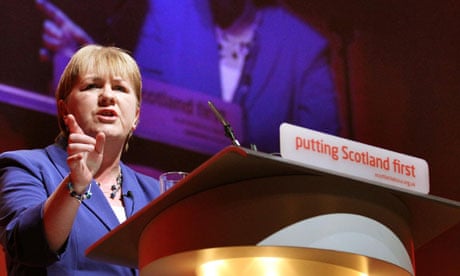
Johann Lamont: Reveals Labour Party Dogma – “Scot’s are not genetically programmed to make political decisions.” https://www.youtube.com/watch?v=nBH55ZeZU4w Johann Lamont


29 November 2012: The public in Clydebank were provided with an opportunity to question Labour and SNP politicians. They didn’t mess around. Jackie Ballie attended and was “put to the sword” by a mainly Labour supporting audience. The anger displayed towards the Labour party was intense and is entirely relevant to the 2016 Scottish elections since the mood of Scotland is unchanged.


Trades Union Council – Public Meeting Clydebank – Free Tuition, Free Bus Passes, Free Prescriptions – Can We Afford Them?

Scottish Labour leader Johann Lamont’s ‘something for nothing’ speech has been described as being like ‘a train wreck’ and the ‘longest suicide note in history’.
The problem for Lamont and her supporters is that the universalism of free bus passes for the elderly, free prescription charges and free tuition are very popular and people know they’re not free. They voted to pay for them through their taxes!

It is argued that there are lots of reasons why universal services are preferable to means testing such as better take-up, less admin costs, more equality and social solidarity.

Therefore shouldn’t progressive taxation – the rich pay more – be the way to fund decent public services and shouldn’t these be central to Labour’s policy rather than ditching universal benefits in favour of the hated means test?


The Speakers

Tom Morrison, Chair – Secretary of Clydebank TUC.

Jackie Baillie MSP – Labour

Gil Paterson MSP – SNP

Stephen Boyd – STUC

Cathy Leach – Scottish Pensioners Forum


https://www.youtube.com/watch?v=NFaLQT9wEBM 27 minutes: The speakers address the audience

https://www.youtube.com/watch?v=UKBN7mF1vx8 1 hour 36 minutes: Question & Answer session. Brilliant expose of the Labour Party in Scotland


Comments:

* Jackie Baillie is a disgrace. She is terrified of the SNP because they have helped people in a way the Labour Party never have. Our local hospital MRSA capital of Europe under her watch.

* It does make me laugh when Jackie Baillie wants to be honest about the NHS.

* Sooner Jackie Baillie is voted oot the better!

* All Union members in Scotland need to, must, realise that there is no Labour Party. The Labour Party of Scotland, Keir Hardie, is gone a long time ago…you have a New Labour Tony Blair creation that is aligned to Tory Policies.

* The only option is to vote for Independence and return a true Labour movement into Government in Scotland. Any other notion is just fanciful and the STUC need to get a grip and wake up to the fact that the UK Union is not serving you.

* The Labour Party are a disgrace to the name, they are just a bunch of tory infiltrators, withdraw all support to them now

* Blue tories, red tories. Scotland should be governed fully from Edinburgh. End London Rule, vote YES. The only way is up for Scotland if we remove the dead hand of Westminster.

* Who are the panel? Whit a fine Clydeside accent Jackie the Hutt has … sounds like she’s never been outside the home counties!! She is totally false!!

* Jackie Baillie probably regrettin she turned up. Great to see the good people of Clydebank telling it like it is

* When are the good people of Scotland going to see sense? We get the Government England votes for every time. It doesn`t matter how Scots vote in Westminster. We would be aswell not voting at all. This is not democracy. If Scotland votes NO in the referendum we are voting to remain a region of greater England and will be forever labelled subsidy junkies by the English even though we receive no extra money from what we contribute, we actually get less back.

* How can anyone in Scotland vote Labour? How can anyone be that stupid? Really, I mean, really get a grip…Labour are a sack of lying, anti-Scottish careerists, who couldn`t give a flying fart for anything other than their tickets out of Scotland on their way to a job in Westminster.

* Am trying figure out what Baillie and the chairperson were laughing at. They held the meeting in disregard (this can be seen @ 7mins.) Totally shocking. But the locals are pissed aff and they have my respect for tellin as it is outside the labour bubble.


I Don’t Want To Appear Evasive But!!!!!! – Francesca Osowska Director of the Scottish Office Runs Rings Around the Scottish Affairs Committee in Defence of her Boss David Mundell


Francesca Osowska OBE,

Educated in Cumbria and at Cambridge University where she obtained an MA in economics, she also received an MA in European Economics from the College of Europe in Bruges.

Having joined the civil service as an economist in 1993, her first posting was in the Employment Department in Sheffield. After brief stints in London and Brussels, in 1997 she moved to Edinburgh as a government economist with the then Scottish Office.

In 1998 she joined the Scottish Office education department before going on to hold posts in the education and justice departments of the Scottish Executive and was appointed Head of Sport at the Scottish Executive / Government.

Between 2007 and 2009, she was Principal Private Secretary to the First Minister before being appointed, in December 2009, as Director for Culture, External Affairs, and Tourism.

In January 2010, she was appointed Director for Housing, Regeneration and the Commonwealth Games and subsequently moved to the post of Director for the Commonwealth Games and Sport in January 2013.

She was awarded an OBE ( Other Buggers Efforts) in the Queen’s New Year’s Honours in January 2015 for services to Government and to the Commonwealth Games.

She was further rewarded with a promotion to the post of Director for the Scotland Office in the UK Government in January 2015.

Her new boss David (mundane) Mundell was delighted since she would be the catalyst ensuring successful implementation of the Westminster government’s plans to usurp the will of the Scottish people through an invidious extensive programme of change transferring financial and political responsibility away from Holyrood. Direct rule by the back door. HiHo!  Mundell.

She also maintains links to the secretive  “Common Purpose” networking organization created by its chief executive, Julia Middleton (I wrote a blog about this lot). This was the organisation that formed the “33Fifty” group of young leaders of the future who participated in the conduct of the games in partnership with the Royal Commonwealth Society.  

See: https://caltonjock.com/2015/02/13/common-purpose-the-terminal-virus-at-the-heart-of-british-politics/


Image result for Francesca Osowska


Scottish Affairs Committee Meeting 2015 – Chairman Pete Wishart – Appearance of Francesca Osowska OBE, Director, Scotland Office – Financial matters

Mr Chope:  We are talking today about the work of the Scottish Office, not just looking at what was happening previously and in particular the  Westminster government’s plans to allocate £8 million for 2015-16, as against the actual out-turn for last year, (which included the Independence referendum) of £7.7 million. Is there an explanation for this?


Osowska: Again, thank you for the question, because I think it does bear explanation. No, we don’t have a referendum in 2015-16, but what we do have is the continuing work of the Scotland Office to deliver on some of the events after the referendum.

You will be aware that the Smith Commission report was delivered in November 2014. There was an agreement that a draft Bill would be brought forward as soon as possible. That draft Bill was introduced into Westminster the day after the Queen’s Speech, and that legislative process, which commenced effectively on 19 September 2014, has had a great bearing on the work of the Scotland Office.

We have put resources into that to deliver in a very compressed timescale from concept to delivery of a Bill, so the resources for 2015-16 support that work; it is a key priority of the Scotland Office to deliver that Bill.

In addition, earlier in the year, the UK Treasury did have a review of the Scotland Office provision and agreed that the original trajectory of the budget provision set for the office in 2010 needed to be adjusted for this fact.

Finally, in terms of the Scotland Bill specifically, as well as the staff resources that are needed to deliver it, which I have mentioned, in addition, there are some costs in relation to the drafting of the Bill that add into our costs.

That is the explanation. It is also worth saying that obviously, these are plans. As you will know, there is a spending review process going on at the moment. The Treasury has yet to announce departmental provision and so we don’t know whether that will be fulfilled.


Margaret Ferrier: The Annual Report and Accounts show that the grant payable to Scotland was increased by a very small increment 2014/15 over 2013/14. Excluding the impact of devolution, is the next spending review settlement likely to mean any cuts for Scotland?

Osowska: In terms of this coming spending review?

Margaret Ferrier: Yes.

Osowska: I am afraid I cannot answer that. Obviously, the Treasury is considering the spending review at the moment and they will make their announcement on the spending review in due course, and we will see what that means for the Scotland Office.

Margaret Ferrier: The Scotland Office is going to play no part, then, in the spending review process?

Osowska: No. We have had discussions with the Treasury; sorry, I should have explained that. The Treasury have discussions with all Departments in advance of them finalizing their decisions.

We have obviously had these discussions with the Treasury in terms of what the Scotland Office will be doing and the Treasury will then take decisions on the most appropriate budget for the Scotland Office, and I await those decisions eagerly.


Mr Chope: This is about the cash reserves. Who administers the Scottish cash reserves that are created to mitigate potential volatility in tax receipts?

Osowska: Is this the mechanism by which funds are paid to the Scottish Government?

Mr Chope: Yes, £135 million in a year or something.

Osowska: Yes, the Scotland Office administers that, and that is a consequence of the 1998 Scotland Act.

Mr Chope: Do you think the Scottish Government should have more discretion over when to draw upon that Scottish cash reserve to go alongside its power to make discretionary payments into the cash reserve?

Osowska: It would not be appropriate for me to comment on whether the Scottish Government should have a more discretionary role in the procedure. However, what I can say is that, as a process, this has been in place since devolution.

All payments relating to both the block grant and changes to the grant are made to the Scottish Consolidated Fund and administered through the Scotland Office. As I said, that is a consequence of the 1998 Act.

Each month, the Scottish Government calculates the amount required to fund its various bodies covered by the grant, and the Scotland Office requests the funding from the Treasury and it is transferred to the Scottish Consolidated Fund.

Treasury is responsible for a cash management programme, which means that funding cannot be drawn down in advance of need, and I think that the system has worked very well up to now.

Mr Chope: Do you think it is easily understood by the people in the United Kingdom, collectively?

Osowska: Again, I am not sure I could comment on that. I understand it, but then perhaps I am slightly more steeped in it than the average person on the street. I think the point is that it works and it works well, and if the average person on the street, if there is such a thing, does not understand that, does it matter? The Scottish Government receives the funding that it needs on time.


Image result for Francesca Osowska


Pete Wishart: Just on this issue, there is always a fight and a fuss about perceived underspends; we have had that in the Scottish Parliament in the course of the past few weeks.

Are there any plans or provisions where this money could be carried forward if there is an underspend that has been identified within the Scottish Government budget?

It is 0.6% that needs to be taken forward. Is there any flexibility in that that would allow the Scottish Government to spend much more if there is an underspend at the end of a parliamentary session?

Osowska: In terms of any underspend by the Scottish Government and carryover, that is really a matter for discussion between the Scottish Government and the Treasury.


Chris Law: I want to ask some questions surrounding the future of income tax collection in Scotland, which is due to start next year. I want to know: is HMRC ready for its implementation and has it identified Scottish taxpayers and all of them?

Osowska: My view on that and you will appreciate that I don’t want to speak overly for HMRC would be yes. We know that HMRC will be writing to those that they have identified as Scottish taxpayers, based on postcode data.

There is very good working between HMRC, the Scottish Government and Revenue Scotland. We have seen already this year the devolution of two taxes as a consequence of the 2012 Act (stamp duty land tax and landfill tax) and I think close working between the Governments allowed that to be delivered.

Indeed, on the day that the new taxes commenced, the chair of Revenue Scotland, Dr. Keith Nicholson, wrote to Edward Troup, who is the Tax Assurance Commissioner for HMRC, and said, “on what is a historic occasion for Scotland, I wanted to take the time to pass on my gratitude to you and the staff of HMRC for the incredible effort and collaborative working that has been instrumental in seeing a smooth transition from the UK taxes to the devolved taxes today”.

Chris Law: Thank you. Can I ask you, what efforts have been made to ensure that Scottish businesses are ready and that Scottish businesses are fully on board?

Osowska: I can point to two strands of activity. One of the roles of the Scotland Office, as I mentioned earlier, is obviously to lead some of the engagement on behalf of the UK Government overall in Scotland.

As an organization, we do engage regularly with the business community and we are able to by this means—through seminars, through emails, through our ongoing contacts provide this information to them. I also know that HMRC is undertaking their own stakeholder engagement and business community engagement to ensure that businesses are prepared for the change.

Chris Law: Let us suppose HMRC costs increase, for example, diverging tax rates increasing through customer contact or possibly prompting people to attempt to gain the system. Which Government is going to be liable for these additional costs?

Osowska: I would need to have a discussion with HMRC and get back to you on that.

Chris Law: What preparatory work have you done for the new devolution of income tax? Is there anything that you have in place already, or have you just learned from the experience of the small devolution of the tax powers just now? What are you doing to ensure that we are going to be in a position to pick up the new income tax powers in the next few years?

Osowska: As I have set out, I think we did learn a lot, and Revenue Scotland and HMRC learned a lot, from the devolution of the previous taxes. Work continues on that basis and the Scotland Office has continued dialogue with HMRC, who are leading on this issue for the UK Government.

We have a dialogue and asked for assurance on this work and that assurance is given. Again, if the Committee requires further information on that, we can provide it.


Image result for Francesca Osowska


Kirsty Blackman: In terms of the Scottish rate of income tax coming in and the mechanism for adjusting the block grant going forward, how is that going? Has a decision been taken or an agreement been taken on the mechanism for adjusting the block grant, going forward?

Osowska: Again, I don’t want to appear evasive, but you will be aware that there are discussions being conducted between the Scottish Government and the Treasury at the moment in terms of the fiscal framework.

Those discussions are ongoing and I cannot comment any further. We know, for example, from the devolution of stamp duty land tax and landfill tax, that block grant adjustment mechanisms can be agreed and are used, and the same will be true for the Scottish rate of income tax.


Pete Wishart: How many of your staff are going to be allocated to working on the fiscal framework? What type of resource is the Scotland Office going to be putting into this whole major piece of work that we are going to have to undertake in order to ensure this is going to be done properly?

Osowska: I think it might be helpful, in terms of understanding responsibilities, to say that the Scotland Office is responsible for the overall passage of the Scotland Bill that is now going through Parliament.

We also have oversight and are interested in how all of the recommendations from the Smith Commission report are delivered. You will be aware that there were recommendations that were non-legislative recommendations in terms of inter-governmental working, for example, and one of the other aspects of the Smith Commission report was to put in place a new fiscal framework to reflect the new arrangements.

Treasury leads on that piece of work. The Scotland Office’s role is to make sure that we connect the fiscal framework conversation, discussions and agreements with the legislative process.

Chair: When it comes to the fiscal framework, then, your role is to be the conduit between the legislation and work with the Treasury, and the Treasury will take the lead in putting together the fiscal framework, in partnership with the Scottish Government? Is that a rough way to look at this?

Osowska: Yes.


Image result for Francesca Osowska


Scottish Office – Works For Westminster But Against Scotland


Sir David Steel


21 November 2001: Scotland Act Not Fit For Purpose and Needs to be Changed Says Lib/Dem Lord Steel

Lord Steel, the Scottish Parliament’s Presiding Officer, yesterday criticised the devolution settlement, claiming that Scotland’s institutions should have more power to act without seeking Westminster approval.

Lord Steel, who was giving evidence to a parliamentary committee for the first time, indicated that Holyrood was fettered by the Scotland Act.

He told the parliament’s procedures committee that the Act should be altered to allow Scottish institutions to be changed without the permission of Westminster.

His objection to the current position became clear when his attention was drawn to the provisions of the Scotland Act, which state that the number of MSPs at Holyrood should be reduced from the current level of 129.

Lord Steel has always disagreed with plans to cut the number of MSPs to keep the Scottish parliament in line with proposed changes in the number of Scottish MPs in the House of Commons.

He said: “There’s one problem with the position of the parliament and that’s that it is still set up under the Scotland Act and we have to go back to that if we want to introduce changes in our structure.

I don’t think in the long run that’s a sensible way to proceed. Even if we are all agreed on a sensible change here it means we have to persuade both Houses at Westminster that they have got to give up time.

I think the real answer lies in that if and when the Scotland Act is reviewed, one of the changes that should be made is that the constitution of our own proceedings should be transferred to us, full stop.”

Fiona Hyslop, the Scottish National Party spokesman for parliament, said: “Lord Steel has raised very real concerns over the shackles that are being imposed on the Scottish Parliament by Westminster.

It is absolutely essential that we reclaim control of the parts of the Scotland Act that affect the running of the Scottish Parliament.”

http://www.telegraph.co.uk/news/uknews/1363006/Change-Scotland-Act-says-Lord-Steel.html


Lord Wallace


11 February 2002: Scotland’s Deputy First Minister Lib/Dem Jim Wallace Calls for Abolition of the Scottish Office

The Deputy First Minister, Jim Wallace, said last week that there was no longer any need for the post of Secretary of State for Scotland.

The leader of the Scottish Liberal Democrats said Scottish ministers were already working closely with their counterparts in London, bypassing the need for a Scottish Secretary.

http://www.telegraph.co.uk/news/uknews/1384476/Scotland-Office-role-defended.htm


George Foulkes attempts to justify retention of the Scottish office

“There was a great deal of work to do in representing Scotland’s interests at Westminster despite devolution, the Scotland Office minister George Foulkes said yesterday.”

Foulkes, who acts as deputy to the Scottish Secretary, Helen Liddell, was replying to critics who said his job had been made redundant.

Foulkes said: “The Scottish Secretary is a very strong voice in the Cabinet and we are on about 20 cabinet committees and sub-committees which are determining what happens not just in Scotland, but in the whole of the UK.

We have huge amounts of Government papers to go through to make sure that the Scottish Executive is consulted as appropriate.”


The Role of the Scottish Office (defined by David Mundell, Sir Andrew Dunlop (Mundell’s minder, unelected peer and personal friend of David Cameron) and the Tory party: 2015)

Ensure the smooth working of the devolution settlement in Scotland. Representing Scottish interests within the UK Government and representing the UK Government in Scotland and ensure that when it comes to reserved matters (the issues that the UK Government deals with in Scotland), the people of Scotland’s voice is heard at the highest level in UK Government.

Objectives:

To strengthen and sustain the union.
To act as a custodian of the devolution settlement.
To be Scotland’s voice in Whitehall.
To represent Scottish interests within Government and support the rest of Government on UK matters.
To champion the UK Government in Scotland
To represent and advocate for the UK Government’s policies and achievements in Scotland.


Report by the Scottish Affairs Committee (2009) – Scotland and the UK: Cooperation and Communication Between Governments

There is a striking disparity in the size of the Scotland and Wales Offices since in many ways the roles they play are similar.

Apart from the Scotland Office incorporating the Office of the Solicitor to the Advocate-General (OSAG), which has no parallel for Wales since Westminster remains the sole legislature for Wales we would expect the staffing of the two offices to be similar. They are not.

The latest annual reports for the two show that, (excluding the OSAG) the Scotland Office has 85 staff and the Wales Office an average of 41.

The Scotland Office therefore has more than twice as many officials as the Wales Office, even though the devolution settlement for Scotland is rather more straight forward from a UK Government point of view than the Wales one. We were offered no cogent explanation for this staffing discrepancy and do not understand how it has arisen.

It is recommended that the UK Government consider with care how to deal with devolution matters at an early date, so that the machinery of government relating to devolution can cope not just with inter-governmental relations as they stand but as they are likely to become in the medium term.


Scottish Affairs Committee Meeting – 2015 – Scottish Office – Financial matters – Francesca Osowska OBE, Director, Scotland Office, and Michael Chalmers, Director and Solicitor to the Advocate General were in attendance

Chair: Welcome to the Scottish Affairs Committee; we are very grateful for you both coming along today. If you would like to introduce yourselves and say what you do, and if there are any initial statements that you want to make to the Committee, please feel free to use that time.

Francesca Osowska: Thank you very much. I am Francesca Osowska. I am Director for the Scotland Office and I am also Principal Accounting Officer for the Scotland Office and the Office of the Advocate General. I have no opening statement, other than that I am very pleased to appear before the Committee to answer questions on the Scotland Office and the Office of the Advocate General Annual Report and Accounts for 2014-15.
Michael Chalmers: Thank you. My name is Michael Chalmers. I am the Director of the Office of the Advocate General and the Solicitor to the Advocate General. Similarly, I have no opening statement to make but am happy to answer any questions the Committee may have.

Chair: Thank you very much. Obviously, we are here to talk about the Annual Report, which we have all digested and know inside out and back to forward, and so on. We are grateful that we are able to ask you a few questions about what is included in the Annual Report.

One of the things that struck me, perhaps you could explain to me how this works is that there are 100 staff currently employed within the Scotland Office. Is that correct, roughly 100 staff?

Francesca Osowska: Across the Scotland Office and the Office of the Advocate General, yes.

Chair: Across the estate that is operating the Scotland Office. None of them are permanent. Does that create any difficulties or problems or issues for you? I would imagine it must, and why has the decision been taken that they have no permanent staff in the Scotland Office?

Francesca Osowska: Maybe I will kick off on that and I will ask Michael to comment and give a perspective from the Office of the Advocate General. Since devolution and since the creation of the Scotland Office this has been the case: that the Scotland Office does not itself directly employ staff, but we second or take staff on loan from other Departments.

Part of that is pure economics, efficiency and practicality; to run a full scale HR system for such a small office would be inefficient. By tapping into the resources of other Government Departments for example, in the Scotland Office in London most of our staff are on loan, but we also benefit from arrangements with the Cabinet Office we can access external expertise and indeed access external HR expertise, which is effective and efficient for us.

Members of staff, once they are in post within the Scotland Office, I feel are fully part of the Scotland Office team, so if the question is about allegiance, there are no difficulties there. Michael, do you want to say something?

Chair: Just before Michael comes in, if you don’t mind, it is not about allegiance and I don’t think that is the issue. It is just being able to build up a staff capacity when none of them are permanent and most of them seem part-time.

Are they shared with other Ministry Departments or are they exclusive to the Scotland Office?

Francesca Osowska: They are exclusive to the Scotland Office.

Chair: Seconded from other Departments?

Francesca Osowska: They are seconded or on loan from other Departments. They have direct line management throughout the Scotland Office in the case of my staff, and for Michael in the case of OAG staff and they are answerable to Scotland Office Ministers, so that line of accountability is very direct.

Chair: Are there any plans to get permanent staff in place, given you have significant and substantial pieces of work to consider as we go forward in the session? Are you happy and relaxed about the current arrangements with the….

Francesca Osowska: Yes, I believe the current arrangements work very well, because we are able to bring in staff from other Departments and benefit from their expertise.

Michael Chalmers: Yes. It is similar for the Office of the Advocate General, in that what I require to run my office is staff that have public law expertise and Scots-qualified lawyers. It is a relatively small office. We have about 36 lawyers.

It helps the resilience of my office to able to draw from a larger pool. So, the Office of the Advocate General is part of an association of Government legal offices, together with the Scottish Government Legal Directorate, Scottish Parliament lawyers and Scottish Law Commission lawyers.

All of these offices together draw from the same pool of staff but, yes, as Francesca has outlined for the Scotland Office, we have staff fully dedicated to working in our office. They do not move between offices day to day; they are on a reasonably long-term secondment and that operates as quite a successful model for us because it helps the resilience of not just our office but the other legal offices I mentioned.

It also means that staff interchange and it helps their development of legal skills. In fact, adding the perspective of working for another administration is helpful as well.

Chair: How many staff does the Office of the Advocate General have then?

Michael Chalmers: We have 36 legal staff and I think it is 46 in total.

Chair: The last year, as I think we touched on, has been a particularly trying year, with lots of pieces of significant and substantial work, particularly the referendum and the Smith Commission. What do you see as the main issues and challenges and the main thrust of your work as you go forward over the next year or two years in the parliamentary term?

Francesca Osowska: Thank you for the question. Again, I will speak for the Scotland Office and allow Michael to speak for the Office of the Advocate General.

In terms of the Annual Report, obviously that sets out five objectives for 2014-15. For the Scotland Office, I think our work continues in that vein. We have a strong constitutional role, primarily in relation to the Scotland Bill, which, as you are aware, is passing through these Houses at the moment.

That is a key priority for the Scotland Office. In addition we continue to be the voice of Scotland in Whitehall, so our work with other Government Departments across Whitehall, in terms of ensuring that they appreciate the devolution settlement and that they are conscious of the Scottish context, will continue.

Similarly, we are the voice of the UK Government in Scotland and, again, we work co-operatively with other Government Departments who have reserved responsibilities in Scotland to ensure that the UK government can work effectively in Scotland.

Chair: Just before we go to Mr Chalmers, do you have any sense of the balance? I am quite intrigued by seeing that you are the voice of Scotland and Whitehall and the voice of the UK Government in Scotland.

How would you see that balancing out in terms of the commitment to either of those fine offices?

Francesca Osowska: In terms of numbers of staff?

Chair: No, not in terms of numbers of staff but about how much time or effort. Do you see yourself primarily as the voice of Scotland in Whitehall or do you see more of a role as being the voice of the UK Government in Scotland? How would you characterise the effort that is put on to each of those very laudable aims and objectives?

Francesca Osowska: I think we treat them equally. If I were to take those objectives along with our constitutional objectives which, as I mentioned, include the Scotland Bill, but also include responsibilities in terms of Scotland Act orders and LCMs—then I would say that we give those equal weight.

Chair: Mr Chalmers?

Michael Chalmers: Yes. The role of our office is to provide Scots law advice to the whole of the UK Government. Our objectives reflect that, so that includes litigation for UK Government Departments in Scotland.

It includes giving Scots legal advice to all UK Government Departments, particularly on Westminster Bills, for example but not restricted to that and also supporting the constitutional objectives that the Scotland Office shares.

Obviously that would include the Scotland Bill and legal work on the Scotland Bill but it also includes a lot of the stuff that goes on below the radar.

Francesca mentioned Scotland Act orders; so, lawyers from my office will work closely with lawyers in the Scottish Government to make sure those orders proceed smoothly through each of the Parliaments.

I suppose an example would be the section 30 order that we put through in the early part of this year to change the competence of the Scottish Parliament to allow legislation for 16 and 17 year olds to vote at next year’s Holyrood elections, so there is a lot of that sort of working below the radar that we continue to do and we see ourselves as part of the good operation of devolution and government for Scotland.

Chair: Thank you.


Financial matters – The Scottish referendum – Use of the Civil Service in support of the “Better Together” campaign

Margaret Ferrier: Looking at the 2015-16 budget for the Scotland Office it was set at £5.8 million in the 2013 spending round, but the most recent main estimate asked Parliament to approve an additional £3 million for capability enhancement. What are these additional funds for?

Francesca Osowska: In terms of the out turn for 2014-15 the total combined out turn for the Office of the Advocate General and the Scotland Office was £7.7 million. You will appreciate that that did include an uplift from the original budget setting process that occurred in 2010.

At that point, a referendum was not anticipated; a lot of the work in terms of 2014-15 has been the follow through or was related to the referendum, so the work in the run up to the referendum, contributing to the Scotland analysis papers for example, supporting Ministers as they gave public information to inform the debate about the referendum, and that explains the increase in that provision.

Margaret Ferrier: These public Ministers, are you meaning UK Ministers?

Francesca Osowska: Yes.

Margaret Ferrier: Not Scottish Government?

Francesca Osowska: No.

Margaret Ferrier: The Annual Report and Accounts show that general administration costs rose by about 8% from £7.2 million in 2013-14 to £7.7 million in 2014-15. Why do you feel the general administration costs are rising? Is there another reason, other than the referendum debate that was taking place?

Francesca Osowska: No. As I said earlier, the very initial budget was set in 2010 as part of that spending review. The referendum was not anticipated at that point and this increase represents the resources dedicated by the Scotland Office to supporting the work of the UK Government, overall, in informing the referendum debate.

Kirsty Blackman: The Scotland Office had allocated to it and spent an extra £3 million helping UK Government Ministers with information about the referendum, mainly?

Francesca Osowska: In terms of the increase, there are a number of different figures being talked about here. It might be helpful if I wrote to the Committee after this hearing to set out the sequence of events, because there were uplifts granted and changes in the Budget made from the original 2010 provision at different periods, including during the course of 2013-14, so I do not think it is entirely correct to say it was a single jump of £3 million.

In terms of what that money delivered and the outcomes that the Scotland Office delivered, I would refer the Committee to chapter 3 of the report. That sets out quite a detailed analysis of the outcomes and the outputs from the five objectives set by the Scotland Office, and certainly part of that work and a focus of that work in 2014-15 was in relation to the run-up and then the after-events—including the Smith Commission—of the referendum.

Chair: It would be helpful if you write to the Committee to explain properly what that £3.3 million did account for. What we are hearing is that this might have been the figure that was used for the referendum campaign, for the “No” campaign, and used by UK Ministers to take part in the referendum. Would that be roughly a correct characterisation of that spending?

Francesca Osowska: I don’t think it would be, if you don’t mind. What I am saying is that, if we look at page 54 of the Annual Report and Accounts, then you see the trajectory of the Scotland Office and Office of the Advocate General accounts.

You can see, in terms of general administration costs, that they have more or less been around the £7 million. That is why I feel it is important that I write and set out the explanation of the £3 million figure.

Chair: Please do.

Francesca Osowska: However, in answer to your question, Mr Chairman in relation to “Was this a way of the Government funding the ‘No’ campaign?” this was to fund the activities of UK Government civil servants, in line with the civil service code.

All activities undertaken by civil servants in my Department would meet a propriety test, yet I think you would agree that in the run-up to a referendum, obviously when Ministers want to be more visible, when we need to ensure that there is a good flow of public information for example, via the Scotland analysis papers that increases our activity and that is why there was an increase between the 2013-14 out turn and 2014-15 out turn.


Francesca Osowska OBE, Director, Scotland Office,


Damm, Damm and Double Damm – What a con – The civil service and their Janus-faced illegal political behaviour

Francesca Osowska in a number of her evasive statements to the Scottish Affairs Committee represented them misleadingly glossing over the expensive and extensive work of a large group of (supposedly politically neutral) Civil Servants who actively supported the objectives of the “Better Together” campaign. A gross misuse of public finances and Civil Servants presumably authorised by David Cameron and Sir Jeremy Heywood.

The matter of the Scottish Office staffing establishment drew comment but did not address the previously advised 50+ excess staffing of the Scottish Office over the Welsh Office.

So the Scottish Office has retained 50+ unjustified posts the costs of which are charged to Scotland’s block grant at a cost of around 2.5million each year.

The annual slush fund is a never reducing financial nest egg ( it is skimmed off Scotland’s block financial grant) and used, abused by the Scottish Office for purposes such as the UK government anti-devolution leaflet production, printing and distribution. Hiring of Special Advisors (SpAds), usually sons, daughters, other relations, friends of ministers or other MP’s. Temporary secondment of Civil Servants from other Government Departments.

Sir Jeremy Heywood and David Cameron


November 2014: Public Statement from the office of the head of the Civil Service Sir Jeremy Heywood (not long after the referendum)

The Cabinet Secretary and Head of the Civil Service Award 2014: Presented by Sir Jeremy Heywood to an individual or team who deserving of particular recognition for outstanding achievements in making a marked difference on an issue of national importance – Awarded to a group of impartial UK Civil Servants (The Scottish Referendum Dirty Tricks campaign).

http://www.civilserviceworld.com/articles/news/hm-treasury-team-wins-special-civil-service-award
Speaking for the 20+ strong Civil Service Team, Mario Pisani Deputy Director at HM Treasury said:

“In the Treasury, everyone hates you. We don’t get thanks for anything. This is one occasion where we’ve worked with the rest of Whitehall. We all had something in common, we’re trying to save the Union here, and it came so close. We just kept it by the skin of our teeth. I actually cried when the result came in.

After 10 years in the civil service, my proudest moment is tonight and receiving this award. As civil servants you don’t get involved in politics. For the first time in my life, suddenly we’re part of a political campaign. We were doing everything from the analysis, to the advertising, to the communications.

I just felt a massive sense of being part of the operation. This being recognised (at the Civil Service Awards), makes me feel just incredibly proud.”

Paul Doyle;

“This award is not just for the Treasury, it’s for all the hard work that was done by all government departments on the Scotland agenda.

The reality was in all my experience of the civil service, I have never seen the civil service pull together in the way they did behind supporting the UK government in maintaining the United Kingdom. It was a very special event for all of us.”

Shannon Cochrane;

“we’ve learned that it is possible for civil servants to work on things that are inherently political and quite difficult, and you’re very close to the line of what is appropriate, but it’s possible to find your way through and to make a difference.”

William MacFarlane, Deputy Director at HM Treasury, (Budget and Tax Strategy);

“As civil servants you don’t get involved in politics. For the first time in my life, suddenly we’re part of a political campaign.

We were doing everything from the analysis, to the advertising, to the communications.

I just felt a massive sense of being part of the operation. This being recognised (at the Civil Service Awards), makes me feel just incredibly proud.”


Labour Party in Government in Scotland – Incompetence or criminal deception


The Late Donald Dewar and the First lady of the UK

McLeish

McConnell with his pal Donald


Labour Party Accused of Cheating the Scottish Electorate

The Labour Party, assisted by the Lib/Dem’s formed the government in Scotland from the start of devolution until 2007. In that time Donald Dewar, Henry Mcleish then Jack McConnell held the office of First Minister. In this period the Labour Party in Scotland was found to be wanting in honesty and integrity. The right wing press attacked Labour questioning it’s fitness for government.

Mcleish resigned and handed over to McConnell who despite being nominated by no-one within the Party was elected to lead the Scottish government, ( a coronation). McConnell resigned in 2007, following electoral defeat by the SNP. From that time the party has been led by: Wendy Alexander, Ian Gray (twice), Johann Lamont, Anas Sarwar (twice), Jim Murphy and Kezia Dugdale.


Wendy Alexander

Johann Lamont

Ian Gray

Jim Murphy

Anas Sarwar

Kezia Dugdale


15 November 2001: The sorry saga of devolution under a Labour Government

Before we start talking about the hopes and dreams of new First Ministers, before we begin to talk about reshuffles, let us get one thing straight. And that is that some of us warned against taking the devolution road. Not once, not twice – but consistently.

That we are entitled to say “We told you so” is beyond peradventure. But I feel provoked into saying it now because everyone seems to be trying to get in on the act. By this I mean everyone who insisted that devolution would bring sunshine and light to the land. Instead, what it has brought is:

  • One First Minister’s (Mcleish) resignation because of irregularities – to say the least – about his office expenses, dating back 14 years.
  • That same First Minister, having served less than 12 no doubt arduous months, is in receipt of a pension for the rest of his life of £34,000 a year – courtesy of a grateful taxpayer.
  • His resignation unearthed a plethora of sweetheart deals between a constituency Labour Party and a melange of public authorities, charities, blue chip law firms and office equipment suppliers, all of whom appeared only too happy to make sizeable contributions towards the running of a Labour MP’s office.
  • The confession of the man who would be First Minister, (McConnell) that he had cheated (with a close working colleague) and lied to his wife.
  • The succession for the post of First Minister has been reduced to a coronation, with Labour failing dismally to arrange anything remotely resembling democracy for the nation’s pre-eminent political post.
  • Such is the strength of the lickspittle tendency within Scottish Labour that in spite of the fact that not a single Cabinet minister signed McConnell’s nomination papers, neither did even one of them have the guts to stand against him.


In spite of acres of guff about recent events proving the worth of devolution and of the Scottish Parliament, the bald truth – accepted by everyone who thinks seriously about it – is that the whole project has been besmirched and undermined to an incredible degree. “We are taking on the appearance of a banana republic,” said one senior nationalist who fears that devolution, never mind independence, is holed below the waterline.

He is right. Scotland has become a laughing stock. If you don’t believe me, ask a friend or relative elsewhere in the United Kingdom who witnessed Henry McLeish’s Question Time performance, or his resignation saga, or who saw Mr McConnell’s “confessional”.  The rest of Britain thinks we’re nuts. And just in case anyone should be in any doubt about it there is no joy, only worry, here even for those of us who might have wished that devolution had never been born. After all, we live here. And outsiders hold us all – however we voted in the 1997 referendum – to be equally guilty for the farce that now engulfs us.

All of which makes it all the more galling, as I said at the start, that some of those who were the most vociferous in advocating devolution as a cure-all are now trying to claim that they had always opposed it and that they had warned that home rule would see us run by second-rate no-hopers. It fairly takes the breath away.  Still, this is a minor irritant when compared to the main job in hand, which must be to restore some of this country’s battered pride and dignity. http://www.telegraph.co.uk/news/uknews/1362425/So-far-so-bad-in-this-sorry-saga-of-devolution.html


It’s not over!!


Mundell & the Scottish Office – The Millstone Dragging Scotland Down


Mundell Plea – Let’s all be civil to each other

David Mundell calls for a “reboot” of the relationship between Holyrood and Westminster, and said there should be an end to the “petty politicking and sniping” between the Scottish and UK governments after the Scottish elections in May.

He cited the “extensive and collegiate” inter-governmental work carried out on issues such as the Forth Road Bridge closure and the response to the falling oil price. All this goes to show that we can and do work well together, but why can’t this be the norm for all our interactions? The problem is this positive work behind the scenes is not what gets the coverage. What does are the spats and fall-outs.”

Comment: inter-governmental work. Forth Road Bridge and falling oil price? No response as yet from Westminster. He lives in a dream world.
The SNP said Mr Mundell should match his “warm words” with real action, and that it was looking for real evidence of the UK government’s willingness to cooperate.

Comment: Mealy mouthed Mundell plea for unity is a deceptive ploy and should be treated as such.

http://www.bbc.co.uk/news/uk-scotland-scotland-politics-35348750


Examples of Mundell’s Petty Politicking and Sniping (it’s all one way traffic)

Scottish Secretary is behaving like the Governor of a colonial outpost

Would it not be more honest for David Mundell now to delete the word “for” in his official title and replace it with “against”? Once again our Secretary of State for Scotland honours us with a flying one-day visit, this time to announce his refusal to endorse a perfectly sensible visa scheme for post-graduate overseas students, which is widely supported in academic circles and has already proved successful in bringing significant economic and financial benefits for Scotland (“Outcry as Tories block work visas for overseas students”, The Herald, January 12).

It seems he is happy for our universities to collect large tuition fees from international students from outside the EU, but when they qualify and some of them wish to remain in Scotland to undertake post-graduate studies and thus contribute to the Scottish economy, Mr Mundell blocks the re-introduction of the special visa scheme which worked well in Scotland for several years until recently. What a negative and short-sighted attitude.

A few months ago in the House of Commons Mr Mundell positively revelled in opposing every one of the 40-odd proposed amendments to the seriously-flawed Scotland Bill, based on the watered-down Smith Commission proposals for increased powers for the Scottish Government. He follows the same totally negative line at every monthly session of Scottish Questions, proving that he is quite clearly the lackey of this anti-Scotland UK Conservative Government.

I can remember the day when honourable Conservative Scottish Secretaries like George Younger, Malcolm Rifkind and Michael Forsyth stood up even to Margaret Thatcher in defence of Scotland’s specific interests. But the present incumbent behaves more like the British Governor of a colonial outpost than the defender of Scotland’s interests inside the Cabinet. Yet Mr Mundell is Scottish Secretary only because he is the only Tory MP elected in Scotland, scraping home last May by just a few hundred votes. He is hardly the popular choice of the Scottish people, and is certainly not increasing his popularity by his current behaviour.

http://www.heraldscotland.com/opinion/14199490.display/

https://www.youtube.com/watch?v=SaMNdhrpxFw The infamous Frenchgate memo. Bluff and bluster. He was complicit in the Carmichael affair.


Mundell Governing Scotland with no Shame

David Mundell has been accused of governing with “no shame”, after the welfare section of the Scotland Bill passed without any amendments from Labour or SNP being accepted by Scotland’s sole Tory MP.

North Ayrshire and Arran SNP MP Patricia Gibson said welfare cuts would have a devastating impact on Scotland, accusing Mundell of being a “colossal governor-general” who presided over the Scottish people with “no shame”.

She said: “The people of Scotland would consider it unreasonable that a party that has a far weaker mandate in Scotland than at any time during any of the years in which they last had a majority government, pontificates over what powers Scotland should have, while reneging on the all-party agreement arrived at in Smith.

“The Secretary of State clearly thinks that this situation is entirely reasonable, and presides over the dispatch box like a colossal governor-general, with no shame, and takes on the elected and legitimate representatives of the huge majority of the Scottish people.

https://www.commonspace.scot/articles/1768/scotland-bill-colossal-governor-general-david-mundell-rejects-all-amendments-on-welfare


Meeting of the (Westminster) Committee for Scottish Affairs ( Chairman Ian Davidson Labour)

Mr Salmond, Scotland’s First Minister was questioned about the Scotland Bill by Committee members at a meeting in Westminster. The extract provided provides example of the attitude of Mundell to Scotland and it’s first minister. His entire persona is one of blatant hatred of anything political that is not Unionist. His post and his cronies in the Scotland Office should be removed. Scotland does not need to carry the millstone of Unionist control.


David Mundell: I think it is a fundamental part of the relationship between Holyrood and Westminster that you appear before this Committee .

Some of your critics would suggest that you have a political advantage in ensuring that there is not a good relationship between Westminster and Holyrood. What positive evidence can you put forward to rebut that particular criticism?

Mr Salmond: I think probably the most positive evidence has been that I looked for the instigation of a process of dispute resolution, of communication, of joint working between ministers, which had been in abeyance for at least five years before the Government in Scotland took office.

Over that period of time there were many celebrated disputes, some of which got into the public domain between the then Scottish Executive and the administration, despite the fact they were of the same political party.

For example, Attendance Allowance and free personal care was a particularly famous example.

A long running dispute now in terms of the Barnett consequential’s or not of Olympic regeneration of spending would be another example.

The evidence I would cite, David, is the fact that I was so keen on having this process resumed after it being in abeyance for a substantial period of time.

I think like this: I think across a range of things, and I have cited some examples, it is the job of governments, of whatever political hue, just to get on with the job and cooperate to do that, and I have given you a range of examples.

I think it is perfectly valid to have political divergences either between political parties or indeed between governments. I think it is perfectly reasonable to have them ventilated in political debate.

Could I just say to you, there are enough of these legitimate political divergences in terms of aspiration for the future constitutional status of Scotland without having to invent disagreements over other things.

It has never been my purpose to invent disagreements. On the contrary, I have been looking for resolution and cooperation, where cooperation and resolution can be found.

David Mundell: You have to concede, given your comments about parity of esteem, that some comments you have made in your capacity as First Minister of Scotland, have not been reflective of a parity of esteem from your perspective?

Whilst your memorandum indicates that UK Government has not accepted a change in relations over the period of devolution, leading to a lack of respect for Scotland’s status, surely there is plenty of evidence that you have not demonstrated a respect for Westminster and the UK Government?

Mr Salmond: If you are going to give me evidence, David, I think you had better cite it.

With parity of esteem the difficulty has been the assumptions which are still held in many areas of Whitehall that the Scottish Government, the Scottish Civil Service, the Scottish Parliament are actually another department still of the Westminster Government; but the same would apply, incidentally, to the Northern Irish and Welsh.

I suppose the concrete evidence I would put forward to say that the position is the one that we suggest, that we have been trying to find structures which would have that parity of esteem as the essence of the relationship (and the parity of esteem incidentally was implicit in the Memorandums of Understanding that were agreed at the outset of devolution; that is what they were about), is that on all of these occasions that I could cite, let us say the one I took on regeneration expenditure from the Olympic Games — not the Olympics itself but the question of the Barnett consequential’

s of the regeneration expenditure and whether the financial rules would mean that that expenditure should be Barnetted — the position of the Scottish Government is exactly the same as the Welsh administration and the Northern Irish administration, despite the different political complexions.

Basically in all of the key examples that I could cite where there is a divergence of opinion, then the divergence is not one between Scotland and Wales or Scotland and Northern Ireland, it is one that the devolved administrations normally have a divergence from the position of the Westminster Government or perhaps just the position of Westminster departments, forgetting that the political structures have changed very substantially and continue to change.

David Mundell: But those other administrations have taken a different approach to setting out their case. They have not used the media to the extent that you have. I think you would have to concede that.

Mr Salmond: Am I conceding that I use the media? Yes, occasionally I do! David, I think you use the media occasionally, do you not?

David Mundell: But not in the context of the conduct of the dialogue between the Scottish Government and the First Minister of Scotland, and the Prime Minister and the UK Government.

I think one thing that surprised many people, myself included, Mr Salmond, was that in the period of the recession nearly a year went by without you having any dialogue at all with Gordon Brown. What is the reason for that lack of dialogue?

Mr Salmond: If we take the Prime Minister’s predecessor first, the first prime minister I dealt with, the Prime Minister’s predecessor would not speak to me at all from day one of the SNP Government.

That was nothing to do with me; I was perfectly happy to speak to the Prime Minister, but I think that the then Prime Minister was upset with the Election result.


I am delighted to speak to the Prime Minister at any time and would love to do so on much more regular occasions.

I accept of course that the then Prime Minister has many, many competing demands, but the wish for communication from the Scottish administration and I suspect the Welsh and Northern Irish administration is very great.

That is why we have been so keen to re-establish structures which at least would set in train that process.

There have actually been two meetings about the recession with the Prime Minister and leaders of the devolved administrations. One took place last spring and the other was at the September JMC meeting where the issues of the economy and the recession were discussed in some detail.

Would it be my wish that there had been more? Yes, it would, although it should be pointed out that these are not the only inter governmental meetings.

For example, the financial take place on a fairly regular basis. I think meetings like that are extremely useful. Hence the meeting and summit on jobs that was held in Easterhouse yesterday with myself and the Secretary of State for Scotland, and crucially the people employed in Scotland, in delivering the various programmes either under the Scottish Government or the Department of Work and Pensions in terms of enabling us to accelerate recovery.


Devolution- A Tightening of the Cold Hands of Westminster Unionist Politicians Around the Necks of Scots – With the Expressed Purpose of Destroying Their Will to Live in a Free Nation


How Maastricht changed Europe


Maastricht  and its implications

Having signed the treaty the Tory Party went into meltdown over the implementation of matters of policy required by the EU. Although John Major eventually won through the in-fighting had badly damaged the image of the Party and Tony Blairs “New Labour” replaced it in government.

One area of governance (among many) the negotation of which was declared unacceptable was the “sovereignty” of Westminster. Any and all discussions with the EU would be directed through the UK government and its officers.

But democracy was a key subject of the treaty and this brought with it policies of decentralising authority within member states. But this was an anathema to the Tory Party which vehemently rejected any change. All powers would be retained by Westminster.


1999 – Devolution – Establishment of the Scottish Assembly

The proposal was used by Tony Blair as an election propaganda tool with the purpose of encouraging Scottish voters to join the Labour Party cause, reversing the damage to Scottish society of 13 years of Tory centralisation.

“New Labour” would devolve control of public and economic policy to Scotland further strengthening the Labour Party’s already solid political base in Scotland. 

But Unionist politicians at Westminster failed to embrace the prospect of a return to local democracy since it was a threat to the power of Westminster and their livelihood.

The “New Labour” Government, using its massive majority forced through a devolution deal but true to form all was not as it appeared to be. Arch Unionists, Blair and Brown cobbled together a package of measures crammed full of caveats many of which would surface over time. They devolved little and removed a lot.

Voting arrangements, introducing a strange hybrid form of proportional representation were put in place by the Labour government and the Lib/Dem’s ensuring there would be a permanent coalition government in Scotland to the exclusion of the SNP and the Tory’s.

In 2003, a Commons Select Committee highlighted an urgent need for the UK government to introduce organisational change in Westminster, at the centre of government, reflecting the new political relationships with the recently devolved Scottish Government.

Failure, on the part of Unionist politicians, to identify the purposes of devolution and put in place agreed “terms of reference” for the newly devolved government might introduce difficulties arising resulting in a “war of wills” which could encourage the UK government to weaken or indeed set aside devolution.

In the first few years of devolved government in Scotland new ways of working appeared to be bedding in well, despite Unionist politicians studiously ignoring the recommendation of the Commons Select Committee, to address issues formalising inter-governmental relationships.

The new activated parliament was given universal public support, even after a series of major financial blunders on the part of incompetent and corrupt Labour/Libdem coalition governments driven by dogma driven right-wing policies brought forward by Unionist politicians at Westminster and eagerly embraced and implemented without question by Scottish Unionist politicians.

The loyalty of Scottish government ministers to their governing body at Westminster was absolute.


The Westminster/Holyrood Experience – 1999-2006

But weaknesses in the devolution arrangement soon unravelled and the Scottish parliament was often publically reminded of the pecking order within the UK.

Scotland had no authority over macroeconomics (interest rates, taxation or banking) or micro matters (employment law, industrial relations, or large parts of the welfare state).

Financial grants provided the Scottish government with the authority to manage the expenditure of devolved budgets.

But the expenditure policy was dictated by the UK government who also reserved the bulk of powers to Westminster, rendering the Scottish Parliament impotent and of little consequence.

Devolution had transferred limited powers to the Scottish Assembly but even these were not exclusive since they simply cemented Westminster’s sovereignty, and controlling influence over the politics of the entire UK.

Westminster would still crack the whip insofar as the Scottish economy was concerned. Devolution had created 2 governments in Scotland. A recipe for failure.

Devolution created an abundance of overlapping and shared policies and party interests meant that politicians in both parliaments worked together and any difficulties arising were quietly resolved to the satisfaction of Westminster politicians without undue publicity.


2007 – The Scottish National Party government

The election of a minority SNP government in May 2007 presented the Westminster Labour government with major problems.

One of which was the Unionist politicians fear that the “Treaty of Union”, to which the Labour, Conservative and Lib/Dem parties were committed would be abandoned.

The stage was set for a major confrontation between Westminster and Holyrood. And the SNP Government did nothing to dispel their fears.

Spurred by a need to do things differently, the Scottish Government speedily introduced “divergence” to Scottish politics. The first policies brought change, “at odds” with the NHS in England namely:

* Free long-term care for the elderly.
* Removal of prescription charges.
* Removal of car parking charges in hospitals.
* Increased funding per head of the Scottish Health Service.

The “House of Lords” confirmed the proposed changes to be within the limits of devolved divergence and although discussed at Westminster censure was not forthcoming.

Encouraged with success the Scottish Government went on to implement a wide range of greatly improved welfare, social, domestic and economic politics benefitting many Scots.

But Unionist politicians at Westminster had ensured many limitations to devolution and there were many things that the Scottish Government wished to introduce, but couldn’t due to the entrenched attitude of the UK Government who insisted that the perceived needs of the UK took precedence over that of Scotland.


The Barnett Formulae

The pervading dependence of Scotland on Westminster is overwhelming due to the allocation of annual finance enacted using the “Barnett Formulae.” which recognising spending on “comparable functions in England” and creates a “block grant” for Scotland.

The primary weakness of the “Barnett Formulae” is its exposure to the whims of Westminster Unionist politicians who are intent on increasing privatisation across a range of services much reducing the size and shape of the “Welfare State”.

Annual funding of the “Scottish Block Grant” will, over time, render it impossible for the Scottish government to maintain services as they would wish forcing Scotland to adopt the policies of Westminster. So much for devolution.


Higher Education in Scotland

Westminster Unionist politicians chose to introduce individual charges for higher education.

Students would be provided with deferrable loans by universities, repayable over time.

Financial allocations to higher education were reduced by Westminster.

The SNP Scottish government gave notice of a divergence from the Westminster policy and introduced higher education in Scotland free of University fees.

Finance covering the measure would be allocated from the “reduced block grant for education” to appropriate places of learning annually. More Squeezing of finance by Westminster Unionist politicians.


Council Tax – the 2008 proposals

The SNP government brought forward proposals which, if introduced would essentially change local taxation removing the much-maligned “Council Tax” replacing it with a “local income tax”.

There was an almighty row about “council tax benefits” with Westminster Unionist politicians who had retained control of Welfare.

The UK Unionist government would not confirm a transfer of additional benefit finance to Scotland.

This meant that any “local income tax” would not be underpinned by Westminster.

The proposed divergence had to be abandoned exposing the weakness of devolution where there is a crossover between devolved and non-devolved areas of policy.


1999 -2007 – The demise of the Labour Party in Scotland

The 2007 Labour/LibDem party election campaigns in Scotland were disastrous.  There was very little policy promotion, instead, Unionist politicians, in government, systematically attacked the SNP accusing it of being divisive and acting against the best interests of Scots.

The SNP, well organised and focused sent out a simple message to the Scottish electorate that, “only the SNP will stand up for Scots against Westminster”. 

Scottish Labour, the Tory’s and the LibDems repeatedly failed to convince the electorate that the interests of Scots were paramount. Against all the odds the SNP won the day.

Adding to Labour’s problems was the increasing dissatisfaction with corrupt Labour-run local councils.

This had been revealed at the time of local council elections when the “single transferable vote” was introduced.

Many former Labour-run councils reverted to no overall control or to SNP stewardship.

Labour influence in Scotland from 2007 has, at best been marginal and at worst irrelevant.

The authority and ability of the party to control the political agenda of Scotland was at an end.


Devolution – A Diplomatic Gift From Westminster Or A Poisoned Chalice Concocted to Destroy Scotland – Part 1


17 December 2002: Devolution (Scotland) Arrangements within the UK Government

A commons select committee was formed early in the year 2002 with a remit to review inter-government working arrangements insofar as they were applicable to devolution and to bring forward recommendations, if any, for change which would further enhance devolution legislation.

Within the UK Government, responsibility for intergovernmental relations is widely dispersed. Few parts of the UK Government are untouched by devolution. In a department such as the Department for the Environment, Food and Rural Affairs (DEFRA) almost every part of the organisation has to interact with its counterparts in the devolved administrations with some degree of frequency. What follows addresses how the UK Government is organised at the centre to deal with intergovernmental relations as they affect Scotland.


David Mundell and his son (Future Secretary of State for Scotland) Nepotism !!


The Secretary of State For the UK Government in Scotland

The Scotland Office, in it’s present form, was established in 1999 to deal with UK Government functions which related to Scotland. The Secretary of State for Scotland is supported by a Parliamentary Under-Secretary.

  Under-Secretary of State for the UK Government in Scotland


The Secretary of State and office plays a number of roles. Different views have been expressed as to what these roles are and some of the claims made are contested. Not all of the roles are related to devolution. According to a senior official in the Scotland Office, the Secretary of State:

“is there to have particular regard to the impact of the UK government in Scotland and to Scottish concerns that need to be dealt with within the UK government”

The Secretary of State’s “two headed dog” role has been defended by UK interested parties who offer that:

“It is a false dichotomy to say that the Secretary of State is either Scotland’s man in government or the government’s man in Scotland. He tries to be both. To be the voice of Scotland within the Cabinet and also to promote the Government’s policies in Scotland”

This particular interpretation of the Secretary of State’s role implies that the minister assumes a broad political role in relation to the devolved area concerned. It involves membership of upwards of 20 Cabinet Committees.

Such a role need not be limited to devolution; it follows that the Secretary of State will be involved in discussions on any matter concerning that area whether the matter is devolved or not. Indeed, one would expect them to be more active where the matter remains a UK responsibility (for example in relation to defence) than where the matter has passed to the devolved bodies. This role relates to the devolved area, and not to devolution as such; it is very much the same role as that always played by the relevant Secretaries of State.

Beyond this, we are sceptical about the value of the political role of the Secretary of State for Scotland. The Secretary of State is not accountable to Parliament for what the devolved administration does. He or she has no financial responsibility for how the devolved administration spends its funds. While the role may have been valuable for a transitional period, while the devolved institutions were established and immediately afterward, we have to question what its value is once devolution has become a settled part of the constitution.


This Janus-faced role of political presentation and liaison is not in itself the consequence of devolution. It complements a further role arising as a result of devolution, that of resolving issues concerning both the UK Government and the devolved administration. The Secretary of State for Scotland has lost almost all responsibility for government programmes; elections being the principal exception.

In other areas, the Secretary of State has no direct involvement in policy-making. Rather, the relationship is directly between the devolved administration or administrations involved and the relevant UK Department.

The Secretary of State and his or her Office only become involved when matters cannot be resolved at that level or become complicated or difficult, as their expertise is in the particular devolution settlements, not the policy issues involved.

The Secretary of State is therefore at one removed from the making of policy, kept abreast of what is going on but only involved when an issue cannot be resolved directly between the devolved administration and the relevant UK Department. For the Secretary of State this means that a great deal of his/her work is done behind the scenes. Consequently, the nature of the roles of Secretary of State has changed considerably with devolution.

Both these roles rely in large part on the Secretary of State being a member, not just of the majority party at Westminster but also the dominant party in office in the devolved administrations. The assumption is that parties share “a common agenda, a common understanding as to the values and problems they were trying to address. That obviously raises the question of how these functions would work if different parties are in office.


The Third Role

A third major role for the Secretary of State is in relation to Westminster legislation affecting devolved functions. The the role appears to involve determining whether legislation before the Scottish Parliament is within the Parliament’s powers. (If legislation at Westminster affects devolved matters it therefore requires a (Sewel motion) There is a legislative role at Westminster if legislation affecting Scotland is introduced. Determining the status of legislation also calls for heavy involvement from the Advocate-General for Scotland and the Office’s legal advisers.


Sewel Motions

Sewel motions are motions introduced into the Scottish Parliament inviting the Westminster Parliament to legislate on matters that are devolved and thus fall within the competence of the Scottish Parliament.

Sewel motions derive their name from the statement made in the House of Lords by the Scottish Office Minister, Lord Sewel, during the Second Reading of the Scotland Bill. He outlined the principles governing the introduction of legislation at Westminster affecting devolved matters. These principles are now set out in a “Memorandum of Understanding.” Paragraph 13 of this provides:

“The United Kingdom Parliament retains authority to legislate on any issue, whether devolved or not. It is ultimately for Parliament to decide what use to make of that power. However, the UK Government will proceed in accordance with the convention that the UK Parliament would not normally legislate with regard to devolved matters except with the agreement of the devolved legislature. The devolved administrations will be responsible for seeking such agreement as may be required for this purpose on an approach from the UK Government.” Sewel motions are the means through which such agreement is expressed.


The Fourth Role

A fourth role concerns legislation enacted by the Scottish Parliament. Such legislation would be void if it were beyond the Parliament’s or Assembly’s legislative competence. The primary responsibility for ensuring that a bill is within legislative competence lies with the Minister responsible for the bill and the Presiding Officer. However, the relevant statutes have provisions to prevent the granting of Royal Assent to legislation by challenge before the Judicial Committee of the Privy Council. The consideration of whether legislation is beyond legislative competence falls to the Law Officers and the Secretary of State.


The Fifth Role

A fifth role relates to finance. On a formal level, the block grants payable to the devolved administrations is paid to the Secretary of State, who passes those grants to the devolved administration after deducting the costs of running the Scotland Office, (A ring fenced budget). This has served as a convenient means of enabling funding to be paid to the devolved administrations within the existing financial framework of Votes and Appropriations to ensure Parliamentary accountability. The Secretary of State is responsible for the use of public funds by the Scottish Office, but not to the devolved administration which is accountable to its own assembly or legislature and thence to its own electorate.

On a more practical level, the Secretary of State has a key role in any negotiations about financial matters, such as the overall amount of the block grants as determined by Spending Reviews, and any amounts additional to that. While the Secretary of State does not act as a proxy for the devolved administration, his/her office relys heavily on support from officials working for the devolved administrations regarding technical matters.

The foregoing roles are important in making devolution work. The issue is not whether they should exist, but whether there is a need that they should continue to be played by a Secretary of State or some other more suitable arrangement.


The Scotland Office

The role of the Scotland Office, in large part, is to support the Secretary of State. To that extent, they replicate the roles of the Secretary of State.

One important exception is the arrangements within the Scotland Office for legal matters. Scots law is different in many respects from the laws applying elewhere in the UK. This creates two legal offices: the Advocate-General for Scotland, the UK Government’s Scottish law officer, and the Office of the Solicitor to the Advocate-General, (OSAG) which houses the UK Government’s general legal advisers on matters of Scots law. OSAG also deals with Scots law issues arising from Westminster legislation and has a role in the scrutiny of legislation before the Scottish Parliament.

There is a glaring disparity in size of the Scotland and Wales Offices. In many ways the roles they play are similar. There are two major differences that do exist:

(1). The Scotland Office incorporates the Office of the Solicitor to the Advocate-General (OSAG), which has no parallel for Wales.

(2). Since Westminster remains the sole legislature for Wales it is expected the staffing of the two offices would be similar.

This is not the case however. Reports indicate that the Scotland Office has retained 85 staff, (excluding OSAG and the Legal Secretariat to the Advocate-General) despite many functions being transferred to the Scottish Parliament. This has the effect of increasing the cost of running the Holyrood parliament whilst retaining an unsustainable ring fenced establishment at the Scottish Office.

The Wales Office an average of 41 (excluding its legal adviser). The Scotland Office therefore has more than twice as many officials as the Wales Office, even though the devolution settlement for Scotland is rather more straightforward from a UK Government point of view than the Wales one. There is an on-going lack of a cogent explanation for the discrepancy and how this anomally has been allowed to be retained.


Remedial Action

In recognition of a transfer of many powers of state to devolved governments it is recommended that the UK Government should merge all UK Devolution teams under the direction of one Cabinet Minister. This single single group of officials would be well able to deal with the full range of much reduced intergovernmental issues.

http://www.publications.parliament.uk/pa/ld200203/ldselect/ldconst/28/2801.htm