Getting On With The Day Job Is Exactly What The SNP Government Does – Compare This List Of Achievements To That Of The Westminster Labour-Tory and Lib-Dem Governments


9a581-img085


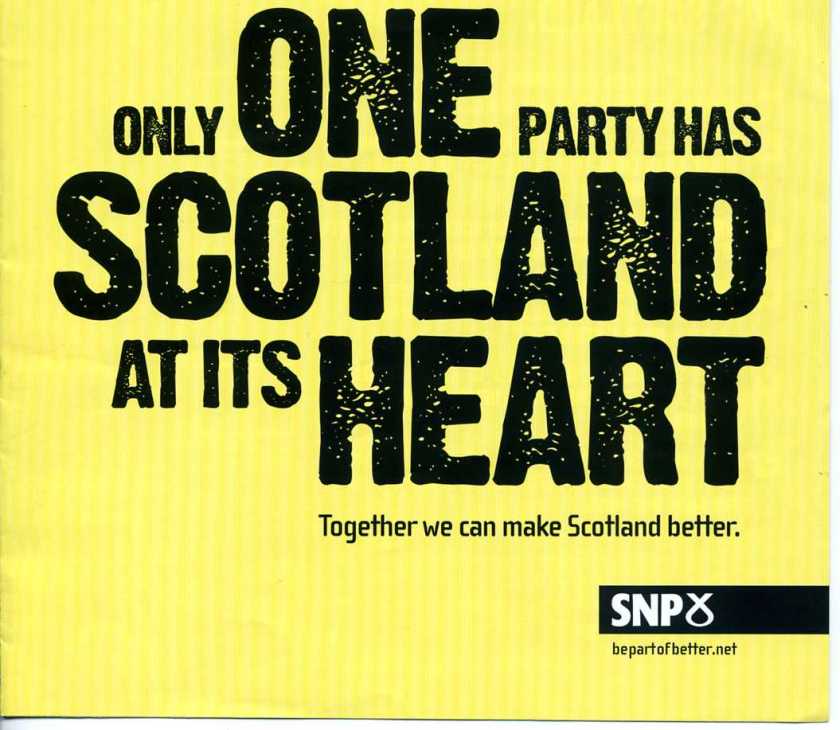
The SNP’s Achievements

“I support the government, but there are policies I don’t like” is an often heard caveat. No government attracts uncritical support, especially one elected to govern a nation of hyper-judgmental, compulsive nit-pickers. We are quicker to criticise than praise. But the SNP have a lot of implemented policies to chose from, if you don’t like the ones they espouse.

As we approach an election in which the SNP’s opponents are doing their devious best to convince us a vote for the SNP is wasted, and both votes for the SNP is a crass misuse of democracy, I thought it only fair to reproduce their achievements since they took office.

Scotiaphobes will dismiss the lot. But there’s one thing they can’t deny:  the SNP altered Scottish political life and discourse in a profound way – for the first time in 300 years we are empowered as individuals. Our voice matters. We’re heard, and not treated as a herd.

Lists are tedious; so they’re lumped into categories: you can pick an’ mix.


In The Beginning

  • Record health funding – over £13 billion in 2017, £3.6 billion more than when we took office.
  • Free, high quality childcare has been increased to 16 hours a week for all 3 and 4 year old’s – up from 12.5 hours in 2007 – and extended to 2 year olds from low income households, saving families up to £2,500 per child per year in total.
  • More people in employment in Scotland than the pre-recession high point, outperforming the UK on female employment and inactivity rates.
  • Higher exam passes up by a third since 2007, and we’re investing record amounts in schools to close the attainment gap. £120 million will go direct to schools this year alone.
  • We exceeded our world-leading target to reduce emissions by 42 per cent by 2020 – six years early.
  • 1.3 million older and disabled people benefit from free public transport through the National Concessionary Bus Travel Scheme – now extended to help disabled veterans.
  • Target to build 30,000 affordable homes exceeded, with an investment of £1.7 billion.
  • Free tuition protected, saving students in Scotland up to £27,000 compared to the cost of studying in England.
  • To help protect jobs and businesses through the recession, we’ve slashed or abolished business rates for 100,000 premises – saving small businesses £1.2 billion to date.
  • 78,000 elderly benefit from access to a wide range of personal care without charge.
  • Recorded crime in Scotland has reached its lowest level in 42 years.
  • Prescription charges abolished. In England, patients are forced to pay £8.40 per item.
  • Road Equivalent Tariff rolled out to all ferry routes in the Clyde and Hebrides, cutting fares by around 40%.
  • 178,000 low income households helped to buy essentials such as nappies, food and cookers through our Scottish Welfare Fund since it was established in 2013.
  • By keeping Scottish Water in public hands customers pay less for a better service – charges for the average household bill are £39 lower than in England and Wales. 
  • We’ve kept Council Tax down. Bills are lower in Scotland than in England – by between £300 and £400.
  • We’re leading the way on fair pay. Scotland has the highest proportion of employees in the UK paid at least the Living Wage.
  • 16 and 17 year olds now have the right to vote in Scottish Parliament and local government elections.
  • Recorded crime in Scotland has reached its lowest level in 42 years.
  • Scotland, with one of the most progressive equal marriage laws in the world, has been rated the best country in Europe for LGBTI equality and human rights for the second year running.
  • We’re standing up for Scottish industry. We have secured a future for Scottish steel, the last remaining aluminium smelter at Lochaber, and Ferguson shipyard too.


A healthier Scotland 

  • The number of nurses, doctors and dentists working in Scotland’s NHS has increased. Staffing is at record high levels, up more than 11,500 in the last ten years.
  • Patient satisfaction continues to increase with 90 per cent of NHS Scotland patients rating their care and treatment as good or excellent.
  • Scotland’s A&E services are the best performing in the UK.
  • 95% of hospital day case and inpatients seen within 12 weeks last year.
  • Healthcare kept local. A&E units saved, children’s cancer services and neurosurgery units protected, and maternity units kept open.
  • Over £5 billion has been invested in Scotland’s health infrastructure since 2007, including the South Glasgow Hospitals and Emergency Care Centre in Aberdeen.
  • We’ve kept healthcare local. That means A&E units have been saved, children’s cancer services and neurosurgery units protected, and maternity units kept open.
  • We’re supporting the lowest paid workers in our NHS by delivering the real Living Wage. Entry level pay for NHS support staff, Band 1, in Scotland is £881 higher than England, and over £1,300 higher than Northern Ireland.
  • Nurses in Scotland are better paid than anywhere else in the UK. A nurse in Scotland, at Band 5, is paid between £225 and £309 more than their English counterparts.
  • Our hospitals are cleaner and safer. In over 65s cases of C.Diff are down 86 per cent, and cases of M.R.S.A. are down 93 per cent.
  • Almost £40 million has been invested to raise public awareness of cancer, and catch it sooner, driving earlier diagnosis in a range of cancers.
  • The risk from cervical cancer for the next generation of young women has been cut by providing the HPV vaccine for girls in second year of secondary school.
  • Scrapped parking charges at NHS-run hospital. Patients and staff save £27 million.
  • Highest number of G.P.s per head of the population in the UK; more practices are now open in the evenings and at weekends.
  • Scotland was the first country in the UK to have a mental health waiting times target, and spending on mental health services in Scotland will exceed £1 billion for the first time in 2017-18.
  • A record nine in ten people are now registered with an NHS dentist – up from just 52 per cent when we took office
  • 98% of primary and secondary schools providing two hours of physical education a week – up from 10 per cent in 2005.
  • More funding than ever before is being provided to support carers and young carers, with investment of over £122 million in a range of programmes since 2007.
  • Irresponsible alcohol discounts in supermarkets and off-licences banned.
  • Legal age for buying tobacco raised to 18.
  • Everyone who uses social care services can now control their individual care budget through the Self-directed Support Act.
  • Extra funding for Scotland’s veteran charities, ex-service men and women receive priority treatment in the NHS and other services.
  • We have brought forward plans for a £5 million expansion of the Golden Jubilee Hospital – the first part of our plan to invest £200 million in a network of elective and diagnostic treatment centres to help meet the needs of an ageing population.
  • We’re recruiting more G.P.s by increasing the number of training places from 300 to 400 each year.
  • We’re training more paramedics, with a commitment to train 1,000 more by the end of this Scottish Parliament term.
  • IVF is being expanded to more families – making access in Scotland the fairest and most generous in the UK.
  • We’ve banned smoking in any vehicle carrying anyone under 18.


A smarter Scotland 

  • All children in primaries 1 to 3 – around 135,000 pupils – benefiting from free school meals, saving families around £380 per child per year.
  • We have launched the Scottish Attainment Challenge, and investment in that programme will be £750 million over the life of this Parliament.
  • Total revenue spending on schools has risen by at least £220 million since 2006-07, and spending per pupil is higher in Scotland than England.
  • More school pupils are now in well-designed, accessible and inclusive learning environments. Between 2007 and 2015, 607 schools were built or refurbished – twice as many as the previous Labour/Lib Dem administrations.
  • Since the introduction of the Gaelic Schools Capital Fund in 2008, the number of young people in Gaelic Medium Education has increased nationally by 32 per cent.
  • The Disabled Students Allowance has been protected and bursaries for students have been maintained in Scotland, while the Tories have abolished both elsewhere in the UK.
  • We’ve expanded the Education Maintenance Allowance in Scotland – now scrapped south of the border – to support even more school pupils and college students from low income families.
  • Over 117,000 full-time equivalent Scottish Government-funded college places are now being provided – exceeding our 2011 manifesto commitment to maintain 116,000 places.
  • We have invested over £550 million in college estates between 2007 and 2015, £250 million more than the previous Labour/Lib Dem administrations.Full-time college students in Scotland can now benefit from the highest bursary of anywhere in the UK.
  • A record number of Scots have been supported into university, and young people from the most deprived areas are now more likely to study at university.
  • The poorest university students who are living at home are benefiting from a minimum income guarantee of £7,625 per year – the highest in the UK.
  • Since 2007, the number of female entrants in STEM subjects at Scottish universities has increased by 26 per cent in first degree courses and 47 per cent in postgraduate courses.
  • The percentage of pupils leaving school with at least one Higher level or equivalent qualification has increased by almost 45 per cent under the SNP.
  • The First Minister’s Reading Challenge, which aims to encourage children to read for pleasure, has been opened to all primary school pupils after the success of the initial scheme for primaries 4 to 7.
  • We’re supporting a further £300 million of investment to deliver new campuses at City of Glasgow, Inverness and Ayrshire Colleges. And Forth Valley and Fife Colleges will share £140 million for new campuses too.
  • We’re providing our further education students with record levels of support of £106 million – up 34 per cent under the SNP.
  • The number of full-time college students completing recognised higher education qualifications is at an all time high.
  • The number of graduates from Scottish universities going into work or further study is among the highest in the UK.
  • Graduates from Scottish universities are earning more than their counterparts in other UK nations.
  • Since 2007, the number of female entrants in STEM subjects at Scottish universities has increased by 26 per cent in first degree courses and 47 per cent in postgraduate courses.


A Wealthier Scotland

  • Youth unemployment has hit its lowest rate since records began, and is the second lowest in the EU.
  • Today Scotland has the highest pay anywhere in the UK outside of London and the South East.
  • Productivity growth in Scotland is four times as fast as the UK – as measured by output per hour worked. Since the SNP came to office, productivity has increased by 9.4 per cent, while stagnating for the UK as a whole.
  • Around 200,000 young people have had the opportunity to undertake a Modern Apprenticeship since 2007. And by 2020, a further 30,000 opportunities will be available every year.
  • Around 20,000 families supported to buy their own home through home ownership schemes – three quarters of them under the age of 35.
  • Councils have been enabled to build new homes for the first time in years – with 7,169 new council homes delivered.
  • 15,500 social houses for rent have been safeguarded by ending Right to Buy.
  • We’re taking action to stimulate Scotland’s economy following the result of the EU referendum. This includes bringing forward £100 million of government spending on infrastructure, and a £500 million Scottish Growth Scheme to support businesses – particularly start-up companies – with the potential to grow and export more.
  • £500 million invested to stimulate economic growth in Glasgow and the Clyde Valley.
  • £125 million has been allocated through the Aberdeen City Region Deal to stimulate and support economic growth in the city, alongside an additional £254 million for infrastructure projects in the North-east.
  • £60 million put towards a Town Centre Regeneration Fund.
  • By the end of 2021 we will have committed £1 billion to tackling fuel poverty, and over one million energy efficiency measures have already been installed in almost one million households across Scotland.
  • Tax burden reduced on the sale of homes, with 93% of house buyers paying less than under UK stamp duty land tax or paying no tax at all.
  • The number of registered businesses in Scotland has reached 173,995, the highest number on record.
  • Scotland’s international exports – valued at £28.7 billion in 2015 – are up 41 per cent under the SNP.
  • Scotland’s tourism industry is going from strength to strength – with 14 million tourists visiting Scotland in 2015.
  • Enterprise and development spending per head in Scotland is almost double that of the UK.
  • Scotland is the top destination, outside of London, for foreign direct investment.
  • Scotland has the highest house-building rate in the UK. Since 2007, we have built 41,000 more homes than if we’d matched the lower rate in England – that’s the equivalent of a new town the size of Paisley.
  • We are investing £135 million in the Inverness and Highland City Region Deal – two and a half times the UK Government investment.
  • We’ve helped people into home-ownership through the Land and Buildings Transaction Tax, which has lifted 15,000 households out of tax compared to Stamp Duty in the rest of the UK.
  • Public sector procurement has been simplified, with more small and medium-sized enterprises now competing for and winning public sector contracts.
  • We won new powers over tax and social security, and protected Scotland’s budget from a £7 billion cut by the Treasury over the financial arrangements enabling new powers.


A fairer Scotland     

  • In 2011, we became the first government in the UK to pay the Living Wage to our staff.
  • Poverty levels down. 260,000 fewer people in poverty in 2014 than in 2000.
  • We have already ensured that nobody in Scotland has to pay the Bedroom Tax. And we will use new powers to effectively abolish it once and for all, protecting over 70,000 households
  • Over half a million vulnerable households in Scotland – including around 190,000 pensioners and over 80,000 single parents – have been protected from UK Government cuts to Council Tax benefit.
  • We have already safeguarded the rights of 2,800 of the most severely disabled by establishing the Scottish Independent Living Fund.
  • Over 200 companies signed the Scottish Business Pledge to boost productivity and increase diversity.
  • Number of days lost to industrial disputes down 84%, the lowest of any UK country.
  • Encouraging public, third, private sector companies to boardroom gender equality.
  • Nicola Sturgeon appointed first cabinet with an equal number of women and men.
  • Scotland is leading light on LGBTI equality, with progressive equal marriage laws.
  • Over £75 million has been spent since 2007 to help some of the world’s poorest and most vulnerable people.
  • From summer 2017, all babies in Scotland are to be provided with a Nordic-style ‘baby box’ in a bid to reduce infant mortality and help families at the start of a child’s life.
  • Over 230,000 low income households in crisis have been helped to buy essentials such as nappies, food and cookers through our Scottish Welfare Fund since it was established in 2013.
  • 1.3 million older and disabled people have benefited from free public transport through the National Concessionary Bus Travel Scheme.
  • Around 77,000 older people in Scotland benefit from access to a wide range of personal care tasks without being charged.
  • We have introduced a Child Poverty Bill which will set targets to end child poverty by 2030, and established a new £29 million fund to tackle poverty at a grass roots level.
  • We’ve kept Scottish Water in public hands. Customers are now paying less for a better service – charges for the average household bill in Scotland are £38 lower than in England and Wales.
  • Our new employment support programmes will be on a voluntary basis and will not interact with the UK government’s punitive benefit sanctions system.
  • Over 300 companies have signed the Scottish Business Pledge – a voluntary code for companies to commit to policies that boost productivity, recognise fairness and increase diversity.
  • We are piloting a Returners programme to help women who have had career breaks back into the workplace.
  • We are leading a 50:50 campaign to encourage public, third and private sector companies to commit to boardroom gender equality by 2020.
  • We now have Scotland’s first cabinet with an equal number of women and men.
  • We have launched a £300,000 Sports Equality Fund with the aim of increasing women’s engagement in sport.


future-324x235


A safer Scotland 

  • Since we took office, violent crime is down by 52 per cent, homicides are down by 52 per cent and handling offensive weapons is down by 69 per cent.
  • £216 million invested in the creation of the new national police service.
  • The new Scottish Crime Campus provides a focal point for excellence in intelligence-sharing, evidence gathering and forensic science to tackle serious organised crime.
  • Since 2007, 1,000 more police officers keeping our communities safe. By contrast, police numbers south of the border have fallen to their lowest level in 15 years.
  • Automatic early release has been ended, meaning that long-term prisoners who pose an unacceptable risk to public safety will serve their sentence in full.
  • The reconviction rate has been reduced to its lowest level in 17 years, thanks to tough community sentences.
  • £75 million has been seized from criminals and has been reinvested in community projects for young people across Scotland.
  • HMP Grampian opened in March 2014 and HMP Low Moss opened in March 2012, two major parts of the prison building programme.
  • Access to air weapons has been tightened to improve public safety.
  • A record £33 million invested to tackle domestic violence against women and girls.
  • Access to justice for survivors of domestic abuse improved too.
  • Tackling sectarianism backed up with record investment.
  • The new Scottish Fire and Rescue Service has been created.
  • Scotland has the UK’s first national action plan on human rights, showing our ambition to be an example of how to realise human rights and tackle injustice at home and abroad.


Investing for the future

We’re investing £1 billion annually in public and sustainable transport to encourage people out of cars.

We are delivering the £1.35 billion Queensferry Crossing

Commuters have saved around £2,000 since bridge tolls on the Forth Road Bridge and Tay Bridge were scrapped by the SNP.

  • The Borders Railway, the longest new domestic railway to be built in Britain in over 100 years, has reopened and welcomed over 1 million passengers in its first year.
  • £742 million Edinburgh-Glasgow rail improvements; widespread electrification of the network between the two cities, and to Stirling and Dunblane.
  • £3 billion to dual 80 miles of carriageway on the A9 Perth-Inverness, £745 million for the Aberdeen Western Peripheral Route, plus M8, M73 and M74 motorway improvements.
  • £170 million Aberdeen Inverness rail upgrade; new stations at Dalcross and Kintore.
  • Contracts worth £97 million will protect the 150-strong workforce and create 100 new jobs at the last commercial shipyard on the Clyde.
  • Prestwick Airport saved from closure, safeguarding around 1,350 jobs.
  • £500 million a year to deliver higher water quality, better environmental protection, and better service for customers. Scottish Water now UK’s most trusted utility.
  • £400 million to deliver superfast broadband to 95 per cent of properties across Scotland by the end of 2017.
  • We have invested twice as much per head in the rail network in Scotland than the UK Government –  £7 billion in rail since 2007.
  • A £5 billion investment programme in Scotland’s railways up to 2019 will deliver longer, greener trains, new stations, new track upgrades, more seats, and more services.
  • We’ve exceeded the 2016 target to provide broadband access to 85 per cent of premises, and we’ll reach 100 per cent by 2021.


Empowering communities

  • Scotland’s independence referendum was the biggest democratic exercise in Scotland’s history.
  • The voting age for Scottish Parliament and local government elections permanently lowered to 16, starting from May 2016.
  • Local communities have been given a voice in the planning and delivery of local services – backed up by £20 million of funding – through the Community Empowerment Act.
  • The Scottish Land Fund has already helped 52 communities across the country to purchase land, with over 500,000 acres now in community ownership. And the Fund has been increased to £10 million per year.
  • The radical and ambitious Land Reform Act has been passed to transform rules around the ownership, accessibility and benefits of land in Scotland.
  • We’ve launched a £200,000 Access to Politics Fund to help disabled people stand for the 2017 local government elections. And we will continue the fund for the Scottish Parliament elections in 2021.


A greener Scotland 

  • Scotland has exceeded its target to produce 50 per cent of its electricity from renewables by 2015 – with almost 60 per cent of Scotland’s electricity needs met from renewable sources.
  • Our target to reduce energy consumption by 12% by 2020 exceeded, a 13.3% reduction between 2006 and 2013.
  • Scotland is outperforming the UK and all but one of the EU-15 countries in reducing greenhouse gas emissions.
  • We have blocked underground coal gasification and a moratorium means fracking cannot take place in Scotland.Scotland’s household recycling rate was 44.2 per cent in 2015 – up from around 32 per cent for municipal waste in 2007.
  • We’ve helped make our communities safer from flooding with investment in flood defences and new measures in the Flooding Act. And we’ve agreed a new 10 year funding strategy for flood protection, consisting of £42 million a year, aiming to protect 10,000 families across Scotland.
  • Scotland was one of the first countries in the world to sign up to the UN Sustainable Development Goals; established the world’s first Climate Justice Fund.
  • Scotland became the world’s second Fair Trade Nation in 2013.
  • With the support of the SNP Scottish Government, low carbon industries in Scotland and their supply chains generated almost £11 billion for the economy in 2014.
  • Carrier bag use has been reduced by 80 per cent – the equivalent of 650 million bags – in the first year of the carrier bag charge.


Supporting rural communities

  • A record £1 billion has been invested in vessels, ports and ferry services since 2007 as part of our commitment to our islands and remote communities, with six ferries added to CalMac’s fleet and two new ferries due for delivery in 2018.
  • Residents of Caithness and north-west Sutherland, Colonsay, Islay, Jura, Orkney, Shetland and the Western Isles are eligible for a 50% discount on air fares.
  • Created a key role in reforming EU fisheries policy to bring an end to the wasteful discarding of fish at sea.
  • With food and drink exports valued over £4.5 billion and 14,000 new jobs estimated to be created in the sector by 2020, we strive to promote Scotland’s top quality produce.
  • Fares on lifeline ferry services have been frozen for 2017 for passengers, cars and commercial vehicles.
  • The clean, green status of our valuable food and drink sector has been protected by opting out of the cultivation of genetically modified crops in Scotland.
  • Scotland’s first National Marine Plan to achieve sustainable development of our seas
  • Road Equivalent Tariff has been rolled out to all ferry routes in the Clyde and Hebrides network, delivering significantly reduced ferry fares and the highest passenger numbers since 1997.
  • With produce output worth around £2.3 billion a year and around 65,000 people directly employed, we work tirelessly to get the best deal for Scotland’s farmers, crofters and growers.
  • We played a key role in reforming EU fisheries policy to bring an end to the wasteful discarding of fish at sea.


Enabling creativity and sport 

  • Free access maintained to museums and galleries, with 27 million visits to Scotland’s world class national collections since 2007.
  • Government provided support for Scotland to welcome the world in 2014, with the staging of the Ryder Cup at Gleneagles and the Commonwealth Games in Glasgow.
  • £162 million pumped into Scotland’s screen sector since 2007.
  • Over £130 million has been invested in our cultural infrastructure – including the revamped National Museum of Scotland, National Portrait Gallery, and homes for our performing companies including National Theatre of Scotland and The Royal Scottish National Orchestra.
  • More than million £19 million indirect investment in Edinburgh’s major festivals since 2008.
  • £25 million for the Victoria and Albert Museum of Design in Dundee.
  • The new Bannockburn visitor centre which opened in February 2014, and the creation of the Robert Burns Birthplace Museum in Ayrshire which opened in December 2010.
  • 1.5 million opportunities created for young people to take part in youth arts in 2015.
  • Since the SNP government backed the ‘Daily Mile’ challenge 180,000 children in over 1,000 of Scotland’s primary schools now walk or run a mile each day.
  • 98 per cent of primary and secondary schools across Scotland are now providing two hours of physical education a week – up from 10 per cent in 2005.

But there’s still much more we want to do. Together, we will continue to shape a fairer, more successful Scotland.


And finally

  • Scotland’s budget protected from a £7 billion cut by the UK Treasury over the financial arrangements enabling new powers for our Parliament.

Remember this, like P.F.I. contracted schools, no matter how good or bad you think life is in Scotland under whatsoever political party, we do not own our own country for which we pay direct and indirect taxes to  the UK Treasury, and soon some taxes to our own Parliament. Ownership comes only when independence is restored.

https://grousebeater.wordpress.com/2016/04/19/the-snps-achievements/


The Most Expensive MSP in Holyrood – John Lamont Re-Elected in Ettrick, Roxburgh & Berwickshire – How the Hell did he Do It?


John Lamont Re-Elected – How in hell did he manage it?

Given he was the highest expense claimant in Holyrood I was surprised that John Lamont managed to get himself re-elected as a Tory Party MSP  in May of this year. But his tactics revealed him to be an effective campaigner who keeps his eye firmly on the mission to hand. He cares nothing for the Tory Party in Scotland using it as a vehicle to hitch a ride on until something more substantial ( a seat at Westminster).

  • In his campaign literature he took great care to ensure he would not be associated with the Tory Party by omitting any mention of it.
  • He actively promoted himself as being the only person capable of preventing the SNP from winning. Garnering, Lib/Dem and labour supporters to his cause.
  • Emphasised his commitment to his constituents regardless of Tory Party policy.


John Lamont, the Tory hopeful in Ettrick, Roxburgh & Berwickshire constituency claimed more in members’ expenses than Nicola Sturgeon, Ruth Davidson and Kezia Dugdale put together during the first nine months of the 2015/16 financial year.

A trawl through the Scottish Parliament’s financial records shows most of the Conservatives elected in 2011 – many of them as list rather than constituency MSPs – are among the highest claimers of expenses across the political spectrum.

Whether they represent value for money is entirely a separate issue for debate.

The statistics covering the period April 1st to December 31st 2015 show Mr. Lamont handed in 369 separate claims (that’s more than one per day) totalling £23,234.11. These included £10,427 for office costs and £5,900 for travel expenses.

A random sample of 33 members who served mainland seats and are representative of all political parties at Holyrood failed to produce a higher figure than Mr. Lamont’s. And it was usually his Tory colleagues who featured near the top of the expenses league.

Two other members of the Conservative group, Alex Fergusson (Galloway & West Dumfries) and John Scott (Ayr) claimed £19,519 and £18,485 respectively.

Turning to the list MPs, the Tories again appear to have raked in more than most with Murdo Fraser (Mid Scotland & Fife) on £18,756; Jackson Carlaw (West Scotland) at £14,386; Alex Johnstone (North-east Scotland) £17,143 and Mary Scanlan (Highlands & Islands) £16,608.


Mr. Lamont’s latest claims appear to be the continuation of a trend. In the past political opponents have dubbed him ‘the most expensive’ MSP in the Parliament following annual sums claimed of £30,385 in 2012/13, £33,676 in 2013/14 and £27,631 in 2014/15.

His out-of-pocket expenditure for 2015/16 (so far) leaves Sturgeon, Davidson and Dugdale trailing in his wake. The leaders’ respective claims under the heading Member’s expenses are a modest £9,712 for the former First Minister, £8,559 for Ms. Davidson and a totally paltry £2,064 for the Labour leader in Scotland. The combined spending of the three ladies comes to £20,355, well short of Mr. Lamont’s achievements.

If that comparison appears unfair, how does his spending stack up against that of other Borders politicians from other parties?


Paul Wheelhouse, Mr. Lamont’s SNP opponent at the May elections was a list member for the South of Scotland last time round. Like his Tory adversary, Mr.Wheelhouse has an office in Hawick.

The figures show Paul Wheelhouse submitted 107 claims totalling £8,674 between April and December last year. Office costs came to £3,878 and travel swallowed up just £210, a fraction of Mr. Lamont’s hefty £5,900. Yet the two men live a few miles apart in Coldstream (Lamont) and Ayton (Wheelhouse).

Meanwhile in neighbouring Midlothian South, Tweeddale & Lauderdale SNP MSP Christine Grahame, who is seeking re-election, submitted 122 itemised claims worth £12,196. Her office costs were £8,112 with travel claims amounting to £1,386.

The conclusion is that having Mr. Lamont as an MSP has cost more in expenses than Ms. Grahame and Mr. Wheelhouse combined. It will be up to the voters to decide which ‘models’ have produced value for money in the past and which ones might cost more to run in the future.

http://notjustsheepandrugby.blogspot.co.uk/2016/04/no-expense-spared-by-borders-tory-msp.html


Ettrick, Roxburgh and Berwickshire

John Lamont of the Scottish Conservative and Unionist Party was elected as MSP for Ettrick, Roxburgh and Berwickshire.

 Surname Forename
Party
 Number of Votes
Cunning Barry Scottish Labour Party 1,766
Hume Jim Scottish Liberal Democrats 2,551
Lamont John Scottish Conservative and Unionist 18,257
Wheelhouse Paul Scottish National Party (SNP) 10,521

Total Electorate 54,517
Total Votes Cast
33,183
Turnout
 61%
Majority 7,736


No mention of the Tory party


One month to go before the Scottish Parliament elections. Over these final few weeks I will be speaking to as many voters as possible to hear your concerns and set out my priorities for the Borders:

I will stand up for the majority of the Borders who support Scotland’s place in the UK and hold the SNP to their promise that the referendum was ‘once in a generation’.

I will always put local people first. My priority is the Scottish Borders, ahead of party politics.

I will stand up for local services and local jobs. The Borders is being let down by a central belt focused SNP Government who do not understand the importance of a local NHS, local policing and other public services.


No mention of the Tory party


Great to speak to so many former Lib-Dem and Labour supporters who are voting for me on Thursday. In Ettrick, Roxburgh & Berwickshire the choice is between me and an SNP candidate whose number one priority will be to push for a second referendum.


Emphasising his close vote at the 2015 GE. Persuading swing voters to his cause.


I will always put the Borders ahead of party politics.  Unlike SNP politicians, I’m not bound by any internal rules banning me for criticising my party.  My number one priority is standing up for the interests of local communities in the Scottish Borders.


Highlights his independence from Party policy


A constituent commented: But the Conservative split over Europe is unedifying. The Conservatives are deeply divided into Euro unionists and Euro separatists. More party discipline is required, how could anyone vote Conservative when the party position on Europe is so unclear.


David Mundell centre stage, (pulling the strings)


Homeland Security UK Style -Counter Terrorism Strategy Information is Widely Available – Get Reading


The new powers


Counter-Extremism Strategy – Extract from the Foreword by David Cameron

Over generations, we in Britain have built something extraordinary: a successful multi-racial, multi-faith democracy. Our country today is more vibrant, buoyant and diverse than ever before in our history. There is still more to be done to defeat racism, promote genuine equality of opportunity and build a more cohesive society. But I believe it is right to say that Britain is on the rise, strong and growing stronger with each new day.

One of the greatest threats we face is the scourge of extremism from those who want to divide us. We see it in sickening displays of neo-Nazism, Islamophobia, anti-Semitism and, of course, Islamist extremism.

We will disrupt extremists, aggressively pursuing the key radicalisers who do so much damage. And we will seek to build more cohesive communities, tackling the segregation and feelings of alienation that can help provide fertile ground for extremist messages to take root.

Defeating extremism in all its forms is not something the state can do alone. We need the help of everyone, including our faith communities. We must be absolutely clear that when it comes to countering Islamist extremism, our strategy is not about criticising or attacking the religion of Islam or its followers. Our aim is to work in partnership to isolate the extremists from everyone else – and to stop them from driving a wedge between British Muslims and the rest of our society.

If we implement this strategy, if we build that partnership, I am confident that together we can defeat the extremists and build a more cohesive country for our children, our grandchildren and for every generation to come.

https://www.gov.uk/government/uploads/system/uploads/attachment_data/file/470088/51859_Cm9148_Accessible.pdf

https://www.gov.uk/government/uploads/system/uploads/attachment_data/file/445978/3799_Revised_Prevent_Duty_Guidance__Scotland_V2.pdf


Government policy: counter-terrorism – CONTEST

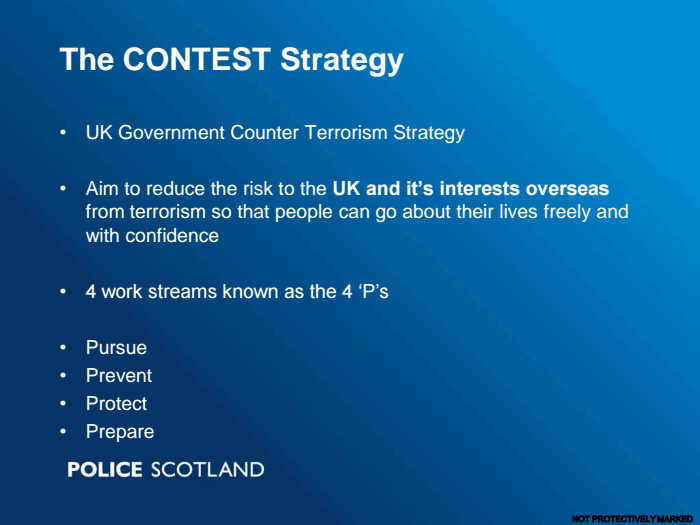
The aim of CONTEST is to reduce the risk to the UK and its interests overseas from terrorism, so that people can go about their lives freely and with confidence. The scope of the CONTEST strategy covers all forms of terrorism. Counter-terrorism strategy will be organised around 4 work streams, each comprising a number of key objectives:

* pursue: to stop terrorist attacks

* prevent: to stop people becoming terrorists or supporting terrorism

* protect: to strengthen our protection against a terrorist attack

* prepare: to mitigate the impact of a terrorist attack

https://www.gov.uk/government/policies/counter-terrorism


Education Scotland – Preventing terrorism

Prevent duty guidance is about keeping people and communities safe from the threat of terrorism. It aims to stop people becoming terrorists or supporting terrorism and provides guidance for local authorities on their duties within the Counter Terrorism and Security Act 2015. It is one of four elements of CONTEST, the UK Government’s counter-terrorism strategy.

What happens in Scotland?

The delivery of Prevent duties in Scotland seeks to tackle all forms of violent extremism and terrorism. It has a primary focus on international terrorism influenced by Al Qa’ida/ISIL and also terrorism linked to the troubles in Northern Ireland. It also has a focus on domestic extremism, in particular on extreme right-wing groups.

How does Prevent stop people from being drawn into terrorism?

It provides practical help to prevent people from being drawn into terrorism and ensures that partner agencies work together to give individuals the correct support.The collective focus is always on the early identification of risk to individuals and guiding them towards a more positive destination. The support provided could include signposting individuals to community projects, sports or arts programmes. It may also involve or providing access to educational, employment and housing services.

http://www.educationscotland.gov.uk/readyforemergencies/terrorism/prevent/whatis.asp


Government’s Counter Extremism Strategy poses a serious threat to religious freedoms as call for evidence opens

Government plans to defend British values and “systematically confront and challenge extremist ideology” would undermine the very democracy that they seek to protect. The Evangelical Alliance is calling for members to submit evidence on the Counter Extremism Strategy now. Many out-of-school education settings, including, churches, youth leaders, Sunday school teachers, home schoolers, volunteers and anyone else who comes into contact with children could be inspected by Ofsted as a result of proposed anti-extremism legislation. More here:

* http://www.eauk.org/current-affairs/media/press-releases/governments-counter-extremism-strategy-poses-a-serious-threat-to-religious-freedoms-as-call-for-evidence-opens.cfm?


Muslim Council of Scotland Looks at Counter-Extremism Policy

The Muslim Council of Scotland held a seminar on countering extremism on Wednesday 2 March. The seminar, attended by about 30 invited participants, took place in Glasgow City Chambers.

Michael Matheson MSP, the Scottish Government’s Cabinet Secretary for Justice, spoke about the duties created under the statutory Prevent strategy, saying the “duty is to keep people safe.” The Prevent Duty Guidance for Scotland was issued jointly by the UK and Scottish Governments under the UK’s Counter Terrorism and Security Act 2015.

Asked why there had been no Scottish involvement in the Westminster debate on the Prevent Duty Guidance for Scotland (no Scottish MPs had been invited to participate in the debate), he said he could not comment on Westminster matters.

He was asked at the same time why, in view of the Scottish Government’s acknowledgement that Prevent involves devolved as well as reserved functions, there had been no debate at Holyrood and, in particular, why the statutory Prevent guidance had not triggered a Legislative Consent Motion (Sewel Motion) in the the Scottish Parliament. He said that a Legislative Consent Motion was not possible because terrorism policy is reserved to Westminster.

Scotland Against Criminalising Communities (SACC) Chair Richard Haley addressed the seminar. This is the text of the speech, corrected from memory. It may differ slightly from the speech delivered:

* “Barking up the wrong tree – the Prevent strategy and the Muslim Community”

Other speakers on the panel were Mazhar Khan (representing MCS), Haq Ghani (speaking about the role of mosques), Sajid Quayum (representing the Islamic Society of Britain), Khadija Elshayyal (representing Al Waleed) and AbdulAhad Hussein (representing FOSIS).

http://www.sacc.org.uk/articles/2016/barking-wrong-tree-prevent-strategy-and-muslim-community


Unionist response to threat


Terrorists are the only people who won’t be affected by Cameron’s surveillance plans

As with all intrusions into British people’s privacy, the surveillance powers being proposed by Theresa May today are justified on the grounds of defeating terrorism. Occasionally paedophilia makes an appearance as well, but generally it’s a terror argument.

So it’s worth considering for a moment how profoundly ineffective these measures are when dealing with terrorism. If media reports are accurate the government has dropped plans to ban encryption technology. There’s good reason for that. Doing so would mean that either companies like Amazon and Apple, which use encryption, would have to drop it because David Cameron said so. Or, more likely, they would stop operating in the UK.

It was, of course, tosh. Cameron blurted out some authoritarian rubbish about how important it was that the state could see people’s communications and only bothered to check whether it was possible afterwards. It wasn’t.

surveillance warrants

Having a home secretary sign off on these warrants is completely archaic. They don’t do it in Europe. They don’t do it in the ‘five eyes’ countries like the US, Canada and Australia who we share information with. And for good reason. May signed off on 2,345 intercept warrants in 2014 alone. Either they were not properly scrutinised, or she was failing to give her other responsibilities appropriate attention. The current system just doesn’t make sense and justifying it by constantly referring to judges as ‘unelected’, as ministers have done, will not make any more sense.

Even on this minor issue, the Home Office wasn’t prepared to compromise in order to convince foreign firms to cooperate. On the actual ways in which people can operate secretly online, they have done nothing. Instead, they are casting their net far and wide in the areas where the majority of non-terrorists operate: the mainstream internet and normal internet usage.

Communications companies will apparently be required to store records of customers’ phone and internet use for a year, according to the briefings given to the press. Police will be able to access people’s internet connection records, a power currently banned in the US and all of Europe.

GCHQ’s existing powers will be enshrined in law, including those allowing it to sweep up the contents of a laptop or smartphone, to track your location, listen in on your calls, or take photos of the people around a device.

Authorities’ power to see which websites you’ve been visiting will also be present. Anderson was very sceptical about this, insisting that a “detailed operational case” needed to be made with a “rigorous assessment” of its lawfulness. That hasn’t happened, but the proposal seems to have made its way into the bill anyway.

These measures will affect the public but not the terrorists. Any terrorist capable of carrying out a terror attack knows how to use Tor, or encryption software, or a library computer, or an internet cafe. They are not organising terror attacks on Facebook Messenger. These moves are not aimed at terrorists. They are aimed at us. This is a programme for the mass surveillance of the British public. Terrorism is just an excuse.

http://www.politics.co.uk/blogs/2015/11/04/terrorists-are-the-only-people-who-won-t-be-affected-by-may


The Home Office's measures will affect the public but not the terrorists


Transatlantic Trade and Investment Partnership (TTIP) – Cameron and His Much Loved EU in a Headlong Rush to Destruction


ttip: yes we can stop TTIP, slogan Stock Photo


Multilateral Agreement on Investment (MAI). (The first attempt at TTIP)

In 1995, (MAI) appeared as a draft agreement, negotiated by OECD members.

The mission statement: “To develop multilateral rules ensuring that international investment would be governed in a more systematic and uniform way between states.”

Developed in secret the draft was leaked in 1997 and attracted significant criticism. The primary fear centred on a lack of control measures available to member governments leaving them vulnerable to the whims of foreign investors.

A particular concern was that the MAI would result in a ‘race to the bottom’ among countries willing to lower their labour and environmental standards to attract foreign investment.

The pressure to abandon the agreement became so strong that in 1998 the French government abandoned the draft document


TTIP: The EU-US trade deal explained (The current draft under discussion)

The bi-lateral trade agreement, (TTIP) is about cutting tariffs and reducing barriers to trade for big business.

It embraces just about every aspect of society including: pharmaceuticals, cars, energy, finance, chemicals, clothing, food and drink, education, health and safety, food safety law, environmental legislation, infrastructure, banking regulations and sovereign powers.

It does not best fit with a country that operates a mixed economy since there is no place for state owned (NHS) or any centrally controlled planning.

(TTIP) negotiations, (with implications for the UK) began in February 2015 (mostly in secret) between the EU and US. The undemocratic secrecy measures remain in place, probably until just before a treaty signing date.

Any information in the public domain on negotiations has been obtained from leaked documents and Freedom of Information (FOI) requests.

The inappropriate conduct of negotiators adds strength to the arguments of critics that TTIP is an instrument to be used to supplant social democracies with corporatocracy.


EU dropped plans for safer pesticides because of  TTIP and pressure from the USA

EU plans to regulate hormone-damaging chemicals found in pesticides have been dropped because of threats from the USA that this would adversely affect negotiations for TTIP. Draft EU regulations would have banned 31 pesticides containing disrupting chemicals (EDC’s) hat have been linked to testicular cancer and male infertility.

http://arstechnica.co.uk/tech-policy/2015/05/eu-dropped-plans-for-safer-pesticides-because-of-ttip-and-pressure-from-us/


ttip: White road warning triangle with black exclamation point and red frame on a wooden mast in front of a blue sky. A second rectangular sign warns in english about TTIP


What do supporters say it will achieve?

The British government claims TTIP could add £10bn to the UK economy, £80bn to the US and £100bn to the EU every year.

It says shoppers would benefit by the removal of EU import tariffs on popular goods, such as jeans and cars.

It’s also claimed that reducing regulation would help UK businesses export to the US, with small businesses in particular predicted to benefit.

And supporters say restrictive markets would be opened up; for example, currently British lamb and venison cannot be exported to the US.

David Cameron has promised to put “rocket boosters” behind talks to secure the deal, saying TTIP is central to his vision of a reformed competitive Europe.

TTIP is also supported by the Liberal Democrats. Labour, UKIP and the SNP broadly support it with caveats over the NHS.

Plaid Cymru is more sceptical and the Green Party is strongly opposed.


ttip: concept signage on the road with feet and yellow line - stop ttip !


How did it come about?

Leaders at the EU-US summit of November 2011 set up a working group to find ways to increase growth and competitiveness, given shared concerns over economic stagnation and frustration at the lack of progress in the Doha round of multilateral trade negotiations.

The working group reported in February 2013, recommending a “comprehensive” bilateral trade agreement, which became the TTIP.


ttip: Words TTIP stop on a paper and marker.


How is it being negotiated?

The EU’s trade commissioner takes the lead in trade talks. The commission consults the UK and other EU governments during the negotiations through the Trade Policy Committee, made up of senior officials from each member state. Negotiators have been meeting alternately in Brussels and Washington.


ttip: Word TTIP on a paper with dollars and euros. Stock Photo


What is the main focus of negotiations?

Tariffs between the EU and US are already low – averaging around 3% – and both sides foresee they will be eliminated under the agreement. The main focus of negotiations is on harmonising regulations, reducing “non-tariff barriers” to trade, or getting rid of them if they’re deemed unnecessary.

For instance, US and EU regulators have different requirements for testing the safety of cars, drugs and soft furnishings. Going through the different tests is expensive for firms, particularly in developing new medicines.

TTIP aims to reduce those costs by bringing in common standards. Other areas being contemplated include protection for foreign investors, co-operation to achieve greater participation by small businesses in EU-US trade and a controversial procedure to resolve investment disputes between the US and EU.


How EU nations are being sued for billions by foreign companies in secret tribunals

Much of the opposition to TTIP in the UK and other EU countries including Germany, is focused on its provisions for “investor-state dispute settlement”.

This procedure would allow companies to sue foreign governments over claims of unfair treatment and to be entitled to compensation.

Critics say the measures undermine the power of national governments to act in the interests of their citizens.

For example, they warn that tobacco giants could use the procedure to challenge restrictive regulations, citing a case in Australia, where Philip Morris Asia used a 1993 trade agreement with Hong Kong as the basis for a legal move to stop a change to packaging.

In the UK, attention has focused on the potential impact on the NHS, with critics saying TTIP would allow private firms running NHS services to sue the government if it chose to return the services to the public sector.

Opponents have called for the NHS to be exempted from TTIP, arguing that other sectors have already secured exemptions, such as the French film industry.

http://arstechnica.co.uk/tech-policy/2015/12/how-eu-nations-are-being-sued-for-billions-by-foreign-companies-in-secret-tribunals/


Global trade deals will help facilitate an increase in meat and dairy exports, leading to rising consumption and associated climate emissions.

Critics also worry about the impact on food standards, arguing that the EU has much stricter regulations on GM crops, pesticide use and food additives than the US.

They say the TTIP deal could open the EU market to cheaper products with poorer standards.

They also warn that food giants could use investor-state dispute settlements to bully governments into dropping legislation to improve food standards.

http://www.theguardian.com/sustainable-business/2015/nov/30/paris-climate-change-talks-secretive-trade-agreements-ttp-ttip


Sheep and cow cheeses ripening in a cellar


German Frustration builds over TTIP secrecy from the USA

In 2012, after a widespread protest, the European Parliament rejected a multilateral agreement to harmonise and step up anti-counterfeiting law.

Protesters had claimed the agreement threatened privacy by encouraging surveillance of personal data.

Some critics have suggested proposals in TTIP on intellectual property could have a similar effect to the proposed anti-counterfeiting measures.

http://www.dw.com/en/german-frustration-builds-over-ttip-secrecy-from-us/a-18819097


Who is going to pay the bill for #regcoop in #TTIP? New blog post by @moniquegoyens http://t.co/jiiJebDcIk http://t.co/CjifAT8VYr


Financial services

After the 2008 financial crash, the EU and US embarked on different programmes of reform to the regulations governing banks and other financial institutions.

The TTIP deal would attempt to harmonise those regulations.

Critics say TTIP could weaken the rules governing banks by diluting the tougher reforms adopted in the US.

The European Commission says a common framework on banking regulation is needed for economic stability.


TTIP and the secretive collusion between business lobbyists and trade negotiators

The aggressive agenda of services corporations, with regards to TTIP  pushes for far-reaching market opening in areas such as health, cultural and postal services, and water, which would allow them to enter and dominate the markets.

Those in charge of EU trade negotiations are rolling out the red carpet for the services industry, with TTIP reflecting the wish-list of corporate lobbyists.

https://www.tni.org/en/publication/public-services-under-attack-0


Deutschland München Protest gegen TTIP


UK Business against TTIP

We UK-based businesses have come together to express our grave concerns about the secretly negotiated EU-US trade deal, the Transatlantic Trade and Investment Partnership (TTIP).

Together with thousands of our counterparts in other European countries, we are concerned that many European businesses risk being wiped out by unfair competition from US corporations if TTIP is allowed to go through.

TTIP will enable some of the world’s biggest corporations to undermine EU social and environmental standards. Under its investor protection rules, TTIP will also give US firms unprecedented powers to sue the UK government when any new laws affect their profits.

It is unfair to give US businesses a competitive advantage in their dealings with Europe. Equally, we do not want to reduce the social and environmental standards we hold dear.

The overwhelming majority of British businesses do not export at all to the USA. TTIP has been designed by and for the largest corporations that trade and invest across the Atlantic, not the majority.

Worse still, the European Commission’s official study predicts that the EU will suffer at least 680,000 job losses as a direct result of TTIP – putting our employees and our businesses at risk.

We call on the UK government and the European Commission to stop the TTIP negotiations, and to ensure instead that trade is regulated to the highest standards for people and the environment.

http://businessagainstttip.org/the-statement


TTIP Threatens ability to enforce fair taxes on corporations

“Despite the enormous public outcry over companies like Google and Amazon paying ridiculously small amounts of tax in the UK, the government is trying to sign us up to a trade deal that could effectively prevent us from bringing about laws that could address tax injustice. The ability to enact effective and fair tax systems to finance vital public services is one of the defining features of sovereignty. The fact that multinational companies would be able to challenge and undermine that under TTIP is testament to the terrifying extent of the corporate grab embedded in this toxic trade deal.” Nick Dearden, the director of Global Justice Now said:


“The evidence of the dangers of these investment deals continues to mount. Not only do they affect health and the environment and cost taxpayers millions in legal fees, this report shows they also affect the ability of governments to tax corporations effectively. This is yet more money lining the pockets of corporate executives stolen from the public taxpayer. New trade deals such as TTIP and CETA have to be stopped and the public interest defended.” Cecilia Olivet from the Transnational Institute

http://www.taxjustice.net/2016/02/14/14866/


https://i0.wp.com/www.taxjustice.net/wp-content/uploads/2016/02/TTIP-horse.jpg


What happens next?

In the EU, the deal has to be presented to the European Council and the European Parliament, both of which must agree the outcome.

The deal will then have to be separately ratified by the national parliaments of all 28 EU member states.

The three main Westminster parties in the UK broadly support TTIP, though Labour has called for the NHS to be exempted from the investor-state dispute settlement measures.

In the US, the agreement must be approved by Congress. The White House has indicated it intends to request a so-called ‘trade promotion authority’ under which Congress agrees to a simplified procedure for approving the deal.

Without that provision, TTIP could be wrecked by amendments written by special interests, with Democrats more hostile to free trade than their opponents.

http://www.bbc.co.uk/news/uk-politics-30493297


US President Barack Obama is currently in the UK pushing for progress on secret EU-US trade deal TTIP (the Transatlantic Trade and Investment Partnership).

TTIP is facing renewed opposition across Europe and in the USA: in addition to more than 3.4 million people having signed a petition calling for an immediate end to negotiations on the deal, the French government has threatened to terminate talks, while public support for TTIP has plummeted in Germany and the USA.

In the UK, more than 130,000 people have signed a letter calling on President Obama to end talks on TTIP.

War on Want Senior Trade Campaigner Mark Dearn said: “TTIP is an unpopular, anti-democratic stitch-up.

If President Obama truly believes in democracy he should forget about forcing this dodgy deal on the people of Europe.”

http://www.waronwant.org/media/president-obama-uk-force-toxic-trade-deal-ttip#.VxkSD-V_GMs.twitter


Image from Sustainable Food Trust


Conclusion

The much reported, oft denied Bilderberg “globalisation” agenda continues to be implemented with alarming speed.

The voting electorate has been pummelled into submission and is now more inclined to support the view that business interests must always be allowed to come out on top – even over democratically elected governments.

Careful study of the objectives of the abandoned (MIA) and its replacement (TTIP) reveals that TTIP is not simply a free trade agreement between the UE and the USA, (which incidentally delivers very little in the way of new benefits since there are adequate trade agreements already in place).

There is a need to address “Global Challenges for Humanity” in the 21st Century but the loss of democracy that implementation of TTIP would bring about is unacceptable.

http://www.millennium-project.org/millennium/challenges.html


There’s a cuckoo in the nest – The Tory Party is Dumping its Dogma all Over Scotland


There’s a cuckoo in the nest – The Tory Party is Dumping its Dogma all Over Scotland

I wrote to the subject recently giving warning of the future shape of the UK now that independence has been rejected and the Scottish government has been bought off with increased powers making it the most powerful devolved government in the world.

The UK Government in Scotland intends to legislate to devolve powers directly to Scotland’s local authorities.

This is the secretly discussed ‘double devolution’ agenda which strengthens the role of Cameron’s government in Scotland.

Forward planning by Cameron, Mundell, Baron Dunlop and the Civil Service, implementation of the “Divide and Rule” strategy is gathering pace and the Scottish electorate is sleepwalking to disaster.

I am minded of an aside from a leading Tory: “We reject claims there’s one rule for the Tory Party and another for the poor: There are no rules for the Tory Party.”


Scotland Office – The Gobble Gobble Monster – Rapidly Increasing Financial Allocations

The cost of maintaining the Scotland Office is extortionately high and is ever increasing year on year without justification or satisfactory explanation. A House of Commons report submitted in 2005/2006 recorded that the Scotland Office was hopelessly overstaffed and recommended a 50 per cent establishment reduction. In the years that followed salary costs were reduced. But from the time the Tory Government took up the reins of government salary costs have increased year on year. But it only recently that the method in the apparent madness of the Tory Government has surfaced. The Scotland Office is no longer a team existing to assist Scotland and it’s devolved government. It is the UK Government of Scotland. Its supremo is David Mundell assisted by the unelected Lord Dunlop. Read the 2014/15 Annual Report:

https://www.gov.uk/government/uploads/system/uploads/attachment_data/file/448145/SO_Report_2014-15.pdf


6 February 2011: Scotland Office – a Political Propaganda Unit maintained to retain supremacy over Scotland

Twenty staff are employed at the £6m-a-year Scotland Office to cope with just three letters a day. The astonishing revelation sparked calls for it to be scrapped as an irrelevant waste of cash.

The Scotland Office occupies plush Dover House in Whitehall and is supposed to look after our interests down south. But its role has shrunk dramatically since devolution in 1999.

20 staff employed to deal with mail replied to 1252 letters in 2006-2007 – just over one per member of staff every week. The letter scandal follows a series of damning reports on money-wasting at the department.

Its 50 staff, who work between Edinburgh and Dover House, claimed £75,000 hotel expenses last year and another £8000 on hiring plants. Matthew Elliot, of the Taxpayers’ Alliance, said: “These figures show how little work the Scotland Office is doing at the same time as it is costing taxpayers an extortionate amount.

http://keyboredwarrior.blogspot.co.uk/2011/02/newsnet-scotland.html


Divide and Rule Strategy: Phase 1

https://caltonjock.com/2016/04/09/the-three-isles-western-isles-orkney-and-shetland-and-british-protected-semi-autonomous-british-overseas-status-scotland-to-be-stripped-of-the-islands-before-any-future-independence-referendum-part1/

https://caltonjock.com/2016/04/10/httpscaltonjock-com20160409the-three-isles-western-isles-orkney-and-shetland-and-british-protected-semi-autonomous-british-overseas-status-scotland-to-be-stripped-of-the-islands-before-any-futu/


Divide and Rule Strategy: Phase 2

12 April 2016: Tories announced plans to form a South of Scotland Enterprise (SE), similar to Highlands and Islands Enterprise (HIE), to boost the economy of the Borders and Dumfries and ­Galloway.

If affirmed the initiative would receive a budget of around £25 million a year and would be a break away from the existing Scottish Enterprise, Scotland’s main economic development ­agency.

The announcement is a key part of the Scottish Conservatives’ manifesto, which was launched in Glasgow today. The Scottish Conservatives see the south of Scotland as a key area as they attempt to achieve their ambition of overtaking Labour as the main party of opposition at Holyrood.

The manifesto says: “Scottish Enterprise and Highlands and Islands Enterprise provide an important service to our businesses across Scotland. Nonetheless, the recognition of the Highlands and Islands as a unique business landscape requiring unique support, leads us to believe that this approach could be replicated elsewhere too. In particular, we believe a South of Scotland Enterprise should be considered. This should have a social as well as an economic remit – which is the key difference between SE and HIE today.”

Yesterday a Scottish Conservative source said: “Businesses in the north of Scotland benefit from the existence of Highlands and Islands Enterprise. We believe we could learn from this, and establish something similar for the south of Scotland. “That’s an area which faces unique challenges, and would be boosted by a dedicated organisation created to stimulate growth and the economy. Any new set-up could also have social benefits too.”

http://www.scotsman.com/news/politics/scots-tories-call-for-agency-to-boost-the-borders-economy-1-4098520


An early General Election is on the horizon – If Corbyn is defeated New Labour will be raised from the ashes to challenge the Tories – But who would vote for more of Blair Brown and Mandelson?


The Scottish labour Party: Kezia Dugdale is actively broadcasting Scottish Labour’s plans (for Education, Education, Education) to be given a top priority in any future government lead by herself. But in doing so she is simply repeating the slogan used by Tony Blair in his 1997 campaign. So nothing new.

But a look-back at New Labour’s time in office, from 1997 reveals unacceptable levels of ministerial incompetence together with excesses of government practised by Blair and then Brown on the UK.


Education: The budget for education was tripled (from £22bn to £68bn.) But 250,000 children still left primary school unable to read, write and add up. About 110,000 parents were routinely refused a first choice of secondary school. And, largely due to the inadequate education in their formative years nearly 1 million (16-24 y.o.’s) were not in any form of education, employment or training.


Health: From 1997 Labour tripled financial allocations to the NHS (from £35bn to £104bn). The action was laudable but Health Service minister, John Reid squandered vast amounts of the new money awarding senior medical staff and G.P.’s obscene pay increases securing nothing in terms of flexible working in return.

Coupled with the foregoing the introduction of the Blair/Brown privatisation “agenda for change” brought about a huge increase in the levels of senior administration managers and their legions of support staff. So money for healthcare ended up in the already well filled pockets of Senior Medics and administrators progressing the “agenda for change”.

An added disgrace is that only 49% of cancer patients were surviving for five years after diagnosis – lower than virtually all Europe. MRSA and C-difficile killed almost 44,000 people since 1997.


Criminal Justice: Financial allocations were increased (from £16bn to £24bn). But in 2008-09, there were in excess of 100 serious knife crimes a day, nearly a million victims of alcohol/drug fuelled assaults and over 10,000 incidents of anti-social behaviour daily.


Defence: Spending was increased (from £27bn to 37bn) necessary due to the illegal deployment of the armed forces to the invasion and occupation of Iraq and Afghanistan. But the new money was insufficient to support regular forces fighting bitter wars of attrition on 2 fronts.

The British Army sustained casualties well in excess of the USA, due to being ill-equipped and over deployed (rotation) to the fields of war resulting from cutbacks in the level of the very forces needed to support a nation at war.

Since Labour came to power, regular troops are reduced by 21,000. Naval forces have lost 12 warships and the RAF 217 war planes.

Against this scenario of incompetence the death toll in Afghanistan mounted. The daily press carried stories of bereaved families speaking out again and again about the lack of proper equipment and support.

Other intolerable insults foisted on the young men of the nation included housing their families in sub-standard leaky, ill-maintained, rat infested housing unfit in many cases for human habitation and the final insult being handed their notices of redundancy on the field of battle.

And yet Gordon Brown assured the recently published Chilcott inquiry that defence spending had been increased so that all aspects of the wars in Iraq and Afghanistan were fully funded.


Immigration: Official figures, (and they are not entirely accurate) record that the number of new arrivals annually increased from 48,000 in 1997 to 163,000 in 2008. After a decade of Labour government it is accepted that there were between 800,000 – 950,000 illegal immigrants living in the UK at 2008.


The Economy: Being fair-minded the UK and the world was hit with a series of financial disasters largely created by greedy, incompetent utterly useless bankers and no political party could have emerged without criticism.

But many believe Gordon Brown’s earlier reckless spending, banking deregulation and sale of gold reserves at knock-down prices just about bankrupt the UK in the first place.

The budget deficit is well in excess of the level reached during WW2. Companies are folding and dole queues are lengthening daily.

Faced then with a basket case economy and a high level of financial attrition, reversing of which has been forced upon the electorate, (allowing bankers to distance themselves from the effects of their largesse) it was imperative that all parties committed unreservedly to the task of saving the nation.

But just as this message was being released Westminster was caught up in the expenses scandal which revealed many M.P.’s, ministers and civil servants to be little better than greedy pigs with their heads permanently in the trough ripping off the electorate.


Summary: The Tory Party took up the reins of government in 2010 and will remain in place until 2020 (unless the new Prime Minister calls an early election.)

The national debt is around £2.0 Trillion (up from £840 Trillion inherited from Labour in 2010). The budget deficit fluctuates between £200-£300.

Many more radical cuts, to be introduced over the term of the parliament will be concentrated on reducing welfare spending with the purpose of rescuing the UK from terminal economic decline.

Taking all of the foregoing into account there is no way a vote for the Labour Party can be justified.  I doubt the party will ever be electable again. A sad end to a great ideal.

Scots who wish to be free of the incompetence of Westminster should support the SNP in it’s mission to achieve independence for Scotland.


Prof Curtice – Echoes of the Spymaster Daniel Defoe in his pronouncements – Another Snake in the Grass?


How are MSP’s Elected?

The system used to elect MSPs is known as the Additional Member System (AMS). At the May 2016 Scottish Parliament election each voter has two votes.

* With one vote, voters choose between candidates standing in their constituency to elect a constituency MSP. The candidate who receives the largest number of votes in the constituency wins the seat. This voting system is called first-past-the-post. There are 73 constituencies for Scottish Parliament elections.

* The other vote is for a political party, or for a candidate standing as an individual, within a larger electoral area known as a region. (A region is formed by grouping together between eight and ten constituencies.) There are eight Scottish Parliament regions and each region has seven additional seats in the Parliament. The MSPs chosen to fill these 56 additional seats are known as regional MSPs. Regional MSPs are allocated seats using a formula that takes into account the number of constituency seats that a party has already won in that region, as well as the number of regional votes an individual or party received.


Prof Curtice – Echoes of the Spymaster Daniel Defoe in his pronouncements – Another Snake in the Grass?

Shaping the voting electorate’s intentions in favour of political parties against each other is a well practised strategy used by politicians and lobbyists. But secret agenda’s intent on manipulating the minds of voters should not be used by political pundits and commentators who lay claim to the title, “honest John”. It is evident from recent public statements that Prof Curtice is embarked on a mission to ensure an election outcome meeting his intent. SNP voters should bear the foregoing in mind at the time they place their votes. It is ludicrous to expect an SNP supporter to vote for a party other than the SNP. Lend both votes to the SNP.


The activities of the Spymaster Daniel Defoe come to mind:

“In September 1706, in the critical run-up to the Union, Defoe was sent to Edinburgh, where he became an adviser to the General Assembly of the Church of Scotland, and to committees of the Scottish Parliament: from where he could feed inside information back to his controllers in England. He wrote pamphlets selling the benefits of the Act of Union to Scots, usually anonymously or while pretending to be a Scot: and often using arguments that directly contradicted those he used to sell the Act of Union to the English. His spin continued into what represented itself as an objective history of the Act of Union (but in fact was anything but) published in 1709.”

http://www.undiscoveredscotland.co.uk/usbiography/d/danieldefoe.html

Set out below are two examples of the unwelcome involvement of Prof Curtice in the political affairs of Scotland.


21 January 2014: Prof Curtice works with the BBC manipulating the outcome of the referendum

The ScotCen Social Research conducted a survey interviewing 1,497 adults between June and October 2014. Speaking to the report, Prof John Curtice, said “voters want to hear about the economic and financial consequences of the choice that they make and it is on the outcome of that debate that the result of the referendum is likely to turn.” This is hardly as surprise when the questions asked focused on economic rather than political matters.

A write up of the story on BBC Online also extracts specific questions that focus on voting intentions based on whether Scots will be £500 better or worse off after independence, or whether the Scottish economy will be better or worse. There is no report of the all-important political factors, which is what the independence debate is all about.

It is important to note that the piece included comments from four Scots voters. Only one of them said financial considerations were an important factor when it came to voting on independence. The other three spoke about variations on the theme of who decides how Scotland is run.

Once this segment had been played, the presenter then ignored the voter contributions and turned the discussion straight back to economics, disregarding what the voters had said. Curtice himself then introduced identity as an issue rather than politics, to move the conversation further away from the central political dimension.

The feeling is of there being a clear agenda to frame the Scottish debate firmly in terms of economics, while doing everything possible to confine the politics to the wilderness. The BBC and Prof Curtis are manipulating the Scottish public into focusing on issues that are irrelevant to the concept of independence – namely who should run Scotland.

No matter whether one feels Scotland should be independent, or whether the union should be preserved as it is, all should be concerned that the crux of the independence issue is being airbrushed from the discourse by the media, which is taking its line from entities with vested interests in keeping all structures as they are – which suits Westminster perfectly.  http://www.bbc.com/news/uk-scotland-scotland-politics-25833692


17 April 2016: Prof Curtice (Yet again) seeks to influence the outcome of the Scottish election manipulating party political information

A recent study was commissioned by the Electoral Reform Society (ERS) a left wing motivated organisation headquartered in London (with a Scottish branch.) It is headed by Katie Ghose who is a Labour Party member who has tried on four occasions to be selected as a Parliamentary candidate. Her partner is Andrew Harrop, General Secretary of the Fabian Society. Celebrity ambassador for the ERS is the notorious Dan Snow (married to the richest young lady in the UK). The Scottish branch is staffed by individuals with strong links to the Labour party.

Curtice advised he had collated and analysed recent opinion polls and found that the SNP would win all but three constituencies and be returned firmly as the majority party of government on that vote alone. Speaking to the report he said “SNP voters should give their second vote to another pro-independence party (such as the Greens or the left wing party Rise) to prevent unionist MSPs being let in by the back door.”

The controversial claims of Curtice are designed to weaken the ‘Both Votes SNP’ campaign. The SNP responded to the Curtice study saying voters who followed his advice “risk playing into the hands of those who oppose a fully self-governing Scotland”.

Director of Electoral Reform Society (Scotland), Labour Party stalwart, Willie Sullivan, said “the report is intended as a resource for voters who want to understand the election – but the analysis clearly has implications for the smaller parties whose support could be squeezed by the ‘both votes SNP’ strategy. We think politics should contain lots of different voices, said Sullivan. In the past we have stated our concern about the predominance of a single party in Scottish politics.” Read all about Willie here: http://www.powerbase.info/index.php/Willie_Sullivan

A spokesman for the SNP said: “Only by giving both votes to the SNP can people be sure of returning Nicola Sturgeon as First Minister, leading a re-elected SNP Government in a position to take forward our manifesto plans.  While we welcome other parties’ backing for independence, fracturing the pro-independence vote merely risks playing into the hands of those who oppose a fully self-governing Scotland.”

http://www.heraldscotland.com/news/14432696.Independence_supporters_should_not_cast_second_vote_for_SNP_at_Holyrood_election__says_study/?ref=ar

Wings over Scotland investigated the entire matter and revealed a can of worms linked to the labour Party – http://wingsoverscotland.com/reforming-your-principles/


rsz_screen_shot_2015-03-01_at_113639_am-2


BBC Radio Services – Scotlands Pig in a Poke Rip Off


The British Broadcasting Corporation (BBC) – An instrument of the State?

The BBC is funded by compulsory public subscription in the form of a Licence Fee. Licence payers paid £2.7billion in fees in (2002-2003) making the BBC the most extensive and best funded Public Service Broadcaster in the world.


BBC Public Radio Broadcasting in the UK

The delivery of Local, national and international news, current affairs, entertainment, social services and documentaries through the medium of radio retains it’s place at the head of broadcast media. Distribution of financial resources in support of the foregoing should reflect the financial contribution of all who purchase an annual licence fee. The BBC is in breach of the trust the people of Scotland have a right to expect of those who levy the compulsory annual licence fee against them.


Broadcasting and the Scottish Parliament – Scottish Broadcasting Commission Report

When the Scottish Broadcasting Commission published its final report in September 2008, the final recommendation was that “Scottish Ministers report should overall progress on implementing the report to the Scottish Parliament. This extract is from the final report.

A proposal to establish a Scottish Digital Network received unanimous support from the Scottish Parliament in October 2008 but little progress has been made on implementing the key recommendation — the establishment of a Scottish Digital Network to ensure secure and sustainable competition to the BBC for public service broadcasting in Scotland. Since broadcasting legislation is reserved, responsibility for establishing a network rests with the UK Government, which refused to implement the proposal. But notwithstanding the lack of Westminster support the Scottish Government commissioned the Scottish Digital Network Panel to investigate funding models for a Scottish Digital Network. It’s final report supported a publicly funded network financed by the BBC licence fee.
In October 2010, the UK Government and the BBC Trust secretly agreed a licence fee settlement for the BBC, to last until 2016-17. The agreement, which was decided in a matter of days, with no external consultation, had contrasting consequences, It endorsed the principle that television licence fee revenues could be used for public service broadcasting purposes other than the funding of core BBC services.

For example, from 2013-14, the S4C network in Wales will receive a significantly increased level of licence fee revenue support. But the new settlement also made it almost impossible for licence fee revenues to be allocated to a Scottish Digital Network before 2016-17.

The UK Government also made it clear that it is not inclined to reconsider the licence fee settlement before 2016-17, and because the licence fee negotiations took place in private, Scotland’s public service broadcasting needs do not seem to have been considered during the decision-making process for the settlement.

It is imperative the Scottish Government is granted the power to establish broadcasting organisations in the Scotland Bill. Scotland’s public service broadcasting needs to implement recommendations which attract a consensus across the Scottish Parliament, the Scottish Parliament should have greater powers to take action itself. However until the UK Government agrees to work with the Scottish Government on the establishment of a digital network for Scotland, the work of implementing the Broadcasting Commission’s report will remain unfulfilled. http://www.gov.scot/Resource/Doc/127313/0121552.pdf


UK Networked Radio Stations

The BBC has ten Radio Stations broadcasting UK wide. All of these are based in London with very little, or in most cases no, Scottish output. London and the south-east of England accounted for 69 per cent of all BBC output in 2002-2003, with the other English regions accounting for most of the rest.

These ten Radio Stations broadcast 63,740 hours of programmes between them in 2002-2003. Only four of the ten broadcast programmes that had originated in Scotland and the other six had no Scottish output at all. The Scottish output from these ten Stations was minuscule in comparison to their total hours of broadcasting i.e. 779 hours from a total of 63,740 hours (1.2%).


UK Networked Radio Hours Output                                 Scottish Radio Input

BBC Radio1:     9,021:                                                                         89
BBC Radio2:    8,760:                                                                         124
BBC Radio3:    8,760:                                                                         404
BBC Radio4:    8,013:                                                                          162
BBC Radio5:    8,760:
BBC Extra:       1,320
I.xtra :               5,454
BBC 6 Music:  8,760
BBC Radio7:    1,911
Asian:                2,981

Total 63,740:                                                                                      779 (1.2%)


BBC Radio Scotland

BBC Radio Scotland is something of part-time service. It concludes each evening at midnight, carries a number of repeated programmes and broadcast for only 6,029 hours in 2002-2003.

Radio Scotland/nan Gaidheal / Community Radio together broadcast for only 9,267 hours for the year.

Such a limited service is grossly inadequate for a national community of over 5 million people. This London and south east of England bias at the BBC not only in its network broadcasting but on BBC Scotland television has no place in a fair and equitable society and certainly not in today’s age of advanced technology.


The BBC – Provision of Regional radio services

The BBC has eleven regional television services in England. These regional channels produce their own local programmes as well as commissions for the BBC network. They are:

BBC North, BBC West, BBC North West, BBC South, BBC North-East and Cumbria, BBC South East, BBC West Midlands, BBC South West, BBC East Midlands, BBC London, BBC East.

Excepting London and the South East, the BBC English regions have similar, or indeed smaller, populations to that of Scotland. However, this “similarity” in population is where the similarity ends. Unlike in Scotland, each of these English regions has a number of local BBC radio stations.

The West Midlands region has five. East Midlands region has four. BBC West region has six. BBC East region also has six. The North region has four. The South East and South West regions each have two, The North West three and the North East and Cumbria region four, as the following table illustrates:


BBC Regions England Number of BBC stations & Broadcast Radio Hours

BBC North 4 BBC local radio stations                                                          24,316
BBC North West 3 BBC local radio stations                                                18,384
BBC North East & Cumbria 3 BBC local radio stations                            17,537
BBC West Midlands 5 BBC local radio stations                                         24,458
BBC East Midlands 4 BBC local radio stations                                          22,321
BBC East 6 BBC local radio stations                                                             30,224
BBC West 5 BBC local radio stations                                                            20,017
BBC South 3 BBC local radio stations                                                          15,895
BBC South East 2 BBC local radio stations                                                14,741
BBC South West 4 BBC local radio stations                                              20,587

BBC Scotland Radio Scotland/nan Gaidheal                                              9,267


As the above figures show, BBC local radio broadcasting hours in Scotland is paltry in comparison to the individual English regions despite Scotland having a larger population than most of them.

That a Scotland of over 5 million people can have only 9,267 of local BBC radio broadcasting hours per year while the BBC provides anything between 14,000 to 30,000 hours of local broadcasting for individual English regions defies belief and is nothing short of a national scandal.

Not only is Scotland being short-changed by the BBC in its London-based UK Networks, Scotland is also being very much under provided for in the Corporation’s local services, and most notably radio provision.


English BBC local Radio Output

According to the BBC’s 2002-2003 Report and Accounts, there were 38 local BBC Radio Stations in England. These range from BBC Radio London with an adult catchment area of over 10 million to BBC Radio Guernsey with a catchment area of 50,000. See below:

Station:  population (1000’s): Hours of Broadcasting per Year:

BBC London                                                           10,384                                          8,736
BBC Southern Counties                                     2,383                                             8,460
BBC WM                                                                  2,770                                            8,816
BBC Bristol                                                             1,238                                            7,555
BBC Wiltshire Sound                                          498                                               7,287
BBC Three Counties Radio                                958                                               6,895
BBC GMR                                                                2,081                                            6,871
BBC Nottingham                                                    736                                             6,708
BBC Solent                                                             1,659                                            6,684
BBC Newcastle                                                      1,361                                            6,450
BBC Norfolk                                                             683                                            6,430
BBC Leeds                                                               1,506                                           6,406
BBC Cambridgeshire                                              612                                            6,373
BBC Devon                                                                916                                             6,327
BBC Kent                                                                 1,293                                            6,281
BBC Merseyside                                                    1,623                                            6,178
BBC Berkshire                                                         794                                             3,714
BBC Cleveland                                                         794                                             5,302
BBC Cumbria                                                            384                                             5,853
BBC Lancashire                                                     1,134                                             5,785
BBC Sheffield                                                         1,227                                            5,875
BBC Derby                                                                  588                                             5,127
BBC Essex                                                                1,173                                              5,522
BBC Northampton                                                   440                                             5,004

BC York                                                                       467                                              6,249
BBC Gloucestershire                                               464                                              5,175
BBC Hereford Worcester                                       492                                               5,192
BBC Humberside                                                      729                                               5,786
BBC Lincolnshire                                                     490                                               5,263
BBC Oxford                                                                 504                                               5,497
BBC Leicester                                                            760                                               5,223
BBC Stoke                                                                  603                                                5,144
BBC Suffolk                                                               422                                                5,113
BBC Cornwall                                                            416                                                5,735
BBC Shropshire                                                        361                                                 5,306
BBC Jersey                                                                    74                                                4,294
BBC Guernsey                                                              50                                                4,231

Total for all 38 Stations                                                                                            222,849 hours

BBC Radio Scotland                                               4,190                                             6,029
(incl.Orkney Shetland)
Radio nan Gaidheal                                               4,190                                             2,616
Community Radio                                                                                                            622

Total                                                                                                                                  9,267


UK network radio broadcasting aside, Scotland has a population equivalent to 10.5% that of England. One would therefore assume that BBC Radio Scotland should be broadcasting approximately 10.5% of the radio hours that the BBC English Regions broadcast.

Indeed, given Scotland’s national status, one would think that BBC Scotland would be broadcasting more hours per head than the average English Region or County.

However, as the tables above and below show, BBC Radio in Scotland broadcast only 3.9 % of what is broadcast in England.

Total Local Radio Broadcasting Hours % Share

England (local):     222,849:    96.01%
Scotland (local):    9,267:         3.99%

Total                          232,116       100%


As the above figures show, BBC local radio broadcasting hours in Scotland is paltry in comparison to the individual English regions despite Scotland having a larger population than most of them.

That Scotland with over 5 million people can have only 9,267 of local BBC radio broadcasting hours per year while the BBC provides anything between 14,000 to 30,000 hours of local broadcasting for individual English regions defies belief and is scandalous misappropriation of Scottish taxpayers compulsory financial contribution.

Not only is Scotland being short-changed by the BBC in its London-based UK Networks, it is is also being very much under provided for in the BBC’s local services, most notably radio provision.


Financial considerations

Finally, this overall London/English bias at the BBC is not in the best interest of the licence payer with London and the South-East of England being the most costly place to produce and broadcast programmes in the UK.

The BBC produced 69 % of all its radio programmes in London and the South-East in 2002-2003. Costs per Hour of Originated Programmes. Radio:

BBC Radio1:  £ 2,700 per hour
BBC Radio2:  £ 4,200 per hour
BBC Radio3:  £ 4,000 per hour
BBC Radio4:  £11,000 per hour
BBC Radio5:  £ 7,900 per hour
Nations and Regions £500 per hour

As can be seen from the costs above, not only is it culturally and economically disadvantageous to the Nations and other regions of the UK that 69 % of the BBC’s output originates from London and the south-east, it also doesn’t make economic sense for the BBC and the licence payer.

By its own admission, the BBC accepts and acknowledges that these programmes can be produced so much less expensively elsewhere.But the corporation insists on doing it’s own thing regardless of public concern.


Conclusion:

There are many cultural and economic benefits that a vibrant and thriving media can produce with the many quality jobs, training and opportunities that that entails.

However, due to the present underfunding of BBC Scotland, many of those benefits are limited or simply denied to the people of Scotland and the few that we do have are completely reliant on the decisions and whims of others.

Those benefits are very much concentrated in London and the south-east of England, with the other English regions taking a lion’s share of the little that remains.

Scotland having 25-30,000 hours of BBC radio broadcasting, which would be more proportionate to the service currently available in the English regions, could mean the creation of other national and/or local BBC Scotland services.

This would not only produce a much more diverse service for the Scottish licence payer with an inevitable increase in jobs and opportunities but would end the national travesty and embarrassment of Scotland having only one national BBC Radio station trying to be all things to all men and all women and all age groups.

Having a more abundant and diverse BBC Scotland service would be entirely in keeping with the situation in similarly sized and smaller neighbouring countries where they have a more extensive service from their Public Service Broadcaster.

For example, RTE, the Public Service Broadcaster in the Republic of Ireland, has four national radio stations, despite the licence fee being similar to that of Scotland and the UK.

RTE also broadcasts an Irish Gaelic language channel, separately funded by the Government. The Republic of Ireland has a smaller population than Scotland.

Indeed, a number of “regions” in some neighbouring countries already enjoy a greater service from their respective PSB. Again, for example, the Flemish Community in Belgium also has four national radio stations, despite Flanders having a similar population to that of Scotland.

http://stakeholders.ofcom.org.uk/binaries/consultations/psb/responses/mceihil_annex.pdf

Systematic Implantation of Britishness in the Minds Of Scots – This is How They Did It in the 1940’s


The British view of Scotland 1938-1957

The vexed issue of the relationship between nationhood and the Union pervades recent Scottish historiography, much of which has focused on the kinds of nationalism that developed in response to perceptions of the British Empire.

Throughout the twentieth century political commentators delineated the political, social, economic and cultural landscape through which Scotland’s relationship to the United Kingdom may be understood.

Their analyses contributed to defining a frame of reference through which “Scotland” would be envisioned, an imaginary largely generated from within by Scottish historians discussing “our” accommodation to or rejection of Britishness.

It may prove instructive to compare such inside stories with external notions of Scottishness, these latter ranging from racist caricature, through invented traditions, to academic accounts of Britishness itself.

The ensuing discussion argues that in the emergence of a documentary way of viewing the earlier twentieth century, there exists evidence of a popular British conception in Westminster of Scotland within the union.

This article considers the role of Picture Post, in its time the UK’s most popular photo-weekly, in visualising Scotland during a period of significant economic and social change after the 1930 depression and prior to the advent of mass television.


It explores how the magazine constructed a journalistic space through which Scotland’s encounter with modernity could be understood by the wider nation state. The research involved a contents analysis of many articles and photographs alongside readers’ letters and editorials, and assesses the combination of image, narrative and dialogue in creating perceptions of Scotland.

Picture Post sought to map ordinary lives while implicitly reforming society. Yet, in focusing upon its innovative means of capturing “a new social reality: the domain of everyday life”, via “the punchy radicalism of the photo that shows and the caption that tells”, critics neglected some of its more conservative aspects such as a rather banal imperialism.

When one recent commentator remarked that Picture Post “ventured forth into strange landscapes to try to present to its readers a varied world yet one that all people could feel at home in” he is referring to the sense in which England was that home – it was “strongest in capturing the native strengths of English life.”

The “we” being addressed were always its predominantly English readers. To this extent, its absorption with British national character is one that over-rides and enfolds the delineation of Scotland and the Scots – they are not “other”, but differently British.


Consciousness of Nationhood

Hungarian refugee Stefan Lorant, having edited four German and one Hungarian picture magazine, became founding editor of the British Weekly Illustrated (1934) and Lilliput (1937) before introducing Picture Post in 1938. Prior to this, pictorial publications (Illustrated London News, Sphere, Tatler, Sketch, and Bystander) had catered only to the aristocracy.

Staff were mainly recruited from European anti-fascist political refugees and the editorial content of the publication, up to 1945 emphasised the political significance of its editorial connections, continuity and control.

In 1945 the ownership of the Picture post changed. The new owner supported the concept of a mixed economy welfare state and welcomed Attlee’s Labour victory. However, by 1950 editorial support had swung back firmly to the Tories. There then ensued a period of “vacillating market strategy, frequent changes of editor and mounting losses”, forcing the magazine’s eventual closure in 1957.

Whilst these factors assist the reader clarifying Picture Post’s editorial preoccupations, they reveal no clear ideological breaks in a portrayal of Scotland which consisted of the themes of Empire and Identity.


The depiction of Scottish history was evident only in articles such as those concerning institutional differences from England and coverage of occasional pageants. In the main, it was a narrative conveying the residual strengths of the British Empire, with an increase in royal visits suggesting “concessions to combat the perception of Scotland’s diminishing nationhood.”

Because of its adherence to the overarching sense of Britishness, no coherent idea of Scottish national identity in or for itself emerged. Instead, Scottish articles were conveniently subsumed under a handful of stock categories, each of which played a part in the representation of British culture, in the Geertzian sense as “the stories we tell ourselves about ourselves.” The “we” here was an English one that looked at Scotland.

In the years before, much boils down to the presentation of stereotypes: picture stories about the kilt, ships being built and launched, and miners coming from the “filth of the pit” to “the row of mean, sordid houses”, of “grey fishing villages.” In sharp contrast there is the scenic beauty of the landscape. And there is Glasgow. So Scotland in the round is imagined rather dichotomously, either as a place of “grave beauty” and “wild, infertile districts such as the Highland [deer] forests”; or it is the home of scandalous urban poverty, appalling housing and rickets.


Symbolism of Crown Authority

The symbolism is clear from depictions of George VI opening the Empire Exhibition in Glasgow and the richly ceremonial images of Queen Elizabeth’s 1952 trip to Edinburgh.

A photo-essay of her rain-sodden voyage in the Hebrides was rather less formal, although the opening line of text served to remind readers of the ritual aspect: “To go to Scotland in August has been a habit with the Royal Family since Queen Victoria’s time.”

“Bed Socks for a Queen” sought to make the link between everyday working life in Scotland and the wardrobes of the grand: “Through five generations, this factory in Edinburgh has been making quality footwear for monarch, soldier, sportsman and glamour girl.”

Meanwhile, the effort to convey an impression of Anglo-Scots unity led to some extraordinary tweaking of the historical record. A wartime propaganda piece juxtaposed photographs of Fort George with images of Culloden Moor where the names on the stones are the same names which label wooden crosses in the sands of the Egyptian desert now.

The men of the Highland Division – the men who stormed the Axis lines at El Alamein – are the kith and kin of the clansmen who rose for Bonnie Prince Charlie in the ’45 … neither the men nor the lands they live in have changed … they’re fighting for the same age-old Highland cause.


The saddest part about the Battle of Culloden is the fatalities on either side– nearly 2,000 Jacobites were killed. Only 50 died on the British side.


Scottish military stories were few, although articles about clan gatherings, Highland games, and the aforementioned kilt, in conflating “Highlander” with “Scot”, provided a spurious sense of national singularity.

Unsurprisingly, discussions of a separate national identity were few during the war years. However, an intermittent dialogue around nationalism was ongoing. Some Scots blamed Westminster’s dismissal of independence claims for Scotland’s manufacturing industry falling into dereliction.

Yet, railed Compton Mackenzie embracing the Scots audience, “it is our own fault”; so long as “we” submit to London control, we can only blame ourselves for industrial decline, unemployment and rural depopulation.

His 1939 article stressed growing political support for the Nationalists, sporting a photograph of graffiti with the caption “few Englishmen have heard much of the discussion on Home Rule for Scotland – but a plea for it covers almost every bridge on the Edinburgh-Glasgow road.”

Mackenzie’s article unleashed a slew of correspondence. Some questioned the wisdom of publishing material suggesting British disunity in the face of impending world war, blithely adding that “Scotland sends its best to England and we are glad to have them”.

But political nationalism resurfaced very quickly in 1945. Responding to a line in the King’s speech at the opening of the first post-war Parliament that “the special problem of Scotland” would gain ministerial attention, the Nationalist John Kinloch described how the country’s greater resources, output and manpower were accompanied by greater unemployment, poverty and death rates, a predicament he attributed to “Scotland’s subordinate governmental position.”

When subsequently the devolution minded Scottish National Assembly drew up a Covenant supported by thirty-six percent of the Scottish electorate, Fyfe Robertson remarked that “the English press can almost be accused of a
conspiracy of silence” for ignoring important constitutional concerns.

His subsequent investigation asking “Are 2,000,000 Scots Silly?” reported “a new liveliness and confidence largely due to a new awareness of nationality.”

Despite Robertson’s claim of “massive” English indifference, the article sparked a rush of letters, an edited postbag being published under the heading “The Question That Has All Britain Talking.”

For all this, the next month, as “Queen Elizabeth of Scotland” rode in state up the Royal Mile, a decidedly unionist Picture Post praised the protective loyalty of the Royal Company of Archers, contending that “If the Scottish Republican Army were to start any trouble they would soon resemble a row of over-patriotic pin-cushions.”


queen
Elizabeth was never crowned Queen of Scotland

Sport, Arts and Entertainment

Sports coverage as existed tended towards elitist pursuits – deer stalking and grouse shooting, yachting, rugby union, and – guaranteed to captivate visually – skiing.

Despite its mass popularity, and, indeed, its importance as a lighting-rod for the solidarity of skilled workers, football received scant coverage.

Until a 1955 initiative which saw the launch of “A Great Scottish Football Series” profiling all the major teams in successive issues, the only stories are a piece considering the precarious survival of amateurism, and two negative articles about fan behaviour. “The Football Ticket Stampede” (1952) attempted to explain an incident when 12,000 Glaswegians waiting for tickets for the England v. Scotland game ran amok.

An English sports journalist noted that the Rangers v. Celtic match was traditionally considered “an opportunity to get rid of your empty bottles and vent your religious bigotry.” His article drew indignant responses from many Scots, some accusing the author of being anti-Celtic, others anti-Rangers, others simply arguing that in highlighting the Old Firm’s routine rivalry he was promoting a caricature. “He airs, in true English fashion, the old lie that civil war is our national pastime.” Outside Glasgow, argued another, “people go to see a football match, not two teams representing different religions.”


Moral and Social Issues

For a country supposedly steeped in Presbyterian culture, discussion of religion was rather thin: a photo-essay on the parish kirk of Burntisland, showing “the whole history of the Reformation made permanent in stone”; a quirky tale about the Arbroath padre using ship-to-shore radio telephones to entertain fishermen; and a story about the activities of industrial chaplains questioning the contention that “the Church has lost touch with the workers.”

Nevertheless, complemented by articles on the Iona community’s mission “to bring Christianity to the workers of Glasgow”, this struck a tone very much in sympathy with the magazine’s visual ethos, where locals were pictured engaging in social activity.

Commentary on social issues ranged from health and education to youth crime and immigration. In a debate conducted via the letters page concerning the scourge of “young thugs”, a reader commented give one family a house with modern conveniences; another a room in which there are no sanitary arrangements, in which plaster is falling off the walls and people are forced to sleep four or five in one bed.

Which will be the readier to conform to social laws? Which will produce the delinquent children? This is glaringly obvious in Glasgow, where housing conditions are the worst in Scotland and criminal figures are the highest.

The problems of the “swarming tenement” were being dealt with, but “not always imaginatively” through re-housing schemes lacking in social amenities, as the image of the violence-prone slum continued to cling to the city. Some Glaswegians protested that this was distortion, others that “slums are not an excuse for filth”, while “I’ve had it drummed into me that England is the most democratic country in the world. I find it hard to believe after seeing those slums…. Thank you for opening my eyes.”


Tenement collapse


Post-war responses to social medicine were nevertheless redolent of an innovative approach so that although, for example, a doctor attributed Scotland’s singular failure to show improvement in tuberculosis mortality to “scandalous overcrowding in insanitary, badly-ventilated and sunless houses” and lack of hospital accommodation, Picture Post could show people being encouraged to attend mobile X-ray units using incentives such as raffle tickets and images of futuristic infirmaries.

Elsewhere there were attempts to dispel detrimental cultural stereotypes, with, for instance, the reputedly “inferior” Scottish diet called into question. The education system was revered as being rather better than
England’s. “Little Scotland, with a population equal to Finland, still sends forth from her highlands and islands a steady stream of talent to rule the Empire. This is because she has possessed universal education since the end of the 17th century … and courses of University standard in village schools.”

Similarly, despite Glasgow’s razor gangs, a decline in violent crime, compared to a rise in England, was attributed to differing domestic practices and values: “early discipline in home and school is stricter, the home is a tighter and better-functioning unit, and what is left of regular church-going and Presbyterian morality is still potent.”

In stark contrast to the claustrophobic poverty of the slums the wartime sense of rural Scotland as distant panacea is evident from an advertisement placed by railway companies reading: “What do you seek for your 1940 holiday? A mountain retreat? A lochside resort? A seashore playground? Go to Scotland, where solace comes to weary minds and balm to fretted nerves.”

While similar evocations studied the text of advertisements regularly taken out by bus and ferry companies and holiday resorts, there were also features on yachting on the Clyde, the diverse delights of Arran, the new pastime of pony-trekking, and school adventure holidays. Such escapism was highlighted by photographs of spectacular mountain scenery, majestic sea cliffs and snowbound landscapes.

“Scotland is a lovely place for wildness and beauty, but not in its towns … such a waste to have all those open and often wasted spaces and such huddled towns”, wrote one correspondent.

By 1945 readers were suggesting that the “private wilderness” be handed over to ex-servicemen to farm – “Why does the Government talk about emigration to the Dominions, when Scotland is almost vacant” – and, indeed, land settlement schemes were being developed. The question was posed: “Why can’t the Highlands … be opened up for the Gorbals dwellers?”

“I went on a tour in the Highlands and the conditions are awful”, added another correspondent, “deserted shielings and poverty-stricken crofts, next to mansions whose owners only come in the grouse season and take no interest in their poor tenants”, while a third cited “appalling” unemployment figures and referred to “one long tale of misery” since 1745 with “huge areas denuded of people” to make way for sporting estates.


Crofters’ houses, Stornoway, Lewis, Western Isles, Scotland, 1924-1926


Reconstruction and Modernity

During the inter-war years the Labour Party “pushed the notion of a democratic and radical Scotland which had been under the heel of a corrupt aristocracy … The Scots were a democratic and egalitarian people.”

But the Party did not betray any lasting nationalist commitment and in the immediate post-war years Scottish developments were very much regarded as part-and-parcel of Britain’s wider economic renewal.

Picture Post published a “Plan for Britain” in January 1941. The modernizing vision of “rationally ordered sites and spaces” was embraced by Tom Johnston, appointed by Churchill in February 1941 as Secretary of State for Scotland.

A Labour stalwart, Johnston was “a giant figure …promised the powers of a benign dictator” went on to set up some thirty-two committees and developed planning perspectives in concert with the various socio-economic issues.

Johnston’s single most successful venture, the Hydro Board, was designed to alleviate a British fuel crisis while promoting industrial recovery, re-population and electrification in the Highlands.


Tom Johnston. Father of Hydro power in Scotland


Power generation carried much symbolic weight in the push for reconstruction. However, initial proposals were strongly opposed. A graphic feature on the Glen Affric scheme set the alliance of “beauty lovers” fearing the loss of sanctuary, holiday resort and sporting preserve against the plight of local people.

While the text conveyed a good deal of technical detail, economic and political, regarding the progress of hydro-electrification, its human dialogue came from conversations with the local crofters. Subsequently, a reader wrote in to re-iterate the stark contrast between the lovely landscape and the “abject poverty” and “backwardness” of its inhabitants.

“New hope for the Highlands” ran another article, as “Highland glens light Highland homes.” With dams “surprisingly hidden in the hills”, aqueducts and pylons were “a small price to pay for new prosperity” and relative national efficiency, the more so as a UK fuel crisis loomed.

Re-forestation and ranching added optimism, yet with “roads inadequate beyond belief”, “archaic farming methods” and “progressive deterioration of morale and opportunity” the Highland economy remained precarious, albeit that the sight of Highland cattle presented “A Highland Idyll.”


In January 1955, Picture Post released a special supplement. “Festival Scotland” was both informative and promotional, a shop window of the nation’s attractions and advertisement of its successes.

It provided a potted inventory, incorporating articles on religion, the arts, nationalism, food, fishing, Highland games and Gaelic, but also shipbuilding, shopping, manufacturing, the Scottish joke, history and national identity.

In a foreword, the Lord Provost of Edinburgh noted that he regarded the Edinburgh Festival as “the focus of the post-war revival of Scotland.”

For the tourist, there was advice on “where to go and what to see” from the Secretary of the Scottish Tourist Board as well as guidance on “How to see Scotland”, each itinerary “a gateway to romance” in places “where the dolce far niente of the Mediterranean is matched by the quiet Celtic ways and gentle manners.”

Similarly, Nigel Tranter stressed the urgency of building a Forth river crossing, whether a bridge or a tunnel: “right in the heart of industrial Scotland, precious hours are wasted while cars, lorries and ambulances wait for overworked ferry boats.” Doubtless these writers added weight to debate – much nationalistic, much eccentric yet there is something of the feel of a patrician coterie pontificating from their shared literary quarter in New Town Edinburgh.


Dalmellington, Ayrshire


Nevertheless, a certain gritty realism remains apparent, for instance in a fine portrait of Dalmellington. Here much is redolent of the emerging community studies tradition in British sociology, with its analysis of social segmentation, gendered mores, statistics of religious observation, and anthropological, almost colonial distancing – “Even the “natives” can be sub-divided, for the men who have come down from the now abandoned hillside hamlets … still cling together. You can see at the local dances how much Dalmellington is a man’s world … the young men stood in large clusters talking to each other. There are 1,709 adult communicant members of the Church of Scotland.”

The daily dominance of the mining industry is evoked in the accompanying pictures and their captions, which highlight the day-shift waiting for the bus at 6 a.m., then leaving the pit at 2.30 in the afternoon; meanwhile, the text beside an image of the Saturday dance notes: “it was a grand evening – even for the back-shift who couldn’t get there till after eleven.” There is also a debunking of stereotypes – “curiously enough, Dalmellington does not look like a typical mining village… you do not find there the long, repetitive rows of houses … Instead you see a large country village built around a square … at the edges you find twentieth-century suburban-style houses.” Finally, we read: “There is the insularity of the villages, and, on the other hand, there are the young people’s July excursions to Blackpool.”

This is mid-1950s Scotland in the throes of modernization and a tension between cultural continuity and economic change. Subsequent readers’ letters endorse the “strong community spirit of Dalmellington’s citizens”, extending this sensibility to the city:

Although I have lived in Glasgow all my life I do not think of myself as a Glasgow man. When I was a child the word “home” as it was used by my parents meant not the city tenement, where we lived, but a croft on the Isle of Mull. There may be thousands of Glasgow citizens like me, and perhaps it is because to so many of us our real background is in the Highlands, or the country places, that Glasgow, despite its size, is … like an overgrown village.

Complaints over London dominance of the BBC were being addressed as the network sought to embrace regional broadcasting, they saw no cause for alarm, continuing to represent Scotland as resolutely provincial. (This was, after all, one area of the country where people were still getting their news stories from the press.)

In this imaginary of the nation “Edinburgh is a village where everybody meets everybody else” Characters abound in the Old Town, for it retains many of the qualities of a self-contained community. Neighbours are known to each other.” Glasgow’s “warm-hearted loyalty” draws much praise, while the nation becomes a cultural space in which each major city is given a defining character.


A story about Inverness strikes at the contradictions of capitalism: “Inverness is the great paradox of the Highlands today, the shining example of prosperity and growing population amid economic malaise and depopulation.”

These contradictions are played out in a number of articles concerning the Hebrides. “The Last of the Gaelic” bemoans the “hopeless stand” of a once-widespread language, the “wild, departed spirit” of a dying way of life on Eriskay. Once “peopled by enterprising fishermen”, but now “an island of the old and infirm, with a few horses laden with “creels” to act as transport”, Eriskay’s way of life is being rapidly dispersed by “the dramatic invasion of an air service from the mainland.”

Seaweed-processing came and went on South Uist, where, however, more obviously political concerns had emerged over the proposed siting of a guided missile range. A local wrote to warn that “the entire peace of the island, as well as its crofting and craftsman traditions are likely to be shattered … by the arrival of troops.”

He was not alone: “The Fighting Priest of Eochar” presents “the story of a courageous Hebridean and his fight to save the future of his parish”, the very place that had been so sympathetically photographed the previous year. Again, in the images, there are the expressive rugged faces, mirroring the wind-torn landscape; again, the odd juxtaposition of a precious living on the cusp of change: “On her croft, by the rocket site, a woman finds barbed wire – and wonders.”

Meanwhile, some Hardy images of figures silhouetted against a broad sky suggest a vanishing spiritual purity in a mechanistic industrial age: “the eternal bounty and struggle of life in its simplest, and at the same time, most profound form. I came away from the Crofters’ Isle cleansed and refreshed.”


This dialectic of tradition and modernity, development and dependency, finds broader resonance across the Highland region. “No Future for the Highlands?” asks: “What shall we do to arrest the process of decay … which threatens disaster in the North?” The inner malady of depopulation and ruined cottages. “Some townships will perish within a generation”;

A futuristic shot of Herculean engineering, carries the caption: “Due for completion in 1957, the Loch Shin hydro-electricity scheme employs 900 men, nearly 4/10 of them from the Highlands. But the permanent staff may total only 30.”

Against such brooding concern, “The Road to the Isles” is sanguine. A picture of a woman at a water pump might not suggest progress or engagement in the process post-war industrialization. But the caption suggests otherwise: “Where guidewives gossip in Gaelic, in the old village of Glencoe. Crofting has ceased, and most of then men are employed in the aluminium works at Kinlochleven.”

Vignettes of the triumph of the machine age find their crudest visualization in a photograph of fish being blown sky-high. The caption reads: “Depth charge in the loch. Seventy tons of gelignite are detonated to destroy pike and perch before this water is stocked with young salmon from the hatcheries.”

At the sophisticated end of the spectrum lay the construction of Britain’s first large-scale nuclear fast reactor at Dounreay, a site chosen “because any possible radiation effects can be more easily checked in a sparse population.


Dounreay: Radioactive waste was disposed down the Shaft from 1959 to 1977, when an explosion ended the practice


” As with the guided missiles on South Uist, the motives for scientific advancement concerned strategies other than the strictly socio-economic. They indicated the continuing role of Westminster government in the political management of change. External control of the Scottish economy was welcomed as inward investment.

Where Clydeside shipbuilding, like other heavy industries, had figured in the wartime propaganda effort and “men who build the ships that sail the seven seas” were still honoured reflecting the mood of post-war optimism in its embrace of manufacturing as the route to economic buoyancy.

Promotion of the “American Invasion” was accompanied by photos of the Queen visiting an adding machine factory, a “bonnie Scots lassie” checking clock mechanisms, more “Scots girls at work on assembling components of electronic devices”, rubber footwear, mechanics at an IBM plant. Here were the newly “thriving towns” of the Central Belt, its oil refineries, rolling mills, and, indeed, fresh orders for the shipyards.


Dounreay: shaft cleared of waste after huge explosion


“Let Glasgow Flourish” brought characterful resilience to the fore: “Thrice within a couple of centuries, Glasgow has reeled from the impact of economic forces beyond its control. Each time it has recovered. Now it faces the hazards and opportunities of a new industrial age…. Here is vitality, energy in abundance. Here is the Vulcan’s forge of the North.”

Cue pictures of busy quaysides, locomotive and tobacco production, golf club manufacturing, and “a pavement of biscuits” on the conveyor belt at the Glengarry Bakery, churning out “a quarter of the total chocolate biscuit
output of Britain.”

In the “breath-taking panorama of Glasgow”, was an optimism underpinned by commitment to adaptation and diversity. And not just in the big conurbations. A social commentator said “Kilmarnock has been called “a planner’s delight, ready-made for prosperity.” Where else can one find such a remarkable variety of industry? With full employment, progressive businessmen, and a rigorous spirit of craftsmanship, its future seems secure.


“But is the town really slump-proof?” With images of tractor assembly lines, shoe patterns, distilleries, men at Glenfield and Kennedy, hydraulic engineers, “leading organisation of their kind in the British Commonwealth”, and sub-heads such as “Cushioned against depression”, the answer was a resounding Yes!

Mass production without tedium, in the highly modernised assembly department of British Olivetti, Ltd., at Queenslie Industrial Estate, a young lass from Airdrie, dexterously plays her part in the building of a portable typewriter. Many of these machines go to Australia and New Zealand; also to Africa.

“The Hospital of the Future” provided “an exclusive peep into the first complete new hospital to be built in Britain since the war” at Alexandria. Futuristic architectural images accompanied the “new design for living – for patients and hospital staff.”

The fight against urban health problems was still being conveyed by photo-journalists with characteristic vigour. In March 1957, a double-page feature showed long queues awaiting X-raying under the banner “Glasgow Blasts TB.”


TB Epidemic in Scotland. X-Ray Coaches deployed from all over the UK to Assist

Caused by overcrowded houses and poor diet.


While nationalization, new towns, engineering projects, tourism and Edinburgh Festival culture were promoted as the New Scotland, so the meaning of nationhood came under fresh scrutiny as unionist-nationalism declined.

Contradictions surfaced over the presentation of national identity, and, relatedly, land use and access, that are still important today. “An American in Scotland” opined “they have mountains like the Alps and roads like Burma”.

while the historical Scotland author, Nigel Tranter provocatively argued that a new road should be built through the Cairngorms. It was only, he said, “the remoteness of legislators, hunting, shooting and fishing interests, those benefiting from other roads and the sanctity-of-the-wild enthusiasts” that were preventing the construction of “a glorious, a darling road.

Likewise, when a reader responding to an article on the “strange collapse” of Scotland’s former aviation industry pleaded “Let us concentrate on our tourist industry and have more beaches, better roads and better hotels rather than more factories, with their dirt and smoke”, he was effectively arguing for the preservation of an invented tradition – romantic tourism – within a framework of modern industrial development. In grasping the horns of a dilemma first captured visually through the hydro-electric debate, both writers were perhaps more prescient than they imagined.


Typical Tourist photo


Conclusion

1955 was a pivotal point, for it was in this year that two significant events occurred: a General Election on 26 May in which the Unionist party reached its zenith of 51% of the Scottish vote, never to be achieved again as the end of Empire, decline of sectarianism and, latterly, Tory anglicisation conspired to create an agenda for national identification dominated by debates between Labour and the Nationalists

A complete run of Picture Post is available in the National Library of Scotland. A fully searchable archive may also be consulted via http://www.gale.cengage.co.uk/picturepost (Accessed Nov. 2012)

Andrew Blaikie is Professor of Historical Sociology, Department of History, University of Aberdeen.


Gorbal life


The-three-isles-western-isles-orkney-and-shetland-and-british-protected-semi-autonomous-british-overseas-status-scotland-to-be-stripped-of-the-islands-before-any-future-independence-referendum-part2/


The report continued

Part 1 of the report was centred upon the activities of Lib.Dem MP’s and David Mundell in Scotland actively undermining the Scottish government at Holyrood in the period 2013-2014, up to the time of the referendum.

After the referendum, armed with a “No” vote majority and backed by the resources of the state at Westminster the persons concerned, (aggressively led by Mundell) saw no reason to continue with a low key approach developing their plans for the islands.

The gloves were removed and any disguise of their activities was abandoned in the knowledge that the Westminster government had taken charge of the agenda to the complete exclusion of the Scottish government.


27 November 2014: Islands welcome Smith Commission findings

The Leaders of Scotland’s three Islands Councils have welcomed the findings of the Smith Commission as a major landmark for the “Our Islands Our Future” campaign. The Commission was set up following the Referendum. Its recommendations will form the basis of legislation on more powers for Scotland and the 3 Isles.

Through “Our Islands Our Future”, the councils in Orkney, Shetland and the Western Isles are working together to achieve a further devolution of powers to the islands they represent. Their shared aim is greater control over decisions that affect island communities – and an enhanced ability to develop their local economies for the benefit of the people the Councils serve. The campaign made a joint submission to the Smith Commission.

In his report published today, Lord Smith says: “There is a strong desire to see the principle of devolution extended further, with the transfer of powers from Holyrood to local communities.

The Scottish Government should work with the UK Parliament, civic Scotland and local authorities to set out ways in which local areas can benefit from the powers of the Scottish Parliament.”

A key aspiration of “Our Islands Our Future” is for the three Councils to take over the Crown Estate’s current responsibility for the foreshore and seabed around their islands. Lord Smith says responsibility for the management of the Crown Estate’s economic assets in Scotland – including the seabed and foreshore – should be transferred to the Scottish Parliament. “Following this transfer, responsibility for the management of those assets will be further devolved to local authority areas such as Orkney, Shetland, Na h-Eilean Siar.”

Orkney Islands Council Convener Steven Heddle said: “This is a major achievement for the campaign, with the island authorities the only councils referenced by name in Lord Smith’s report. Devolution of the Crown Estate’s assets will give us the ability to ensure development in our waters is sustainable and delivers the maximum benefits for our communities.

This has been a good week for “Our Islands Our Future.” Today’s announcement follows the appointment of Scotland’s first Minister for the Islands – another of our aspirations. Derek Mackay’s brief also includes transport and he has already demonstrated his willingness to discuss matters such as the future of our internal ferry service, reiterating that the cost of replacing vessels should not rest solely on the island authority.

Our joint campaign is clearly making a difference for the three island communities, and adds value to the extensive lobbying we carry out individually.

Angus Campbell, Leader of Comhairle nan Eilean Siar, said: “The recommendations on the Crown Estate are historic and very welcome indeed. The Comhairle has long made the case that Crown Estate revenues should be retained in Scotland and that local communities should be the beneficiaries of income derived from sea-bed and foreshore developments. Indeed, this was a key aim of the OIOF campaign and was recognised by the Scottish Government in the Prospectus, Empowering Scotland’s Island Communities, which set out an agreed way forward for Island authorities and the Scottish Government.

The Commission’s recommendations are a fundamental shift in the democratic structure of modern Scotland and recognise the wish for the further transfer of powers to local levels.

This is a particularly welcome recommendation and I look forward to discussing the format and structures that will make this a reality. I would urge both the Scottish and UK Governments to enter into discussions immediately to implement this recommendation and we will be seeking a meeting with both Governments at an early stage to take forward those discussions.”

Gary Robinson, Leader of Shetland Islands Council, said: “The publication of Lord Smith’s report is an important milestone in the OIOF campaign and we expect it to deliver tangible benefits for our island communities.

For example, the proposal to devolve powers over Air Passenger Duty to the Scottish Parliament is to be welcomed. The Scottish Government has made no secret of its wish to abolish this tax, which will obviously benefit our lifeline air transport services. Further control by the Scottish Parliament over home energy efficiency schemes will reduce the scale of fuel poverty in our islands.

If all the recommendations in Lord Smith’s report are implemented, it will deliver many positive outcomes for all of us. We welcome the support of national politicians for our work on the” Our Islands Our Future” initiative.”

http://www.noodls.com/view/6EB6CD99552F7D70FDC2147897C443847E67163D?8734xxx1417111228#sthash.uFFemLH7.dpuf


13 May 2015: Island Councils Taking “Our Islands Our Future (OIOF) Forward With New Government

The three Island Councils of Orkney, Shetland and the Western Isles are seeking early meetings with the new Secretary of State for Scotland and other key players to discuss (OIOF) and specifically to seek reassurances on the commitments of the previous Government on the campaign for more powers for Island areas.

Although the previous agreements took place with a Conservative/Liberal Democrat coalition government, the 3 Councils expect commitments to be honoured by the new Conservative Government.

Leader of Comhairle nan Eilean Siar, Angus Campbell, said: “We welcome the appointment of David Mundell as Secretary of State for Scotland, having worked productively with him in the past, and look forward to doing so in the future. We did the groundwork previously with the UK Government and although there has been a change in Government we would expect them to continue along similar lines with regard to Our Islands Our Future.

It is good to hear the Prime Minister say that the Smith Commission recommendations, arising from the ‘Vow’, will be honoured in full. From the Islands point of view that is important as one of the key recommendations is the transfer of revenues and management of the Crown Estate to the Scottish Government and, as agreed by Scottish Government, onwards to local coastal communities, one of the key aims of the OIOF campaign. Hopefully there may be additional powers for Scotland as argued for by the islands Councils in their submission to the Smith Commission”.

The Island Councils continue to meet with the Scottish Government on a regular basis in taking forward discussions on OIOF and hope to meet with the new Secretary of State for Scotland, as the UK Government’s representative, in the near future. Mr Campbell said: “Whilst we recognise that some of the faces we will now be meeting at a UK Government level will have changed, many of the key players, including Ministers and senior civil servants, will be the same and they are well acquainted with OIOF and the wishes of Island Councils and communities.”

Orkney Islands Council Convener, Steven Heddle, added: “We’re keen to quickly build on the progress made with the last UK government in terms of ensuring the islands have a voice and have our perspectives considered and accounted for as matter of course.

This is across a whole range of reserved issues, but notably with respect to our ambitions for the ultimate transfer of the powers and revenues of the Crown Estate to the islands councils, as recommended by the Smith Commission following our representations. The new government has undertaken to implement the Smith recommendations in full and we are clearly keen to see this happen.

We’ve always based our arguments on principles rather than personalities so that the results can be long lasting, but nonetheless we welcome the appointment of David Mundell as Alistair Carmichael’s successor, as we’ve worked productively with Mr Mundell in the past and look forward to continuing this in the future.”

http://www.noodls.com/view/AF3F96C20113E1FA59C131AAD20168680EB4AF26?8529

xxx1431510934#sthash.ZhPWppUW.dpuf


29 July 2015:

The Scottish Secretary Mundell praises the work of the OIOF campaign

Confirming, (ahead of a visit to Stornoway) the British Government’s on-going commitment to working with the OIOF campaign Mundell is to attend an upcoming “Islands Working Group” meeting with each of the islands leaders and those closely involved in the campaign taking forward commitments detailed in the Islands Framework. He also confirmed the British Government’s on-going commitment to a major decentralisation in decision making across Scotland.

He said: “I’m looking forward to visiting Stornoway to confirm my on-going commitment to the Islands framework, placing power in the hands of communities making sure opportunity and prosperity reach every part of the United Kingdom.

It also shows how the Western Isles coming together with Orkney and Shetland has created an example for other parts of the UK to follow. I’m keen for the Islands Councils to play a full part in the on-going debate on how the substantial powers in the Scotland Bill are used to directly benefit island communities.

Over the past few years there has been a process of centralisation from the Scottish Government but I hope through opportunities such as the devolution of management over the Crown Estate, this imbalance can be redressed.

https://www.gov.uk/government/news/mundell-commitment-to-islands-framework


Old man of Hoy Orkney


30 July 2015: Scottish Secretary pledges more power to island communities

Days after he was met with protests at the opening of a food-bank in his Dumfries-shire constituency, Scottish Secretary David Mundell was in Stornoway today, where he pledged a commitment to handing more power to island communities. Mundell said the OIOF campaign – established earlier this year by the Comhairle, Orkney Council and Shetland Councils – was a model which other parts of the UK could learn from.

During his visit to Lewis, Mr Mundell met with officials from the Comhairle, as well as calling in on local businesses including Harris Tweed Hebrides, in Shawbost, and Hebridean Seaweed. He was also given a guided tour of the new Museum and Archive centre at the restored Lews Castle.

Mundell said: “ I’m keen for the islands councils to play a full part in the ongoing debate on how the substantial powers in the Scotland Bill are used to directly benefit island communities. Over the past few years there has been a process of centralisation from the Scottish Government but I hope through opportunities such as the devolution of management over the Crown Estate, this imbalance can be redressed.”

Meanwhile, Isles MP Angus MacNeil has claimed that by endorsing more power to island communities, Mundell has performed a ‘u-turn’. He said: “Hopefully Mr Mundell has become a belated convert to decentralisation.

If he had listened when I put this forward at the last Scotland Bill in 2011 we would be a lot further forward. He opposed moves for decentralisation and resisted a push to devolve the Crown Estate to Scotland.

His position on this issue has now changed due to the strength Scotland has with the SNP making Tory Westminster listen a little more.

I hope Mundell will see for himself during his visit to the islands what real benefits could come from more decentralisation of powers from London and that he will, from now on, be supporting me in fighting to ensure the islands voice is heard at Westminster.”

http://www.welovetheisleofharris.com/index.php/politics-now-harris/2366-scottish-secretary-pledges-more-power-to-island-communities


Kildonan on the Hebridean island of Eigg with the Sgurr of Eigg, the island’s highest point, visible in the background.

 
30 July 2015: Mundell: The Western Isles are making their mark across the globe

Mundell praised the global aspirations of Scotland’s island communities as he toured businesses across the Western Isles. His day included a visit to Hebridean Seaweed. Having established itself as the UK’s largest seaweed processor it is also one of the country’s export success stories having sold their produce across Europe, Asia and the United States.

He said: “I’ve been extremely impressed by what I have seen today. Hebridean Seaweed’s announcement of a partnership with one of the most prestigious golf tournaments in the world shows how far they have come and highlights the global ambitions of companies from our island communities.

He also visited the world renowned Harris Tweed Hebrides Mill in Shawbost and the Hebridean Smokehouse in Stornoway where he discussed trade, exports and the recent measures for businesses introduced in the Budget.

He commented: “From Harris Tweed to Hebridean Seaweed I’ve valued the opportunity to visit a number of innovative and established companies in the Western Isles who are making their mark across the globe. Through the UK’s diplomatic and trade network in over 170 countries around the world, we want to encourage more companies to follow in their footsteps and get exporting. With this support the UK Government is right behind the aspirations of our island communities.

https://www.gov.uk/government/news/mundell-the-western-isles-are-making-their-mark-across-the-globe


Barra
23 September 2015: Mundell to visit Shetlands – but will he find his way?

Scotland’s Secretary of State David Mundell will visit the islands next Wednesday to meet representatives of Shetland Islands Council. Full details of his itinerary are yet to be released, but already some are wondering whether Mundell – who succeeded Northern Isles MP Alistair Carmichael as Scotland Office minister – will succeed in finding his way to Shetland.

In response to the Scotland Office tweeting a photo flagging up how 6,900 new businesses were set up in Scotland with government support, political activist Miriam Brett suggested: “If you’d like to combat the criticism that you fail to understand the north, I’d start by adding Shetland to your map.

http://www.shetnews.co.uk/newsbites/11448-mundell-to-visit-but-will-he-find-his-way


Embarrassingly for the Scotland Office, a week ahead of Scottish secretary of state David Mundell's visit, the department is sharing a map which has edited Shetland out of existence.


23 September 2015: Scottish Secretary David Mundell has called for a debate on what new powers Scottish local government should be given by Holyrood in order to take greater control over their own affairs.

Mundell said that councils such as the Western Isles need to make their voice heard with the Scottish Government and make the case for greater powers. He said that Scottish towns and villages risked falling behind their counterparts in the rest of the UK.

He also said that the Smith Commission Agreement was explicit that responsibility for managing the Crown Estate should be devolved to councils such as Orkney, Shetland and the Western Isles. Mundell said: “The issue of devolution to local communities is now an urgent one for Scotland. There is a revolution going on in local government across the rest of the United Kingdom, with local areas regaining power and responsibility at an unprecedented rate.

Scotland cannot afford to be left behind as the rest of the UK revolutionises how it governs itself, giving towns, cities and counties more of the autonomy which our international competitors enjoy. It’s time we had a proper debate about devolution within Scotland. Councils like the Western Isles need to build on the OIOF initiative and make their voices heard with the Scottish Government on what powers and responsibilities they want to have to shape their futures.

That should be national debate, and I commit to play my part in that. Devolution is not worthy of the name if it stops at the gates of Holyrood. The Smith Commission Agreement was explicit that responsibility for managing the Crown Estate, which is being devolved in the Scotland Bill, should be further devolved to local authority areas such as Orkney, Shetland, the Western Isles or other areas who seek such responsibilities.

It has been argued by some that the UK Government should legislate to devolve these and other things directly to Scotland’s local authorities: so-called ‘double devolution’. That is the right intention, but the wrong approach. The Scottish Parliament and Scottish Government are responsible for local government in Scotland and it is their responsibility to drive that devolution onwards.”

http://www.stornowaygazette.co.uk/news/local-headlines/islands-should-make-voice-heard-on-powers-says-mundell-1-3983267


Orkney


8 April 2016: Councils to meet new government on islands campaign

Shetland, Orkney and the Western Isles councils are seeking meetings with the new UK government to discuss the future of the (OIOF) campaign.

Council leaders hope to meet Scottish secretary David Mundell, who replaced Northern Isles MP Alistair Carmichael, and other key players to seek reassurances on the commitments of the previous government on the campaign for more powers for Island areas. Although the previous agreements took place with the Conservative/Liberal Democrat coalition, the councils expect commitments to be honoured by the new Conservative government.

Speaking for the three councils, Comhairle nan Eilean Siar leader Angus Campbell said: “We welcome the appointment of David Mundell as Secretary of State for Scotland, having worked productively with him in the past, and look forward to doing so in the future. We did the groundwork previously with the UK government and although there has been a change in government we would expect them to continue along similar lines with regard to Our Islands Our Future.

It is good to hear the Prime Minister say that the Smith Commission recommendations, arising from the ‘vow’, will be honoured in full. From the islands point of view that is important as one of the key recommendations is the transfer of revenues and management of the Crown Estate to the Scottish government and, as agreed by Scottish government, onwards to local coastal communities, one of the key aims of the OIOF campaign.

Hopefully there may be additional powers for Scotland as argued for by the islands councils in their submission to the Smith Commission. Whilst we recognise that some of the faces we will now be meeting at a UK government level will have changed, many of the key players, including ministers and senior civil servants, will be the same and they are well acquainted with OIOF and the wishes of island councils and communities.”

http://www.shetlandtimes.co.uk/2015/05/13/councils-to-meet-new-government-on-islands-campaign