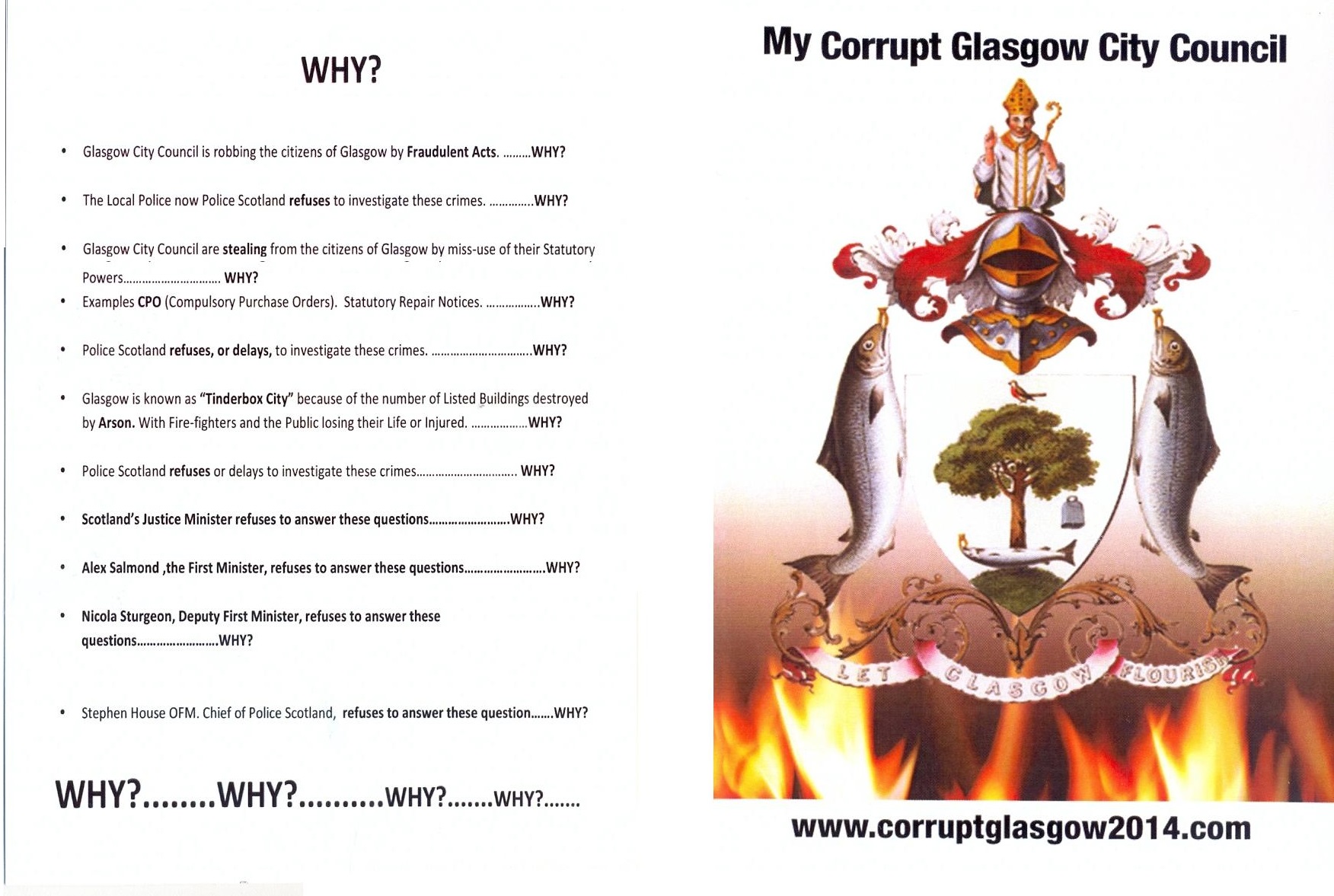
Glasgow City Councillors Foolhardy Gamble with Public Finance To Be Reversed – Expect Chaos in Glasgow Throughout 2016-17


21 March 2014: Glasgow Council Rips Off Female Employees – But the lamb Nips the Lion. Remember this fiasco- and the cost of Attempting to Defend Their Actions

In the Inner House Lords Brodie, Drummond and Philip this morning handed down a major decision affecting more than 2,500 Action 4 Equality Scotland clients with equal pay claims against Glasgow City Council.

The Council then argued that these female employees could no longer compare themselves to male comparators who remained in the employment of the Council – the plain purpose of the Council’s strategy being to try and evade responsibility for equal pay claims.

“We began this litigation back in 2005 and over the past 10 years we have witnessed Glasgow City Council enter into complicated and costly avoidance measures to escape their responsibilities to low paid.

I might also add that none of the local Labour MSPs spoke out against these payments at the time – including Johann Lamont, the Scottish Labour leader – whose partner/husband Archie Graham was, and still is, a senior Labour councillor in Glasgow.

Finance Secretary John Swinney said the new rules will end payments to Councillors who sit on bodies known as arms-length external organizations, after a Holyrood committee discovered that Glasgow Councillors had claimed £260,000 between them.

True to his word during the Scottish election campaign – John Swinney has now put a stop to the practice which has been widely condemned – as a ridiculous waste of public money.

Glasgow City Council has lost a big appeal case, I’m pleased to say – over whether or not thousands of council workers transferred to various arms length bodies (known as ALEOs) – can continue with their equal pay claims.

The good news is that they can – so hip, hip, hooray – for the 2,700 claimants from Action 4 Equality Scotland who are affected by this decision!

Last year Glasgow City Council managed to persuade an Employment Tribunal that these ALEOs were not an ‘associated employer’ – in employment law terms.

The significance of which was that these ALEO workers effectively lost their ability to continue with an equal pay claim – once they had been ‘TUPE transferred’ to one of the new Arms Length External Organizations (ALEOs for short).

Now that always looked like a crazy decision – since the council controlled all of these bodies and even paid some of its Councillors extra ‘top-up’ payments for overseeing the ALEOs – which to many people, myself included, seemed like money for old rope.

My view has always been that Glasgow created these ALEOs in a cynical attempt to evade their responsibilities over equal pay.

Because the council calculated – wrongly as it now turns out – that by putting many of its low paid women workers into a separate, artificially created box (Cordia) – that the women would no longer be employed alongside higher paid male workers who were comparators for equal pay purposes.

Since the men – according to this train of thought – were all placed in their own ALEO (City Building) which was not the same or even an associated employer – so the was ‘off the hook’ as far as future equal pay claims were concerned.

All I would say is that whoever dreamed up this despicable plan – should be sacked forthwith by Glasgow’s ruling ‘socialist’ Labour administration – that is if they have not already departed the scene with an generously enhanced tax-free lump and final salary pension.

The Action 4 Equality Scotland clients were represented by Fox and Partners Solicitors – and Daphne Romney a leading QC who also represented A4ES during the successful GMF hearing against Glasgow City Council back in 2007.

Action 4 Equality Scotland now represents 5,500 clients in the ongoing equal pay claims against Glasgow City Council – whereas the trade unions represent only penny numbers.

 The unions in Glasgow kept their members in the dark about the huge pay differences between traditional male and female council jobs – and originally sided with the council when these big pay differences were exposed by A4ES in 2005.

So the trade unions have a credibility problem because of their behaviour in Glasgow which remains to this day – since the trade unions Glasgow also failed to put up any serious resistance over the creation of ALEOs either. So watch this space for news.

http://action4equalityscotland.blogspot.co.uk/2014/03/glasgow-city-council.html
http://www.employmentcasesupdate.co.uk/site.aspx?i=ed16273


GLASGOW’S largest arms-length body has overspent by almost £3million in the last nine months according to the latest council figures.

Cordia, which runs home care services and catering across Glasgow, is £2.8 million shy of what council bosses had budgeted for.

The figures were revealed in the latest ALEO report covering April 1 – December 18, 2015.

Care services are running at a loss of £3m which the shortfall expected to rise to £4.4m by the end of March, while catering is due to end the year £3m in the black.

Finance chiefs have put the problems down to higher staff absence levels, fixed fees for home-care services and staff pay awards, and said the high absence levels were related to the workforce reforms introduced by the company last year.

A Freedom of Information request seen by the Evening Times shows the company spent more than £1m on agency staff between April 2015 and January 2016.

For five of the last six months of 2016, the firm overspent by as much as three times their target for agency staff, which they said was due to staff absence and the opening of the Queen Elizabeth University Hospital.

A spokesman for Cordia said: “Around 2% of Cordia’s overall home care operation is made up of agency staff, a figure which is lower than many other local authorities.

“This is to ensure a continuity of service provision during peaks in major holiday periods or exceptionally high volumes of work.”

The whole company is predicted to finish the year with a deficit of around £700,000, instead of an expected surplus of more than £2m.

Four other ALEOS, including Glasgow Life and City Parking are expected to end the year with less cash than budgeted for by the local authority, while five are forecast to come in on budget.

As reported by the Evening Times, the Cordia’s home-care sector has undergone a major restructure in the last eight months with staff moving to a seven-on seven-off shift pattern in June.

Union representatives slammed the shortfall and said Cordia has “mismanaged” its spending.

Sam Macartney, of Unison’s Glasgow City branch, said: “The home-care reorganisation was a shambles. It has weakened the service and it has not improved it.

“It stressed their staff out and it penalised the public.

“They have wasted a lot of resources, particularly within the home-care structure where there has been misspending.

“There has been far too much money being spent on agencies particularly if you take into account that the council themselves has ceased using agencies for years, especially in social work where it was shown not to be cost-effective.”

SNP councillor Susan Aitken, Glasgow city council opposition leader, said: “The value of removing social care services from the Council, both financially and in terms of the quality of service provided to vulnerable service users, was always open to question.

“The fact that Cordia is now not even delivering the profits it was set up to achieve shows that the original concerns were valid ones.”

Councillor Aitken said social care services must be returned to focus on the “needs of service users”, instead of “profit being the main driver”.

A council spokesman said: “Cordia is dealing with a number of increased costs – including overtime and associated pension payments and the delivery of key service reforms.

“This is being managed within Cordia’s own budgets and will not impact on the service delivered to home-care clients.

“The council has been fully aware of the position and has taken it into account in the probable out-turn for the current financial year.”

Earlier this month we revealed that discussions are at an advanced stage which would see the dismantling of Cordia.

The company employs around 7,000 staff, most will move across to Glasgow City Council by the end of the year, with workforce levels and terms and conditions expected to remain the same in the medium term.
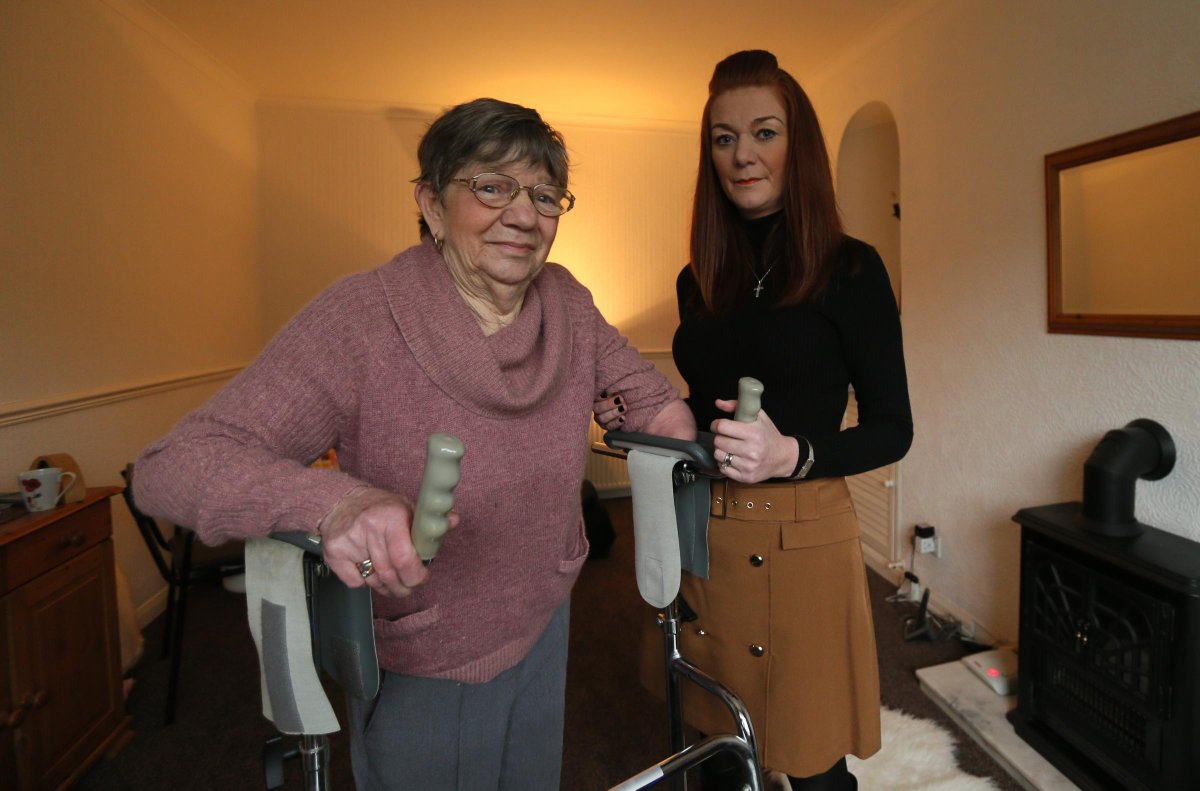
 

Margaret Matts with her daughter Jane


A MAJOR overhaul of care services must be made by Glasgow city council, claim staff and clients at care provider Cordia.

In the last year, the Evening Times has highlighted a number of cases where Cordia failed to provide a service to vulnerable clients, some of whom were left for hours without help.

Home carers were moved to a seven on-seven off shift pattern in June 2015, sending the service in to meltdown within days of it being introduced.

Bosses said at the time the new rota would provide clients with “greater continuity of care” and vowed the service would improve once the new pattern “bedded in”.

Now staff and clients have called for Glasgow City Council to introduce vital changes to the service should they take on responsibility for home care provision.

Frances Smith previously raised concerns about care for her diabetic mum after she went without care for 17 hours one one occasion, and had reported at least 16 other missed visits from Cordia carers.

Frances, 59, said: “There have been too many apologies and something different needs to happen. Glasgow City Council must look at what they are able to provide. A lot will depend on whether the council get it right, and if it’s the same management. If all it is is a different name, that would worry me.”

Frances added that since she raised her concerns in the Evening Times, her mum’s care has been “excellent” but said she would be concerned if there were changes to the individual carers who come to visit, due to her mum’s dementia.

The daughter of 74-year-old Margaret Matts also said she hoped the local authority would improve the service should it take control.

Jane, whose mum Margaret was previously left lying in bed for hours when carers didn’t turn up for their appointment, said: “I think before [the service] became Cordia it ran much better.

“It was relatively new to our family anyway, but I’d hope the council would do a better job of it. This is a chance for them to sort out the issues which were happening before.”

Two members of staff echoed their concerns, but admitted they were not aware of the plans.

One employee, who has been with the firm for more than five years, said: “Whatever happens, it has to get better than it is now. Things must change, they need an overhaul.  We [the staff], never get told anything until the last minute. There were rumours that this might happen, but nothing has been told to us.”

Another home carer, who has held her post since the service was previously controlled by the council, said: “Cordia has just made a mess of everything, so hopefully it will be better going under the council. I don’t know if it will be the way it was under social work before, but hopefully, if they are going to do that, it would be better. When I first started…it has changed so much since then. It’s not the same any-more, you’re not treated the same.”

The carer said she hoped she would be given more time to spend with clients if the council were in charge, adding: “I’m just in and out with them at the moment, I hardly get to spend any time with them and some of them need much more time than I have. I’m hoping this will change things. It’s just terrible now, hopefully if it goes back to the council hopefully it will be a lot better.”

http://www.eveningtimes.co.uk.news/14258432.Staff_and_families_call_for__major_overhaul

__at_Cordia_under_Glasgow_City_Council_s_control/


Thousands of staff will be on the move as plans are launched to scrap some of Glasgow's controversial council spin-off companies


Thousands of staff on the move as plans launched to scrap controversial council spin-off companies

Scotland’s largest home care provider is to be wound up and the country’s most successful marketing bureau merged as part of plans to overhaul Glasgow’s network of controversial council spin-off bodies.

Discussions are at an advanced stage which would see the dismantlement of Cordia, the arms-length agency which provides social care, catering and janitorial services.

The company employs around 7,000 staff, most of whom will move across to Glasgow City Council by the end of the year, with workforce levels and terms and conditions expected to remain the same in the medium term.

Cordia was set up almost a decade ago from the council’s social work department in a move primarily designed to avoid its predominantly female staff being caught up in the avalanche of equal pay claims.

Meanwhile, in a related move, the council-owned marketing agency, credited with generating hundreds of millions of pounds annually for the city economy via conferences and events, is to merge with the trust which runs Glasgow’s museums and sports facilities.

It is unclear what the new body combining the Glasgow City Marketing Bureau and Glasgow Life will be called but sources insist none of its functions will be diluted and the coming together is “about efficiencies and economies of scale”.

Questions have been raised, however, about the future of the council’s most successful spin-off merging with an organisation with a number of internal challenges, whilst unions and opposition leaders have expressed concern over the impact of axing Cordia on workers and the thousands of elderly people using their services.

Details of the plans, which it is understood is being driven by the council’s Labour leadership, come two months after it emerged the chief executives of both the Marketing Bureau and Cordia were stepping down.

Glasgow’s arms-length bodies, or ALEOs, have been an often controversial addition to the local government landscape in the past decade, not least because of the system of payments paid to councillors who sat on their boards.

However, after this was exposed and questioned the £250,000 top-up payments were axed by John Swinney.

One council source said the Cordia plan was “about tidying up the council family and simplifying complex arrangements” and that it would be gradually broken up.

The source also said the Marketing Bureau would continue with all its top staff continuing the work they do but under a different corporate. The source added: “It makes sense as far as efficiencies go, both organisations are also involved in events. It’s an economies of scale thing.”

Under the stewardship of chief executive Scott Taylor, the marketing bureau became one of the most successful in the UK. However, Mr Taylor announced in December that he was stepping down from the organisation.

Susan Aitken, leader of the council’s SNP group, said: “Dismantling Cordia simply exposes the reasons why this ALEO was set up in the first place, to avoid an equal pay settlement for low paid women workers and to provide extra paid jobs for Labour councillors. Since neither of those now apply, Cordia is no longer politically expedient.

“Protecting vulnerable service users and Cordia staff must now be the priority. People who rely on Cordia services, particularly home care, should not experience any disruption and staff must be kept fully informed about what’s happening to their jobs and be guaranteed that there will be no detriment to their pay and conditions as part of any move.”

Unison’s Brian Smith added: “Unions have argued for the ALEOs to be back under democratic council control for years. We find Cordia a particularly difficult ALEO to deal with, their current treatment of school janitors being a case in point.

“Home care service is also underfunded. We want Cordia workers treated with the respect they deserve.”

A council spokesman said they had to find savings of at least £133 million over the next two years.

He added: “A range of options to meet the savings target is being considered for inclusion in the council’s budget for 2016/17. Until then, it would be inappropriate to comment on specific proposals. Councillors will consider the budget at a meeting of the full council on 10 March.”


Prince William the “Butcher” of Culloden Infamy ensured the Scottish Highlands Would be Forever England


Hot Irish Battles | Page 16 | Political Irish | The Irish ...


The Legacy of the (Butcher) Duke of Sutherland, His Cronies & The Rape, Pillage and Theft of the Highlands of Scotland

In 1854 Britain declared war on Russia. Highland regiments, so conspicuous in the past, were now equally conspicuous by their absence. “Where are the Highlanders?” was asked. The Duke of Sutherland hastily travelled from London to Dunrobin Castle and enquired why there were no Highland volunteers, an elderly gentleman replied:

“Your Grace’s mother and predecessors applied to our fathers for men upon former occasions and our fathers responded to their call. They have made us liberal promises, which neither them nor you performed. We are, we think, a little wiser than our fathers, and we estimate your promises of today at the value of theirs; besides you should bear in mind that your predecessors and yourself expelled us in a most cruel and unjust manner from the land which our fathers held in lien from your family. I do assure your Grace that it is the prevailing opinion in this country, that should the Czar of Russia take possession of Dunrobin Castle and Stafford House next term, that we could not expect worse treatment at his hands than we have experienced at the hands of your family for the last 50 years.”

In Sutherland there were no volunteers. The dwindling number of men said: “We have no country to fight for. You robbed us of our land and gave it to the sheep. Therefore, since you have preferred sheep to men, let sheep defend you.” Those young men who refused to volunteer called a public meeting stating: “we are resolved that there shall be no volunteers or recruits from Sutherland shire. Yet we assert that we are as willing as our forefathers were to peril life and limb in defence of our Queen and country were our wrongs and long-enduring oppression redressed, wrongs which will be remembered in Sutherland by every true Highlander as long as grass grows and water runs.”

http://www.yourphotocard.com/Ascanius/documents/The%20history%20of%20the%20Highland%20clearances.pdf

Duke of Cumberland "The Butcher" When it became clear to ...


Over half of Scotland is owned by just 500 people, few of whom are actually Scots. As Britain’s great land-owning aristocratic families decline, a new breed of foreign laird is exploiting Scotland’s arcane land laws to buy up tracts of the Highlands and islands – Europe’s last great wilderness. The revelation comes in two new books which examine who owns Scotland. The authors have searched through ancient deeds and estate agents’ sales brochures to compile the most detailed picture of land ownership for a generation.

They show that most lairds no longer hail from Britain’s tweed-clad huntin’, shootin’ and fishin’ classes; these days your local feudal overlord is more likely to be a self-made continental millionaire or an entrepreneur from Dubai, Egypt, Malaysia, Hong Kong or plain old America. The findings have sparked a political row north of the border. Many of the new lairds are absentee land-owners who, environmentalists claim, neglect Scotland’s greatest asset – the land itself.

Nationalist MPs and crofters, frustrated by the failure of Westminster politicians to bring Scotland into line with England and other European nations by abolishing feudal structures and regulating land use, are drawing up plans to limit foreign land ownership and introduce environmental codes for all estates.

The two books, “Who owns Scotland now?” and “Who owns Scotland”, update John McEwen’s ground-breaking attempt to sketch Scotland’s land-owning geography 30 years ago.

His study revealed that ancient British families dominated the hills, straths, glens and islands, controlling lucrative salmon beats and deer stalking from the Borders to Barra.

Since the Fifties and Sixties, however, the decline of some of the most distinguished and notorious names in the Highlands – the clan chiefs of the Frasers of Lovat, the Sutherlands and the Wills tobacco family paved the way for new owners to take to the hills.

Andy Wightman, author of, “Who owns Scotland”, recently published in April, explains: “Some of the old landowners like the Duke of Buccleuch, the Duke of Atholl and Cameron of Lochiel have survived. Their old money is still good and some of their estates have expanded. But other families have fallen on hard times and a new group of landowners has stepped in swiftly to take their place. Many of these are from overseas and as they move in, a new pattern of land ownership is emerging.”

A map of the Highland Clearances : Scotland


All over Scotland there are now glens and peaks that are forever Swiss, Danish, Malaysian, Middle-Eastern and American. One year ago the whisky distilling MacDonald-Buchanan family sold off the Strath Conon estate in Ross-shire, which they had held for three generations. The new kilted monarch of the 50,000-acre glen is Kjeld Kirk-Christiansen, who runs the huge Danish Lego corporation.

On the Hebridean island of Eigg, Keith Schellenberg, the fantastically wealthy former captain of Britain’s Olympic bobsleigh team who once described “his” islanders as “drunken, ungrateful, lawless, barmy revolutionaries”, sold up as part of a divorce settlement with his second wife Margaret Udny-Hamilton. The new laird is the chain-smoking, beret-wearing “fire” painter, “Professor” Marlin Eckhard Maruma from Stuttgart.

Visitors to Queen’s View in Glen Avon, where Queen Victoria used to look out on her Royal fiefdom, now look down on land owned by the mysterious businessman behind the Kuala Lumpur-based Andras conglomerate. He bought the 40,000-acre estate, once owned by the Wills family, for £6m last year.

Some ancient aristocratic families have hit the buffers in spectacular fashion. The Lovat Frasers’ downfall began when three family members died suddenly; one was gored to death by a buffalo in Tanzania, another collapsed while hunting, and the third succumbed to old age.

Others have been crippled by debt. Losses in the Lloyd’s insurance market forced Lord Kimball, a Lloyd’s Name, to sell the 47,000-acre Altnaharra estate in Sutherland. Whatever the cause, the result is that fewer than half of the big Highland estates are owned by Scots.

“It’s a dramatic change,” said George Rosie, the veteran Scottish land- reform campaigner. “In the 19th-century, parliament passed an Act allowing foreigners to buy any property. As Britain was then the biggest rooster on the midden, the idea that any foreigner would be able to buy into Britain was risible. But now there are millions of wealthy foreigners and Scotland is ripe for the plucking. And plucked we have been.”

Some of the new wave of overseas buyers enjoy good relations with locals and have earned environmentalists’ praise for their land management practices. Paul van Vlissingen, the Dutch businessman whose “holiday cottage” is the eight-bedroom white-washed Letterewe lodge on the banks of Loch Maree in Wester Ross, has helped to fund a new swimming pool and re-introduced native woodland on his 80,000-acre estate.

Other lairds, however, have been accused of barring access to walkers and neglecting the natural environment. “Mountain Closed” signs appeared on estates north of Ullapool. In Perthshire, His Excellency Mahdi Mohammed Al Tajir, from the United Arab Emirates who owns the Blackford Estate, home of Highland Spring mineral water, was accused of abandoning farms to nature on the slopes of the Ochil Hills.

Was the Highland Clearances the Main reason for Scottish ...


The winds of change are increasing

Nationalist politicians say Scotland’s free market in land (one of the few countries in Europe which allows wealthy foreigners to buy up unlimited amounts of land with no questions asked) has created a “land lottery”. And, while far-sighted landowners are welcome, they say new measures will need to be introduced limiting the size of their holdings and removing property from owners who neglect their land.

The Scottish National Party, set up an independent land commission and unveiled limited new proposals which encouraged the Scottish Crofters’ Commission to support crofting communities in their efforts to raise money to take over their marginal plots. In Scotland, land is suddenly a political issue.

Dr James Hunter, a Skye-based environmental historian, said: “Land has moved up the agenda ever since the first crofters took over their land in Assynt 1992. That showed that land ownership patterns could change. Since then we have had controversies over the Knoydart estate and other Highland wilderness areas. ”

The “winds of change” unsettled landowners who launched an unprecedented campaign to counter reformers’ demands. At a special public meeting Graeme Gordon, convenor of the Scottish Landowners’ Federation representing 4,000 estate owners north of the border who manage some seven million acres claimed that the debate over land ownership was based on “dangerous generalisations and misleading assertions”.

He told his audience that the “majority of landowners were committed custodians of natural heritage who provide jobs, housing and security for remote communities often at a personal financial loss”.

The battle for the Highlands is only just beginning.

Highland Clearances | Scottish Tartans Authority


Fracking & George Osborne

Lord Howell, former Tory Energy Secretary and father-in-law of the Chancellor, George Osborne, said that there were, “justified worries” about, “fracking” a method of extracting shale oil and gas and that this should not be inflicted on the “beautiful” South. But he offered a way forward stating, “there are large uninhabited and desolate areas, certainly up in the North East, where there’s plenty of room for fracking well away from anyone’s residence… without any kind of threat to the rural environment.” Recognising his close affinity with his Son-in-law it might be he is foretelling the future of the North East.

The 1956 Suez Crisis – The Special Relationship Stretches in One Direction Only


Eisenhower with Nasser


Lessons from history – The Suez Crisis

Anthony Eden, (Conservative Party) took on the role of Prime Minister of the UK in 1955, shortly after the death of Churchill. His party had a healthy parliamentary majority and for the first year things went well. Problems arose in the course of 1955 when Eden started to suffer from recurring illnesses and many important policies were left to, “Rab Butler” to attend to including forming partnership with other european countries. Rab failed to take up the invitation to meet with, “the europeans” and the chance to be in at the start of the EEC was missed.


At around the same time Colonel Abdul Nasser came to the fore in Eygpt and nationalized the Suez Canal. Eden and the Conservative Party still believed the UK to be one of the World’s great powers, (although the country was skint and up to it’s ears in debt to the USA). Fearing the canal would be closed to Europe, acting together with France and the fledgling state of Israel, Eden ordered the invasion of Egypt taking the Suez Canal back under the control of the UK, France and Israel.

The invasion was costly. Eden, seeking support from the, “special relationship” was shocked to be informed that the USA would not aid the UK. Instead, giving support to the United Nations, (who had ordered the UK to withdraw from Egypt) the USA threatened to impose aid, trade and financial sanctions on the UK. UK forces withdrew from Egypt within days. In a later parliamentary inquiry Eden admitted lying to Parliament and to ordering civil servants to destroy anything that might provide evidence of the conspiracy he had entered into with France and Israel. He was forced to resign not long after.


Eisenhower threatened to bankrupt Britain unless it complied with US intructions and withdraw from Suez immediately

Harold Macmillan and President Dwight Eisenhower


Harold Macmillan, (supermac) took over the Party and limiting damage, set about modernising the country, increasing living standards, putting, “the pound in the pocket of the working man”. His 1959 electoral boast was, “You’ve never had it so good”. The Conservative party increased its majority in the General Election. The Suez fiasco was erased from history, (almost). Eden might have avoided disgrace had he heeded the content of the extract from Harold Macmillan’s diaries from September 27th 1952. The Special Relationship:

“We are threatened by the Americans with a mixture of patronizing pity and contempt. They treat us worse than they do any other country in Europe. They undermine our political influence all over the world. They really are a strange people. Perhaps the mistake we made is to continue to regard them as an Anglo-Saxon people. That blood is very much watered down. Now they are a Latin-Slav mixture with a fair amount of German and Irish. They are impatient, mercurial and panicky.”


John F Kennedy & Harold mcMillan


Fast forward from 1956 to 2003. Change the headline name to Blair then change Suez Canal to Iraq and you have history repeated. Oh!! one difference this time the USA assisted by the, “puppy dog UK” invaded a middle east country and created chaos resulting in the deaths of in excess of 650,000 Iragi’s and 5000 USA/UK servicemen and women, (casualties an additional 30,000+. Just what gave Blair & Bush cause to wreak such horror on nations?

1. Eden & Blair, both Westminster Prime Ministers, sent UK armed forces to invade a middle eastern country, having lied to Parliament, to gather support to their decision. Many Scottish soldiers were wounded, maimed and died. Independence will allow our parliament to decide when it is right to commit our armed forces to war.

2.The, “special relationship” quoted by, Blair, Brown, Cameron, Obama and Clinton is a myth since it implies mutual support. At the time of Suez the USA ordered Eden to withdraw UK armed forces from Egypt within 48 hours or suffer sanctions, withdrawal of financial support and other restrictions.

3. The, “special relationship” enjoyed a rebirth, through Blair & Bush, so that they would be able, (through emotional blackmail) to garner support of the UK public for invasion of Iraq. When the strategy failed the, “Weapons of Mass Destruction” story was concocted.

4. The so called “Special Relationship” is more astutely described by, Harold “Supermac” McMillan. Additionally, since that time the population of the USA is markedly changed. There are more citizens of Spanish, Asian and Indian descent than white Anglo Saxons. Gives substance to my view that there is no, “special relationship”. There never was.

5. Recent, “staged” press conference statements, (blatantly organized by Cameron) in support of the, “no” campaign by, Obama and Clinton should be treated by the UK public with contempt.


Lessons from History.

1. The, “Special Relationship” is easy to explain. The UK supports the USA.

2. Westminster politicians are well versed in the matter of being, “economical with the truth”. Remember Thatchers representative’s performance in Australia at the time she sought to block diary revelations damaging to the Conservative Party?

3. Committing UK forces to war, on a lie is commonplace in Westminster.

Vote, “Yes” to independence in September free Scotland from the sickness that is Westminster.

Living in the East End of Glasgow in the 1940’s

Living in the East End of Glasgow in the 1940’s

My first brush with the politics of Glasgow came in July 1946. I was a teenager, living, with my family, in a single end in Kent Street, Calton. Myself and two of my friends were returning from a Socialist Party political meeting being held on, “the Green”. Speakers had been extolling the benefits of a new, “inclusive post war nation”.

My mate had been given a leaflet on which was printed the words of the, “Red Flag”. He insisted on singing the song as we entered the, “Gallowgate” and proceeded up the road towards Kent Street. I noted two, “Bobbies” on the other side of the street, standing near to, “the Sari Heid” and told him to stop singing so as to avoid trouble. We still got it. A gang of, “Billy Boys” steamed out of, “Doo-Hill Road” shouting, “Communist Bastards” and gave us a severe beating. The policemen, (who witnessed the incident) did not come to our assistance. We managed to get back to my place and cleaned up.

Later, my father, (a committed communist) offered the reason we were beaten up was most likely my mate’s singing since there were very strong links between, (the Scottish Protestant League), (the Billy Boys), (the Police), (the Orange Order) and the Tories. He went on to say that the only way to bring about change, improving housing, health and wealth and gaining full employment was for, “oor sort” to stick together and gain power through the, “ballot box”. From that time, (the bulk of Roman Catholic Glasgwegians have voted Labour). My father was right, from 1945 -to date, through the ballot box, the Glasgow electorate has been committed to, (a contract of care) under control of the, “Labour Party”.

When Glasgow was declared host to the 2014 Commonwealth Games the urgent need for new sports facilities, accommodation, removal and redevelopment of run down parts of the east end of the city, (where the bulk of Roman Catholics live) exposed a disgraceful lack of progress, over 70 years, under the auspices of Labour councils that had been returned to power unchallenged. Poor health continues to plague families. Early death, (55y) is the sad fate of many Glasgow Eastenders. Poverty is rife. Unemployment remains higher than the national average and housing stock is run-down.

Labour Councillors have also, (through a litany of dodgy deals enhancing their personal finances) brought ridicule and anger upon themselves and their offices in Glasgow District Council and the Labour Party. Deals since exposed and banned by the Scottish National Party Government. The referendum provides opportunity for change. I know it will be difficult for Roman Catholics in the East End of Glasgow to vote other than Labour. But there is an alternative. Vote, “Yes” in the independence referendum. In our country, freed from the excesses of the past it will be possible to elect Councillors who will work for their constituents not themselves or the Labour Party in England.

Glasgow City Council and New Labour a Systematic Transfer of Finance and Assets From the Public Purse to the Wallets of Friends of Labour


imgid38478222  McAvetty


cash_2285410b       imgid50709322-jpg-galleryPurcell

These two Guys Led Glasgow City Council


The Empire That Was – Glasgow & the Labour Party

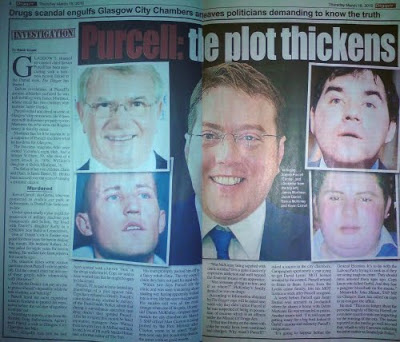
Steven Purcell, leader of Glasgow City Council, (GCC) quit office without warning amid increasingly fevered allegations of drugs, corruption and sleaze. The Labour Party, “shut up shop” and said nothing. The Scottish Labour party’s control of life in the West of Scotland is wide reaching across civic life.

This has always been accepted as, “that’s just how it is”. That familiarity, which at times can feel too close for comfort, can also be a benefit but a much darker side was exposed. Politicians, businessmen, media and the law were so interlinked in this tale that it is difficult to see the wood for the trees.

Blair once hailed Purcell as a, “visionary civic leader”, and his rise from, “deprived” Yoker, to leader of the Council at the City Chambers seemed to personify the Blairite fantasy of meritocracy.


maggie


But the entrepreneurial narrative is implicitly an individualizing discourse: being, “excluded” is at least partly one’s own fault for having the wrong skill set, the wrong character traits or the wrong kind of family life.

In this context, alternative, and more importantly collective models for dealing with one’s personal situation, (workplace or community organizing, grass-roots campaigns, etc.) become inconceivable. To disagree is to be, “against aspiration”, to be recalcitrant and against change, to want to keep people, or one’s self, in the ghetto.

The positivist aspects associated with this discourse have unravelled of late with Purcell quitting his posts amidst cocaine and alcohol confessions; the quoted strain of running the local authority; the pressures of planning the Commonwealth Games; and controversies over Strathclyde Partnership for Transport. The recession has also worked to de-legitimise the modus operandi of the market calculus personified by Purcell’s administration, though hardly as much as it should have.


frankclock


Following Purcell’s fall, the dominant Labour Party within the Council quickly sought to distance themselves from his once venerated Leadership, concerned that, “everything the council achieved during Mr Purcell’s time as leader has somehow been devalued”.

This acute reversal suddenly averred that the, “City is not just about one man”, that the, “transformations” were, “not because of the person who was in charge but because of the hard work and dedication of you and your colleagues” at the Council.

But recriminations over Purcell’s personal life shouldn’t obscure the fact that he’d been heading a local authority caught up in a web of, “cronyism” and an, “elaborate system of political patronage”. The real issue – that which, “scandal” obfuscates – is the restructuring of local government along lines of market largesse at public expense.

Purcell’s, “State of the City Economy” address in 2008 is an exemplary document in that it expresses quite clearly his, “vision” for the city. Regurgitating the dull rote of neo-liberal convention, he promised that, “Team Glasgow” (a self elected cabal of business leaders purporting to represent the wider interests of ‘Glasgow’) would do everything they could to help businesses, “cope with the downturn”, “The first thing that all public bodies, including my own Council, must do, is to examine where we can help business by being more flexible and willing to do things differently.

This is no time for unnecessary rules and processes; this is a time to do everything we can to help”. The message couldn’t be clearer, “My main priority is helping business in the city through the economic difficulties ahead”, he said.


dig


Purcell’s, “vision” included a, “flexible” land disposal policy that gave away, “empty” commercial premises owned by the Council to new businesses rent free, so that they can do without, “the burden of rent costs”.

Purcell argued that this showed how Glasgow City Council is, “willing to do things differently, willing to be flexible to help businesses”, willing to, “relax” rules in order to promote development and safeguard businesses. “We are willing to look at deferred payment arrangements, profit sharing, joint ventures and greater risk taking on the part of the Council”, he promised.

One beneficiary of this largesse at the public’s expense are the developers of the Commonwealth Games Village, who obtained the site rent-free, alongside an undisclosed, “profit-sharing agreement” with the Council.

As a commercial property market magazine concluded in March 2010 (under the headline, “Loss of council’s, “Team Glasgow” is huge blow for property’), the scandal surrounding Purcell may grab the headlines but the loss will also be felt by a feather bedded property industry.

Another means by which the City Council has shown its willingness to prioritize neo-liberal enclosure and restructuring has been in the privatization of basic services run previously by the authority.


purcell


Since the council housing, “stock-transfer” in 2003 (the largest transfer in the UK), there has been an acceleration of Council functions carved off to arm’s-length external organisations (ALEOs): care services, culture and leisure, catering, construction and maintenance services, parking, community safety and city marketing.

Against a backdrop of diminishing terms, conditions and salaries for those employed by ALEOs, the, “cronyism at the heart of Purcell’s council” ensured friends and allies – sitting on the boards of these companies which met just a few times a year – were being paid enhanced salaries for doing what the Council was already paid to do.

“Political patronage”, at work? Willie Haughey (a good friend of Purcell, key member of, “Team Glasgow”, and the largest Scottish donor to the Labour Party) received £680,000 (plus VAT) for a plot of land in Rutherglen from Clyde Gateway Developments, an ALEO run by Purcell’s former political advisor, Iain Manson.

Haughey had leased the land from the then-Glasgow District Council but bought it outright in the mid-1990s. Despite an independent valuation of £7.4 million, Haughey also received a £17 million compensation package for his business premises, which had to be relocated due to the construction of the M74 motorway.

” a nation of sheep results in a government of wolves”, “For evil to flourish, all that is needed is for good people to do nothing.” “The individual is handicapped by coming face-to-face with a conspiracy so monstrous he cannot believe it exists.”


crooks-of-the-crown-cover


Another ALEO, City Building, was awarded two large contracts to Haughey’s City Refrigeration Holdings, worth £11.2 million, despite his bid being significantly higher than other competitors.

Clyde Gateway’s board includes four Councillors, all Labour, including George Ryan, Mr Purcell’s right-hand man when he became council leader in 2005. The head of City Building is Willie Docherty. His wife, Sadie Docherty, is a Glasgow Labour Councillor. Garnering further accusations of cronyism, Scottish Labour’s former general secretary Lesley Quinn was recruited as City Building’s first business development manager.

City Building’s £20,000-a-year chair, Gerry Leonard, is also a Labour councillor in Glasgow, as are three other board members. Just one board member is an SNP Councillor as with Culture and Sport Glasgow, whose Chief Executive is Bridget McConnell, partner of former First Minister Jack McConnell.

Glasgow’s Labour-dominated Council was also found to be passing public money into party political funds via at least one ALEO run by Labour activists, in the form of buying tables at party fundraisers. City Building treated Labour grandees, including Scottish leader Iain Gray and his wife, to a £2,000 dinner at a party fund-raiser.

David Miller, at Strathclyde University, helped disclose Purcell’s free use of public cash as he used Encore catering service, one of the authority’s spin-off companies, to host lavish dinners for fellow Labour politicians.


images


Within days of Purcell resigning lawyers and a PR company arrived on the scene attempting to gag his former colleagues who sought to distance themselves and their Party from Purcell’s personal peccadilloes.

But what exactly, behind the morality tales, might they wish to distance themselves from? It was offered that ALEOs had not been established for the sole purpose of buying loyalty, they, “provided a convenient vehicle for purchasing patronage”.

But to personify the system of largesse in Purcell alone is to erroneously perpetuate the story of, “one bad apple”. Polite press commentary consisted primarily of emotive stories of Purcell’s personal habits, obfuscating the high degree of institutional aggregation at work in Glasgow in marketing the, “success” of Glasgow’s urban renaissance.

What was perceived as a dearth of mainstream media reporting led bloggers to speculate on west-coast failure to hold power to account.

The Sunday Herald, driven to comment, reacted defensively to, “suggestions of a network of powerful figures working behind the scenes to influence the workings of the city … that this so-called network included leading figures from the media [and] threatened to undermine public confidence in the integrity of the Scottish press”.

Responding to, “hints” that some Scottish newspapers had, “pulled their punches on the controversy because editors had been too close to Mr Purcell or, worse, they had been cowed into submission by Peter Watson and PR firm Media House”, these allegations were rebutted but unconvincingly, “Glasgow is a large city but its political and business centre is small. Personal and business relationships meld together, contacts extend and overlap, boundaries blur. Business dinners become social occasions, colleagues become friends”.


1476267_672271199473445_514886622_n


Herald and Evening Times editor-in-chief Donald Martin told his sister-paper the Sunday Herald: “I was glad to play a role in Team Glasgow along with other individuals who believed in co-operating for the good of the city. Our aim was to encourage actions which would help the city. As a newspaper editor it is an important part of my job to make contacts in the political, business and other spheres and I also believe it is part of my job to work for the good of Glasgow and indeed Scotland”.

This suggests, even confirms, an all-too-cosy political compact between Glasgow governance and certain sectors of the crisis-riven Scottish media. Indeed, Martin was part of a regular Friday afternoon drinking date, dubbed, “The Ritz Club”, which, Holyrood magazine spilled, “included the editors of rival red tops [David Dinsmore], the Herald’s departing editor-in-chief [Donald Martin] and Purcell himself”.

That Martin could be so open about these relationships suggests not a conflict of interests but a convergence of interests, effacing any significant debate of the underlying economic antagonisms in Glasgow. None of the above points to any, “conspiracy” of course, just politics as usual: the same old revolving doors network of legalized looting avid viewers of, “The Wire” have become accustomed to.

No laws, moral or otherwise have been broken – no matter how much money has been channelled into the Labour Party via publicly owned companies, or how many members, relatives and friends are employed in senior positions in such companies.


leaflet


As for multi – million pound contracts and shady land deals being awarded to Party donors, well, that just shows that an entrepreneurial spirit is rewarded in an age of entrepreneurialism. What is perhaps remarkable about Glasgow’s economic policies and system of political patronage is that the dis-juncture between the myth of market provision and, “urban renaissance”, and the reality of a city with 40 per cent of it’s residents living below the poverty line, hasn’t been more consistently and effectively exposed. (Composed by Neil Gray & Leigh French)


cleanupglasgow_big


Probably the main reason the Labour Party is against Independence. Scotland, free of Westminster control will be able to address the excesses of the ruling Labour Cabal in Glasgow and adjacent Councils of similar ilk.

The UK Taxpayer’s Alliance recently published a list of UK Town Hall top earners. Glasgow employed 27 members of staff earning over £100,000 p/a. Of these 5 featured in the top 10 highest paid executives.

Commenting the, ” Alliance”, said, “Residents won’t be impressed when their council pleads poverty then demands more and more council tax, (Glasgow’s annual operating budget is around £3 Billion) only to spend it creating more town hall tycoons.”

1. In second place. Linda Hardie. South Lanarkshire Council, £543,538, (Retired April 2011.)

2. In third place. Thomas McDonald. Former Assistant Director of Land and Environment Services, £520,590 total remuneration inclusive of £342,957 in pension contributions, (Retired.)

3. In fourth place. William Docherty. Glasgow Council (subsidiary company) City Building, £485,698.

4. In fifth place. Steven Kelly. Glasgow Council (subsidiary company) City Building, £481,166.

5. In ninth place. Robert Booth. Former Director of Land and Environment Services, £382,789 total remuneration inclusive of 171,929 in pension contributions, (retired.)

6. In tenth place. Kenneth Harkness. Ex Head of Service development, £371,610.

7. The largest pay package overall, excluding larger than usual, one-off payments, was that of John Sharkey, group chief executive of SEC, (a private company whose majority shareholder is Glasgow City Council) which owns and operates the Scottish Exhibition and Conference Centre. He received £314,553.

The residents of Glasgow and the West of Scotland, (45%+ of whom live below the poverty line) need to abandon the past and seize the opportunities for a much better standard of life independence will bring. Vote, “yes” in the referendum.


maxresdefault


Johann Lamont & Scottish Labour

Johann Lamont & Scottish Labour

It is a fact that from the time she took up office as leader, (Johan Lamont and the Scottish Labour Party) meekly toe the line sent down by Ed Miliband and his cohorts. Entirely suited only to the needs of English voters, (not Scots) policies are to be foisted upon Scotland, should Labour win the next General Election, (which it is increasingly uncertain.)

Mindful of the foregoing, Johan Lamont and her Labour Party’s support of a, “no” vote in the Referendum is becoming ever more savagely hysterical claiming, “cybernats” are unfairly conducting personal vendettas online against those who might voice disagreement with their views. At long last, “The Sun” has, “climbed off the fence” and sided with the, “Yes” campaign, publishing disparaging comment in regard to the aforementioned concerns, mocking Johan Lamont and her Labour colleagues for pursuing childish witch-hunts on social media outlets. Paraphrasing an extract from, The Sun Editorial;

“The left-wing, (Labour Party) mob on Twitter fuel their self-righteousness, taking offence at their political opponents, whipping up frenzies of phony outrage willfully ignoring the context in which things are said”.

Scots do not take kindly to Labour Party officials warping the truth to suit their political aspirations. Vote, “Yes” in the referendum. Cleanse English control from of Scottish politics.

Work or Want – The Impact of Welfare Changes

Work or Want – The Impact of Welfare Changes

A recent court case in Dundee highlighted the brutality of Ian Duncan Smith’s changes to Social Security systems, in place to protect those in need of assistance. A young mother fled her abusive husband. She asked for assistance at her local social services office only to be told any financial benefits which she might be afforded would not be paid to her for at least 6 weeks. Desperate and needing to feed her children she went to a local supermarket and stole food sufficient for her needs. She was caught and ended up in court. The Sheriff, trying the case, contacted Social Services and was assured no-one would be required to go without food as a result of benefits changes. In summary he said, “this case however was an example of that not having worked. As such there were significant mitigating circumstances allowing the young mother to be admonished”. Increasing use of sanctions against claimants is becoming commonplace, even for the most minor of misdemeanors, (late for an appointment due to a late bus. Is this the Scotland for our families. I think not. We need to care for those less fortunate. Vote, “Yes” in the referendum move Scotland away from the harsh right wing policies that have done so much damage to our society.

The Royal Mail and the Future

The Royal Mail and the Future

The, part-privatised, (on the cheap) Royal Mail derives about 50% of it’s annual revenue from delivery of, “snail mail.” It is contracted, “by law” to deliver such mail on a universal basis throughout the UK. Retention of a, “Universal Mail Delivery” service is more expensive to maintain in the large rural areas of Scotland. Measures, correcting matters, reducing costs are ready for early implementation after the next general election. The measures; Universal home delivery of mail is to be withdrawn, (over a period not exceeding one year), in urban areas, with a population exceeding 5000, to be replaced with Post-Box, (PO) delivery. This will require homeowners to, “collect” their mail in person, (no exceptions) from a designated PO-Box which will be located locally, supermarket, Newsagent, Garage or similar enterprise. Inconvenient!!! Tough!!! will be the response of the new Conservative government.

Read the article; “http://www.telegraph.co.uk/news/uknews/royal-mail/10850281/Royal-Mail-demands-Ofcom-curbs-rivals.html.”

The above changes can only be implemented in Scotland with the authority of UK Government. Vote, “Yes” in the September referendum. Let the Scottish Parliament decide the future of mail delivery.

Benjamin Franklin – A Great Empire Reduced To A Small One

Benjamin Franklin – A Great Empire Reduced To A Small One

Benjamin Franklin, one of United States of America’s founding fathers, loved Scotland and the company of it’s highly respected philosophers of the, “Great Scottish Enlightenment.” Had he lived in these times he would have encouraged Scotland to vote, “Yes” to independence. In discussion with, Thomas Jefferson, (a fellow founding father and friend) referring to a nation’s right to be free he said; “He who sacrifices Freedom for security deserves neither”

His advice is clear and unambiguous. Do not succumb to the, “no” campaign’s patronising unspecified promises of jam tomorrow, (remember 1979.) Have confidence take the opportunity and elect for freedom.

He also wrote, “Rules By Which A Great Empire May Be Reduced To A Small One”. Clearly Westminster politicians have either not read it or choose to ignore the advice contained therin, which is possibly the reason why Scottish independence will bring about all that is predicted therin.

http://en.wikisource.org/wiki/Rules_By_Which_A_Great_Empire_May_Be_Reduced_To_A_Small_One”