Scotland Within The UK Debate Westminster – The First Debate After The Referendum

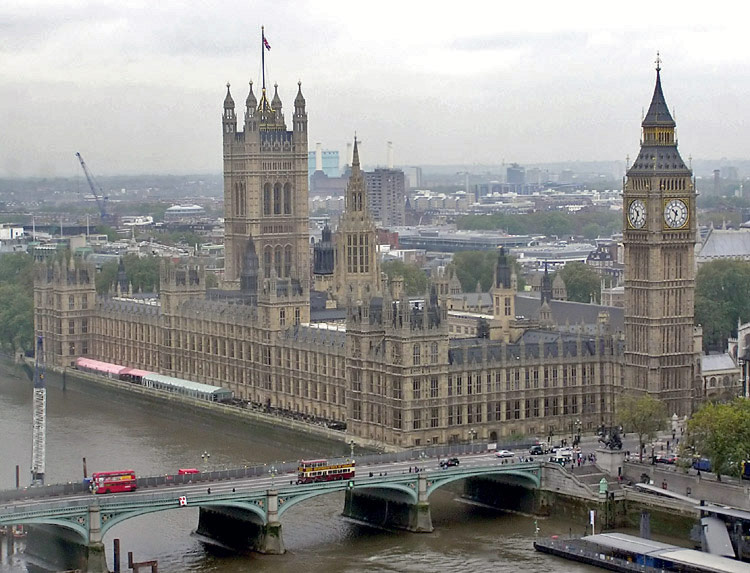
Palace.of.westminster.arp

13 Oct 2014 Scotland within the UK Debate Westminster Scottish Affairs

The Secretary of State for Scotland (Mr Alistair Carmichael): With permission, Mr Speaker, I wish to make a statement to the House about the position of Scotland within the United Kingdom.

As hon. Members will know, on 18 September the people of Scotland voted in a referendum on independence. I am pleased to report to the House that, by a margin of 10.6%, or by 55.3% to 44.7%, the people of Scotland voted to remain part of the United Kingdom.

The referendum was underpinned by the Edinburgh agreement, signed between the United Kingdom Government and the Scottish Government in October 2012. That agreement ensured that the referendum would have a clear legal base, that it would be conducted in a way that commanded the confidence of both Parliaments, Governments and people, and, most importantly, that it would deliver a fair, legal and decisive expression of the views of people in Scotland—a result that everyone would respect.

More than 2 million people made a positive choice for Scotland to remain part of the United Kingdom. The franchise for the referendum included, for the first time ever in this country, 16 and 17-year-olds. At a time when our elections have suffered from declining participation, the turnout across Scotland was nearly 85%—something that I am sure all across the House would welcome. Politics works best when people take an active interest in supporting the things that matter to them most. It also adds emphasis to the democratic result.

The decision of the people of Scotland was clear: they voted to continue to be part of this family of nations; they voted to continue to work alongside people in England, Wales and Northern Ireland; and they voted for all of us to remain together as a United Kingdom. It is important that everyone now accepts that result. We should all move on from being part of the 55% or the 45% to working for 100% of the people of Scotland.

That is what we are doing. The vow made by the Prime Minister, the Deputy Prime Minister and the Leader of the Opposition during the referendum campaign is already being put into practice. The Smith commission, chaired by Lord Smith of Kelvin, was up and running on 19 September. He will convene cross-party talks to reach agreement on the proposals for further devolution to Scotland. His terms of reference make it clear that the recommendations will deliver more financial, welfare and taxation powers, strengthening the Scottish Parliament within the United Kingdom. But that process is not just about the parties; the referendum opened up civic engagement in Scotland across sectors, communities and organisations, and Lord Smith has made it clear that he wants to hear from all those groups to ensure that the recommendations he produces are informed by views from right across Scottish society.

By St Andrew’s day, Lord Smith will publish “Heads of Agreement”. The Government are committed to turning those recommendations into draft clauses by Burns night 2015. The timetable is demanding, but that is because the demand is there in Scotland to see change delivered, and it is a demand we shall meet. On Friday 10 October, all five main Scottish parties submitted their proposals to the commission. In the case of the Labour, Conservative and Liberal Democrat parties, the

proposals reflect the positions published by the parties prior to the referendum campaign. The Scottish National party and the Green party agreed to join the cross-party talks after the referendum, and they too submitted proposals on Friday—a development that we welcome.

Today I can confirm that the Government are meeting the first step in the further devolution process by publishing a Command Paper. The Command Paper we are presenting today provides a clear, factual summary of the proposals for further devolution in Scotland published by each of the three pro-UK parties, as we committed to do during the referendum campaign. Those plans encompass a broad, complex and often interlinked range of topics, from taxation to borrowing and from welfare to regulation. To inform and assist consideration of each of those proposals, the Command Paper also sets out factual information about the current situation in the key policy areas, as well as presenting some background information about devolution in Scotland to date. The publication is wholly without prejudice to the work of the Smith commission, which will look at proposals from all the parties and others and seek to establish the ground for consensus. This will be the first time in the development of Scotland’s constitutional future that all its main parties are participating in a process to consider further devolution. It is a truly historic moment, and one that I very much welcome.

With all five main Scottish parties working together in collaboration, I am confident that we will reach an agreement that will provide the enhanced powers to the people of Scotland and accountability for the Scottish Parliament while retaining the strength and benefits of being part of the United Kingdom. That was the message heard loud and clear during the referendum campaign, and it is one that this Government, and all Scotland’s political parties, are committed to supporting.

Margaret Curran (Glasgow East) (Lab): I thank the Secretary of State for advance sight of his statement.

Only three weeks ago, in unprecedented numbers, the people of Scotland voted to remain part of the United Kingdom. It was an historic decision, and the result was emphatically clear: the Scottish people voted for pooling and sharing resources across the United Kingdom; they voted to continue with devolution; and they voted for a stronger Scottish Parliament. I wish today to pay particular tribute to my right hon. Friends the Members for Edinburgh South West (Mr Darling) and for Kirkcaldy and Cowdenbeath (Mr Brown), who put the case with so much passion throughout the campaign.

Following the referendum, we can say with confidence that devolution is the settled will of the Scottish people and that we shall have a stronger Scottish Parliament. A vital part of the campaign was the commitment made by the Leader of the Opposition, the Prime Minister and the Deputy Prime Minister to have a strengthened and empowered Scottish Parliament. Led by my right hon. Friend the Member for Kirkcaldy and Cowdenbeath, we guaranteed a clear and definitive timetable for further powers, and I am pleased that the Secretary of State has published the Command Paper ahead of time today. Can the Secretary of State confirm that a motion now appears on the Order Paper detailing that timetable?

The process now ongoing under the leadership of Lord Smith of Kelvin will guarantee that more powers will come to the Scottish Parliament. The Labour party will enter the talks this week in a spirit of partnership and co-operation with the other parties. We will apply a simple test to reaching a conclusion: what outcome respects the result of the referendum and will make the people of Scotland better off? The people of Scotland have voted for pooling, sharing of resources and greater prosperity, and that should guide the commission’s discussions.

The referendum attracted the highest level of participation of any national poll ever held in Scotland. It is important that, as we develop this next stage of devolution, we reflect that. The Secretary of State has mentioned how voluntary organisations can participate. Will he lay out how individual members of the public can contribute to that process too and tell the House how Lord Smith intends to engage with people across every area of Scotland?

We debated the agreement for the referendum two years ago, as the Secretary of State said. At that time, I said that we would spend the campaign vigorously defending devolution from those who would seek to bring it to an end. Over these last two years, that is exactly what the Labour party has done. Not only does this campaign conclude with the devolution settlement secured; that settlement will be strengthened. We will continue to argue that the best future for Scottish people comes from pooling and sharing resources inside the United Kingdom and from a powerhouse Parliament that can again change the lives of people across Scotland. That is what the people of Scotland want, and it is what the Labour party will fight for.
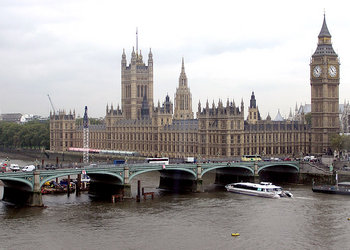
OLYMPUS DIGITAL CAMERA

Mr Carmichael: I thank the hon. Lady for the very constructive tone of her response. Working with people across parties has been an interesting experience, as it always is in Scotland, and it is clear that the process of cross-party working will have to continue if the will of the Scottish people expressed on 18 September is to be honoured. That will become all the more challenging, although I still believe it will be more effective as a result, for having members of the Scottish National party and Scottish Green party on board. A high price will be paid by any political party that does not enter the Smith commission and the process that follows in good faith.

I echo the hon. Lady’s comments about her right hon. Friends the Members for Edinburgh South West (Mr Darling) and for Kirkcaldy and Cowdenbeath (Mr Brown). All Members from Scotland, and a number from beyond it, played their role in giving leadership across the referendum campaign, but her two right hon. Friends indeed played a particularly important and significant role.

The motion on the Order Paper honouring the timetable has indeed been tabled. On the approach of the Labour party and the Government, I should remind the House that under the Scotland Act 2012 any proposal should have cross-party support, should be based on evidence and should not be to the detriment of other parts of the UK. It is the Government’s view, as expressed in the Command Paper today, that that should also be the guiding principle in relation to the current process.

Dr Liam Fox (North Somerset) (Con): Does the Secretary of State accept that throughout the House many believe that further devolution to Scotland can occur only if there is a rebalancing of the entire constitutional settlement, with English votes on English issues? Does he agree that those who say that that would create two classes of MP are being disingenuous? The House has had an imbalance since devolution; many Members have been able to vote on issues such as health and education in England without having to answer to a single voter for those decisions.

Mr Carmichael: I have said many times that the completion of the job of devolution in Scotland and the process we are now undertaking would unlock the door to further constitutional change across the whole of the United Kingdom, and I believe that to be the case. Let me be clear, however, that the timetable we have set out here will be honoured. If other parts of the United Kingdom are able to take advantage and to move along in our slipstream, so to speak, that will be to their advantage, but we will not delay the implementation of the proposals in Scotland for other parts of the UK.

Anas Sarwar (Glasgow Central) (Lab): Scotland has decided and spoken, and it is now the accepted sovereign will of the Scottish people to work in partnership with the rest of the United Kingdom and support it through devolution. One of the lessons from the referendum campaign, though, is that although our country may not be broken, people believe that our political, social and economic model is broken and does not work for ordinary people. That is why I urge the Secretary of State and, indeed, the entire Government not to fall into the trap of thinking that we can just talk about which politician has what power in what building; more important is what politicians choose to do with the powers they have to make a genuine difference to people’s lives. Will the Secretary of State confirm that the process being talked about is separate from the process being mentioned by others—that of English votes for English laws?

Mr Carmichael: On the hon. Gentleman’s latter point, I think I have already made that clear. I very much hope that once we have done this piece of work, we will in Scotland at last be able to move on to using the powers of the Parliament rather than just talking about them.

Sir Malcolm Bruce (Gordon) (LD) rose—

Sir Menzies Campbell (North East Fife) (LD) rose—

Mr Speaker: Ah! Two distinguished Liberal Democrat knights in heated competition—what a delicious choice! I call Sir Menzies Campbell.

Sir Menzies Campbell: Does my right hon. Friend understand the general welcome there has been in Scotland for the fact that change in Scotland should not be held up to enable England to catch up? Having agreed that position, is it not right for the Government, and indeed for him today, to say that, although not in lockstep, there will undoubtedly be progress on constitutional change for the other nations that form the United Kingdom? Particularly with regard to any possible change in the role of Scottish MPs, does he agree that however superficially attractive it might appear, changes to the Standing Orders would be inappropriate, and that such a change to the role of Scottish MPs should undoubtedly be enshrined in primary legislation?

Mr Carmichael: My right hon. and learned Friend is entirely correct about that. This should be something that does more than just affect just the Standing Orders of this House. Indeed, even if it were to be done in that very narrow way, he would, I suspect, be one of the first to remind me that the House guards very jealously, through your office, Mr Speaker, its right to determine its Standing Orders for itself. It has never normally been the practice for Government to lead on these matters.
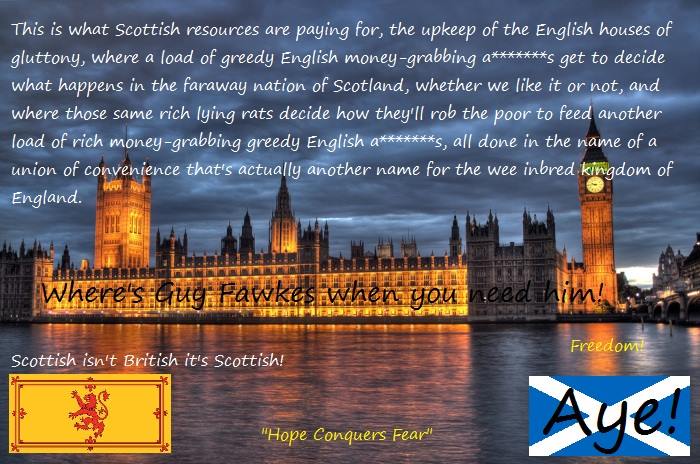
westminster fraud

Mr William Bain (Glasgow North East) (Lab): Does the Secretary of State agree that the Smith commission process will require compromise and good faith from all political parties in Scotland? Does he also agree that in the agreement that comes we must see the sharing of resources across the United Kingdom? Is not that in keeping with the spirit of the way in which the Scottish people voted on 18 September?

Mr Carmichael: I think Lord Smith has already made it clear that he is not going to deliver independence by the back door. Whatever proposals he comes up with on St Andrew’s night in relation to further devolution, they will be in the context of there continuing to be a United Kingdom, and the constitutional integrity of the United Kingdom will be respected.

Mr Bernard Jenkin (Harwich and North Essex) (Con): Does my right hon. Friend agree that we ought to learn some lessons from this near-death experience of the United Kingdom and the fact that we did not intend the winning margin to be as narrow as 10%? Does he also agree that if we are to avoid another referendum, Westminster politics and Westminster politicians must raise the tone of debate with our Scottish counterparts in order to ensure that we develop more of a relationship of mutual respect, with less opportunity for the nationalists to make mischief?

Mr Carmichael: There are indeed many lessons to be learned from this, and their full extent will probably not be apparent for some time to come. This statement is an important part of the process, because it is very important that the Government, with the official Opposition as well, are able to demonstrate to the people of Scotland that we are making good the commitment that we made in the course of the referendum campaign. Politicians doing what they say they will do in that way is probably the most important thing we can do to restore faith in politics.

Pete Wishart (Perth and North Perthshire) (SNP): The Secretary of State is, of course, right: the referendum was an incredible, transformational event that gripped and energised our whole nation. I am sure he will want to join me in congratulating the Scottish people on the way in which they went about that business. He is also right to say that Scotland is moving on. According to one opinion poll, two thirds of the Scottish people want devolution maximum—everything devolved, other than foreign affairs and defence. Three quarters have said that they want all taxation devolved to Scotland. This is the thing, isn’t it? There might be a Command Paper, but the people in charge of this process are the Scottish people themselves and we will be judged by their good judgment on what they want for their future.

Mr Carmichael: May I say again that I welcome the participation of the hon. Gentleman’s party in the Smith process? I very much hope—in fact, I believe—that that is being done in good faith. However, perhaps the hon. Gentleman should take heed of the 60.19% of the people in his own area who voted to remain part of the United Kingdom. If he tries to subvert the Smith process by getting independence through the back door, as others have said, he will pay a heavy price.

Sir Malcolm Rifkind (Kensington) (Con): Should we not all be grateful to the Scottish National party for having called the referendum? Has it not in fact provided an opportunity for the Scottish people in the 21st century to show that they have come to the same conclusion as their ancestors in 1707 that the best interests of all the peoples of this island are to have a British citizenship in a United Kingdom?

Mr Carmichael: There are, indeed, occasions when we should be grateful to the Scottish National party; they are few and far between, but this may, in the way the right hon. and learned Gentleman describes it, be one of them. It was not, of course, the Scottish National party that called the referendum; it was an agreement between Her Majesty’s Government here and the Scottish Government in Edinburgh—the Edinburgh agreement—that gave the basis for it to happen. It would be helpful for the SNP leadership to now make it clear that we have met the terms of the Edinburgh agreement, that the decision was fair, legal and decisive, and that, accordingly, we will not revisit the process.

Gregg McClymont (Cumbernauld, Kilsyth and Kirkintilloch East) (Lab): As a Labour nominee to the Smith commission, may I welcome the Secretary of State’s constructive comments? In that spirit of constructive dialogue, as we approach the debate about further devolution will he consider bringing forward the public information campaign on the raft of tax powers that are to be transferred to the Scottish Parliament by 2016?

Mr Carmichael: I wish the hon. Gentleman and his colleagues well on the Smith commission; he has a job of work to do, but he is very well qualified to do it. I will give consideration to his question about our public information campaign on the powers already coming from the 2012 Act.

Sir Hugh Robertson (Faversham and Mid Kent) (Con): The Secretary of State is to be commended for introducing the Command Paper in such a timely fashion. Has any thought been given to the lessons learned from this campaign, particularly whether a simple majority of 50% plus one is sufficient for a matter of such far-reaching constitutional implications?

Mr Carmichael: I have thought of little else in the past few weeks. I know that when referendum processes are undertaken in other parts of the world a debate often takes places on the point raised by the right hon. Gentleman. My view continues to be that 50% plus one should be the threshold for any referendum in a democracy.

Mr John Denham (Southampton, Itchen) (Lab): It is clear that Scotland will now get what Scotland wants, and so England must get what England wants. The Secretary of State has outlined a process through which the debate about Scotland’s future reached every corner of Scottish society. Does he agree that, in determining our future, England must have that same opportunity and that to push changes through a narrow Cabinet Committee on an artificially short time scale would be absolutely unacceptable?

Mr Carmichael: In relation to the work of the Cabinet Committee, there is not of course a time scale, except that we are looking towards the next general election in May 2015. I would say to the right hon. Gentleman that we are perhaps more familiar with the process in Scotland than in the rest of the United Kingdom. We have been round this course at least twice: first with the constitutional convention, and then with the Calman commission in 2008. On each occasion, we brought together political parties and the voices of business, trade unions, churches, local authorities and others to build consensus, and then we implemented it. That is the way that people are best guaranteed to get the constitutional change they want.

Mrs Cheryl Gillan (Chesham and Amersham) (Con): The Secretary of State knows that, with the advent of devolution under the previous Labour Government, the number of seats for Scotland in this House was reduced from 72 to 59. With further devolution, will he support a reduction in the number of seats for Scotland in this House?

Mr Carmichael: No.

Tom Greatrex (Rutherglen and Hamilton West) (Lab/Co-op): Further to that question, I note that the Secretary of State has made it clear that implications for other parts of the United Kingdom will follow from this process, and some of those points are set out in the Command Paper. Will he clarify that? On page 43 of the Command Paper, it states that the Liberal Democrat commission’s view is that

“the present level of Scottish representation at Westminster should be retained until a federal structure for the UK has been delivered”. Does that remain his position and that of his Front-Bench colleagues?

Mr Carmichael: That remains the position of my party.

Sir Malcolm Bruce (Gordon) (LD): May I first welcome my right hon. Friend’s Command Paper? As somebody who led our party in the constitutional convention, I welcome the fact that the Scottish Parliament will now get proper tax-raising powers. Does he agree that anything more than 50% looks a lot like home rule and a shared partnership? To those who want devolution within England, may I say, “You have our support, but it is quite difficult to support something that is unclear”? We need a constitutional convention. I suggest that devolution has in every case been accompanied by electoral reform and proportionality, and that should also be a condition in England.
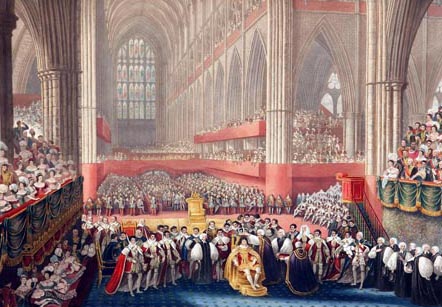
Coronation of George IV, 1821, Westminster Abbey.

Mr Carmichael: It is an important point that devolution has in every case been accompanied by electoral reform, and that institutions to which power is devolved are always elected proportionately. I cannot add a great deal to my answer to the right hon. Member for Southampton, Itchen (Mr Denham) on the need to build consensus in whichever way people in England choose. In Scotland, we have done it in a way that has worked for us twice, and will I believe now work for us a third time. It could work for people in England, but it is for them to make up their own minds about that.

Ian Paisley (North Antrim) (DUP): I welcome the Secretary of State’s statement. I welcome more the resounding result of our Scottish kith and kin choosing to stay within the Union, and I welcome the way in which the debate was fought and won. The implications go well beyond the Scottish highlands and islands or the borders: where Scotland goes with devolution, Northern Ireland invariably follows. What engagement will the Smith commission and Lord Smith have with parties in Northern Ireland to ensure that the outcome reflects the needs of all the United Kingdom in all its diversity, especially the needs of Northern Ireland?

Mr Carmichael: Lord Smith has been charged with building a consensus in relation to further powers for the Scottish Parliament. I am sure that if the hon. Gentleman has a view informed by his experience of devolution in Northern Ireland, Lord Smith will certainly be interested to hear it. Given the remit that we have given Lord Smith, however, I do not expect him to say anything in relation to changes for Northern Ireland.

Iain Stewart (Milton Keynes South) (Con): Will my right hon. Friend assure me that the business community on both sides of the border will be fully consulted on the further devolution of powers over personal taxation, because they shoulder much of the administrative burden? Much as further devolution might be desirable, it must not increase the regulatory burden on wealth and job creators on both sides of the border.

Mr Carmichael: Indeed, the voice of business is very important in this process, as it was throughout the referendum campaign. I know from my discussions with the CBI, the chambers of commerce and others that they are working on their proposals. I urge all collective organisations, individual businesses and individual citizens who have something to say to come forward and say it—this is their time.

Graeme Morrice (Livingston) (Lab): Will the Secretary of State confirm that the decisive no vote was not a vote for the status quo, but a vote for continued change, and that we in this House must deliver and be seen to deliver on our commitments to further Scottish devolution quickly, inclusively and decisively, without tying them to any decentralisation plans for south of the border?

Mr Carmichael: I am happy to give the hon. Gentleman that assurance, which I have already given on two or three occasions this afternoon. There are few things that would be worse for the constitutional integrity of the United Kingdom than our not delivering on the promises that we made or not meeting the timetable. It is because I care so much about keeping the United Kingdom together that I am determined that we will meet the timetable that we have laid out.

Sir William Cash (Stone) (Con): Today’s Command Paper does not contain a section dedicated to the supervening question of the position of European law in relation to Scotland. That is a reserved matter under the Scotland Act 1998. Will the Secretary of State give an absolute and categorical assurance that, having saved the Union of the United Kingdom, under no circumstances will we surrender the Scottish functions to the European Union?

Mr Carmichael: I would be more than happy for the hon. Gentleman to engage directly with Lord Smith. Indeed, I will make every effort to explain to Lord Smith what he might expect.

Mr Brian H. Donohoe (Central Ayrshire) (Lab): In his statement, the Secretary of State said: “It is important that everyone now accepts this result”. The $64,000 question is how long it will be before the SNP demands another referendum.

Mr Carmichael: Demands for a further referendum would have an exceptionally damaging effect on Scottish businesses, Scottish jobs and the Scottish economy. We know that because we can see what happened in Quebec in Canada when the separatists did not accept the outcome and came back a second time. We know what happened to the financial services sector in Montreal. I do not want that to happen in Scotland. Unfortunately, I cannot dictate what the Scottish National party will do, but I say to it that if it does not make it clear that it accepts this result and if it does not engage in the Smith commission in good faith, it will suffer.

Crispin Blunt (Reigate) (Con): As my right hon. Friend congratulates the people of Scotland on the 85% turnout in the referendum, I hope that he will reflect on the 85% of people in the United Kingdom who did not get a vote on the Union: namely, the people of England. He has no mandate from me or my constituents to devolve further powers to Scotland, while expecting my constituents to bankroll it and failing to address the issue of English votes for English laws.

Mr Carmichael: I fear that my hon. Friend does not quite reflect the intricacies of the settlement in the United Kingdom. I invite him to reflect on that at some leisure. I understand completely the concerns that he expresses about the position of England within the United Kingdom. Of course that discussion needs to take place. We have had such a discussion for decades in Scotland and I wish the people of England well in having it, but I cannot emphasise too strongly that that discussion cannot and will not hold up the delivery of the powers to the Scottish Parliament.

Cathy Jamieson (Kilmarnock and Loudoun) (Lab/Co-op): A key principle during the referendum debate was the delivery of fairness in Scotland. I was pleased to hear the Secretary of State confirm that the principle of pooling and sharing resources across the United Kingdom will be fundamental. Will he say more about whether Lord Smith will have access to various resources within the Treasury and the Government so that he can produce further analysis of the various proposals that have been put forward by the different political parties, with the principle of the pooling and sharing of resources in mind?
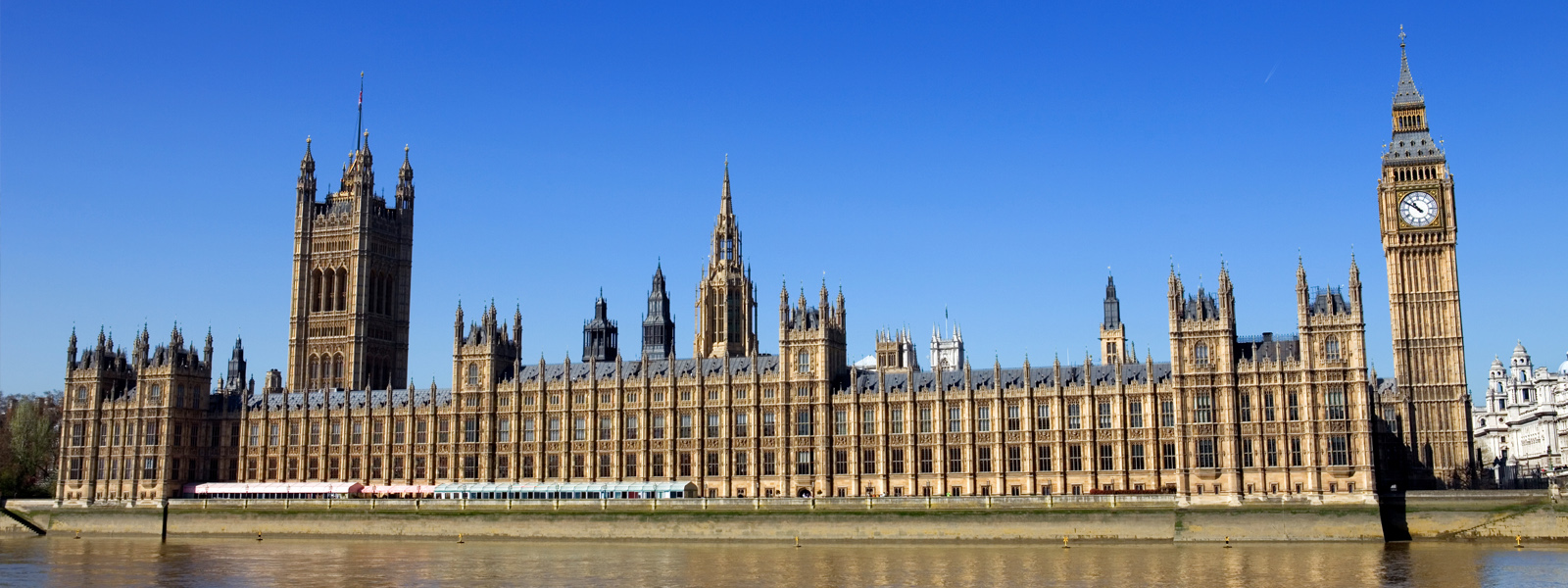
palce_westminster

Mr Carmichael: The secretariat for Lord Smith’s commission is already supported by civil servants from the Scotland Office, the Cabinet Office and the Treasury. I met Lord Smith on the Monday following the referendum and I told him then—I am happy to repeat this commitment publicly—that any resources that he felt he needed would be given, such is the importance that we attach to the work with which he has been tasked.

Sir James Paice (South East Cambridgeshire) (Con): Does my right hon. Friend agree that one of the holes in the current devolution settlement, as some of us pointed out at the time, is that effectively the Scottish people have representation without taxation? We must ensure that the Scottish Government have not only the power but the obligation to raise some of their taxes, thus increasing their accountability and enhancing democracy.

Mr Carmichael: My right hon. Friend is absolutely right. The completion of the job of devolution requires the Scottish Parliament to be given control of at least half its budget—preferably more in my view, although we will see what Lord Smith comes forward with on that in the fullness of time. It is important for the rebalancing of the political debate in Scotland that we have a Parliament that debates not only how to spend money, but how to raise it.

Katy Clark (North Ayrshire and Arran) (Lab): Does the Secretary of State agree that the high level of participation among ordinary members of the public in the referendum debate was incredibly important, and a stark contrast to the debate leading up to the Scotland Act 2012, which of course delivered substantial further powers to the Scottish Parliament on the taxation and indeed borrowing that come to it? Does he agree that we must listen to the message of that debate, which was that whether people voted yes or no, they wanted change and we have failed to deliver on social justice? Will he hold a public education campaign and ensure that the Government talk not only about the powers that need to be delivered, but about how those powers can be used by the Scottish Parliament to deliver social justice?

Mr Carmichael: Having a short process such as the one we have outlined allows early delivery of those powers, and that will allow us to get on to talking about how we use those powers, not just where they are. I share the hon. Lady’s commitment to progress and social justice, and one thing that is clear from 18 September is that people in Scotland, and elsewhere, understand that these are often complex and subtle problems that we cannot solve just by drawing a line on the map.

David Mowat (Warrington South) (Con): Does the Secretary of State agree that part of this settlement needs to be a public spending agreement that is fair to all four nations of the UK? On that basis, will he be reviewing the Barnett formula to ensure that it continues to reflect relative need and will do so in the future?

Mr Carmichael: Part of the vow made by the three party leaders was that there would be no change to the Barnett formula, and that remains Government policy.

Jonathan Edwards (Carmarthen East and Dinefwr) (PC): With the Wales Bill about to proceed to the other place, what improvements will the UK Government bring to the Bill to reflect the changing constitutional landscape following events in Scotland?

Mr Carmichael: I am afraid that the answer to that question will have to be delivered by my right hon. Friend the Secretary of State for Wales.

Mike Crockart (Edinburgh West) (LD): I thank my right hon. Friend for his statement, and may I echo his call for all of Scotland, whether part of the 45%, 55%, or indeed 65% of my constituents in Edinburgh West who voted no, to now set aside our differences and party affiliations and ensure that the will of the Scottish people is delivered?

Mr Carmichael: I echo that sentiment, and having campaigned on a number of occasions with my hon. Friend in his constituency during the referendum campaign, I was not in any way surprised that his constituents voted by such a handsome margin; it was almost as good as the decision in Orkney—[Interruption.] Shetland also voted no very heavily. The best way to capitalise on that magnificent result is for us in this House to demonstrate good faith in relation to the vow.

Jim McGovern (Dundee West) (Lab): I am mindful of the previous hon. Member’s contribution. At the risk of sounding partisan, we see the separatists’ turnout here today. Are they really the party that stands up for Scotland? They cannot even turn up for Scotland.

Mr Carmichael: I am sure there are good reasons why hon. Members are here or not, and they can explain that for themselves.

Andrew Percy (Brigg and Goole) (Con): The Secretary of State is absolutely right that the vow must be made good on, but the devolution of considerable additional powers to Scotland has a particular impact on the north of England and we need a long-term solution to our constitution. One thing that could very quickly enhance the voice of the north is to deliver English votes for English laws. Can the Secretary of State confirm that there is absolutely nothing to prevent that happening in tandem with the new powers for Scotland?
never give up

Mr Carmichael: To make any change of that sort, it will be necessary for the parties to build consensus and to deliver it through this House. That is something that goes beyond my responsibility.

Mrs Anne McGuire (Stirling) (Lab): Given the enthusiasm of the Scottish electorate during the referendum campaign, how will the Secretary of State maintain the enthusiasm, engagement and transparency of the process, so that on 30 November it does not look as though we have delivered a fix, instead of something that has support among the Scottish people?

Mr Carmichael: I will be more than happy to play my role in the process that the right hon. Lady outlines. There is a duty and an opportunity for all of us, across all the parties, to play a role. The electorate has rebooted politics in Scotland. It is for us now to respond to the initiative that has been taken by the people.

Mr Philip Hollobone (Kettering) (Con): I am told that on all sorts of measures Kettering is the most average borough in England. I would contend that Kettering people are the most fair-minded people in England. I am sure that my constituents would be very happy for Scotland to have lots more powers so that it can decide things for itself. However, what the fair-minded people of Kettering cannot accept—I would like the Secretary of State to try to explain it to them—is the Scottish people receiving premiums for public services, over and above what the average English taxpayer gets in England, unrelated to relative deprivation.

Mr Carmichael: The flow of money between the different parts of the United Kingdom comes and goes at different times over the years. What we have—Scotland has just said that it wishes to continue to be part of this—is a situation in which we all share and pool risks and resources. That is what the people of Scotland have voted for. I hope the hon. Gentleman will sign up to that too.

Sheila Gilmore (Edinburgh East) (Lab): In relation to greater devolution, one proposal that my party made was for the devolution of housing benefit. I appreciate that to some extent that cuts across one of the current Government’s pet projects, universal credit, but will the Secretary of State assure me that his colleagues on the Government Front Bench will be as flexible as possible and willing to see changes that will really help people in Scotland. Incidentally, this proposal might get his Government off one of their uncomfortable hooks—a policy that is not even going to work.

Mr Carmichael: Time will tell exactly what the change to universal credit achieves. On the devolution of housing benefit and other matters, we will wait and see what Lord Smith comes forward with. It is not appropriate at this stage for me, as a Minister, to second-guess what he might come up with, but the Government will respond in good faith when we see his heads of agreement.

Mrs Anne Main (St Albans) (Con): The Secretary of State will be aware that very late in the campaign all three party leaders promised significant extra powers to the people of Scotland. What calculations were done on the costs of implementing any additional powers? I heard the Secretary of State say that all resources would be given in terms of making up the deal, but when will the House see any figures associated with what will happen in the name of giving extra powers to Scotland?

Mr Carmichael: May I gently correct my hon. Friend on one point? The proposals of the three parties that support the continuation of the United Kingdom were published, in some cases, 18 months ahead of the independence referendum, and all certainly were published well before the summer. What was made clear in the latter stages of the referendum campaign was the timetable that would be followed. That was the essence of the new commitment that was made. On the figures that will be available, I am afraid that my hon. Friend will, like the rest of us, have to wait until Lord Smith comes forward with his heads of agreement on 30 November, because we cannot put figures on something that we do not yet know the details of.

Sandra Osborne (Ayr, Carrick and Cumnock) (Lab): These powers are, of course, extremely important, but may I join colleagues on the Opposition Benches in emphasising the need for further devolution to deliver on social justice and equality? That is what the Scottish people voted for, and it is what they want to hear. We are very proud of our young people and the way they conducted themselves and engaged with the campaign, but does the Secretary of State agree that it is illogical to give them a vote for just one election?

Mr Carmichael: I certainly join the hon. Lady in congratulating 16 and 17-year-olds on the enthusiasm and vigour that they brought to the campaign, which was one of the most heartening aspects of the whole process. Although this goes beyond the next general election, I think it would be difficult for any future Government to resist such a change across the whole of the United Kingdom, and, having seen its effect in Scotland, I do not see why anybody would want to.

Michael Connarty (Linlithgow and East Falkirk) (Lab): I commend the Secretary of State for being able to take the heat out of a situation better than almost anyone else in politics. He has taken some heat himself during the campaign. Will he assure me that the people who do not shout the loudest—people who do not gang up on others—will be heard by the Smith commission? I am talking about the quiet people—the 10,000 contacts I had from constituents who said they wanted this to be solved, whether they voted yes or no, and who wanted their group, whether it was a non-governmental organisation or a charity, to be heard by whoever designs the future of Scotland within the Union.

Mr Carmichael: The hon. Gentleman commends me on taking the heat out of the situation. I wonder if that is perhaps an oblique way of saying I am boring if that is what is necessary. I have certainly been accused of an awful lot worse than that during my 13 years as a Member of this House. In terms of engaging the quiet majority who spoke, the hon. Gentleman is absolutely right: it should not just be the squeaky wheel that gets the grease. Anybody who has a view on how Scotland can be better governed should be able to express that view and expect it to be given the respect it will undoubtedly deserve.

Gemma Doyle (West Dunbartonshire) (Lab/Co-op): The people of Scotland have made a positive choice to stay in the UK. There is clearly support for the further devolution proposed by the three parties, and that must now happen and that process must move forward. I understand that there need to be discussions about devolution to other parts of the UK, but will the Secretary of State urge calm among his colleagues? It will be ludicrous if the result of this vote is that we start to rip apart this Parliament because of their ill-thought-out and rushed proposals.

Mr Carmichael: I cannot restate too often the importance of building the broadest possible consensus. It has taken us decades to do that in Scotland, and the Smith commission is just the latest iteration. I believe that parties in England, Wales and Northern Ireland now have to enter into that process with the same good faith we are showing in Scotland. There is no alternative to building that sort of consensus. Reflecting on some of the efforts of this Government, I see no other way of achieving constitutional reform than by building that consensus.

Ms Gisela Stuart (Birmingham, Edgbaston) (Lab): I wish the Secretary of State well in completing the process of devolution to Scotland, but it cannot be denied that that will leave unfinished business in the form of devolution in England to our great cities outside London such as Birmingham. In his capacity as a Cabinet member of the United Kingdom Government, is he talking to his colleagues—particularly the Minister responsible for cities—about how the greater devolution of power to cities in England can take place in tandem with the work that he is doing in Scotland?

Mr Carmichael: I reiterate that I hesitate to use terms such as “in tandem” because they might suggest a link that could cause delay for one process or the other. It is apparent to me that there is an increased appetite for discussing constitutional change, especially in England. I see that among my own family living in England. I think that it is entirely healthy, and I will encourage it in any way I can. The hon. Lady mentioned devolution to cities. I believe that this Government’s record on city deals and on giving opportunities and resources to cities represents one of our biggest successes. It has probably brought more significant change to the way in which England is governed than many people realise.
john McLean

Wayne David (Caerphilly) (Lab): I strongly support more powers for the Scottish Parliament, but as the Secretary of State has said, there is a growing appetite for more devolution throughout the whole of the United Kingdom, perhaps in different forms. Will he therefore support the sensible suggestion that the way forward might well be to have a constitutional convention?

Mr Carmichael: I have already made it clear that I am something of an enthusiast for that process, having been through it north of the border. I have always thought that there were applicable lessons for the rest of the United Kingdom, but I have to tell the hon. Gentleman that I do not see us resolving that issue this side of the general election.

Mr Iain McKenzie (Inverclyde) (Lab): I do not think that it is lost on the Secretary of State, or on any of the hon. Members in this House who took part in the referendum campaign, that there are now deep divisions among the Scottish people. Does he agree that, if those divisions are to be healed to allow people to come together, a good starting point would be for the leadership of the Scottish National party to acknowledge that the question of Scottish independence is now dead for decades?

Mr Carmichael: I have already made it clear that I expect the leadership of the Scottish National party—in whatever shape or form it eventually emerges—to give that commitment to the Scottish people. That was what the party signed up to in the Edinburgh agreement and that was what it was saying in the week before the referendum. I see no reason why it should not stick to that position.

Chris Bryant (Rhondda) (Lab): I am absolutely certain that the events in Scotland will lead to further devolution in Wales and in England, but what analysis has the Secretary of State made of the proposals on English votes for English laws? Would it not be bizarre if Scottish MPs were barred from voting but Scottish peers were allowed to vote on exactly the same legislation? Such peers could include the ninth Earl of Arran, the 14th Earl of Stair, the 16th Earl of Lindsay and, for that matter, Lord Smith.

Mr Carmichael: Lord Smith is not an hereditary peer. As my right hon. Friend the Member for Yeovil (Mr Laws) has already said, where we have devolved, we have devolved to a legislature, be it a Parliament or an Assembly, that is elected proportionally. That has been an important part of the way in which we have gone about the process of devolution, and I think that the people of England should be entitled to that as well. The essential difficulty that the hon. Gentleman touches on is that it is—[Interruption.] He knows my views on an unelected House of Lords. It is very difficult to devolve within Parliament but not the Executive, and that is something that those who want changes of this sort will have to address and explain.

Disgraced Ex Assistant Metropolitan Commissioner Bob Quick – His and Gordon Brown’s Participation In The Damian Green Whistle-Blower Witch-Hunt Fiasco – No Mention Of Computer Porn


July 1985; Gordon Brown, “The Leaker” Sets The Standard For Jim Murphy And Fellow Labour Politicians To Follow

During his long years in opposition Brown became a regular conduit for publicising confidential documents leaked to him by civil servants and he was admired for the way he could put them to good use when attacking the Conservatives.

In distributing his leaks and tip-offs among the political correspondents of Westminster, he had made some friends for life.

Once Labour were in power, he demonstrated an equally deft touch when making use of the journalists he could trust.

The press build-up his Budgets and financial statements was always carefully manipulated to prepare the ground for any changes which he intended to make and Brown has continued as Prime Minister to be Labour’s leading exponent of institutionalised leaking.

The master leaker had the Tory Damian Green arrested on allegations of the same thing whilst he was Prime Minister.  

Yet at the time he was interviewed by the BBC’s Frank Bough in July 1985 he just couldn’t avoid gloating and smirking about the leaks he had orchestrated, received and passed on through his network of minions who were always eager to do his murky deeds.

Many people will have cause to have hatred in their hearts for him.

He has departed the scene as a politician, but he leaves a foul stench that will linger for years to come.

https://www.youtube.com/watch?v=QIrweIqqsOc


December 2008; The Damien Green Fiasco – Scotland Yard Determined To ‘Motor On’ In Tory Leak Case

The Telegraph has learnt that senior officers met with lawyers from the Crown Prosecution Service last week to discuss possible charges against Damian Green and Christopher Galley, who are under investigation over allegations of leaking confidential information.

MPs on the all-party Home Affairs Committee are preparing to launch their own investigation into the affair, in a move which will intensify pressure on the Metropolitan Police and on Michael Martin, the Commons Speaker.

Mr Green, the Tory immigration spokesman, was questioned for nine hours and had his homes and Commons office searched 10 days ago.

He is suspected of receiving leaked documents.

Ten days earlier Mr Galley, 26, an assistant private secretary at the Home Office, was arrested at his home at dawn and taken to Paddington Green, the most high security police station in Britain.

He is suspected of leaking the information.

Senior officials at Scotland Yard, who have been accused of being heavy handed, denied yesterday that they are “backtracking” over their actions or seeking to drop the case.

They remain satisfied that they acted lawfully and proportionately, even though there is understood to have been disagreement at the highest level within the Met over whether Mr Green’s arrest should go ahead.

Sir Paul Stephenson, the Acting Commissioner, was told of the plan in advance and challenged Bob Quick, the head of anti-terrorism at the Yard and the man who ordered the arrest, over the wisdom of the move.

Sir Paul has now called in one of Britain’s most senior police officers to scrutinise his force’s handling of the operation.

Ian Johnston, chief constable of the British Transport Police and chairman of the Association of Chief Police Officers crime committee, will produce an interim report on the case on Tuesday and a full report the following week.

One source said: “We are not looking to drop this action. If Ian Johnston says everything was handled properly, then we will motor on.

We are confident that we have acted legally and the investigative team is happy it took proportionate action.

But a fresh pair of eyes [Ian Johnston] may see it differently to others who are close to the case.”

Mr Martin’s position was eroded yesterday when a Labour MP called for him to quit over the police raid.

Bob Marshall-Andrews said that Mr Martin had lost the confidence of the House after he allowed police to enter the Commons without a search warrant, and should now go.

Mr Marshall-Andrews, who is the first Labour MP to call for the Speaker’s resignation, said that Mr Martin’s handling of the affair represented a “deplorable breach of his duties”.

The Home Affairs Committee investigation, revealed today, is set to be announced this week.

It is understood the official in charge of security for the House of Commons, Jill Pay, the Sergeant at Arms, will be called to give evidence, as will senior Scotland Yard officers including Sir Paul and Mr Quick.

Jacqui Smith, the Home Secretary, and Sir David Normington, her permanent secretary, are also expected to be called.

Mr Martin is not expected to be called, but it is understood his role in the affair will also come under scrutiny.

Commons officials could have demanded that police had a warrant before they searched Mr Green’s parliamentary office, but allowed officers to proceed without one – a decision which has caused widespread anger among MPs.

Mr Martin has announced plans for a separate all-party inquiry into the “Greengate” affair, but it will be launched only after the police have concluded their investigation, which may take months. Mr Green has been bailed until February.

Keith Vaz, the Labour chairman of the Home Affairs Committee, said he feared there could be a long delay before the findings of the formal parliamentary inquiry were known.

He said: “We welcome the fact that the Speaker is setting up an inquiry through a motion put forward by Harriet Harman, but we are concerned by the fact that it is to be delayed until after possible criminal proceedings come to an end.

This is all required rather more urgently than the motion allows.” In a statement to the Commons last week, Mr Martin expressed “regret” that police officers were admitted to the Palace of Westminster without his personal authority.

He claimed that officers did not inform Ms Pay that she could decline their request for consent to carry out a search.

However, in a letter to Ms Smith, which was made public last week, Mr Quick, an Assistant Commissioner at Scotland Yard, appeared to contradict the Speaker’s statement.

Scotland Yard has said that Mr Green was held “on suspicion of conspiring to commit misconduct in a public office and aiding and abetting, counselling or procuring misconduct in a public office”.

The likelihood of a charge is thought to centre on whether the MP directly asked Mr Galley to provide leaked information, which would be illegal.

The Tories insist that they merely received information from a whistle-blower.

Mr Quick is understood to have reassured Sir Paul before Mr Green’s arrest that he was confident that correct procedures had been, and would be, followed.

Both men have applied to be the new Metropolitan Police Commissioner.

When the news of the leak inquiry broke, Mr Galley was moved to an RAF base at taxpayers’ expense to isolate him from reporters and the Westminster rumour machine.

The civil servant was smuggled into RAF Uxbridge in west London and remained there voluntarily for several days in a carefully-planned Home Office operation.

A Home Office spokeswoman refused to comment on the manoeuvre.

The civil servant is understood to have since moved off the base “under his own volition”.

Gordon Brown and Ms Smith have both denied involvement in the decision to arrest Mr Green and insisted that it was purely a matter for the police. (The Telegraph)


labourneveragain(willy)


December 2008; New Laws To Permit Search Of MPs’ Offices Without a Warrant

A new Bill outlined in last week’s Queen’s Speech contains small print allowing officers of the Electoral Commission unfettered powers to search MPs offices or homes.

If the Commons’ Speaker tried to stop the searches, he would be committing a criminal offence.

The details of the Political Parties and Elections Bill, appear to blow out of the water claims by Michael Martin, the Speaker, that in future no MP’s office will be able to be searched without a warrant.

Mr Martin, who is clinging to his job in the wake of the police raid on the office of Mr Green, the Conservative immigration spokesman, made his claim during his statement on the affair in the Commons last week.

Last night Francis Maude, the shadow minister for the Cabinet Office, branded minister’s new plans “alarming” and said they were a further blow to parliamentary privilege.

Currently, Electoral Commission officials are allowed to make unannounced raids, without a warrant, on the offices of political parties, to search for information or documents.

The new Bill seeks to widen these powers to apply to the offices or homes of “regulated doners”, which include MPs.

No warrant would be needed – just a “disclosure notice” issued by the commission itself.

The new laws could also apply to the homes and offices of anyone who has ever made a donation to a political party.

The Speaker told the House of Commons in his statement last week that “from now on a warrant will always be required where a search of a Member’s office or access to a Member’s Parliamentary papers is sought. Every case must be referred for my personal decision as it is my responsibility.”

However, under the new proposals, he would not be consulted and he would face arrest if he resisted.

The Damian Green case has taken a new twist after it emerged that ministers plan to legislate to make it easier for state officials to raid MPs’ offices without a warrant. (The Telegraph)


December 2008; The Damian Green Affair: The Unanswered Questions

* Did the Commons Speaker, Michael Martin, really play such a small part in the decision to allow the police to search Mr Green’s office as he claimed in his Commons statement last week?

* If so, why was he not fully involved in making such a major decision?

* Will the Sergeant at Arms, Jill Pay, explain publicly for the first time why she allowed police to search Mr Green’s House of Commons office without a warrant?

* Whom did the Sergeant at Arms consult before making her decision to give written consent for the search?

* Why was Jacqui Smith, the Home Secretary, not informed in advance of the raid on Mr Green’s offices, as she claims?

*Did Jacqui Smith instruct her staff in advance not to inform her if any opposition politicians were about to be arrested?

*Did the alleged whistle-blower, Christopher Galley, provide Damian Green with any information which threatened national security?

*Did Mr Green ask Mr Galley to leak particular documents?

* Did Mr Galley receive payment or the promise of a job in return for leaking?

* Were the police misled by civil servants about the severity of the leaks?

*Specifically, were police told that the leaks involved high-level state secrets involving terrorism?

* Did Scotland Yard make any attempt to obtain a warrant to search Mr Green’s office?

* If so, were they refused?

* What steps have been put in place by Scotland Yard to protect sensitive and private communications between Mr Green and his constituents, particularly as some of the information may relate to the police themselves?

* Will Gordon Brown, and other senior Labour figures, come under any sort of official scrutiny regarding leaks of government material they obtained and released when Labour was in opposition?  (The Telegraph)


Gordon-Browns-Cabinet-001


December 2008; Speaker Michael Martin Under Pressure As MPs Prepare To Debate Damian Green Affair

MPs are set to increase the pressure on Michael Martin, the Speaker of the House of Commons, when a debate on the way police were allowed to search a Tory MP’s office gets under way at Westminster.

Damian Green, the shadow immigration minister, had both his Commons office and home searched by anti-terrorist police investigating a Whitehall whistle-blower.

Last week Mr Martin admitted that he did not know about the search and blamed his junior officials – in particular Jill Pay, the Sergeant at Arms – for allowing the raid to go ahead without a warrant.

MPs do not usually criticise the Speaker, but that convention will now be put under strain.

Some MPs have openly questioned Mr Martin’s position.

David Cameron, the Conservative leader, used very careful language over the weekend.

He said he “wanted” to have confidence in the Speaker.

Senior Labour figures are now discussing a plan to persuade Mr Martin to announce he intends to stand down at the next election. (The Telegraph)


December 2008; Commons Speaker Michael Martin Under Pressure From MPs

The position of the Commons Speaker Michael Martin is looking increasingly precarious after a poll of MPs found more than 30 backbenchers say they have lost confidence in him.

On the eve of a crucial Commons debate on the Damian Green affair, more than a third of MPs responding to a BBC survey indicated the Speaker should go.

The findings came as more senior figures voiced their misgivings at his handling of the whole affair, while one former deputy speaker said that he should now stand down “with a degree of dignity”.

The survey, by Radio 4’s The World This Weekend programme, approached 130 MPs of whom 90 took part.

Of those, 32 said that they had lost confidence in Mr Martin.

They included eight Labour MPs, 14 Tories, and seven Liberal Democrats.

Another 50 said that they thought the Speaker was in some way “culpable”, including 14 Labour, 22 Tories and 14 Liberal Democrats.

Labour former minister Stephen Ladyman was one of a series of senior backbenchers to express misgivings at one had happened. “It is a very serious matter for a Member of Parliament to lose confidence in the Speaker,” he told The World This Weekend. “We will be incredibly distressed if the inquiry throws up evidence that there was any level of culpability in the Speaker, that he did have the opportunity to do something about it but didn’t do it. “It is a very serious matter and we have to put our loyalty to democracy before our loyalty to the Speaker and our friendship with the Speaker.”

Tory former foreign secretary Sir Malcolm Rifkind said that the concerns were widely shared across Parliament. “I say it with a great degree of sadness that I was deeply surprised and very, very disturbed,” he told The World This Weekend. “One can’t just say it is a small number of people who are worried and concerned. I think most Members of Parliament, regardless of political party, believe the way in which these matters were handled in the last week was seriously flawed. “I don’t think I am being controversial in saying I don’t think that Speaker Martin will go down as one of the great Speakers of the House of Commons.”

Liberal Democrat health spokesman Norman Lamb said that it was “unfair” that the Sergeant at Arms Jill Pay had been left by Mr Martin to shoulder the responsibility for allowing police into the Commons without a warrant. “It is right to say that MPs are reluctant to criticise any Speaker, but I felt that I couldn’t just sit on my hands when a senior member of staff was treated in that way and I think that ultimately we become complicit if we remain silent,” he told the programme.

However the most scathing comments came from the former deputy speaker Michael Morris, now Lord Naseby, who said that he was “amazed” that Mr Martin had not stopped the police from entering. “Why the Speaker was not in lead role is something I find absolutely incomprehensible,” he told The World This Weekend. “He needs to reflect on that situation. I don’t think that it is for the members to necessarily put down a motion of no confidence, because that is a very drastic stage, but I think he needs to reflect on his position frankly. “In my judgment he has let the House of Commons down.” He said that he believed that Mr Martin should now consider stepping down before the next general election in order to give his successor a chance to settle in, “We are all human, we make mistakes. In my judgment he has made a mistake, and a very big mistake, and I think you go out with a degree of dignity,” Lord Naseby said  (The Telegraph)


republicandarling


December 2008; Damian Green Affair Must Never Be Repeated

Sometimes vindication can be a bitter pill.

Despite the intensity of my belief that this government was systematically undermining our historic freedoms, even l was shocked by the senseless and insensitive behaviour of our police force in arresting my close friend and colleague, Damian Green.

Whether it was chaotic mishandling of the first order by the police, the Home Office, and the House of Commons authorities, or the inevitable consequence of a weakened Commons and over mighty Executive, or something even more sinister, we may never know. Whatever the cause, it must never, ever, happen again.

If it is allowed to stand it will fatally undermine the last vestiges of power in the Commons, intimidate legitimate whistle-blowers from highlighting misdeeds and cover-ups in government, and suppress free speech.

We also hear a lot of bogus talk about threats to national security. When this is challenged we are told “we don’t know all the facts.” Well, yes we do, as far as this case goes anyway.

Remember, we are not talking about leaks to the Russians here. We are talking about information that appeared in newspapers, all of which by definition we know about.

That is why this investigation was launched: it has nothing to do with the security of the nation, and everything to do with the psychological insecurity of the Home Office.

The answer lies in making the shield of parliamentary privilege-or democratic protection as it would be better named – a far more robust device.

“The privilege of freedom of speech enjoyed by Members of Parliament is in truth the privilege of their constituents. It is secured to Members not for their personal benefit but to enable them to discharge the functions of their office without fear of prosecution, civil or criminal.”

Those are the words of the House of Commons Privileges Committee, ruling in 1939 that the government would not be allowed to prosecute Duncan Sandys, who had effectively disclosed Britain’s weakness in defence against the looming Nazi threat.

Duncan Sandys had been threatened with prosecution, not for saying what he said, but for refusing to disclose to the government which Civil Servant had given him the information, or help them in their subsequent witch-hunt.

The protections we have as elected representatives should not be absolute – but they should be clear.

A few are currently codified, essentially in the Bill of Rights.

The rest is governed by the House of Commons itself in a combination of convention, consensus and common sense. Last week that combination came apart at the seams.

Members of Parliament do a number of jobs, and each has its implications for privilege.

In dealing with their constituents, they deal in matters of extreme personal trust and confidentiality.

In exposing failings in government, and the associated cover ups, they act more like journalists.

What this all means is that the House of Commons should apply some fairly straightforward tests before allowing the police to ransack the files of an MP and breach the confidentiality of his constituents and informants.

* Firstly, the crime involved should be serious and specific. Neither should it be a widely cast vague charge as “conspiring to commit misconduct in a public office” very much is.

* Secondly, there should be solid evidence. If the MP has not been charged – as Damian Green has not, then this almost certainly means obtaining explicit approval from a Law Officer.

* Thirdly, the charge should not relate to the MP’s legitimate parliamentary activity. The Duncan Sandys case was serious – disclosure of official secrets about military preparedness –yet it was ruled as appropriate Parliamentary action. History proved that judgement right.

* Finally, the intrusion on constituents’ privacy must be absolutely necessary, not some further fishing expedition.

Amid a classic who-said-what-to-whom farrago, the Speaker has been contradicted by the police, who have in turn been contradicted by eminent lawyers.

Even more deplorably, the committee of seven senior MPs proposed to resolve the affair will not even start work until the police (and possibly the courts) have completed their work.

The truth is that the protections we assumed we had for our constituents and whistle-blowers are either not believed in, or are not upheld, by the authorities. Convention has broken down.

The only route left to us is to codify the protections, either in the standing orders of the House, or law, or both.


December 2008; Damian Green Affair: Timeline

MPs are to debate the police raid on the House of Commons office of Tory frontbencher Damian Green amid deepening concern over the role played by Speaker Michael Martin.

Here is a timeline of events surrounding the arrest of the shadow immigration minister:

* October 8: Gus McPherson, Cabinet Secretary calls in the Metropolitan Police to investigate the Home Office leaks.

* November 19: Junior Home Office official Christopher Galley is arrested and suspended from duty.

* November 27: Shadow immigration minister Damian Green is arrested and held by the Metropolitan Police for nine hours, on suspicion of “conspiring to commit misconduct in a public office, and aiding and abetting, counselling or procuring misconduct in a public office”.


December 2008; Labour’s Hypocrisy Over Leaks And Damian Green’s Arrest

Labour cannot shrug off the charge of hypocrisy over the arrest of the Conservative shadow minister Damian Green because under the Blair and Brown governments successive Home Secretaries have engaged in the deliberate and systematic leaking of their own decisions in order to gain political advantage.

Jacqui Smith’s private office at the Home Office was no different to any other in Whitehall.

Right across the various government departments, Labour’s political spin doctors have shown scant regard for the confidentiality of ministerial announcements and they have regularly been trailed in advance through leaks to sympathetic journalists.

The poisonous legacy of Tony Blair’s action in doubling and then trebling the number of ministerial special advisers has been a rapid acceleration in the politicisation of the flow of information from the state to the news media.

Even though young civil servants have had to sign the Official Secrets Act it is no wonder they might occasionally be tempted to leak information.

They work alongside special advisers who also have the status of temporary civil servants but who are not subject to the same rules and who have the freedom to pass on confidential data to journalists.

Tipping off newspapers about the content of forthcoming announcements has become a way of life under New Labour.

When Jacqui Smith defended the Metropolitan Police for arresting the twenty-six-year old civil servant Christopher Galley and the Conservative shadow minister Damian Green she complained about there having been “a systematic series of leaks from the department which deals with some of the most sensitive confidential information in the government”.

But she could just as easily have been giving the job description of one of the many Labour Party spin doctors working at the heart of the government.

There has been a systematic trailing of Home Office decisions on her watch, just as there was during the tenure of her predecessors who showed the same cavalier disregard for parliamentary conventions by pre-empting announcements.

The last of the leaks which preceded the arrests of Galley and Green related to the impact on crime of the economic downturn. “Crunch will send crime soaring” was the Daily Mail’s front-page headline (1.9.2008) over its report about the leak of a “dynamite draft letter” from Ms Smith to the Prime Minister predicting a sharp rise in burglary and violence.

Perhaps the Home Secretary has chosen to overlook the exclusive stories which her own spin doctors have leaked to the News of the World:

* “War on Guns” — an exclusive front-page splash about Ms Smith’s plan to announce a “dramatic gun amnesty to clean up Britain’s streets of fear”. (News of the World 26.8.2007)

* “It’s victory for Sarah” — an exclusive report confirming that the Home Secretary would “push ahead with plans to protect kids from paedophiles in a major victory for our Sarah’s law campaign”. (News of the World 17.2.2008)

The failure of New Labour to recognise their own double standards beggars belief.

Lance Price, a former BBC correspondent who became a Downing Street spin doctor, revealed all when writing about Green’s arrest for the Daily Telegraph (29.11.2008).

He admitted that during the early years of his premiership Tony Blair routinely leaked information which pre-empted government announcements.

Price’s account of the hidden trade between politicians and the news media can hardly be bettered: “I sat in on briefings with senior journalists in which he (Blair) would reveal, ahead of time, the government’s plans in one area or another.

It was my job to do the same on an almost daily basis, and I was paid from the public purse for the privilege”.

Gordon Brown’s difficulty in attempting to castigate Damian Green is twofold:

not only was Brown an assiduous exploiter of leaked documents during his days in Opposition, but he has also become the Labour government’s most prolific and longest-serving trader in government secrets.

Brown learned the hard way how to cover his tracks.

He did not repeat, for example, the mistake he made in a BBC Breakfast interview in 1985 when he owned up to the presenter Frank Bough about the origin of a leak about the latest estimates for supplementary benefits.

Brown: “I was given them by a civil servant who was as concerned as I was about a government that misled people”.

Bough: “You’ve got a very good mole in there, haven’t you?”

Brown: “Well, I don’t know, I’ve got someone who’s very concerned about the public interest”.

A decade later when he was shadow Chancellor he took greater care not to be caught off guard.

In November 1993 he obtained a leaked copy of the government’s latest review of social security and after being interviewed with the document in a report for Breakfast with Frost he complained that it could be seen in close up.

Brown demanded that the shot should be removed from all further news bulletins because he had said “seventeen times that no minister should see it”…and he wanted to “make sure if Virginia Bottomley (Secretary of State for Health) is interviewed by On The Record she doesn’t get to see it”.

But Brown’s quote to end all quotes was from Budget day in 1996 after Labour had made use of an illicitly-acquired document which contained most of the key announcements and which the shadow Chancellor’s aides leaked so comprehensively that it torpedoed Kenneth Clarke’s final Budget for the Conservatives.

“1p off tax today” was the front-page headline in the Sun which thanks to the help of spin doctors like Charlie Whelan correctly pre-empted most of Clarke’s announcements.

But when he was interviewed that morning on Today, Brown could hardly have sounded any more upstanding.

He said that when he personally was offered the chance to read the 94-page pack of Treasury press releases, he refused.

With a general election only months away, Brown must have looked over his shoulder momentarily, remembered his own questionable behaviour in the past, and realised that as the likely future Chancellor it was time, at least in public, to play by the rules of Whitehall and to start attacking leakers.

Had Margaret Thatcher still been in the House of Commons, she would not doubt have been incandescent at the effrontery of Brown’s answer on Today: “Nobody can condone the leak of sensitive Budget matters the day before the Budget…The most important thing to recognise is that the civil servant who did this is serving no public purpose. I don’t think anyone should condone the action”.

In his decade as Chancellor, Brown progressively disregarded virtually all the ballyhoo about pre-Budget purdah and the traditional secrecy surrounding the contents of the Budget box.

During his long years in opposition Brown had become a regular conduit for publicising confidential documents leaked to him by civil servants and he was admired for the way he could put them to good use when attacking the Conservatives.

In distributing his leaks and tip-offs among the political correspondents of Westminster, he had made some friends for life.

Once Labour were in power, he demonstrated an equally deft touch when making use of the journalists he could trust.

The press build-up his Budgets and financial statements was always carefully manipulated to prepare the ground for any changes which he intended to make and Brown has continued as Prime Minister to be Labour’s leading exponent of institutionalised leaking.( Spinwatch)


Michael Gove


December 2008; Gordon Brown Gave Me Leaked Whitehall Secrets – Michael Gove

He was a young Opposition politician motivated by an admirable sort of idealism.

He believed the establishment was arranging things, which mattered hugely to his constituents, entirely on their own terms.

He felt that the public should be informed about big issues which touched on their livelihoods and safety.

So when a leak came, indeed when a series of leaks came, that blew open just what was going on behind closed doors, he shared the information with me.

The young Opposition politician in question? Gordon Brown.

In the early 1990s, when the Prime Minister was in the shadow cabinet, I worked for Scottish Television.

Gordon had cut his teeth as a producer for STV years before.

Not only did he appreciate how broadcast news operated, he was also co-operative towards young journalists at his old station.

That is why he would always make time to troop out to the rain-soaked green outside the Commons to share with me details of the latest leaked document he had received.

As shadow trade and industry spokesman, Gordon was developing a formidable Commons reputation and was clearly in the party’s top three performers.

He had the safest of seats in Fife and a loyal phalanx of supporters within the Scottish Labour Party.

He had no particular need to cultivate his own, very secure, backyard.

But he took the trouble to keep me informed because the leaks touched on a constituency issue that mattered hugely to him – the future of the Rosyth naval base, which was smack on his doorstep.

Over a prolonged period, Gordon was in receipt of a whole series of documents which led him to believe the Government was preparing to do the dirty on Rosyth.

He feared that electoral calculations would lead the Government to favour naval bases in Tory seats down South, when ministers should be standing by Rosyth.

He fought a tenacious campaign, which as a young reporter I appreciated being able to cover.

And what gave the campaign an extra edge and panache, indeed what gave it the ability to dominate the Scottish media and influence Cabinet opinion, was the potency of the leaks.

Papers flowed from the heart of the Ministry of Defence into Gordon Brown’s office and straight onto the nation’s news-desks.

Papers which gave Gordon a fantastic platform. But papers which also, crucially, touched not just on his constituents’ security of employment but also the security of the nation.

For Rosyth was home not just to Type 42 destroyers but was also a base for refitting the nuclear submarines which provide Britain with its deterrent.

And the leaks we received came, as Gordon often pointed out himself, at a time when British forces were committed in the Middle East against Saddam Hussein.

Of course, at the time, Gordon argued he was enhancing our national security.

Securing guarantees for Rosyth’s future was in the national interest, he maintained. And I saw force of the argument then.

But if that justification was valid when Gordon Brown was an opposition politician, then what does it say about the Prime Minister’s attitude now?

It seems hypocritical to say the least for Gordon to argue that my colleague Damian Green has committed some sort of grave sin by publicising information he has received.

Damian has placed information in the public domain, about the Government’s failure to police immigration, which is crucial to the national debate about how we secure our borders.

No-one has argued that the public debate has been cheapened or demeaned by Damian’s actions.

Exposing the fact that thousands of illegal immigrants are working in the security industry is important, and a telling example of the Government’s failure to get a grip on a hugely sensitive issue.

But, in security terms, there’s a difference between what happens with Group Four guards and what happens with Trident submarines.

And it must be clear, even to the most partisan Labour stooge, which is the bigger national security issue.

Police will continue to ask their questions. But that mustn’t stop opposition politicians asking serious questions too.

Why did officials decide that this was a criminal investigation and not a simple matter of breach of an employment contract?

As Maurice Frankel of the Campaign for the Freedom of Information has pointed out, the law was specifically changed in 1989 to ensure these sorts of leaks were employment issues, not criminal matters.

What was the ministerial involvement in launching this investigation and who within Government, at whatever level, has been kept informed about the its progress?

What national security issues are really at stake?

Are they anything like as serious as the nationals security issues raised by the MoD leaks to Gordon Brown in the 1990s?

And if they’re not, then why do the police think it right to arrest someone now when they didn’t then?

Above all, why should the full investigative power of the criminal justice system be used to harass and intimidate a politician who has exposed Government failure?

And why won’t Gordon Brown tell us what he thinks?

He was never so shy 17 years ago when the leaks were all coming his way.  (The Telegraph)


Who’s Pulling Murphy’ Strings? It’s a Fallacy

Murphy is able to claim autonomy for the Scottish Labour branch in the areas where Westminster has devolved authority. This is a must have since to be otherwise would place Murphy at a disadvantage to the SNP.

So, the argument advanced by Murphy that only Labour can ensure removal of a Conservative government is a misnomer since the influence of the Scottish Labour membership over the mainstream Labour party is restricted and very much neutered by the fact that Miliband calls the shots over national policy which Scottish Labour will need to bend the knee.

Not the case where the SNP is concerned. The policies of the party are decided in Scotland by Scots for Scots without regard to the nuances or predilections of Westminster parties. It follows therefore that only a large body of SNP MP’s is capable of removing the Conservatives from office AND holding the National Labour Party to account across the entire range of policy direction and or implementation over the term of the parliament. Any Scot that votes for the Scottish Labour Party branch membership in the General Election would be misguided and gullible and I am confident Scots are wise enough to do the right thing and vote SNP.

Puppet on a string

British Prime Minister Gordon Brown Is Taken Apart By European MEP’s

March 24 2009; European Parliament, Strasbourg – British Prime Minister Gordon Brown Is Taken Apart By European MEP’s

Gordon-Browns-Cabinet-001

An unelected Prime Minister, never elected to office who forced through the Westminster parliament ratification of the ill judged European treaty setting aside a clear Labour Party manifesto commitment allowing the British electorate the decision in a referendum. A really nasty man who will depart politics leaving a nasty odour. In office he sold large amounts of Britain’s gold reserves for a pittance, losing the country many billions and when this didn’t give up enough to fund the largesse of the Labour Party he raided the pension funds of Britain’s pensioners asset stripping, rendering them in danger of collapse. In his unadulterated flannel of a speech to the European Parliament he exposed a nightmare vision of a Labour Party dominated future state. A loathsome man indeed!! https://www.youtube.com/watch?v=n1WlpzvgciY

brown pocketmoney

George Osborne – Man – Mouse or Tory Rat – The Man Who Would Be King

MoS2 Template Master

October 1 2011; George Osborne: from the Bullingdon club to the heart of government

When George Osborne was 17, he took part in a school debate on nuclear disarmament. He was then an A-level politics student at St Paul’s in London, one of England’s leading public schools. On the day of the debate, a crowd of sixth-formers gathered to listen. Osborne, already perhaps displaying latent right-wing sympathies, was to argue in favour of the nuclear deterrent. On the opposing side, his classmate Sam Bain would put the case for the CND. But as Osborne rose to speak, a rugby teacher came into the classroom to say he was required to play in a match. Osborne rushed out, leaving the notes of his speech behind. “Some guy in the audience read it out and he won pretty unanimously,” recalls Bain now. “So basically, I failed to win a debate against him even though he wasn’t there.”

For Bain the humiliation was not entirely unexpected. Even as an adolescent, Osborne seemed preternaturally composed, somehow older than his contemporaries and with a clear idea of where he was heading and of the kind of person he wanted to become.

“We were 17, and at that point he was grown-up in a way that no one else was in our year,” recalls Bain, who went on to co-create Channel 4’s Peep Show and the new student comedy Fresh Meat. “He looked and behaved like a man who had already decided what he was going to do with his life.”

The story of how that teenager went on to become the youngest chancellor of the exchequer in 120 years is an intriguing one. It contains many surprising elements, including tales of riotous debauchery, allegations of electoral malpractice in student politics and, at one point, an intimate encounter with the pop star Geri Halliwell – more of which later. But in many ways Osborne at 40 still retains the essence of Osborne at 17. Those who work for him now remark on his exceptional political brain, on his ability to out-think his opponents with strokes of tactical genius, to present even the most dense economic argument with an eye to what will make the next day’s headlines and to know, deep down in his bones, what will win over a crowd.

“I remember many times when we were faced with a tricky political problem and there’d be a light bulb moment,” says Conservative MP Matthew Hancock, who was Osborne’s economic adviser and chief of staff until last year. “There’s nobody else I’ve ever met where that moment was so obvious – his entire face would light up and he’d say: ‘No, we’ll do it like this.’ And it was always a really brilliant idea. He’s very creative.”

Yet for all that he inspires loyalty among those who work for him, Osborne has enough self-knowledge to realise that his public persona is fatally lacking. On television he comes across as stilted, lacking David Cameron’s easy bonhomie and banter. In parliament his youthful features – a plump, pale face; foppish dark hair – only serve to underline the impression that he is an overgrown public schoolboy not quite up to the job of steering the country through a devastating financial crisis. His privileged upbringing – Osborne is the eldest son of Sir Peter Osborne, the 17th holder of a hereditary baronetcy and the co-founder of wallpaper designers Osborne & Little – adds to the tabloid caricature of a toff with a trust fund. His mouth, according to one commentator, “is curled into a permanent sneer so it looks as if he’s laughing when he announces yet more cuts to public services”.

osborne

Unhelpfully, he is forever dogged by two infamous photographs from his past: the first, taken in 1992, depicts Osborne as a latter-day Sebastian Flyte, resplendent in tails and a blue bow tie as a member of Oxford University’s Bullingdon Club; the second, taken a few years later, shows him grinning inanely with his arm flung casually around the shoulders of escort Natalie Rowe, surrounded by empty bottles of wine and what might or might not be a line of cocaine on the table in front of him. Those two images have reinforced – unfairly or otherwise – an overriding public sense of Osborne as a dilettante possessed of a healthy sense of entitlement. At a time when he is championing a series of swingeing austerity measures, Osborne is only too aware that such a preconception is unfortunate.

As a consequence he carefully rations his public appearances – a tactic that has earned him the nickname of “the submarine” among Tory staffers. “He stays underwater for a long time and when he appears he prepares impeccably,” explains Janan Ganesh, the political correspondent for the Economist who is currently writing a biography of Osborne. “He’s very open in private that he will – in his words – ‘never be a man of the people’. It’s a combination of material privilege and more superficial stuff, like the way he looks and sounds… During the past election campaign, for instance, he was not visible. That was because he knew he was more of an asset behind the scenes.”

osborne

Osborne at 17 could win a school debate without having to appear in person, but simply by having someone else read out his cleverly structured arguments. Twenty-three years later, as chancellor of the exchequer, that same strategy has been successfully refined and redeployed, albeit on a rather larger scale.

For Sam Bain, Osborne’s erstwhile debating partner, there is a feeling of inevitability about his classmate’s rise to power. “I certainly feel very old now looking at him as chancellor, but thinking about how he got there, it does make sense,” he says. “You probably have to be working at it for 20 years or more to achieve that. It does speak of someone who is very single-minded, and whether or not you agree with his politics, that’s a pretty extraordinary thing.”

To those who have observed his ascent from the outside, Osborne has always seemed to know exactly where he was going. Friends say that he is adamant that there was no steady teleological process – after graduating with a 2:1 in modern history from Magdalen College, Oxford, he toyed with the idea of becoming a journalist and pursued a number of dead-end jobs (at one point refolding towels in Selfridge’s) before a friend mentioned there was a vacancy in the research department of Conservative Central Office. From there he rose to become political secretary and speechwriter to William Hague before getting elected Conservative MP for Tatton in 2001 and then being appointed shadow chancellor by Michael Howard at the precocious age of 33.

Anyone looking at that inexorable rise would be forgiven for thinking Osborne had a masterplan. “Actually at every step [of his career], he had massive doubt,” says one friend. “It was: ‘What the hell am I going to do next?'”

george & francis osborne

Although there might have been doubt beneath the surface, superficially he seemed ambitious from the off. During the early days of Cameron’s opposition, employees at Conservative Central Office remember that Osborne’s professional style was markedly different from that of the leader’s. Whereas Cameron would come in each morning bluff and cheerful, greeting everyone by name, Osborne would walk straight to his office without a word and close the door.

“Osborne comes from this clever, entitled background; he’s got this ‘born to rule’ attitude,” says one peer. “He’s sharp, but he’s not as clever as Cameron.”

The Cameron-Osborne partnership has always been close – they are godfathers to each other’s children – in large part because of their differing strengths. Whereas Cameron is the public face of the party and the embodiment of a broad ideological vision, Osborne is the arch-tactician, the political chess player who delights in the game. He is in some ways the purest (and, some might say, the most terrifying) form of politician: driven not by any specific ideology but by the thrill of the chase, the exercise of statecraft and by ambition itself. “For him, politics is the biggest toy in the playground,” says one acquaintance.

“His first thought is: what is the politics of this, both internal and external?” says a former adviser. “It’s a great strength, but it can also be a weakness. There are plenty of times in politics where the right thing to do is not the politically correct thing to do. I think George is put on the spot in interviews when people say to him: ‘Why are you in politics? How do you want this country to be?’ That shines a telling light on him as a person and a thinker. His wiring is political and that means it is contextual, so his answer would depend on the prevailing political mood.”

Occasionally his obsession with day-to-day tactics rather than an overarching strategy has led to criticism within the Tory ranks. During the 2010 election campaign, which Osborne was masterminding, he produced a “Top Tory of the Day” T-shirt for any staffer who came up with the cleverest publicity coup. “He loves that kind of stuff,” says one political commentator. “He can put doing over your opponent ahead of the need for an underlying vision.”

Hague-Cameron-adn-Osborne-007

His Liberal Democrat colleagues in the coalition government talk darkly of Treasury briefings against them, always carried out by underlings rather than Osborne himself, who is careful to remain charming in person. “Of course it’s partly Treasury arrogance – the institutional inability to give any other department credit,” says Liberal Democrat peer Lord Oakeshott, who quit as a House of Lords Treasury spokesman earlier this year in protest at Osborne’s failure to take strong enough action on bank bonuses. “Osborne is a very, very clever operator. He’s got a real eye for the political main chance.”

And yet Cameron – who is five years older than his chancellor – has been canny enough to harness this to his own advantage: he already has the advice of Steve Hilton (Cameron’s director of strategy) for blue-sky thoughts about Big Societies and the like. Osborne, by contrast, provides the hard-headed calculation. He also has more liberal instincts than Cameron on issues such as abortion and gay adoption. A low-tax, small-state Conservative, he is said to find some of Cameron’s money-guzzling social and environmental initiatives baffling. And Osborne can be radical: as a new backbencher, he proposed that the royal family should pay rent for Kensington Palace. It is for these reasons, says Ganesh, that “Cameron absolutely counts on him”. They are a complementary partnership.

Unlike Tony Blair and Gordon Brown, whose alleged gentlemen’s agreement in 1994 over who would stand for the leadership became part of New Labour political mythology, Osborne insists he struck no such bargain. “There was no deal over the rabbit polenta,” he said in an interview six years ago with the Daily Telegraph. That, of course, does not mean he has no ambitions for the leadership – quite the contrary.

“To be a politician at that level, you have to take yourself very seriously and believe you can be leader,” says a former Conservative MP who used to work for Osborne. “But I think they learned a lesson from the Blair-Brown years. And that was: never, ever let it happen to us. They are genuinely brothers-in-arms. They’ve always both just put winning at the top of their list, even if their outlooks and priorities are different.”

The door between No 10 and the Treasury at No 11 is always open – in stark contrast to some previous regimes – and the prime minister trusts Osborne enough to allow him to chair the daily 4pm strategy meeting with Cameron’s inner team if he is away.

Mac Daily mail Osborne cartoon

“They were always very close,” says one former Conservative cabinet minister, “but David was always clearly the dominant figure in that partnership. When I first met George and David for discussions, George would be silent. He would occasionally chip in, but it was evident that there was a lack of assertiveness and self-confidence. I think that’s changed. He’s grown in stature very encouragingly, because he needed to if he was going to be effective.”

How would his lack of confidence manifest itself? “You’d notice it. There was a certain nervousness.”

Again, there is a disparity here between the public and private Osborne. In public he comes across as being almost too confident for his own good; smoothly assured that his deficit-reduction plan is the right course of action even though almost no other western nation has followed suit and some economists continue to predict fiscal measures will cause sluggish growth and high unemployment for decades.

According to one senior adviser: “That’s when his political instincts come straight through and he says: ‘OK, I’m going to take some flak for this; I’ll fight my corner.’ I’ve not seen any impression of any particular gloominess. He’s not often shy of political jousting.” He is also well-regarded on the international stage, counting Christine Lagarde, the head of the International Monetary Fund, and US Treasury secretary Tim Geithner among his admirers (not bad for someone who used to have a beginner’s guide to economics in his office).

In private, however, there are signs that his self-assurance in parliament is something of an act. At parties he often appears uncomfortable and guarded, as though constantly on the lookout for a potential conversational banana skin. People who meet him outside the House of Commons find him difficult to connect with. “There’s an emotional distance there,” says one. “Everyone who works with him says he’s so charming, but I must admit I’ve always found him rather charmless.”

And it is true that in the corridors of power it is difficult to find anyone with a bad word to say about him on a personal level. Even his most strident critics admit he is likeable, even if his policies aren’t.

Westminster London SW1 19/03/09

In coalition he has, according to one Liberal Democrat, been “a courteous colleague. He’s a very smooth operator”. After the election Osborne made a point of going to business secretary Vince Cable’s office to introduce himself, even though it is customary for the more junior minister to make the effort. “He is always polite, quick and very sharp,” says one Liberal Democrat. This in spite of the fact that, according to one Conservative peer, Osborne finds the constraints of coalition “extremely irksome”. His relationship with Cable is said to be good – at least on the surface – but, says the Lib Dem: “We have to warn Vince about Osborne, because when someone’s being nice to him he lets his guard drop.”

Within his close team of young advisers – chief of staff Rupert Harrison, special advisers Eleanor Shawcross and Ramesh Chhabra are all in their late 20s or early 30s – he inspires almost fanatical loyalty. They are keen to stress his quick wit and dark, acerbic humour (although the best Osborne joke I heard was his remark during a Christmas party attended by the rapper 50 Cent. He is said to have quipped to guests: “That’s Mr Cent to you”), his sympathetic attitude to mothers who need to knock off early if their child is ill and his willingness to give career advice to up-and-coming politicos.

Time and again I am told that “the worst thing you can do in a meeting with George is not to speak your mind”. No one I talk to has ever seen him get angry, which suggests a remarkable level of self-control. “No, I’ve never seen him lose it,” says Hancock. “He gets passionate about things, but that’s different.” There is certainly no phone throwing these days in No 11.

“The people who work for him say that Osborne is young enough to remember what it was like to have a boss,” says Ganesh. “People say he’s considerate, and as a result of this he engenders a lot of residual personal loyalty. He’s developed a parliamentary following – MPs like Greg Hands, Claire Perry, Matt Hancock – all of whom worked for Osborne at some stage and who have retained their former loyalty.”

If he ever did decide to stand for leader, an Osbornite cabal would already be in place.

Osborne was born in 1971, the eldest of four brothers in a liberal-leaning, bohemian family. His mother, Felicity Loxton-Peacock, was a former debutante turned anti-Vietnam protester who eventually switched to voting Conservative after Margaret Thatcher became leader. His father, also liberal-minded, set up the family wallpaper business around the kitchen table in Notting Hill. It was, Osborne has said in the past, “a metropolitan upbringing [rather] than a landed, shire-county upbringing” of the kind David Cameron enjoyed.

The fact that he turned out a Tory is a cause of some amusement among his extended family. His brothers – Adam, Benedict and Theo – have all followed less conventional paths. Adam Osborne is a doctor who was suspended from the General Medical Council for six months last year after improperly prescribing drugs to a cocaine-addicted escort. He converted to Islam to marry his wife Rahala in 2009. Benedict is a graphic designer, while Theo runs an online bookmaking company.

As a child Osborne was, by his own admission, “the most sensible out of all the kids. I was extremely well behaved.” His love of learning earned him the nickname “Knowledge” from his siblings.

In reality the name his parents gave him was Gideon, which he famously chose to drop at the age of 13 for the more straightforward George (his grandfather’s name) because “life was easier as a George”. Some of his classmates at St Paul’s believe Osborne made the change in order to sound less exotic and “more prime ministerial”. “It certainly falls in with my profile of someone who was already thinking about his image,” says one.

At school he was clearly bright, but not especially popular. His personal tutor Mike Seigel remembers him as “one of the most talented students I came across in a quarter of a century. He had a determination to do well.” Osborne went on to Oxford, where he edited the university magazine Isis in 1992 and produced a special edition partially printed on hemp paper to indicate the importance of “green issues”.

Unlike his future boss William Hague, who had graduated from Magdalen a decade before, Osborne did not get involved in the Oxford Union. But as a 19-year-old he did stand for the post of Entertainments Representative in his college junior common room (JCR) along with a friend. It was here, perhaps, amid the cut-price beer and freshers’ high jinks, that he got his first taste for politics. In fact his electioneering was so enthusiastic his rival for the position wrote a letter of complaint to the JCR vice president outlining Osborne’s underhand tactics.

The letter, dated 15 November 1990, reads: “I wish to lodge a complaint concerning electorate malpractice on the part of Messrs George Osborne and [the friend] on three counts, namely:

1 The dissemination of five different wordings of posters, instead of the mandatory two.

2 The posting of the above on places other than noticeboards, such as doors and walls.

3 The attempt on the part of Mr Osborne to pervert the democratic process by electioneering in the JCR.

I would urge that these matters be considered with a view to possible disqualification.”

The complaint is signed by RD Harding, who went on to win the election. Rupert Harding, who now works at a language school in Finland, is rather embarrassed by the strident tone of his letter. “I have little to no recollection of the campaign,” he says. “Perverting the democratic process I think meant going up to people after Neighbours and asking them to vote for him.” Osborne was, in any case, roundly defeated at the hustings.

At Oxford, Osborne’s contemporaries remember him as one of a clique of “braying public schoolboys”. His friends saw a different side – “My recollection of George is that he was a nice bloke, quite approachable, shy and very bright,” says one – but his membership of the notorious Bullingdon Club did little to dampen the perception of elitism. Infamous for its riotous behaviour, the society is open only to sons of aristocratic families or the super-rich. The initiation process was to down a bottle of tequila while standing on a table. That immortal Bullingdon photo would come back to haunt him.

The goings-on of the Bullingdon are extremely secretive, but one of Osborne’s contemporaries, who has never spoken to the press, told me what happened after that photograph of Osborne, standing imperious in bow tie and tails, was taken. “We got on a double-decker bus and drove to Waddesdon Manor in Buckinghamshire,” he says. “It started to get really out of control. I remember a guest being comatose on the lawn, being tended to by a butler who was applying cold towels to his forehead, trying to bring him round. One of the guys got into a fist fight because he was Italian and a football match was on and there’d been some racial taunting. Plates had been thrown. As usual, it escalated. It was a group of young, testosterone- and alcohol-fuelled men, many of whom don’t ever have to work. I think George was mildly alarmed. He was enjoying the food and wine, enjoying watching the football, and I just remember him looking at me with raised eyebrows at what was going on. I never saw him take drugs.”

On a different occasion with Osborne also present, he remembers one Bullingdon member “trying to snort lines of coke from the top of an open-top bus and the bus was speeding along so it kept blowing away. I said to him: ‘You’re stupid. It’s blowing away,’ and his response was: ‘I can afford it.'”

Another time Osborne and the other Bullingdon members went for a meal at a Michelin-starred restaurant in Berkshire where, coincidentally, the comedian Lenny Henry was having dinner with his then-wife Dawn French. “We interrupted the whole evening,” the source says. “A couple of the boys started getting obnoxious and talking about their family wealth and Henry said: ‘Actually, sod off.’ Then there was a slight altercation when a member put a cigar out on someone else’s lapel and it turned into a fight and furniture was broken. It was horrible, horrible. We used to smash everything up and then pay a cheque, saying: ‘It’s OK; we can pay for it.’ It was pretty shocking.”

How did an undergraduate who supposedly smashed up furniture and downed tequila get from there to become chancellor of the exchequer? “In a sense there’s no difference between the Bullingdon George and the chancellor George: they both simply wanted to be the best,” explains one former colleague. “Being the best at Oxford, in his eyes, meant joining the Bullingdon.”

Natalie Rowe Hooker

Osborne has remained understandably tight-lipped about his youthful excesses, insisting, even when the photograph of him with vice-girl Natalie Rowe emerged in 2005, that MPs are entitled to have lived a life pre-politics. But it certainly appears from this account that Osborne liked to cut loose and have a good time. And it seems an element of that has stayed with him, despite the guardedness he is now careful to assume in public. When I ask a senior coalition colleague how Osborne made the transition from party animal to sober-minded politician, the reply comes: “I don’t think anyone’s ever believed he’s sober. I wouldn’t be surprised if he was trying to relive the youth he never had.”

A few years ago, at the wedding of his brother-in-law Toby Howell (Osborne’s author wife, Frances, is the daughter of Conservative peer Lord Howell and the couple have two children, Luke, 10, and Liberty, eight), Osborne was, according to onlookers, encouraged to play a game of “pass the ice cube” with fellow guests. Osborne gamely agreed and is said to have found himself mouth-to-mouth with the pop star Geri Halliwell, who was there as the girlfriend of Henry Beckwith, the son of a millionaire property developer. Posterity does not record the reaction of either party. By all accounts, Frances would have taken it in good part. “She’s very much her own woman,” says an acquaintance. “They both lead quite independent lives.”

More seriously, Osborne’s taste for the high life also led to one of the worst errors of his political career. In October 2008, it was claimed that Osborne had tried to solicit a £50,000 donation from the Russian aluminium magnate Oleg Deripaska while holidaying on the oligarch’s yacht with Peter Mandelson off the coast of Corfu. Such a move would have been a violation of the law against political donations by foreign citizens. A formal complaint was made to the Electoral Commission. Although the Commission rejected the claims and Osborne has always strongly denied the allegations, he was astute enough to know that it did not look good.

“He learned the lesson of his folly in Corfu,” says one former chancellor of the episode. “It was obviously very silly. But the important thing was not that he did it but that he learned his lesson and that will prevent him from doing something stupid in future.”

When Natalie Rowe gave an interview last month to the Australian news channel ABC in which she claimed Osborne had taken cocaine with her, the chancellor seemed unperturbed. He did not comment on the allegations, even when there was speculation that Osborne remained so indebted to the then News of the World editor Andy Coulson for not making too much of the Rowe story when it first broke six years ago that he recommended him to Cameron as his director of communications.

“He definitely thinks he’s silly to have done some of those things,” says one of Osborne’s close associates. “But it does speak to his deep self-confidence that he’s always assumed he’ll be running the country and none of this breaks his stride.”

From the school debating team to the Bullingdon and all the way to No 11, Osborne has always wanted to be the best. If this means the next logical step is to become prime minister, it would be foolish to underestimate his determination to get there. http://www.theguardian.com/politics/2011/oct/01/george-osborne-bullingdon-club-government

Cameron & Boris – The Early years Revisited

Bullingdon 1987 Cameron Johnson

September 26 2009; The Bullingdon Boys – When Boris met Dave

Two years ago, a photograph of the 1987 Bullingdon Club emerged. It showed a bunch of elegant, arrogant and carefully coiffured teenagers wearing tailcoats and bow ties; it seemed like a curious snapshot from Britain’s high Victorian era. So it was a shock to discover that this photo was in fact taken in the mid-Eighties, a time more synonymous with Wham!, Beverly Hills Cop and the miners’ strike. If you looked closely, you recognized the blond seated in the front row staring defiantly into the camera as Boris Johnson, the mayor of London. Look harder, you’d spot the man most likely to be leading the country next year: David Cameron, a handsome youth staring dreamily into the distance.

But what was the Bullingdon Club? What drove the generation that spawned today’s two most powerful Conservative politicians in the country? And how had they been shaped by a background of Eton, Oxford and secret societies?

In Washington we tracked down U.S. political consultant Frank Luntz, who helped Johnson gain the presidency of the Oxford Union and years later worked on Cameron’s Tory leadership bid. Luntz witnessed the extraordinary birth of Johnson the Machiavellian politician. Aware of how unfashionable it was to be a dyed-in-the-wool Tory, and having failed to win the presidency once, Johnson presented himself as an environmentalist and even let it be known that he was aligned with the then-popular Social Democrat Party. ‘I’d never seen anyone speak like him,’ said Luntz. ‘There was a candid quality to him. I initially thought it was an act, because I’d never seen it in anyone before.’ Johnson thrived at the Union but he also coveted the presidency of the Bullingdon, which would have given him the ultimate stamp of social approval.

The Bullingdon was founded in 1780, originally as a hunting and cricket club. From the beginning its name was synonymous with excessive drinking and a competitive destructiveness, and membership has always been by invitation only and known for being, for most, prohibitively expensive (costs include a bespoke set of tails, outrageously lavish dinners and a charge against expected damages). Past ‘Bullers’ include Edward VII, Edward VIII, John Profumo and Alan Clark. The club was also satirized by Evelyn Waugh as ‘the Bollinger’ in Decline And Fall. ‘I was awoken from a deep sleep by a dozen men in tailcoats, who smashed up my furniture, books, hi-fi., everything… I was completely dazed’

Three of the boys in the 1987 picture had titled parents, and Cameron is fifth cousin twice removed from the Queen. But in spite of his ‘poshest chap in the land’ schtick, Johnson is not so well connected. He’s a scholarship boy from a bohemian background, and while he was reportedly always at the heart of ‘the Buller’, he never won its presidency. Luckily he was a very bright boy and his father, Stanley, was always extremely zealous in seeking out scholarships and prizes for him, without which Eton, Oxford and the Bullingdon would have proved out of reach. At Eton he shone brightly but also gained a reputation for complacency and procrastination. Cameron, two years behind him, would have been aware of Johnson but this awareness is unlikely to have been reciprocated. At Oxford the two again crossed paths – and this time Johnson must have become familiar with the future Tory leader.

From the beginning, the Club’s name was synonymous with excessive drinking and a competitive destructiveness, and membership has always been by invitation only By getting elected into the Buller, Johnson pulled off another feat of social climbing and, once in, he threw himself into the ritualized drinking with gusto. Drunken destruction was a trademark of the Buller and trashing bedrooms was the standard form of initiation. Radek Sikorski, now Poland’s Foreign Minister, recounted an extraordinary story of Johnson leading a troop of Bullers into his room in the dead of night. ‘I was awoken from a deep sleep by a dozen men in tailcoats, who smashed up my furniture, books, hi-fi, everything,’ he said. ‘I was completely dazed. Then Boris shook my hand and said, “Congratulations, you’ve been elected!”‘ Johnson (whose nickname at Eton had been ‘the Berserker’) was the quintessential Buller.

But Cameron was harder to pin down – more likely to shirk than ‘berserk’. Photos from the time show him to be an elegant man, and a touch aloof. We tracked down one of his Oxford girlfriends, Francesca Ferguson, to her home in Switzerland. ‘He was a tall, intelligent, fit guy,’ she remembers. ‘I fancied him!’ She said that one time she brought him home to meet her father and her German mother. Cameron gave them a Monty Python record, which, unbeknown to him, included a famously bad-taste Hitler and Goebbels sketch in which the two Nazi leaders have taken over a B&B in Minehead after the war. When Francesca’s family insisted on immediately playing the record, Cameron apparently doubled over in embarrassment. Yet somehow he was able to charm his way back into the family’s affections so nimbly that Francesca’s mother predicted his political rise. ‘My mother said to me, “He’ll be Prime Minister one day…” In fact she thought the episode was hysterical, and still does.’ No one else suspected Cameron might one day be PM.

According to his best friend at the time Giles Andreae, better known as creator of the best-selling ‘Purple Ronnie’ cartoon character, Cameron was hard-working but showed no interest in politics. They spent most of their time on the sofa watching daytime TV. ‘We’d watch Neighbours and Going For Gold, and then go for a pint and a game of darts once we’d finished our work,’ he said.

Johnson and Cameron’s political rivalry is every bit as defining of the next ten years as was the Brown-Blair one of the past decade Cameron had almost been thrown out of Eton for smoking cannabis. Perhaps it was this drug-related scrape that meant he kept his head down at Oxford. Or perhaps he just had a blood-borne assurance that he belonged to a grander narrative. As he prepared to leave Oxford with his First in PPE he applied for jobs in banking and management consultancy..and the Conservative Research Department.

On the day of his interview Tory Central Office received a phone call from Buckingham Palace saying that they were about to meet an exceptional young man. It’s unclear who made the call but among the suspects is Captain Sir Alastair Aird, then Equerry to the Queen Mother and husband of Fiona Aird, Cameron’s godmother. Cameron believes it was Aird who made the call; Aird himself denies it. Whatever the truth, it seems that Cameron’s blue-blood connections did him no harm. Perhaps the most revealing snapshot of Cameron at Oxford is not, ultimately, the photograph of him in his Bullingdon finery but the image of him kicking back on the sofa watching daytime TV. He didn’t need to try too hard, and his lack of obvious ambition may be his biggest weapon. Oxford alumnus Toby Young says, ‘Cameron very consciously didn’t just hang out with other old Etonians but mixed a lot with other people. That’s probably what makes him such an effective leader today.’

Johnson always wore his ambition to be prime minister on his sleeve. Yet he’s likely to be pipped to the top job by someone he’s known most of his life but probably didn’t suspect was a contender until quite recently. This is a political rivalry every bit as defining of the next ten years as was the Brown-Blair one of the past decade. And it all started more than 20 years ago with the photo, when Boris met Dave. http://www.dailymail.co.uk/home/moslive/article-1215635/Our-Boys-Bullingdon-The-early-years-David-Cameron-Boris-Johnson.html

London Olympics Opening Ceremony

The Sins of Osborne’s Brother – Google’s “Right To Be Forgotten” Ruling Buries The Information

a osborne


Updated go to:     https://caltonjock.com/2016/02/09/dr-adam-mohammed-osborne-sex-drugs-and-rock-n-roll/

Know Thine Enemy – Nat Rothschild, Jo Johnson & Osborne – Closing in on Downing Street

Nat Rothschild and best mate Jo Johnson Getting a grip on things. A general election throws up many opportunities.
MoS2 Template MasterThe Spectator Summer Party

April 26 2013; Boris and Jo: A sibling rivalry to eclipse the Milibands

Ever since one certain flamboyant blond became London Mayor, speculation has been incessant (and, of course, regularly fuelled by the man himself) that it wouldn’t be long before a Johnson moves into No 10 Downing Street. But few people expected that rather than Boris Johnson himself, his little-known younger brother, Jo, would get there first. Indeed, the 41-year-old’s appointment as the head of David Cameron’s policy unit took most people in Westminster by surprise.

The promotion of the old Etonian (‘Johnson Minimus’ in the posh school’s parlance), an MP for only three years, was the idea of Chancellor George Osborne. Apart from harnessing Jo’s strategic skills in a bid to make the Tories more popular, the move is seen as a mischievous ruse to rein in Boris, who makes no secret of the fact he wants to succeed Cameron as Tory leader. The thinking is that if his brother is part of Team Cameron, Boris won’t want to be seen as a critic.

This is a classic piece of Osborne devilry. As a colleague says: ‘He hopes that although Jo’s presence in Downing Street will wind up Boris, it will make it more difficult for him to criticize the Government.’ But it is a huge gamble that could easily backfire – not merely for political reasons but also because of the fact that family loyalty is a double-edged sword when it comes to the Johnson clan. For not only are they fiercely competitive with the rest of the world, they are fiercely competitive with each other. Indeed, cradle-reared competitiveness has been a hallmark of Johnson family life. So a great danger for Cameron and Osborne is that little Jo’s appointment will consume big brother Boris with jealousy and propel him to even more Machiavellian tactics to muscle his way in to No 10.

As Boris’s biographer Andrew Gimson says, the childhood of the two Johnson boys (and their sister Rachel and other brother Leo) was one of ‘cut-throat meal-time quizzes, fearsome ping-pong matches, height, weight and blondeness contests’. But equally, the family has a formidable clan loyalty – so some fear there is the risk that Jo might even help Boris achieve his once self-proclaimed ambition to be ‘world king’. As one friend of Jo’s says: ‘Cameron and Osborne may think his first loyalty will be to them but they may find to their cost that it is to the Johnson clan.’

Indeed, many Tory MPs believe that Jo is more likely than Boris to become Prime Minister. One backbencher says: ‘He’s is brighter than Boris, he’s nicer than Boris, he’s got less personal baggage than Boris. It could be David and Ed all over again.’ Although politically inexperienced, Jo is undoubtedly very clever, with a first-class degree in Modern History from Oxford as well as two further degrees from European universities. His friends love to point out that the fluent French speaker has more qualifications than Boris. Of course, as the youngest of the Johnson clan, he had a great deal of catching up to do in the wake of Boris, now 48, journalist Rachel, 47, and entrepreneur Leo, 45.

After three lucrative years as an investment banker with Deutsche Bank, he joined the Financial Times – working in Paris and South East Asia before editing the influential finance column, Lex (a previous incumbent being Nigel Lawson). He eventually turned to politics and was selected by the Tories to fight the seat of Orpington, which he won in 2010. His parliamentary career has been unremarkable, as he has risen from being an effective member of the Public Accounts Committee to junior whip.

Diffident to the point of shy, the only things he appears to have in common with Boris are his genes and blonde hair. No showman, he’ll never appear on TV’s Have I Got News For You or get himself stuck on a zipwire. He’s sanguine about living in the shadow of his celebrity brother, who has 685,000 followers on Twitter to his own 3,500.

Although Jo, like Boris, was a member of the notorious Bullingdon Club (a drinking society known for its wanton acts of drunken vandalism, and numbering Oxford’s wealthiest undergraduates among its members), he has strong links with the Left through his marriage.

His wife is Amelia Gentleman, the Guardian’s trenchantly left-wing social affairs correspondent. Her father is the brilliant artist David Gentleman, best known for being the most prolific designer of stamps in the Post Office’s history and for his platform-length mural at the Charing Cross Tube station in London.

Amelia (who went to St Paul’s, one of Britain’s leading private schools) and Jo have two children and a conventionally happy marriage that is the antidote to Boris’s scandal-strewn love life. As one of Cameron’s so-called ‘modernisers’, Jo will use his role in the No 10 policy unit to give the PM’s image a sharper political edge and develop radical ideas for a government widely thought to have run out of intellectual steam.

Among his key interests are the benefits of Britain forging stronger economic and strategic links with India. Unlike Cameron, though, he believes that the Government should cancel its controversial £250million annual aid package to the country. Such views will clearly infuriate Nick Clegg and the Lib Dems, who believe that the policy unit should serve the interests of the Coalition rather than just the Conservative Party.

Labour will undoubtedly try to exploit Jo Johnson’s links with Boris, as well as depicting him as utterly out of touch with the struggles and aspirations of ordinary voters. Only the eagle-eyed will have spotted Jo in embarrassing published photos of ‘The Buller’, wearing the members’ uniform of Georgian tailcoats.

He is standing proudly in a group which includes a young George Osborne. Labour will surely also highlight the fact that Cameron’s revamped policy unit team includes two more Old Etonians: Hereford MP Jesse Norman, who is also the former director of an investment bank, and bungling Cabinet Office minister Oliver Letwin.

For the non-partisan observer, however, the most intriguing tensions are not political but familial. The father of the Johnson clan, Stanley, is unrepentant about having created a competitive atmosphere among the four siblings and has described Boris as ‘the great prodigious tree in the rainforest, in the shade of which the smaller trees must either perish or struggle to find their own place in the sun’.

With typical self-promotion, sister Rachel reacted to Jo’s appointment with a tweet, saying that she’s waiting for ‘her telephone call from 10 Downing Street’. For his part, an irritated Boris (who is now not an MP, remember) is already being ribbed that his ‘little brother’ got to Downing Street first. The risk for him is that Jo will become accustomed to being in No 10.

If David Cameron loses the next election he will surely step down as Tory leader. Any ensuing battle between Johnson Maximus and Johnson Minimus would make the act of fratricide between the Milibands seem by comparison like an exercise in brotherly love. http://www.dailymail.co.uk/debate/article-2314934/BoJo-JoJo-How-Boris-younger-brother-Jo-Johnson-Minimus-sibling-rivalry-eclipse-Milibands.html

Bullingdon Boy Jo

April 27 2013; Jo Johnson almost got thrown out of Oxford for leaking riot to Boris’s paper

When Boris Johnson’s younger brother Jo was given a plum 10 Downing Street job by David Cameron, the political commentators were agreed, Jo is a much more strait-laced figure than the London Mayor. But new revelations from his Oxford University days have shown a more risk-taking side to ‘Johnson Minimus’ – including a claim that he was threatened with expulsion from his college for selling a story to the national newspaper where Boris worked. He also showed flashes of his brother’s rakishness in a review of the university’s party scene which included a picture of amphetamine powder, complete with the caption: ‘The solution?’

Mr Cameron shocked Westminster last week by appointing 41-year-old Jo as head of his policy unit. The promotion prompted headlines about Jo becoming the ‘first Johnson into No 10’, with profile writers noting that although both men attended Eton and Oxford, only Jo – the more ‘sensible’ of the two – won a first-class degree. But according to a 1992 edition of the student newspaper Cherwell, Jo had more of a buccaneering image at the time.

In a piece written to mark Jo’s appointment as editor of Isis, a rival publication, Cherwell described Jo as a ‘Nat-ite’, a reference to his friendship with banker Nat Rothschild: Jo was famously pictured with Rothschild and George Osborne in a 1993 Bullingdon Club photograph unearthed by The Mail on Sunday.

The Cherwell article, written at the start of Jo’s second year as a Balliol history student, describes him as a ‘Rothschild crony’. It says: ‘His crowning glory was an article he penned for the Daily Torygraph over the summer about the New College Ball … a 100-word piece shuffled into the corner of the Peterborough column.’ According to Cherwell, Jo told the Telegraph that ‘class war loonies’ who had disrupted the rival ball were Balliol students, triggering a furious reaction.

British Prime Minister David Cameron (R)

April 27 2013; A contest between my two boys? That sounds like tremendous fun! Says Father Stanley Johnson

Stanley Johnson got the news late because he spilled wine on his phone. Now a proud father celebrates his son Jo’s new job in No10. A Johnson in No 10! I did a sudden double-take when I saw the front-page headlines. Jo had telephoned me a couple of days earlier to say that some kind of move was under discussion, but I certainly hadn’t been expecting front-page news. The BBC had the story too.

My son’s appointment to head the Downing Street Policy Unit didn’t lead the news, but it was not far off. My mobile phone didn’t ring much that morning but that was only because I had spilt a glass of wine over it the night before. As the youngest of the Johnson clan, Jo had a great deal of catching up to do in the wake of Boris, now 48, journalist Rachel, 47, and entrepreneur Leo, 45.

At 11am when I had finally got a substitute from the helpful O2 shop in Camden Town (thank you Nigel Izuchi from Nigeria!), I had a stack of missed calls and voice mails. My first reaction was a purely personal one. I split up with my first wife, Charlotte – Jo’s mother – at the end of 1978 when he was seven. I have never sought to minimise the impact divorce has on a young family and I do not do so now.

It would be absurd to pretend that young children do not feel a cataclysmic shock when their parents go their separate ways. As a father, one has obviously a sense of pride when a child shines in his or her chosen career. In the case of my children, I say to myself: ‘I jolly well did let them down. But they seem to have come through anyway, thank God.’ I particularly feel that in the case of Jo, the youngest of my first four children.

Charlotte, a brilliant painter, had not been particularly well during Jo’s early years. I had perhaps done more ‘parenting’ in Jo’s case, than I had in the case of his older siblings Boris, Rachel and Leo. I can certainly remember quite often reading Jo to sleep in those early years in Brussels when I was working for the European Commission. (And I discovered the Fisher-Price tape-player. You could switch it on and leave it by the bed, while you answered the phone or poured yourself a drink!) When did Jo first begin to surprise me? When did I say to myself: ‘Wow, this kid has really got something’?

I can remember the moment very clearly. It was in July 1994 when he had just finished his last year at Oxford. I was living in Oxford at the time but Jo had already left, so he asked me if I would go to look at the exam results which would be posted on a certain day. I duly looked at the list of third class degrees first. Jo’s name didn’t appear. ‘That’s a relief,’ I said to myself, ‘at least he’s got a second.’ I looked at the seconds. No Jo. ‘Oh dear!’ I said to myself, ‘has he got a fourth?’ When finally I discovered Jo’s name among the firsts, I have to admit I did an Osborne. Not a total Osborne. But a definite puckering-up.

I never really knew Jo was seriously interested in politics until one night I got a text message saying he had been selected as the Conservative candidate for Orpington by one vote on the sixth ballot. And when, on Election night on May 6, 2010, the brilliant electors of Orpington tripled the Conservative majority to over 17,000, and Jo stepped forward on to the rostrum to thank them, I have to admit that I had another of those Osborne moments. I felt much the same this week when I saw those headlines.

It may be a bit odd for a father to take to the pages of a Sunday newspaper to congratulate his son on a spectacular achievement but what the hell! I raise my glass. Jo may have started late in the political stakes, but he has certainly come on fast. Jo Johnson worked for the Financial Times – once the europhiles’ favourite paper and attended a school for the children of eurocrats. As one of Cameron’s so-called ‘modernisers’, Jo Johnson, will use his role in the No 10 policy unit to give the PM’s image a sharper political edge.

The PM and Mr Johnson met today at Downing Street, but Jo’s appointment as the head of David Cameron’s policy unit took most people in Westminster by surprise. Over the last few days, some more fanciful commentators have been speculating about a possible Bo-jo v Jo-jo contest. Is that going to happen in some distant future? Frankly, I haven’t the faintest idea. But if it did, I am sure that – from a spectator point of view at least – it would be tremendous fun.

We Johnsons, as I keep on reading nowadays, are ‘famously competitive’. In my view, Jo, as an MP head of the policy unit with ministerial rank, has a chance to contribute to the major regeneration of Conservative fortunes which could, I believe, now be in prospect. Yes, we will lose seats in next week’s local elections but that was always on the cards, given how well we did last time.

More to the point is the fact the Conservatives, at this point in the electoral cycle, could be much further behind than they are. But what will it take to bring the party together into a coherent, unstoppable force between now and May 2015? The key thing will be actually to listen to the voice of the traditional Conservative voters.

I spent almost 20 years on European issues. It’s time to lance the boil one way or another. Bill Cash’s call for a referendum now – that is, before the next Election – makes a lot of sense. At the very least there is surely a strong case for getting the legislation providing for a referendum through Parliament before the next Election.

Jo may be a ‘European’. He grew up in Brussels, went to school there, and holds degrees from two European universities, as well as Oxford. But that doesn’t mean he’s a fanatic European. Jo, obtained a First from Oxford, is a fluent French speaker has more qualifications than Boris. I’ve canvassed with him in Orpington. I’ve spoken at the Orpington Ladies Lunch Club! It’s quite clear to me that traditional Conservative loyalists in Orpington and around the country are troubled, to put it mildly, at the current state of the relationships between Britain and Europe.

Jo is astute enough to see that finally making good on David Cameron’s ‘cast-iron guarantee’ of a referendum is politically wise as well as intellectually coherent. There are other things the new policy team might want to take another long, hard look at. Have we really got immigration under control? How many Conservative voters does planning Minister Nick Boles lose each day in his mad rush to concrete over the green fields? Why do we need all those new houses, if not because the previous government simply let immigration run riot?

Why, for that matter, do we need the HS2? Aren’t there other, far better things to spend £30 billion on … and counting? And, while I’m about it, what about the mad EU biofuel directive which is leading to the destruction of rain-forests all over the world? And Jo’s wife, Amelia Gentleman, is an award-winning reporter for The Guardian, so I doubt if she shares my opinion. But Jo has a cool head and a logical mind. He is trained to see beyond the breakfast table.

Much has been made of the Conservatives’ need to ‘reconnect’ with their roots. That, as far as I can understand, is one of the things Jo will have to promote in his new role. Does this all sound pretty serious? Does it sound too serious? In politics, as in real life, a good sense of humour can go a long way. So is Jo going to be funny enough? If you have any doubts, just click on to YouTube and watch Jo’s maiden speech in the House of Commons on June 27, 2010, a few weeks after the General Election and the formation of the Coalition Government.

Jo begins by saying: ‘Anyone hoping that I will enliven proceedings in the manner of one of my elder brothers is likely to be sadly disappointed.’ He goes on to read out a quote from Private Eye. ‘He could not be more different to Boris. It is as though the humour gene by-passed Jo altogether and he inherited only the ambition gene!’ I was in the chamber that day and I heard the loud laughs that greeted that remark.

But Jo turned the joke into a serious point, saying: ‘It is absolutely fair comment, but I don’t really apologise for the humourectomy, nor indeed for any hint of ambition that you might detect. ‘For these are serious times and politicians need to be ambitious when the country is in such a mess. ‘History will not forgive us if we flannel around in this house for the next five years and fail to pick the economy up off the floor where it is at the present.’ Watch this space!
Book launch party for Diary of The Lady

Circle Holdings PLC Abandon Hinchingbrooke Health Care NHS Trust Contract – Taxpayer To Take Back All Responsibilities

Faced with the usual winter headache of much increased use of A & E bringing with it pressure on bed use and staff the usual suspects, (politicians) are abusing the Service in Scotland, kicking it around the media and in parliament like a football. It would be to the credit of the aforementioned if they would keep mum for a time. providing support where required, allowing the Service to get through what is always a difficult few weeks.

Contrast the Health Service in Scotland with it’s much troubled and abused sister organization in England. Emergency measures are in place all over the country due to privatization measures introduced piecemeal over the past 4 years.

Today a Private healthcare Provider has defaulted on it’s contract and handed an entire Trust back to the government. Now that is what I would classify as a disastrous situation.

circle holdings nhs

January 9 2015 NHS privatization in sick bay as Circle pulls out of Cambridgeshire hospital

The experiment to privatize parts of the NHS has been dealt a blow as the company running Britain’s only privatised general hospital said it was handing it back to the taxpayer due to government spending cuts and the unprecedented increase of A&E patients. Circle shares plunged 16.5% to 50.25p on the news, which comes as a savage blow to the reputation of the company led by Steve Melton.

Stock market-quoted Circle Holdings took over the running of the troubled Hinchingbrooke Health Care NHS Trust in early 2012 after a tender process started by the previous Labour government. But it has since been harshly criticized by the health regulator for serious failings including condemnations of cases where “staff treat patients in an undignified and emotionally abusive manner”, failure to follow hand washing guidance and failing to lock away medicines from the reach of patients.

Circle today blamed its decision to hand back the keys on the “significant changes in the operational landscape for NHS hospitals” since the tender process began in 2009. It said this included “unprecedented increases in accident and emergency attendances, insufficient care places for patients awaiting discharge, and funding levels that have not kept pace with demand”.

It added that conditions have “significantly worsened in recent weeks”, meaning it faced making increased investment beyond the £4.8 million it had already put in “aggregate support payments”. Under the drafting of the Circle contract, it is allowed to terminate the franchise if these payments go beyond £5 million. Amid state funding cuts of more than 10%, Circle faced making “substantial” extra investment for the foreseeable future, it said.

Chairman Michael Kirkwood said: “It is with regret and after considerable thought we make this announcement. The board has unanimously concluded that current conditions in the healthcare economy and regulatory environment are unsustainable for a franchise operator.”

http://www.standard.co.uk/business/business-news/nhs-privatisation-in-sick-bay-as-circle-pulls-out-of-cambridgeshire-hospital-9966939.html

Libya – Ghaddafi – Blair – Lockerbie – Al-Meghri – Rothschild – Ghaddfi’s Son – Mandelson – The True Story

osborne (2)OsborneMoS2 Template MasterBullindon Club


August 10 2009; From Libya to London – The World of a Wild Child Turned Power – Broker. The Financier Nat Rothschild is at The Centre of a Web of International Intrigue

Once again, the name of Nat Rothschild has emerged at the centre of web of intrigue, with questions over his links to Libya, his friendship with Peter Mandelson and his alleged role in the release of the Lockerbie bomber. Indeed, his name seems to be linked with almost every influential, rich and powerful person on the globe, from billionaires to presidents and royalty. But it wasn’t always like that.

For years Nat Rothschild appeared destined to be yet another scion of the rich and famous who had it all and blew it all – mainly through partying. At some point in the mid-1990s he underwent an almost Damascene conversion into a responsible financier, who managed to channel his gambling instincts into money-making investments for a hedge fund. As his skills in handling investments helped turn the Atticus hedge fund into a multi-billion pound concern, so his personal stock rose – in the 13 years he has been with Atticus he has built up his own multimillion pound fortune, quite apart from the £500m he is expected to inherit one day from his father, Jacob, the fourth Baron Rothschild. He has also become an increasingly influential figure not just in the world of finance but in political circles.

Influence is something deeply familiar to the Rothschilds, whose banking concerns have been a force in Europe for two centuries, but for the member of the Bullingdon Club who once rolled an occupied portable loo down a slope, it seemed an unlikely future. Instead of partying with models and socialites, these days he is more likely to be found hob-nobbing with some of the world’s richest and most powerful people. His sphere of influence, it has been revealed, now extends even into Libya, which during the 1980s and 1990s was reviled as a terrorist state. Seif Gaddafi, President Muammar Gaddafi’s son, was the guest of honour at a party held by the financier in New York in 2008 and this year he allowed his home in Corfu to be the venue for a meeting between the Libyan and Lord Mandelson.

The meeting took place earlier this month, just a week before it emerged that the Scottish executive was considering the release from prison of the Lockerbie bomber Abdelbaset Ali al-Megrahi. Lord Mandelson accepted that Megrahi’s name came up in the discussions but he strongly denied any suggestion he interfered in the decision to release the prisoner.

Nat Rothschild’s interests are further thought to overlap with those of Seif Gaddafi in Montenegro, where he has been linked to investments in the £500m Porto Montenegro project, which is intended to give the country a leading marina. Gaddafi is thought to be keen, signing up to a range of deals in Montenegro to benefit Libya.

Prior to winning friends in Tripoli, the former wild child had built up enviable contacts and deals with Russian oligarchs. Roman Abramovich, the billionaire owner of Chelsea Football Club, is reported to be one of Rothschild’s closest friends and he has been appointed as an adviser to Oleg Deripaska, the owner of Rusal, which became the biggest aluminium company in the world as part of a merger deal with two other companies that Rothschild helped to put together.

Deripaska, described as Russia’s richest man and the Kremlin’s favourite oligarch, had a fortune estimated at more than £16bn in 2007 and is believed to be close to Vladimir Putin, the Russian prime minister.

It was Deripaska whom George Osborne, the Conservative front-bencher, was said to have spoken to about a £50,000 donation to the Tory party. The MP admitted he discussed a donation but denied asking for or receiving any money. The row blew up when Mr Rothschild accused Mr Osborne of approaching the oligarch for a donation. He is thought to have been prompted by a breach of etiquette on the MP’s part by leaking the story of Lord Mandelson meeting the oligarch on a yacht – the two politicians were Rothschild’s guests. The row soured a friendship between the MP and the financier which dated back to contemporary membership of the Bullingdon Club.

Mr Rothschild’s success in recent years has come as a surprise to many who knew him in his wilder days. Peter Munk, the founder and chairman of Barrick Gold, the world’s largest gold producer, recalled meeting the future fifth Baron Rothschild in the lobby of a London hotel in 2001. The financier was hoping to persuade Mr Munk to invest in Atticus but failed to impress at first hearing. “He did not carry the halo of being the future of the family. I wanted to get rid of the boy,” said the gold producer who now has him on his own advisory board. It is thought that as a young man Nat Rothschild was intimidated by the prospect of having to live up to the achievements of his father and ancestors. Now, he is seen as a man who may well set new high standards for his family. Mr Munk added: “This kid is special. It’s back to when they [the Rothschilds] were ruling the world.” “He is one of the few sons of great men who has enhanced the family stature and created his own wealth,” said Charles Phillips, who supervised him when he worked at the investment firm Gleacher & Co.


Rothschild Mover & Shaker SupremeNat Rothschild


Spheres of influence: Rothschilds connections:  Business associates:

Oleg Deripaska: The Russian oligarch owns Rusal, the world’s biggest aluminium company. Rothschild has won a position as an adviser to Deripaska and one of his select inner circle.

Seif al-Islam Gaddafi: Investment interests thought to overlap in Montenegro. He recently hosted a party with guests including Rothschild Prince Albert of Monaco and steel magnate Lakshmi Mittal.

Roland Rudd: Atticus employed Finsbury, which is run by Rudd, as its PR firm. Rudd is a friend of Lord Mandelson and Oleg Deripaska is another of Finsbury’s clients.

Timothy Barakett: The founder of the hedge fund Atticus took on Rothchild in 1995. The two have never looked back. Atticus is now a multi-billion concern and its success has enabled Rothschild to make his own fortune instead of relying on his father’s money.

Friends:

Roman Abramovich: The Russian oligarch and billionaire owner of Chelsea Football Club is a close friend of Rothschild. It was through Abramovich that Rothschild met Deripaska.

Peter Mandelson: The depth of the friendship is uncertain but Lord Mandelson has been linked to Rothchild on several fronts, including as a guest at his Corfu home.

George Osborne: Having known each other for years relations soured when Rothschild accused him of seeking donations for the Conservative Party from a Russian oligarch.

Matthew Freud: Rothschild was a guest at the 40th birthday party that Freud, the PR guru, threw for his wife, Elisabeth, Daughter of media mogul Rupert Murdoch, in Corfu last year.


jacob rothschild


Love Interests:

Annabelle Neilson: Rothschild married the model and friend of Kate Moss at a ceremony in Las Vagas after eloping. The marriage lasted less than three years, with a divorce being agreed in 1997.

Petrina Khashoggi: The daughter of Jonathan Aitken, Ivanka Trump, the socialite and businesswoman daughter of Ivana and Donald Trump, and the actress Natalie Portman are among the women Rothschild has dated. Princess Florence von Preussen: The great great granddaughter of Kaiser Wilhelm II, the last German Emperor, is the latest woman to be romantically linked to the financier. http://www.independent.co.uk/news/uk/home-news/from-libya-to-london-the-world-of-a-wild-child-turned-powerbroker-1776482.html


Peter Mandelson Mellowing


August 17 2009; Mandelson Met Gaddafi’s Son Before Lockerbie Bomber Move

Lord Mandelson met Colonel Gaddafi’s son at a Corfu villa only a week before the announcement that the perpetrator of the Lockerbie bombing could be released from prison. Seif al-Islam Gaddafi, widely seen as the Libyan leader’s most likely successor, was a fellow guest of the Rothschild family at its Greek property a fortnight ago in a wider annual gathering of powerful friends. Stays by the two men overlapped by only one night, according to Lord Mandelson’s spokesman. He said the pair spoke only briefly but they did discuss Abdelbaset Ali al-Megrah. “There was a fleeting conversation about the prisoner; Peter was completely unsighted on the subject,” he said.

It was only one week later that news emerged that Mr Megrah could get an early release on compassionate grounds because he is suffering from terminal cancer. Lord Mandelson said through his spokesman that he had had no involvement in the decision and only learnt of it through the BBC. Mr Megrah’s possible release was a decision entirely for the Scottish government rather than London. “It was entirely coincidental,” the spokesman said.

The government is likely to portray the meeting as unexceptional because relations between the UK and Libya have normalised in recent years. It was in 2003 that Muammer Gaddafi surrendered his weapons of mass destruction programmes and helped deliver the Lockerbie bombing suspects for trial. In November 2008 he agreed a $1.8bn (£1.1bn) compensation package for bomb victims.

Libya’s role as a large oil producer, with the potential for much greater mineral discoveries in the future, has made it a magnet for international business – including British oil companies. “Libya is . . . very much back in the mainstream of international affairs,” the British ambassador to Libya, Sir Vincent Fean, said this summer.

However, news of the meeting could renew questions about Lord Mandelson’s affinity for rich and powerful individuals and his ability to create controversy. Seif Gaddafi antagonized relatives of some of the 270 Lockerbie victims last year when he said in a BBC interview that they were “very greedy” and “trading with the blood of their sons and daughters”. 501 of 2845 https://archive.org/stream/ABCNews19781979/Libya-FT-2007-to-2012-b.txt


al-Megrahi at the time of his arrest for the Lockerbie bombingAbdelbaset Ali Mohmed al Megrahi


August 17 2009; Mandelson Sends Signals From Corfu

The business secretary used his summer break to convey contempt for his critics, By returning to the Rothschild family’s estate in Corfu for his summer break a fortnight ago, Lord Mandelson was making a characteristically defiant gesture. The veiled riposte to critics who question the company he sometimes likes to keep seemed to reinforce his intensifying sense of purpose and confidence as Labour’s most effective operator. As Matthew D’Ancona wrote in yesterday’s Sunday Telegraph: “It was a positive crowd-pleaser showing that the old stager is still ready to please himself and the punters with a bit of old-fashioned New Labour ligging and poncing off rich folks.”

Last summer the business secretary’s holiday with his friend Nat Rothschild led to his stay on the yacht of Oleg Deripaska, a Russian oligarch – and raised questions about a potential conflict of interest. A dinner at the local “Taverna Agni” with George Osborne, shadow chancellor, also ended up in the newspapers – although it was Mr Osborne whose reputation took a temporary knock.

This summer, as Lord Mandelson was spotted once again flying to Greece, his spokesman declared: “Peter is not going to allow what happened last year to put him off Corfu. He is there for a week – but this time without Russians, yachts or George Osborne.” True, of course. But it was an apparently chance encounter with another character – this time the son of Muammer Gaddafi, the Libyan leader – which could reignite questions of the business secretary’s judgment. Such is the secrecy surrounding the annual shindig at the Rothschild’s luxurious £30m estate that most conversations stay -private.

But the Financial Times has been told of another conversation, between Saef Gaddafi and Lord Mandelson, which touched briefly on a more serious issue: Abdelbaset Ali Mohmed al-Megrahi, the man imprisoned for the Lockerbie bombing of 1988 that killed 270 people. The two men had met on at least one previous “official” occasion – a formal event in London.

Both are mutual friends of Nat Rothschild, co-founder of the Atticus hedge funds and an international socialite. Mr Rothschild hosted a party for the Libya powerbroker at his New York townhouse last autumn – although Lord Mandelson was not present.

But the conversation’s timing, days before news of Mr Megrahi’s possible release, is an unfortunate coincidence for the business secretary. Feelings are running high on Mr Megrahi, with the US state department stating flatly last week that he should “spend the rest of his time in jail.” It could be seized upon by those who believe the British government is overly keen to improve relations with Libya because of the north African state’s large oil reserves. Asked if the two men discussed the oil industry, Lord Mandelson’s spokesman said: “[In] the context of this party, discussions on bilateral relationships cannot be very extensive.”


Peter Mandelson MellowingLord Mandelson       al-Megrahi on his return to Libya.Abdelbaset Ali Mohmed al Megrahi,


August 22 2009; Lord Mandelson Faces Fresh Questions Over His Links to Libya Following the Decision to Free the Lockerbie Bomber.

The Business Secretary denied that the Government had done a deal to free Abdelbaset Ali Mohmed al Megrahi, who was convicted of the 1988 terrorist atrocity that claimed 270 lives. However, his claims were contradicted by Saif Gaddafi, the son of the Libyan leader, in a conversation with Megrahi as the pair flew home from Glasgow. In a transcript obtained by The Sunday Telegraph, Mr Gaddafi tells Megrahi: “You were on the table in all commercial, oil and gas agreements that we supervised in that period. You were on the table in all British interests when it came to Libya, and I personally supervised this matter.

Also, during the visits of the previous prime minister, Tony Blair.”Downing Street confirmed last night that Gordon Brown had discussed the possible release of Megrahi with Colonel Gaddafi when the two men met on the fringes of the G8 summit in Italy last month. A letter the Prime Minister sent to the Libyans, dated last Thursday, the day of the release, said: “When we met I stressed that, should the Scottish Executive decide that Megrahi can return to Libya, this should be a purely private, family occasion.”

Libya’s talk of trade deals has shone the spotlight on Lord Mandelson, who is facing mounting questions over his links with Mr Gaddafi, 37, the man widely tipped as his country’s next leader. An investigation has disclosed that the Business Secretary’s controversial businessmen friends, Oleg Deripaska and Nat Rothschild, have a closer relationship with Mr Gaddafi than has so far been publicly known. Earlier this summer Mr Gaddafi hosted a birthday party at a resort where Mr Deripaska, a billionaire Russian oligarch, and Mr Rothschild, a wealthy British financier, held a business meeting the following morning. The 37th birthday celebrations took place in Montenegro, a tiny country whose interests have been championed by Lord Mandelson and where Mr Deripaska and Mr Rothschild have substantial business interests. Late last year Mr Rothschild hosted a party in honour of Mr Gaddafi in New York.

Lord Mandelson has met the Libyan at least twice in the past four months. Last week he admitted to a “fleeting” discussion with Mr Gaddafi about the convicted Lockerbie bomber at the Rothschilds’ family estate in Corfu. It came just days before it emerged that preparations were being made for Megrahi’s release and raised questions from opposition politicians.

Douglas Carswell, the Tory MP, said yesterday that the public would wonder whether Lord Mandelson had “once again” allowed his private life to mix with controversial decisions made in his role as Business Secretary. Edward Davey, the Liberal Democrat foreign affairs spokesman, demanded greater transparency over the Government’s role in the release. “The evidence is mounting that there was far more to the release of Megrahi than simply a judicial decision based on compassion,” he said.

Yet Saif Gaddafi said in his conversation with Megrahi, which was filmed for broadcast on Libyan television: “Frankly, we did a lot of work, secret and public, which involved all parties and took years. The work was constant to get your release.” The Business Secretary has denied acting improperly and his spokesman said claims of a conflict of interest were “farcical”, adding: “People are reading far too much into this.”

Colonel Gaddafi heaped further embarrassment on Britain by praising “my friend” Gordon Brown and his government for their part in securing Megrahi’s freedom. It also emerged that a Foreign Office minister had written to the Scottish government in what critics claimed was an attempt to put pressure on Scotland to set Megrahi free. Ivan Lewis, the minister responsible for Libya, wrote to Kenny MacAskill, the Scottish justice secretary, less than three weeks before Megrahi was freed. He is said to have explained that there was no legal reason not to accede to Libya’s request to transfer him into its custody under the terms of a treaty agreed between Tony Blair and Colonel Gadaffi in 2007.

Whilst confirming the letter, the Foreign Office last night insisted that it was only an explanation of the legal position, which Mr Lewis had given in response to a letter requesting clarification of the Treaty from Mr MacAskill. “Ivan Lewis reiterated our understanding of the legal situation. It is absolute rubbish to suggest that this letter provided any encouragement to transfer Megrahi to Libya.” http://www.telegraph.co.uk/news/worldnews/africaandindianocean/libya/6073631/Lockerbie-bomber-Lord-Mandelson-faces-new-questions-over-Libya-links.html


mandelsonLord Mandelson


23 August 2009; Mandelson Denies Release Linked To Deal

Lord Mandelson has dismissed claims the release of the Lockerbie bomber is linked to a trade deal – as the head of the FBI has slammed the Scottish government. The trade deal claims were made by the son of Libyan leader Colonel Gaddafi, Seif al Islam, in a television interview filmed as Abdel Baset al Megrahi was flown home. He said: “In all commercial contracts, for oil and gas with Britain, (Megrahi) was always on the negotiating table. “All British interests were linked to the release of Abdel Baset al Megrahi.” The claim was rejected by the Foreign Office, and was followed by an angry response from the Business Secretary. “It’s not only completely wrong to make such a suggestion it’s also quite offensive,” Lord Mandelson said. He said he had met Colonel Gaddafi twice in the past year, and on both occasions he had raised the issue of Megrahi. “They had the same response from me as they would have had from any other member of the Government. The issue of the prisoner’s release was entirely a matter for the Scottish Justice Minister,” Lord Mandelson said. “That is how it was left, that is how it was well understood.”

Meanwhile, head of the FBI Robert Mueller, who as a US Justice Department lawyer led the investigation into the 1988 bombing, said the decision to release Megrahi made a “mockery of justice”. His comments came in a letter written to Scottish Justice Secretary Kenny MacAskill, the man who made the decision to the release the bomber. In Libya, Colonel Gaddafi met Megrahi and praised the Scottish authorities for their “courage” in releasing him. He thanked his country’s “friends” in the Scottish Nationalist Party for the early release on compassionate grounds.

Megrahi is suffering from terminal cancer and is said to have less than three months to live. According to the Libyan official news agency Jana, he said: “I congratulate (the Scottish authorities) on their courage and for having proved their independence despite the unacceptable and unreasonable pressures they faced.”The British and US governments have expressed outrage at the “hero’s welcome” Megrahi received on returning to Libya.

Megrahi is the only person to have been convicted of the attack, which killed 270 people in the air and on the ground in the Scottish town of Lockerbie. He has always denied involvement in the bombing and has told The Times he will produce new information that will prove his innocence. http://news.sky.com/story/718710/mandelson-denies-release-linked-to-deal


ap_saif_al_islam_gadhafi_ll_111221_wmainSeif al Islam  Gaddafi


August 24 2009 The Libyan Despot’s Son, The Rothschilds and Other Questions For Lord Mandelson

The Rothschild villa on Corfu and the oligarch-rich coast of tiny Montenegro have once more hosted what could easily be mistaken as a Mandelson – orchestrated salon of mutual backscratching. The despot’s son, a Corfu soiree and yet more questions for the Fixer Supreme. Mutual connections, ‘chance’ meetings and social back channels are often what make the diplomatic and economic worlds go round. But Lord Mandelson’s Adriatic vacations with his rich friends are in danger of becoming an annual cause celebre. Last summer they resulted in ‘ Yachtgate’ – his vicious spat with Shadow Chancellor George Osborne over what was said on their high seas holiday in Corfu with controversial Russian oligarch Oleg Deripaska.

This year the Business Secretary faces growing speculation over his part in the release last week of Abdelbaset Al Megrahi, the Libyan convicted of the Lockerbie bombing which killed 270 people. The backdrop to this fresh controversy is a very familiar matrix of exotic faces and locations. We have the involvement of Mr Deripaska, the Russian oil and metals baron, and British financier Nat Rothschild – two Mandelson cronies who were also central to Yachtgate.

But the crucial new figure this year is that of Saif al-Islam Gaddafi, second son of Libyan dictator Colonel Muammar Gaddafi, whom he is widely expected to succeed.

Lord Mandelson denies that he had any influence over Megrahi’s release and triumphal return home, which has so infuriated the United States. But he has already had to admit that the matter was discussed at least once in private with the urbane Saif, who then declared on Libyan TV. ‘In all commercial contracts for oil and gas with Britain Megrahi was always on the negotiating table.’

It is worth remembering that last year it took some little time before Lord Mandelson admitted that he had known Mr Deripaska for at least two years longer than his office had previously let on. Will the forgetful Business Secretary have to make similar admissions this time round?

There is no doubt that Saif is the coming man on the Libyan scene and already an international player in both politics and business. If his one-time pariah father has managed a remarkable rehabilitation in the West – thanks in no small part to the 44billion barrels of oil as yet untapped on Libyan territory – then the London School of Economics educated Saif, who has exhibited as an artist, appears to be the regime’s more palatable future. And it is a future which offers immensely lucrative trade deals for the UK – one hint of the emerging relationship between Libya and Britain came with the news this weekend that Saif has just purchased a £10m mansion in Hampstead, North London.

Saif’s official role is that of running a Tripoli – based family charitable foundation. Last year he foreswore any active part in Libyan public life. He declared that democracy was the only way forward and that North African politics – Libya aside – was a ‘ forest of dictatorships’.

Such noble utterances are greeted with skepticism by Libyan dissidents. It is difficult to tell the truth about what Saif’s true politics and intentions are,’ says Ashour Shamis, a leading London-based Libyan opposition activist. ‘Saif says he wants a new beginning and for the country to be run with more freedom. We shall see. Do not forget that in Libya there is no opposition, only Gaddafi and his sons. They treat Libya as their own possession. Its assets belong to their family. ‘Saif is not rebelling against this regime. He is part of it. I place no credence in his saying that he has no interest in succeeding his father.’

Another Libyan exile was even more cynical: ‘Saif is his father’s son. The idea that anything dramatic will change under him is laughable. He is very good at presenting himself as a reformer and blaming the excesses for people around his father. But I for one do not believe him.’ Saif is not the only son of a head of state to appear in this circle of friends. Our own Prince Andrew, the UK’s special trade envoy, is a friend of his, having met him on a number of occasions in private and public capacities.

Saif has also been a guest at Buckingham Palace and Windsor Castle. The Gaddafi family are particularly keen to nuture this connection it seems. Another boost for them on the global stage. And what a small world it is. In March this year, Andrew went to Montenegro to open the new British embassy there. During the trip he took time out to be shown round the £500m Porto Montenegro marina which is being developed on the coast near Tivat. Two of the main investors in the project are Mr Deripaska and his financial adviser Mr Rothschild. Indeed, the former’s business interests make him the largest private employer in Montenegro.


formerly_lehman_brothers_by_bigunknown-d39xn43


Early last year, when he was still EU Trade Commissioner and not yet ennobled, Peter Mandelson announced that he had secured a bilateral agreement with the tiny Adriatic nation. ‘Today’s signature is an important milestone,’ he declared at the time. Montenegro’s progress toward becoming a reliable world trading partner had been ‘ remarkable’. Mr Deripaska must have been delighted. It later emerged that during Lord Mandelson’s tenure as commissioner, there had also been two cuts in EU aluminium import tariffs, which has benefitted Mr Deripaska’s company Rusal – the EU’s biggest importer of the raw metal – by tens of millions of pounds a year.

In June this year what was described as the most lavish celebration ever held in the Adriatic took place near the Tivat marina. Saif Gaddafi had chosen the Splendid hotel in Becici as the location for his 37th birthday party. Among the guests, who flew in on a fleet of a dozen or more private jets, were Prince Albert of Monaco, Mr Deripaska and Mr Rothschild. Saif is said to be interested in investing in Montenegro. Presumably he and Mr Deripaska had plenty to talk about – the Russian also controls the oil company Russneft and Libya is looking for foreign investors in the energy industry. Business and pleasure combined in one ostentatious display.

August came and the Mandelson circus arrived back on Corfu. Displaying his trademark rhino hide, he brushed off the 2008 imbroglio and returned once again as a guest at the Rothschild villa. No Mr Deripaska this time. But sharing the Rothschild hospitality for 24 hours of his holiday was someone with the potential to be equally if not more controversial: Saif al-Islam Gaddafi. Lord Mandelson has admitted to having met the despot’s son at least once before, in May this year. On Corfu they chatted. And, inevitably, the subject of Megrahi came up. Within the month the convicted mass murderer was free and being welcomed at Tripoli airport by a jubilant Saif.

We are asked to believe by the Foreign Office that there were no linked trade deals, and no input by Lord Mandelson. Unfortunately experience has taught us to be more than a little circumspect about the Business Secretary’s declarations. His soiree with Saif on Corfu, at a time when the Megrahi affair was about to reach a crisis, leaves too many questions unanswered from the fixer supreme.

For the moment there is only one clear beneficiary of the affair: Saif’s father. ‘Gaddafi is reaching a crescendo of success as he approaches his 40th anniversary,’ says Mr Shamis. ‘He is the chairman of the African Union, has visited most of the European and world capitals that were once closed to him and now he has freed Megrahi. He has achieved most of the things he wanted to do. ‘Lord Mandelson and other politicians in the West have fallen completely into his lap.’ http://blacklistednews.com/?news_id=5297


Qaddafi_Chavez_Tripoli_060306_by_AFP_Getty1


August 29 2009; Lord Mandelson Accused of Secretly Lobbying For The Interests of Libya at The Time of The Alleged Prisoner-For-Oil Deal With Britain.

Informed sources say that, nearly a year after Lord Mandelson stepped down as European Trade Commissioner to return to the Cabinet, he continued to push personally for a new and quick European Union (EU) trade deal with Libya. The persistence of his lobbying on Baroness Ashton, his successor as Trade Commissioner, is said to have alarmed officials at the EU headquarters. “Mandelson has been putting Ashton under pressure to give something quicker to Libya,” said one European official close to the trade talks.

The Business Secretary has however strongly denied the allegation. Lord Mandelson’s growing links to Libya can be revealed just days after Saif Gaddafi, the Libyan leader’s son, insisted that freedom for the Lockerbie bomber was directly linked to lucrative deals in the North African country for British firms.

It has been revealed that Mr Gaddafi last week repeated his earlier claim that Megrahi’s release was always “on the table” during talks about trade agreements. Deals included a £545 million deal for BP. Last night there was more evidence to support this theory as it emerged that the British government had decided in 2007 that it was “in the overwhelming interests of the United Kingdom” to pave the way for his return to Libya.

Letters were sent two years ago by Jack Straw, the Justice Secretary, to Kenny MacAskill, his counterpart in Scotland, which show the government was abandoning its attempt to prevent Megrahi from serving out his sentence in his home country. The decision was taken after discussions between Libya and BP over the multi-million pound oil exploration deal hit difficulties.


Libya-Muammar-Gaddafi-004


Fresh information comes to light

The Business Secretary, Gordon Brown’s right-hand man, faced fresh calls yesterday to “come clean” over his links to Mr Gaddafi and Libya. The country was a pariah nation until six years ago when, in return for a lifting of economic sanctions, it accepted responsibility for the bombing of Pan Am Flight 103, above Lockerbie, in December 1988.

On February 27 2008, Lord Mandelson, as Trade Commissioner, proposed that the EU should start negotiations for a “Framework Agreement”, to develop trade and other links, with Libya. He said: “An ambitious Free Trade Agreement would intensify co-operation between the EU and Libya on trade and economic issues and would further strengthen and deepen our relationship.” Such an agreement usually takes up to 10 years to arrange.

In June of this year, British officials lobbied other EU member states to give interim trade breaks to Libya by scrapping tariffs on certain textiles and engineering products. In Montenegro, where Mr Deripaska and Nat Rothschild, two of Lord Mandelson’s most wealthy and controversial associates, have invested, their £500-million new marina project is on the site of a shipyard that had Libyan links. After the Porto Montenegro marina project, in which Mr Deripaska, Mr Rothschild and others have invested millions, was launched in 2007, some 100 workers from the former government shipyard on which it is being built were transferred to Libya. The workers had previously been overhauling Libyan warships.

The heat is on Lord Mandelson, the Prime Minister and David Miliband, the Foreign Secretary, this weekend after William Hague, the Shadow Foreign Secretary, demanded answers over their conduct. “If there was no UK government involvement in the decision to release Megrahi then Gordon Brown and Lord Mandelson should have no objection to releasing details of the government’s dealings with Libya,” he said.

The 24-hectare marina site in Montenegro was sold to Peter Munk, the Canadian mining tycoon, for a reported price of only £3.2 million in a deal personally overseen by Milo Dukanovic, Montenegro’s controversial prime minister. Mr Gaddafi, who was a guest of Mr Rothschild at his villa in Corfu earlier this summer at the same time as Lord Mandelson, was actively promoting Libyan business interests in Montenegro, which is aggressively courting high-profile foreign investors.

During his time as EU Trade Commissioner in Brussels, Lord Mandelson championed the cause of Montenegro, supporting its entry into the World Trade Organisation and ending EU trade tariffs on the country’s largest export, aluminum. That move benefited Lord Mandelson’s friend Mr Deripaska, who bought Montenegro’s former state aluminum plant.


images


27 November 2009; Peter Mandelson’s Closeness to Gaddafi’s Son ‘Is Sickening’

Lord Mandelson should use his friendship with the son of Colonel Gaddafi to help negotiate compensation for people injured by IRA bombs, a victims’ campaigner has said. Willie Frazer, who lost his father and two uncles during the Troubles, said he was “sickened” by reports that the former Northern Ireland Secretary of State had attended a shooting party with Saif al-Islam Gadaffi in England earlier this week. He said: “At the minute, at the very least it is distasteful for that man, Lord Mandelson, to be affiliating himself with Colonel Gaddafi. “Has he forgotten what happened to British citizens and British victims? Until that’s dealt with there should be some respect for the people that have lost their lives and given their lives for the defence of British cities.”

Lord Mandelson and Saif al-Islam Gaddafi reportedly met at Lord Rothschild’s villa in Corfu, days before the announcement earlier this year that Lockerbie bomber Abdelbaset Ali Mohmed Al Megrahi was to be freed on compassionate grounds. Saif Gaddafi later accompanied the dying terrorist back to Libya. A Conservative frontbencher said victims of Libyan-sponsored terrorism would be “sick to the stomach” at reports of the country house social event. Conservative Scotland spokesman Ben Wallace said: “The hundreds of victims of Libyan Semtex will be sick to the stomach to see Lord Mandelson gallivanting around the countryside with Gaddafi’s son.” http://www.belfasttelegraph.co.uk/news/local-national/peter-mandelsons-closeness-to-gaddafis-son-is-sickening-28504340.html


strawJack Straw


August 31 2009; Home Secretary Jack Straw Letter Rekindles Megrahi Row – Opposition MPs Call For An Inquiry

The government dropped an attempt to exclude the Lockerbie bomber from its prisoner transfer agreement (PTA) with Libya two years ago after resistance from Tripoli, it emerged yesterday. Jack Straw, justice secretary, decided it was in the UK’s “overwhelming interests” to agree to Libyan calls for Abdelbaset Ali Mohmed al-Megrahi to be included in the deal. In a letter, Mr Straw wrote: “The wider negotiations with the Libyans are reaching a critical stage and, in view of the overwhelming interests for the United Kingdom, I have agreed that in this instance the [PTA] should be in the standard form and not mention any [specific] individual.”

Within six weeks of the decision on December 19 2007, Libya had ratified an exploration deal for oil and gas made with BP seven months earlier.

Mr Straw said yesterday that the decision was “academic” to this month’s release of Mr Megrahi, which was taken by the Scottish executive on humanitarian grounds outside the prisoner transfer agreement (PTA). But the disclosure, made in letters to Kenny MacAskill, the Scottish justice secretary, and leaked to a Sunday newspaper, prompted a strong reaction from opposition MPs yesterday, who said the government should hold an inquiry into the affair.

Ed Davey, Liberal Democrat foreign affairs spokesman, said the letters were evidence that the government had been talking to the Libyans about Mr Megrahi with a view to safeguarding Britain’s commercial interests. Document 552 of 2845 https://archive.org/stream/ABCNews19781979/Libya-FT-2007-to-2012-b.txt


Blair Ghaddafi 2007 Does he ever change his clothes


September 2 2009; Oil Helps Grease Improvement In Relationship

The surge in Libya’s oil exports to the UK coincided with Britain becoming a net importer of oil since 2005. Mr Blair’s meeting with Colonel Muammer Gaddafi in March 2004, followed by a second visit in 2007, helped cement Libya’s re-admission into the international community. For oil companies the company that has the most riding on Libya is BP. The deal it signed in 2007 gave it a huge area to explore, and it plans to start drilling wells next year, but any discoveries are unlikely to result in production until late in the next decade. Document 555 of 2845 https://archive.org/stream/ABCNews19781979/Libya-FT-2007-to-2012-b.txt


blair-gadaffi Just Good friends


June 5 2010; Tony Blair Our Very Special Adviser by Dictator Gaddafi’s Son

Tony Blair has become an adviser to Colonel Gaddafi, the Libyan dictator’s son has sensationally claimed. Saif al-Islam Gaddafi said the former prime minister has secured a consultancy role with a state fund that manages the country’s £65billion of oil wealth. In an exclusive interview, Saif described Mr Blair as a ‘personal family friend’ of the Libyan leader and said he had visited the country ‘many, many times’ since leaving Downing Street three years ago. Personal friends? If true, the claims will plunge Mr Blair – now a Middle East peace envoy – into a fresh row over potential conflicts of interest between his public and private roles.

His business affairs have attracted widespread controversy because they are deliberately shrouded in secrecy. Last night, families of the 270 Lockerbie victims accused Mr Blair of breaking bread with people who ‘have blood on their hands’. They have in the past raised questions about Mr Blair’s relationship with Colonel Gaddafi especially over a prisoner transfer agreement with Libya that paved the way for the return of the Lockerbie bomber last year.

Saif made clear that the agreement – drawn up when Mr Blair was prime minister – was key to creating a ‘special relationship’ between Britain and Libya. Saif suggested Mr Blair was involved in ‘Africa projects’ with his father, alleging: ‘He also has some consultancy role with the Libyan Investment Authority.’ Mr Blair was adamant last night he had no relationship whatsoever with the LIA. However he is advising several firms seeking a slice of the massive revenues from Libya’s oil reserves.


Bullingdon Boy Jo


Saif, speaking in his private suite in Mayfair’s five star Connaught Hotel, said: ‘Tony Blair has an excellent relationship with my father. ‘For us, he is a personal family friend. I first met him around four years ago at Number 10. Since then I’ve met him several times in Libya where he stays with my father. He has come to Libya many, many times. ‘He’s adviser to the LIA, the Libyan Investment Authority. He has some consultancy role.’ Saif defended Mr Blair’s right to exploit his contacts in Libya. ‘Many people are unhappy with him [Blair] because of Iraq,’ he said. ‘It’s much easier to deal with the LIA than the Middle East. Tony Blair has the right to earn money. ‘It’s a good thing to be a businessman.

The LIA is ready to talk to anybody who wants to do business in Libya.’ Last night, Mr Blair’s spokesman said: ‘Tony Blair does not have any role, either formal or informal, paid or unpaid, with the Libyan Investment Authority or the government of Lybia. But sources close to the Gaddafi family said Saif – tipped to succeed his father as leader of his country – stands by his comments.

Colonel Gaddafi is understood to be on first name terms with Mr Blair, who saw his work in Libya as one of the great foreign policy successes of his premiership. Mr Blair has always insisted he played no role in the return of Lockerbie bomber Abdelbaset Ali Al Megrahi, who was sent home last August by the Scottish government on compassionate grounds after doctors wrongly said he had only three months to live. But Saif said Megrahi’s release was ‘always on the negotiating table’ in discussions about ‘ commercial contracts for oil and gas with Britain’.

Frank Duggan, president of the Victims of Pan Am Flight 103, told the Mail: ‘If this is true, I guess this is Tony Blair’s reward from the Libyan government for what he has done. It’s important for world peace that Libya is brought back into the community of nations but that doesn’t mean that you have to honour people with blood on their hands.’

Saif, 37, was a key player in Libya’s bid to end its pariah status and renounce nuclear weapons. That decision led to Mr Blair’s trip to Tripoli in 2004, where he shook Colonel Gaddafi’s hand and declared a ‘new relationship’. The meeting led to lucrative Libyan oil contracts for Shell. A month before stepping down as PM, Mr Blair visited-Colonel Gaddafi in Tripoli again at the same time that BP signed a $900million deal with the Libyan National Oil Company.

Saif said: ‘Libya has a special relationship with Britain.’ Since becoming a part-time Middle East peace envoy on leaving office in 2007, Mr Blair has exploited his contacts to amass a personal fortune in excess of £20million. He has a lucrative contract to advise JP Morgan, which pays him £2million a year. Part of his job for them is to develop banking opportunities in Libya. It is understood that British firms Mr Blair is linked to are also being given contracts to tap Libya’s massive natural resources, and to help rebuild the country’s outdated infrastructure.The details are sketchy because he has built a labyrinthine business empire of interlocking partnerships designed, it seems, to conceal the sources and scale of his income.


??????????


Tory MP Daniel Kawczynski, who chairs the all-party Commons committee on Libya, said Mr Blair should spend more time on his role as a Middle East envoy than allegedly exploiting his links with the Gaddafi family. He said: ‘Mr Blair has a very important job. It does concern me greatly that he seems to spend so much time with the Libyans, who are not key players in the Arab-Israeli conflict. ‘There should be greater transparency to ensure that Tony Blair is not using his current position and his previous position to assist his business interests.’

Sources close to Mr Blair said it was a matter of public record that he has visited Libya since leaving office, where he has discussed a range of issues. They said he fully supported the decision to integrate Libya back into the international community and is proud of the role he played in the process.

Saif Gaddafi sits at the centre of a remarkable social web that has ensnared both Tony Blair and Lord Mandelson. The men are bound together by their interests in Libyan business and their friendship with the multi-billionaire financiers of the Rothschild family. Lord Mandelson once remarked that he was ‘intensely relaxed’ about extreme wealth, a position he has justified ever since. It was only natural that he should share an interest in networking and wealth with one of the world’s oldest banking families.

But even the Rothschilds have probably never described him as a ‘killer of a man’. That was Saif Gaddafi’s take on the former Business Secretary. After Labour’s election defeat, Mr Gaddafi said: ‘It’s bad news for the UK that he left because he is a killer of a man. It’s a loss for the UK.’  The two men met briefly last summer at the secluded cliff top mansion compound of the Rothschild family on the holiday island of Corfu. Curiously, their stays overlapped by one night and came only a week before the announcement-that the perpetrator of the Lockerbie bombing could be released from prison. They ‘fleetingly’ discussed the fate of the bomber Abdelbaset Ali Al Megrahi but Lord Mandelson’s spokesman said he was ‘ completely unsighted’ on the impending release.

Last November, Lord Mandelson spent more time in the company of Saif during a shooting weekend at Waddesdon Manor, Lord Rothschild’s mini-Versailles in Buckinghamshire. Cherie Blair was also a guest. Earlier this month, the former business secretary was seen zipping around the Swiss ski resort of Klosters in Nat Rothschild’s £250,000 Ferrari convertible. http://www.dailymail.co.uk/news/article-1284132/Tony-Blair-special-adviser-dictator-Gaddafis-son.html


Bush-Blair-0555


September 19 2011; Blair Made Two Secret Visits to Gaddafi in Libya Before Lockerbie Bomber’s Release

Tony Blair held secret talks with Colonel Gaddafi in the months before the release of the Lockerbie bomber, letters and emails uncovered in war-torn Tripoli reveal. After he stepped down as Prime Minister, Mr Blair was twice flown to Libya on a Gaddafi private jet. He visited the dictator in June 2008 and April 2009, when Libya was threatening to cut all business ties with Britain if Abdelbaset al-Megrahi stayed in a Scottish jail. At one of his encounters, Mr Blair took a billionaire U.S. businessman with him. The Libyans wanted to discuss a beach resort deal.

The revelation of the meetings will provoke further claims that Mr Blair worked behind the scenes on behalf of the tyrannical regime to get the bomber released. But despite admitting that Gaddafi brought up the issue of Megrahi, Mr Blair strenuously denied having anything to do with his release, saying it had always been solely a matter for the Scottish Executive.

Pam Dix, whose brother died in the 1988 Lockerbie bombing, said: ‘The idea of Gaddafi paying for Mr Blair’s visits is deeply offensive. ‘These new meetings are disturbing, and details of what was discussed should be made public. I am astonished Tony Blair continued to have meetings like this out of office.’ The emails and letters, in which Gaddafi is referred to as ‘The Leader’, show that in 2008 and 2009, Mr Blair negotiated to fly to the Libyan capital from Sierra Leone, where he was promoting tourism, in a jet provided by Gaddafi.

One letter was written on June 2, 2008, by Gavin Mackay, from Mr Blair’s office, to Libya’s ambassador to the UK. It said: ‘Let me begin my [sic] saying that Mr Blair is delighted that The Leader is likely to be able to see him during the afternoon of June 10, and he is most grateful that the Libyan authorities have kindly offered an aircraft to take him from Freetown to Tripoli and back to London.’

Another letter shows that Mr Blair took billionaire Tim Collins to the April 2009 meeting. Mr Blair’s events organiser Victoria Gould wrote to the British ambassador in Tripoli, Sir Vincent Fean, to ask whether the former PM could stay at his residence. She wrote: ‘If we were able to stay at the Residence, I know TB [Mr Blair] would be really grateful (as would we all).’ Sir Vincent wrote back: ‘Just to confirm that the residence is at your disposal.’

A week later, Miss Gould wrote in an email: ‘We have asked the Libyans to collect us from Sierra Leone and bring us to Libya. In terms of calls, if you could note that TB would like to do the following: a meeting with The Leader (partly 1:1 and partly with Tim Collins).’ The meeting came a day after Britain signed an agreement with Libya which paved the way for Megrahi’s release. This happened in August 2009 after doctors gave him three months to live because of cancer.

He is still alive. A spokesman for Mr Blair said: ‘The subjects of the conversations during Mr Blair’s occasional visits was primarily Africa, as Libya was for a time head of the African Union; but also the Middle East and how Libya should reform and open up. ‘Of course the Libyans, as they always did, raised Megrahi. Mr Blair explained, as he always did, that it was not a decision for the UK Government but for the Scottish Executive. As we have made clear many times before, Tony Blair has never had any formal role, paid or unpaid, with the Libyan Investment Authority or the Government of Libya and he has no commercial relationship with any Libyan company or entity.’ The former prime minister continues to have round-the-clock armed protection, and it is understood that Scotland Yard spent up to £20,000 during the trips to Libya. http://www.dailymail.co.uk/news/article-2038765/Tony-Blair-secret-meetings-Gaddafi-Lockerbie-bomber-release.html


Tony Blair and George Bush


August 4 2013; Tony Blair Assisted Colonel Gaddafi in £1bn Legal Dispute With Victims of a Libyan Terrorist Attack

Documents show that Gaddafi turned to Mr Blair after a US court ordered Libya to pay $1.5billion (£1billion) in damages to relatives of seven Americans killed when a bomb exploded on a Paris-bound passenger jet in west Africa. According to the email, Mr Blair approached President George W Bush after promising the Libyan leader that he would intervene in the case. Mr Bush subsequently signed the Libyan Claims Resolution Act in August 2008, which invalidated the $1.5billion award made by the court.

UTA Flight 772 from Chad was blown up on Sept 19, 1989, by Libyan intelligence services, killing all 170 passengers. The attack took place nine months after Pan Am Flight 103 was blown up over the Scottish town of Lockerbie killing 270 people. The relatives of UTA Flight 772 had won the billion-pound court case in January 2008 after a seven-year legal battle, causing serious difficulties for the Libyan regime in the US. The ruling meant the proceeds of Libyan business deals, mainly in oil and gas but including other investments, could be seized in the US.

Mr Blair’s involvement in the case is outlined in an email obtained by The Sunday Telegraph. The document was written by Sir Vincent Fean, the then British ambassador to Libya, and was sent to Mr Blair’s aides on June 8, 2008, two days before Mr Blair met Gaddafi in Libya. It was one of at least six private trips made by Mr Blair to Libya after he quit as prime minister in June 2007. The first trip to meet Gaddafi was made in February 2008. The previous month a US federal court had made the $1.5billion award to Flight 772 victims. The email written by Sir Vincent outlines points for Mr Blair to raise in his meeting with Gaddafi. It also shows that a key aide to Mr Blair had met with a senior US diplomat to discuss the Flight 772 case.

Sir Vincent wrote: “On USA/Libya, TB should explain what he said to President Bush (and what Banner [a Blair aide] said to Welch [a US diplomat]) to keep his promise to Col Q [Gaddafi] to intervene after the President allowed US courts to attach Libyan assets.” The memo went on: “He [Blair] could express satisfaction at the progress made in talks between the US and Libya to reach a Govt to Govt solution to all the legal/compensation issues outstanding from the 1980s. It would be good to get these issues resolved, and move on. The right framework is being created. HMG is not involved in the talks, although some British citizens might be affected by them (Lockerbie, plus some UK Northern Irish litigants going to US courts seeking compensation from Libya for IRA terrorist acts funded/fuelled by Libya).”

The memo reveals that Nick Banner, Mr Blair’s chief of staff in his role as Middle East peace envoy, had spoken to David Welch, the US official who was negotiating with the Libyans over compensation for victims of terrorism. The American lawyer who had won the court order in January 2008 only to have it made invalid by the act signed by Mr Bush said his clients had “got screwed”.


Blair Ghaddafi 2007 Does he ever change his clothes


Stuart Newberger, a senior partner at the international law firm Crowell & Moring, said: “This case was thwarted by President Bush, who directed the State Department to negotiate a package deal that ended all Libyan-related terrorism cases, including my judgment. I had heard rumours about Blair’s involvement but this is the first time that role was confirmed.” He added: “I never considered this an honourable way to carry out diplomacy. It sent the wrong message to terrorist states – don’t worry about these lawsuits and judgments as the politicians will eventually fix it.”

Under the terms of the Libyan Claims Resolution Act, Libya made a one-off payment to victims of all Libyan state-sponsored terrorism including the bombings of Pan Am Flight 103, UTA Flight 772 and a Berlin discotheque. The payment, totalling $1.5billion, gave Libya immunity from all terrorism-related lawsuits. The relatives of victims of UTA 772 received about $ 100million, rather than the court award of $1.5billion. Relatives of victims of Pan Am 103 welcomed the agreement which saw them get the final instalment of compensation already agreed. The deal meant all victims of Libyan terrorism received the same award.

The Sunday Telegraph has also obtained a separate letter, sent on June 2 from Gavin Mackay – a Foreign Office official seconded to Mr Blair in his role as Middle East peace envoy at the Office of the Quarter Representative (OQR) – to Libya’s ambassador in London. The letter, on OQR-headed notepaper details Mr Blair’s gratitude that Libya is providing him with a private jet to fly him from Sierra Leone to Tripoli for a four-hour stopover and then on to the UK.

Sir Malcolm Rifkind, the former Foreign Secretary, expressed concern that the trip appeared to be arranged through Mr Blair’s public role as Middle East envoy. He said: “Unless Mr Blair can come up with a convincing explanation as to why the Quartet secretariat should have been involved in this visit, it would indeed be a reason for legitimate and serious criticism.”

A spokesman for Tony Blair said: “The only conversation he ever had with regard to this matter was to give a general view that it was in the interests of both Libya and the USA to resolve those issues in a fair manner and move on.” http://www.telegraph.co.uk/news/politics/tony-blair/10220684/Tony-Blair-helped-Colonel-Gaddafi-in-1bn-legal-row.html


blair-gadaffi Just Good friendsPeter Mandelson Mellowing