The UK Supreme Court – An Illegal Pseudo Body Tasked with Ensuring the Protection of Westminster – Sod the Scots and their “Claim of Right”


Image result for supreme court uk scotland images


Appellate Jurisdiction Act 1876

The House of Lords historically has jurisdiction to hear appeals from the lower courts.

Theoretically, the appeals are to the Sovereign-in-Parliament, but the House of Commons does not participate in judicial matters.

The House of Lords does not necessarily include judges, but it was formerly attended by several judges who gave their opinions when the Lords desired.

They did not, however, have the power to vote in the House and “Lords of Appeal in Ordinary,” commonly known as Law Lords, were appointed under the Appellate Jurisdiction Act 1876 to the House of Lords of the United Kingdom in order to exercise its judicial functions, which included acting as the highest court of appeal for most domestic matters.

To be appointed a Lord of Appeal in Ordinary under the 1876 Act, an individual is required to have been a practicing barrister for a period of fifteen years or to have held a high judicial office (Lord Chancellor (before 2005) or judge of the Court of Appeal, High Court or Court of Session) for a period of two years.

They are required to retire from judicial office at 70 or 75 years of age, though as peers under the style of Baron they continue to serve as members of the House of Lords in its legislative capacity for life.


Image result for supreme court uk scotland images


The Constitutional Reform Bill – A duplicitous “New Labour” designed to subjugate Scots

In 2003 the Lord Chancellor, Lord Falconer brought forward the “Constitutional Reform Bill” which contained proposals for reforming the powers of the Lord Chancellor and the dismantling of his office.

The argument advanced in support of his initiative was that this would formally separate the powers of law makers from the judicial authorities.

A major part of the reformation was the repeal of existing legislation replacing it with a “Supreme Court.”

At that time the, “Appellgate Jurisdiction Act 1876” acted as the final court on points of law for all UK jurisdictions in civil cases (and for England, Wales and Northern Ireland in criminal cases.)

In debate the Lords perceived there to be no need for a “Supreme Court” to replace the House of Lords as the final court of appeal.

They were also discontented about a lack of adequate warning of the proposed changes to remove the Law Lords from the upper house to a new court and the absence of public debate.

Warning was also given that the legislation, as drafted threatened the independence of Scots law which was guaranteed in perpetuity by the, “Claim of Right.”

The government was defeated and the matter was remitted to the “Constitutional Affairs Committee” for discussion and amendment.

The committee interviewed a number of eminent figures from the political and judicial system, including Scotland’s most senior judge Lord Cullen.

An amended bill was finally introduced into law in 2009 (roughly 5 years after). 

From that time there has been an amount of controversy in regard to the operation of the court and the matter of the Scots “Claim of Right” , that pre-dates the 1707 “Act of Union” and dictates that the “Independence of Scots law” is guaranteed, in perpetuity and remains extant.

Afternote: On 4 July 2018, the House of Commons officially endorsed the principles of the Claim of Right, agreeing that the people of Scotland are sovereign and that they have the right to determine the best form of government for Scotland’s needs.


Image result for supreme court uk scotland images


Tuesday 9 December 2003: Constitutional Affairs Committee – Examination of Witness – Rt Hon Lord Cullen, (Lord Justice General of Scotland and Lord President of the Court of Session)

Chairman: We are particularly pleased to have the head of judiciary in Scotland.

Lord Cullen: we have met before when we were carrying out our inquiry into the judicial appointments in Scotland before the Government announced its plans for England and Wales.

What we thought we might do is start by looking at the Supreme Court issue and initially looking at it in general terms before coming on to those aspects which are particular to Scotland.

Lord Cullen: It all depends what kind of Supreme Court we are talking about.

We seem to be talking about one which is simply taking over lock, stock and barrel the existing functions of the Appellate Committee and perhaps also the Judicial Committee of the Privy Council, so what is happening is to happen somewhere else in a different atmosphere and I do not quite see how that takes you any further.

There may be opportunities possibly for making pronouncements which would be of use to the whole of the United Kingdom, but one has to remember that the existing civil jurisdiction as far as Scotland is concerned is that the Appellate Committee functions as a Scottish court (with a wall, as it were) between it and its functioning as an English court.

Q: Could I address my comments to you, Lord Cullen. I understand from your evidence that you are not wildly enthusiastic about the proposed changes?

Lord Cullen: That is right.

Q: Many of us were astounded that the Government could come up with proposals to reorganize our court of final appeals without consulting the outgoing Lord Chancellor, the incoming Lord Chancellor, the present members of the Judicial Committee of the Lords, and I think we would do better to discuss this in terms of a court of final appeal and leave the title to be chosen afterwards. Referring to perceptions. What would be the minimal changes that might meet the perception point?

Lord Cullen: I am not sure what you mean by “minimal changes”.

Q: Largely that the Lord Chancellor should not be able to sit as a law lord.

The minimal change is the Lord Chancellor saying “I will not sit as a law lord” rather than throwing the whole system in the air.

People argue that having the law lords meeting in the House of Lords is somehow the executive interfering, forgetting of course that Parliament is not the executive and that any arrangements are likely to be more expensive. Could they be cheaper than the present arrangements?

Lord Cullen: I cannot say because I do not sit as a Lord of Appeal but my impression is that it would be cheaper to leave things as they are than to create something free-standing outside, and there also is the advantage at the moment, as I understand it, that the Appellate Committee is funded through the House of Lords whereas if it is to be exported to some other place it would then be funded by the Department of Constitutional Affairs, hence you get a closer association or greater association with the executive which did not previously exist. Now that itself raises a problem of independence.

Chairman: Turning, Lord Cullen, to the Scottish aspects of this, are the Government’s proposals compatible with the Act of Union, Article 19 and the “Claim of Right” and, if not, what would have to be done to them to make them compatible?

Article 19 of the Act of Union states “… that the Court of Justiciary do also after the Union, and notwithstanding thereof, remain in all time coming within Scotland, as it is now constituted by the Laws of that Kingdom, and with the same Authority and Privileges as before the Union, subject nevertheless to such Regulations as shall be made by the Parliament of Great Britain, and without Prejudice of other Rights of Justiciary…”

Lord Cullen: I venture this matter in my response really in order to make the point that this aspect ought to be considered by the Government.

Before the “Act of Union” there is the “Claim of Right”, which was a Scottish provision at the time when the monarchy was returning to Scotland in 1689 and there was then a declaration by the Scottish Parliament as to the right of subjects to protest for remede of law to the King and Parliament and that is the ancestor, so far as Scotland is concerned, of the hearing of civil appeals from the Court of Session to the House of Lords.

The “Act of Union” was silent on the question of appeal from the “Court of Session” or, indeed, the “High Court of Justiciary” but it was later, much later, interpreted in such a way as to indicate that the “Court of Session” and its decisions should be subject to review whereas the “High Court”, the criminal court, would sit its decisions to be regarded as final and conclusive, so what you have, firstly, is an interpretation of the “Act of Union.”

The second point is that, until now, it has been recognized that there are some situations, not easy to define, where certain elements in our constitution may be unalterable – that is a possible view.

It arises from time to time, most recently in the case involving Lord Gray’s Motion where certain members of the “Committee for Privileges” reserved their view on that matter.

So however strange it may seem there is an argument that Parliament might not be able to alter or undo certain elements of a constitutional nature. That is a sketch of the argument: whether it is good or not I do not propose to advance, but simply say it is there to be considered.

Chairman: Are you proposing any way in which the Government’s proposals might be modified to avoid collision with that argument?

Lord Cullen: I am inclined to think that it may very well be that so far as civil appeals are concerned there is not a problem, but it is simply something that ought to be looked at. Therefore my answer to that is probably that no alteration is, in fact, required.

Chairman: Do you agree that legislative competence so far as any changes to leave to appeal and things of that kind are concerned does not lie with Westminster under the devolution settlement but with the Scottish Parliament?

Lord Cullen: That is quite a difficult matter. If you look at the Scotland Act you will find that what is reserved is the continued existence of the Court of Session and the High Court of Justiciary.

The way that the Scotland Act is constructed certain matters are specifically reserved: the rest is not, and therefore it appears on the face of it that matters other than the continued existence of these courts is a matter for the Scottish Parliament.

Nobody is entirely clear as to that being the case but that seems to be the position, in which case there seems to be a role here for the Scottish Parliament.

Now I would hope that the matter was not, so to speak, nodded through in Scotland but given serious consideration, but that is the position, as I understand it.

Chairman: Lord Hope expressed the view that the Scottish Parliament would need time to deal with this matter before it proceeded at Westminster?

Lord Cullen: I would agree with that and the consultation paper, whereas it makes clear what the executive’s attitude is and we have seen the executive’s response since then, so far as I know as yet there has not been a considered discussion in the Scottish Parliament.

Chairman: There is a phrase which I think you may have challenged already which the Government use in respect of constitutional issues where they say that the establishment of the new court “accordingly gives us the opportunity to restore a single apex to the United Kingdom’s judicial system where all the constitutional issues can be considered”.

That is in the consultation paper. Is it your view that, leaving aside the devolution issues, there ever was or should be a single apex which combines the judicial systems of England and Scotland?

Lord Cullen: I do not think that is correct. The position until now is that the Appellate Committee functions sometimes as an English court and sometimes as a Scottish court, and I say that because what is binding in England is not binding in Scotland.

You have two completely separate jurisdictions so that whatever decision the House of Lords reaches in regard to a civil matter it does not bind in Scotland, and vice versa, so you really have two apices rather than one apex and, if the position is that that is to be taken over by the Supreme Court, it will have those two high points, whereas the paper tends to talk as if this is the opportunity for the United Kingdom court.

Well, I say that is obscuring the point: that you have two separate jurisdictions each with its own head happening to be administered under one device, namely the Appellate Committee.

That is what we have: it is a result of the separate growth of two legal systems, and it is preserved, of course, by the Act of Union.


Image result for supreme court uk scotland images


1 October 2009: The Introduction of the UK Supreme Court

A new United Kingdom Supreme Court, separating the judicial function from Parliament (those who make the law from those who interpret it in courts).

It will be based in the Middlesex Guildhall, (opposite the Houses of Parliament in Parliament Square.)

From 1 October 2009, the Supreme Court of the UK assumed jurisdiction on points of law for all civil law cases in the UK and all criminal cases in England, Wales and Northern Ireland.

The 12 Lords of Appeal in Ordinary (the Law Lords) are the first justices of the 12-member Supreme Court and are disqualified from sitting or voting in the House of Lords.

When they retire from the Supreme Court they can return to the House of Lords as full Members but newly-appointed Justices of the Supreme Court will not have seats in the House of Lords.

http://www.legislation.gov.uk/uksi/2009/1603/contents/made


Image result for scottish justice court system images


15 April 2015: Lord Carloway attacks Supreme Court and its ‘depressing influence’ on the Scottish legal system

The lord justice clerk has attacked the UK Supreme Court, calling it remote and “far removed” from the realities of Scots law.

Lord Carloway said the court had a “depressing influence” on the legal system in Scotland.

The remarks came in a speech made by the judge at a conference of Commonwealth Law Reform Agencies in Edinburgh.

He said: “The Supreme Court, which has hitherto sat only in London, may be deemed to exercise greater autonomy in the selection of topics for the reform of Scots civil law than the Scottish Law Commission itself.

While the criminal law court hierarchy in Scotland ends with the High Court of Justiciary, the Supreme Court can deal with particular questions relating to devolution and arising from civil or criminal proceedings.

In some respects, the oversight of Scots Law from a position that is relatively remote, far removed from the practical realities of operating the Scottish legal system and of Scots society as a whole, is apt to have a depressing influence on the efforts of those operating positively within the jurisdiction.”

http://www.scottishlegal.com/2015/04/15/lord-carloway-attacks-supreme-court-as-having-depressing-influence-on-scottish-legal-system/
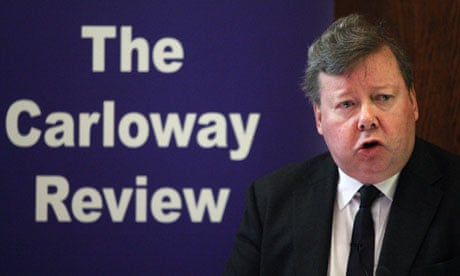
 

Image result for lord carloway scottish justice images

Lord Carloway Blasted Supreme Court Interference in Scottish law


28 November 2015: UK Supreme Court overrules Scottish judges on two human rights cases

The UK Supreme Court has today over-ruled Scotland’s highest appeal court in two important human rights cases.

In both, judgements passed in Edinburgh were unanimously overruled by a five-judge panel sitting in London on fundamental legal issues.

Their decisions raise the possibility of another judicial and political cross-border row.

Senior political figures such as First Minister Alex Salmond and Justice Secretary Kenny MacAskill have already raised concerns about what they see as the Supreme Court interfering in Scottish legal affairs.

The Supreme Court bench in both cases was headed by Lord Hope, deputy president of the London-based court and former Lord President of the Court of Session in Edinburgh who has previously spoken out against the “corrosive anti-English sentiment” in Scotland’s courts, describing it as an obstacle to legal progress, and has been the subject of biting criticism by Mr Salmond, who accused Lord Hope of allowing “some of the vilest people on the planet” to win compensation from the taxpayer.

http://www.heraldscotland.com/news/13082711.UK_Supreme_Court_overrules_Scottish_judges_on_two_human_rights_cases/
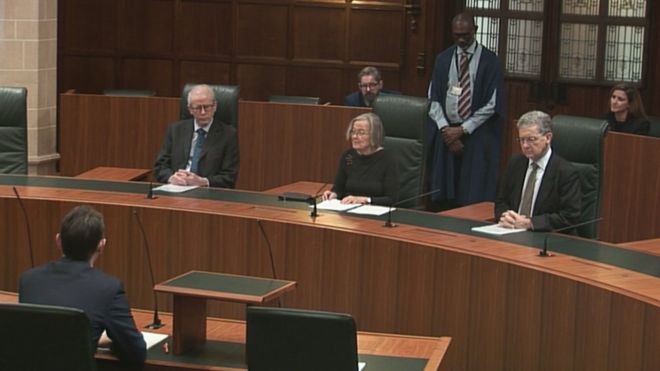
 

Supreme Court judgement

UK Supreme Court in London


8 November 2016: Scotland applies to join Brexit triggers court battle

Scotland is to apply to the Supreme Court to be allowed to table a legal challenge at the Court on 5 December 2016, against the UK Government as it tries to overturn a Brexit court ruling.

The attempt is to make sure MPs and Scotland’s parliament have a say on triggering Article 50.

First Minister Nicola Sturgeon said “it simply cannot be right” that European Union membership “can be removed by the UK Government on the say-so of a Prime Minister without parliamentary debate, scrutiny or consent”.

She added: “So legislation should be required at Westminster and the consent of the Scottish Parliament should be sought before Article 50 is triggered.

Let me be clear – I recognize and respect the right of England and Wales to leave the European Union. This is not an attempt to veto that process.

But the democratic wishes of the people of Scotland and the national Parliament of Scotland cannot be brushed aside as if they do not matter.”

http://news.sky.com/story/scotland-will-apply-to-supreme-court-to-overturn-brexit-court-ruling-10649998


Image result for uk supreme court images


13 Dec 2018: Brexit Legislation – UK Supreme Court Upholds  Scottish Parliament – But its ruling is thwarted by the Westminster Government’s Introduction of Counter Legislation, (with Royal Assent) before the Supreme Court Judged the Westminster Government Appeal.


Preamble:

Brexit legislation was drafted as an alternative to Westminster’s EU Withdrawal Bill, which MSPs refused to give their consent to following a row over how powers currently exercised from Brussels will be used after Brexit.

Holyrood Presiding Officer Ken Macintosh wrote an official memo saying the bill was “not within the legislative competence of the parliament”.

His assertions were denied by the Scottish government’s legal advisers.

But the delay paved the way for UK law officers to apply to the Supreme Court to provide “legal certainty” about whether the Holyrood vote was valid. A two-day hearing was held in London in July, with the UK government arguing that the bill should be struck down.

“On 4 July 2018, the House of Commons officially endorsed the principles of the Claim of Right, agreeing that the people of Scotland are sovereign and that they have the right to determine the best form of government for Scotland’s needs.”
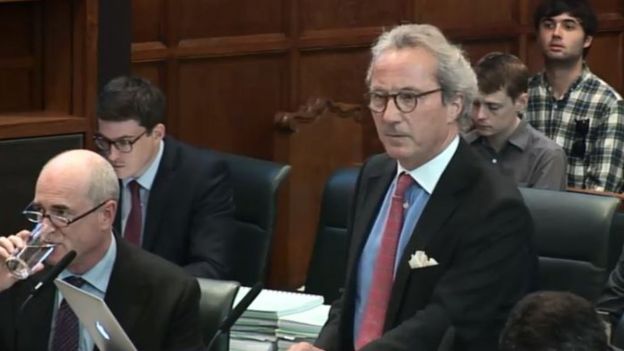
 

Lord Keen

Lord Keen Advocate General argued the case for the Westminster government.


The Supreme Court judgement

Lady Hale said the judges had unanimously rejected all but one section of the UK government’s arguments.

She said “the whole of the Scottish bill would not be outside the legislative competence of the Scottish Parliament”, but that one section – relating to MSPs having to give consent for UK Brexit laws – was not within Holyrood’s remit.

The judges explained in their ruling that changes had been made to the UK legislation, (before the appeal hearing) adding a special schedule of protected legislation which MSPs could not modify , returning to Westminster authority over 21 previously devolved provisions.

This meant that the bill was entirely competent when it was passed by MSPs in March 2018.
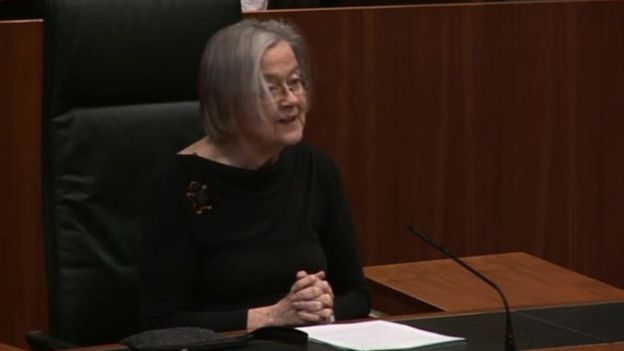
 

Lady Hale

Lady Hale Supreme Court Judge


Review the disgraceful series of events, from March-December 2018

The UK Withdrawal from the European Union (Legal Continuity) (Scotland) Bill – known as the “continuity bill” – was passed under emergency procedures

Only the Tory’s and a single Lib Dem MSP voted against it.
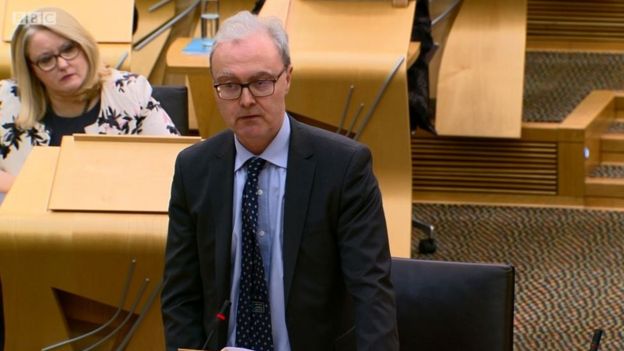
 

Lord Advocate James Wolffe

Lord Advocate James Wolffe


What will happen now?

The ruling means that the EU Withdrawal Act remains the basis on which Scotland’s statute book will be prepared for Brexit.

MSPs could potentially bring the continuity bill back for reconsideration at Holyrood, provided they take action on the areas highlighted by the Supreme Court.

Lord Advocate, Mr James Wolffe said ministers would seek talks with all opposition parties about “whether that’s the right way forward”.
 

Supreme Court


Teddy Bear Supporters Embraced the Unionist Fear Campaign in the 2014 Referendum – The Tory Party is Hi-Jacking the Club to Its Cause – Rangers Fans Beware


Image result for adam tomkins images


2014 Scottish Independence Referendum Analysis

An academic study into the independence referendum was conducted by Professor Ailsa Henderson of the University of Edinburgh. The research, which surveyed 4,849 voters, examined how voting linked to demographics, risk aversion, national identity, and attitudes to change. It interviewed people before and after the referendum result and assessed why people voted the way they did. Findings:

* The typical “yes” voter was male, Roman Catholic, and living in social housing.

* The typical “no” voter was more likely to be female, Presbyterian and more well-off.

* The gender gap played out with 53% of men voting yes, and 56% of women voting no.

* Religion was a factor, most Roman Catholics supporting independence and most of those identifying with Church of Scotland favouring the union.

* A narrow majority of native Scots were yes voters.

* Voters qualified through residence in Scotland but born elsewhere in the UK overwhelmingly backed the union.
The analysis indicated that a minority of Presbyterian voters supported an Independent Scotland. This was attributed to the influence of the “Orange Order and “Rangers Football Club” supporters.

Assuming there will be another referendum it is crucial that “Yes” campaigners work hard to get the Rangers support onside. Failure to achieve this might well bring about a similar result. What follows is an informed treatise on the Rangers Football Club.


Image result for rangers images


Glasgow Rangers: How an illustrious football club became the emblem of a faltering belief in the United Kingdom and lost its identity. The Start of  the Downfall – Rangers V Maribor

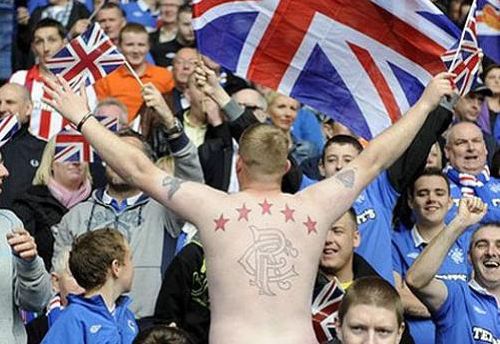
Rangers FC, the Scottish club that is one of the most famous names in world football, were 15 minutes away from being knocked out of Europe by the champions of Slovenia. The team needed one more goal to take the game into extra time. This was the moment that, traditionally, a home team would be rallied by its fans bellowing, baying, singing a rousing song. Instead, the Glasgow crowd struck up a weary chorus of the British national anthem, “God Save the Queen”. Rangers failed to score.

Soon, the whole club was in need of divine intervention. Without the funds from lucrative European cup competition, years of hubris and inept leadership caught up with Rangers. In February 2012, it entered administration. Four months later, it was liquidated. Following votes by other clubs, a new incarnation of the club that had been champions a record 54 times started the 2012/13 season in Scottish football’s fourth tier.

Three years on, the sense of crisis persisted. Administration left a void in the boardroom, through which passed a procession of businessmen, many claiming to be “Rangers men”. No one ever took full control of the club, which remained in desperate, monthly need of cash to pay its high wage bill. According to Harry Reid, an author of books on Scottish football and religion, “Rangers became a magnet for every chancer in town.”

Many football fans like to think that their team is “more than a club”. In Rangers’ case, the claim was true. For much of its 143-year history, its successes were a source of pride for fans throughout Scotland, if not for supporters of Celtic, Glasgow’s other big club. “Rangers were the unofficial sporting champions of a different Scotland,” said Alasdair McKillop, the co-editor of “Born Under a Union Flag”, an anthology about the club’s place in the UK.

The club, like the nation, had a comfortable dual identity as both Scottish and British. At its most famous game, the 1972 European Cup Winners’ Cup victory over FC Dynamo Moscow, fans sporting kilts and Robert Burns T-shirts waved the Union Jack alongside the Lion Rampant, Scotland’s royal flag. “There was then an unquestioning acceptance of a strong Scotland within an overarching Britishness,” said Graham Walker, a renowned historian of politics in Scotland and Northern Ireland as well as a life-long Rangers fan.

Off the pitch, Rangers was run in unspectacular fashion. It exemplified traditional Scottish Protestant virtues such as “strength, solidity, pride, decency and probity”, said Harry Reid. “This was turned on its head.”

For many fans, it was the European game against Maribor which foreshadowed the subsequent decline. Only three years previously, Rangers had reached the final of the same competition, but it wasn’t just the bad result that stayed in people’s minds.

Rangers drew much of its support from working-class fans in Glasgow and the West of Scotland, many of whom identified themselves as Protestant unionists. Graham Walker, who saw the game that night, said: “It seemed to me that too many fans are more concerned about defending Britishness than supporting Rangers.”

Today Rangers is a faded emblem of a faltering belief in the UK: a Scottish institution in Britain and a British institution in Scotland. Its rise and fall reflects not only how a football club lost sense of financial reality but much of its identity, too. Its story represents an imperfect microcosm of contemporary Scottish and British history.


Image result for rangers images


Success – Arrogance and – Unionism – The modern transformation of Rangers was dominated by two men

* Graeme Souness, the cocksure, moustachioed Scottish football legend who was appointed player-manager in 1986 after the club had gone eight years without a league title.
* Sir David Murray, an industrialist who in 1988, encouraged by Souness, bought a controlling stake in the club for £6m.

Rangers — and Scottish football — would never be the same again. Murray’s money bought star players on high wages, including the England midfielder Paul Gascoigne and Mo Johnston, the first openly Roman Catholic player signed by Rangers since the end of the first world war. Between 1989 and 1997, Rangers won nine league titles in a row. Sustained success on the pitch set the club apart, and the arrogance that accompanies serial winning undoubtedly alienated other football fans in Scotland.

But changes in society also threatened the sense of a dual Scottish and British identity that Rangers represented. Memories of the British empire and the second world war — both of which encouraged a pro-union sentiment — were growing distant. And falling church attendances, especially Protestant, spoke of Scotland’s rising secularism. According to the historian Sir Tom Devine, the “centralising drive of Margaret Thatcher eroded Scotland’s distinctiveness”, too, and provoked today’s left-wing Scottish nationalism.

Partly in response, a growing minority of Rangers fans displayed a more defiant type of Britishness. Religious sectarianism ran through the clubs fierce rivalry with its city neighbours Celtic, formed by an Irish Catholic priest in 1887. And, influenced by the deepening “Troubles” in Northern Ireland, fans sung “Rule Britannia” alongside rejoicing in the deaths of popes. The strident unionism that Rangers fans displayed was anomalous.” It wasn’t that Britishness was dead .. . …… but the kind of flag-waving unionism that some Rangers fans indulged in was exposed as a minority taste in contemporary Scotland, and it robbed [the club] of a lot of sympathy in the country.


Image result for rangers images


Financial Disaster

Yet the ordinary Rangers fan was deserving of sympathy. “Rangers suffered from every financial calamity imaginable,” said Henry McLeish, Scotland’s former first minister, who in 2009 conducted a review into the state of the country’s football. “It is the longest running business saga in football history.”

Despite its footballing success, spending on star players in the absence of stellar revenues meant that, by 2002, Rangers were £80m in debt. Murray appeared to have adopted the right strategy in the wrong country. Satellite television had turned the English Premier League into a big business. Rangers indicated a wish to join the English league but the entity enthusiastically embraced by the Rangers supporters rejected the approach. The United Kingdom was disunited when it came to soccer. The inevitable result was that the club became over-leveraged within the smaller market of Scottish football. By 2006, Murray was ready to sell. A situation which became critical when the financial crisis hit in 2008. when Murray International Holdings (MIH), suffered severe losses to its property portfolio.

Rangers had indeed spent beyond its means in a time of easy credit — and fans paid the price. “As far as I’m concerned, the bank is running Rangers,” Walter Smith, then the club’s manager, said in 2009. Two years later it was revealed that Rangers had used Employee Benefit Trusts, a tax avoidance vehicle, to reward staff. HMRC launched an investigation which is still not fully resolved at 2016.

In May 2011, Murray sold Rangers to Craig Whyte, another Scottish businessman, for the sum of £1. At first, Whyte appeared to be like Murray but with even more money. Yet promises of investment proved hollow and worse was to follow. Whyte failed to comply with tax obligations, ran the club without proper reference to the board, and caused the club to effectively fund the purchase of its own shares, according to a UK court verdict in 2014.

Under Whyte’s ownership, the club ran up a tax bill of £9m. This was the direct cause of Rangers entering administration in February 2012. Four months later, the club’s creditors, owed £124m, voted to liquidate the old company. That same day in June 2012, a consortium bought Rangers ’ remaining assets for £5.5m. But this new incarnation of the club has, said Henry McLeish, “been unable to attract stable finance backed by stable personalities”. In April 2013, yet another consortium leader Charles Green resigned as chief executive and the two men that followed him lasted only a combined total of 18 months.

The most recent power struggle featured Mike Ashley, a retail billionaire who owns English Premier League club Newcastle United, as well as a 9 per cent shareholding in Rangers. In 2012, the enigmatic sportswear mogul entered a joint venture to sell the team’s merchandise. It was a deal that led to a boycott of official gear by some fans, who claimed that the club only received 75p from every £10 spent on kit. Ashley wielded power disproportionate to his holding by acting as Rangers’s short-term creditor. He reportedly offered the club a further £10m loan, in exchange for taking Ibrox and Rangers’ training ground as security. The Scottish FA prevented him from increasing his stake in the club, citing rules on dual ownership

Sandy Easdale, a businessman convicted of non-payment of VAT in 1997, controlled 26 per cent of the shares in Rangers, mostly via the proxies of mysterious institutional investors. In December he loaned the club £500,000 to avoid a winding-up order by HMRC, an amount repaid after Rangers sold its best player to an English Championship club. Dougie Wright of the website Rangers Media forum, puts it this way: “Twenty years ago we were buying players from Barcelona, now we’re selling them to Brentford!”

At the start of 2015, several groups emerged as potential opponents to the combined control of Ashley and Easdale. These included:

* Dave King, a businessman, guilty of contravening South African tax laws.

* Robert Sarver, an Arizona billionaire who also owned the Phoenix Suns basketball team.

* A trio of rich Rangers fans who go by the name of the “Three Bears” (one of Rangers’ nicknames is the “Teddy Bears”).

The “Three Bears and Dave King emerged the winners after a corporate goalmouth scramble, but the question “why are we still in crisis? remained on the lips of many Rangers fans.


Image result for scottish independence images


The 2014 Independence Referendum and Rangers Supporters

In the course of the 2014 independence referendum campaign in Scotland “Better Together” campaigners used the term “silent majority” to describe pragmatic voters who cared little for romantic Britishness but ultimately saved the union, which was preserved by a 55 to 45 per cent vote.

In consequence parallels are drawn between the referendum vote and the club’s supporters continued state of angst. This was manifest in the unacceptable anti-social behaviour of some Rangers fans (witnessed throughout the referendum campaign) who repeatedly taunted other fans by singing, “You can shove your independence up your arse.”

But Glasgow was one of the few Scottish cities where a majority voted “Yes.” Given the class divide in votes (the poor are more likely to vote “Yes”), pollsters said, it would be surprising if an institution in Govan, a large working-class area, did not reflect that in some way. It follows that some Rangers fans must have voted “yes.”

It is accepted that Scots reluctantly affirmed the union. But it is a different sort of unionism to that of the past. For the majority a quieter, contingent belief in the UK has replaced the default bellicose Britishness of the past and it is expected (not with confidence) that the public behaviour of Rangers supporters will reflect the new reality. Extracted from:

http://www.ft.com/cms/s/2/cfbddcce-9c12-11e4-a6b6-00144feabdc0.html


Image result for scottish independence images


Westminster Behind the On-Going Gerrymandering of the Scottish Parliamentary Electoral System – The SNP needs to Wise Up and Sort Them Out


Image result for scottish parliament images

The first parliament


Gerrymandering the Newly devolved Scottish Parliamentary Electoral System

In recent times Unionist party MSP and activists have been constantly bleating about the unfair electoral system in Scotland which they allege has allowed the establishment of an SNP one party state. But they had been hoisted on their own petard plotting and scheming for many months under cover of the Calman Commission, working in secret designing a voting system which (they delightfully assured themselves) would prevent the election to office of an SNP majority. Having guaranteed their supporters a Labour/ Lib/Dem government would be elected in Scotland in perpetuity they committed their efforts to backing the successful devolution process.


Image result for scottish parliament images


The 1999 Election

Predictably, as planned, the election of the first devolved government to Holyrood in 1999 returned a Labour/LibDem  government.  A secret, secure future, free of the influence of the SNP had been delivered. Self satisfied and smug, members of the new government went about their business with breathtaking incompetence. Scandals, graft, nepotism, fraud and in fighting were prevalent. All the vices of unaccountable, dismissive despotic governance were deployed to the detriment of Scots.


Image result for scottish parliament images


The 2003 Election

Reflecting increasing dis-satisfaction with the Labour/LibDem government a number of new parties, Greens, SSP and Independent candidates were elected reducing the number of SNP and Unionist supporting parties. The timely warning from the electorate was ignored by the government and the level of largesse, waste and incompetence increased.

The SSP imploded with the leader and membership bickering endlessly. The Greens appeared to be overwhelmed by the election of MSP’s which required them to give up protesting, substituting the loss with constructive dialogue, which did not suit the agenda of the Party.

The SNP completed a root and branch analysis of the party which had not gained the seats projected in the campaign period. This brought about a party reorganisation. Senior officers were appointed to posts more complimenting their abilities. Alex Salmond and Nicola Sturgeon took on leadership roles together with John Swinney. The fightback had begun.


Image result for scottish parliament images

2007/2011 elections


The 2007 Election

Attempts at gerrymandering the 2007 election in favour of the Labour party were made by the Labour Party Secretary of State for Scotland, Douglas Alexander who employed the most complicated set of voting papers ever presented to an electorate combining two totally different elections on the same day.

The resulting debacle exposed the weakness of an electoral system put in place by Westminster civil servants and the Labour/ Lib Dem leaders to thwart the electorate. Scots, (fed up with the incompetence) returned SNP MSP’s in a majority.

With no overall control the SNP Party formed a minority government which (if defeat in parliament was to be avoided) would require the employment of first class political skills. Alex Salmond and his leadership team were up to the challenge and provided effective government in Scotland despite the odds being stacked in the favour of the unionist parties who resorted to spoiling tactics throughout the duration of the parliament.

Gordon Brown, Prime Minister, believing he had all the power refused to acknowledge or meet with Scotland’s First Minister, Alex Salmond in any capacity whilst enjoying friendly relationships with the leaders of other devolved governments. Hardly the behaviour of a statesman.


Image result for scottish parliament images


2011 Election


The 2011 Election

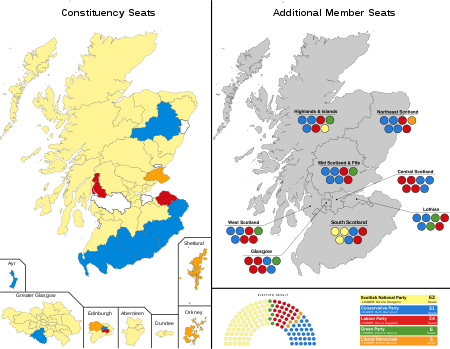
The 2011 election delivered the first majority government since the opening of Holyrood, which was truly remarkable since the “mixed member proportional representation system” used to elect MSPs had been implemented by Westminster with the purpose of preventing the SNP achieving an overall parliamentary majority.


Image result for scottish parliament images


2016 election


The 2016 Election

The outcome of the election was manipulated by the Unionist Press and Media who in the course of the campaign, relentlessly promoted the concept of “tactical voting” seeking to persuade the electorate to give their votes to the new girl on the block: Ruthie (put in place by MI6) Davidson (no mention of the Tory Party).

The tactics worked and the Tory alternate vote increased at the expense of the Labour and Lib/Dem vote which was significantly reduced but not transferred to the SNP.

The SNP was still returned to government in another landslide victory. but an increase in the Green Party vote meant that the SNP did not enjoy an overall majority in parliament.

This was construed by the Unionist Tory Party to be a signal from the electorate that their manifesto had been approved by Scots and the days of the SNP in government in Scotland were numbered.

The Unionist press, media and Tories, emboldened by a new found confidence that they are the next government of Scotland (in waiting) attacked the electoral system that in their view had failed, yet again to deliver the government it had been designed for. But the voting system had in fact saved the Unionist parties from electoral oblivion.

However, true to form the selective arguments they advanced in support of their whining conveniently failed to mention that, (had the election been conducted under the much vaunted “First Past the Post” voting system strongly supported by the Unionist parties in Westminster) the SNP with 42% of the overall vote would have swept the board and the unionist parties would have been wiped out. Indeed in the 2015 UK general election the Tory Party formed the next government with only 37% of the vote.

Scotland has been lumbered with an electoral system proven to favour poorly performing political parties with many more MSP’s than deserved. It is also evident that there is a democratic deficit in Scotland which needs to be urgently addressed. Wise counsel recently proposed the introduction of transferable voting and open lists, (allowing voters freedom of choice in their selection of transfer candidates) abandoning regional weighting which has been widely abused by the Unionist parties who persist in nominating questionable, poorly performing characters previously rejected by the electorate.

But the Unionist parties continue to deny Scots the benefits of progressive policy changes which would do much to improve the performance of Scottish parliamentarians, preferring to reward self interested party nobodies nominated through nepotism, with seats in Holyrood.


Image result for scottish parliament images


Parliamentary Committees

The 2015 election brought Prof Tomkins to Holyrood (as a Tory list MSP). Proclaimed by the Unionist Media and Press to be an expert in constitutional affairs they widely broadcast to the Scottish electorate that he had a deal of input, through the Secretary of State for Scotland’s office, to the 2015 Scotland Act which delivered a limited range of newly devolved powers.

The Holyrood parliamentary committee system of political accountability, (through which the views of the electorate, media, business and opposition political parties can be fed back to government ensuring good governance) works well. But it is under attack by the Media Press and Unionist parties who constantly disrupt and frustrate the good work of committees.

The foregoing gives credence to reports that Prof Tomkin (with not at lot to do for his large salary) had been tasked to create alarm and despondency at Holyrood, undermining and discrediting the committee system so that he would be able to bring forward proposals for change which, if implemented as planned would weaken SNP control in committees, increasing the second placed opposition Tory party membership. A form of job creation for Unionist party MSP’s who would have nothing to do otherwise. This he has duly done. He doesn’t hang about this chap.


Image result for scottish parliament images

Deputy Leader of the Tory Party in Scotland


28 October 2016: Tories set out proposals for Holyrood reform

A review, announced by presiding officer Ken Macintosh, follows concern that Holyrood is failing in its task of effectively holding the Government to account.

Backbenchers who represent the governing party at Holyrood should be banned from holding the key jobs on major committees, the Scottish Tories have said. The party also set out preliminary proposals that they said would ensure Scotland had a “parliament with real teeth” following the announcement that structures at Holyrood are to be reviewed.

If the measures are accepted SNP politicians such as James Dornan, convenor of the education committee and Local Government convenor Bob Doris would be stripped of their roles. The Conservatives also said that ministers should be quizzed by their opposition counterparts more regularly and that MSPs should serve on committees for the full parliamentary term.

Scottish Conservative chief whip John Lamont said: “The last parliament, when the SNP had a majority, exposed the flaws in our democracy. SNP MSPs toed the party line, put party before parliament, with the result that bad laws were railroaded through.”

* He conveniently forgets to refer to the Westminster, House of Commons legislative committees who’s membership also reflects the proportion of MP’s at Westminster.

He went on: “The Scottish public ended the SNP’s majority, and we now have a more balanced parliament. So we welcome the Presiding Officer’s plan to ensure we get a parliament with real teeth. We don’t need yet more politicians in Scotland. We do need a parliament with more clout which can hold this Government to account. Our proposals will help do that – and we hope they will attract cross-party support.”

* But this example of the 2015 Holyrood election reveals the inadequacies of the existing system. North East Scotland:

Tories: 85,848 votes returned 4 additional Regional member MSP’s ( 21462 votes per MSP)

Lib/Dem: 18,000 votes returned Mike Rumbles as a Regional member MSP.

SNP: 137,085 votes returned 0 additional Regional member MSP’s (effectively disenfranchising a very significant number of voters).

The Commission on Parliamentary Reform will study the role of Holyrood in scrutinising legislation, the committee system and parliament’s independence from the Scottish government. The study will be led by the outgoing Electoral Commissioner John McCormick.

http://www.heraldscotland.com/NEWS/14831047.Tories_set_out_proposals_for_Holyrood_reform/?commentSort=score


Image result for scottish parliament images


Scottish Soldiers – Past – Present and Future – From the Dole to the Battlefield – Oh!!! and there’s the Covenant


Image result for scottish soldier images


So You Want To Be A Soldier – The Recruiting Process – Streaming by Ability

An understanding of the recruiting policies of the British military is necessary so that any judgement of soldiers in the Scottish regiments can be arrived at from a position of knowledge.

At the recruitment stage applicants are required to complete a number of written and oral tests each of which is compiled by psychologists, designed to allow an individual to be grouped into one of four classes. There might be changes in the process from time to time but the purpose remains the same.

These provide the means through which the Recruitment Centre is able to allocate recruits to the arm of the service most suited to their educational abilities. Namely:

Class 1: Gifted and intelligent: Most likely educated to higher level. Qualifiers usually sent for training with specialist services e.g. Royal Electrical and Mechanical Engineers (REME), Royal Signals (RS) or Royal Engineers.

Class 2: Promising. Educated to ordinary level standard. Those taller than 5.10 are directed to the Guards Regiments (Scots and Coldstream). Others guided to the Royal Artillery (RA) , Royal Tank Regiment (R.T.R.). Recruits with a stated preference for service with the Scottish infantry allowed to join the Regiment of their choice

Class 3: Education problematic. Under achieving but displaying some ability. Dependent on place of residence sent to one of the Scottish Infantry Regiments.

Class 4: Not well educated and or other difficulties. Usually non-combatant (except for personal protection). Earmarked for the Royal Transport Corps, Royal Catering Corps or Royal Pioneer Corps or other supporting service.


Image result for scottish soldier recruit images


The Scottish Infantryman – Training and Indoctrination

Recruits are sent to a specialised military unit for 3-4 months training at the end of which they are usually (but not always) allocated to the Regiment of their choice. The training is physically intensive, mentally demanding and life changing. Some fail to meet the standards demanded and repeat the training. Persistently poor performers are discharged or sent for training with a less demanding service. The process of creating the Scottish infantry soldier is well planned, well structured, well practised and successful. It comprises:

1. Individual thought process eliminated and replaced with uniformity (thinking as one). Military number allocated and memorised. Civilian clothing and personnel effects confiscated. Head-hair removed. Issue of military clothing and explanation of how to dress uniformly. Bed blocking and locker layout (uniform presentation of kit). Cleaning duties allocated.Square bashing, up to four hours daily. Weapons training. Combat training. Physical exercise, field training. The list is extensive and the process lasts for up to 16 weeks.

2. With the Regiment. More of the same but including weekly indoctrination sessions including, regimental history, espousing glorious past battles and campaigns in which the Regiment was involved, religious education and weekly address to the family by an officer providing reminder of the authority of Commissioned Officers and the requirement for unquestioned obedience to their will.


Image result for scottish soldier officer images


Right of passage – Roles and Responsibilities of Officers of the Scottish Regiments

Young men accepted as commissioned officers are usually Public School educated and descended from Scottish nobility and other well connected Scottish families. After 6 months of training at Sandhurst they enjoy a “right of passage” and their commission in the Regiment is almost always handed down from father to sons who are expected to honour their family tradition of military service. The officers form an elite tight knit community, membership of which is exclusive and zealously protected. There is no place in the hierarchy for the common soldier.

The concept of family is heavily promoted and attention is given to training officers in the subtle art of persuading soldiers that their welfare and that of their dependents is paramount in the thoughts of their officers. The intent is to build trust between commissioned officers and their soldiers. The system works extremely efficiently although not always to the benefit of the ordinary soldier. The word of the officer is law.


Image result for scottish soldier at war images


Scottish Infantrymen – Brave-hearts

In the course of the 2014 Scottish Independence campaign many contrary views were voiced by the informed and uninformed about the future loyalty of the soldiers of Scottish Regiments. But the dialogue (except by proxy) was not inclusive of rank and file servicemen who were forbidden from any discussion or the expression of any view of independence.

The strictly imposed silence (under threat of disciplinary action) did not however extend to a number of Generals and other senior officers who, with a lifetime commitment and obligation to Her majesty’s forces were vociferous in the Scottish Press and other media in their support of “Better Together.” The measures silencing the voices of the rank and file stifled debate within the military and most likely adversely influenced the outcome of the referendum in favour of remaining in the Union.

The policy must not be permitted at the next referendum. Its removal would be assisted by the publication of a well presented discussion document outlining the make-up of Scotland’s armed forces in an independent Scotland.


Image result for scottish soldier at war images


A Scottish Infantry After Independence

The infantry make-up of an independent Scotland might comprise 2 divisions (Highland and Lowland) each comprising 4 Regiments with 1 regular battalion of 650 soldiers and 1 Territorial Battalion. This provides a total compliment of 5,200 regular soldiers supported by an expanded force of 5,200 Territorial soldiers. The regimental system butchered by successive Westminster governments would be re-instated.

Regiments would be permanently garrisoned in Scotland and deployed as necessary by the government in support of NATO commitments. Forces families would be provided with married quarters, based within the local community and maintained by the Local Council

A transfer of relevant military personnel, equipment, weaponry, transport and dependents would be agreed through negotiation with the Westminster government and implemented over a period of 1 year from the date of independence. Any soldier that wished to remain with the UKr armed forces would be allowed to do so.

Given freedom of choice it is expected that in excess of 90% of rank and file infantry personnel would exercise a preference to transfer to a Scottish Defence Force.

Not all Commissioned Officer’s will follow the lead of the soldiers and (given their support of the Westminster system of government) it would be reasonable to anticipate that less than 50% would transfer their military loyalty to Scotland. Any shortfall would be made up through the promotion of warrant officers and/or senior NCO’s who are well able to fill the gap.


Image result for scottish soldier at war images


Meantime – Soldiers of the Queen

In recent months fanfares have been sounding in the unionist press proclaiming, glorifying the groundbreaking decision by the Ministry of Defence (MOD) to allow women to serve as soldiers on the front-line. Much was made in the announcement of the equal rights act and the need to provide opportunity for women to volunteer to fight and die for their country. But the unexpected messenger bearing gifts it is not entirely upfront. The real reason for the new approach to army recruitment is a marked fall off in the number of male volunteers.

This is attributed to the extended over deployment of soldiers to foreign fields of war with little chance of a change of emphasis. Indeed there are many ex- soldiers who at the time of their discharge had been away from the UK at war throughout their entire contract of service.

Another factor is that in the last 20 years Westminster politicians have been complicit in the exposure to the public of jingoistic rhetoric reminding the nation, (usually after yet another military setback, loss or cock-up resulting in loss of life) of its enduring commitment to the Armed Forces, their families and veterans.

But the Westminster politicians pledge to care for servicemen and women, their dependents and veterans, many suffering from the adverse effects of war is not honoured and the jaundiced views of military personnel (serving and discharged) are being increasingly voiced in public warning off those who might be tempted to take the “Queens Shilling.” Hence the need for women.


Image result for scottish soldier at war imagesImage result for scottish women soldier images


The Much Maligned Covenant between the Westminster Government, the Public and the Armed Forces

Soldier dad away for 6 months fined for taking children out of school to spend time with him – http://www.mirror.co.uk/news/uk-news/soldier-dad-away-6-months-6872096

Wounded British soldier refused a hotel room – http://www.dailymail.co.uk/news/article-1052372/Hotel-forced-apologise-refused-wounded-British-soldier-hotel-room-Army.html

Benefits Cut ‘Took Away Ex-Soldier David Clapson’s Lifeline,’ Says Sister – http://www.huffingtonpost.co.uk/2016/03/03/david-clapson-inquiry-crowdfunder-dwp-benefit-insulin_n_9372008.html

Care for UK military veterans is ‘flawed’, medical experts say – http://www.bbc.co.uk/news/uk-29807947

Government ‘breaking military covenant over veterans’ care’ – http://www.telegraph.co.uk/news/uknews/defence/11470842/Government-breaking-military-covenant-over-veterans-care.html

A soldier speaks: ‘The covenant is just words’ – http://www.independent.co.uk/news/uk/politics/a-soldier-speaks-the-covenant-doesnt-help-anyone-its-just-words-8505845.html

Deal to aid brave British troops is ‘not honoured’ says military report – http://www.express.co.uk/news/uk/705046/British-troops-failed-military-covenant-not-honoured


Image result for soldier casualties of war imagesImage result for soldier casualties of war images

They all died in Iraq


Ex Soldiers Add Their Comments About The Covenant

Thieves such as the boss of BHS, and time served wasters in the civil service get lordships, knighthoods and very fat pensions. Forces people who put their life on the line get shafted. This is down to the liars in the lib,lab,con sh*t pile that is parliament.

Sadly, it has always been the British way.

Another one of the thousands of lies that Cameron told. From the speech that won him the Tory leadership to the moment he left Number Ten, he never ceased to treat us like something at the bottom of his shoe.

The Tories are Known As the NASTY PARTY. But they are much much worse that that. They have betrayed our armed forces more times than I want to remember. When A Country Jails It’s own troops to appease the enemy It’s time to get rid of them forever, and never trust them. The Tories are the artists of betrayal. They have a history of betrayal. They dumped our loyal commonwealth countries to join the EU.

Cameron sent redundancy letters to our troops serving In Iraq and Afghanistan and tried to cut the pensions of wounded and limbless veterans.

He housed refugees and EU migrants In houses with gardens whilst the MOD put limbless and incapacitated veterans and their families in flats. The MOD are pure evil.

Cameron even recruited one of his pen pushing Generals to back him, in his decision not overturn the decision to jail Sgt Blackman, Royal Marines for 20 years for shooting a wounded Insurgent after a ambush / firefight in Afghanistan which beggars belief. If there is any justice at all in this country at all, our soldiers that are interned, should be released now:

Its hardly shocking, in fact pretty much of what was expected by this government who seem hell bent on giving as much of taxpayers money as they can on foreign aid, supporting migrants, whether legal or not, in this country and of course their £10 billion per year EU contributions that go towards other basket case countries in club Med or on the Eastern Front, there’s no money left for our own vulnerable people everybody knows that!

Since the days of the Napoleonic wars, successive British governments have promised a land fit for hero’s, and then promptly dumped them onto the streets. The military covenant was supposed to have stopped that,but governments decided that the welfare of 3rd world despots and so-called refugees and asylum seekers were a priority. Perhaps our time served newspaper industry can campaign for some honesty and action?

Lots of county councils across the country are now run by our immigrant friends, whose priorities for housing are not what they should be, Birmingham council housing priorities are:

1. Pakistani – 2. Muslim 3. Friends 4. … etc Ex soldiers are not even on their list because they hate them.

Same here in London. Let’s name and shame all the council’s who are treating our hero’s with contempt.

Go on strike until the issue is resolved, they cant shoot you all.

Image result for soldier casualties of war images

One former military soldier sleeping rough on the streets is one too many and the people responsible should hang their heads in shame. Meanwhile a black person arriving on our shores, with no paperwork gets to claim asylum is given a fully furnished council house, allowances, legal aid and a free TV license.

The weak and incompetent tool-bags running the show are more concerned with making sure***************coming from Africa and other ding-holes are sorted out first!

Come on Boys you have done your Job for the Country, we don’t require you any more, all our promises to you are off, don’t you forget we now have to support all the filth you fought against, we have got Thousands of them coming into the UK, they need Benefits, Housing and Medical, how on earth can we support you as well. British government shame on you.

Started when Gordon Brown snapped the purse shut, denying the troop proper kit and equipment, and continued by Gideon, the poor clone of Brown, aided and abetted by Cameron.

They would support the illegal migrants and foreign criminals than supporting the troops they demand do their bidding at considerable personal risk. The electors want the troops supported, not illegal immigrants nor foreign criminals.

As a veteran and like my ex military colleagues I have moved on since finishing military service. In any case service charities are an industry with over 3000 organisations with staff and infrastructure to support with a lot of them run for the benefit of those involved

Another Cameron pie-crust promise. Made to be broken.

Typical Cameron and government promise to the people who protect us, hot air and lies. We should protect the people who protect us, if it was a politician they would be no shortage of money, vigils or services, no wonder everybody hates politicians.

The Armed Forces should have all the support necessary. It is a disgrace that many are sleeping rough. Some of the foreign aid budget could be utilised to give them a roof above their heads.

We can look after and give houses to people who have not been born or worked here. But we can’t look after our own. While the lords and MP’s milk the system for all its worth.

Our military veterans and their dependants Must be put at the top of the queue for housing and welfare when they retire. It is totally unacceptable they are not, especially as priority seems to be given to other people who have contributed little or nothing to this country.

Of course the covenant is not being honoured. Because the establishment politicians of the legacy parties are dishonourable traitors !

The armed forces covenant and the so called remit should be written up as a policy document as a minimum requirement, not as a remit that can be twisted and even ditched all together by the local councils etc:

We put our lives on the line & we have no guarantee on a fair deal for our families or even ourselves.

We cannot get decent housing or proper food to eat.

At least when we had our own cooks we decent food, the civilian contractors are screwing the troops and seem to be doing it expressly in the eyes of the troops. Bring back the ‘Catering corps’.

Rob16: The Military Covenant is a waste of time and only pays lip service to personnel leaving the armed services, it’s the governments way of showing that they are doing something, something that doesn’t really mean anything. I spoke to my GP and he had never heard of it, that’s how good it is, if no one buys into it then it’s total waste of time.

He’s right And Most Likely a Tory Traitor? But that’s what I was told after serving 12 years and not residing in the UK for 3 consecutive years. Because I was overseas in the Army. The Council told me we were aliens in our own country. The Council Regulations are you have to live in England for 3 years or U don’t qualify for housing. Unless you are a EU migrant or a Refugee. That’s the rules in this land. Made up by people Like Rob16 . This Country is full of people like him. They are obsessed with EU rules and regulations.They are not really British. Just like the remain students in London they say they are not British but European. http://www.express.co.uk/news/uk/705046/British-troops-failed-military-covenant-not-honoured


Image result for soldier casualties of war images

Casualties of War Iraq & Afghanistan


In Bed With the Unionist Scottish Tories – Rangers Football Club Supporters reveal their hand


Image result for rangers unionist images


In Bed With the Unionist Scottish Tories – Rangers Football Club Supporters reveal their hand

The 2016 Scottish Cup Final was marred by the bad conduct of a large section of Rangers supporters who, throughout the match baited Hibernian fans with sectarian chants The songs (clearly audible to television viewers) contained the phrases ‘Fenian bastards’ and ‘up to our knees in Fenian blood’.

Despite the foregoing the game was played in a good spirit by both teams and the final result was in the balance up to the final minute when Hibs scored the winning goal. At the final whistle (seconds after the restart) a number of Hibs fans invaded the pitch. They were mainly exuberant, but a few sought to re-enact the events of 1977, when Scotland beat England at Wembley. This brought Rangers supporters onto the pitch and the resultant confrontation was inevitable. Many watchers and television viewers were horrified at the violence between both sets of supporters and allocated blame equally between them.

But not Prof Adam Tomkins. He made it clear, when writing to the Rangers Forum that the Scottish Tory Party absolved Rangers and their supporters of any blame. He then basked in the adulation of Rangers fans who commented favourably about the Tory party and Tompkins in particular.

But a subsequent investigation, completed by Sheriff Principal Edward Bowen QC made it clear that there was fault on all sides and he could not attribute blame to either club or to any individual, or group.

The Scottish government and First Minister, Nicola Sturgeon were castigated in a statement issued by Rangers Football Club shortly after the incident which stated:

“It must also be said that it was not at all helpful to see leading members of the Scottish Government, including the First Minister whose parish is Govan, passing comment on social media without any attempt to condemn the behaviour of Hibernian’s fans. These failures are unbecoming of our elected representatives.”

The comments made were: “Ms Sturgeon “condemns unreservedly any act of violence or disorder by anyone who attended the cup final”. “Violence has no place in football, either on or off the pitch,” Justice Secretary Michael Mathieson. The foregoing statements were vindicated by the later findings of Sheriff Principal Edward Bowen QC.

Prof Adam Tomkins MSP comments were unbecoming of a member of the Scottish Parliament but, as yet no disciplinary action has been taken against him by his Party leader. Shame!!!


Image result for prof tomkins images


28 September 2016: Hibs and Rangers in the clear over Cup Final disorder at Hampden

Hibernian and Rangers escaped punishment by the football’s governing body in relation to the disorder at the Scottish Cup Final at Hampden.

Hibs triumphed 3-2 to win the Scottish Cup but the post match celebrations were marred by scenes of crowd disorder and a pitch invasion.

A report by Sheriff Principal Edward Bowen QC into the disorder said it was impossible to attribute blame to either Club or to any individual or group.

He suggested a reserve of police should be ready to deal with possible pitch invasions in high profile matches and said new laws should be brought in to make pitch invasion a criminal offence.

http://www.heraldscotland.com/news/14770011.Hibs_and_Rangers_in_the_clear_over_Cup_Final_disorder/


Image result for scottish cup final 2016 images


Events of 21 May and Follow up.

23 May 2016: The Rangers Forum – Scottish Cup Final – Rangers v Hibernian – A supporter Sent Adam Tomkins (MSP) an e-mail

I’m writing to hopefully discuss the disgusting scenes witnessed at Hampden yesterday. I would write to Nicola Sturgeon, but she’s already made it quite clear that she has no interest in condemning it, in fact, on the contrary.

At the age of 29, and having attended hundreds of football matches at both Ibrox and Hampden, I’ve never seen scenes like yesterday. As a Rangers supporter, it’s safe to say I feared for my safety, and to watch Rangers player getting attacked was my worst moment as a Rangers fan.

I appreciate there’s not a huge amount that can be done with the SNP in control, but I was curious to hear your thoughts on the matter, none the less, and hoped as the main opposition, you would be the best person to contact (I should mention I’m a local constituent).

Any suggestions on what can be done to take the matter further would be greatly appreciated. I think I speak for the majority of Rangers fans when I say that we can’t accept what happened yesterday getting swept under the rug by the SNP.

Adam Tomkins responded:

I was at the game: not on a corporate freebie but with Rangers season-ticket holders in the Rangers end. I used to be a season-ticket holder myself at Ibrox.

I have tweeted several messages about the disgraceful and dangerous actions of the Hibs fans in storming the pitch at the final whistle. Like you, I was appalled by what I saw. It is important that the police and SFA inquiries proceed without political interference, but I will be looking for answers to two sets of questions in particular:

* Why Hibs fans were allowed to reach Rangers players who were still on the field of play?

* Why the police seemed (to me) to take quite a while to restore order?

It is the job of MSPs to press for answers to questions such as these and you may be assured that I will not rest until I have them. I will be discussing with colleagues in the Parliament tomorrow morning what further action we as MSPs should take at this stage. As the father of four young children, a number of whom enjoy coming with me to football matches, I share your concerns. What follows, in case of interest, are the lines the Scottish Conservatives have put out today:

“The events after the final whistle at Hampden on Saturday ruined what should have been a day of celebration for the whole of Scottish football; not only the culmination of a long cup competition but the first time that two teams outside the top tier have competed in the final. While Hibs supporters will rightly wish to celebrate winning their first Scottish Cup in 114 years that can be no excuse for the reported assaults on players and officials, nor the destruction of the fabric of our national stadium.

l understand that Police Scotland have set up a unit to track down the perpetrators, and I would urge them to ensure that all routes are taken to identify and charge those involved in these criminal acts. Thereafter, it will be for Parliament to determine how best to review the performance of Police Scotland in responding to this disorder.

The hard work of the footballing authorities, the police, football teams and their supporters has meant that significant progress has been made in the past two decades in making attending football matches in Scotland safer and more enjoyable, sadly the scenes on Saturday represent a significant setback for that progress.” This is not the end of this matter, but I hope you can see from the above that we have made a start in getting to the bottom of this, with a view to ensuring that all relevant lessons are learned. With very best wishes: Adam Tomkins MSP: Conservative MSP for Glasgow :

http://forum.followfollow.com/showthread.php?1084645-Adam-Tomkins-MSP


Image result for rangers supporters images


Forum members comments:

Can’t argue with that, its set the bar for other MSP’s to respond to similar questions with the same respect and attention to detail.

Bravo Mr Tomkins, I actually trust this guy to do his best for us, most unusual for a politician.

I’m heartened to read that response from Adam Tomkins MSP

Thank you Mr.Tomkins and I trust that you will be vigilant when the SNP and Labour attempt to whitewash this affair.

Excellent response but where are SNP and Labour in their condemnation of the events or even acknowledge them.

Puts his party leader to shame. If this guy was in charge, they would get more votes.

The problem with police Scotland the route they will be taking will be mostly directed at our support.

Future leader of the Scottish unionist party

One of the reasons why I voted Conservative for the first time in recent elections.

That is the difference between a real political party and a shower of charlatans (SNP and Labour).

Impressed with that response. Wee Nic is my constituency MSP. I emailed her. Still waiting.

He was on one of my lecturers at uni. Full of his own self importance and loves the sound of his own voice however very committed to the union. Didn’t know he was a bear. That reply is very good. Hope he delivers.

Good reply, I hope he shares it with his party leader. She could learn from Prof Tomkins.

I’ve written to mine whose constituency covers Hampden. Not expecting much … he’s an SNP asslicking knobend

Just remember this is the result of voting Conservative in the Glasgow region. Far from a wasted vote.

Just remember this is the result of voting Conservative in the Glasgow region. Far from a wasted vote. Correct, don’t give SNP or Labour your votes, they despise Gers fans.
He is one of the reasons I voted conservative for the first time

Puts his party leader to shame. If this guy was in charge, they would get more votes. She was too busy getting married. Don’t suppose she gave much thought to the game.

Good reply. Fair play to him.

Decent reply, hope he follows it up.

Excellent response. I don’t know why we don’t vote more conservative in Scotland. SNP are fascist. Labour/liberals a joke.

That is a good reply. Glad to see that we have someone our side. I was at the game (as I was in 1980) and Saturday was a lot worse.

Best political response so far…..sadly maybe the only one. Saturdays troubles and concerns should transcend politics.

Excellent reply from Mr Tomkins, it’s good to know we have a politician on our side, I may need some advice later.

Just read about him in today’s Daily Mail said that he is a constitutional lawyer (whatever that is ) and academic who is probably the cleverest person at Holyrood. Just so happens that he is up against Angela Constance who is probably about the thickest person at Holyrood

Just gained a vote for Tory next elections. Bravo to him, hopefully he keeps his word.


Image result for unionist torys images


Get to Know Chancer Prof Adam Tomkins – the Tory List MSP is the Brains Behind the Scottish Tory deferendum Campaign


Image result for Prof Tomkins images


https://caltonjock.com/2015/09/02/professor-adam-tomkins-a-visionary-or-a-plonker-the-scottish-jury-is-still-out-but-a-verdict-is-expected-very-soon-part-1/

https://caltonjock.com/2015/09/02/professor-adam-tomkins-a-visionary-or-a-plonker-the-scottish-jury-is-still-out-but-a-verdict-is-expected-very-soon-part-2/

https://caltonjock.com/2015/09/02/professor-adam-tomkins-a-visionary-or-a-plonker-the-scottish-jury-is-still-out-but-a-verdict-is-expected-very-soon-part-3/


Image result for Prof Tomkins images

Prof Tomkins


UK and the City of London – Dirty Money Laundering Capital of the World – Spreading the Disease to Scotland – But it is Being Addressed -Isn’t it??


Image result for uk tax haven images


UK and Tax Haven’s

“Land Registry” figures show UK real estate worth more than £170bn is held by nearly 40,000 secret tax haven companies and “The National Crime Agency” believes up to £100bn of tainted cash could be passing through the UK each year. Much of it ending up in real estate, but also in other assets such as luxury cars, art and jewellery. The laundering of the dirty money also funds terrorism which is an unacceptable practice since it has contributed to the death and injury to many members of the British forces in the past 20 years.


Image result for tier 1 visa scheme images


The Teir 1 Investor Scheme – A Major Blunder by The Labour Government Extended by the Tories

At the height of the financial crisis in 2008 the Labour government decided that it would trade UK citizenship for cash investment through the introduction of the Teir1 Investment scheme.

The “no questions asked” policy required only that persons seeking to invest would need to lodge at least £2million in UK banks, trusts or investments. In return the investors and their families would be granted UK golden visa’s. After 5 years a visa requirement would lapse and those wishing to remain in the UK would be afforded permanent residency in the UK.

At 2016 the total number of visa’s issued exceeded 3000. In the so-called “blind faith period” where few checks were done over the source of income – 37% of Tier 1 investor visas were awarded to Chinese nationals and 23% to investors from Russia. In consequence very significant wealth has been transferred away from Russia and China to the disadvantage of their economies and to the benefit of the UK.

This UK Treasury: “no questions asked policy” exposed the Teir1 investor Scheme to abuse. Money laundering, was prevalent, leading to an increasing number of complaints and threats of retaliation, from nation States adversely impacted by the illegal transfer of finance away from their economies.

In excess of 75% of corruption cases involving property investigated by the Metropolitan Police’s Proceeds of Corruption Unit (POCU) involved anonymous companies registered in ‘secrecy jurisdictions’.

The Panama Papers scandal confirmed what was long-alleged: corruption is now a global problem, crossing multiple jurisdictions, in which the implausibly large wealth accumulated by certain politicians, shady business people and officials is easily hidden within a secretive financial system, and used to buy assets in stable countries like the UK.

In May 2015 the UK government hosted the London Anti-Corruption Summit, pledging better international coordination on corruption. The UK was forced to accept anti-money laundering procedures in the UK were inadequate and undertook to address the problem introducing effective, comprehensive checks on Tier 1 Investor visa applicants ensuring timeous reporting of any individual(s) who might be suspected of an illegal or improper attempt to invest money in the UK.

There was an added commitment that the UK would ensure measures would be taken, working with relevant governments or authorities, identifying illicit wealth, returning all such money to it’s rightful owners. http://www.transparency.org.uk/publications/gold-rush-investment-visas-and-corrupt-capital-flows-into-the-uk/


Image result for london property images


London – The Queen of all She Surveys

In a single 50-storey apartment complex in London, the Tower at St George Wharf in Vauxhall, a quarter of the flats are held through offshore companies.

Millionaires Road (Bishops Avenue) London is well named since over a quarter of the avenue has been purchased by Teir1 status: Nigerian billionaires, business tycoons, oil rich magnates and Nigerian politicians, have acquired many of the street’s multi bedroom mansions for their families, and second and third properties for their mistresses.

Not to be outdone the President of the Nigerian senate, who faces allegations that he failed to declare his assets, owns a property in Belgravia in his own name.

Adding insult to injury “Real Estate” agents in London compared notes and identified that more than £600million has been spent in London by Africans from Nigeria, Ghana, Congo, Gabon, Cameroon and Senegal, with wealthy nationals forking out £250million on homes in the period 2013-2016 and there is no indication of fall off in demand.

Nigerians are the biggest spenders, and include, Aliko Dangote, a Nigerian business magnate, Folorunsho Alakija, a billionaire oil tycoon, fashion designer and philanthropist from Lagos and her British-born nephew Rotimi Alakija, who also goes by the stage name of DJ Xclusive are among the wealthy African buyers spending almost £4million on London property every week.

Folorunsho is said to have recently bought four apartments in One Hyde Park, the super-exclusive development in Knightsbridge. Many other tycoons have also been eyeing up homes on Kensington Palace Gardens – known as Billionaires’ Row. http://naija247news.com/2016/10/hundreds-of-nigerian-properties-could-be-seized-in-uk-corruption-crackdown/


Image result for panama papers images


2014: The Panama Papers – the Destination of Libya’s Billions

“The Panama Papers” revealed how a powerful member of Muammar Gaddafi’s inner circle has built a multi-million-pound portfolio of luxury homes in Mayfair, Marylebone and Hampstead in London. Further extending the portfolio, adding housing, boutique hotels and other properties in Scotland.

Ali Dabaiba, head of Libya’s infrastructure fund for a decade, is accused by government prosecutors in Tripoli of plundering money meant for hospitals, schools and archaeology. Scottish police confirmed they are investigating, but at 2016 Libya’s request for an asset freeze has not been implemented.

It is alleged he secretly squirrelled away ‘stolen’ Libyan money by as revolution engulfed the troubled North African country. Amid the chaos of the Arab Spring, the 68-year-old is accused of shifting some of his family’s vast wealth – thought to run into millions of pounds – into the London property market by purchasing shares in Chesterton Humberts the London based Estate Agency

In documents sent to the UK’s National Crime Agency, it is claimed: The Libyan government is trying to claw back billions of pounds wrongly funnelled out of the strife-ridden country by Gaddafi’s former associates as the regime collapsed. Libyan Attorney General Abdulqader Radwan, that Mr Dabaiba was among those being investigated on suspicion of embezzlement and abuse of office.

A document sent to the UK by investigators working for the Libyans said: ‘The state of Libya believes that the estate agency Chesterton Humberts is part-owned by Ali Ibrahim Dabaiba or his brother or sons.’ In February, General Radwan sent a letter to Scottish authorities asking for help recovering ‘Libyan state assets stolen by Ali Ibrahim Dabaiba and concealed abroad with the help of his family members and others.”

http://www.dailymail.co.uk/news/article-2623653/Henchman-Libyan-dictator-Col-Gaddafi-secretly-ploughed-MILLIONS-pounds-British-estate-agent-Chesterton-Humberts-tyrannical-regime-collapsed.html


Image result for Ali Ibrahim Dabaiba images

Ali Ibrahim Dabaiba and son


2016: Gaddafi insider accused of using state cash to buy Scottish Properties

Scottish police are investigating claims by Libyan authorities that a powerful member of Muammar Gaddafi’s inner circle used money meant for hospitals and housing to buy luxury hotels in the Highlands, other property throughout Scotland and a string of multi-million pound homes. The allegations were made in confidential documents sent to Scotland’s lord advocate in a request for legal assistance by the Libyan attorney general in 2014. Ali Ibrahim Dabaiba is suspected by Libyan prosecutors of embezzling millions from public funds during his two decades as head of the country’s major infrastructure commission.

Dabaiba is suspected of awarding contracts worth more than £200m to companies that he ultimately controlled, It is alleged he then laundered the proceeds in England and Scotland. They say he may have been helped by his sons, his brother, and a group of British associates based in Dunfermline. Business records reveal his involvement in multiple companies all registered at the same address in Dunfermline.

The Dabaiba family have dismissed the allegations as baseless. They maintain that they are not under investigation in Libya, and their lawyer claims they are “not wanted by any judicial, financial or security bodies”.

According to Libyan prosecutors companies the Dabaibas appear to control have invested in at least six prestigious properties in England with a current value of more than £25m. In London these include a £16.5m flat in Mayfair, a £1m flat in Marylebone, a £7m house in Hampstead; Land Registry records also show two £1m homes in Surrey.

Dabaiba’s salary in Libya was equivalent to just £12,000 a year and his declared earnings were not, according to Libyan prosecutors, sufficient to allow him to own these properties.

Officers from Police Scotland’s serious organised crime division are understood to be actively pursuing their own investigation. A Scottish Crown Office spokesman said: “We can confirm we have received a request for mutual legal assistance from the Libyan authorities. As this relates to an ongoing investigation it would not be appropriate to comment further.”
https://www.theguardian.com/news/2016/may/16/gaddafi-insider-accused-of-using-state-cash-to-buy-luxury-scottish-hotels


Image result for criminal finance bill images


The Criminal Finances Bill

The weakness in present UK legislation requires individuals to be first convicted in their native countries before any action can be taken against them in the UK . This barrier to the relevant authorities is to be removed through the introduction of the “Criminal Finance Bill” which contains an “Unexplained Wealth Order” section. The Serious Fraud Office, HM Revenue and Customs and other agencies will be able to apply to the high court for an order forcing the owner of an asset to explain how they obtained the funds to purchase it. The measures (to be applied retrospectively) places at risk of forfeiture or freezing the bank accounts and other assets such as jewellery and art and the many hundreds of properties hidden away in the UK, under the ownership of criminals, corrupt politicians and tax evaders. London’s long held reputation as a safe place to store dirty money will be nullified.


Image result for unexplained wealth orders images


Unexplained Wealth Orders

The orders, targetting politicians, public and private individuals and criminals (who need not to be resident in the UK so long as their assets can be seized) will apply to property and other assets worth more than £100,000. If the owner fails to demonstrate that a property or item was acquired using illegal sources of income, agencies will be able to seize it. It is expected the “Bill” will become law as early as the spring of 2017. Enforcement agencies will be increased significantly to cope with the new workload.

Sue Hawley, Corruption Watch commented: “The UK must end its role as a facilitator of the looting of state coffers by corrupt officials across the world, which undermines democracy, creates instability and fuels poverty. Unexplained Wealth Orders are an essential tool in ensuring the UK can seize corrupt wealth speedily and return it to countries that desperately need it.”


Image result for corruption watch images


Scottish Affairs Committee Recommend Changes Strengthening the Role of the Redundant Secretary of State for Scotland


Image result for secretary of state for Scotland images

James Douglas, 2nd Duke of Queensberry (1662-1711) Secretary of State for Scotland, 1709-1711.  procured the signing of the 1707, Treaty of the Union


Secretary of State for Scotland – About the post

The post was created soon after the Union of the Crowns, but was abolished in 1746, following the Jacobite rebellion. Scottish affairs thereafter were managed by the Lord Advocate until 1827, when responsibility passed to the Home Office.

In 1885 the post of Secretary for Scotland was re-created, with the incumbent usually (though not always) in the Cabinet.

In 1926 this post was upgraded to a full Secretary of State appointment.

The 1999 Scottish devolution has meant the Scottish Office’s powers were divided, with most transferred to the Scottish Government or to other UK Government departments, leaving only a limited role for the Scotland Office. Consequently, the role of Secretary of State for Scotland was much diminished.

The role of the Secretary of State for Scotland: https://www.gov.uk/government/uploads/system/uploads/attachment_data/file/60979/role-secretary-state-scotland_20.pdf


Image result for helen liddell images


Helen Do-little – Labour Party – Secretary of State for Scotland

The Secretary of State for Scotland manages to fit French lessons and Burns Suppers into her less-than-arduous three-day-week, yet still manages to pull down a £100,000 salary.

The sinecure that Helen Liddell, the present incumbent, enjoys is breathtaking. The details of her diary, showed that because the Scottish Parliament is now responsible for virtually all domestic legislation north of the border, she has very little to do.

Opposition politicians, as well as some in her own party, are now asking whether the new constitutional arrangements justify having a minister of Cabinet rank solely for Scotland. The Scottish National Party has called for the abolition of the post of Scottish Secretary but, as its raison d’etre is the end of the union, this is hardly surprising.

The best solution – certainly the one that would appeal to those with an interest in preserving the United Kingdom – is for Scottish affairs to be handled by a Cabinet minister with other UK-wide responsibilities. In a re-arranged Cabinet the Chancellor of the Duchy of Lancaster, for instance, could make sure that Scotland’s interests were represented – and its voice heard – in Cabinet.

It would be an improvement on the current farce of Mrs Helen Do-little. http://www.telegraph.co.uk/comment/telegraph-view/3572712/Helen-Do-little.html


Image result for des browne images


What happened next?

Blair and Brown tried to address the much reduced role in various ways. Douglas Alexander and Alistair Darling fitted in the UK Minister of Transport posts whilst Des Browne took on the UK Ministry of Defence role, (at the time of the Iraq and Afghanistan conflicts).

The appointment of Jim Murphy to the post full time in 2007 was met with some surprise when set against the foregoing. It was expected the post would be downgraded or given up reflecting the changing political scene in Scotland.

In 2010 David Cameron transferred responsibility for Scotland to the Lib/Dem party meeting the terms of the coalition government agreement. Michael Moore MP held the post from 2010. He was replaced, in 2013 with the infamous, Alistair Carmichael. David Mundell (Cameron’s blue eyed boy) took up the post in 2015 following the Tory party’s return to government


Image result for scottish secretary of state images


2010: Scottish Affairs Committee Scotland and the UK: cooperation and communication between governments: Government Response to the Committee’s Fourth Report of Session 2009-10
Recommendation: (Establishing the Secretary of State for Scotland as the custodian of Scotland)

(C): We recommend that the Scottish Executive recognise the Secretary of State’s role as custodian of the Scotland Act and work with the Secretary of State to improve communication and cooperation between UK and Scottish Governments where possible.

(G): This Government remains committed to the role of the Secretary of State for Scotland. We believe that it is vital for the interests of all the Devolved Administrations to be represented
at the Cabinet table, not least at this time of economic and financial challenges and given the ambitious proposals we have set out to facilitate further devolution of powers to Scotland. The Secretary of State for Scotland will play a full and active role in policy formulation, ensuring that the devolution settlement in Scotland is fully respected during policy development, and also ensuring that the UK Government is represented in Scotland.


Image result for scottish secretary of state images


Recommendation: (Asserting Secretary’s authority over the Scottish Government daily business)

(C): We note the Secretary of State’s concern that he is not copied routinely into correspondence sent from the Scottish Executive to UK Departments. We encourage the Scottish Executive to copy the Scotland Office into intergovernmental correspondence in future, as better and more open lines of communication are likely to enable the Scotland Office to offer its assistance to discussion at an earlier stage.

(G): We welcome the Committee’s encouragement to the Scottish Government to copy the Secretary of State for Scotland into all correspondence. This Government does not see the role of the Secretary of State for Scotland to act as an intermediary in direct and constructive bilateral relations between UK Departments and their Scottish Government equivalents, but we do share the Committee’s assessment that the Scotland Office plays an important role in supporting the full consideration of Scottish interests in policy formulation and development. Such action on the part of the Scottish Government will help ensure that the Scotland Office is best placed to help early identification of any areas of contention and work with relevant parties (in both the Scottish Government and in Whitehall) to resolve them satisfactorily.


Image result for scottish secretary of state images


Recommendation: (Relates to the secret anti-devolution “Fifth Column Civil service team” that schemed, plotted and conducted a successful “spoiling campaign” against Scottish independence in 2014)

(C): We welcome the action that the Government is taking to improve the knowledge of devolution matters amongst civil servants which has been shown to be occasionally wanting in the areas of Whitehall which have little to do with devolved issues or Scotland. We recommend that the Ministry of Justice ensures that each department has a “devolution champion” at senior level to ensure that structures are put in place to achieve and maintain higher levels of devolution awareness amongst staff.

(G): As a result of recommendations and findings from the Calman Commission, the UK Government undertook an audit of its devolution capability between October 2009 and March 2010 which agreed a series of actions for improvement – one of these was that each department should identify a senior devolution champion. All departments have now identified at least one senior member of staff as their devolution champion. It was also agreed that these leads should form a network across Whitehall and meet periodically. A first meeting of these departmental leads took place on 15th April and we expect a second meeting to take place this summer.


Image result for scottish secretary of state images


February 2014: A committee of MPs has announced an inquiry into the impartiality of civil servants in Scotland, ahead of the independence referendum.

Westminster’s Public Administration Select Committee (PASC) said it would look at the “challenges” they face in the run up to the 18 September vote. The independence campaign has already seen concerns raised about the neutrality of senior civil servants. The committee has asked for submissions by 4 April 2014. It will look at five key issues:

* The dual obligations of civil servants in the Scottish government to their ministers and to the UK civil service as a whole.

* Explore what “impartiality and objectivity” mean in practice for civil servants working on the referendum.

* Examine how the civil service code will be enforced, and complaints of alleged breaches of the code examined.

* Scrutinise the leadership of the civil service in relation to the referendum. (read my many posts about Cabinet Secretary, Sir Jeremy Heywood)

* Consider what lessons the civil service can take from the referendum when planning for similar events in the future.
The inquiry came after the UK government’s unusual decision to publish advice from the Treasury’s top civil servant caused a row between the Holyrood and Westminster administrations. Sir Nicholas MacPherson said a currency union with an independent Scotland would be “fraught with difficulty”, which prompted Scottish Finance Secretary John Swinney to say the mandarin had “crossed the line” of civil service neutrality. The Treasury said Sir Nicholas’s advice was “completely impartial”. http://www.bbc.co.uk/news/uk-scotland-scotland-politics-26344766


Image result for McPherson civil servant  images

Sir Nicholas Macpherson, permanent secretary to the Treasury


October 2014: Row deepens over Treasury civil servants’ indyref role

Mario Pisani, deputy director of the UK Treasury, made several controversial remarks at a ceremony where he and the rest of the department’s “Scotland Analysis Programme Team” received the Cabinet Secretary and Head of the Civil Service Award in the annual Civil Service Awards. He said:

“In the Treasury, everyone hates you. We don’t get thanks for anything. This is one occasion where we’ve worked with the rest of Whitehall. “We all had something in common, we’re trying to save the Union here, and it came so close. We just kept it by the skin of our teeth. “I actually cried when the result came in. After 10 years in the civil service, my proudest moment is tonight and receiving this award.” adding “As civil servants you don’t get involved in politics. For the first time in my life, suddenly we’re part of a political campaign. We were doing everything from the analysis, to the advertising, to the communications. I just felt a massive sense of being part of the operation.”

The foregoing is controversial because civil servants are supposed to retain a strictly neutral profile during political campaigns. Ironically, Mr Darling and several leading Better Together figures had accused the Scottish Government of abusing the rules in its use of civil servants during the referendum campaign – a charge that was never proven, and for which Mr Darling provided no supporting evidence.

In contrast, the role of the Treasury has been at the eye of controversy within the Civil Service itself, not least because of the publication by the UK government of “advice” offered by its Permanent Secretary Sir Nick Macpherson in support of Chancellor George Osborne’s crucial intervention on the currency question.

Better Together sources have stressed post referendum how important the currency question was in persuading people to vote No, as well as giving Darling a bat with which to beat former First Minister Alex Salmond MSP during last summer’s TV debates.

Whether Macpherson’s advice – basically that in the event of a Yes vote he would give advice that a rUK Chancellor should not agree to a common currency deal with Scotland – was actually “impartial” has been a controversial point.

The move, launched in a lightning visit to Edinburgh by Osborne – who refused, famously, to be interviewed on the subject by STV’s Bernard Ponsonby – is believed to have been initiated by Darling, and received public support from Labour’s Ed Balls in the belief that a joint Unionist front would beat back the SNP position.

http://newsnet.scot/archive/treasury-admits-took-partisan-approach-scottish-referendum/


Image result for jeremy heywood images images

The man who runs the UK (its him in the middle) Sir Jeremy Heywood


Recommendation: (Keeping the Scottish Government in the loop))

(C): In future, the UK Government must consider whether the interests of confidentiality outweigh the responsibility it has to keep the Scottish Executive informed of international agreements made on its behalf, particularly in cases such as this where Scottish Ministers will be forced to make decisions on highly emotive and controversial devolved matters as a result.

(G): The UK Government is committed to the principles of co-operation and communication with the Scottish Government, as enshrined in the Memorandum of Understanding and Concordats. As recommended, Government will consider carefully the appropriate balance between interests of confidentiality and the responsibility to keep the Scottish Government informed of international agreements made on its behalf. This includes consultation with the Devolved Administrations on matters relating to international relations which touch upon devolved matters.


Image result for jeremy heywood images images


2016: European referendum – Brexit – Role of the Secretary of State for Scotland

A leaked document has shown half of the cabinet is made up of hard-line Eurosceptics, yet Scottish Secretary of State David Mundell misses out. The 54-year-old Tory MP, will only be summoned to the crucial Brexit negotiations “as required”.

SNP’s deputy leader Angus Robertson criticised the decision to leave Scotland out in the cold in critical Brexit talks. He said: “The revelation that the Scottish Secretary is not a full member of Theresa May’s Brexit cabinet committee is deeply embarrassing for David Mundell — but also seriously undermines Theresa May’s claim that Scotland will be fully involved in the Brexit negotiations. But make no mistake — the SNP will ensure that Scotland’s voice is heard in the Brexit process. The people of Scotland voted overwhelmingly to remain in the EU, yet we face being dragged to the EU exit door — and as the ugly reality of the Tory vision of Brexit Britain becomes clear, we will explore all options to protect Scotland’s place in and relationship with EU.”

Chief Brexit negotiators Boris Johnson, David Davis and Liam Fox have all been drafted into the permanent committee. Prominent Leave campaigners and cabinet ministers Andrea Leadsom, Priti Patel and Chris Grayling have also been given key roles in taking Britain out of the bureaucratic bloc.

A Government spokesman said: “The UK government governs for the whole of the UK We have been very clear that we will work closely with the devolved administrations in order to deliver the best deal for the country.”

The revelation will only add to the SNP’s call for another independence referendum – with Nicola Sturgeon stating a new bill will be published in a bid to force Theresa May to back down to climb down from her threats of a hard Brexit which would see Britain pull out of the single market. During the first day of the SNP party conference on, Sturgeon said: “If you think for one single second that I’m not serious about doing what it takes to protect Scotland’s interests, then think again. “If you can’t – or won’t – allow us to protect our interests within the UK, then Scotland will have the right to decide, afresh, if it wants to take a different path.” http://www.express.co.uk/news/uk/721423/SNP-fury-Scottish-Secretary-of-State-David-Mundell-Nicola-Sturgeon-Angus-Robertson


Image result for civil service images

Civil Servants awarded special Civil Service Award for their Key role defeating Scots in the Referendum


Baroness Helen Liddell – Stalin’s Granny didn’t just bake the (l)Pies – She had her finger in every single one


Image result for helen liddell images

The blessed Helen and even more blessed Tony


Baroness Helen Liddell of Coatdyke  – The Scottish Referendum

Helen Lawrie Liddell, Baroness Liddell of Coatdyke, is a British Labour Party politician who served as the Member of Parliament (MP) for Monklands East from 1994 to 1997, and then for Airdrie and Shotts until 2005. It was announced in the 2010 Dissolution Honours List that she would be created a Life Peer.

An ardent Blairite and Unionist she was an active member of “Better Together” in the 2014 Scottish Referendum.  https://en.wikipedia.org/wiki/Helen_Liddell

Her opening contribution to the Reading of the Scottish Bill in the House of Lords 24 November 2015 was typical of her attitude towards Scotland. Referring to the “Vow” published in the Daily Record a few days before the referendum date she boasted of her ability to strike fear into the minds of gullible Scots saying:

“My Lords, I am delighted to follow the noble Baroness, Lady Goldie. She and I were a double act during the referendum and spread fear throughout the land. I shall take up one of her final points. She talked about faith and trust in the process and the “Vow”, or the promise, or whatever you call it. I agree that Ms Sturgeon will be cracking open the champagne bottle, because the one thing the SNP is very good at is whingeing. It has raised it to an Olympic sport.”


Image result for helen liddell images

Spread fear throughout the land


Syria – Aleppo Factual Update Late October 2016 – Ignore the Hype


Tuesday 18 October 2016: Aleppo Update – Do Not Believe the Hype -These are the facts

Terrorists of Al-Quaeda (recently renamed Al Nustra) in East-Aleppo are boxed in with nowhere to go. The Syrian army is steadily reducing terrorist held areas engaging in close combat, house to house fighting. Syrian and Russian air-forces deal swiftly with any overt attempts by the terrorists to gain advantage over ground troops. Al-Nustra fighters are reduced to less than 1000 and the civilian population is reported to be less than 20,000, (not the 1.5million headlined in the press.)

President Assad has halted military operations providing opportunity for civilians and fighters to leave the city and (under UN escort taken to a safe haven in Turkey.)

The 2013 and 2016 city maps provide supporting information:


2013

aleppo2013


October 2016

The Syrian army is advancing from the East using the main East-West road as the Axis. When complete Al-Nustra forces will be spit then rolled up within 2 weeks.


aleppo201610