The Clair Field Sweet Oil Discovery

Major Oilfield Development

It is expected that the third phase of the Clair Oilfield, (to the West of Shetland) will be approved very soon, (but an announcement has been deferred by the government in Westminster until after the referendum) The new investment, extracting upwards of 900 million barrels of oil will run into billions of pounds and will sustain activity and jobs in the region for decades to come. http://www.thecourier.co.uk/business/news/bp-leads-330m-clair-field-oil-exploration-project-1.80533

Casino Banking RBS London

Casino Banking-London

The vast bulk of RBS losses are attributable to the, “Investment Banking Division”. A division registered, managed and staffed entirely in London. The, “bank of last resort” for the, “Casino Banking” losses of RBS is therefore the, “Bank of England.

The RBS division of the bank the headquarters of which is based in Scotland is, in effect a medium sized high street bank which is and always has been has been always profitable. In consequence it is a bit of a misnomer since just about all of the, “movers & shakers” are based at the London Headquarters of the Bank. Only the business licence plate is registered and posted in Edinburgh, nothing else of note. It follows therefore that any threat to transfer the headquarters of the bank to England is simply an exercise in bluster, transferring a 6″ metal plate from a door in Scotland to something similar in London.
Staff employed in Edinburgh supporting the profitable high street branch division would be unaffected by any change.

Influence Of The Lobbyists

Influence of the Lobbyists – Bell Pottinger

Lord Bell of Bell Pottinger. Bell, Wikipedia In December 2006, Lord Bell successfully lobbied on behalf of the Saudi government to discontinue the UK Serious Fraud Office investigation into alleged bribes in the Al Yamamah arms deal. Lord Bell has also performed public relations work for the authoritarian government of Belarus and for the Pinochet Foundation (Fundación Pinochet).

Bell Pottinger connection to UK oil and gas here. November 2011 Oil & Gas UK, the industry representative for offshore oil and gas, has appointed Bell Pottinger Public Affairs to provide public affairs counsel.

The team will be led by Claire Jakobsson, Director of the Energy Unit at Bell Pottinger Public Affairs. Claire Jakobsson said: “We are delighted to be working with Oil & Gas UK. There is a huge amount going on in this sector. The debate on the future role of oil and gas in the energy mix and the industry’s contribution to the UK economy continues to be prevalent. We want to help ensure that the voice of the offshore oil and gas industry is heard.” Trisha O’Reilly, Director of Communications at Oil & Gas UK, commented: “Oil & Gas UK works closely with its members and the Con/Dem government on a range of issues that have an impact on the activities of the industry and its future success, and we look forward to working with Bell Pottinger to help us deepen and extend the political debate”. http://bell-pottinger.co.uk/news-articles/oilandgas .Prospective Anglo Scottish Maritime Boundary Revisited http://www.ejil.org/pdfs/12/1/505.pdf. written in 2001 by a law lecturer at Glasgow Caledonian University, Mahdi Zahraa.

Who Agreed the Border and When-Legal Agreement or Not? A Report Compiled by Craig Murray

Who Agreed the Border and When-Legal Agreement or Not? A Report Compiled by Craig Murray

http://www.craigmurray.org.uk/archives/2012/01/scotlandengland-maritime-boundaries/

In 1999 Tony Blair, abetted by Donald Dewar, (when parliament was in recess) illegally redrew the existing English/Scottish maritime boundary to annex 6,000 square miles of Scottish waters to England, including the Argyll field and six other major oilfields. The idea was specifically to disadvantage Scotland’s case for independence. So, according to Westminster legislation, English waters stretch at their North Easterly point to 56 degrees 36 minutes north – that is over 100 miles North of the border at Berwick, and North of Dundee. The pre-1999 border was already very favourable to England. In 1994, while I was Head of the Maritime Section of the Foreign and Commonwealth Office, I had already queried whether it was too favourable to England. I little anticipated that five years later Blair would push it seventy miles North!! I should explain that I was the Alternate Head of the UK Delegation to the UN Convention on the Law of the Sea, and was number 2 on the UK team that negotiated the UK/Ireland, UK/Denmark (Shetland/Faeroes), UK/Belgium, and Channel Islands/France maritime boundaries, as well as a number of British Dependent Territories boundaries. There are very few people in the World – single figures – who have more experience of actual maritime boundary negotiation than me.

The UK’s other maritime boundaries are based on what is known formally in international law as the modified equidistance principle. The England/Scotland border was of course imposed, not negotiated. It is my cold, professional opinion that this border lies outside the range of feasible solutions that could be obtained by genuine negotiation, arbitration or judgement. It ignores a number of acknowledged precepts in boundary resolutions, most important of which is how to deal with an inverted right angle coastline, as the Scottish coastline is from Elgin to Berwick, with the angle point around Edinburgh. It also fails adequately to close the Forth and Tay estuaries with baselines – by stark contrast to the massive baselines the UK used across the Thames and Stour.
It is essential that Scotland is not conned into accepting the existing England Scotland maritime boundary as a precondition of any independence referendum. This boundary must be subject to negotiation between equal nations post independence, and in my opinion is most likely to end with referral to the International Court of Justice. I have no doubt the outcome would be a very great deal better for Scotland than the Blair-Dewar line, which would cost Scotland billions. There will be many lies thrown from Westminster in the run-up to the referendum: we must take them apart. But the mis-deeds of the past must also be shown for what they are. Ah, perfidious Albion again and will probably stay perfidious “Till a’ the seas gang dry, my Dear”.

“Until 410 million years ago, the area of land now recognised as Scotland was separated from England by an ocean wider than the present-day North Atlantic – the Iapetus Ocean. When the two halves of Britain, which were part of separate larger continental land masses, began to drift towards each other, so the Iapetus Ocean began to close inexorably. The seaway between the converging continents narrowed until they collided and mountains were squeezed up in place of the vanished ocean. The two ancient continents, originally on opposite sides of the vast ocean, were now joined along a line known as the Iapetus Suture which runs almost parallel to Hadrian’s Wall.” http://www.snh.org.uk/publications/on-line/geology/scotland/continents.asp

It is also worth bearing in mind that a decade of opinion poll evidence shows consistently that the people of Berwick council district would want to join Scotland. That actually makes a big difference to the maritime border. Westminster has a track record for imposing boundaries without consultation or representation, going back to the Empire. And there are still disputes (often not acknowledged until the relevant countries’ independence) to be settled – look at the border between Southern Sudan and Kenya. So I’m not surprised at this. After all, Scotland is the classic case of internal colonisation.

I am glad this matter has been raised and by such an authoritative figure. My recollection is that the Blair/Dewar Axis did this by Order in Council while parliament was in recess. It is of very doubtful legality and the boundary will have to be negotiated on independence. They may have slipped up. My recollection is that crime on the rigs was tried in Selkirk Sheriff Court. I don’t think they changed this. Indeed I don’t think they could have changed this by Order in Council. The Border Sheriff Courts may still have jurisdiction over this part of the North Sea. Does anyone know? I don’t.

The conclusion here seems to be that the English domain in the North Sea extends as far as the Auk field, and not the Fulmar field. The report you link to also discusses the implications of any possible secession from Scotland of the Orkney and/or Shetland Islands. These islands have been ‘British’ since 1707. Prior to that, for how long were they actually ‘Scottish’ ? (My understanding is that they belonged to Norway until at least the mid 14th century). Both sets of islands also have a good percentage of English immigrants in situ. Interestingly, the Bloc Quebecqois blamed their narrow defeat in the independence referendum in the 90s on recent immigrants who wanted to keep links to Canada. Will history follow a similar path when the Scotch referendum is held ?

Thanks for your concern for the people of Orkney and Shetland. It is interesting that this concern of English people towards them only appears when the issue of Scottish independence comes up, and is always articulated in terms of oil and gas reserves and no other aspect of the life of those people or the islands. Before the Viking conquests of Scotland , England and Ireland the Picts were living on both Islands. The Norman Conquest of England was carried out by Vikings settled in France. I think we’ve all got a bit of Norwegian or Danish blood in us.

Boundary negotiations (and arbitration, if necessary) are covered in the Scottish Government’s August 2007 document, “Choosing Scotland’s Future: A National Conversation: Independence and Responsibility in the Modern World”;

3.15. Any issues concerning the borders of an independent Scotland, particularly the continental shelf, would also have to be negotiated. The 1999 boundary being discussed pertains to fishing rights and I find it a bit odd that the two maps I have seen published on government websites ( the one cited in an earlier comment and the one at; http://og.decc.gov.uk/assets/og/data-maps/maps/infrast-off.pdf. show borders which do not pertain to the oil & gas industry. The map cited earlier in these comments shows this 1999 border, and the map I have just cited shows a border which is clearly labelled as the RENEWABLES energy boundary. Why should official maps of the oil and gas fields show boundaries which are not applicable to the oil and gas fields? Could it be a deliberate misrepresentation? So far as I know, the legal jurisdiction over the oil & gas fields is still as defined by the Continental Shelf (Jurisdiction) Order 1968 which sets the boundary as the line of latitude at 55° 50′ North, i.e. an east-west line slightly north of the eastern end of the land border.

3.16. These issues are likely to be dealt with in an overall agreement between the United Kingdom Government and the Scottish Government, enshrined in legislation enacted at both Westminster and Holyrood, to allow both Parliaments the opportunity to consider and agree matters affecting both Scotland and the rest of the United Kingdom.

3.17. At the beginning of such a process of negotiation, arrangements should be agreed for arbitration under the principles of international law of any issues which the parties find themselves unable to resolve by mutual agreement.” “The International Boundaries Research Unit (IBRU) at Durham University has an interest in the matter.

For the, “Beyond Petroleum” future of all parts of the present UK there’s a useful Atlas of UK Marine Renewable Energy Sources at, http://www.renewables-atlas.info . For those who are genuinely interested, this is an excellent introduction to the principles and difficulties involved;

Click to access dundua_0607_georgia.pdf

Better quality graphic showing 1987 and 1999 boundaries (but not much of the land border): http://clip2net.com/s/1tuDw

Dept of Energy & Climate Change map showing oil/gas facilities and national boundaries (1.6MB pdf): http://www.og.decc.gov.uk/information/bb_updates/maps/infrast.pdf

There is an internet site called the Scottish Democratic Alliance who have been going on about this boundary change for years. I was not then fully aware of how and why the change had been made and could not, using charts and navigation instruments, find a lot wrong with the border as it seemed to be based exactly on the equidistance law. I visited their site a few weeks ago and it is now more explanatory. There is a dispute about that part of Berwick to the North of the river with claims that it is still in Scotland although administered from South of the river. Now with further comments from Craig and Ian Hamilton regarding baselines and the Law it seems that there was indeed some skulldugry taking place.

Thanks for the heads-up on the Scottish Democratic Alliance. Their website contains an interesting pdf discussion document with maps which can be had at; http://scottishdemocraticalliance.org/international/scotlands-national-borders

Here is a link to the offshore assets. I’m not sure how accurate it is but it may be of help. http://og.decc.gov.uk/assets/og/data-maps/maps/infrast-off.pdf

http://realmofscotland.com/scolandpage.aspx?Cat=14&menu=The%20robbery%20of%20Scotland%27s%20oil,%20-%20read%20the%20details%20and%20amounts,%20with%20the%20geographical%20details.%20In%20the%20section%20on%20Scotland%27s%20resources.

Snow White & The Seven Dwarfs.

Snow White & The Seven Dwarfs.

The seven dwarfs always left to go to work in the mine early each morning. As always, Snow White stayed home doing her domestic chores. As lunchtime approached, she would prepare their lunch and carry it to the mine.

One day as she arrived at the mine with lunch, she saw that there had been a terrible cave-in. Tearfully, and fearing the worst, Snow White began calling out, hoping against hope that the dwarfs had somehow survived. ‘Hello…Hello!’ she shouted. “Can anyone hear me? Hello!”

For a long while, there was no answer. Losing hope, Snow White again shouted, “Hello! Is anyone down there?” Just as she was about to give up all hope, she heard a faint voice from deep within the mine, Singing, “ Vote for Better Together”, “vote for Better Together”, “vote for Better Together”. Snow White fell to her knees and prayed, “Oh, Thank you, God! At least Dopey is still alive”.

Mervyn King – Farting Against the Sound of Thunder – Brown – Darling and Balls Had Cloth Ears in the Face of Adversity


25 June 2009: Mervyn King – Governor of the Bank of England comments on the economic shambles – Jun 2008-9

King made a shocking charge that  “The “Bank of England” had not been party to discussions about Alistair Darling’s plans for the reform of banking regulations.” He also said that the tri-partite regulatory regime designed by Balls and Brown, “was a mess”.

Recent figures showed that Britain has the biggest budget deficit in the world. The global crisis had government borrowing at £20 billion in May, which means the government is overspending by nearly £30 million an hour.

Gordon Brown is spending way beyond the Nation’s means and forcing our children into debt at an unheard of rate and he boasts that he is going to spend, spend, spend.


King  testified that the UK government needed to cut spending much more dramatically than is currently planned or the Country faces financial ruin. But Brown is desperately hoping for a recovery (as Darling confidently predicts) to save him in time for a general election.

News from the “Organisation for Economic Co-operation and Developments” not encouraging.

In a statement recently released it said  “Britain is in severe recession and it is predicted the UK economy will shrink by 4.3%  in 2009/10.

http://order-order.com/2009/06/25/mervyn-on-the-economic-shambles/


Under a model devised by Gordon Brown when he was chancellor, consumer prices index (CPI) inflation should have been kept at 2 per cent.

If the target was missed by more than 1 per cent, the governor of the Bank of England was required to write an open letter to the Chancellor of the Exchequer explaining why it had been missed and what needed to be done to resolve matters.

Mervyn King dispatched 14 of these letters from April 2007, always because CPI has exceeded the target by more than 1 per cent. The Chancellor did nothing.

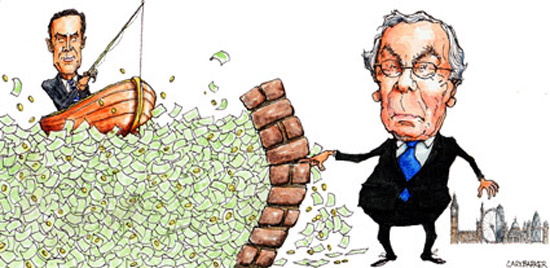
Mervyn King and Mark Carney caricature

Mervyn King & Mark Carney caricature

The outgoing but less outgoing governor of the London based Bank of England hands over the reigns to the younger photogenic ‘saviour’ of the Canadian economy.

The British Government hoping to inject new ideas and impetus in a flagging UK economy plump for the nearest thing the bankers have to a rock star.

Balance of trade figures going in the wrong direction, inflation still out-stripping wage rises and growth turgid it remains to be seen whether they made the right choice. Created for Financial Director Magazine.

https://www.garybarker.co.uk/mervyn-king-mark-carney-illustration.html


Welfare Reforms

Welfare Reforms Debate. Hansard Record

Ian Mearns: Labour MP Gateshead

“Put bluntly, this Government, the Department for Work and Pensions and their agencies are telling us, repeatedly, that people who are dying are fit for work.

Between January 2011 and November 2011, some 10,600 employment and support allowance claims ended and a date of death was recorded within six weeks of the claim end.

This Government have repeatedly refused to release updated 2013 statistics on deaths within six weeks of the end of an ESA claim, calling such requests for information “vexatious”.

Four people a day are dying within six weeks of being declared fit for work under the WCA—it is scandalous and an indictment of this place.

Some might consider this bad taste, but I am told that there was a story doing the rounds that when the bones of Richard III were discovered in Leicester, Atos carried out an assessment and judged him fit for work.

It would be funny if it was not so sad. It is a sad truth faced by 12,000-plus families who every year face their own personal tragedies of this nature—it is a reality.”

Scottish Referendum – Betrayal By the Celebs – Dan Snow & the Chipping Norton Set


The Chipping Norton Set


The Scottish Referendum – The “Let’s Stay Together” Celebrities Campaign

I am ambivalent about celebrities endorsing campaigns. They most definitely are entitled to an opinion and be free to voice their views openly and in public.

But without a definitive knowledge of the cause to which they subscribe there is no compelling reason to be influenced by their views over anyone else.

The campaign evolved through meetings with influential members of the, “Chipping Norton Set” and was funded by persons at the very top of the Tory Party and/or their supporters.

Celebrities, (so called), responded, with gusto to the, “call to arms” from media movers and shakers at their peril. And I expect more than a few titles were gained at the expense of the Scottish electorate.


Dan and his father Peter Snow


Dan Snow – High profile on the BBC – Fronted the campaign

Son of former BBC election night star Peter Snow, Dan was hired to be the public face of the campaign, (as he has previously for other high profile campaigns.). He is married to the fabulously wealthy Duke of Westminster’s daughter, Lady Edwina.

Their families enjoy the friendship of the five richest families in the UK, whose combined wealth is in excess of the total wealth of 20% of the population of the entire UK.


Lady Edwina Grosvenor’s father The Duke of Westminster’s is the UK’s tenth richest man


In a recent BBC1 about WW1, (which he produced and presented) there is a hint to his warped view of the world.

He said, “Many soldiers enjoyed WW1. If they were lucky they would avoid a big offensive, and much of the time, conditions might be better than at home. For the British there was meat every day – a rare luxury back home – cigarettes, tea and rum, part of a daily diet of over 4,000 calories.

Absentee rates due to sickness, an important barometer of a unit’s morale were, remarkably, hardly above peacetime rates. Many young men enjoyed the guaranteed pay, the intense comradeship, the responsibility and a much greater sexual freedom than in peacetime Britain”.

His great great-grandfather was David Lloyd George, British Prime Minister from 1916 until 1922. And his great grandfather was Sir Thomas D’Oyly Snow, one of the generals who planned and executed the battle of the Somme. On just the first day at the battle, 1 July 1916, the army suffered over 57,000 casualties, including more 19,000 dead. Even Snow admitted, “That is the darkest day in British military history, arguably British history, and my great-grandpa was one of the key guys in the planning and execution of that attack”

As well as being part of a TV dynasty second only to the Dimblebys, Snow has a deeply personal connection with the elite responsible for the disasters of the First World War.


Prime Minister (1916 until 1922) David Lloyd George (Dan Snow’s G.G.Grandfather) and Winston Churchill


Now none of us are responsible for the mistakes of our ancestors, but we can seek to learn from them and not to justify them. But Snow has chosen justification, in spite of the fact that his great grandfather’s account of his experience directly contradicts his defence of the war.

Dan Snow describes Thomas D’Oyly Snow as, “a hardened enforcer for the Queen Empress Victoria”. And indeed he was. “He fought Zulus in South Africa and the Mahdi in Sudan, where he carried a bottle of champagne with him to Khartoum and drank it when his troops had avenged the death of General Gordon, who was killed fighting the Mahdi’s warriors in 1885…On the eve of war he was commanding the 4th Division in Britain, assimilating the lessons of the 1899-1902 Boer War for the possibility of war in Europe”.

In the current debate Dan Snow has made a great play of the fact that the, “lions led by donkeys” interpretation of the war is false. Today he insists that the Generals were at the forefront of military innovation.

But when it comes to assessing his ancestor’s exploits it’s a different story. Indeed Sir Thomas D’Oyly Snow saw the war first hand and in very different terms to young Snow.


Lieutenant General Sir Thomas Snow (1858 -1940) KCB KCMG


Sir Thomas D’Oyly wrote, “The higher staffs had had no practice in command, and although they had been well trained in the theory of the writing and issue of orders, they failed in the practice…Added to this we all suffered from the fault common to all Englishmen, a fault we did not know we suffered from till war revealed it, a total lack of imagination”.

It was 2008 when Dan Snow discovered this family history and 2011 when he wrote about it. Back then he thought his great grandfather was, “deeply critical of himself and others, from the inexperience of the British gunners to the shortage of ammunition”.

Churchill refused to re-supply artillery shells to the front claiming there was no money available. In defence of Sir Thomas, Dan Snow wrote, “The revolution in firepower had given the defending side the ability to bring a wall of steel and explosives down on anyone brave enough to attack.


In 1919, under Churchill, by now Secretary of State for Air and War, tanks and an estimated 10,000 troops were deployed to Glasgow during a period of widespread strikes and civil unrest amid fear of a Bolshevist revolt.


Radio was in its infancy. Telephone cables were severed, messengers were picked off by snipers armed with rifles of hitherto undreamed of power and accuracy. Thousands of miles of newly invented barbed wire posed an intractable problem”.

Sir Thomas recorded; ‘We lost several men on the first night, drowned or smothered. The men had either to stand in water, knee deep, with every prospect of sinking in deeper still, or hang on the side of the trench.

Later in the war we should have overcome the difficulty but at this time the men were overworked in keeping the front trenches in order, and we were all inexperienced.

On one occasion one of my staff said to a Corporal of the Engineers, “Now you are an engineer; cannot you devise some method of draining this trench?” to which he replied, “I am afraid, Sir, that I cannot; you see before the war I was a Christmas card maker by trade.”’

And the high command did nothing to help: ‘We were not provided with wood wherewith to make trench-boards, and no extra socks or waterproof boots were forthcoming. We were only censured for having so many sick.’

Dan Snow says that the General’s memoirs finish before, “his darkest days of the war”. At the Somme Sir Thomas’ men, “attacked the strongest stretch of German line as a diversion for the main assault, which went in to the south. Even by the standards of that bloody and futile day, the attack of Snow’s VII Corps was a disaster.”

But Sir Thomas D’Olyly Snow was at a château, not the front. Even Dan Snow admits that when he went to the chateau, “It feels a long way from the carnage of the trenches”.


French château


Worse still, it appears Snow attempted to shift the blame away from himself, writing to his seniors, “I regret to have to report that the 46th Division in yesterday’s operations showed a lack of offensive spirit.”

This was after the men had fought their way through unbroken barbed wire. Then, once they did manage to get into the German trench system, they held off counter-attacks until they had run out of ammunition and were forced to use shovels and their bare hands.” It was says Dan Snow of Sir Thomas, “an inexcusable attempt to shift the blame”.


Does all this really sound like Dan Snow’s recent claim, “Many soldiers enjoyed WW1. If they were lucky they would avoid a big offensive, and much of the time, conditions might be better than at home. For the British there was meat every day – a rare luxury back home – cigarettes, tea and rum, part of a daily diet of over 4,000 calories.

Absentee rates due to sickness, an important barometer of a unit’s morale were, remarkably, hardly above peacetime rates. Many young men enjoyed the guaranteed pay, the intense comradeship, the responsibility and a much greater sexual freedom than in peacetime Britain’.

Doesn’t it sound rather like the myths that the Dan Snow of 2014 is trying to dismiss. Are there not here poorly trained troops, unsupported by the high command? Do the generals not seem to know what they are doing? Are they not versed in colonial warfare but unprepared for an industrialised total war? Are they in the château’s and not the trenches? Are they trying to shift the blame for failure onto others?

If we want to know about the realities of the First World War it would seem the old imperial warrior is a better guide than his historian great grandson.

http://nationalleft.blogspot.co.uk/2014/08/maybe-dan-snow-should-have-another-look.html
http://bellacaledonia.org.uk/2014/08/08/vaudeville-britain-speaks/
https://twitter.com/KeyStakeholder/status/497711608085614593/photo/1


The Chilcott Enquiry

The 2002-3 Iraq war and the Chilcott Enquiry The cost to date, nearly £8 million. The report is yet to be published. Why wont they release the information?

Two million people marched against the war, many more were profoundly disturbed by the suspicion that our government had lied and dissembled in order to please the Americans. For young people in particular, the controversy seemed to confirm that politics was inherently corrupt. In this context, the ludicrous farce of the Chilcott Inquiry is even more damaging. To many people, it will inevitably appear that the Whitehall establishment is protecting its own.

The more you hide, the more people suspect and fear you – and the more you play into the hands of juvenile nihilists who prattle about revolution without really understanding what it means. But as the popularity of conspiracy theories suggests, people always like to believe the worst.

What, they will wonder, do Blair and Brown have to hide? What did they tell President Bush? What promises did they make, and what secrets are lurking in the documents? The great irony, of course, is that the Chilcott Inquiry was meant to shed light on the dark corners of British foreign policy, to heal the wounds of the Iraq invasion, and to restore public faith in the political process.

Yet all of this is so unnecessary. For decades, successive governments have come to power promising to roll back the culture of secrecy, yet none of them has done it. Why the mandarins and their political patrons are so frightened of openness is simply beyond me. Their American friends, for example, are much quicker and keener to open their archives and to air their dirty linen in public, and it never does them any harm.

http://www.dailymail.co.uk/news/article-2491880/Bid-No10-files-secret-halts-Iraq-report-Cabinet-Secretary-blocks-attempt-declassify-130-conversations-Blair-Bush-Brown.html

The UK has the worst state pensions in Europe

The UK has the worst state pensions in Europe;

A study shows the state pays pensioners an income equivalent to just 17% of average earnings. The, “inadequacy” of the UK’s state pension system is, “beyond question”.

This is the lowest level in Europe and well below the average for all European Union countries of 57%. Even the Netherlands, which has the second-lowest level, provides a state pension nearly double the UK figure, the study shows.

At the heart of the problem is Westminster’s failure to undo the damage caused by the Tories under Margaret Thatcher, who cut the link between average earnings and pensions in 1980. Since then annual pension increases have been tied to retail price inflation.

So much for a caring Westminster political system. Scotland would be better served by being independent from the corruption that is Westminster. Vote, “Yes” in the referendum

http://www.thisismoney.co.uk/money/pensions/article-1615956/UK-state-pension-is-the-worst-in-Europe.html