Jacqui Gavin (Prev. Scott Whyte) – Scottish trans champion
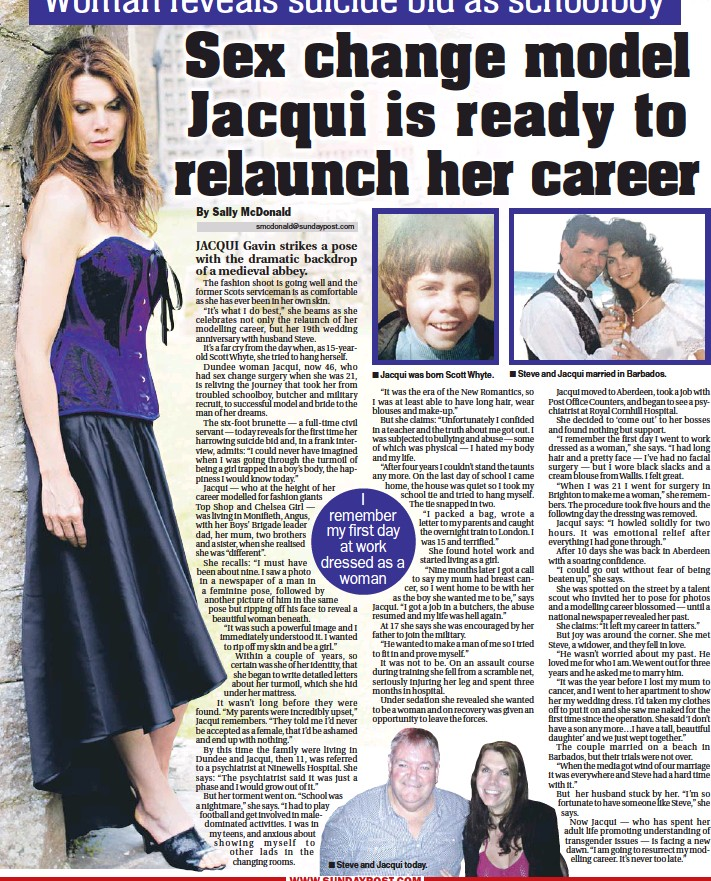
Growing up as a boy in 1970s in rural Scotland, he was young, trans and vulnerable. His short career in the army ended abruptly. After transitioning her budding photographic modelling was destroyed by those who misunderstood her identity and she endured humiliation from the British press. Despite the enduring hate, she channelled her energy into making things better for other trans people. She brought Scottish trans people under her wing and went on to help make the civil service the inclusive industry-leading employer it is today. She was recognised by the Queen with a British Empire Medal in October 2020.
Being trans in 1970s Scotland
She said she realised she was trans when she was 10. “I describe it as a wake-up call, I was 10 years old. I was flicking through the pages of a magazine and found a picture of a man straddling the back of a chair. It was in black and white, he was naked and sad. I didn’t understand why. I flicked to the next page and saw a picture of the same man in the same pose with his skin ripped off. Underneath was a beautiful lady with smooth skin, flowing locks and perfect makeup. As soon as I saw this image I knew what had been missing in my life. But this was 1970s Scotland and my parents dismissed it as a photographic trick. Boys were boys, girls were girls and there was nothing to be done.”
She was encouraged to be a boy and do the things boys do, such as play football, which to her dismay she was quite good at. She said: “I represented my school and country as a boy till I was 15. Then I told my managers I couldn’t do it anymore. I felt like a failure- like I’d let my parents down.”
At only 15 she ran away from home in 1983 and headed to London where she spent evenings waiting tables for a surprising amount of cash and discovering the other outcasts who had arrived in the gay mecca of Soho and come to call it home. Despite this newfound haven, she returned home when her mother was diagnosed with terminal cancer and her parents filed for a divorced. She took care of her siblings and then, not being able to stay there any longer, she enlisted in the army, following her older brother’s footsteps. But then her secret was found out. She hadn’t yet transitioned, and during training had injured her knee so was taken to the hospital. While in the ambulance she was told she screamed, ‘I want to be a girl.’
She said: “I was put in front of my commanding officer and offered prison time or to be sent back to basic training.” She used her waiting money to buy herself out of the military and used the rest of her money to buy her transition surgery at age 20. She ended up working in Aberdeen, but the queer scene there wasn’t like in Soho. She described it as “underground backwater places, down dark alleyways.” She said: “The community was small but it was family. Everyone looked after everyone, but we’d have to leave a venue together or be subject to abuse, hate and people spitting on you.”
She wanted to change things to keep people safe. She said: “I created a group with my friend Anne Forester to give support for people regarding gender expression. It was a safe space where trans and non-binary people could go and be themselves. Guys could come along and put a frock on in a safe environment. We provided a resource and brought in people of authority. The police came in because they wanted to engage and talk with us and even local Aberdeen city council members. These were conversations that allowed us to build trust and respectability between the police and the LGBTQ+ community.”
How transphobia almost destroyed her career
Despite her success in empowering her community and bridging these divides, her career remained non-existent. She said the discrimination against her as a transgender person “has impacted my career massively. All opportunity for promotion was denied. I was told I wasn’t ready. There was a stereotype that trans women are overly sensitive. They’d say ‘you’re too vulnerable because of your trans status.’”
She was scouted by a modelling agency whilst in Scotland, but her career ended when she was exposed as trans. She said: “Being trans in the modelling industry at the time was not acceptable. It destroyed my modelling career. The rights for trans people were non-existent back then. There was no legal protection so I found myself going from job to job. My CV was a patchwork quilt. I’d be in a job for no more than two years and be found out.”
She described the time she arrived back at one job after taking compassionate leave when her mother passed away. She had been exposed as trans by the British tabloid press. She said the director of the company asked her why she’d ticked the ‘F’ for female in her application form. At that point, the HR manager stormed into the room to Jacqui’s rescue and told her to go back to her desk.
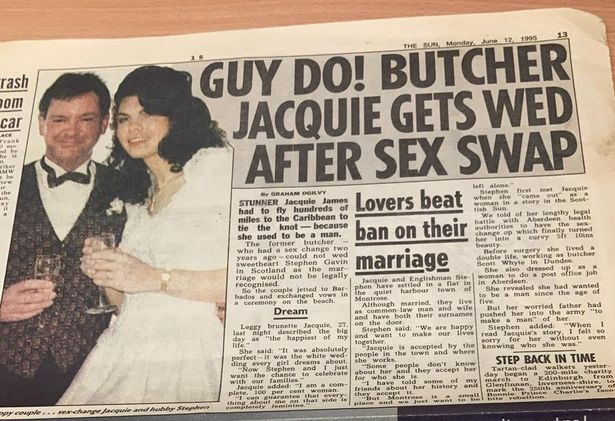
She was ripped apart by the press in 1995 after her runaway wedding in Barbados to her now ex-husband. They took a holiday wedding to avoid the laws in the UK which restricted trans people from marrying. She described clutching her birth certificate as they registered, which had her old name and gender at birth, fearful the clerks would ask for it. She returned to the UK with husband Steve Gavin greeted with devastating headlines like: ‘Guy do! Butcher Jacqui gets wed after sex swap’.
The Sun’s coverage of Jacqui’s wedding, June 12 1995
Why she became a campaigner
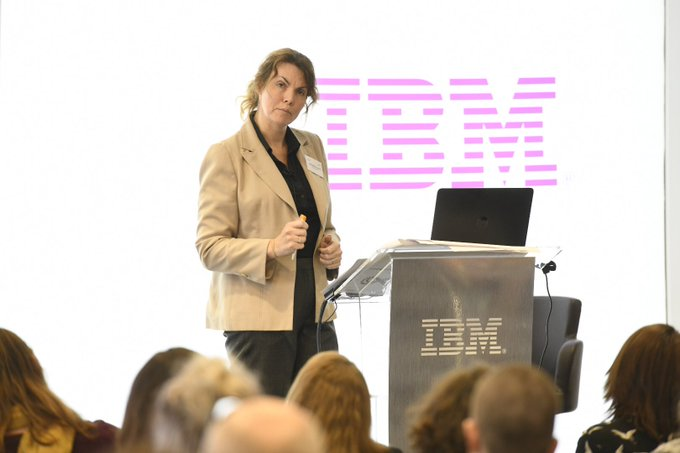
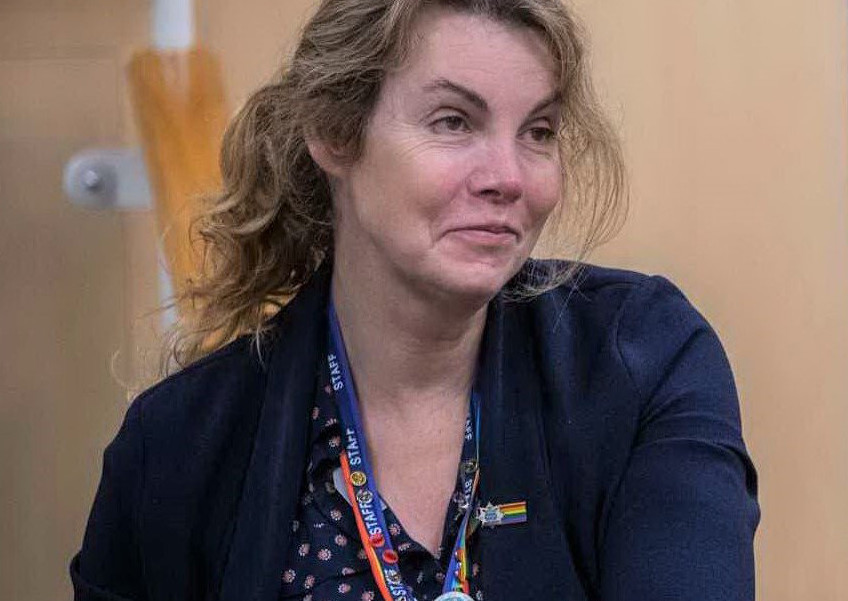
She gained progress and recognition for her efforts when she joined the UK civil service in 2009. After only a few weeks in an admin role for the Department of Work and Pensions (DWP), she said she got the ‘we know about you’ call. But instead of being fired, she was asked to set up a transgender network within the department. From there she became the first chair of the first transgender network in the entire of the civil service. She was then given the role across the whole civil service to impact the way trans issues were seen. She went on to work in a similar role for the Fire Service, not just for trans people but for other minorities too.
However she said her impact at the civil service is her biggest achievement to date. She said: “In Whitehall, in 2009 it was as though you were at school. You don’t speak out of turn or challenge the seniors in these organisations. By the time 2015 came around the organisation was listening to people and viewing and valuing who we are. It’s become the most inclusive employer in the country. We got there by working together and breaking down barriers through conversation. I realised if you get things right for one marginalised group such as trans people, that makes things easier for other groups too. It has a positive knock-on effect.” (summarised from an article in the Cambridge News)
Tuesday 10 March 2020: Extract summary: In a Scottish context: Constitutional Affairs: The Roles and responsibilities of the Cabinet Secretary and the Cabinet Office.
Q: If the Permanent Secretary, is concerned about a ministerial decision they can ask for a written ministerial direction but what course of action is open if the Permanent Secretary is unhappy with the conduct or behaviour of the first Minster?
A: It would depend how serious those concerns are. I would normally expect the Permanent Secretary and the First Minister to make their best endeavours to work effectively together to lead in partnership. If there are tensions one would normally expect those to be resolved between them, in private if they possibly can. If for some reason they were not able to do so, I might be asked to become involved. It is only in very rare cases that one would expect that to be the case. Generally these relationships are good. They are often challenging. They are conducted with candour and courtesy in private. It is that partnership that means that Ministers can ensure the Civil Service is delivering its priorities.
Q: What is the role of the Cabinet Secretary in dealing with such issues.
A: If a difficulty arises it is important to restore harmony. It is to try to ensure that the relationship is productive. Obviously if there are concerns, if a First Mninster has concerns about the effectiveness of the top team, whether the Department is in the right shape, again I would expect the Permanent Secretary to try to resolve those and ensure that the Department is running the way the First Minister wants the Department to run. My role, if there were a point of tension, would be to try to address any concerns and help the two of them work through those together. Of course, if that is not possible, we would have to consider alternative courses of action.
Q: In your endeavours to restore harmony in a St Francis of Assisi way, there is no formal process, is there?
A: There is not a formal process unless an issue has become formal because there are formal complaints about behaviour and so on. As in any big organisation, the process is essentially to try to ensure that the top team, political and professional, are working effectively together and that the professional Civil Service is delivering to the expectations of the agenda of Ministers.
Q: Further on that, what is formal process?
A: For example, if there were a complaint about conduct against an official, a special adviser, a Minister, by anyone, that complaint would be investigated, just as it is in any big organisation if it were about bullying or harassment or discrimination or behaviour, and the appropriate action taken. The appropriate action will often simply be some kind of behavioural intervention, giving someone some advice or coaching on the impact they might be having on others. Obviously, if it is more serious and there is a matter of conduct, whether that is by an official or a special adviser or Minister, there are formal processes set out in the codes that we would follow. Those would only be in the rarest and most difficult cases, obviously.
Q: How does it work in relation to the Permanent Secretary of the Scottish Government because he/she is responsible to the first Minister of Scotland?
A: Essentially the process is the same. The difference is that it is the First Minister of the Scottish Government who makes the final decision as opposed to the Prime Minister. The process and the relationship between me and them, I am still the accounting officer, for the First Minister and the Permanent Secretary so the First Minister in those circumstances is playing both the role of the Secretary of State and taking the final decision that the Prime Minister would take in the other jobs.
Q: For clarity, you are the line manager of the Permanent Secretary of the Scottish Government.
A: Yes.
Q: How does that work in the context of the Scottish Government, for example, pursuing diametrically opposed policies and positions from the UK Government? How can you appraise the Permanent Secretary on that basis for carrying out policies and positions that are contrary to the ones that you have been instructed to carry out on behalf of the UK Government?
A: It is a great question. The job is to carry out the policies of whichever Government you are working for. If the general election result had gone the other way, we would be carrying out a very different programme from the one that we are carrying out now, and that is the job of the permanent Civil Service. My job is to make a professional assessment of the professional performance of the Permanent Secretary of the Scottish Government in pursuing the policies of the Government, ensuring that we are operating in the most collaborative way that we can and assessing their contribution as senior leaders in the broader Civil Service.
Q: With the Scottish service, say a relationship difficulty occurred that was similar to the harassment relationship that has been alleged in the Home Department with the Home Secretary would the Permanent Secretary report to the Cabinet Secretary? Say if the First Minister of Scotland was misbehaving in any particular way?
A: Essentially exactly the same principles and so on would apply. In the end, as I said, one would always hope that it was possible for these things to be resolved between the Permanent Secretary and their responsible Minister, whether it was the First Minister of Scotland or, as you say, in that hypothetical example, but if necessary the Cabinet Secretary would become involved.
Q: In the recent or longer past, has a Permanent Secretary in Scotland had to report any misbehaviours of their First Minister to you?
A: You will understand, particularly in the light of events this week in the Scottish courts, I have to be very, very careful. All I can say is that the Permanent Secretary of the Scottish Government certainly in my time and, as I understand, her predecessors and mine have applied exactly the same system that I described to you.
Tuesday 10 March 2020: Meeting of the Public Administration and Constitutional Affairs Committee for a hearing on the work of the Cabinet Secretary and the Cabinet Office.
Q: If a Permanent Secretary, is concerned about a ministerial decision they can ask for a written ministerial direction. What course of action is open to a Permanent Secretary who is unhappy with the conduct or behaviour of their line manager?
A: It would depend how serious those concerns are. I would normally expect a Permanent Secretary and their line manager to make their best endeavours to work effectively together to lead in partnership. That is the case in the overwhelming majority of the cases and the partnerships are extremely effective. If there are tensions—and Government is challenging and deals with difficult issues—one would normally expect those to be resolved between them, in private if they possibly can. If for some reason they were not able to do so, I might be asked to become involved. It is only in very rare cases that one would expect that to be the case. Generally these relationships are good. They are often challenging. They are conducted with candour and courtesy in private. It is that partnership that means that Ministers can ensure the Civil Service is delivering its priorities.
Q: What is the role of the Cabinet Secretary in dealing with such issues.
A: If a difficulty arises it is important to restore harmony. It is to try to ensure that the relationship is productive. Obviously if there are concerns, if a Line manager has concerns about the effectiveness of the top team, whether the Department is in the right shape, again I would expect the Permanent Secretary to try to resolve those and ensure that the Department is running the way the line manager wants the Department to run. My role, if there were a point of tension, would be to try to address any concerns and help the two of them work through those together. Of course, if that is not possible, we would have to consider alternative courses of action.
Q: In your endeavours to restore harmony in a St Francis of Assisi way, there is no formal process, is there?
A: There is not a formal process unless an issue has become formal because there are formal complaints about behaviour and so on. As in any big organisation, the process is essentially to try to ensure that the top team, political and professional, are working effectively together and that the professional Civil Service is delivering to the expectations of the agenda of Ministers.
Q: Further on that, what is formal process?
A: For example, if there were a complaint about conduct against an official, a special adviser, a Minister, by anyone, that complaint would be investigated, just as it is in any big organisation if it were about bullying or harassment or discrimination or behaviour, and the appropriateaction taken. The appropriate action will often simply be some kind of behavioural intervention, giving someone some advice or coaching on the impact they might be having on others. Obviously, if it is more serious and there is a matter of conduct, whether that is by an official or a special adviser or Minister, there are formal processes set out in the codes that we would follow. Those would only be in the rarest and most difficult cases, obviously.
Performance Appraisal
Q: How does it work in relation to the Permanent Secretary of the Scottish Government because he/she is accountable to the first Minister of Scotland?
A: Essentially the process is the same. The difference is that it is the First Minister of the Scottish Government makes the final decision as opposed to the Prime Minister. The process and the relationship between me and them, I am still their reporting officer, so the First Minister in those circumstances is playing both the role of the Secretary of State and taking the final decision that the Prime Minister would take in the other jobs.
Q: For clarity, you are the line manager of the Permanent Secretary of the Scottish Government.
A: Yes. But I am not of the head of the Northern Ireland Civil Service because that is separate entity from the GB Civil Service.
Q: How does that work in the context of the Scottish Government, for example, pursuing diametrically opposed policies and positions from the UK Government? How can you appraise the Permanent Secretary on that basis for carrying out policies and positions that are contrary to the ones that you have been instructed to carry out on behalf of the UK Government?
A: It is a great question. The job is to carry out the policies of whichever Government you are working for. If the general election result had gone the other way, we would be carrying out a very different programme from the one that we are carrying out now, and that is the job of the permanent Civil Service. My job is to make a professional assessment of the professional performance of the Permanent Secretary of the Scottish Government in pursuing the policies of the Government, ensuring that we are operating in the most collaborative way that we can and assessing their contribution as senior leaders in the broader Civil Service.
Q: If the Scottish Government had indeed managed to stop Brexit, you would have given the Permanent Secretary a five-star rating for achieving that?
A: That would have rather depended on whether the Scottish Government claimed the credit themselves or gave the credit to the Civil Service.
Q: In the context now of where devolved settlements have reached, with devolved Administrations pursuing diametrically opposed policies to the UK Government, and often being the harshest critics of the UK Government and therefore their fellow civil servants, that it is sustainable to continue with the one Civil Service model?
A: I think it is important that we do, because this Government’s position is that the Union is an important institution. Of course there are tensions and of course there are discussions. There are different human resource policies in Scotland, but we work through those and it continues to be a very important aspect of the Civil Service, having one Civil Service reaching right across the United Kingdom.
Q: Is there anything specific you think that would strengthen it, actions that you are taking or could take?
A: Yes. I think a greater presence, particularly a greater presence in the devolved Administrations, and we are doing that. As you know, we have a big office opening in Edinburgh. The hub process. A greater distribution of civil servants from Whitehall into the devolved Administrations is going to be very important, and that is on the agenda and we are working that through as we go forward. That is the obvious step.
There ought to be—and this will be a political decision—a conversation about the policies. If this Government’s position is that we need to strengthen the Union, we need to have the conversations. Rather than just ask, “How does that policy look through a devolved Administration’s lens?” we should be thinking about policies that specifically strengthen that Union. We are not quite there yet but that is the role of the Civil Service to start generating those things. That depends on the creativity and the imagination of the civil servants across working in tandem with our Scottish colleagues.
Q: That is a challenge when the devolved Administration policy is diametrically the opposite.(David Mundell)
A: Of course it is a challenge, but the one Civil Service is one thing that is across the United Kingdom and I think that should stay and we should reinforce it.
Q: Are there still secondments from, for example, the Welsh or Scottish Governments to Whitehall and vice versa?
A: Yes, there are. We do it annually. We do it annually and the intent is to beef that up and do more of it. I would say at the moment we are not satisfied that we have enough of the civil servants that look back to Whitehall in the devolved Administrations. We want to strengthen that in the next phase and that is part of our plan.
Q: Are there still weekly meetings of Permanent Secretaries?
A: Yes, more than. We have a weekly meeting of all the heads of Department and sometimes every couple of weeks of the wider group of Permanent Secretaries, including some of the specialists.
Q: Presumably, at those meetings delivery of Government policy is discussed?
A: Yes, we will brief on what has happened in Cabinet, we will talk about the main issues of the day. We will often talk about Civil Service capability or some of the main issues.
Q: Does the Permanent Secretary of the Scottish Government attend the meetings?
A: Yes, usually. If there are areas of policies that are delicate in that sense, we must not put them in a position where they feel conflicted and we will avoid those conversations and have those in a slightly different group. One has to just manage these things. It was particularly the case during the 2014 referendum that we had to be very careful about that. If we are talking about domestic policies, for example, about social care or homelessness or whatever it might be, even if those issues are essentially Whitehall, it is only focused on England or maybe England and Wales in some cases, it is useful to have the insight and the input from the other devolved Administrations because, in those areas of policy, social policy, we are often working in partnership rather than in the hierarchical sense. We make a judgment case by case.
Q: In cases of sensitivity you convene separate meetings of Permanent Secretaries?
A: Yes, but that in a sense is no different from having a meeting on Coronavirus, for example, which has the Permanent Secretaries who are relevant to that particular issue, or something on national security or something on an economic issue. We do not make everyone come to everything. We tend to use those full meetings, as most big organisations would, as essentially information-sharing meetings.
Q: Is the head of the Northern Ireland service invited to those meetings?
A: Yes.
Q: In that regard you treat it as one Civil Service but you have a separate line-management structure for them. They are a separate service. Therefore, why is it so important that Wales and Scotland are not a separate service if you are able to treat it as one union in some regards with Northern Ireland? Sir John, you mentioned that it was important to the Union. The biggest threat to the Union is Northern Ireland leaving, not Scotland and Wales in my view, if “threat” is the right word. Why not allow the Scottish Civil Service and the Welsh Civil Service to have the same kind of status as the Northern Ireland Civil Service?
A: It is essentially a historical issue. The Irish Civil Service was separate; the Northern Ireland Civil Service then continued to be separate after 1922. It has arisen for no better reason, in a sense, than the circumstances at the time. What we endeavour to do is bind the Northern Ireland Civil Service into the broader Civil Service to ensure that they have access to the broader talent pool and thinking and so on and create that sense of collegiality across the entire UK. There are many issues in which we do govern as a UK as a whole. Of course some domestic policy issues are devolved, very significant ones. In that sense, parts of Whitehall are just governing England. Certain Departments in Whitehall are just responsible for those services and issues in England. Other Departments in very significant areas of work, including the area that I spent most of my career in, are UK-wide. One of the jobs of a Cabinet Secretary anyway is to try to see the connections between all these things. One of my obsessions is to try to ensure that we look horizontally as effectively as we tend to look vertically. Anything that increased the vertical boundaries, sharpened the vertical boundaries and made it harder to work collaboratively across the United Kingdom on some of the issues that affect us all, I think would be an error.
Q: Does the Northern Ireland service having this historical separation make it harder?
A: In some areas it probably does. We have to make a greater effort. I think we do it well but we have to make a greater effort to ensure that they are properly brought into the collaborative enterprise. Increasingly, we are deploying the commercial expertise or the technical expertise or the project expertise right across, including into the Northern Ireland Civil Service and that is strengthening the bond, so I would go the other way.
Q: With the Scottish service, say a relationship difficulty occurred that was similar to the relationship that has been alleged in the Home Department with the Home Secretary would the Permanent Secretary report to the Cabinet Secretary? Say if the First Minister of Scotland was misbehaving in any particular way?
A: Essentially exactly the same principles and so on would apply. In the end, as I said, one would always hope that it was possible for these things to be resolved between the Permanent Secretary and their responsible Minister, whether it was the First Minister of Scotland or, as you say, in that hypothetical example, but if necessary the Cabinet Secretary would become involved.
Q: In the recent or longer past, has a Permanent Secretary in Scotland had to report any misbehaviours of their First Minister to you?
A: You will understand, particularly in the light of events this week in the Scottish courts, I have to be very, very careful. All I can say is that the Permanent Secretary of the Scottish Government certainly in my time and, as I understand, her predecessors and mine have applied exactly the same system that I described to you.
Q: You mentioned earlier that Whitehall was expanding or increasing its footprint in Scotland and I am wondering to back up what was said earlier is that role of the expanded Civil Service, coming out of Whitehall, to support the democratically elected Scottish Government in its manifesto or is it to support the UK Government’s manifesto?
A: Primarily, it will be the UK Government presence in Scotland but in so doing will, therefore, be cheek by jowl with their colleagues in the Scottish part of the Civil Service. Therefore, relationships will improve and all of that will get better.
Q: It is hard to see relationships improving when one is going in one direction and the other is going in the opposite direction.
A: Might I add a point to that? It is important. Of course there is a different position between the two Governments on the eventual status of Scotland, but in terms of the governance of the United Kingdom. The First Minister of Scotland, is concerned with the good governance of the United Kingdom. Fundamentally, although the policies vary, all of the Governments of the United Kingdom are seeking to pursue policies about the governance of the United Kingdom. The First Minister of Scotland has always been clear that she expects us to support them within the current shevernance arrangements of the UK, even though she obviously has a different view as to the eventual status of those arrangements
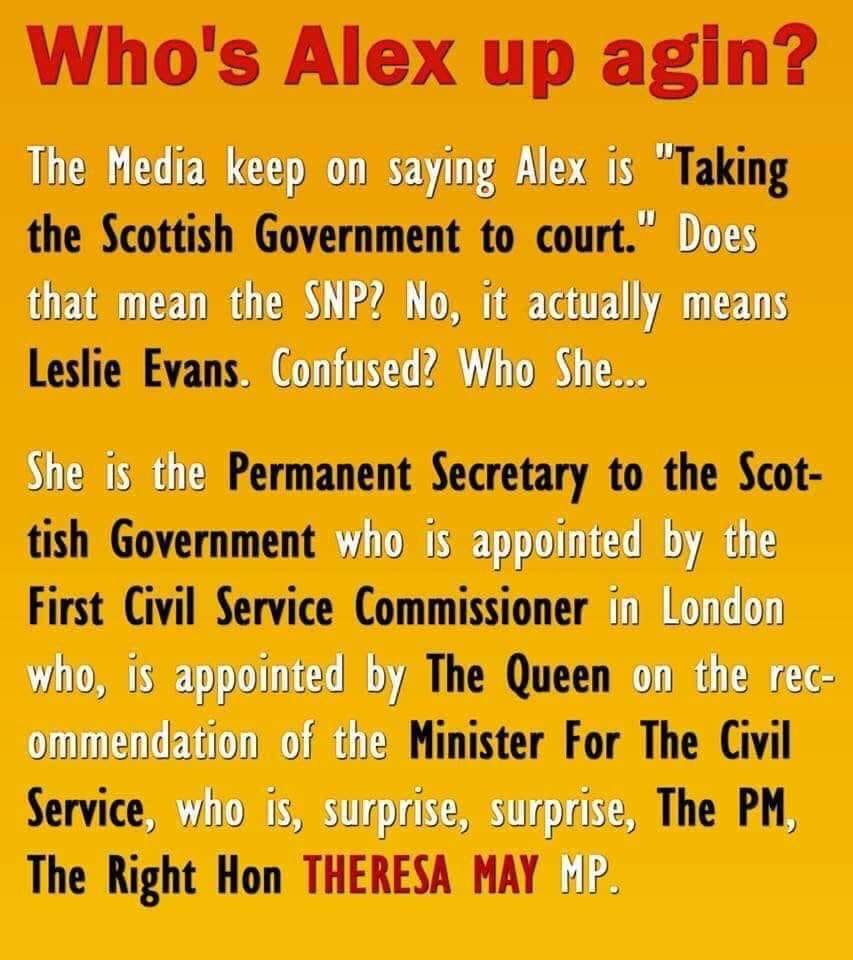
Q: You mentioned earlier that you are the reporting officer of the Permanent Secretary of the Scottish Government, Leslie Evans. Is there anything that she would not report to you or any conversations that she can have in complete privacy with the Scottish Government, with the First Minister, that you would not expect to be privy to?
A: Yes, for example, if they were discussing a policy matter that was entirely within the Scottish Government. The relations have to be relationships of confidence. I do not expect Leslie Evans to be back-briefing me on every conversation she has with the First Minister. All relationships have to have elements of them that are in confidence. That is part of building trust and confidence between people. I would expect Permanent Secretaries across Government to be able to do that with their Minister.
Unionists are individuals whose minds and actions are dominated by the retention of the UK union at any cost
Many of them pursue successful careers in politics fully supporting the aims and aspirations of any Party of their choosing, always provided that their primary motivation is never compromised.
Others are deployed to media manipulation with a guarantee of a long and well numerated career, promoted well beyond their capabilities and fully protected from public exposure.
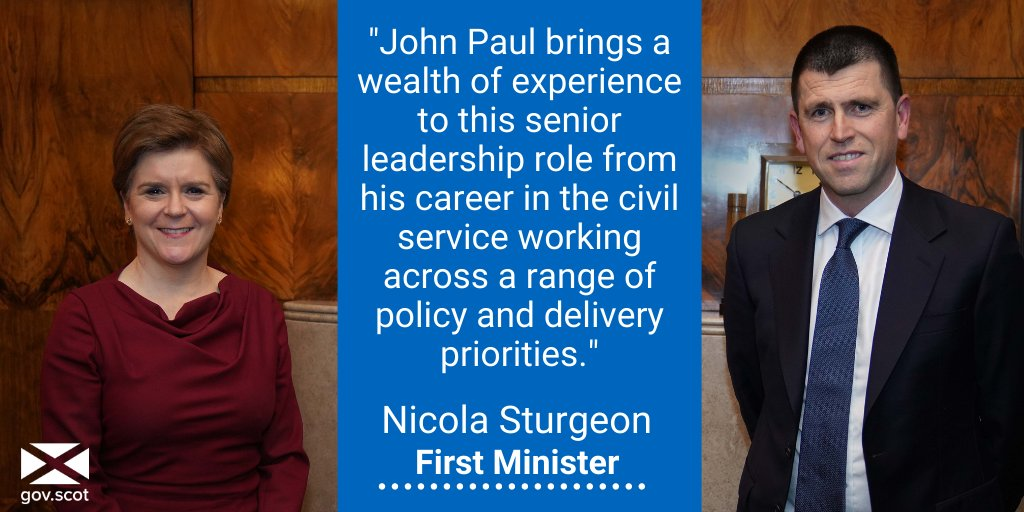
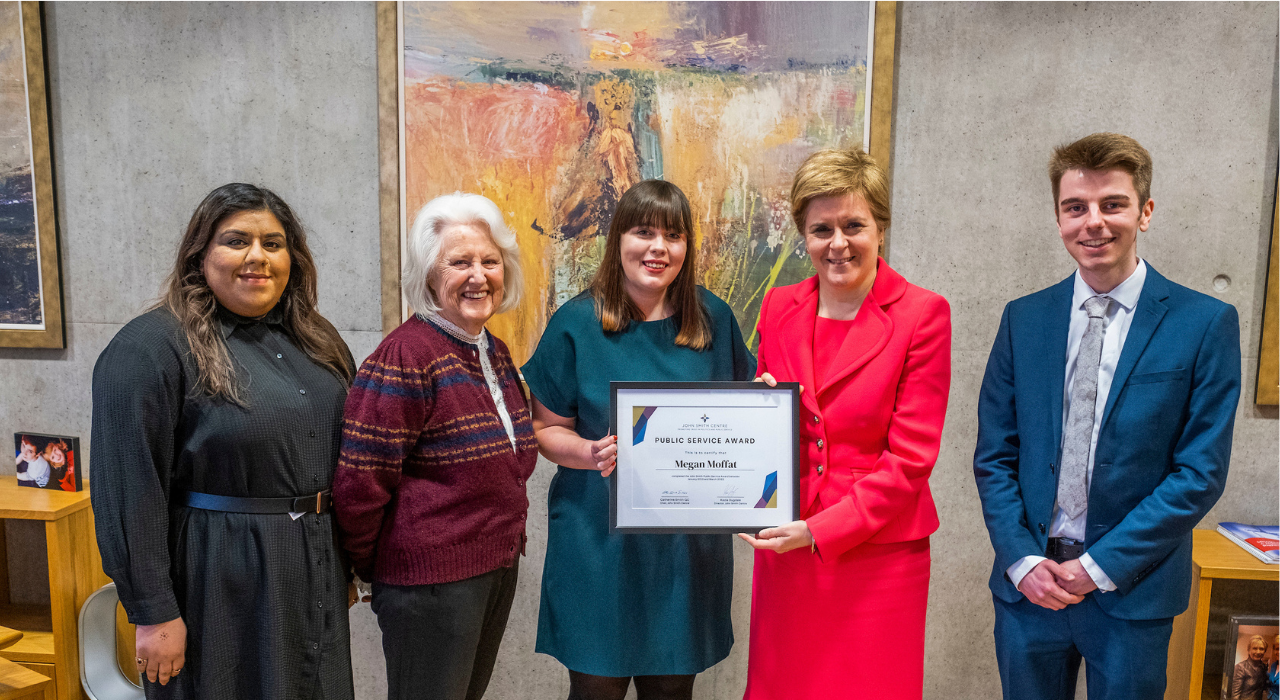
The First Minister Nicola Sturgeon, presenting a John Smith Public Service Award. The Centre is extremely grateful for the time the First Minister gave to speak to students.
The John Smith Centre
Founder member, Baroness Smith of Gilmorehill: Is a British Secret Service agent of long-standing and a powerful political figure in the UK. She is the widow of the late John Smith, Labour Party Leader, and high heid yin of the Zionist, Biderberger, movement. She also retains membership of a number of organisations with political interests at variance with Russia and other Eastern bloc countries.
Smith was a member of the Hakluyt Foundation which was set up by former MI6 executives after the end of the Cold War to provide intelligence for many FTSE 100 companies and UK, US and European clients. The directors include many ex MI6 agents, diplomats, journalists and former special advisers to government ministers.
Following an extraordinary libel trial in which former foreign secretary Sir Malcolm Rifkind gave evidence, there were question marks over the quality of the intelligence Hakluyt provided.
A report produced by Hakluyt on Czech oil tycoon Karel Komarek and his father, which contained allegations of corruption and murder, led to Scottish oil company Ramco being sued for libel. Ramco had employed Hakluyt in good faith on the recommendation of its consultants, Mr Rifkind and Baroness Smith.
The activities of the John Smith Centre are overseen by a Board comprising members of the Smith family, University of Glasgow alumni, political and public service practitioners and academic staff and is accountable for the conduct, leadership and management of the Centre.
It sets the priorities; benchmarks best practices, and reviews performance to enable the Centre to achieve its aim to promote trust in politics and public service and to empower and attract more people to contribute to public life.
The Foundation is operates as a charitable organisation under the auspices of Glasgow University and is not required to publish or make available any sources of income or expenditure to the public.
The Board
Catherine Smith: Daughter of Baroness Smith. Vice-Chair of Justice Scotland. An organisation involved in work promoting the rule of law and human rights in developing democracies and sustainable development in societies in transition.
Ed Balls: Is a neoliberal former member of the Labour Party government who attended the secretive, annual Bilderberg conclaves of the richest 1% of the world financiers.
Dr Matt Carter: Was General Secretary of the Labour Party, overseeing political campaigns and organisation in the period running up to and including the 2005 General Election, which saw Tony Blair win a successful third term in office. He has spent the last fifteen years advising political leaders and others on campaign strategy and messaging, with a particular focus on corporate communications, reputation management, politics and polling.
Professor Sarah Carter: Is Vice-Principal and Head of the college of Social Sciences at the University of Glasgow. She holds a number of external appointments, as a member of the Council of Economic Advisers to the First Minister of Scotland, the Enterprise & Skills Strategic Board, and the Women in Enterprise Action Group and as a Non-Executive Director of Women’s Enterprise Scotland. and is a member of the UK Government’s Women’s Enterprise Taskforce.
Ruth Davidson: In 2011, Conservative Central Office in London decided to take control of the party in Scotland and run it from London through a proxy leader. The Tory Central Office and Party Chairman, a former senior British Secret Service officer selected her for the post and created the Ruth Davidson appreciation society giving her free rein as the Party Leader in Scotland (albeit strictly monitored by senior officers in the party) to rebuild the Party from scratch. She lead the Party for around eight years before surprisingly resigning from politics to take up a position in the House of Lords.
Resham Kotecha: Was a Tory candidate in the 2015 general election, where she was the Party’s youngest BME candidate. Stood for office again in the 2017 election. Presently serving as the Head of Engagement for Women2Win. A strategy and policy specialist she is currently the Head of Policy & Government Affairs, EMEA at Wise. She is the founder of the Conservative Policy Network, designed to increase accessibility to policy-makers, and is a Trustee of the Fawcett Society, the UK’s leading charity campaigning for gender equality and women’s rights.
David Muir: Was the Director of Strategy to Prime Minister Gordon Brown. Possesses a first class degree in politics and economics from the University of Glasgow, and has served as a visiting fellow of the Institute of Politics at Harvard University. Also serves on the advisory board of the Institute of Politics at the University of Chicago.
Andrew Wilson: Founding Partner of Charlotte Street Partners, the strategic communications firm based in London and Edinburgh. Began his career in the civil service in the Government Economic Service then worked as researcher and economist for the SNP and as a business economist at Royal Bank of Scotland.
Elected to the first Scottish Parliament in 1999 he served as Shadow Minister for, variously: Finance, Economy, Transport and Lifelong Learning. In 2003, he re-joined the RBS working in a number of roles including as Deputy Chief Economist.
During the banking crisis, he served as Head of Group Communications and was intimately involved in the bank’s high-profile engagement with the City, UK Government and media during those tumultuous times.
In 2012, prior to launching Charlotte Street Partners, he joined global marcomms group WPP Group in a client strategy role working with agencies and group across the full range of services including media and advertising. In September 2016 he was appointed to chair the Sustainable Growth Commission, which reported to the First Minister, Nicola Sturgeon, in May 2018.
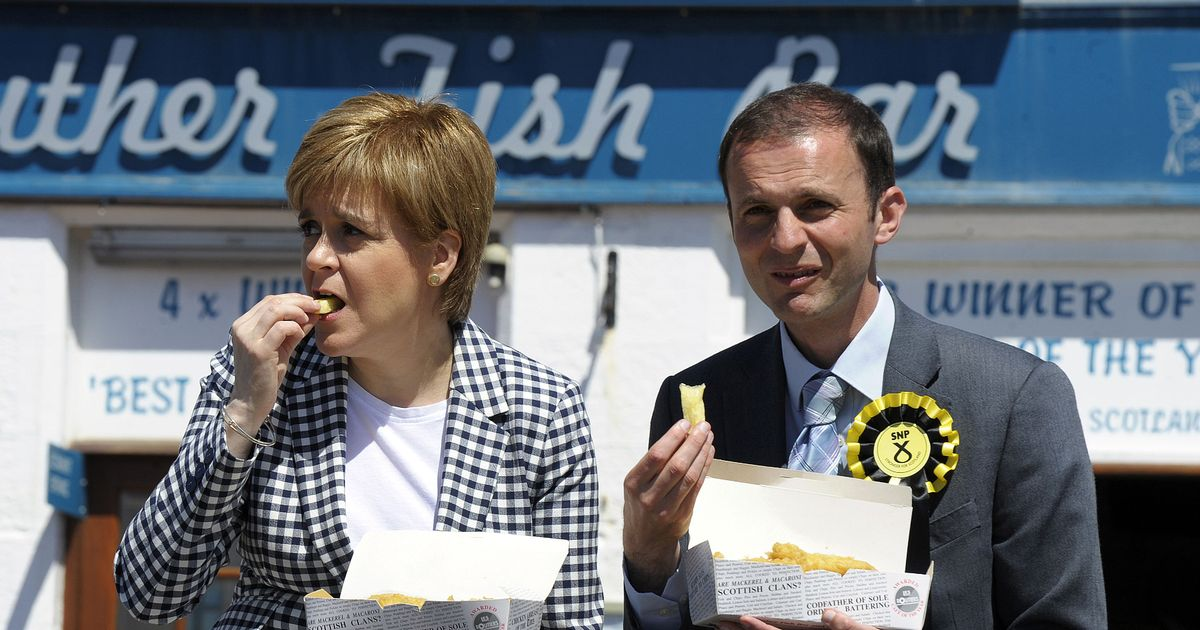
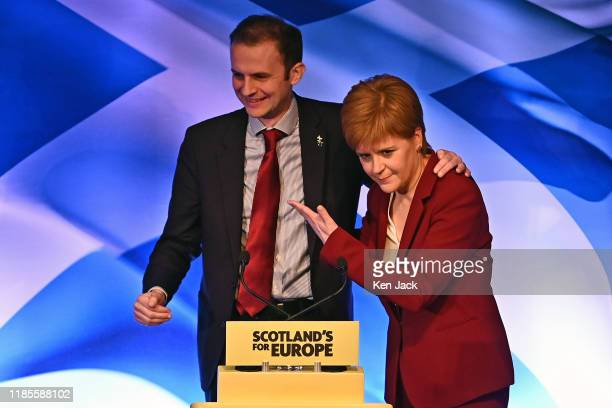
Stephen Gethins: Former SNP MP for North East Fife and shadow SNP Spokesperson for foreign affairs. Worked with Craig Oliphant in Eastern Europe before entering politics for the SNP. Very close politically to Nicola Sturgeon.
Prof. Lord Alderdice: Liberal Democrat member of the Lords since 1996. Currently Director of the Centre for the Resolution of Intractable Conflict at Harris Manchester College, Oxford.
Lord Duncan: Appointed a Tory working peer by UK Prime Minister in 2017, he is currently Deputy Speaker of the House of Lords. he was a Tory UK Government Minister, serving in each of the territorial departments (Scotland, Wales & Northern Ireland) and laterally as Minister for Climate Change with responsibility for international negotiations.
Kezia Dugdale: Former leader of the Labour Party in Scotland is the Director of the Centre.
The Trust runs intensive, four-week Fellowship Programmes twice a year in the UK for emerging leaders from 12 of the countries of the former Soviet Union. The Programmes are built around three pillars – unique insight into UK institutions, personalized meetings and leadership skills development – which together offer both a broad picture and an individual focus.
The reality
The political psychology programmes delivered by the Trust are designed to influence the thought processes of individuals confronted with a wide range of political situations so that they select options that most reflect the political system chosen by the Trust. Achieving success means that it has imprinted on the minds of course participants that the ideal is the western-style democracy, with its human rights legislation protecting individual and minority rights and good governance. Shades of “The Manchurian Candidate”..
Organisations closely linked to the Trust
The Integrity Initiative:
In 2006, NATO Special Advisor Chris Donnelly co-founded a fake charity, the “Institute for Statecraft and Governance” (IFS) together with Daniel Lafayeedney, previously condemned as untrustworthy in business matters by a judge. The IFS which authored and published articles on threats to NATO imperialism, the biggest being Russia, was registered to a semi-derelict mill in the Fife constituency of Board member and ex-SNP MP Stephen Gethins.
In 2015, the IFS established the Integrity Initiative, an organization described by the British government as a counter-Russia-disinformation campaign that received many £millions from the Foreign and Commonwealth Office. In typically language a U.S.-British disinformation campaign.
This is what the Scottish Charity Regulator thought of the organisation:
The Office of the Scottish Charity Regulator conducted an inquiry into the activities of the Institute for Statecraft and found that “its most significant activity the project “Integrity Initiative” did not provide public benefit in furtherance of the charity’s purposes”.
It also found that trustees had “breached their trustee duties to act with care and diligence in the interest of the charity, some of them to a serious extent”.
The 77th (CYOPS Brigade
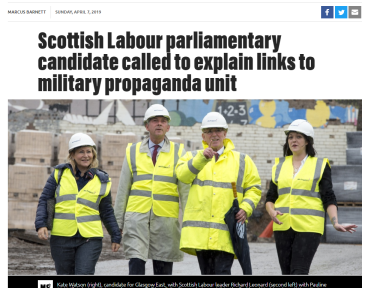
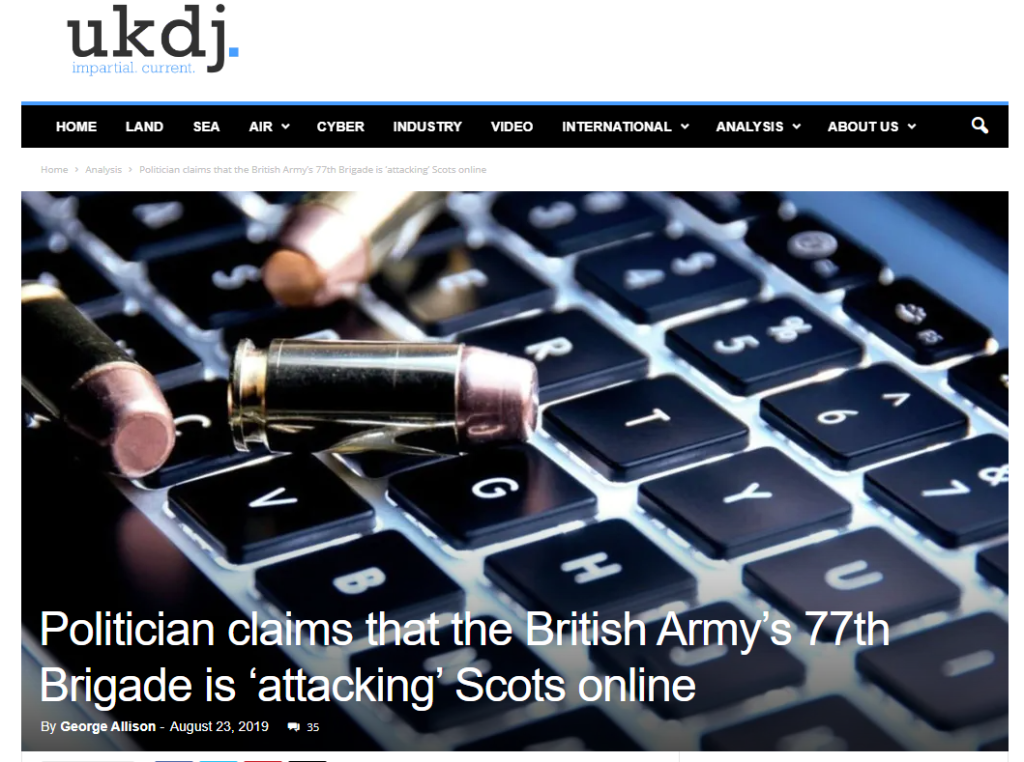
A Black Watch soldier, Brigadier Alastair Aitken, formed the 77th (CYOPS Brigade, referred to in the media as ‘Twitter troops‘ or ‘Facebook warriors‘, which he described as the largest integrated government communications organisation in Europe. Additional links to Scotland include Scottish Labour Party candidate and former “Better Together” boss Kate Watson who refused to explain her links to the “military propaganda unit” within the British Army.
A Scottish government official commented: “In any future Scottish independence referendum will the 77th Brigade be neutral or see the yes campaign as a threat to national security and conduct a campaign to protect the constitutional status quo? The SNP leadership needs to ask these questions and get answers before it’s too late.”



 caltonjock