Influence Of The Lobbyists

Influence of the Lobbyists – Bell Pottinger

Lord Bell of Bell Pottinger. Bell, Wikipedia In December 2006, Lord Bell successfully lobbied on behalf of the Saudi government to discontinue the UK Serious Fraud Office investigation into alleged bribes in the Al Yamamah arms deal. Lord Bell has also performed public relations work for the authoritarian government of Belarus and for the Pinochet Foundation (Fundación Pinochet).

Bell Pottinger connection to UK oil and gas here. November 2011 Oil & Gas UK, the industry representative for offshore oil and gas, has appointed Bell Pottinger Public Affairs to provide public affairs counsel.

The team will be led by Claire Jakobsson, Director of the Energy Unit at Bell Pottinger Public Affairs. Claire Jakobsson said: “We are delighted to be working with Oil & Gas UK. There is a huge amount going on in this sector. The debate on the future role of oil and gas in the energy mix and the industry’s contribution to the UK economy continues to be prevalent. We want to help ensure that the voice of the offshore oil and gas industry is heard.” Trisha O’Reilly, Director of Communications at Oil & Gas UK, commented: “Oil & Gas UK works closely with its members and the Con/Dem government on a range of issues that have an impact on the activities of the industry and its future success, and we look forward to working with Bell Pottinger to help us deepen and extend the political debate”. http://bell-pottinger.co.uk/news-articles/oilandgas .Prospective Anglo Scottish Maritime Boundary Revisited http://www.ejil.org/pdfs/12/1/505.pdf. written in 2001 by a law lecturer at Glasgow Caledonian University, Mahdi Zahraa.

Who Agreed the Border and When-Legal Agreement or Not? A Report Compiled by Craig Murray

Who Agreed the Border and When-Legal Agreement or Not? A Report Compiled by Craig Murray

http://www.craigmurray.org.uk/archives/2012/01/scotlandengland-maritime-boundaries/

In 1999 Tony Blair, abetted by Donald Dewar, (when parliament was in recess) illegally redrew the existing English/Scottish maritime boundary to annex 6,000 square miles of Scottish waters to England, including the Argyll field and six other major oilfields. The idea was specifically to disadvantage Scotland’s case for independence. So, according to Westminster legislation, English waters stretch at their North Easterly point to 56 degrees 36 minutes north – that is over 100 miles North of the border at Berwick, and North of Dundee. The pre-1999 border was already very favourable to England. In 1994, while I was Head of the Maritime Section of the Foreign and Commonwealth Office, I had already queried whether it was too favourable to England. I little anticipated that five years later Blair would push it seventy miles North!! I should explain that I was the Alternate Head of the UK Delegation to the UN Convention on the Law of the Sea, and was number 2 on the UK team that negotiated the UK/Ireland, UK/Denmark (Shetland/Faeroes), UK/Belgium, and Channel Islands/France maritime boundaries, as well as a number of British Dependent Territories boundaries. There are very few people in the World – single figures – who have more experience of actual maritime boundary negotiation than me.

The UK’s other maritime boundaries are based on what is known formally in international law as the modified equidistance principle. The England/Scotland border was of course imposed, not negotiated. It is my cold, professional opinion that this border lies outside the range of feasible solutions that could be obtained by genuine negotiation, arbitration or judgement. It ignores a number of acknowledged precepts in boundary resolutions, most important of which is how to deal with an inverted right angle coastline, as the Scottish coastline is from Elgin to Berwick, with the angle point around Edinburgh. It also fails adequately to close the Forth and Tay estuaries with baselines – by stark contrast to the massive baselines the UK used across the Thames and Stour.
It is essential that Scotland is not conned into accepting the existing England Scotland maritime boundary as a precondition of any independence referendum. This boundary must be subject to negotiation between equal nations post independence, and in my opinion is most likely to end with referral to the International Court of Justice. I have no doubt the outcome would be a very great deal better for Scotland than the Blair-Dewar line, which would cost Scotland billions. There will be many lies thrown from Westminster in the run-up to the referendum: we must take them apart. But the mis-deeds of the past must also be shown for what they are. Ah, perfidious Albion again and will probably stay perfidious “Till a’ the seas gang dry, my Dear”.

“Until 410 million years ago, the area of land now recognised as Scotland was separated from England by an ocean wider than the present-day North Atlantic – the Iapetus Ocean. When the two halves of Britain, which were part of separate larger continental land masses, began to drift towards each other, so the Iapetus Ocean began to close inexorably. The seaway between the converging continents narrowed until they collided and mountains were squeezed up in place of the vanished ocean. The two ancient continents, originally on opposite sides of the vast ocean, were now joined along a line known as the Iapetus Suture which runs almost parallel to Hadrian’s Wall.” http://www.snh.org.uk/publications/on-line/geology/scotland/continents.asp

It is also worth bearing in mind that a decade of opinion poll evidence shows consistently that the people of Berwick council district would want to join Scotland. That actually makes a big difference to the maritime border. Westminster has a track record for imposing boundaries without consultation or representation, going back to the Empire. And there are still disputes (often not acknowledged until the relevant countries’ independence) to be settled – look at the border between Southern Sudan and Kenya. So I’m not surprised at this. After all, Scotland is the classic case of internal colonisation.

I am glad this matter has been raised and by such an authoritative figure. My recollection is that the Blair/Dewar Axis did this by Order in Council while parliament was in recess. It is of very doubtful legality and the boundary will have to be negotiated on independence. They may have slipped up. My recollection is that crime on the rigs was tried in Selkirk Sheriff Court. I don’t think they changed this. Indeed I don’t think they could have changed this by Order in Council. The Border Sheriff Courts may still have jurisdiction over this part of the North Sea. Does anyone know? I don’t.

The conclusion here seems to be that the English domain in the North Sea extends as far as the Auk field, and not the Fulmar field. The report you link to also discusses the implications of any possible secession from Scotland of the Orkney and/or Shetland Islands. These islands have been ‘British’ since 1707. Prior to that, for how long were they actually ‘Scottish’ ? (My understanding is that they belonged to Norway until at least the mid 14th century). Both sets of islands also have a good percentage of English immigrants in situ. Interestingly, the Bloc Quebecqois blamed their narrow defeat in the independence referendum in the 90s on recent immigrants who wanted to keep links to Canada. Will history follow a similar path when the Scotch referendum is held ?

Thanks for your concern for the people of Orkney and Shetland. It is interesting that this concern of English people towards them only appears when the issue of Scottish independence comes up, and is always articulated in terms of oil and gas reserves and no other aspect of the life of those people or the islands. Before the Viking conquests of Scotland , England and Ireland the Picts were living on both Islands. The Norman Conquest of England was carried out by Vikings settled in France. I think we’ve all got a bit of Norwegian or Danish blood in us.

Boundary negotiations (and arbitration, if necessary) are covered in the Scottish Government’s August 2007 document, “Choosing Scotland’s Future: A National Conversation: Independence and Responsibility in the Modern World”;

3.15. Any issues concerning the borders of an independent Scotland, particularly the continental shelf, would also have to be negotiated. The 1999 boundary being discussed pertains to fishing rights and I find it a bit odd that the two maps I have seen published on government websites ( the one cited in an earlier comment and the one at; http://og.decc.gov.uk/assets/og/data-maps/maps/infrast-off.pdf. show borders which do not pertain to the oil & gas industry. The map cited earlier in these comments shows this 1999 border, and the map I have just cited shows a border which is clearly labelled as the RENEWABLES energy boundary. Why should official maps of the oil and gas fields show boundaries which are not applicable to the oil and gas fields? Could it be a deliberate misrepresentation? So far as I know, the legal jurisdiction over the oil & gas fields is still as defined by the Continental Shelf (Jurisdiction) Order 1968 which sets the boundary as the line of latitude at 55° 50′ North, i.e. an east-west line slightly north of the eastern end of the land border.

3.16. These issues are likely to be dealt with in an overall agreement between the United Kingdom Government and the Scottish Government, enshrined in legislation enacted at both Westminster and Holyrood, to allow both Parliaments the opportunity to consider and agree matters affecting both Scotland and the rest of the United Kingdom.

3.17. At the beginning of such a process of negotiation, arrangements should be agreed for arbitration under the principles of international law of any issues which the parties find themselves unable to resolve by mutual agreement.” “The International Boundaries Research Unit (IBRU) at Durham University has an interest in the matter.

For the, “Beyond Petroleum” future of all parts of the present UK there’s a useful Atlas of UK Marine Renewable Energy Sources at, http://www.renewables-atlas.info . For those who are genuinely interested, this is an excellent introduction to the principles and difficulties involved;

Click to access dundua_0607_georgia.pdf

Better quality graphic showing 1987 and 1999 boundaries (but not much of the land border): http://clip2net.com/s/1tuDw

Dept of Energy & Climate Change map showing oil/gas facilities and national boundaries (1.6MB pdf): http://www.og.decc.gov.uk/information/bb_updates/maps/infrast.pdf

There is an internet site called the Scottish Democratic Alliance who have been going on about this boundary change for years. I was not then fully aware of how and why the change had been made and could not, using charts and navigation instruments, find a lot wrong with the border as it seemed to be based exactly on the equidistance law. I visited their site a few weeks ago and it is now more explanatory. There is a dispute about that part of Berwick to the North of the river with claims that it is still in Scotland although administered from South of the river. Now with further comments from Craig and Ian Hamilton regarding baselines and the Law it seems that there was indeed some skulldugry taking place.

Thanks for the heads-up on the Scottish Democratic Alliance. Their website contains an interesting pdf discussion document with maps which can be had at; http://scottishdemocraticalliance.org/international/scotlands-national-borders

Here is a link to the offshore assets. I’m not sure how accurate it is but it may be of help. http://og.decc.gov.uk/assets/og/data-maps/maps/infrast-off.pdf

http://realmofscotland.com/scolandpage.aspx?Cat=14&menu=The%20robbery%20of%20Scotland%27s%20oil,%20-%20read%20the%20details%20and%20amounts,%20with%20the%20geographical%20details.%20In%20the%20section%20on%20Scotland%27s%20resources.

Oh What a Tangled Web the Tory Party Weaves with Vitol

Oh What a Tangled Web the Tory Party Weaves with Vitol

Privately held Vitol SA is led by its long-time CEO Ian Taylor, a Scotsman – The company is the World’s Largest Oil Trader and is one of the Tory Party’s largest financial donors, thus ensuring privileged access to David Cameron and other senior Conservative government ministers. Taylor, attended a private dinner organised by David Cameron, in Downing Street, on 2 November 2011. The event was described as a, “social dinner for strong and long-term supporters of the party, with whom the PM has a strong relationship”. In November 2013 he was invited to dinner at Chequers. In February 2014, the former Tory Energy Minister Charles Hendry MP, became a £60,000-a-year Vitol consultant.

Taylor is one of the Tory Party’s largest and most reliable donors. In the run up to the 2010 election he gave the party £125,000 and since June last year he has given the party £116,000. Overall his donations since 2006 amount to around £1m. He is also under a degree of hostile scrutiny in the referendum campaign in Scotland. His £750,00 donation towards the pro-union ‘Better Together’ and similar campaigns is subject to an increasing amount of criticism. It’s widely accepted in the trade that his act is an attempt to make sure North Sea assets don’t escape Vitol’s grasp through Scotland voting for independence.

In the period 2010-2013 Vitol completed a number of sanction, (UN imposed) busting purchases, (making use of the company’s Swiss registration) buying large stocks of Iranian fuel oil at well below market prices then selling it on the Rotterdam spot market for a premium, making a financial killing, completely undermining Western efforts to choke the flow of petro-dollars to Tehran placing pressure on Iran’s suspected nuclear weapons program. The actions of Vitol side-stepping the UN approved sanctions on Iran is evidence the company is not concerned for the security of not only the West but the entire world. The UK is a vociferous critic of Tehran’s nuclear program and a leading advocate of the EU sanctions bypassed by Vitol.”

In recent weeks, Vitol has been identified to be in negotiations seeking to finance a Russian oil company targeted by US sanctions against President Putin. The US sanctions proscribe ROSNEFT from receiving new long-term loans from US banks and investors as well as targeting the company’s chief executive, Igor Sechin, who is close to President Putin. If successful Vitol will transfer $2Bn to ROSNEFT, in exchange for supplies of refined products over the next five years. The deal would boost ROSNEFT’s cash reserves and, if agreed, would help mitigate the effect of US sanctions that wiped five per cent off the its share price when they were announced last week. It is still a possible target for EU sanctions as well, although most observers believe it will be hard to get agreement among all 28 member states for such dramatic action. Mr Taylor is a director and a significant shareholder in Vitol so would be likely to benefit directly from the deal with ROSNEFT.

Igor Sechin, is a former Deputy Prime Minister of Russia and a close ally of president Vladimir Putin, ROSNEFT has undertaken a string of acquisitions which have transformed it into the world’s largest listed oil company. As well as the $55bn purchase of TNK-BP, the company has in the last year bought ITERA and SIBNEFTEGAS, two significant Russian gas producers, the gas business of ALROSA, the diamond miner, and refineries in Germany and Italy.

Talks on the ROSENEFT deal began before the downing of Malaysian Airlines flight MH17 and last night Vitol refused to say whether they were ongoing. They said, “Our client relationships are confidential,” adding that, “any conflict in which innocent civilians are caught up is tragic”. They further stated Vitol was, and would remain, “fully compliant with all applicable international laws and regulations”.

In 2013 Vitol entered into partnership with another trading firm, GLENCORE, to give another $10bn loan to ROSNEFT in return for future oil supplies. The close links between the two companies mean that the Conservative party is indirectly benefiting from profits made in collaboration with a company with intimate links to the Kremlin.

Yesterday, “The Independent” revealed that Vitol pays just 10.5 per cent tax on its global profits, which totaled nearly $15bn (£8.8bn) over the past nine years. A fraction of the standard UK tax rate for its hugely profitable London operations. Vitol achieves this by “confirming” its deals in low-tax Switzerland even if they have been negotiated in London. Google, another very large company, was only recently, very strongly criticised for operating similar tax techniques, by the House of Commons Public Accounts Committee). Revelations therefore, about Vitol’s tax arrangements and business dealings in Russia will risk embarrassing David Cameron who has led calls for tighter sanctions against Moscow despite his own party’s ties with wealthy oligarchs.

http://www.independent.co.uk/news/uk/politics/major-tory-donors-company-in-talks-to-finance-sanctioned-russian-oil-giant-9627198.html
http://www.heraldscotland.com/politics/referendum-news/silence-over-no-donation.20640745

The foregoing provides informative details of the, “ducking and diving” of the Tory party and Vitol. They are toying with the Scottish electorate determined upon gaining a, “no” vote in the referendum for their own ends, not to enhance the wellbeing of Scot’s. I am voting, “Yes” to independence and I encourage all who live in Scotland and have a vote to vote, “Yes” and send this lot on their way.

http://www.energyvoice.com/2014/08/video-north-sea-resource-produce-700million-barrels/

http://www.heraldscotland.com/politics/referendum-news/silence-over-no-donation.20640745

Economist delivers damning verdict on Treasury Low oil forecasts

Economist delivers damning verdict on Treasury oil forecasts – 18 Aug 2014

One of Scotland’s most respected economists has delivered a damning verdict on Treasury oil forecasts, arguing tax revenues over the next four years could nearly double those predicted. Professor Sir Donald Mackay described the figures from the Office for Budget Responsibility (OBR) – which recently downgraded its outlook for the North Sea – as “precisely wrong”. In a detailed analysis, the former advisor to the Secretary of State for Scotland – including the last four Conservatives to hold the post – backs the position taken by industry body Oil and Gas UK.

Prof Mackay notes the industry expects a major increase in production in the next two to three years as new fields such as BP Clair and Statoil’s Mariner come onstream. The former Scottish Enterprise chairman argues Westminster has been downplaying the potential impact of oil and gas revenues on an independent Scotland, which he believes will be “much greater” than suggested. He describes the OBR as being “hopelessly at sea” in its predictions of future oil prices, which he says are based on a flawed system that is not used by oil companies themselves. He adds: “We don’t need to do any serious extrapolation to arrive at sensible estimates of what output is likely to be over the period to the end of this decade. “In February 2014, the Wood Review concluded that ‘production hit a new low’ last year, but a number of larger new fields are about to come onstream in the next two or three years, and that could take production back to the level of two to three years ago where it could be sustained for the remainder of this decade”. He adds that would yield Scottish Government tax revenues from 2014-15 to 2018-19, close to twice those of the OBR. Prof Mackay states: “I would suggest that this scenario is likely to pass the Keynesian test of being ‘roughly right’, while the OBR’s forecasts are likely to be ‘precisely wrong’.”

Last night First Minister Alex Salmond, said the UK Government’s position on oil and gas was becoming “increasingly threadbare.” He added: “It is ever clearer that next month the people of Scotland have a choice between continued austerity with a No vote, or new prosperity and opportunity with a Yes vote.”

North Sea find could produce for 35 years

An oil field due to begin production east of Shetland could produce oil until 2050, it has emerged. Xcite Energy said yesterday that its Bentley find – one of the North Sea’s largest untapped resources – could produce more than 300million barrels of oil over 35 years. The firm plans to use enhanced oil recover techniques right from the start to maximise recovery. A trading update yesterday revealed that the field has proven, probable and possible reserves totaling 317million barrels. http://www.energyvoice.com/2014/08/video-north-sea-resource-produce-700million-barrels

More Oil Investment

23rd Jul 2014; Chancellor George Osborne announces plans for a “game changer” tax break to boost North Sea oil and gas exploration.

Mr Osborne, speaking during a visit to Bibby Offshore Ltd in Westhill, Aberdeenshire, said, “We are announcing the consultation on a really big new tax break which the industry themselves. I think have described as a, “game changer” for the North Sea oil and gas exploration – that’s the ultra high pressure, high temperature tax break field allowance. “This will mean we can go ahead with some really big investments in the middle of the North Sea, particularly the Culzean field, and that will create billions of pounds of investment, thousands of jobs. It’s an example of us responding to the requests of the industry. “They wanted us to support these new developments, and it is part of a broader strategy to make sure we have an oil and gas regime that is fit for the future, fit for the maturity of the North Sea basin, and also one that is going to secure jobs and investment here in Aberdeen and Aberdeenshire for many decades to come.”

Mr Osborne said, “the allowance for ultra high pressure, high temperature fields will create billions of pounds worth of investment and thousands of jobs.
Industry body Oil and Gas UK last night welcomed the move and said the current tax regime had been a “barrier to investment”. The government said the new allowance would build on Sir Ian Wood’s recommendations for maximising economic production of oil and gas. Sir Ian’s review estimated there are between 12-24billion barrels of oil remaining, although the Office for Budget Responsibility (OBR) recently revised down its forecasts. The new allowance, designed to support investment in “technically challenging” projects and encourage exploration in surrounding areas, will reduce tax on a portion of a company’s profits from 62% to 30% at current rates.

1972 – The North Sea Oil is Scotland’s and Benefits from Production should be credited to the Scottish Economy – Edward Heath Prime Minister


Edward Heath. The North Sea Oil is Scotland’s

1972. The discovery of oil in the North Sea prompted Prime Minister, Edward Heath to initiate a policy review.

Downing Street civil servant, Robert Armstrong wrote to members of the Cabinet;

“As you know, the point has recently been put to the Prime Minister that the benefits of oil production brought ashore in Scotland should accrue, and be seen to accrue, to the Scottish economy.

The Prime Minister sees considerable force in the arguments believing it would be difficult to stress too highly the psychological gains which would come from the revival of the Scottish economy being seen to be something from which Scotland was achieving from its own resources, not just by the grace and favour of the Government at Westminster or of English industry.”

The Scottish Secretary of State, Gordon Campbell, (later Baron Campbell of Croy) and the, Chancellor of the Exchequer, Anthony Barber stridently opposed the suggestion and gathered support, to an alternative proposal, transferring all revenue gathered from the oil bonanza to the treasury in Westminster.

The political consensus being that;

“any change in the financial relationship between Westminster and Scotland would resurrect innumerable issues, (A veiled reference to Scottish Independence) now mercifully dormant.”

Edward Heath, blind-sided, and out-voted in cabinet accepted their proposal.

Scotland was then systematically ripped off for the next 40 year’s. View the story;

http://news.bbc.co.uk/1/hi/scotland/2617525.stm


Romeo Oilfield Discovery

Trapoil and the Romeo Oilfield discovery

Trapoil has entered into an agreement with Prostar Capital Limited, a global private equity firm, which will enable Trapoil to participate in the consolidation of the Romeo discovery, a high value asset within the North Sea. Prostar’s management believes that there is considerable value in the North Sea, and has established a substantial fund targeted at acquiring undervalued assets and companies in the region.

The Romeo discovery (drilled in 2012) in which Trapoil now holds a controlling position, has SIGNIFICANT POTENTIAL in the event a further planned high impact well is drilled. TOTAL OIL controls, with 100% equity, the adjacent block to the west that contains approximately 20 per cent. of Romeo and has a lookalike structure named Alfa (or Scarinish). In Q4 2013, Trapoil farmed out its Valleys asset, located near the Forties field, to TOTAL OIL and in return negotiated, inter alia, an option to acquire up to a 35 per cent. equity interest in Alfa. This option has now been extended through to late July 2014. The Company believes this option to be important as drilling information from the Alfa prospect will be key to unlocking the potential in the Romeo discovery. Alfa is expected to be drilled in 2015 and is a commitment to DECC.

Oil & Gas The Rip Off That is Westminster

Oil & Gas The Rip Off That is Westminster

A 2014 UK government commissioned report stated there were around 24 billion barrels of oil yet to be recovered from the North Sea. The wholesale value of the reserves was put at $2.4 trillion. The figure quoted encompassed recoverable oil in the North Sea block only. It did not include the North Atlantic, West Coast of Scotland or Rockall areas since these are largely unexplored.

Enter the spoiler, “The Clair Field”. First discovered and located in the, “Atlantic Sector” of the, “Continental Shelf” in 1977 it was declared, “off limits for discussion” by a UK government who, (faced with increasing voices of discontent within a Scotland that had finally wakened up to the massive amounts of finance being generated to the coffers of Westminster) broadcast widely and often, (making full use of the media and press, who it now accepted follow the government line without question) that the oil would run out in the 1990’s. Job done. Scotland, “back to sleep” it was thought by the Westminster con-men.

Many years later, in 2003 a license to explore the Clair field was finally granted to BP. Surprise, surprise, “sweet oil, in excellent quantities flowed freely, and this was only phase 1. In a recent conference in Houston Texas, not widely reported in the UK press. BP announced a major further major expansion of the, “Clair Field”. A brief outline of the field development, to date;

Phase 1. Has produced 90 million barrels of oil since operations began in 2005.

Phase 2. is expected to produce reach peak production capacity of 120,000 barrels of oil per day, after operations begin in 2016.

Phase 3. BP joined with Chevron, Conoco/Phillips and Shell and is moving forward with drilling operations. Preliminary results are exciting, indications are the field is many times larger than first thought.

And we are addressing only one field. But here we are again. “Blether Together” politico’s, (largely comprised of discredited time spent old men of Westminster) are now spreading the lie that oil will run-out in 15-20 year’s. This time however Scotland is wide awake and the lies are well exposed for what they are. Scotland will vote, “Yes” in the September referendum ensuring the benefits of oil & gas are accrued to the nation. Enough is Enough.

http://www.upi.com/Business_News/Energy-Resources/2013/05/10/Scotland-sees-major-potential-offshore/UPI-29921368180685/?st_rec=85431369909920

Scottish Oil – Edward Heath – and the Tories that stole it


1972.:  Prime Minister, Edward Heath intended to credit revenue from the sale of North Sea Oil and Gas to Scotland providing a significant boost to its economy. He was overruled. England's exchequer in London assumed ownership of the revenue

A senior civil servant circulated this: “As you know, the point has recently been put to the Prime Minister that the benefits of oil production brought ashore in Scotland should accrue, and be seen to accrue, to the Scottish economy. The Prime Minister sees considerable force in the arguments believing it would be difficult to stress too highly the psychological gains which would come from the revival of the Scottish economy being seen to be something from which Scotland was achieving from its own resources, not just by the grace and favour of the Government at Westminster or of English industry.”

The Scottish Secretary of State, Gordon Campbell, (later Baron Campbell of Croy) and the, Chancellor of the Exchequer, Anthony Barber stridently opposed the suggestion and gathered support to an alternative proposal, transferring all revenue gathered from the oil bonanza to the treasury in Westminster. The consensus was that, “any change in the financial relationship between Westminster and Scotland would resurrect innumerable issues, (A veiled reference to Scottish Independence) now mercifully dormant”.

Edward Heath, blind-sided, and out-voted in cabinet accepted their proposal. Scotland was then systematically ripped off for the next 40 year’s. View the story;

http://news.bbc.co.uk/1/hi/scotland/2617525.stm


GROK has a view on this:

https://twitter.com/i/grok/share/CuC5vDjoquYOBUS8MU0Ss8uns

North Sea oil: Facts and figures

North Sea oil: Facts and figures

Ignore the, “Blether Together” hype. First off residents of an independent Scotland, (without adding in the financial benefits of oil & gas) would enjoy an annual Gross Disposable Income (GDP) comparable with rUK. So both countries would continue to be entirely self sufficient maintaining existing trading policies.

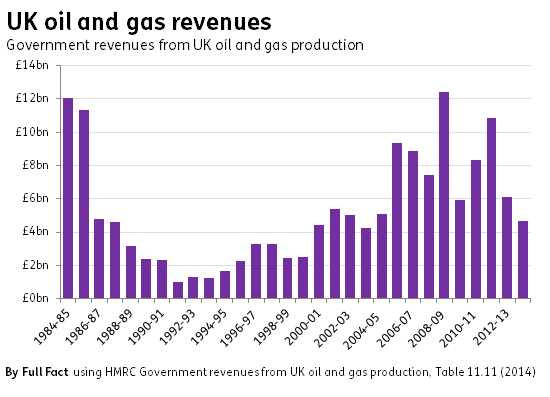
Adding in the financial benefits of oil and gas increases the annual GDP of Scottish residents by approximately £6000. The Scottish government intends to set aside at least 10% of the recurring windfall income, retaining it in a, “Sovereign Wealth Fund”, (something the Westminster government, now cheerfully admits it should have done at the time the oil started to flow but didn’t) to provide long term benefits for the Scottish nation for many year’s to come.

The article provides support to the foregoing; http://www.bbc.co.uk/news/uk-scotland-scotland-politics-26326117