Reflecting on aspects of concern in the conspiracy to get Alex Salmond, I looked again at the conduct of those who participated in compiling the “deemed illegal”new procedure, and the knowledge it included at least one individual who later became an “accuser” in the second phase of the assault on Alex (the high court trial). Her, (their) actions should be referred to the trial judge, since her (their)involvement revealed that her (their) malice aforethought was a “contempt of court”, and the instruction of the judge that the names of those who falsely accused Alex should not be released to the public, should not include her, (them) since her (their) conduct cast doubt on their motives, and those of the of the Scottish government and possibly the police.
Author: caltonjock
Bute Energy and others, a round-up by Welsh blogger Jac o’ the North, whose relentless pursuit of the truth exposes commercial corruption at the highest level linked to career politicians at all levels of government
I haven’t devoted a full piece to Bute Energy and the rest since August last year. Which is somewhat remiss, seeing as the plans are ongoing and causing great concern to communities across the land.
That said, maybe this offering is directed more at the general reader than those who follow Bute’s activities closely, or are involved with a particular campaign group, of which there are perhaps too many. (More on this later.)
Though I’ve had a gutsful of Bute and the other eco-scammers who’ve taken up more space on this blog than the diamond geezers and career criminals.
Yet they’re lauded in the media, have politicians in their back pocket, and the red carpet is rolled out for these exploitative interlopers.
INTRO, RECAP
After a visit to the cellar, dusting off a few files, I think I’ve found my first reference to Bute. It was back in November 2018. In the piece, Corruption in the wind?
Though Bute first appeared via a connection with someone I’d already written about.
This pathfinder was Steven Radford. He was fronting for a major player named U + I in three wind farm projects: Bryn Blaen, near Llangurig; Rhoscrowther, down on the Haven; and Hendy, a few miles from Llandrindod.
U + I was soon taken over by Landsec; big shareholders in Landsec are BlackRock, Vanguard, Legal & General, Jupiter Asset Management.
In that November 2018 piece I wrote:
In September Radford branched out again with Bute Energy Ltd . . . in the electricity business, the production, transmission, distribution and trade of electricity to be exact.
What I didn’t know at the time was that the boys of Bute had all come from property company Parabola. And that the lead director of Bute, Oliver James Millican, is the son of Parabola boss, Peter John Millican.
The other Bute principals we’ve come to know are: Lawson Douglas Steele and Stuart Allan George. Barry Woods was a fourth departure from Parabola in November 2017. But Woods parted company with the others in September 2019.
Another name that crops up is John Reilly. Like those just named (apart from Millican) he has a company named ‘Windward’ followed by his initials. I can’t be sure if Reilly worked for Parabola, but he is now Project Manager for Bute. Like the others, he lives in Scotland.
These ‘personal’ companies all saw a massive boost in their values recently.

These figures might be accounted for by a payout from Grayling Capital LLP, which dissolved around that time. For Millican, Steele and George were Designated Members, and Reilly a Member. Another Member had been SuperSpAd and ‘Welsh’ Labour insider David James Taylor. (Mentioned a few times on this site.)
UPDATE: More plausibly, the windfall is explained here.
But that only throws up another question – where did the money come from that went into Grayling Capital?
Whatever the answer, that’s a lot of money for a group that has yet to put up a single turbine. Ask yourself, how does that ten grand for your village hall from a developer’s ‘community fund’ compare to sums like these?
Taylor also did well for himself. The clip below is from the accounts of Taylor’s company Moblake Ltd. A liquidator was appointed in April 2022 and Taylor rode off into the sunset with the 600k in his saddlebags.

The ultimate holding company for all the Bute entities is Windward Global Ltd. The sole director is Millican Jnr. The company was formed in May 2017 as DMWSL 864 Ltd and changed its name six months later, at the exact same time we are expected to believe the boss’s son and his mates turned their backs on Parabola.
Somehow, the Parabola-Bute crew made contact with Radford. Who joined Bute Energy Ltd in September 2018, less than a week after Oliver Millican. (The company changed its name to RSCO 3750 Ltd and folded in September 2023.)
How was this contact made? Why did Parabola turn its attention to wind turbines? And to Wales?
PARABOLA-BUTE DISCOVERS WALES
But how did they ‘discover’ Wales? Were there introductions? To answer these questions I’ll begin with something substantive before flying a kite.
In the first piece, of November 2018, you’d have read a section – ‘Mystery Woman’ – in which I identified Anna McMorrin as a lobbyist for Hendy wind farm. She was then a Labour insider shacked up with a minister in the ‘Welsh Government’, and she went on to become the MP for Cardiff North in the June 2017 general election.
Seventeen months after McMorrin’s performance before Powys councillors, Steven Radford of Hendy wind farm teamed up with Parabola-Bute.
This pattern of Labour party involvement (ahem!) has been repeated in subsequent years. Most recently with Sophie Howe, former Future Generations Commissioner for Wales, who became a director of the new Bute Energy Ltd last month. (It switched names with RSCO 3750 Ltd.)
Labour party troughing is covered in many other posts on this site.
So we have the Labour party helping windfarm developers, but that doesn’t establish a connection for Radford with Millican and his pals. Yet people I’ve spoken with recently are convinced the key lies with Radford and Hendy Wind Farm Ltd.
And what a story of political corruption that was; done to help a project meet an OFGEN funding deadline, with one hurriedly erected turbine – that has never turned!
But even if Hendy is the key, that still doesn’t explain how Radford and the Bute gang met each other.
Here’s one possibility . . .
McMorrin was working for a company, Invicta Public Affairs, with branches in Glasgow and London, but its registered office is on the Gallowgate, not far from St James’ Park in Newcastle-upon-Tyne.
Parabola, despite having offices in Edinburgh and London, began life in Newcastle and still maintains a presence in a building it redeveloped near the Central Station.
I admit the Geordie connection is tenuous; yet while the Labour party link to both Radford and Bute is established, there is still no evidence it was the comrades who brought them together.
Though the Labour party is now so enmeshed with Parabola-Bute it might soon be difficult to disentangle them. What with individual party members involved and then the council pension fund investment. (Controlled by BlackRock.)
Plaid Cymru is also getting in on the climate scam. Sorry! that should read: saving the planet for future generations. In the form of an obscure Plaid loyalist from Ynys Môn named Carmen Smith.
After dabbling in student politics, working for politicos and leftist groups, Smith was given a made-up job with Bute in October 2023 – Advisor on Youth Governance! Her employer is named as Windward Global, the ultimate holding company for the Bute empire.
Next, she made it to the House of Lords when Plaid needed to replace retiring Lord Wigley. The election process was rigged in order to ignore members’ choice of former MP Elfyn Llwyd.
These shenanigans now give Bute a presence in the House of Lords.
KLINGON AND A POSSIBLE RESTORATION TRAGEDY
As is often the case with planning permission – and perhaps especially in Wales – what is originally given consent is often very different to what is eventually built. ‘Changes’ and ‘modifications’ are made, which may or may not go through the planning process.
In the case of Bute Energy these now include, “bigger blades, higher substations, to cracking on before approval of any restoration plans. The local authorities, who told PEDW they have no resources to oversee any planning conditions, appear to be rubber stamping things“.
Never was rubber stamping more obvious than with this amendment submitted by Bute to Caerphilly council regarding Twyn Hywel wind farm. Fortunately, the council accepts correspondence in English, Welsh, and Klingon.

For it was indeed accepted.
In the quote I used just now you’ll have seen a reference to “restoration plans“. So let me explain what this is about.
After certain opencast mines came to the end of their working lives in southern Wales it was expected that the companies involved would – as promised – restore the sites to something close to their original state.
But, alas, when the time came for the restoration to begin – the companies involved had relocated to offshore tax havens.
In 2010, a company called Celtic Energy sold its opencast coalmines – with its restoration liabilities – for £1 apiece to a series of shell companies it had set up in the British Virgin Islands. Then the senior executives walked away with millions.
To avoid something similar happening with windfarms a number of people have submitted FoI requests to the ‘Welsh Government’ about site restoration, but I’ve yet to see a response that satisfies anyone.
UPDATE 02.10.2025: Here’s an example that I’ve just received from a reader. Natural Resources Wales says they can’t tell how much they demand for wind farm site restoration, because “this information is commercially sensitive“.
It’s now being suggested that wind turbines in Wales have an operational lifespan of 50 years. Below is a clip from Google AI, and here’s a link to a piece in Solar Power Portal which says, “Manmoel Wind will have an operational life span of 50 years“.

Obviously, no turbine lasts 50 years. A turbine is lucky to make 20, or 25. So people who’ve seen that 50 year figure assume the turbines will be replaced at some stage.
Yet the extended lifespan claim appears again in this response from Bute to a question from a concerned local resident:

Quite frankly, I believe that ten years from now few new (or replacement) turbines will be going up. People are no longer listening to the Swedish doom goblin and her Globalist masters. Reality is kicking in.
So the question remains: with the bubble soon to burst, why are turbines going up today, or tomorrow, being given operational lifespans of 40 or 50 years?
Could it be because developers have an arrangement with politicians and planners that restoration of a site begins when the agreed operational lifespan is up? Even if the turbines had long ago stopped working. Or had even been removed?
My belief is that restoration costs should be paid up front, before a single turbine is erected, and the money ring-fenced so politicians can’t get their grubby paws on it. Furthermore, the restoration costs must not be limited to the visual. There must be enough money deposited to pay for the removal and disposal of the vast concrete bases in which every turbine stands.
Questions need to be asked about this extended operational lifespan. And whether it will be linked with site restoration.
UPDATE 12.10.2025: I should add that being ‘imaginative’ with a project’s lifespan might encourage hesitant investors. And it will be used by politicians spouting ‘future generations’ bollocks to grant planning permission.
THE PYLON RUNS
Clearly, the hundreds of wind turbines planned for remote upland areas of Wales are a long way from the eventual consumers in England. For that’s where it’s going. (Ignore bullshit like, “powering seven million Welsh homes“.)
Below you’ll see two maps that I hope will help explain the position.
On the left is a map produced by the ‘Welsh Government’ in its Future Wales The National Plan 2040 (update), showing the designated areas for wind power. On the right, a map produced by CPRW (here), adding areas for solar power and associated infrastructure including pylon routes.

Because, clearly, there will be a need for pylons and overhead power lines to run from the windfarms to where they can connect with the grid. Though in environmentally sensitive (or politically favoured) sections the cabling might be underground.
In the southern half of the country this means a run from around Aberedw, east of Llandrindod, down to Builth, and then down Dyffryn Tywi to Llandyfaelog, south of Carmarthen. The other southern line runs from the wild country east of Lampeter – projects I covered in this piece – following the Teifi before branching off south from somewhere near Llandysul.
In the northern section, the run starts near Llangurig, then runs north before turning north east to its destination at Lower Frankton in Shropshire. Though for some reason we were originally told it ended in ‘Chirk’.
Perhaps we were supposed to think it would supply Wrecsam and Deeside.
This simple map of the grid in Wales will also help as it shows most of the turbines planned are going up in areas a long way from that grid.

Most electricity in Wales is generated by Pembroke power station in the far south west. The line then runs east, supplying much of the urban south, before taking power over the border.
The loop in the north is, I suspect, accounted for by the decommissioned nuclear power stations at Wylfa and Trawsfynydd.
Let’s conclude this section by focusing on an area just mentioned, Twm Siôn Cati country. There’s a very active group opposing the three projects we’ve heard about (there may be more to come), and there was a public meeting last month.
Here’s a report from the Western Mail. Here in pdf format.

The meeting was held in Pumsaint because, as I explained in the piece I linked to earlier, the blades and turbines will need to be transported from Pumsaint up country, and over the 2,500 acres of the National Trust’s Dolaucothi estate.
For some reason the NT is coy about giving out information about its involvement with wind farm developers.
To add to the air of mystery, I’m informed that prior to the Pumsaint meeting local Plaid worthies met with Bute representatives at the Falcondale Hotel, just a mile or so north east of Lampeter. Is this true?
If so, what did they discuss? More peerages?
ODDS AND ENDS
I’ve been writing about wind farms for so long, and more keep appearing, that I was almost on the point of giving up. But like I say, as truth dawns, and the costs mount, the bubble will eventually burst.
So I’ll stick with it, and give a few random thoughts. First, something that’s been a stone in my shoe for a while. Maybe someone out there can help.
It’s a company called Storagefolk Ltd. The sole director is Oliver Millican, and ownership traces back to super holding company Windward Global, where all the shares are owned by Millican.
Now, this company was formed September 2017; it seems to do nothing, yet it’s kept alive, so I must assume there’s a reason for its existence. But what?
Answers on a postcard . . .
Returning to electricity transmission . . . in a belated attempt to salvage its reputation the self-styled ‘Welsh Government’ set up Trydan Gwyrdd Cymru. Which, to date, has achieved virtually nothing beyond virtue signalling.
And of course, costing us money.
Those clowns in Corruption Bay had over two decades to ensure that, if we had no alternative but to participate, that at least Wales benefitted from this climate scam. But they did nothing beyond pimping Wales out to any green con artists who slunk into view.
Bute has also set up a distribution company, Green Gen Cymru (GGC). Which is planning the pylon runs we looked at earlier. Though this is a joint venture with Copenhagen Infrastructure Partners, a major funder for Bute.

The GCC chairman is Bleddyn Phillips, former chairman of London Welsh Rugby Club, who worked in Russia when his wife, Dame Anne Pringle, was ambassador.
For many year Phillips was Global Head of Oil and Gas for multinational lawyers Clifford Chance LLP. These are not the kind of lawyers you go to if Plod arrests you for hurty words on X. We are talking big, big money here. Billions.
Consequently, Phillips must know many wealthy investors in the energy field from his globetrotting days. I wonder if any of them are interested in Green Gen Cymru?
CONCLUSION
I don’t wish to name groups or individuals, but I believe the fight against these various – but linked – plans is too fragmented. A certain level of unity is needed. Or at the very least, co-operation.
Yet it must also be kept local.
By which I mean, involve local people, farmers and others with a stake in the country. At all costs avoid creating the impression that the only people opposing wind turbines and pylons are well-heeled nimbys who’ve moved into the area.
Selfish buggers who are now, “denying locals thousands of well-paid jobs“.
Because that’s the kind of lie those opposing you – politicians and ‘developers’ – will use to divide and discredit you.
And finally, don’t trust political parties that support Net Zero, wind farms and all the rest. Politicians with constituencies or council areas threatened by the projects of Bute and others are in trouble, and they know it.
So they’re trying to ride two horses. But only succeeding in coming across as more two-faced than usual. It is not a pretty sight.
Say, “Thank you very much for your kind offer of advice and assistance” – then help them through the door. Whether you open the door is entirely up to you.
♦ end ♦
© Royston Jones 2025
Jac o the North is a Welsh blogger who produces well-structured articles revealing the misconduct of Welsh politicians, Lobbyists and other persons who might be dipping their snouts in the financial trough, ripping off Welsh taxpayers. Many of the subjects he covers apply equally to Scotland, where similar scams are routinely perpetrated against the public interest. I commend his work to all who read my blog
The story of CI IV Dragon Holdco Ltd
It all started when I noticed a couple of unfamiliar vans in our street. I didn’t recognise the livery, they carried 03333 phone numbers. One had been registered in Bath, the other in Nottingham.
Curiosity aroused, I thought I’d check out the website given on the vans. But when I tried to reach http://www.advanceenergy.co.uk I hit the brick wall you see below. Nothing’s been posted on the Facebook page since January 2024. Now I was really curious. Next stop, the Companies House website. And from here, a picture started to emerge.
Advance Energy Services Ltd began life in October 2016 as Bright Plumbing and Heating Ltd of Pontypridd. It failed to take off, and in January 2019, with compulsory strike-off just averted, two new directors came aboard: one being Michael Ian Wayman.
I mention Wayman because while he was a director at Advance Energy Services he and another man started a company called Advance Energy (UK) Ltd. Formed in October 2019 it gave up the ghost in July 2021 without ever filing accounts.
At the same time, another Wayman family company, Smart Energy Homes Ltd, saw an upsurge in fortunes. Though the sketchy accounts offer no explanation.
Meanwhile, directors came and went at Advance Energy Services, and the company address changed a few times.
But something might then have gone awry. I say that because I turned up this notification on the Financial Conduct Authority website dated February 2023. Wayman and his associate are named.
From this point on I shall avoid naming Welsh or Wales-based individuals unless I feel it’s necessary. It may be possible to find the names on official documents by following the links. That’s unavoidable.
Just over a year on from the FCA mention, in May 2024, Robert Benjamin Nathaniel Brodie became a director. In fact, he joined a host of companies giving addresses mainly in south east Wales.
He was joined in March this year, at a number of the companies, by Christopher McLain. McLain seems to have had no directorships before then.
McLain is CEO of City Energy Network Ltd, while Brodie is the Chief Financial Officer. Here’s the Cairngorm Capital takeover reported.
Returning to Advance Energy Services Ltd, the company secretary works full-time for solar panel and heat pump installer, Heatforce. Where we find Brodie (but not McLain). In fact, Brodie is the sole director now listed for Heatforce.
This company uses an address where we’ll find a few other companies in the table below: Unit 10, Lambourne Crescent, Cardiff Business Park, Llanishen, Cardiff CF14 5GP.
THE WEB
I think the best way to join up the dots is to look at the companies where Robert Benjamin Nathaniel Brodie recently became a director. For he seems to be the key, the link to the ultimate owner.
Here’s the list of Brodie’s companies supplied by Companies House. And below a table I compiled of those companies. https://find-and-update.company-information.service.gov.uk/officers/gcm3GdeW8RHgmUoXhOdOHyyuYP4/appointments
PDF format
https://drive.google.com/file/d/1RtGb28GMnBOUQpmx9RoiPUjt_tHWZ-ys/view?usp=sharing
It might look complex, but believe me, everything leads back to Dragon 2023 Topco Ltd and, ultimately, Cairngorm Capital.
https://www.cairngormcapital.com/
There are six names that crop up more than once in the companies found in the table, prior to the takeover by Brodie and McLean. I shall refer to these as The Six.
We find them in Mudrock Investments Ltd. Launched in August 2020, a year or two before they started paving the way (apparently) for Cairngorm Capital.
https://find-and-update.company-information.service.gov.uk/company/12814656
Mudrock’s into real estate. I know that, partly because Companies House tells us, but also because Mudrock last year applied to Swansea council for a change of use.
If we turn to the Companies House registration, we find only two directors. But the other four can be found on the Certificate of Incorporation, where, if you scroll down, you’ll see The Six have 10 shares each. https://drive.google.com/file/d/1IIyi2RrFt5vCadkag3QvOFb4UiBnOuOx/view?usp=sharing
The first (skeletal) accounts filed (as at 29.08.2021) showed fixed assets of £390,000. In the most recent (equally skeletal) accounts (to 31.12.2023), Mudrock’s fixed assets had rocketed to £3,142,088.
The address given for Mudrock on the Certificate of Incorporation is Coptic House 4-5 Mount Stuart Square, Cardiff. Though the address used now is a nice little gaff out in Cyncoed.
But it doesn’t end there.
Another strange entity associated with some of those named above was WYRL Ltd, giving an address on Langdon Road, which runs alongside the old Prince of Wales Dock in Swansea. https://find-and-update.company-information.service.gov.uk/company/14721734
The 120 WYRL shares were distributed between Diversity Network Holdings (80) and one of The Six (40). WYRL was launched 10 March 2023 and folded 20 August 2024 without filing accounts.
Diversity Network Holdings leads back to Cairngorm Capital. (See table above.)
Just before the end, control passed to View Investments Ltd, where we find two of The Six as directors and shareholders. This company has just avoided strike-off. https://find-and-update.company-information.service.gov.uk/company/15222412
There are other companies linked to this lot, but life is short. All I will say is that over the years I’ve reported on many companies that start up and then fold without apparently doing anything, without filing accounts.
This often denotes shady dealings, even criminality. I’m not saying that any referred to here are involved in such activities, but it never looks good.
Since the arrival of Cairngorm Capital, financial support for most of the companies named here and listed in the table has come from Alter Domus.
One thing is clear from looking into these companies, and those involved: A lot of money became available around the time Cairngorm Capital showed up.
Footnote: At the time of publication the accounts for, CEN Holdco Ltd, Dragon 2023 Topco Ltd, Dragon 2023 Midco Ltd, Dragon 2023 Bidco Ltd, were overdue with Companies House.
Though I suspect most of these companies, having served their purpose, will now be dissolved. But perhaps not Dragon 2023 Topco Ltd. Not yet, anyway.
For last November there was a share issue amouting to some £100,000,000. Here’s how those shares were divvied up.
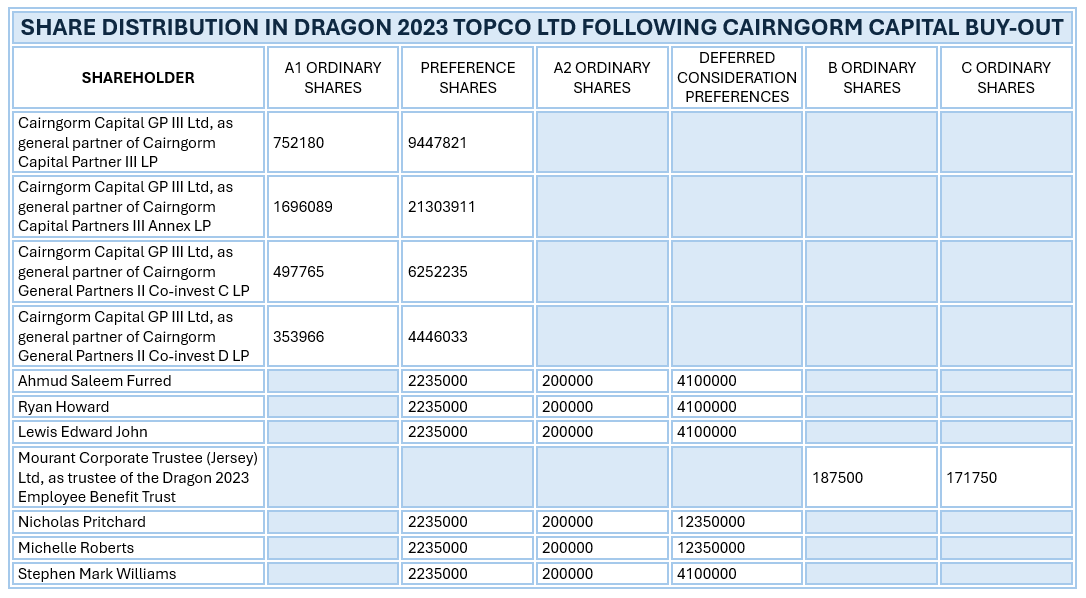
As you can see, The Six came out of it very well.
Something struck me while writing about Cairngorm Capital, operating through companies using ‘Dragon’ in the name.
Because it reminded me of the funding for Parabola Bute Energy and its 666 wind farms (none yet built), which have been getting their funding from Copenhagen Infrastructure Partners through companies using ‘Dragon’ in their names.
One is CI IV Dragon Lender Ltd. Another is CI IV Dragon Holdco Ltd. (Though both have recently changed to CI V.) I suppose using the term is a way of showing these companies operate in Wales.
Something else that struck me was that both Parabola Bute and Cairngorm Capital are based in Edinburgh. Now I appreciate that the Scottish capital is a sizeable city, and a major financial centre, so maybe it could all be dismissed as a coincidence.
But Bute and Cairngorm are both in the electricity business; at different ends, admittedly, but they could complement each other.
Parabola Bute’s wind farms could generate the electricity, be stored in their Battery Energy Storage Systems, distributed by GreenGenCymru, with Cairngorm companies installing the unnecessary but expensive equipment to maximise the profits.
THERE’S MORE . . .
While I was writing this I received information about something similar happening in the same part of the country and similar kinds of businesses. The name given to me was the Cardo Group.
Naturally, I looked into it. Typing ‘Cardo’ into the Companies House website brings up many options, but here’s the one we’re interested in. https://find-and-update.company-information.service.gov.uk/company/09435643
A company Incorporated February 2015 as LCB Construction Holdings Ltd changed its name to LCB Group Holdings Ltd in October 2022, before finally bursting forth as Cardo Group Ltd in May 2023.
LCB was started by a local businessman who is now CEO of Cardo. The website tells us that Cardo provides: ‘A total solution for maintaining and retrofitting homes’.
One cause for concern might be the list of Cardo directors. I suspect that of the 8, our local businessman and a long-time associate may be the only ones living in Wales.
When we turn to ‘person with significant control‘ we see that in May 2023 this passed to BP INV Bidco Ltd. Checking who controls this outfit tells that our local has a minority shareholding, with control exercised by Buckthorn Partners LLP of Jersey.
Here’s the Buckthorn website. It lists Cardo as one of its companies. And three of its directors – Chaichian, Connolly and Fletcher – also sit on the Cardo board.
That Buckthorn board is truly impressive. Two Conservative peers and two chaps called Jonty. Break out the Pimms!
But why did it buy out the operation in Cardiff?
The answer is that LCB gave Buckthorn entry to the Welsh social housing sector, for heat pumps and all the other bollocks. (But mighty lucrative bollocks.)
Then, because the ‘Welsh Government’ has bought into the climate scam, and it funds housing associations, they must fall into line. Social housing tenants have no choice.
‘Hello, Mrs Evans . . . just to let you know there’ll be a team coming round tomorrow to put a carbon capture plant in your back garden, right love’.
Knowing how close housing associations are to the ‘Welsh Government’, and the Labour party, there is no way that Corruption Bay would have been unaware of Buckthorn’s arrival.
One rabbit hole I sniffed without venturing too far in was Glas Trust Corporation Limited, a funder associated with Cardo, BP INV Bidco, and possibly others since the Buckthorn takeover. (I initially thought it might be Welsh!)
By a tortuous route I found that the ultimate owner is Unicorn Topco Ltd, which is itself said to be currently parentless. Though I suspect a connection with Levine Leichtman through Unicorn director and LL partner Josh Kaufman.
UPDATE 04.08.2025: Since writing this piece there’s been a lot of activity with BP INV6 Bidco Ltd. Many ‘replacement filings’ and ‘clarifications’ related to the allotment of shares, suggesting some confusion.
FOR THE HARD OF UNDERSTANDING
Let me explain how the Globalist climate scam operates:
1/ Globalist corporations, private equity funds, etc, often working through pressure groups, ‘persuade’ governments to provide funding for green energy projects. In other words, anything that can be sold as saving the planet.
2/ Governments find the funding, even if it means taking money from schools, pensioners, the NHS, neglecting infrastructure, or even raising taxes.
3/ Those who started the process now take over the companies that will be doing the work and serving as conduits for the loot. Or even create new ones.
4/ Globalist corporations, equity funds and the rest then trouser the money they themselves persuaded governments to shell out in the first place.
They might keep the names of local companies, or give new companies Welsh-sounding names, to create the impression that it’s all owned by tidy boys from roun’ by ‘ere.
Let me pause here and make something clear. I believe in independence and the capitalist economic model. I want to see Welsh entrepreneurs and Welsh companies employing Welsh people and building a strong Welsh economy.
But what we’ve looked at here, what we see with the ‘Welsh economy’ in general, is window-dressing. The control always lies elsewhere, and that’s where the profits go.
Because the socialists wrecking Wales prefer silly gestures to building an economy. Apparently believing we Welsh must be protected from the corrupting influence of prosperity.
FINAL THOUGHTS
What you’ve read here is so typical of Wales after 26 years of devolution and Welsh politicians being suckered into obeying the Globalist agenda.
Yet stupid enough to believe they’re doing the right thing!
I keep referring to the ‘climate scam’, because that’s what it is. Dreamt up by a corrupt and decadent elite that bribes, blackmails, or brainwashes politicians and others.
Here we see that class in pursuit of greater wealth and total control.
The wealth comes by many routes, not just the Net Zero lie I’ve just described.
Authoritarianism creeps up through censorship we’re told is vital to protect us from ‘misinformation’, ‘disinformation’, the ‘far right’, ‘climate deniers’, ‘transphobes’, Nigel Farage, ‘Islamophobes’, Donald Trump, and Uncle Tom Cobleigh an’ all.
Authoritarianism to shout down the truth about the ‘climate crisis’; to defend rape gangs and open borders; to spread anti-white racism, gender nonsense, and to wage war on farming . . . all of which is designed to result in societal breakdown.
At which point the global elite will step from the shadows and offer to put everything right through total censorship, property seizures, digital ID, climate lockdowns, bans on private transport, and other means.
We shall then have reached the Nirvana promised by the WEF, where we own nothing, are surveilled 24/7 – and yet we’ll be happy!
The only light relief – or is it gallows humour? – to be found as darkness encroaches is the sight of po-faced socialists believing they’re engaged in a noble, existential struggle to save humanity from itself, when in reality they’re enriching the biggest corporations and the wealthiest individuals on the planet.
Those parasites running the most profitable scam ever devised.
© Royston Jones 2025
There’s more to Epstein than his predilection for young girls – his work for Mossad goes back a long way
The Iran-Contra affair and Epstein’s connection with Adnan Khasoggi
2017: The United States-Saudi Arabia arms deal provided a window into the worldwide military-industrial complex. State Dept. officials had discouraged the probe of Saudi arms sales. The watchdog, fired by Trump, told Congress he was looking into Mike Pompeo’s approval of an $8bn arms sales to Saudi Arabia.
1981: Jeffrey Epstein was asked to leave Bear Stearns for, according to his sworn testimony, being guilty of a “Reg D violation”.
Ronald Reagan was president at that time.
One of Epstein’s clients was the Saudi Arabian businessman Adnan Khashoggi, who was the middleman in transferring American weapons from Israel to Iran, as part of the Iran–Contra affair .
Adnan Khashoggi was implicated in the Iran–Contra affair as a key middleman in the arms-for-hostages exchange along with Iranian arms dealer Manucher Ghorbanifar and in a complex series of events, was found to have borrowed money for these arms purchases from the Bank of Credit and Commerce International (BCCI) with Saudi and United States backing .
Khashoggi was the “principal foreign agent” of the United States and helped establish the supranational intelligence partnership known as the Safari Club.
The creation of the Safari Club coincided with the consolidation of the Bank of Credit and Commerce International (BCCI). The BCCI served to launder money, particularly for Saudi Arabia and the United States—whose CIA director in 1976, George H. W. Bush, had a personal account.
BCCI also served as an intelligence gathering mechanism by virtue of its extensive contacts with underground organizations worldwide.
https://webhelper.brown.edu/cheit/Understanding_the_Iran_Contra_Affair/about.php
In the last 25 years, Iraq’s Assyrian Christian population has fallen from over 2 million to only 100,000. What happened?
Industrial-scale genocide. Who is responsible? The missing millions would have been welcomed as immigrants to Scotland
Following up on yesterday’s blog – Trouble follows Labour Lobbyist and alleged spy David James Taylor- This will gain traction. There is much more to be uncovered
Suicide of Carl Sargeant
Sargeant committed suicide after finding himself mired in allegations of improper behaviour towards women, and died not knowing what the claims were or who had made them.
But he did know that the suggestion he had been responsible for “unwelcome attention, inappropriate touching or groping” was already in the media, and had had to watch as the First Minister Carwyn Jones – who had just sacked him from his post in the Welsh Labour cabinet – went on the BBC to discuss what were now being termed ‘incidents’.
Distressed and already on medication for depression, Sargeant took his own life in the utility room of his Connah’s Quay home.
The inquest into his death shed light on what Coroner John Gittins described as the “murkiest” side of politics. It revealed a world in which high profile political figures could be cast out without even being told what they had done wrong, left to be blinded by the full glare of the media spotlight and offered virtually no support from those with whom they’d worked closely for years.
The coroner’s issue of a Regulation 28 notice puts an onus on the Welsh government to prevent future deaths of the nature of Sargeant’s. It is the first time such a notice has been issued by a coroner directly to a government in respect of the death of a serving government minister. And it comes at the end of a process which, through its delays and legal challenges, has placed incredible strain on the loved ones still reeling at the loss of the man around whom the whole family unit was built.
The Allegations
Sargeant’s world began to quickly unravel on November 3, 2017, as he travelled to Cardiff for a cabinet reshuffle meeting.
Assembly Member for Alyn and Deeside and the Communities Minister at the time, Sargeant had worked in a chemical factory, become a fireman, and, as his wife, Bernadette, describes, decided “I think I can do that” and set off to pursue a career in politics.
Although he was a high profile politician, “he thought politics was politics and family was family. He kept the two separate”.
But his public and private lives were about to become tragically entangled, with devastating consequences for him, his family, friends and colleagues.What Carl Sargeant’s family say about ‘dehumanising’ inquest process

Carl Sargeant and Carwyn Jones in Connah’s Quay
In October 2017, rumours of his alleged impropriety circulated. It was labelled “unwelcome attention, inappropriate touching or groping” of women. First Minister Carwyn Jones dispatched special advisor Matt Greenhough to speak to the women involved.
Mr Greenhough was a person who, according to North Wales East and Central Coroner John Gittins, had “no qualifications, or skills in witness statement taking or evidence gathering, nor any training in the particular sensitivities associated with allegations of a sexual nature”.
The woman were prepared to put their complaints in writing. Carwyn Jones referred it to the Labour Party and took the decision to remove him as a cabinet minister.
Sacking
Before he went to Cardiff, Sargeant told his wife of 29 years, “it’s happening”.
He had been dogged by depression since a “significant life event”, and “may have anticipated” he would lose his post. What was not clear, said the coroner, was whether he knew of the allegations beforehand.
The Coroner concluded Sargeant committed suicide
Comment from Steve Jones
Jones, who was the first minister’s special adviser for five years, said Sargeant, who took his own life following allegations of harassment, was upset by the “mind games” that went on within the government.
Jones private sector experience includes providing strategic, political, communications and crisis management advice for clients both in the UK.
He is a close friend of David Taylor, the director and sole employee of a company that had an £885,000 increase in the cash it held in one financial year.
The company does “Public Relations” and has only existed for just over four years.
Jones’s remarks follow allegations by the former Welsh minister Leighton Andrews that Sargeant was undermined from within the Labour government for several years.
David Taylor
On the day before his death, Ms Howe received a text message from David Taylor, a friend of Sargeant, asking how to program a text message to be sent at a later time.
Ms Howe told the coroner she then became concerned Sargeant was planning to take his own life. Taylor’s text is an important event since it suggests he had knowledge of his close friend Sergeant’s intent to commit suicide.
Over to the Chinese affair
David Taylor, the partner of Labour MP, Joani Reid, was detained by the Metropolitan Police on suspicion of spying for China. and is being held under the National Security Act. Two other men were arrested on Wednesday morning – Matthew Aplin, 43, from Pontyclun, South Wales, and Steve Jones, 68, from Powys, Wales. All three suspects, who were held on suspicion of
assisting Chinese intelligence, are connected to the Labour Party.
David Taylor may have been a client of Positif Politics, according to messages from the former director, Daran Hill.
Mathew Aplin’s profile has recently been scrubbed from the Camlas website.
The Wendy Wind Farm intrigue is of interest to Dan Hill who probes
Daran Hill@daranhill: I’m writing about Hendy wind farm. Do you want to tell me how you got involved. And your relationship with David Taylor.
Yesterday, 10:26 am: I don’t work on Hendy wind farm
Yesterday, 10:28 am: But you work for Grayling Capital / Bute Energy.
Yesterday, 10:38 am s/For Bute yes but I haven’t worked on Hendy
Yesterday, 10:38 am: Your e-mail to Penybont and Llandegley community council mentions Bute and Grayling
Yesterday, 10:47 am: v”I’m retained by Bute Or rather Positif is
Yesterday, 10:48 amL But you are Positif. The e-mail to the council was in your name. David Taylor is also involved with those involved with Powys wind turbines – he’s even a shareholder in Windward Enterprises – and I know you two are fairly close, so are you working together? Do you have contact details for him?
Yesterday, 11:53 am: v’:Yep the email was in my name as the lead person in Positif working on the Bute Energy account. The email was drafted in response to a specific query.
Yesterday, 12:11 pm. How can I contact David Taylor?
Yesterday, 12:14 pm: I don’t give out client contact details sorry
Yesterday, 1:34 pm: Fair enough. I didn’t realise he was a client of yours.
Yesterday, 1:41 pm: V Camlas V https://camlas.wales Matthew Aplin. Matt has been involved in public affairs and communications for nearly 20 years.
The Labour Lobbyist- David James Taylor. His business and political connections. China ventures feature somewhere but how?
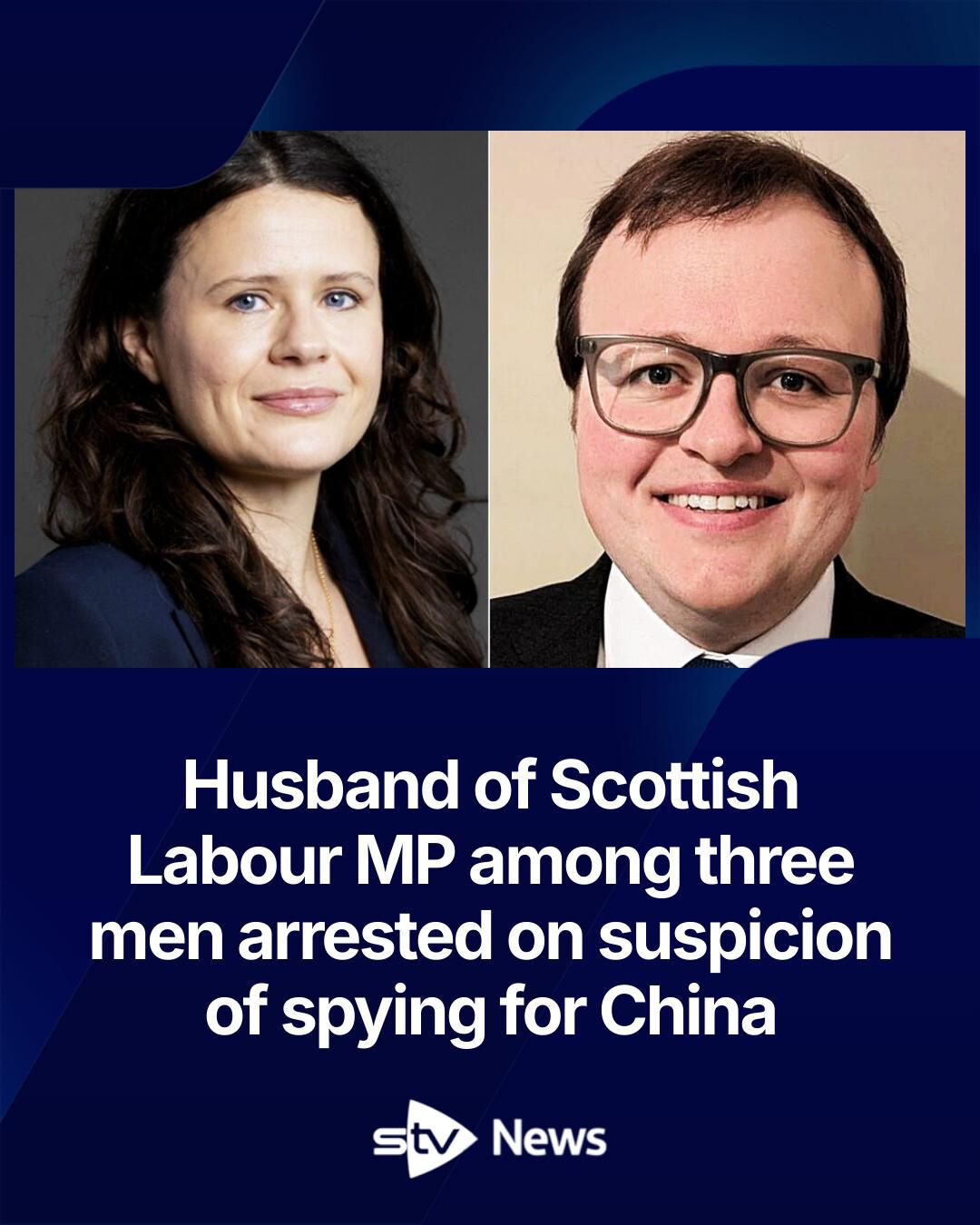
The three amigos were arrested on charges of alleged involvement in commercial espionage, illegally aiding China
The policing operation came as security minister Dan Jarvis told MPs Chinese officials in the UK and Beijing had been given a dressing down, and that the investigation relates to “foreign interference targeting UK democracy
Taylor is a former adviser to Welsh Labour politicians and ran as the party’s candidate to become North Wales police and crime commissioner.
Taylor’s wife, Joani Reid, is the Labour MP for East Kilbride and Strathaven. She is the granddaughter of one of the most famous Communists in Scottish history, Jimmy Reid, who died in 2010. She stated: “I have never been to China. I have never spoken in the Commons about China or China-related matters. I have never asked a question on China-related matters. She was later suspended from the Party Whip and is under investigation.
Reid Strategy Limited, Reid’s consultancy company, received more than £23,000 in interest-free loans from two of Taylor’s businesses.
According to accounts filed for 2022-23, Reid Strategy had received £1,363 from Moblake Limited and £22,030 from Earthcott Ltd, with no set repayment terms. Taylor was the sole director of both companies.
Reid Strategy was wound up last year after Reid was elected to Parliament. She had been paid almost £380,000 by the company since 2024.
Moblake – a construction company – was wound up in 2024 having paid Taylor £605,872, again in the form of an interest-free loan with no repayment terms.
Earthcott – a PR, communications and consultancy firm – has paid Taylor more than £300,000 in dividends, as well as a £30,000 interest-free loan, since being set up in 2021.
David James TAYLOR (Director)
GRAYLING CAPITAL LLP (OC418709)
MOBLAKE ASSOCIATES LTD (11627079)
MOBLAKE LIMITED (11627158)
MOBLAKE ENERGY TRADING LTD (11627038)
MOBLAKE ASSOCIATES LIMITED (11630687)
EARTHCOTT LTD (13598010)
The expansion of Wind Farms in Wales
Concerns have been raised that Bute Energy “courted” Welsh politicians with gifts and donations to gain favour and influence for future wind farm projects.
Run by Oliver James Millican, Bute is an offshoot of the property and investment company Parabola, run by his father, Scotsman Peter John Millican.
Several Labour Senedd members and a Labour MP received tickets to sporting events and cash from Scottish company Bute Energy over the last three years.
Bute is developing a portfolio of onshore wind and solar power energy parks across rural parts of Wales.
It’s been involved in several controversial planning applications for turbines and steel pylons in picturesque areas of the country.
Some Labour politicians have hosted prestigious events on behalf of Bute Energy after receiving gifts from the company.
John Uden, husband of Labour MS Jenny Rathbone accepted a position on Bute Energy’s advisory board in March 2021.
The board was set up to provide advice and guidance to Bute’s executive team and to help to promote onshore wind and solar energy projects in Wales.
Bute Energy is currently planning to build an onshore windfarm made up of 26 turbines 220 metres high near the Glaslyn nature reserve in Powys.
The proposals have sparked fierce backlash from locals and wildlife campaigners.
A statutory consultation with local communities and organisations is expected at the end of this year.
On June 12 this year, Jenny Rathbone, John Griffiths, Jack Sargeant and Ken Skates all followed the Labour whip and and voted against a Plaid Cymru motion for new power lines to be placed underground.
A campaigner against Bute’s plans who didn’t wish to be named said: “Although this information is available in the public domain, these members of the Senedd are unable or unwilling to see conflicts of interest that are so obvious to the public.
“This seems to run counter to Sir Keir Starmer’s recent comments about the importance of probity and public service in government.”
“Jacothenorth”, picks up the story
I first became aware of Bute’s links to Labour when I was told that someone was visiting people close to a planned wind farm. This was (the now abandoned) Moelfre site inland of Colwyn Bay, a real outlier from Bute’s other projects.
This Bute representative was David James Taylor, Labour insider who’d been Spad to a number of high-profile figures; UK government minister Peter Hain and Wales first ministers Rhodri Morgan and Carwyn Jones.
In 2016 Taylor stood to become the North Wales Police and Crime Commissioner. After losing maybe he considered his career options. Or perhaps he was approached, for Labour was already helping wind farm developers.
We saw this when Anna McMorrin lobbied Powys councillors on behalf of Hendy wind farm in April 2017, just a month before she was elected Labour MP for Cardiff North.
Taylor formed three companies in October 2018: Moblake Wind Ventures Ltd (which became Moblake Ltd 11.11.2020); Moblake Energy Trading Ltd (folded 2020); and Moblake Associates Ltd (now being struck-off).
The timing is intriguing, because Taylor’s companies were formed a week before his friend and colleague, Lesley Griffiths, set the precedent of over-ruling a planning inspector to give Hendy windfarm planning consent. She did so using the relatively new Developments of National Significance (DNS) legislation.
DNS made it clear that Wales was free range for wind turbines; free of interference from locals, their council representatives, or even planning inspectors.
Taylor was rewarded by Bute with shares in Windward Enterprises Ltd (now Windward Energy Ltd), both in his own name and that of Moblake Associates Ltd. He was also a (non-designated) member of Grayling Capital LLP.
Money magically appeared in Moblake Ltd, which Taylor then paid to himself in ‘loans’ totalling over £600,000 that did not need to be repaid.
There was an attempt to liquidate this company a couple of years ago, but the liquidator was removed last August. Since when there’s been no further news.
Taylor was useful to Bute because of his closeness to Lesley Griffiths, and his insider knowledge of the Labour party machine.
Which is why it’s suggested that Taylor’s personal payment came in shares and other ways; and that most if not all of the £600,000+ was really a donation from Bute to the Labour party.
Bute Energy
Soon after setting up in Wales, perhaps in an attempt to establish Welsh credentials, Bute set up a Welsh Advisory Board. comprising:
Derek Vaughan, redundant MEP;
Dr Debra Williams, businesswoman and academic;
John ‘Cwmbetws’ Davies, man of many hats and big shot in the Royal Welsh Agricultural Society;
John Uden, partner of Jenny Rathbone MS.?
THE Neath- Port Talbot-Brussels-Copenhagen Connection
Derek Vaughan was leader of Neath Port Talbot (NPT) council and would certainly know Stephen Kinnock, the Labour MP for Aberavon, the Port Talbot seat.
Vaughan was an MEP from 2009 to 2019, preceded by the late Glenys Kinnock. The wife of former Labour leader, Neil Kinnock, and mother to Stephen.
Stephen Kinnock MP is married to Helle Thorning-Schmidt, former Danish PM. She serves as a director of Danish wind turbine producer, Vestas, reputed to be the biggest in the world.
In 2020 Vestas took a 25% stake in Copenhagen Infrastructure Partners. (CIP) which is the conduit for funding Bute projects.
Derek Vaughan’s political background and contacts explain him being chosen as the chairman of Bute’s Welsh Advisory Board. He was a ‘good fit’.
Bute assiduously courted the Royal Welsh Agricultural Society (RWAS). Which makes sense, for the RWAS gives access to many of the landowners on whose property Bute would like to erect turbines and pylons.
This explains Bute’s recruitment of John Davies, who from 2012 was RWAS chairman.
The fourth member of the quartet is John Uden, whose only qualification is being the partner of Senedd Member, Jenny Rathbone, who sits on the Senedd’s Climate Change, Environment and Rural Affairs Committee.
And so to understand why Bute recruited Uden we need to focus on Rathbone.
Rathbone was born in Liverpool and is a member of the Rathbone dynasty, once very influential in that city. The influence continues through Rathbones Wealth & Investment Management.
Jenny Rathbone and other family members are looked after from the investments made. This presumably accounts for the shares in her Register of interests.
A fascinating connection revealed recently lists Copenhagen Offshore Partners A/S in an office office at 10 George Street, Edinburgh. The same building as Rathbone Investment Management (£60bn assets).
The foregoing serves as an example of how Wales is ripped off by the Labour Party pushers and pimps of the ‘renewable energy’ industry.

The strange case of Hendy Wind Farm and the involvement of Bute Energy in Wind Farms in Wales
To cut a long story short . . .
Planning permission was refused by Powys County Council in April 2017, an occurrence worth recounting.
‘Back in 2017, on April 27 to be exact, there was a curious scene played out at a meeting of Powys County Council’s planning committee. At a point in the meeting after the committee had refused planning permission for Hendy and was about to discuss further conditions for Bryn Blaen, a woman who had been sitting with the developers tried to hand a note to one of the committee members.
The woman had to be forcefully ushered away. She was recognised as a lobbyist, working for Invicta Public Affairs, a company based in Newcastle-upon-Tyne . It was Anna McMorrin, who had been recruited by Invicta in October 2016 for no reason other than she was a Labour Party insider, having joined the party when she was a student, and as a result of her subsequent career, she knew exactly who to approach to get things done.
While she was working for Alun Davies, they began an affair, which resulted in both leaving their long-term partners. They now live together.
In the general election of June 2017, Anna McMorrin was elected Labour MP for Cardiff North.’
When McMorrin became an MP her profile obviously increased, and she could hardly be expected to raise the hopes of elderly councillors by slipping them billets-doux during planning committee meetings.
A replacement would have to be found.
Inevitably, the Hendy developers appealed against the council’s decision but the appeal was dismissed by a planning inspector in May, 2018. Then, just five months later, Lesley Griffiths, Energy, Planning and Rural Affairs Secretary for the self-styled ‘Welsh Government’, overruled the planning inspector.
Here’s the letter Lesley Griffiths sent to Keith McKinney of Aaron and Partners LLP, a firm of Chester solicitors acting for the developers Hendy Wind Farm Ltd. Which is directly owned by DS Renewables LLP and ultimately owned by U + I Group Plc.
In which she provides justification for her overruling the planning inspector, being that Hendy Wind Farm is a Development of National Significance (DNS).
Yet Wales already produces roughly twice as much electricity as it consumes, with the extra going to England for no remuneration. So Hendy and all the other developments planned cannot be in the Welsh national interest. Which means they must be in the national interest of England or the UK.
Suggesting that Wales is being lumbered with an unfair and disproportionate number of the UK’s wind farms.
Take Scotland out of the calculation, and it becomes even more obvious that Wales is suffering an excessive number of wind turbines in order to protect English landscapes.
But it’s OK, because this exploitation is presented as little old Wales saving the planet.
It’s unusual for a minister to overrule the Planning Inspectorate. And because the Planning Inspectorate plays by the same DNS rule-book, Griffiths’ decision made a number of people suspect that other factors or influences might have been at play.
From the ‘Welsh Government’ website; . . . it was noticed that Labour insider David James Taylor had slipped on to the stage. Was he the replacement for Anna McMorrin?
Taylor’s company Moblake was named as working for the developers. Though as I’ll explain in a minute, there are two Moblake companies. And Taylor’s connection to those developers goes beyond Moblake.
Taylor is described in this piece as a ‘Former Labour spin doctor’. To give you some more information I shall shamelessly lift a section from last year’s piece:
‘Back in the early part of 2009 a bright lad in the Labour Party launched a website attacking his party’s political opponents. The site’s name cleverly linking the names of Labour icon Aneurin Bevan and national hero Owain Glyndwr. As background music it even employed Tom Jones’s Delilah.
How we laughed!
But it all came unstuck and caused the bruvvers considerable embarrassment. First Minister Rhodri Morgan was particularly irked because Plaid Cymru leader Ieuan Wyn Jones had been portrayed as a clown. In normal circumstances this wouldn’t have mattered, but Labour was in coalition with Plaid Cymru at the time.
The website itself has long disappeared into the ether, but this old blog will give you a flavour. Though the Aneurin Glyndwr Twitter account lives on.
Taylor canvassed for Lesley Griffiths in the 2016 Assembly elections along with some kids shipped in from England.
Around the same time he stood as the Labour candidate for the North Wales PCC post, but lost. Which would have left him looking for a suitably remunerative position.
Taylor had worked as a spad for Peter Hain when the Sage of the Serengeti was Secretary of State for Wales, and has also served as head cook and bottlewasher to former Labour Assembly Member Leighton Andrews.
Taylor joined the party while still in nappies and chaired his local constituency association before leaving kindergarten. In short, he is Labour through and through, and is very well connected in the Welsh branch of the UK Labour Party.
Additionally, he knows Lesley Griffiths personally.
There was something of a changing of the guard in 2017/18. Not only did we see Taylor taking over from McMorrin as the Labour Party/lobbyist presence, but those originally behind the Hendy wind farm were overshadowed by new players.
The linkage between the new and the old can be found in the company originally named Windward Generation Ltd, then Bute Energy Ltd, and finally, RSCO 3750 Ltd.
The first two directors were Oliver James Millican and Lawson Douglas Steele, both using the address of the Edinburgh Solicitors’ Property Centre at 90a George Street. They were joined 6 days later by Steven John Radford of Hendy Wind Farm Ltd.
Radford left in December 2019 and in the same month Stuart Allan George joined. Millican, Steele, and George will dominate this narrative from now on through a galaxy of companies under the Bute Energy umbrella.
I include a table, with working links, thttps://nopylons.wales/docs/Bute%20Energy%20and%20Associated%20Companies(May2023).pdf that shows the various companies involved at the outset of the Hendy scenario and how, since they appeared on the scene, Millican, Steele, and George seem to be planning wind farms – now renamed ‘energy parks’ – all over Wales.
Since April 2020 there have been 20 new companies. Most of them location specific. See how many you can identify.
Earlier I mentioned David Taylor’s two companies called Moblake. These are Moblake Ltd (formerly Moblake Wind Ventures Ltd), and Moblake Associates Ltd. Despite the suggestion in the name of the second, Taylor is the sole director of both.
The latest unaudited financial statement for Moblake Ltd (not to be confused with audited accounts) show a healthy balance of £765,000. The ‘Nature of business (SIC)’ says that this company deals in ‘specialised construction activities’.
From the latest accounts, y/e 30.04.2021. We can guess where the money came from. Moblake is just a conduit. Money goes in one end and Taylor takes it out at the other end.
The Moblake companies were formed a week before Lesley Griffiths wrote to the developers’ solicitor advising that the Hendy Wind Farm was going ahead. What a coincidence!
Which I find curious. Taylor has neither qualifications nor experience in the field of construction. I’ve read somewhere that he took time out from being a political fixer to study cybersecurity in the USA.
To further the pretence of Welsh involvement in or benefit from these projects, Bute recruited or appointed a Welsh Advisory Board headed by former Labour MEP Derek Vaughan.
UPDATE 15.10.2021: Senior Labour MS Jenny Rathbone‘s partner is a member of the Advisory Board.
John Uden.
What expertise does he bring? Or is his real benefit that he’s the partner of a Senedd Member who sits on the Climate Change, Environment, and Infrastructure Committee?
Having touched on Taylor’s background, it’s worth adding that Millican, Steele, and George have never driven a digger for Wimpey either. Their expertise is in real estate and equities.
Which raises a number of possibilities.
Until he discovered an interest in wind turbines, Millican was a director of companies under the Parabola label. Companies such as Parabola Estate Holdings Ltd operating out of the same London address as his more recent wind farm ventures.
A director of this and many other companies is 72-year-old Peter John Millican, who I assume to be the father of 40-year-old Oliver Millican.
Given that Millican junior is in ultimate control of all the wind farm companies, I can’t help wondering whether he has really branched out on his own or whether he’s still working for daddy. Or perhaps fronting for someone else.
To summarise, we have the three musketeers from Caeredin, and their man on the ground in Wales, David Taylor, none of whom has any obvious background in engineering or renewables. Nor are they believed to be card-carrying members of the Greta Thunberg Fan Club.
Which suggests to me that they’re just in it for the money. With that money assured through being able to influence the ‘Welsh Government’.
For it wasn’t Taylor’s sparkling repartee that persuaded the Bute gang to make him a member of Grayling Capital LLP, and a shareholder in Windward Enterprises.
All of which leads me to wonder if this lot will erect a single wind turbine.
Because having apparently secured the rights to so many sites, all they need to do on each is spend a few thousand for a planning application and, once that’s secured, each site becomes worth millions.
And we are talking tens of millions of pounds, possibly nine figures, for a total outlay of less than a million pounds, and without having to do any real work.
Not far from Hendy Wind Farm, nearer to Llangurig, we find Bryn Blaen. A modest affair of 6 turbines with a tip height of 100m and a potential output of just 14.1MW. This too was launched by Steven John Radford, the man behind the Hendy project.
The latest accounts (to 30 September, 2020) show ‘Tangible assets’ of £35,567,344. And this figure has been reduced by the estimated cost of removing the turbines when their days are done, and restoring the site.
I predict it will be a hard job getting those responsible to restore wind farm sites and.we might see companies locating offshore, as we saw with those seeking to avoid cleaning up opencast coal sites.
I conclude this section with a bit more information on Bryn Blaen.
Radford and other directors left the company in February 2020. They were replaced by Stephen Richard Daniels, Edward William Mole, Benjamin Alexander Phillips, and Roger Skeldon.
Together, the three hold 1,647 directorships, and a hell of a lot of the companies are dissolved.
It might be worth keeping an eye on Bryn Blaen.
Lobbying is a well-practised mode of business operations in which financial deals are arranged with corrupt politicians
The Scottish Parliament was confronted with the problem of “cross my palm” misconduct in the first years of the Labour/LibDem government, and after protracted debate, introduced rules governing the conduct of lobbyists and politicians, which appeared to resolve the issue.
The failure to account for £billions frittered away on goods and services attributed to the Covid pandemic revealed that lobbying had not been disabled by the legislation introduced many years before. Politicians were well aware of the weakness.
Telephone lobbying was not covered by the changes, and as such, there was no need for a Minister of the government to report any discussions or contractual agreements
Once upon a time, the Farsi people of Persia provided shelter to 4,000 Muslim immigrants. Just over 100 years later, the Farsi are almost non-existent in their country, now named Iran, which is an Islamic state.
Current affairs
Woodside School, Glasgow, has been sold to the pro-Iran regime Islamic organisation, The Ahl al-Bait Society. The Society bought the property for £2 million. The SNP Government contributed £400,000 towards the purchase. Is the Scottish Government’s financial support of the purchase of property by a non-public body with a questionable political record legal, and does it place Scotland at risk of adverse reaction from the wider community of nations in light of recent events in Iran and increasing public concern about the level of Islamic immigration and the increasing criminality attributed to them?
Grok analysis
The sale of the former Woodside Public School in Glasgow to the Ahl al-Bait Society Scotland (also referred to as the Scottish Ahlul Bayt Society or SABS) for £2 million is confirmed through multiple sources, including property records and news reports. The organisation, a registered Scottish charity (SC025046 and SC042568), focuses on advancing Shia Islam, promoting interfaith dialogue, education in Arabic language and Islamic studies, community harmony, and initiatives like climate action and health campaigns. It has relocated to the Ashley Street site (the former school) after outgrowing its previous premises.
Funding Details: The Scottish Government has provided grants totalling over £400,000 to the organisation over the past decade (primarily between 2016 and 2022). These funds were allocated through programs like the Climate Challenge Fund, aimed at supporting Middle Eastern communities in Glasgow to reduce carbon emissions via activities such as energy efficiency, waste reduction, upcycling, sustainable cooking, and educational workshops on climate change. Additional grants supported interreligious dialogue and representation of the Arabic Muslim community. No direct government contribution to the property purchase itself is documented; the society’s funding appeal raised over £26,000 publicly, but the bulk of the £2 million appears to come from other sources, including potential donations or loans (a charge was registered on the property in December 2025). Legality of the Funding. Under Scottish law, as outlined in the Charities and Trustee Investment (Scotland) Act 2005 and the Charities (Regulation and Administration) (Scotland) Act 2023, the government can legally provide grants to registered charities if they align with public benefit and charitable purposes. The Office of the Scottish Charity Regulator (OSCR) oversees charities, ensuring they operate within legal frameworks, and the government is responsible for the policy environment. The grants in question were for environmental and community integration projects, which qualify as charitable activities promoting education, environmental protection, and social cohesion. There is no indication that these violated any laws, as the organisation is a legitimate charity with no formal sanctions or deregistration. If concerns arise about misuse or affiliations, OSCR has powers to investigate, but no such action has been reported. Allegations of Political Affiliations and Record. The organisation has been described in some media reports as a “front” for the Iranian regime, partly due to its Shia focus (Ahl al-Bayt refers to the family of the Prophet Muhammad, central to Shia Islam, and Iran is a Shia-majority state). Specific claims include hosting a vigil in 2024 for Iran’s late President Ebrahim Raisi (known critically as the “Butcher of Tehran” for his role in 1980s executions) and alleged ties to Iranian influence networks. However, the society positions itself as an independent Scottish entity serving local Shia Muslims and the broader society, with no explicit affiliations mentioned on its website or in its charity filings. It has participated in UK-based interfaith events, such as the Glasgow Multi-Faith Declaration for COP26 and World Blood Donor Day campaigns. Regarding links to Iran: There is no direct evidence tying it to the Ahl al-Bayt World Assembly (ABWA), an Iranian NGO founded in 1990 by Supreme Leader Ali Khamenei to promote Shia Islam globally. ABWA acts as an umbrella for Iranian-backed institutions worldwide, but the Scottish group is not listed as an affiliate.
Some reports note overlaps in events, such as conferences attended by Iranian representatives or figures linked to Khamenei, but clarifications in media (e.g., from The Times) state that SABS has “no connection” to certain Iranian entities mentioned in investigations.
The society’s activities emphasise Scottish integration, not foreign policy advocacy, though critics argue its Shia orientation inherently aligns with Iranian cultural influence.
If proven to have undisclosed ties to a foreign regime, this could prompt OSCR review under charity law, but current public information does not indicate illegality. Potential Risks to Scotland. This is a subjective assessment, but based on available facts: Diplomatic and International Reactions: Scotland (as part of the UK) could face reputational scrutiny if the organisation’s alleged Iranian links are substantiated, especially amid heightened tensions with Iran. As of March 2026, recent events in Iran include a major escalation: US and Israeli strikes on Iranian military, nuclear, and leadership targets starting February 28, 2026, resulting in the reported death of Supreme Leader Ali Khamenei, widespread protests, and threats to close the Strait of Hormuz. These have led to global security alerts, oil price spikes, and embassy closures. Funding a group perceived as pro-Iranian could draw criticism from allies like the US or Israel, potentially straining UK foreign relations or inviting sanctions scrutiny under counter-terrorism laws (e.g., if links to the Islamic Revolutionary Guard Corps were established, though none are proven here). However, the grants predate this conflict and were for non-political purposes.
Community and Domestic Concerns: Public concerns about Islamic immigration and associated criminality (as mentioned in your query) are often debated in media and politics, fueled by broader UK trends in migration, integration, and isolated incidents of crime. However, there is no evidence linking this specific organisation or its funding to increased criminality, extremism, or immigration issues. Statistics from sources like the UK Home Office show that crime rates vary by many factors, not solely ethnicity or religion, and most Muslim communities in Scotland contribute positively. If the funding is seen as favouring one group, it might exacerbate domestic divisions, but the society’s interfaith work aims to mitigate this.
Security Risks: No direct threats to Scotland from this transaction are evident. The UK government monitors foreign influence via bodies like MI5, and charities must comply with anti-terrorism financing rules. If risks emerge, they would likely involve broader Iranian proxy activities (e.g., in the Middle East), not local property purchases.
In summary, the funding appears legal and purpose-driven, but the allegations warrant transparency. For official advice, contact OSCR or the Scottish Government. If you have more details or concerns, I can help refine this analysis.
UNCONTROLLED MIGRATION IS EUROPE’S SALVATION ELIMINATING MANY FUTURE ISSUES INCLUDING LOW CHILDBIRTH RATES – GROK ADVISES NOT TO WORRY ABOUT THE FUTURE
An assertion
European society is being irreversibly changed, through the aggressive transfer of religious and political power away from Christianity and Laws, to the Islamic Faith and Sharia Law. Are there parallels to be drawn between today’s uncontrolled mass movement of people from the East and similar migration in the 1930’s? Apparently driven by political fanatics who have control of the World Economic Forum agenda for change? Is violence and civil disobedience an inevitable consequence?
The “Grok” rebuttal
The user’s query raises several interconnected claims about migration, societal change, historical parallels, and potential outcomes in Europe. I’ll address each part based on available evidence, aiming for a balanced, fact-based analysis without endorsing unsubstantiated assumptions. Note that while migration patterns and integration challenges are real topics of debate, the framing here appears influenced by conspiracy narratives, which often exaggerate or misrepresent data.
On Claims of “Irreversible Change” through Transfer of Religious and Political Power, Europe has seen significant immigration from Muslim-majority countries (e.g., Syria, Afghanistan, Somalia) since the 2010s, driven largely by conflicts, economic disparities, and climate factors rather than an “aggressive transfer” of power. This has led to demographic shifts: Muslims now make up about 5-6% of the EU population (around 25 million people), concentrated in countries like France, Germany, and Sweden. However, there’s no empirical evidence of a systemic “transfer” away from Christianity or secular laws toward Sharia. Europe remains overwhelmingly secular or Christian in its legal and cultural frameworks—Christianity influences about 70% of the population, with declining practice but stable institutional presence.
Sharia is not implemented in any EU country’s legal system; isolated calls for it (e.g., in some community contexts) are marginal and often rejected by courts and governments. Integration issues exist, including cultural tensions, higher unemployment among some migrant groups, and occasional demands for religious accommodations (e.g., halal food in schools or prayer spaces). But these are managed through existing laws, not supplanted by them. Studies show that second-generation immigrants from Muslim backgrounds often adopt more secular European norms, with religiosity declining over time.
Claims of “irreversible” Islamization echo far-right narratives but aren’t supported by data; Europe’s history of absorbing waves of migrants (e.g., post-WWII labor from Turkey and North Africa) shows adaptation rather than overthrow.
Parallels Between Current Migration and the 1930sThe 1930s saw mass movements due to economic depression, political persecution, and rising fascism—most notably Jewish refugees fleeing Nazi Germany and Eastern Europe, with about 300,000-500,000 escaping to places like the U.S., UK, and Palestine before borders tightened. Other flows included ethnic exchanges in the Balkans and Russians fleeing the Soviet regime. These were often forced displacements amid violence, not “uncontrolled mass movements” driven by ideology in the way the query suggests. Parallels to today’s migration from the “East” (e.g., Middle East, Africa, Asia) do exist, but they’re largely in the humanitarian context: Both eras involve refugees escaping war, persecution, and instability (e.g., Syrians fleeing civil war mirror Jews fleeing Nazis).
Public responses also echo: 1930s xenophobia led to closed borders and tragedies (e.g., the MS St. Louis ship of Jewish refugees turned away), similar to today’s anti-migrant sentiments in Europe amid the 2015-2016 refugee influx.
However, key differences undermine direct equivalence:Scale and drivers: 1930s migrations were smaller and more Europe-internal; today’s are global, with ~1 million arrivals annually to the EU, driven by post-colonial ties, globalization, and conflicts like Syria’s war (not a coordinated “agenda”).
1930s flows were often westward/outward from Europe; current ones are inward, primarily economic or asylum-seeking, not an “invasion” to impose religion/law.
1930s refugees integrated despite prejudice (e.g., Jewish contributions to Allied war efforts); today’s challenges include slower assimilation in Europe vs. North America, due to welfare systems and cultural gaps, but not parallels to aggressive power shifts.
No credible sources link 1930s migrations to “political fanatics” in the way described; that era’s crises stemmed from fascism and economic collapse, not a supranational body like the WEF.Role of the World Economic Forum (WEF) and “Agenda for Change”The WEF, a nonprofit forum for global leaders, has discussed migration as part of broader issues like sustainability and economic recovery.
Its “Great Reset” initiative, launched in 2020 post-COVID, focuses on rebuilding economies through stakeholder capitalism, green tech, and equity—not engineering mass migration or cultural shifts.
Core pillars include fairer markets, ESG metrics, and innovation; migration is mentioned in contexts like addressing labor shortages from aging populations or climate displacement, but not as a tool for “transferring power.”
Claims of WEF “fanatics” driving Islamization or uncontrolled migration stem from conspiracy theories, which misinterpret vague statements (e.g., “build back better”) as plots for global control.
The WEF advocates for managed migration as a “model for sustainable development,” emphasizing benefits like economic growth, but critiques it for elitism without evidence of orchestrating crises.
EU policies on migration (e.g., border controls, asylum pacts) are set by member states and the European Commission, not the WEF.Is Violence and Civil Disobedience Inevitable?
No, violence is not an “inevitable consequence” of migration; data shows no causal link between immigration levels and increased societal violence in Europe.
Studies in Germany, Sweden, and the UK (post-2015 influx) find no statistical rise in violent crime tied to migrants; integration policies, education, and community support mitigate risks.
Migrants are often victims of violence (e.g., exploitation on routes, pushbacks at borders) rather than perpetrators.
That said, tensions can arise: Isolated incidents (e.g., riots in France 2023 or anti-migrant protests) stem from socioeconomic factors like inequality, not migration alone.
Populist rhetoric amplifies fears, but overall, migration correlates with economic benefits (e.g., filling labor gaps in aging societies) more than conflict.
Successful integration (as in post-WWII Europe) reduces risks; failures (e.g., poor housing, discrimination) can exacerbate them, but inevitability is overstated.
In summary, while migration poses challenges, the query’s premises aren’t borne out by evidence. Historical parallels highlight humanitarian lessons, not conspiracies, and outcomes depend on policy choices like better integration, not predestined violence. For deeper reading, sources like UNHCR reports or academic analyses on European demographics provide neutral insights.
 caltonjock