
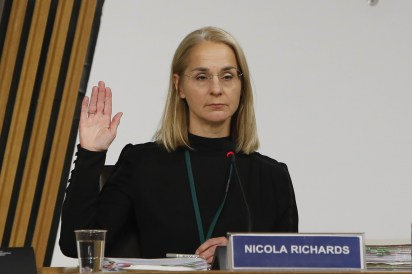
Nicola Richards: Director of People
The Human Resources Director took a key role in events from the outset and worked with MacKinnon, the Investigating Officer, the complainants and others developing the new, novel and untested procedures.
Very late on in the process Richards discussed the content of a draft procedure with at least one of the complainants and immediately after advised the need to ensure the First Minister would not be informed of a complaint against a former minister until after a decision had been arrived at by the Permanent Secretary. This contibuted to a flurry of discussions and rushed late night rewriting of parts of the 8th draft of the new proedures so that the publication deadline would be met.
Late August 2018: A record of events in late August 2018.
The actions of the investigating officer, the Permanent Secretary, The Crown Agent and the police supports assertions of a conspiracy to “get” Alec Salmond.
20 August 2018: MacKinnon spoke to both complainers and advised them that their complaints would probably be referred to the police.
20 August 2018: MacKinnon met with the Crown Agent (having also communicated with him by other means, on 17 and 19 August 2018) and committed to the transfer to his office of all documentation pertaining to the complaints and any decision taken. But Evans had not yet reached a decision at that time. And why all the meetings with the Crown Agent who said later he had only become involved when the case files had been passed to him from the Lord Advocate’s office.
Comment: What the hell!! And all this before Evans had made her decision known!!!!
20 August 2018: Evans decided on the complaints then sent all information pertaining to the investigation and her decision to Richards who forwarded the entire package to the Crown agent Harvie together with the request that he pass it on to the police for their action.
She also alerted Ms B to events and told her to expect a call from the police very soon.
Click to access SP_SGHHC_-_FN45.pdf
21 August 2018: At a meeting convened by Harvie to discuss matters for investigation of criminality with CC Livingstone and DCS Boal, he told them that his line manager Leslie Evans had forwarded him her decision on complaints made by two civil servants against Alex for referral to the police, despite the complainers against Alex wanting to keep the police out of the matter.
He further advised that Evans had decided to make a public statement on Alex’s case including a notice that the matter had been passed to Police Scotland for investigation.
DCS Boal strongly advised against it and refused to accept a copy of the internal misconduct investigation report.
The terse exchange of views confirmed the urgent desire of the Scottish Government to get the information into the public domain.
Detective Chief Superintendent Lesley Boal told the Holyrood Inquiry: “Harvie passed on what he considered were relevant statements, although they were “more a series of listed questions and responses from anonymised individuals.
He told me two individuals had made formal complaints, but that there may be other potential complainers who had not engaged in the internal conduct investigation.
It was agreed that a proactive approach would be required whereby other persons who held similar roles may need to be approached.
Harvie offered me a copy of the Scottish Government’s internal conduct conclusion report, which contained detailed allegations.
I refused this offer and neither I, nor the Chief Constable, viewed the document.
I was also informed that Scottish Government may be making a public statement in relation to the outcome of their investigation and potentially to refer to information being provided to Police Scotland.
Both the Chief Constable and I both voiced our concerns at such a statement being provided.
As such, it was agreed that the main priority was to make contact with the two individuals who had made a complaint to the Scottish Government.”
Comment: An interesting aside was the comment from Alex when he was told about Crown Agent Harvie’s meeting with the Police. Referring to the leak, he said:
“Evans was asked about that in questioning, and she said that it had caused enormous distress to everyone concerned. I am absolutely sure that it did – to the complainants, to me, to everybody. The only question that I would have for Evans is this: Notwithstanding the leak, what did she think would have happened if she had gone ahead and put out the statement at 5 o’clock on that day? “I find it extraordinary.”
21 August 2018: Evans office contacted Alex to say that Evans was not in a position to write on the outcome of the investigation. Evans office was asked for an explanation of the delay by Alex.
21 August 2018: Mackinnon contacted Ms A and Ms B to say that Evans had decided on the case and a police referral was likely to occur that day. Information that was withheld from Alex’ legal team until the day after, without mention of Evans aborted attempt to request a police investigation.
22 August 2018: Ms A, Ms B, Alex, Sturgeon and other members of the Government team were provided with a copy of Evans decision report.
22 August 2018: Ms A and Ms B spoke to Evans at her request, in private.
22 August 2018: Alex ‘s legal team wrote very strongly worded letters each to Evans and Sturgeon advising both of them that the actions they had instructed and decided upon was illegal, contrary to good staff relations and breached every statute of employment Law
Click to access SP_SGHHC_-_FN46.pdf
Click to access SP_SGHHC_-_FN44.pdf
Click to access SP_SGHHC_-_FN43.pdf
23 August 2018: Evans informed Alex’ legal team that she had forwarded the case documentation to the Lord Advocate’s office. Alex’s counsel objected with an added observation that her actions were without foundation and a breach of protocol.
23 August 2018: Evans advised Sturgeon that a FOI request about Alex had been received in mid-June 2018. An answer was due mid-July and had been deferred but she had decided that the information requested would be released and a press statement would be released at 1700 hours (despite Alex objecting). See 18 June 2018 and 20 September 2018.
Comment: Evans sent the investigation report and her findings, to the Crown Office for viewing and police referral two days before she informed Alex of her decision. She withheld any mention of the refusal by the police to accept her findings and/or the documents she had passed to the Crown Office which compromised her carefully arranged plans forcing her to deal with the matter internally.
Her advice to Alex of her intention to press on with a belated but unncessary reply to an outstanding FOI request about Alex was a distraction, she was buying time since she was aware the requestor had left the employ of the newspaper and there was no further action required. Her threat to go public was always an empty one since this would have been construed to be interfering in a Police investigation.
The Internal Misconduct Investigation Report
The response of the Scottish Government to the illegal leak of confidential information to the Daily Record is contained in a report classified “strictly confidential” with distribution restricted to a few senior government officials. A few, heavily redacted but informative extracts were released for public consumption through the Information Commissioners Office (ICO). Namely:
3.5 To progress the investigation, a witness would be needed who would be willing to provide information about the method of disclosure (for example, by hard copy being passed in person) and the identity of the culprit.
3.6 The Daily Record declined to provide information as to how or by whom they came by the copy of the report, relying on the journalistic exemption within the DPA 2018, clause 14 of the Editors Code of Practice and s.10 of the Contempt of Court Act 1981.
3.7 Twenty-three members of staff were identified as having knowledge of, or involvement in, the internal misconduct enquiry. These members of staff were interviewed by the Data Protection Officer at the SG as part of their Data Handling Review. The interviews did not disclose any information which would enable a suspect to be identified.
3.8 In the absence of any information coming to light, or any witness coming forward, there was insufficient evidence to point to any specific suspect and to allow the investigation to move forward. The matter was closed.
Click to access FOI%2B-%2B202100191814%2B-%2BAnnex%2BA.pdf
Editors code of Conduct:
i) The Press must take care not to publish inaccurate, misleading or distorted information, including headlines not supported by the text.
ii) The Press, while free to editorialise and campaign, must distinguish clearly between comment, conjecture and fact.
i) Everyone is entitled to respect for his or her private and family life, home, health and correspondence, including digital communications.
ii) Editors will be expected to justify intrusions into any individual’s private life without consent. Account will be taken of the complainant’s own public disclosures of information.
(i) Journalists must not engage in intimidation, harassment or persistent pursuit.
Conclusion by GROK:
The Daily Record, through David Clegg and its editor, likely breached the Editors’ Code of Practice by publishing inaccurate and privacy-invading information sourced from an illegal leak. Their refusal to disclose the informant’s identity was legally protected under journalistic exemptions, but ethically questionable given the harm caused. The police could demand the source’s identity only with a court order, which was never pursued due to the lack of an investigation—a significant failing by the Scottish Government. The broader conduct of the Scottish Government and SNP, including fishing expeditions and public statements, supports the narrative of a politically motivated campaign against Salmond.
And who leaked confidental information to the police
The leaker anonymously emailed the Daily Record editor part of a page extracted from the Permanent Secretary’s report. Identfying the culprit (s) presented investigators with an almost impossible task due to the number of staff who investigators conjectured may have had access to the infomation, (23) although the report was classified “confidential” and its distribution would be controlled and recorded which should have significantly reduced the number of staff to be interviewed. The person(s) conducting the investigation were colleagues of those they were interviewing and it is not known if the interviews were conducted under caution.
In any event the incident became a criminal matter in consquence of the Daily Record accepting and recklessly publishing inaccuurate information illegally sourced from a Government employee. The Police did not seek nor were they asked by the Crown Office or the Government to investigate the criminality which is surprisng but perhaps not unexpected from the SNP Government who had no interest in getting to the truth.
The leaker was not one of the inner circle, (those trusted with copies of the confidential files and briefings) since they would be aware that the police had declined Evans request for the force to take the investigations further relieving her of the problem. This rules out the people suggested by the press and Ms A and Ms B who were devastated since very early on they had impressd upon the Investigating Officer and her colleagues that it was never their intention to raise a formal complaint against Alex and Evans decision to escalate matters rquesting the involvement of the police had been decided on without their knowledge or support.
Reducing the number of suspects to include employees not in the inner circle and including senior SNP members widens the field but makes the task of identfying the leaker much easier. The leaker must have had a compelling motive to destroy Alex Salmond and the opportunity, perhaps assisted by others which requires a look forward in time to other events. The scenario might involve someone on the fringes of the inner circle with a strong connection to a complainant formerly in the circle (S)
Clegg’s Version of Events
“In the afternoon of 23 Aug 2018 I was working in a quiet corner of a Dundee coffee shop when I received the most memorable email of my life. It was from the Daily Record’s head of news, Kevin Mansi, and contained just five words and a picture. “Anon letter that’s come in.”
The unremarkable introduction meant I nearly spat out my coffee when my phone loaded the attachment, a scanned copy of a 100-word document which had arrived at the newspaper’s Glasgow office that morning.
The contents, headlined “Scottish Government reports Salmond to police”, were absolutely incendiary. An anonymous whistle-blower was claiming that two women had made sexual misconduct complaints against the former first minister.
The government had investigated the allegations before passing them to the police. A summary of the most serious charge was also included. It described an alleged late night sexual assault by Alex on a young female civil servant.
The claims were so extraordinary that the natural reaction was to dismiss them as the work of a crank. Yet on an initial reading my instinct was that several elements of the document seemed authentic. The dry language used to summarise alleged behaviour that would ultimately become a criminal charge of sexual assault with intent to rape could only have been penned by a civil servant.
The small details also felt right – in particular the use of the three letters FFM to describe Alex. It was an abbreviation for former first minister that would mean nothing to the general public but which I had heard many times in political circles.
On balance, my judgment was that it was entirely plausible that the account was genuine. It was also safe to assume that if it wasn’t a hoax then we were in a race against time to break the story. If this information had reached us, it would not be long until other media organisations also got wind of it.
For all we knew, a similar package could have arrived at the office of every newspaper in the country that morning. We had to proceed with speed, caution and care. I immediately left the café and sprinted the half-mile back to my house.
The race was now on to verify the accuracy of the information independently so we could publish regardless of on-the-record confirmation. All the journalists involved were acutely aware that the slightest inaccuracy in any subsequent story could have disastrous consequences.
I began methodically contacting sources who had been useful in recent months in the hope they could provide further corroboration. Tellingly, I found I was unable to get any senior Scottish Government special adviser to answer their phone. Meanwhile, Mansi worked his extensive police contacts.
It was not until 2000 hours that we had enough confidence in our information to contact Alex directly to give him the opportunity to present his version of events.
I was in my small home office when I dialled his mobile number and heard that distinctive voice click onto the line. I had last seen Alex the previous year when I took him for a long lunch in Glasgow two weeks after he lost his Westminster seat.
His tone was much colder on this occasion. “Yes, David, what can I do for you?” he asked. My heart was pounding as I replied: “We’re doing a story on the allegation the police are looking at. Should I be speaking to a lawyer, or is there a comment I should take from you?”
There was a long pause. “And which allegation is this, David?” “The one from December 2013 at Bute House.” “And what’s the detail of it, sorry, David?” “That a staff member at Bute House was harassed or assaulted after a function.”
In the terse three minute conversation that followed Alex avoided being drawn on the substance of the complaints and focused on fishing for more information on the status of the police investigation and inquiring into who was the source of the story. He also asked for the allegations to be put to him in writing, a request I duly obliged.
With the Record’s print deadline looming, an urgent conference call was convened to discuss whether to publish in the event of no substantive response to the details of the allegations being received from the Scottish government, Police Scotland or Alex. This was a big call for the new editor David Dick, who had only been in the post a few months and was now dealing with the biggest story any Scottish newspaper had tackled in living memory. After a brief discussion, he decided he was happy for us to proceed and I began writing.
At 2132 hours an email from Alex’s lawyer, David McKie of Levy & McRae, dropped into my inbox. Its contents were breath-taking. He did not dispute the existence of the allegations or even make a threat of defamation action. Instead, he warned that publication would be a breach of privacy and cited the recent high profile finding against the BBC regarding coverage of the police investigation into pop legend Sir Cliff Richard. An accompanying statement from Alex insisted he was completely innocent of any wrong doing and would fight to clear his name and he would be taking the Scottish Government to court over its botched handling of sexual harassment complaints.
Comments:
A Daily Record employee had already telephoned the Scottish government press office at 2000 claiming confirmation of the accuracy of the leaked information had been received.
Clegg’s assertion that he had been contacted by Alex’s legal team at 2132 hours did not impact on the decision by the editor of the Daily Record to publish.
Clegg’s singular and persistent unfruitful pursuit over many months, seeking from Scottish government employees and civil servants, information that would be damaging to Alex was in direct contravention of a number of the conditions contained in the news editor’s “code of Practice”. As was the inaccurate reporting of fact evidenced by the malicious and irresponsible headline claiming that Alex had been reported to the police over sexual assault allegations which was not the case.
The truth of the matter is that on 21 August 2018 the Crown Agent, according to the police informed them of the Government’s intention to release a story of the fact of the complaints to the press and the Chief Constable and another senior officer strongly advised against it and refused to accept a copy of the internal misconduct investigation report.
An exchange of views confirming the urgent desire of the Scottish Government to get the information into the public domain.
Thursday 23 August 2018, (two days later) without informing the police of their decision to ignore their advice not to do so the Government informed Alex Salmond’s legal team of its intention to release a statement at 1700 hours in the day.
Alex ’s legal team advised in return that they would interdict the statement pending the outcome of the Judicial Review petition forcing the government to withdraw its intent to publish information to the public. An interdict was not therefore pursued by Alex’ legal team acting on the strength of the government undertaking.
The bombshell was dropped later that day, at 1600 hours with the alarming news that the Daily Record newspaper had phoned the Scottish Government press office claiming knowledge of the story which without confirmation it could not publish. Confirmation was not forthcoming from the Scottish government.
At 2000 hours an employee of the Daily Record telephoned and advised they received confirmation of the leaked information and the story would be published later that evening. The story broke at 2200 hours.
A follow up containing specific details of the leaked complaints demonstrating that their informant had access to the Permanent Secretary’s decision report or an extract from it was published on Saturday 25 August 2018
The leaking of the information was a prima facie criminal act, deeply damaging to the interests of Alex and a blatant invasion of the privacy of the complainants as well as a direct contravention of the assurances of confidentiality given to all.
The conclusion of the legal authority who assessed validity of the complaints was that they were “sympathetic to the thesis that the leak came from a Government employee”. But legal action action could only be instructed if the police investigated matters and identified the person(s) who leaked the information.
Police follow up not requested by the Scottish Government
The police were not asked by the Scottish government to investigate the 23 August 2018, criminal leak of confidential information. This despite the Daily Record blatantly breaching rules 1,2 and 3 of the editor’s “code of conduct”.
That the Daily Record was permitted to decline, (without a legal challenge), to provide information as to how or by whom they came by the copy of the report, relying on the journalistic exemption within the DPA 2018, clause 14 of the Editors Code of Practice and s.10 of the Contempt of Court Act 1981 is a travesty of justice and a betrayal of the 2 complainants and Alex Salmond.
GROK report attached:
https://twitter.com/i/grok/share/sOxBAUL9luTf18rs8GyJgiKRC
 caltonjock
It was crude, vicious and evil. It cost Alex his health and- probably -in my opinion- his life.
The exchanges with police, who refused to accept that document, seem particularly important and damning.
There will be many like me who still hope and expect that those responsible will be named and prosecuted. None of them, including their line managers, whoever and wherever they were, should assume he or she has got away with it. Lying low for the rest of their lives also depends on the whole bunch coping with such horrific guilt: Alex Salmond suffered such appalling sustained abuse and pressure; no wonder he died.
Someone surely will eventually feel the need to confess.
LikeLiked by 2 people
We just need to keep the subject active within the social media blogs and continue digging out facts. I am also more than a bit disturbed about the conduct of some members of the inquiry who gave little effort to find the truth in preference for toeing party lines and long held grievances against Alex
LikeLiked by 1 person