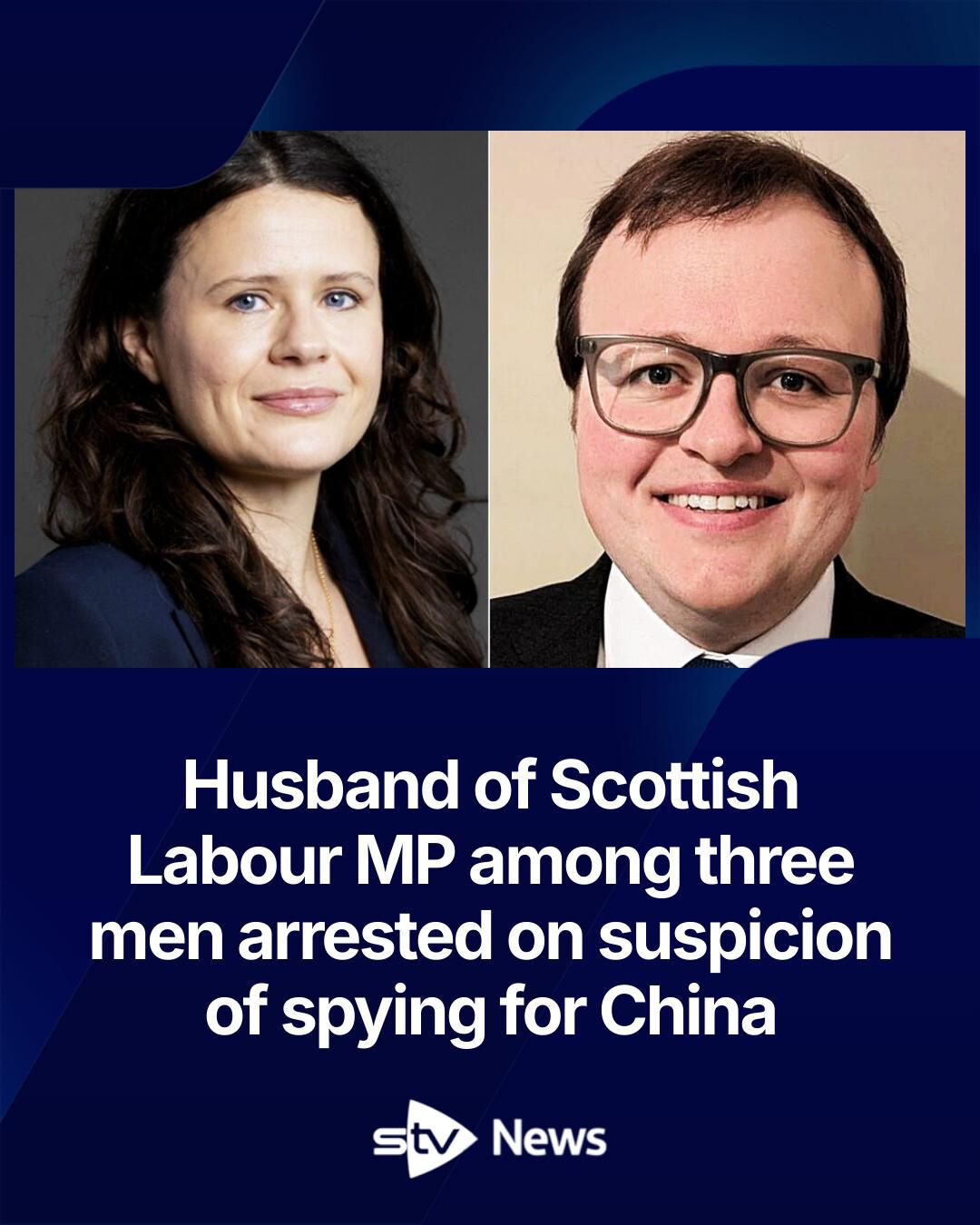
The three amigos were arrested on charges of alleged involvement in commercial espionage, illegally aiding China
The policing operation came as security minister Dan Jarvis told MPs Chinese officials in the UK and Beijing had been given a dressing down, and that the investigation relates to “foreign interference targeting UK democracy
Taylor is a former adviser to Welsh Labour politicians and ran as the party’s candidate to become North Wales police and crime commissioner.
Taylor’s wife, Joani Reid, is the Labour MP for East Kilbride and Strathaven. She is the granddaughter of one of the most famous Communists in Scottish history, Jimmy Reid, who died in 2010. She stated: “I have never been to China. I have never spoken in the Commons about China or China-related matters. I have never asked a question on China-related matters. She was later suspended from the Party Whip and is under investigation.
Reid Strategy Limited, Reid’s consultancy company, received more than £23,000 in interest-free loans from two of Taylor’s businesses.
According to accounts filed for 2022-23, Reid Strategy had received £1,363 from Moblake Limited and £22,030 from Earthcott Ltd, with no set repayment terms. Taylor was the sole director of both companies.
Reid Strategy was wound up last year after Reid was elected to Parliament. She had been paid almost £380,000 by the company since 2024.
Moblake – a construction company – was wound up in 2024 having paid Taylor £605,872, again in the form of an interest-free loan with no repayment terms.
Earthcott – a PR, communications and consultancy firm – has paid Taylor more than £300,000 in dividends, as well as a £30,000 interest-free loan, since being set up in 2021.
David James TAYLOR (Director)
GRAYLING CAPITAL LLP (OC418709)
MOBLAKE ASSOCIATES LTD (11627079)
MOBLAKE LIMITED (11627158)
MOBLAKE ENERGY TRADING LTD (11627038)
MOBLAKE ASSOCIATES LIMITED (11630687)
EARTHCOTT LTD (13598010)
The expansion of Wind Farms in Wales
Concerns have been raised that Bute Energy “courted” Welsh politicians with gifts and donations to gain favour and influence for future wind farm projects.
Run by Oliver James Millican, Bute is an offshoot of the property and investment company Parabola, run by his father, Scotsman Peter John Millican.
Several Labour Senedd members and a Labour MP received tickets to sporting events and cash from Scottish company Bute Energy over the last three years.
Bute is developing a portfolio of onshore wind and solar power energy parks across rural parts of Wales.
It’s been involved in several controversial planning applications for turbines and steel pylons in picturesque areas of the country.
Some Labour politicians have hosted prestigious events on behalf of Bute Energy after receiving gifts from the company.
John Uden, husband of Labour MS Jenny Rathbone accepted a position on Bute Energy’s advisory board in March 2021.
The board was set up to provide advice and guidance to Bute’s executive team and to help to promote onshore wind and solar energy projects in Wales.
Bute Energy is currently planning to build an onshore windfarm made up of 26 turbines 220 metres high near the Glaslyn nature reserve in Powys.
The proposals have sparked fierce backlash from locals and wildlife campaigners.
A statutory consultation with local communities and organisations is expected at the end of this year.
On June 12 this year, Jenny Rathbone, John Griffiths, Jack Sargeant and Ken Skates all followed the Labour whip and and voted against a Plaid Cymru motion for new power lines to be placed underground.
A campaigner against Bute’s plans who didn’t wish to be named said: “Although this information is available in the public domain, these members of the Senedd are unable or unwilling to see conflicts of interest that are so obvious to the public.
“This seems to run counter to Sir Keir Starmer’s recent comments about the importance of probity and public service in government.”
“Jacothenorth”, picks up the story
I first became aware of Bute’s links to Labour when I was told that someone was visiting people close to a planned wind farm. This was (the now abandoned) Moelfre site inland of Colwyn Bay, a real outlier from Bute’s other projects.
This Bute representative was David James Taylor, Labour insider who’d been Spad to a number of high-profile figures; UK government minister Peter Hain and Wales first ministers Rhodri Morgan and Carwyn Jones.
In 2016 Taylor stood to become the North Wales Police and Crime Commissioner. After losing maybe he considered his career options. Or perhaps he was approached, for Labour was already helping wind farm developers.
We saw this when Anna McMorrin lobbied Powys councillors on behalf of Hendy wind farm in April 2017, just a month before she was elected Labour MP for Cardiff North.
Taylor formed three companies in October 2018: Moblake Wind Ventures Ltd (which became Moblake Ltd 11.11.2020); Moblake Energy Trading Ltd (folded 2020); and Moblake Associates Ltd (now being struck-off).
The timing is intriguing, because Taylor’s companies were formed a week before his friend and colleague, Lesley Griffiths, set the precedent of over-ruling a planning inspector to give Hendy windfarm planning consent. She did so using the relatively new Developments of National Significance (DNS) legislation.
DNS made it clear that Wales was free range for wind turbines; free of interference from locals, their council representatives, or even planning inspectors.
Taylor was rewarded by Bute with shares in Windward Enterprises Ltd (now Windward Energy Ltd), both in his own name and that of Moblake Associates Ltd. He was also a (non-designated) member of Grayling Capital LLP.
Money magically appeared in Moblake Ltd, which Taylor then paid to himself in ‘loans’ totalling over £600,000 that did not need to be repaid.
There was an attempt to liquidate this company a couple of years ago, but the liquidator was removed last August. Since when there’s been no further news.
Taylor was useful to Bute because of his closeness to Lesley Griffiths, and his insider knowledge of the Labour party machine.
Which is why it’s suggested that Taylor’s personal payment came in shares and other ways; and that most if not all of the £600,000+ was really a donation from Bute to the Labour party.
Bute Energy
Soon after setting up in Wales, perhaps in an attempt to establish Welsh credentials, Bute set up a Welsh Advisory Board. comprising:
Derek Vaughan, redundant MEP;
Dr Debra Williams, businesswoman and academic;
John ‘Cwmbetws’ Davies, man of many hats and big shot in the Royal Welsh Agricultural Society;
John Uden, partner of Jenny Rathbone MS.?
THE Neath- Port Talbot-Brussels-Copenhagen Connection
Derek Vaughan was leader of Neath Port Talbot (NPT) council and would certainly know Stephen Kinnock, the Labour MP for Aberavon, the Port Talbot seat.
Vaughan was an MEP from 2009 to 2019, preceded by the late Glenys Kinnock. The wife of former Labour leader, Neil Kinnock, and mother to Stephen.
Stephen Kinnock MP is married to Helle Thorning-Schmidt, former Danish PM. She serves as a director of Danish wind turbine producer, Vestas, reputed to be the biggest in the world.
In 2020 Vestas took a 25% stake in Copenhagen Infrastructure Partners. (CIP) which is the conduit for funding Bute projects.
Derek Vaughan’s political background and contacts explain him being chosen as the chairman of Bute’s Welsh Advisory Board. He was a ‘good fit’.
Bute assiduously courted the Royal Welsh Agricultural Society (RWAS). Which makes sense, for the RWAS gives access to many of the landowners on whose property Bute would like to erect turbines and pylons.
This explains Bute’s recruitment of John Davies, who from 2012 was RWAS chairman.
The fourth member of the quartet is John Uden, whose only qualification is being the partner of Senedd Member, Jenny Rathbone, who sits on the Senedd’s Climate Change, Environment and Rural Affairs Committee.
And so to understand why Bute recruited Uden we need to focus on Rathbone.
Rathbone was born in Liverpool and is a member of the Rathbone dynasty, once very influential in that city. The influence continues through Rathbones Wealth & Investment Management.
Jenny Rathbone and other family members are looked after from the investments made. This presumably accounts for the shares in her Register of interests.
A fascinating connection revealed recently lists Copenhagen Offshore Partners A/S in an office office at 10 George Street, Edinburgh. The same building as Rathbone Investment Management (£60bn assets).
The foregoing serves as an example of how Wales is ripped off by the Labour Party pushers and pimps of the ‘renewable energy’ industry.

The strange case of Hendy Wind Farm and the involvement of Bute Energy in Wind Farms in Wales
To cut a long story short . . .
Planning permission was refused by Powys County Council in April 2017, an occurrence worth recounting.
‘Back in 2017, on April 27 to be exact, there was a curious scene played out at a meeting of Powys County Council’s planning committee. At a point in the meeting after the committee had refused planning permission for Hendy and was about to discuss further conditions for Bryn Blaen, a woman who had been sitting with the developers tried to hand a note to one of the committee members.
The woman had to be forcefully ushered away. She was recognised as a lobbyist, working for Invicta Public Affairs, a company based in Newcastle-upon-Tyne . It was Anna McMorrin, who had been recruited by Invicta in October 2016 for no reason other than she was a Labour Party insider, having joined the party when she was a student, and as a result of her subsequent career, she knew exactly who to approach to get things done.
While she was working for Alun Davies, they began an affair, which resulted in both leaving their long-term partners. They now live together.
In the general election of June 2017, Anna McMorrin was elected Labour MP for Cardiff North.’
When McMorrin became an MP her profile obviously increased, and she could hardly be expected to raise the hopes of elderly councillors by slipping them billets-doux during planning committee meetings.
A replacement would have to be found.
Inevitably, the Hendy developers appealed against the council’s decision but the appeal was dismissed by a planning inspector in May, 2018. Then, just five months later, Lesley Griffiths, Energy, Planning and Rural Affairs Secretary for the self-styled ‘Welsh Government’, overruled the planning inspector.
Here’s the letter Lesley Griffiths sent to Keith McKinney of Aaron and Partners LLP, a firm of Chester solicitors acting for the developers Hendy Wind Farm Ltd. Which is directly owned by DS Renewables LLP and ultimately owned by U + I Group Plc.
In which she provides justification for her overruling the planning inspector, being that Hendy Wind Farm is a Development of National Significance (DNS).
Yet Wales already produces roughly twice as much electricity as it consumes, with the extra going to England for no remuneration. So Hendy and all the other developments planned cannot be in the Welsh national interest. Which means they must be in the national interest of England or the UK.
Suggesting that Wales is being lumbered with an unfair and disproportionate number of the UK’s wind farms.
Take Scotland out of the calculation, and it becomes even more obvious that Wales is suffering an excessive number of wind turbines in order to protect English landscapes.
But it’s OK, because this exploitation is presented as little old Wales saving the planet.
It’s unusual for a minister to overrule the Planning Inspectorate. And because the Planning Inspectorate plays by the same DNS rule-book, Griffiths’ decision made a number of people suspect that other factors or influences might have been at play.
From the ‘Welsh Government’ website; . . . it was noticed that Labour insider David James Taylor had slipped on to the stage. Was he the replacement for Anna McMorrin?
Taylor’s company Moblake was named as working for the developers. Though as I’ll explain in a minute, there are two Moblake companies. And Taylor’s connection to those developers goes beyond Moblake.
Taylor is described in this piece as a ‘Former Labour spin doctor’. To give you some more information I shall shamelessly lift a section from last year’s piece:
‘Back in the early part of 2009 a bright lad in the Labour Party launched a website attacking his party’s political opponents. The site’s name cleverly linking the names of Labour icon Aneurin Bevan and national hero Owain Glyndwr. As background music it even employed Tom Jones’s Delilah.
How we laughed!
But it all came unstuck and caused the bruvvers considerable embarrassment. First Minister Rhodri Morgan was particularly irked because Plaid Cymru leader Ieuan Wyn Jones had been portrayed as a clown. In normal circumstances this wouldn’t have mattered, but Labour was in coalition with Plaid Cymru at the time.
The website itself has long disappeared into the ether, but this old blog will give you a flavour. Though the Aneurin Glyndwr Twitter account lives on.
Taylor canvassed for Lesley Griffiths in the 2016 Assembly elections along with some kids shipped in from England.
Around the same time he stood as the Labour candidate for the North Wales PCC post, but lost. Which would have left him looking for a suitably remunerative position.
Taylor had worked as a spad for Peter Hain when the Sage of the Serengeti was Secretary of State for Wales, and has also served as head cook and bottlewasher to former Labour Assembly Member Leighton Andrews.
Taylor joined the party while still in nappies and chaired his local constituency association before leaving kindergarten. In short, he is Labour through and through, and is very well connected in the Welsh branch of the UK Labour Party.
Additionally, he knows Lesley Griffiths personally.
There was something of a changing of the guard in 2017/18. Not only did we see Taylor taking over from McMorrin as the Labour Party/lobbyist presence, but those originally behind the Hendy wind farm were overshadowed by new players.
The linkage between the new and the old can be found in the company originally named Windward Generation Ltd, then Bute Energy Ltd, and finally, RSCO 3750 Ltd.
The first two directors were Oliver James Millican and Lawson Douglas Steele, both using the address of the Edinburgh Solicitors’ Property Centre at 90a George Street. They were joined 6 days later by Steven John Radford of Hendy Wind Farm Ltd.
Radford left in December 2019 and in the same month Stuart Allan George joined. Millican, Steele, and George will dominate this narrative from now on through a galaxy of companies under the Bute Energy umbrella.
I include a table, with working links, thttps://nopylons.wales/docs/Bute%20Energy%20and%20Associated%20Companies(May2023).pdf that shows the various companies involved at the outset of the Hendy scenario and how, since they appeared on the scene, Millican, Steele, and George seem to be planning wind farms – now renamed ‘energy parks’ – all over Wales.
Since April 2020 there have been 20 new companies. Most of them location specific. See how many you can identify.
Earlier I mentioned David Taylor’s two companies called Moblake. These are Moblake Ltd (formerly Moblake Wind Ventures Ltd), and Moblake Associates Ltd. Despite the suggestion in the name of the second, Taylor is the sole director of both.
The latest unaudited financial statement for Moblake Ltd (not to be confused with audited accounts) show a healthy balance of £765,000. The ‘Nature of business (SIC)’ says that this company deals in ‘specialised construction activities’.
From the latest accounts, y/e 30.04.2021. We can guess where the money came from. Moblake is just a conduit. Money goes in one end and Taylor takes it out at the other end.
The Moblake companies were formed a week before Lesley Griffiths wrote to the developers’ solicitor advising that the Hendy Wind Farm was going ahead. What a coincidence!
Which I find curious. Taylor has neither qualifications nor experience in the field of construction. I’ve read somewhere that he took time out from being a political fixer to study cybersecurity in the USA.
To further the pretence of Welsh involvement in or benefit from these projects, Bute recruited or appointed a Welsh Advisory Board headed by former Labour MEP Derek Vaughan.
UPDATE 15.10.2021: Senior Labour MS Jenny Rathbone‘s partner is a member of the Advisory Board.
John Uden.
What expertise does he bring? Or is his real benefit that he’s the partner of a Senedd Member who sits on the Climate Change, Environment, and Infrastructure Committee?
Having touched on Taylor’s background, it’s worth adding that Millican, Steele, and George have never driven a digger for Wimpey either. Their expertise is in real estate and equities.
Which raises a number of possibilities.
Until he discovered an interest in wind turbines, Millican was a director of companies under the Parabola label. Companies such as Parabola Estate Holdings Ltd operating out of the same London address as his more recent wind farm ventures.
A director of this and many other companies is 72-year-old Peter John Millican, who I assume to be the father of 40-year-old Oliver Millican.
Given that Millican junior is in ultimate control of all the wind farm companies, I can’t help wondering whether he has really branched out on his own or whether he’s still working for daddy. Or perhaps fronting for someone else.
To summarise, we have the three musketeers from Caeredin, and their man on the ground in Wales, David Taylor, none of whom has any obvious background in engineering or renewables. Nor are they believed to be card-carrying members of the Greta Thunberg Fan Club.
Which suggests to me that they’re just in it for the money. With that money assured through being able to influence the ‘Welsh Government’.
For it wasn’t Taylor’s sparkling repartee that persuaded the Bute gang to make him a member of Grayling Capital LLP, and a shareholder in Windward Enterprises.
All of which leads me to wonder if this lot will erect a single wind turbine.
Because having apparently secured the rights to so many sites, all they need to do on each is spend a few thousand for a planning application and, once that’s secured, each site becomes worth millions.
And we are talking tens of millions of pounds, possibly nine figures, for a total outlay of less than a million pounds, and without having to do any real work.
Not far from Hendy Wind Farm, nearer to Llangurig, we find Bryn Blaen. A modest affair of 6 turbines with a tip height of 100m and a potential output of just 14.1MW. This too was launched by Steven John Radford, the man behind the Hendy project.
The latest accounts (to 30 September, 2020) show ‘Tangible assets’ of £35,567,344. And this figure has been reduced by the estimated cost of removing the turbines when their days are done, and restoring the site.
I predict it will be a hard job getting those responsible to restore wind farm sites and.we might see companies locating offshore, as we saw with those seeking to avoid cleaning up opencast coal sites.
I conclude this section with a bit more information on Bryn Blaen.
Radford and other directors left the company in February 2020. They were replaced by Stephen Richard Daniels, Edward William Mole, Benjamin Alexander Phillips, and Roger Skeldon.
Together, the three hold 1,647 directorships, and a hell of a lot of the companies are dissolved.
It might be worth keeping an eye on Bryn Blaen.



 caltonjock