
The Trump-Russia Saga
The 2017 Special Counsel inquisition is an ongoing investigation in the United States led by former FBI Director Robert Mueller as special counsel under supervision of the United States Department of Justice.
Mueller is exploring any coordination or Criminal conspiracy between Donald Trump’s 2016 presidential campaign and the Russian government as part of the election interference that Russia is accused of conducting against the U.S. in 2016.
The investigation has expanded to include several lobbying firms, including the Podesta Group and subsumed several existing FBI investigations including those involving former campaign chairman Paul Manafort and former National Security Advisor Michael Flynn.
On October 30, 2017, Manafort and his business partner Rick Gates surrendered to the FBI on charges brought by the special counsel unrelated to the Trump campaign.
On the same day, Mueller’s team revealed that former Trump campaign adviser George Papadopoulos had admitted making false statements to FBI agents about contacts he had with Russian citizens while working for the Trump campaign in 2016.
What is potentially unravelling is a series of events so huge it covers international espionage, off-shore banks, dodgy real estate deals, mobsters, money laundering, poisoned dissidents, computer hacking, and the most shocking election in American history.
This article provides detail supporting contact/ links between:
Paul Manafort, Rick Gares, Michael Flynn, George Papadopoulous, Professor Joseph Mifsud, Stephan Claus Roh,Prasenjit Kumar Singh, Boris Johnson, Alok Sharma, Andrew Colin, Jeffrey T Leeds, Colin Powell, The Hon. Rupert Soames OBE and many other persons of interest
It also provides evidence of working relationships within/between the following organisations:
INTO university partnerships, Leeds Equity Partners, The London Academy of Diplomacy, Stirling University, The London School of Executive Training (LSET), The Vavaldi Club, The Brexit Campaign, The Tory Party, The Link Campus University in Italy, ‘Globalistics’ in Moscow
 Joseph Mifsud
About Joseph Mifsud
Born in Malta in 1960 his career began at the University of Malta where he became head of the education faculty in 1993.
He also claimed to have “served prominently” in the Maltese foreign ministry and to have played a “vital” role in Malta’s joining of EU in 2004……..though it’s doubtful whether he actually did.
People who know him say Mifsud is a “Walter Mitty” character who is always networking and exaggerating his access to decision-makers.
The content of his stories and career is frequently contradictory.
1982: Gained BAed. University of Malta.
1989: Obtained the Laurea in Pedagogia (Dott. Ped.) from the University of Padua.
1993: Obtained his Doctorate of Philosophy (Ph.D.) at the Queen’s University in Belfast.
1997-1999: Head of Department in the Faculty of Education at the University of Malta.
2000 -2005: Head of the European Unit at the University of Malta, later director of the international office and professor of international relations in Malta, Perugia, London and Rome.
Malta representative on the Board of the Bologna Follow up Group, on the Erasmus Mundus Committee and on the Tempus Committee.
Malta representative on the Socrates Committee, on the Socrates Sub-Committee for Higher Education and on the Joint Research Centre (European Commission).
Programme Committee Member for the 6th Framework Programme on Research & Infrastructure and Mobility.
Representative on the Executive Board of the Compostela Group of Universities, Utrecht Network and Santander Group.
2006-2007: Chef de cabinet of the Ministry of Foreign Affairs of Malta and adviser to the centre EMUNI on EuroMed higher education during the Slovenian EU Presidency.
2008-2012: Elected President of Euro-Mediterranean University (EMUNI) in Slovenia. left in haste, in 2012, owing the university a significant amount of money
 Mifsud
17 Apr 2002: Setlist Ltd Formed – Director: Stephan Claus Roh, Fund Manager
Located at 67 Westrow Street, Upper Norwood, London the company was involved in finance. It ceased trading in 2011 and was dissolved in 2012.
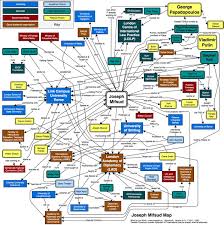
The network
22 Nov 2002: Diplomatic row erupts on London Diplomatic Academy course
London Diplomatic Academy Limited set up on 24 May 1999, had its registered office at 145-157 St John Street, London EC1V 4PY.
Its status at 2009 is listed as “Dissolved”.
It had one director Info-rich International Inc. at the time it closed.
(http://www.inforichgroup.com/about.html) Registered in Panama.
Westminster University’s academy for diplomats is at the centre of its own diplomatic row after international students complained about poor facilities and teaching standards.
Postgraduate students from Westminster’s Diplomatic Academy are demanding better library and study facilities, more student support and smaller classes at more convenient times.
The Times has been given a statement with the names of 47 students on the £7,000 diplomatic studies master’s course.
The students, from Asia, Africa and South America, say that they are getting a “raw deal” and that the course is a mere “cash cow”.
The website for the Diplomatic Academy of London describes Westminster as “a renowned and internationally recognised British university” with an “excellent” Quality Assurance Agency rating for its diplomacy and international relations courses.
The students say that they were seduced by “grandiose claims” made in the prospectus, but claim that with such large numbers of students, few get individual attention and lecture rooms are overcrowded.
They also said that the library lacks essential books and that students compete with other undergraduates in the use of computing facilities.
The students say they had not been made aware that classes would be in the evenings and claim that their part-time teachers “lack commitment”.
One student said: “We have paid £7,000 in fees, and most pay £4,200 a year for accommodation. But it seems the main entry criterion is that if you can pay the tuition fees, they’ll take you.
Many of us feel trapped. We cannot get our fees back and cannot tell our families, who have guaranteed loans.
The government should have a mechanism to ensure that international students get value for money and not a raw deal.”
(https://www.timeshighereducation.com/news/diplomatic-row-erupts-on-westminster-course)

18 Jun 2004: Clampdown on Bogus Colleges
The government has given details of a new register designed to stop people entering Britain by posing as students.
Ministers want to stop people gaining visas by claiming to be students at bogus colleges.
From now on, all colleges and other educational establishments will have to register with the Department for Education and Skills.
Visas will only be granted to students enrolling at registered establishments.
The announcement came as three men arrested during police raids on Wednesday to smash an alleged student visa scam were appearing in court on immigration and money laundering charges.
In April, the Home Secretary David Blunkett announced that a clampdown was on the way. The register will be up and running by the end of the year.
Education Secretary Charles Clarke said: “Student mobility is a welcome feature of 21st-Century globalisation and we benefit from it.
“The recent British Council report showed that students from overseas currently contribute £3 billion a year to the UK economy. “But, we must make sure the system is not abused.
Those coming to study here must be genuine students studying at a genuine and approved college.” Officials say education providers who receive public funding or are accredited will automatically be added to the register.
Private colleges which are not accredited will need to register over the next few months.
Private English language schools are being encouraged to seek accreditation with existing bodies such as the British Council or the Association of British Language Schools.
07 Jul 2004: Shadow Foreign Secretary – Michael Ancram in ‘University’ Dispute With Dr Dr Prasenjit Kumar Singh
A dispute has broken out over the use of the term “university” by some US organisations serving students in the UK.
The Department for Education and Skills says it is reporting the Wyoming-based Preston University and Halifax University for using the title without permission.
Halifax has also upset the Conservative Party by saying its campuses in London and Birmingham were launched in a grand ceremony by the deputy leader, the shadow foreign secretary, Michael Ancram.
A university spokesman insists this is what happened – and says there is nothing wrong with the use of “university” in a trading name.
Ancram did attend a Preston “graduation ceremony” at a hotel in London last year and handed out diplomas and medals to students.
A party spokesman said that, while he was there, it was announced that its associated institution, Halifax University, was opening campuses in London and in Birmingham.
He had welcomed this, out of politeness – but that had been the extent of his involvement.
The disputed claim was repeated on Halifax University’s UK website. “These campuses were launched in a grand ceremony by Rt Hon Michael Ancram, QC, MP The Shadow Secretary of State for Foreign and Commonwealth affairs and the Deputy British opposition leader.”
The Conservative Party spokesman said it asked for this to be toned down.
But in the prospectus for Preston University, Middlesex, are photographs of Mr Ancram at its ceremony in May 2003, along with another Tory MP, Peter Luff, and the 1999 Miss World, Yukta Mookhey.
The Department for Education and Skills (DfES) said in a statement that Preston University and Halifax University were American institutions with operations in the UK. “Because the word ‘university’ is protected under UK law, both of the organisations … have been reported to Companies House for use of the word ‘university’ without permission to do so in the UK.”
Companies House regulates the use of business names. Preston and Halifax are “licensed” by the Wyoming state department of education as degree-awarding private institutions.
Preston’s UK campus is in Hayes, west of London. Its website says: “Preston University Middlesex campus is the trading name of Preston International College London Limited and is a part of Preston University world wide chain.” It has a letter from the UK Home Office, dated 5 March 2002, confirming it as a bona fide private educational establishment and saying that its qualifications are “acceptable”.
But the DfES said it did not comment on the quality or authenticity of private or foreign institutions. “Our only argument with Preston is that they shouldn’t operate in the UK using the name ‘University’ without prior Privy Council Office approval. “The letter gives a Home Office view on whether Preston University and its degrees are ‘acceptable’ – for immigration purposes.”
Preston’s website says awards of degrees are conditional upon satisfactory completion of all coursework, a dissertation or thesis and written professorial approval – and payment of all fees, which are £3,900 a year for a Bachelor of Business Administration, for example. “All official academic documents are embossed with the Preston University seal.
These documents also have a covered letter sealed by the department of education State of Wyoming USA,” it says. It adds: “Upon request, Preston University Middlesex may get the degree legalized by the Foreign and Commonwealth Office in London where it will be signed by an official on behalf of Her Majesty’s Government.”
The Dean of Preston University, Middlesex, Dr Prasenjit Kumar Singh, said that, for a fee, the Foreign Office would attest that the degree certificate, seal and stamp were genuine.
He stressed that it was made very clear, however, that his institution was not offering UK degrees – which would be illegal.
He said there were 300 students at the Middlesex campus, on both undergraduate and PhD courses, and a number of highly qualified faculty members, working both full-time and part-time mostly teaching business and information technology.
Singh said Halifax University was not run by the same company as Preston but was “under the same management”.
Halifax had a £1.2m building in Birmingham and had “inaugurated” its London campus but did not yet have a site for it, although this is not clear from the Halifax website – parts of which appear to be identical to pages on the websites of other, long-established universities.
Singh said his advice had been that it was not an offence to use the “university” title in the UK provided it also said clearly this was a college’s trading name.
He disputed the Conservative Party’s version of Mr Ancram’s involvement in launching the new campuses.
Singh said previously that he welcomed the government’s move to compile a register of genuine colleges in the UK, in response to concerns about bogus students obtaining visas. “There are more than a hundred private colleges with two or three rooms in London, I’m sad to say, but we didn’t practise that way – we have a very reputable organisation, within our own limitations,” he said. “I’m so fed up with some other establishments,” he said. He added: “We are a bona fide establishment and meeting the requirements of the UK immigration rules.” (BBC News)
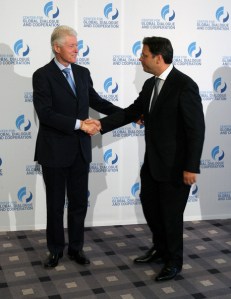 Stephan Roh & Bill Clinton
2004: RoH Attorneys at Law – an international Law firm established
Founder: Dr. Stephan Claus Roh – Areas of practice: Company law, Banking legislation, Financial markets, International trade law
The aim of the company is to provide clients with optimal solutions that fully suit their demands.
Whatever the scenario, situation and constraints the partners have the experience, capacity and know-how to work out and resolve the solution. Offices: Zurich, Zug, Berlin, London and Hong Kong. (www.rohlaw.com).

2005: Leeds Equity Partners, LLC
Founded by Jeffrey T. Leeds and Robert A. Bernstein, Leeds Equity Partners, LLC, the New York based private equity fund focuses exclusively on investing in the knowledge sector has raised and managed more than $1.1 billion of capital.
It announced today that it has signed and closed a £66M investment in INTO University Partnerships Limited (“INTO”) in return for a 25% equity stake.
Founded in 2005 by Andrew Colin and based in Brighton, United Kingdom, INTO is a leader in partnering with premier universities around the world to increase student capacity, drive additional revenue and support greater international student mobility.
Since 2005, INTO has developed 41+ university partnerships in the United Kingdom, United States, Russia and Asia.
All of INTO’s partnerships share the common theme of forming long-term relationships with high quality universities in order to attract talented students from international markets outside the universities’ traditional target geographic areas.
Current partners include the University of Exeter, Newcastle University, Oregon State University, Colorado State University, the University of South Florida and Nankai University.
“We are delighted to invest in INTO,” said Jeffrey T. Leeds, President and Co-Founder of Leeds Equity Partners. INTO’s founder directors, have built a successful, impactful business because they understand the complexities of the higher education marketplace as well as the needs of students. “We look forward to helping them to continue to build an industry-leading, relationship-driven model that helps universities meet their increasingly complex challenges.”
INTO’s founder and Chairman, Andrew Colin said, “We are thrilled to welcome Leeds Equity as our investor and partner and appreciate this strong vote of confidence in both our team and business model.
There is a powerful cultural fit between our two organizations. Throughout our discussions I was particularly impressed with their commitment to our vision.
We look forward to leveraging their expertise, strategic insight and resources as we continue to innovate and grow.”
“In an era of soaring demand and declining public funding, INTO, working with its global network of world-class universities, is a strategic enabler,” said Carter Harned, Managing Director at Leeds Equity Partners. “INTO’s transformational model, supported by private sector investment, has already demonstrated its impact to major public universities on both sides of the Atlantic.
This investment will support those endeavours and, through this model, continue to deliver exceptional experiences and outcomes to students and innovative capacity building solutions to great universities around the world.”
The Board of Advisors of Leeds Equity Partners:
Chairman General Colin L. Powell, former Secretary of State, National Security Advisor, and Chairman of the Joint Chiefs of Staff.
Dr. Barry A. Munitz, former Chancellor of the California State University school system and CEO of the J. Paul Getty Trust.
Thomas F. (“Mack”) McLarty III, President of McLarty Associates and former White House Chief of Staff under President William J. Clinton.
Dr. Rod R. Paige, former Secretary of Education under President George W. Bush.
Richard W. Riley, former Secretary of Education under President William J. Clinton and two-term Governor of South Carolina.
Tim J. Fitzpatrick, the former CEO of Sallie Mae Corporation.
Timothy P. Shriver, Chairman of the Board of the Special Olympics.

03 Jun 2005: Leeds Equity Weld & Co. Acquire Miller Heiman Inc. – General Electric Pension Trust and CIT Co-Invest with Leeds Weld
Jeffrey T Leeds: A Marshall Scholar at the University of Oxford, graduated summa cum laude from Yale University with a B.A. degree in History and gained his J.D., magna cum laude, from Harvard Law school.
He founded Leeds Equity Partners now a leading New York based Private Equity Firm focusing on the Education, Information Services, and Training Industries and is also a director of publicly trading companies: BarBri, Inc., Evanta Ventures, Knowledge Factor, INTO University Partnerships, Real-page, Inc. and is a member of: The Board of Directors of the Association of Private Sector Colleges and Universities. The Council on Foreign Relations. The Board of Visitors at The Colin L. Powell School for Civic and Global Leadership.
For the past 27 years, Miller Heiman has been offering solutions that enable Fortune 1000 customers to achieve a sustainable competitive advantage.
The company has trained more than 500,000 sales professionals, conducted more than 10,000 engagements, and published more than 1 million books and publications. In 2004 alone, the company served more than 500 companies from diverse sectors such as health care, consumer products, information technology, business services and financial services.
The board of advisors, led by founder Jeffrey T Leeds of Leeds Weld & Co comprises:
The Hon. Rudolph W. Giuliani, the former mayor of New York City.
Dr. Rod Paige, former secretary of education under President George W. Bush.
Richard Riley, former secretary of education and two-term governor of South Carolina.
Thomas F. McLarty III, vice chairman of Kissinger McLarty Associates.
Barry Munitz, president of the J. Paul Getty Trust in Santa Monica, Calif. & former Chancellor of the California State University system.
Other Leeds Equity Acquisitions
05 Aug 2008: Leeds Equity Partners, the largest fund focused exclusively on investing in knowledge industry companies, has completed the acquisition of the Ex Libris Group a leading provider of library automation solutions.
14 Oct 2014: Leeds Equity Partners invest in iModules Software. The company produces software for educational institutions and serves more than 800 clients reaching more than 100 million constituents worldwide.
07 Jan 2016: Leeds Equity Partners Invest In Educate 360 Holdings. The Academy was founded in 2009 and teaches over 400 courses annually to more than 8,000 students, and offers in-house training to corporations.
21 Nov 2017: Leeds Equity Partners Complete Investment in Fusion Education Group. The Group operates 43 schools in 8 states and Washington, DC through a personalized education model and today educates more than 4,000 students.
Sept. 28, 2017: Campus Labs, Inc., a subsidiary of EdCentric, Inc. and a portfolio company of Leeds Equity Partners, LLC, is pleased to announce the acquisition of Academic Management Systems, a provider of online course evaluation software used by higher education institutions to assess faculty and course performance.
http://www.weny.com/story/36479245/campus-labs-a-portfolio-company-of-leeds-equity-partners-completes-acquisition-of-courseval
08 Dec 2016: Leeds Equity Partners, LLC, the New York based private equity fund focused exclusively on investing in the Knowledge Industries, announced today that it has invested in Simplify Compliance Holdings.
Simplify Compliance is a newly formed entity exclusively focused on the information and compliance solutions sector.
 Stephan Roh and Olga
25 Aug 2006: International Legal Services (ILS) and the Energy Consulting Group Formed – Registered in Hong Kong
Founder, President & CEO, Dr. Stephan C. Roh: ILS is an international legal, financial and fiduciary service provider.
It also provides targeted services through its Energy Consulting Group to the energy industry worldwide encompassing; Crude Oil, Gas & Gas Products, Refining, Nuclear, Petrochemicals, Power Generation Industries.
Clients worldwide: Production, transformation and consumption organisations, Political institutions, Research centres, Industrial and financial players.
What It Does: ILS Energy regularly analyses issues and trends affecting the energy industry with international company leaders and government policy makers while providing expertise and strategic support.
What It Offers: ILS Energy provides legal, commercial and technical scenarios which offer the foundation for strategy development, investment evaluation and commercial decision making at a global and regional level.
Our People: (President & CEO), Dr. Stephan Claus Roh, Georgy Gomshiashvili, Thierry Pastor, (Moscow Office), Konstantin Danilov, Zhanna Rais, Daniel Schröder, Gert-Rainer Neumann, Alekseeva Kseniya
ILS Energy Ltd. is composed of an international team of multidisciplinary experts from a variety of complementary backgrounds (corporate world, utilities, consultancy, funding agencies, private banking, NGOs, research institutes, industry).
ILS Energy Ltd. is a strictly independent company, working with a network of collaborators: engineering and manufacturing companies of energy, service companies and private local and international operators and research institutes.
This network, developed worldwide over the years, enables us to mobilise the best and most effective expertise for projects in the areas of energy, local development and / or environmental services.
2 Oct 2006: Holyport Finance Ltd Formed – Registered British Virgin Islands Linked country: Liechtenstein
Partners: Stephan Claus Roh, Milan and Bozidaka Komlejovic (Montenegro) Business: Real Estate. Dissolved: 30 Apr 2017:
(https://offshoreleaks.icij.org/nodes/10209927 Panama Papers)
The brothers went on to develop and run an education establishment in Montenegro.
(http://www.adriaticcollege.com/en/information-about-organization)
 Stephan Roh & Clinton
14th July 2007: Threat of court action to owner of colleges
The move by Northumbria University in Newcastle follows concern that Albert College in Leicester, a sister organisation of International College Scotland (ICOS) in Edinburgh, is advertising a law course in its 2006-07 prospectus which officials at the university say it has no right to teach.
A spokeswoman for Northumbria University said: “Albert College does not have any affiliation with Northumbria University and our LLB law distance-learning course is run and administered entirely by Northumbria University and is not affiliated with any external institutions. “This information has been passed to our legal team, who will take whatever action they can. We don’t recognise this college at all.”
London University also said yesterday Albert College was advertising several of its external courses in its prospectus, but had not asked for up-to-date study materials and had never put forward any candidates for examination.
The director of Albert College is Prasenjit Kumar Singh, 34, an Indian national who lives in Hayes, Middlesex, and is also director of Halifax College in London and the ICOS. He is also director of Halifax Travels Ltd, in Hayes.
ICOS, set up in 2004, occupies a well-equipped suite of rooms above a bank on St John’s Road in Corstorphine, Edinburgh.
The college has chosen to register its internet site, http://www.icos.ac, in the Ascension Islands, rather than the UK, in order to take advantage of the country code “ac”.
This suffix is easily confused with that used by all officially recognised colleges and universities in the UK, whose web addresses end with “ac.uk”.
Its crest is also identical to one sported by Halifax University in Wyoming, which is on an official list of unauthorised colleges, maintained by Oregon’s office of degree authorisation “for the protection of the citizens of Oregon”. In a section for overseas students, the Edinburgh college’s website advises that, once their application has been accepted, they will be required to pay a £1500 deposit before being sent a letter of enrolment “which will facilitate you to secure a Visa”.
Typical fees range from between £3900 for a one-year accredited course teaching communication skills, arithmetic, computing awareness and book-keeping, to £5000 for an accredited one-year international diploma in business.
When The Herald visited the college’s premises, principal Gordon Wright joked he had been “expecting” a reporter, having read recent articles about some private colleges in Glasgow with questionable credentials.
Four were unearthed and police and trading standards are investigating a fifth.
Mr Wright insisted ICOS did not offer an LLB course like that offered by Albert College, and acknowledged there was a serious problem with many of the private colleges operating in the UK, but said: “As you can see, we are a very different outfit: this is an established and professional organisation.” He said the college adhered strictly to all regulations regarding student visas. “If a student doesn’t turn up for classes, we will write to them and, if they still don’t appear, we inform the Home Office they are not attending classes, which can invalidate their visa.”
The college’s website featured a section on Scotland’s Fresh Talent Initiative, but Mr Wright said: “It’s a joke that some of these private Glasgow colleges are enticing students with Fresh Talent; the reality is that you are not eligible for the scheme if you have simply completed a course at a private college.” The Fresh Talent section has since been removed.
Mr Wright said yesterday it had been taken off in case it led to any misunderstanding. “We have never told any of our students they would be eligible for Fresh Talent through our courses,” he said.
The college had recently severed links with Halifax University in the US after Home Office advice. It is understood Mr Singh is away on business to India.
 Joseph Mifsud
10 Jan 2008: Mifsud Appointed President of the New Euro-Mediterranean University (Emuni)
Based in Slovenia, Emuni was a product of international cooperation.
It had been formed under the auspices of the intergovernmental Union for the Mediterranean and co-founded by four existing universities: the University of Haifa in Israel, the University of Maribor in Slovenia, the University of Sousse in Tunisia and the University of Urbino in Italy.
Mifsud was a hyperactive net-worker and the idea of international collaboration among universities clearly appealed to him.
Whatever else that achieved, it gave him plenty of opportunities to travel the world making speeches, signing partnership agreements for INTO and generally being treated as an important person.
02 Feb 2008: Andrew Colin and INTO University Partnerships
Andrew Colin is the founder/owner of INTO University Partnerships.
He provides the leadership and vision which has helped INTO to develop partnerships with leading universities across three continents.
He combines a strong entrepreneurial spirit with a passion for education and international student mobility.
Back in 1981, while studying law at the London School of Economics, he launched his first company – providing Apple-sponsored computer courses for schoolchildren.
In 1990, he founded and directed Study Group, which, under his leadership, became a major force in international pre-university education with centres established throughout the United Kingdom, United States, Australia and New Zealand.
In 2005, he founded INTO University Partnerships, with the aim of transforming the international student experience and helping leading internationally-focused universities to expand access and improve student mobility.
Since its establishment, INTO has delivered world-class educational experiences to international students through joint venture partnerships with leading universities across the UK, the US and China. (Crunchbase)
About INTO University Partnerships:
INTO University Partnerships specializes in large-scale transformational partnerships that support and drive leading universities’ international goals.
Within university led partnerships, it expands opportunities for students to pursue higher education by investing in the resources, systems and processes to deliver a first-class student experience.
The company has over 1,400 staff working on INTO projects and generates annual revenues of £160m.
It estimates that more than 50,000 students will have enrolled at INTO centres by the end of the 2012-13 financial year.
The investment value of its infrastructure projects currently exceeds £200m.
Projections see the company more than doubling in size over the next 5 years. INTO’s partnership model provides investment and access to resources beyond the scope and capacity of individual universities.
Students benefit from university-designed and delivered programs, highly supportive learning environments and state-of-the-art learning and living spaces while enjoying full access to their host university’s campus facilities, resources and services.
The company currently operates a student recruitment network with 31 offices in 17 countries.
For investors, INTO provides access to the fast growing international higher education market, in a highly diversified portfolio of leading higher education brands.
 Andrew Colin
01 May 2008: INTO Rejected by the Higher Education Trade Unions
Andrew Colin, unpopular chairman and owner of INTO University Partnerships, the private provider of English-language courses for foreign students, has been accused by the University and College Union of leading the “creeping privatisation” of UK higher education.
INTO’s joint ventures with the universities of East Anglia, Newcastle and Exeter sparked protests and claims that it is undermining terms and conditions.
The Combined Union Committee of Glasgow Caledonian University organised a protest against plans by the university to use INTO to “recruit and teach” international students, claiming “massive support”.
Colin launched a point-by-point defence of his company and set out his plans for ambitious expansion into several other British universities, including Essex, Goldsmiths, Stirling, Queen’s University Belfast and other universities.
He said INTO was countering the “chronic under-investment” in English-language programmes that threatened the UK’s share of the international student market and argued that his vocal critics were motivated by simple ideology.
One key concern of the company’s critics is a lack of financial transparency – illustrated by INTO’s failure to file its accounts on time.
Colin said this was a simple mistake. Accounts for 2006 are now filed, and the next set of accounts, due to be filed in May, will show a £1.7 million loss.
The deficit, which he said was “totally in line with projections”, relates to the cost of maintaining a large international marketing team.
He has personally invested more than £8.5 million in INTO and its subsidiary property companies, £3.7 million of which has gone on marketing. “By our third year, we will be well beyond break-even,” he said.
Colin is also chairman of a property investment and development businesses and critics have also alleged that making money from property is a prime motivation for him.
For each joint venture, INTO has set up a subsidiary to develop a site and lease the building back to the host university.
Colin denies that he expects to make more money out of the estate than student recruitment, maintaining that the union’s opposition is simply ideological. “I’m an old-fashioned Blairite.
I believe that private capital can support public provision, and the UCU is opposed to that ideologically … The union sees Into as a profound threat to higher education structures, but it isn’t meant to be that.”
One UCU member from the University of East Anglia explained that their opposition was to “the idea that the private sector is essentially exploiting public-sector resources”. Colin said: “I’ve asked for a dialogue with the UCU, but they won’t talk to us.
The union causes a lot of anxiety and talk about standards and job losses, they don’t mention the fact that we are creating jobs and that the university is responsible for academic standards.”
On terms and conditions, universities can choose whether to transfer staff to INTO or to keep them in university employment.
Colin admits, however, to paying INTO staff less than those in equivalent positions in the university. “Rates of pay are probably worse,” he said, but he added that INTO compares well with the UK’s private English-language teaching market.
INTO is carrying out a study to provide benchmarks for its employees, he said.
At Newcastle University, a UCU spokesman claimed that INTO had fallen short of its teacher recruitment targets, which meant class sizes had gone up from 12 to 16 and that new employees had no experience of teaching academic English.
An INTO spokesman said class size for English was standard at all its centres, with 16 regarded as the optimal size.
He added that INTO’s appointments criteria were the same as those for university-based staff.
Although Colin may lack union support, he does have a powerful backer in Sir David Eastwood, chief executive of the Higher Education Funding Council for England.
As vice-chancellor of the UEA, he was a driving force behind the first Into joint venture. “I’d been helping David Eastwood with an international project at UEA, and he asked whether I would do a joint venture,” Colin said. “We discussed outsourcing, and David said that international recruitment was strategic to the university and that he didn’t want to lose control.
We created the 50:50 joint venture so that the university retained control.”
Colin set up INTO in 2005 with the aim of increasing the number of UEA’s 40 “pathway” students to 500 in five years. “We got them in two,” he said. Now about 70 per cent of students meet the qualification criteria for access to the host institution. “That gives you 1,000 extra international students on campus over three years,” Colin said.
The venture, he said, had also contributed significantly to a 40 per cent increase in direct international recruitment at UEA since 2005.
Colin wants to see 25 INTO centres set up by 2012, about 11 of them in the UK.
As well as Glasgow Caledonian and Essex, the company is about to sign a deal with the University of Manchester. “English-language programmes have suffered from chronic under investment in the UK, compared with Australia,” he said. “We believe the UK will perform poorly in international recruitment if there is no investment in high-quality provision.” (The Times)
 Andrew Colin
INTO Ropes in USA Universities to Lure Foreigners
In July 2008, INTO announced that it had signed its first agreement in the United States, to operate a foundation year programme for Oregon State University.
OSU said that it had long wanted to expand the number of international students, and turned to INTO for its worldwide infrastructure and expertise in recruitment; some staff, on the other hand, expressed concerns over working conditions.
It intends to begin with 150-200 students. The new venture will “replace the English Language Institute, a self-sustaining program that has helped international students learn English for 43 years”, a move that fills its former director with concern.

08 Apr 2008: INTO – UK University Foundation Courses – Russian Students
Russian high school programs finish a year earlier than those in the UK, which means Russian students looking to do a UK degree course almost always need a need to do a foundation year first.
There are two types of foundation programs. One has its course content validated by a UK university, and successful students are guaranteed a university place.
These offer courses in specialist subjects together with academic English.
They employ highly qualified teachers – the English language staff, for example will have at least a diploma.
The other kind does not have validated courses and does not guarantee a university place.
At best they offer a good top-up in a specialist subject and/or a solid academic English course.
From 2009, Russian students who wish to study at private institutions will need to enrol in a college accredited by the British Accreditation Council (BAC) or a language school covered by Accreditation UK to obtain a visa.
Unfortunately, the BAC inspects only specialist subjects while Accreditation UK inspects only English-language teaching.
Foundation programs should offer both. In addition both schemes accredit courses that don’t guarantee university places as well as those that do.
So how do you choose a good foundation year? By asking some very tough questions.
If you already know which university you want, simply ask the admissions office.
The university may run its own foundation program or outsource it to a state college, private college or a language school while guaranteeing degree places to successful students.
In either case, it is important to check what assistance is available if the student fails. “If a student [barely] fails the foundation year, we help them find a place somewhere else,” says Claire Ballard of Reading University’s International Office.
An increasing number of universities have private-sector partners who run foundation programs on the university campus.
Students can enrol direct with these partners and get help choosing a university subsequently.
Most of these organizations have formal arrangements with other universities for students who don’t quite make the grade.
INTO is involved in joint ventures with a number of British universities, which means the university remains responsible for academic quality. Again other universities will accept their course.
INTO are also building on-campus centres for their courses which include pre-foundation courses for those whose English is weak through to English-language support for students during their degrees.
Students who haven’t decided on the university to which they wish to apply, could consider a foundation year at an accredited college whose programs are formally accepted by a number of university partners.
Proper validated foundation years are very expensive.
Courses without validation are much cheaper. But if no university will accept them, what is the point? (Career Centre RU)

05 Jul 2008: But There is Resistance
Several British universities approached by INTO, including Bristol and Southampton have decided not to link up with INTO.
A survey of staff at Essex University, 90% rejected the proposed partnership for two reasons: that INTO does not recognise unions, and that Colin acknowledges that the hourly rates of pay rates offered are likely to be worse.
The International Centre for English Language Studies (ICELS) at Oxford Brookes University strongly opposed INTO’s approach, the University College Union (UCU) claimed credit for the opposition influencing the university’s decision).
The university stated that it would not go ahead with the project because it required such a large real estate commitment.
In February 2007, the Times Higher Education published an article featuring the UCU’s dispute of guarantees that INTO offered to existing Newcastle staff.
Colin rejected the UCU criticism, saying in 2007, “Give me three years and I will show you it is possible to create secure, well-paid jobs in EAP, and more of them,” and rejected the similarity of his business model to private finance initiatives (PFI).
Colin said of the lecturers’ union in 2008, “I’ve asked for a dialogue with the UCU, but they won’t talk to us.
The union causes a lot of anxiety and talk about standards and job losses, they don’t mention the fact that we are creating jobs and that the university is responsible for academic standards.” In July 2008, INTO threatened UCU with a legal suit for defamation, in response to a union briefing entitled “Into the unknown.” The union removed the document from their website.
 Olga Roh & Model
16 Apr 2009: The R&B Investment Group Formed
Founder & Chairman: Stephan Claus Roh, of Zurich, (residing in Monaco).
A London based management and business consulting firm, located in the heart of Mayfair.
Through its subsidiaries, the firm provides company management and advisory services to an international clientele.
The Group operates a spectrum of products and services.
Funds are registered in Cyprus, within the European Union jurisdiction and are subject to European regulations and laws guaranteeing a high degree of investor protection.
They are comprised of:
R&B Selected Strategies Investment Fund. Management and advisory services provided by:
ABN AMRO, (Zurich) provides portfolio management, custody, and fiduciary transaction services, as well as offers investment advice.
In addition, it provides securities transaction services for private and institutional customers; and involves in currency dealing business.
Marmite Capital Ltd., (Zurich) are independent asset managers.
Core competences are traditional portfolio management and advisory investment.
R&B Financial Services Ltd., (Zurich) Reg: Apr 2009:
Chairman: Stephan Claus Roh, of Zurich, (residing in Monaco).
Provision of asset management services. In addition, the company aims for its own account or on a trust basis, the acquisition, management and sale of participations in other companies of all kinds at home and abroad as well as related investments, corporate finance, borrowings, loans issued to related parties or to third parties.
Services such as consulting and business support for the establishment and maintenance of business and trade relations and the exchange of business and finance for trade and investment in related fields.
The Russia Investment Fund. Financial analysis and advice through:
Renaissance Capital, (Rencap) a premier Russian investment house based in Moscow and Cyprus.
Co-Chief Executive Officer Ruslan Babaev.
Rencap provides the full range of investment banking products and services, including equity and debt sales and trading, corporate advisory, capital raising, research, structured solutions and derivatives.
The Firm’s clients include corporations, governments, institutional investors and individuals.
R&B Financial Services Ltd., Zurich. Reg: Apr 2009:
Chairman: Stephan Claus Roh, of Zurich, (residing in Monaco).
Provision of asset management services. In addition, the company aims for its own account or on a trust basis, the acquisition, management and sale of participations in other companies of all kinds at home and abroad as well as related investments, corporate finance, borrowings, loans issued to related parties or to third parties.
Services such as consulting and business support for the establishment and maintenance of business and trade relations and the exchange of business and finance for trade and investment in related fields. (http://www.rbinvestgroup.com)
18 Aug 2006: Cyprus Registration – P & C Global Gold and Natural Resources Fund Ltd
Investments mainly in Russia, through an actively managed concentrated and hedged portfolio of different asset classes.
The fund investments may include securities, real estate, venture capital.
Directors of ICIS
(a) Name: Mr Stephan Roh Nationality: Swiss Date of Appointment: 18/8/2006
(b) Name: Charalambos Papas Date of Appointment: 18/8/2006 Name: Hellenic Bank Public Co Ltd Address: : P.O. Box 24747, 1394 Nicosia
 Joseph Mifsud
10 Jun 2009: Cultivating Emuni links with Russian Education Institutions
Shortly after becoming head of Emuni, Mifsud began developing its relations with Russia……..though Russia was not itself a member of the Union for the Mediterranean.
He travelled to Moscow and signed a letter of intent with the Peoples’ Friendly University of Russia regarding joint research and study programmes.
He also gave a lecture in St Petersburg at the state university’s School of International Relations.
11 Oct 2010: London Academy of Diplomacy reformed: Founder: Professor Nabil Ayad. Dissolved 2014. Sales pitch:
It is hoped the academy, given the participation of high profile diplomats in its courses, will enhance INTO and UEA London’s reputations around the world, and attract more students to the burgeoning INTO London Centre. ‘It is great to see INTO and UEA London coming together for this groundbreaking new set of masters courses.
I believe it will significantly enhance INTO UEA’s reputation as a provider of leading professional courses in years to come,’ said INTO Director of Business Development, Geoff Webster.
http://globaldiplomaticacademy.com/lad.htm) (http://luil.web4.rkh.co.uk/about/academic-faculty/professor-nabil-ayad/)
11 Mar 2011: Professor Mifsud Develops links with Russian Education Institutions
Professor Mifsud gave a presentation at the Moscow State Institute of International Relations…….an academic institution run by the Russian foreign ministry……….plus others at the Peoples’ Friendly University and the School of International Relations in St Petersburg.
He also had meetings with the Russian Academy of Sciences, the Solzhenitsyn Foundation and the Russkij Mir Foundation.
During the visit he signed a memorandum of understanding with the foreign ministry’s with a view to organising joint degrees and joint conferences.

12 Oct 2011: Obama Backs Down Following Lobbying Blitz – Rules Constraining For Profit Colleges Greatly Diluted
Last year, the Obama administration vowed to stop for-profit colleges from luring students with false promises.
In an opening volley that shook the £25billion industry, officials proposed new restrictions to cut off the huge flow of federal aid to unfit programs.
But after a ferocious response that administration officials called one of the most intense they had seen, the Education Department produced a much weakened final plan that almost certainly will have far less impact as it goes into effect next year.
The story of how the for-profit colleges survived the threat of a major federal crackdown offers a case study in Washington power brokering.
Rattled by the administration’s tough talk, the colleges spent more than £12million on an all-star list of prominent figures, particularly Democrats with close ties to the White House, to plot strategy, mend their battered image and plead their case. Full story here:
 INTO
INTO
24 Jul 2012: Founder of Leeds Equity, Financier Jeffrey Leeds Throws a Birthday Party
After being married at their Manhattan home by Rudy Giuliani in March 2012, financier Jeffrey Leeds and his new wife, Elizabeth (née Marshall), threw a grand wedding celebration in East Hampton on Saturday.
The founder of Leeds Equity and Elizabeth, director of planning at the Common Good, were toasted at the 11-acre Georgica Pond estate of media and education entrepreneur Chris Whittle and Fiat heiress Priscilla Rattazzi.
Among the 300 guests mingling and dining on the lawn under the stars were Giuliani and wife Judith, Sen. Chuck Schumer, Candace Bushnell, Jay McInerney and Anne Hearst, Andre Balazs, Tory Burch and Lyor Cohen, Allen & Co’s Stan Shuman, Randi Weingarten, HBO’s Richard Plepler, Marie Claire editor Joanna Coles, Melanie Lazenby, Allure’s Linda Wells, Bronson Van Wyck, Euan Rellie and Michael Mailer.
Dancing went on inside the sumptuous house until 2 a.m., with some knocking back shots at the well-stocked bar while others puffed cigars on the terrace.
Meanwhile Hon. Rupert Soames OBE, a British businessman and Oxford University pal of Leeds, commandeered a golf cart to help well-heeled guests make it safely back to their cars.
 Stirling INTO
15 Feb 2013: Mifsud’s first known involvement with INTO
Mifsud met the Maltese opposition leader, Joseph Muscat, offering to set up new facilities which would attract 3,000 students to study in the country.
Muscat was quoted saying his party was determined to give more choice to students at tertiary level.
This happened just a couple of weeks before a general election in Malta and some viewed INTO’s intervention as a ploy to help Muscat’s Labour party win……which it did.
The first British university to tie up with INTO was the University of East Anglia (UEA), around 2005–2006.
Together they developed UEA’s satellite campus in central London which housed the London Academy of Diplomacy from 2010 onwards.
In January 2014, however, UEA announced that it would “cease offering degree courses in London from September 2014 and focus on continued delivery of the UK’s number one student experience at its main Norwich campus”.
This did not yet signal the end for the London Academy of Diplomacy, though.
The press release said: “The London centre will offer a range of Master’s degrees in Business and Management, Finance and TESOL (Teachers of English to Speakers of Other Languages) in addition to a wide range of English Language courses.
The London centre will also provide validation services for Master’s degrees offered by the London Academy of Diplomacy.”
Shortly after Stirling University took over responsibility for the diplomatic academy Joseph Mifsud surfaced as its new director. (www.al-bab.com.)
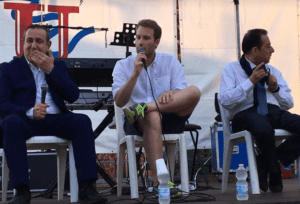 Joseph Mifsud
01 Mar 2013: ‘Ineligible’ expenses academic in trouble Academic also penalised €9,600 for failing to comply with stipulated handover
Expense claims and high mobile phone usage have landed a distinguished Maltese academic in trouble with the Slovenian Government.
Joseph Mifsud, the former director of the University of Malta’s international office, allegedly owes at least €39,000 to Slovenian-based EMUNI University for expenses claimed during his tenure as president.
According to an audit report commissioned by EMUNI, his mobile phone usage last year cost €13,767, when he was only eligible for €3,600.
“The Slovenian Government is awaiting documentation from EMUNI in relation to this matter and shall consider whether to pursue judicial proceedings, be they civil and/or criminal, against Dr Mifsud,” a spokesman for the Slovenian Minister of Higher Education said.
The spokesman added that action was being considered in liaison with OLAF, the EU’s anti-fraud agency.
When contacted, Dr Mifsud, who also served as personal assistant of then Maltese Foreign Affairs Minister Michael Frendo, said the case of alleged wrongdoing was a “private matter” and his lawyers had responded to the “legal communications” by EMUNI.
He argued that the case was only becoming public because of “political reasons” tied to the fact that the Labour Party had acted on an international project he had promoted to both parties.
“I can only give you one comment. I was not employed by the Slovenian Government but by EMUNI, a private university.
I have not had any communication with the Slovenian Government of my wrongdoing,” said Dr Mifsud. “For me this is a non-issue because if there is an issue we will go to litigation and we will find a solution,” he said, adding that his lawyers would take care of the case “civilly”.
According to the Labour Party, Dr Mifsud is simply a “consultant” for INTO…………University Partnerships, a company that operates universities worldwide and plans to invest in Malta.
“Dr Mifsud has no relationship with the Labour Party. He acts as a consultant to INTO – University Partnerships, who have expressed an interest in our proposal to open up to more choice in tertiary education,” said a Labour spokesman.
04 Mar 2013: INTO Cracks the US Equity Market
A US private equity company has paid over $100 million for a 25 per cent stake in INTO University Partnerships, valuing the total UK-based international education company at over $400 million, or quarter of a billion pounds.
The sale to New York-based Leeds Equity Partnerships, which invests exclusively in education and knowledge-based industries, is designed to provide INTO’s university partners with access to external capital, according to INTO chairman Andrew Colin, who said he was ‘delighted to confirm that we have secured this significant new funding to support the continued development of public-private partnerships’.
Unlike other global pathway programmes, INTO operates a joint venture model with partner universities in the UK, US and Asia, benefiting from international student fee income on pre-university programmes and retaining control over academic standards and branding.
Sources at INTO said the money would be used to increase market presence, particularly in the US, where international students make up only 4 per cent of total enrolments compared to some 14 per cent in the UK and 20 per cent in Australia.
Funding will also focus on regional education hubs and Transnational Education programmes, in which English-medium universities deliver programmes in the students’ own country.
The INTO group, which was founded only six years ago, turned over a quarter of a billion dollars (£160 million) in the last financial year and has an infrastructure portfolio with a current investment value of over $300 million.
Jeffrey T Leeds, co-founder and president of the US company, said, ‘We are excited about partnering with such an exceptional team. Andrew Colin, John Sykes and Steve Sale have built a successful, impactful business.’
The Leeds–INTO deal sees Colin teamed up with Colin Powell, former US secretary of state and chair of the Leeds board of advisers.
Other members of the board include two former US secretaries of education: Richard R Riley, who served under Bill Clinton, and Roderick R Paiger, who served under George W Bush. Private equity firms have taken an increasing interest in the international sector.
The Carlyle Group acquired the Aspect chain of language schools from US education company Laureate before selling it on to Kaplan, part of the Washington Post group of companies.
Study Group, founded by Andrew Colin in the early 1990s, was acquired by Providence Equity from Australian private equity firm CHAMP and Petersen Investment in 2010 for $660 million. (elgazette.com)

05 Jun 2013: No To INTO University Partnerships
Originally based in the British seaside resort of Brighton, INTO has been described by the Financial Times as “a niche UK education company” which makes its money by establishing links with universities:
“INTO aims to partner with universities, attract and prepare foreign students for their degree courses, and even build new campus facilities.
“For the universities, the INTO model can reduce the financial risk of investing in new buildings, and make it easier to attract lucrative students from new markets.”
In 2013 a private equity deal valued the business at more than £200 million, but not everyone is enthusiastic about its activities. It is “opposed by many lecturers”.
Why does UCU oppose INTO partnerships? In common with other private companies,INTO put the bottom line first. Their staff are paid less and employed on worse contracts than comparable university staff.
We have fought to protect those staff who are transferred to INTO joint ventures.
But we also oppose these joint ventures because we believe they pose a massive risk to partner universities.
What are the risks of an INTO joint venture?
Risks to university reputation.
Because they are a private company, INTO’s interest lies in recruiting as many international students as possible and getting as many as possible onto university courses.
While the university says it will control and maintain standards, UCU believes that the financial pressure to get students onto undergraduate courses will become too great.
At Exeter, the university council recently expressed concern that students coming via INTO were now of a lower quality than those recruited by the university.
Risks to finances. Some INTO joint ventures are now running profitably, but even these are still dependent on long term loans from their partners.
And other INTO ventures have shown years of losses, investments written off and even failure.
In 2009, Manchester College pulled out of a joint venture with INTO after it posted losses of £1.4 million.
In January this year, UEA pulled out of a joint venture with INTO in London having lost £2.5 million over two years and written off a further £3 million that it invested late last year trying to save the project.
City University’s INTO joint venture has made three successive years of losses and now has not got enough money to pay its debts.
It is entirely dependent on continued lending from the university and INTO to keep afloat.
Queen’s Belfast’s joint venture with INTO also continues to make losses and is also dependent on lending from its partners to keep going.
These INTO joint ventures have cost millions in operating losses and lost investment and are dependent on continued lending from their universities.
That money can only come from the university’s general budgets and the costs of failure will be paid by university staff.
An increasingly risky partner Now that it is partly owned by a private equity fund, INTO will become even more geared toward growth at any cost.

13 Feb 2014: Colin Powell Chairs Business Accused of Systematically Defrauding Veterans
US veterans return home to earn a college degree, many say they have been defrauded out of their education benefits from a company chaired by none other than retired general and former Secretary of State Colin Powell.
Powell is the chairman of the advisory board to Leeds Equity Partners, an investment firm that co-owns for-profit college mega-corporation EDMC, the parent company of the Art Institutes, Argosy University, Brown Mackie College and South University.
Leeds Equity is part of a consortium of investors including Goldman Sachs and Providence Equity Partners that took control of EDMC in 2006.
Over the years, EDMC has developed a history of aggressively targeting returning veterans to use their GI benefits at EDMC-owned schools.
Increasingly, many veterans complain about low quality programs.
They also claim they have been deceived by EDMC’s recruiting tactics, including false promises of high paying jobs after graduation and degrees that cost far more than what students say they were led to believe when enrolling.
Colin Powell Chairs Business Accused of Systematically Defrauding Veterans

02 Apr 2014: University of Stirling and INTO Launch Major Educational Partnership
The centres will provide a range of academic and English language preparation courses for international students, with teaching due to begin in September 2014.
Programmes on offer at the Stirling campus include General English, Academic English, International Foundation, International Diploma and International Graduate Diploma courses, together with pre-sessional and in-sessional support.
Students who successfully complete the preparation courses will be able to progress to undergraduate or postgraduate degree programmes at the University of Stirling.
Agreements already signed with affiliate partner institutions in Scotland, England and Northern Ireland will offer students additional options for progression.
Students at INTO Stirling will have full access to all of the University’s academic and support services as well as the full range of sporting and social facilities.
The London centre will offer a range of Master’s degrees in Business and Management, Finance and TESOL (Teachers of English to Speakers of Other Languages) in addition to a wide range of English Language courses.
The London centre will also provide validation services for Master’s degrees offered by Professor Mifsud’s, London Academy of Diplomacy.
The Professor will also be employed by the University.
Andrew Colin, Chairman of INTO University Partnerships, said: “We are delighted to enter into partnership with such an ambitious and innovative university.
Scottish higher education has helped shape the world for centuries – and with this venture we look forward to helping the University of Stirling extend its global impact in the century ahead.” “Our partnerships in the UK have helped to re-define the international student experience, enrolling almost 40,000 students and delivering truly world-class experiences.
We are proud to work with a University who shares this commitment to extend opportunities for life-changing higher education to students from around the world.”
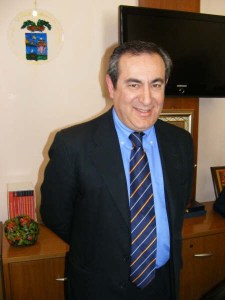 Joseph Mifsud
10 Apr 2014: Professor Mifsud and His Recruiting Visit to Washington DC in 2014
Speaking at the American University, Mifsud expounded on the London Academy for Diplomacy (LAD) and encouraged students to join it.
Early into his address, Mifsud asked the audience whether they had heard of the “Valdai Group” (a Russian discussion forum).
No one had.
Mifsud then praised the increasing role of social media in diplomatic messaging. Mifsud described a recent meeting “with 45 ambassadors in London,” suggesting he was an effective mover on the diplomatic circuit.
Another interesting comment came when Mifsud described discussing the then-upcoming Brexit vote with a Member of Parliament (MP).
The MP, Mifsud said, was from an ethnic minority but strongly opposed to immigration.
A telling part of Mifsud’s speech came at the end, when he asked if there were any students “interested in diplomacy.”
For those that were, Mifsud said, “we have some funds for scholarships as well, so people who are interested… you can send me an email, I’d be very, very happy to do that… Or else if people are passing through London who would like to come spend some time with us…”
During a question-and-answer session, Mifsud also indicated that he offered paid internships.
Indicating that he had brought brochures for students to peruse, the American University representative helpfully held some up in the air.
The offer of “scholarships” to the American University students “interested in diplomacy” is significant.
The American University attracts top students from all across the world, many of who will pursue careers in government.
Mifsud’s offer fitted the commonly used intelligence recruitment pattern, namely: target government career focused students, get them abroad and then recruit them.
It would be of informative if the “scholarships” money trail could be traced identifying any students who took Mifsud up on his offer.
Asked to comment former NSA counter-intelligence officer, John Schindler said: “I’d like to know who was paying for all this travel and activities by a semi-academic.
Any counter-intelligence investigator would have questions here.” Yet, Mifsud’s Washington visit didn’t end at the American University.
He also spoke with The Washington Diplomat magazine about his London Academy.
Describing Mifsud as a former Maltese diplomat and cutting edge foreign policy thinker, the Diplomat noted that The London Academy of Diplomacy “arranges visits to the Houses of Parliament, The Commonwealth Secretariat and business organizations in London.”
The Diplomat further explained that the Academy also takes “students to The Hague, the European Parliament, NATO, EU headquarters and the United Nations.”
It also claimed the Academy to be: “a foundation funded from tuition fees. It does not accept corporate funds nor national grants.”
The Diplomat was sold the package, proudly noting that it had previously awarded the London Academy of Diplomacy (LAD) its “diplomat of the year” award in 2012 “for distinguished contributions to diplomacy in London.”
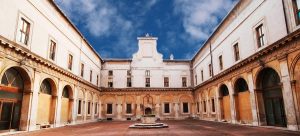 Link Campus University Rome
10 May 2014: proposed joint project with Link Campus University of Rome
Professor MifSud, representing London Academy of Diplomacy attended a “Globalistics conference” at Lomonosov Moscow State University together with Nabil Ayad, Professor Richard Harvey and Dr Francis King from the University of East Anglia.
In a presentation he outlined expansion plans for Link Campus University in Rome, which included a project combining the best aspects of the Anglo-Saxon and classical European systems of higher education.
One of the borrowings from the Anglo-Saxon model would be the campus principle.
The campus would be fitted with facilities for recreation, sports and participation in public affairs as well as with residences.
The classical European system would be the source of standards for education.
Non-Western achievements would also be used ensuring education conformed with modern and future practical standards, and for this reason the authors of the project were keen to cooperate with Lomonosov Moscow State University, the flagship of the Russian higher education system.
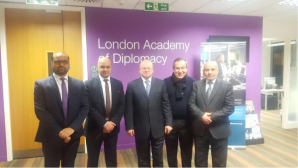 Mifsud & friends
29 May 2014: Ambassador Alexander Yakovenko received Professor Dr Joseph Mifsud, Director London Academy of Diplomacy, University of East Anglia.
The Professor presented his views on the results of the Global University Summit which he attended (Moscow, 24-25 April).
They also discussed different issues of the Russian-British cooperation in the sphere of international relations, diplomacy, science and education.
 Joseph Mifsud
10 Jul 2014: Russian Embassy Official Visits the London Academy of Diplomacy
Embassy official, Ernest Chernukhin and a delegation from MSU visited Mifsud at the London Academy of Diplomacy.
The embassy’s website said they discussed “different issues of Russian-British cooperation in the sphere of high education” including the collaboration between MSU and the London Academy of Diplomacy.
 Jeffrey Leeds & Wife
26 Jul 2014: Jeffrey Leeds emailed Colin Powell
“Spent the day with Rudy [Giuliani] and [former Maine Gov.] Jock McKernan. Fun golf and interesting politics.
I got Rudy to admit Obama is a decent man. They don’t think Hillary is stoppable. Everyone is beatable,”
 Powell & Jack Straw
26 Jul 2014: Powell Attacks the Clintons
Colin Powell wrote in a jaw-dropping e-mail that he will not vote for his pal Hillary Clinton because she’s: “A 70-year person with a long track record, unbridled ambition, greedy defender of the status quo, with a husband still d…..king bimbos at home, the former secretary of state wrote to Democratic donor and financial wizard, Jeffrey Leeds.
Powell sent the message just days after it was revealed that Bill Clinton allegedly had a blond mistress, neighbour Julie Tauber McMahon who visited his Chappaqua home so often, she was dubbed “the Energizer” by the Secret Service.
Powell also wrote several other e-mails critical of his fellow former secretary of state.
In one dated 18 Aug 2015, he blamed her for his losing a lucrative speaking engagement. “Everything Hillary touches she kind of screws up with hubris.
I told you about the gig I lost at a University because she so overcharged them they came under heat and couldn’t pay any fees for awhile.
I should send her a bill,” Powell griped. (DC Leaks)
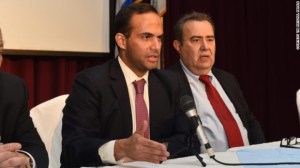 Mifsud & Papadopoulos
19 Oct 2014: Mifsud back to Moscow.
On behalf of the London Academy of Diplomacy he signed an agreement with the Faculty of Global Processes at MSU which provided for “joint research, exchanges of trainees and teachers, the possibility of creating joint Masters programmes, holding conferences and publishing joint training materials”.
22 Oct 2014: Mifsud attends Valdai Discussion Group Conference in Moscow
Mifsud’s Russian connections were moving up a notch and becoming more political: he was starting to be treated in Moscow as an expert on international relations.
The conference was especially significant because of a speech by Putin.
The political backdrop to this was the growing crisis over Ukraine and the conflict in Syria, and some regarded it as Putin’s most important speech for seven years.
A news report by Reuters, on the other hand, described it as “a 40-minute diatribe” and said: “The speech was one of the most hostile Putin has delivered against the West and it appeared partly intended to show Russian voters he will stand up to the rest of the world and defend their interests.”
18 Dec 2014: Maltese Official Raises Profile Of U.K. Diplomacy Academy
As a former top official at Malta’s Ministry of Foreign Affairs, Joseph Mifsud was a key member of the team that negotiated his tiny nation’s entry into the European Union.
With only 420,000 inhabitants, Malta…..a Mediterranean island twice the size of Washington, D.C………is the smallest of the EU’s 28 states.
Ten years later, the multilingual Maltese diplomat has taken on a new challenge: to raise the profile of the London Academy of Diplomacy (LAD), a venerable institution located on Middlesex Street in the heart of London home to some 150 students hailing from 50 nations.

09 Jan 2015: London Academy of Diplomacy Ltd, Formed:
Managing Director, Andrew Jeremy Colin.
Closed 2015. Located at: One Gloucester Place, Brighton, United Kingdom, BN1 4AA . Controlling Company INTO, University Partnerships Limited

15 Jan 2015: OAS and London Academy of Diplomacy Sign Cooperation Agreement
The Secretary General of the Organization of American States (OAS), José Miguel Insulza, and the Director of the London Academy of Diplomacy, Joseph Mifsud, today signed a cooperation agreement between their respective institutions to strengthen education and human development.
The agreement stipulates that the OAS and the London Academy of Diplomacy will share resources and join efforts to advance education and diplomatic relations through staff exchanges and training activities in the areas of development, education and diplomacy.
In November, Director Mifsud made a presentation during a special meeting of the Permanent Council at OAS headquarters in Washington, DC, on the relationship between diplomacy and development in a complex global environment.
Today´s signing ceremony took place at the Academy in London. (http://www.oas.org/en/media_center/photonews.asp?scodigo=fne-16746)
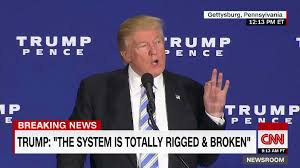
14 Mar 2015: Colin Powell cites concern for Hillary Clinton’s health
In an email to his business partner, financier, Jeffrey Leeds he wrote: “crummy press conference she did at the UN, flying to San Francisco to go to a paid gig for EBay and then to Marc’s house to get ready for a money dinner for the Clinton Foundation.
On tv she doesn’t look good. She is working herself to death.” Powell went on to write that he “ducked her” later that evening when the two were “in Marc’s second house” for fear of being seen together and triggering “another email story.”
Leeds responded that Rhode Island Democratic Sen. Sheldon Whitehouse was a “huge Clinton supporter, but when he and Hillary gave “speeches at the same event a few months back and she could barely climb the podium steps.”
19 Nov 2015: Mifsud wrote an article about international diplomacy for the Valdai Discussion Group
Commenting on Russian “military participation” in Syria he wrote, “This had been organised by Russia ensuring that diplomacy took its course, whilst the US administration had been on the defensive, still heavily labouring under the internal repercussions of the nuclear deal with Iran, the ‘fiasco’ in Libya, the heating up of the presidential race, the dismantling of the ‘iron partnerships’ with Saudi Arabia and Israel, and the overt economic power struggle with China.
On the other hand, the Russian leader had walked the talk, first establishing a permanent naval base in Tartus ensuring the security of its subsequent direct involvement and success in the war in Syria.”
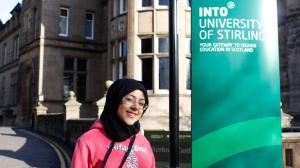
16 Feb 2016: The London Centre For International Law And Diplomacy Ltd – Founded by Dr Claus Roh
Previously listed under the name of Global Global the company was re badged on 16 Feb 2016 and located in London, replacing the London Academy of Diplomacy, after it closed .
Business purpose: “other education not elsewhere classified”.
Mifsud listed as Convenor and Director for “International Strategic Development.”
George Papadopoulos was listed as Director for “International Environment, Energy and Natural Resources Law”.
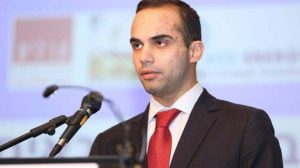 George Papadopoulos
2 Mar 2016: Papadopoulos and His Bid For Political Stardom
George Demetrios Papadopoulos was born in August 1987 in Chicago, Cook County, Illinois.
He graduated from DePaul University in 2009 with a degree in political science and government.
Richard Farkas, a Russian politics professor at DePaul University, on discovering that his former student was one of Trump’s few foreign policy advisers said: “he studied for a bachelor’s degree in political science.
All the classes I taught at DePaul during his tenure would’ve centred on Russia.
His expertise was virtually non-existent. It was thin and embellished. Lots of young people, when they aspire to get close to a campaign, exaggerate their experience.
George did that in spades and it was the talk of the department here.
I’ve been really generally embarrassed by the fact that I don’t have a lot to share, my classes were 20 to 25 and he was invisible even in a class that size.”
As an undergraduate, he was involved in “The Hellenic Professional Society of Illinois” taking an academic interest in Greek, Turkish, and Cypriot politics.
After graduating, Papadopoulos enrolled at, “University College, London School of Public Policy” where in 2010 he gained a “Masters of Science” degree in security studies.
Returning to the US he was employed by the Hudson (right wing think tank) Institute, first as an unpaid intern then as a research assistant to a senior fellow at the institute from 2011-2014.
He left the Hudson Institute in 2014 to work for a small, oil and gas firm called Energy Stream in London, which lists only two employees.
Then his fortunes changed for the better.
In November 2015 there was a terrorist attack on Paris, France and in the days following every Republican presidential candidate began frantically scrambling to hire experts to bulk up their campaign’s foreign policy credentials.
But all the of the Republican foreign policy establishment was working for the front runners, Jeb Bush and Marco Rubio.
Barry Bennett, Campaign Manager, for Republican candidate, Ben Carson recalled: “It was utter and total desperation to find people.”
So when a resume from an unknown young man named George Papadopoulos arrived, unsolicited, at the Carson campaign headquarters, Bennett gave it more attention than it may have deserved.
Bennett had never heard of Papadopoulos, who was in his late twenties at the time, nor did he recognize much on the young man’s resume.
But he did notice that between 2011 and 2014, Papadopoulos had worked at the Hudson Institute, a conservative, Washington, D.C. based think tank, where Bennett’s friend, Kenneth Weinstein, was president.
So he called Weinstein to check him out. “I said, ‘Who’s this guy? Did you like him? Did you fire him?’” Bennett recalled, with a laugh. “Ken didn’t know him well, but said, basically, ‘He’s junior, he’s smart.’ So we hired him and that was it.”
Papadopoulos brief period as an advisor to the Carson campaign seems to have passed largely without note.
Armstrong Williams, who served in various roles in Carson’s campaign, said: “After the Paris terrorist attack, Barry Bennett and his deputy Lisa Coen thought we had to have substance so they had this hiring spree, employing all these people to show we had foreign policy experts, Papadopoulos was one of those people.”
He was paid $8,500 for his work in December 2015 and January 2016, and then received only a partial salary, $2,125, in February, when he left the campaign.
Bennett resigned from the campaign in December 2015 and within two months, most of those new people were let go due to restructuring and cuts.
No one in the Carson campaign remembers much about Papadopoulos, perhaps in part because he worked remotely from Chicago, Bennett said. “If there was any work output, I never saw it.
It never ended up on my desk.” Shermichael Singleton, Carson’s communications director said: “I don’t remember the guy. I recognised his name in emails, but I can’t recall ever meeting him.
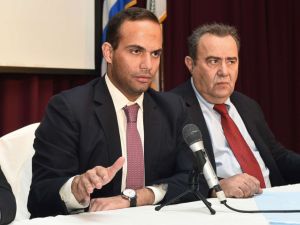 George Papadopoulos & Mifsud
05 Mar 2016: George Papadopoulos Gets Trump in His Sights
Up to “Super Tuesday,” 1 March 2016, the Trump campaign had been a largely family affair with little external input or support from the Republican Party and he was lagging in the polls.
But when the swingometer shifted in Trump’s favour there was a realization that “Team Trump” was devoid of competent foreign policy advisors and this generated an urgent scramble to compile a legitimate list of experienced people as the media and those in political circles kept pressuring the campaign to release names.
According to Trump campaign spokesman, Sam Clovis, then a policy advisor, urgently put together a “team” (including Papadopoulos) so that Trump could release names in an attempt to “at least shut up” the critics.
During the campaign, Clovis defended the roster he had compiled for Trump, saying that “these are people who work for a living” who have “real world” experience, and that “if you’re looking for show ponies, you’re coming to the wrong stable.”
But to this day, some senior staff in the Trump White House blame Clovis for recruiting staff without due diligence, saddling Trump with the incompetent Papadopoulos.
 Mifsud
08 Mar 2016: Professor Mifsud – Always Ready to Help!
Mifsud’s interest was sparked after being told by Papadopolous, who was then living in London, that he had been appointed to the Trump campaign team as an advisor.
The FBI claimed that they first met in Italy on 14 March 2016 and again in London 24 March 2017.
(1) At the second meeting Mifsud was accompanied by a woman who, according to Papadopolous, was introduced to him as a relative of Vladimir Putin.
(2) After the meeting Papadopolous emailed Trump campaign manager, Corey Lewandowski advising that he had discussed with Olga Vinogradova the possibility of arranging: “a meeting between Trump’s campaign team and the Russian leadership to discuss US – Russia ties under President Trump.”
The manager told him he had done “great work” and to keep him informed.
Around a week later he attended a campaign team meeting in Washington at which he touted his connections and proposed a meeting between Trump and Russian President Putin.
Jeff Sessions (now Attorney General) dismissed the proposal “out of hand” declaring it to be a non-starter.
(3) But, by 11 April, 2016, ignoring the earlier directive, Mifsud and the Russian woman were on an email chain with Papadopolous in which the campaign adviser sought a meeting for himself in Russia to discuss foreign policy.
Mifsud replied: “This is already been agreed. I am flying to Moscow on the 18th for a Valdai meeting, plus other meetings at the Duma.”
Mifsud attended a Valdai summit in Sochi, Russia, on 19 April, 2016.
Papadopolous stated in the stipulation that he next had breakfast with the professor at a London hotel on 26 April, 2016.
Mifsud, recently returned from Moscow, told Papadopolous that he had learned the “Russians had obtained ‘dirt’ on then-candidate Clinton” in the form of “emails of Clinton… they have thousands of emails.”
It is not clear, at the meeting of 26 April 2016, which tranche of Clinton emails Mifsud was referring to the Russians possessing.
That same month, a hacker group known as “Fancy Bear” had breached the network defences of the “Democratic National Committee”.
But the hack was not made public until 22 July 2016.
But, WikiLeaks, who denied any connection with the Russian government, had, by 16 March, 2016 already published a searchable archive of Clinton emails from her private server obtained, the group explained, through the “Freedom of Information Act”.
(4) But, according to the FBI, Papadopolous believed the information would still be valuable to the Trump campaign and according to the stipulation he circulated within the team the prospect of a meeting with the Russian government.
Olga Vinogradova later emailed Papadopoulos the message: “we are all very excited by the possibility of a good relationship with Mr. Trump. The Russian federation would love to welcome him but only once his candidature is officially announced.”
Papadopoulos emailed Mifsud around 30 April 2016: “it’s history making if it happens,” thanking him for his: “critical help.”
A few weeks after, a contact, alleged to be Ivan Timofeev, Programme Director of the Valdai Club Foundation Council, spoke with Papadopoulos over Skype about laying the groundwork for a meeting between the Trump campaign team and officials in Moscow.
Papadopoulos was persistent throughout the summer of 2016, repeatedly emailing members of Team Trump seeking permission to establish contact with individuals whom he believed had high-level Russian government connections—and could supply the campaign with damaging information about Hillary Clinton.
In August 2016, at a meeting of Team Trump in Washington, DC, he told the group that he had connections that could help arrange a meeting between then-presidential candidate Trump and President Putin.
Paul Manafort and Sam Clovis who were aware of Papadopoulos’ efforts to set up a high-level meeting between the Trump campaign and the Russians praised his work ethic.
But a wary Manfort advised it would be inappropriate for Trump to attend any meetings.
Manafort subsequently forwarded an email to his associate Rick Gates firmly rejecting the idea of Trump making a trip to Russia.
It said: “We need someone to communicate forcefully that DT will not be doing any trips or meetings with Putin.
It should be someone low level in the campaign so as not to send the wrong signal.”
(5) Months passed but the “history making” meeting was never convened. Papadopoulos had been catfished and conned.
Notes:
1. The meeting in Italy was not the first time they had met (as claimed by the FBI).
Mifsud served as convenor and Director for “International Strategic Development” in the London Centre for International Law Practice (LCILP) in 2016.
The LCILP’s director for “International Environment, Energy and Natural Resources Law” from February to April 2016 was George Papadopoulos.
2. Reference by Papadopolous to President Putin’s niece was spurious since he does not have one.
Information that could have been confirmed in less than a minute through a “Google” enquiry.
The woman, later identified as, Olga Vinogradova, was described by Mifsud as “just a student, but a very good-looking one, and Papadopoulos’s interest in her was very different from an academic one.”
Later revelations revealed “Olga Vinogradova,” to be a 32 year old graduate from St. Petersburg Polytechnic University.
Now a wine company manager, (married name) Olga Polonskaya, lives in St Petersburg and is one of a dozen Russian women listed as friends on Facebook with Mifsud.
Polonskaya’s brother, Sergei Vinogradov, told the press that she had never worked for the Russian government, and had been introduced to Papadopoulos having previously met with Mifsud to discuss a promised internship.
Her English was poor and at the meeting on 24 March 2016, she was not able to fully follow the conversation between Papadopoulos and Mifsud.
He added: “it’s totally ridiculous, She’s not interested in politics. She can barely tell the difference between Lenin and Stalin.”
But the affidavit filed together with Papadopoulos’ guilty plea indicates Polonskaya continued with her catfishing, allegedly emailing Papadopolous: “I have already alerted my personal links to our conversation and your request for a foreign policy trip to Russia.
Federal prosecutors alleged that Papadopoulos hoped that Putin’s “niece” would introduce him to the Russian ambassador in London.
Papadopoulos was likewise interested in Mifsud: “because, among other reasons, the professor claimed to have substantial connections with Russian government officials, which he thought would increase his importance as a policy advisor to the campaign.”
3. Press leak identified Trump’s National campaign co-chairman Sam Clovis.
4. A carefully phrased message giving no indication she knew President Putin
5. Rubbish. The alleged offer, from the Russian’s on 26 April, 2016, to “dish the dirt” on Clinton through the provision of emails was useless since Wikipedia had already published the information 16 March 2016.
6. Former campaign chairman Paul Manafort, and his long-time assistant, Rick Gates, have subsequently been indicted by the FBI on 12 counts, including conspiracy against the United States, making false statements to federal officials and committing financial crimes, including laundering more than $18 million in cash.
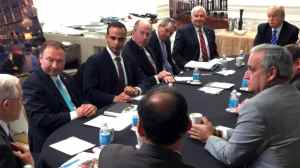 Trump’s Advisory Group
19 Apr 2016: Valdai Club Discussion – Global Energy Development
The world’s leading oil exporters, met in Doha, Qatar on 17 Apr 2016 but failed to reach an agreement on freezing oil production.
In a follow up the Club hosted a discussion about the implications of the Doha summit on world stability and the oil market.
It was moderated by Ivan Timofeev, Programme director of the Foundation for Development and Support of the Valdai Discussion Club.
Dr Stephan Claus Roh, President and CEO of ILS Energy offered that a key issue was the lack of demand for oil, which had led to an amount of destabilization in the world geopolitically and the Doha summit had been unable to reach any sort of consensus because of key differences among the players.
And, said Roh “The trend is that everyone is fighting for himself alone, so at the moment we have no agreement on the operating level, or even on the wider level.”
Joseph Mifsud, Director of Stirling University’s, London Academy of Diplomacy, said that it is important to look at the failure of the Doha meeting in terms of the disagreements between Iranian and Saudi Arabian interests, in particular, Syria and Yemen.
Noting that it would be possible for Russia to work with both Iran and Saudi Arabia, bridging their differences and working toward a comprehensive oil output agreement he said “I think it is possible, but the voice is a bit timid and muted, but there is a role for the Russian Federation.”
He added that few European pipeline projects in Europe had been activated, and a number of factors, such as the Brexit referendum, the migration deal with Turkey and disagreements among major EU subgroups had to be taken considered.
Addressing the Chinese Silk Road project, he said that the issue of instability in Afghanistan could make it difficult for pipelines such as TAPI to succeed.
He also observed that there is a great diversity of views on energy across the European Union, with result that the market was inward looking and this created opportunities for Russia in the Middle East.
But, some economists were of the view that instead of seeking new oil consumers, Russia would be better off diversifying its economy and conducting sweeping structural reform.
Igor Tomberg, senior research fellow of the Moscow-based Institute of World Economy and International Relations, (IWEIR) questioned Russia’s role in pacifying Riyadh and Tehran, because Moscow always tries to be “neutral” in such disputes and cannot influence the agenda of the Organization of the Petroleum Exporting Countries (OPEC).
According to him, Moscow should diversify its oil partners and turn to the East.
He also noted that Russia had typically remained neutral in negotiations with OPEC, and that the United States’ influence could also impact the attempt at negotiations adding that he did not view Iran as a significant hurdle in the negotiations because any production increases would be relatively small, compared to total world oil output.
Vladimir Korovkin, Head of Digital Research at Skolkovo’s Moscow School of Management opinioned that such an approach required strategic, long-term thinking and the Kremlin needed to broaden its planning horizon and give up any hopes of receiving substantial revenues from oil in the near future.
(http://www.russia-direct.org/analysis/what-failure-doha-oil-summit-means-russia)
 The Roh Empire
19 Apr 2016: The Valdai panel discussion
Mifsud was most likely in Russia when he sent his 18 April email to Papadopoulos suggesting they meet, on his return, since the following morning he took part in a panel discussion on global energy.
The panel consisted of Professor Mifsud, Professor Igor Tomberg of the Russian Academy of Sciences, and Stephan Roh, a Swiss lawyer who officially resides in Monaco.
Chairing the discussion was Ivan Timofeev, Programme Director of Valdai and the Russian International Affairs Council (RIAC)……… a think tank established in 2010 by presidential decree.
At the start of the discussion, Monaco resident, Stephan Claus Roh, introduced himself as, President and Chief Executive of ILS Energy, a consultancy firm based in Hong Kong.
RoH Attorneys at Law, names Mifsud as its founder and he is also a member of the administrative council of the Link Campus University in Italy through another of his company’s, “Drake Global”
More mysteriously, in February 2016 Roh registered another company called London Centre for International Law and Diplomacy.…….. a name sounding like a blend of the “London Centre of International Law Practice” (where Mifsud and Papadopoulos both worked) and the now-defunct “London Academy of Diplomacy” (where Mifsud was director).
(https://medium.com/@Brian_Whit/to-russia-with-love-the-travels-of-joseph-mifsud-f9082ca0ba3b)
A video, apparently recorded the same day, shows Timofeev interviewing Professor Misfud about energy and recent press reports in the US confirm him to be the “Russian Connection”, who corresponded with Papadopoulos.
 George Papadopoulos
21 Apr 2016: Papadopoulos received an email from Timofeev suggesting a meeting in London or Moscow with a view to “moving forward” a proposed Trump-Putin meeting.
 Trump Advisory Group
21 Apr 2016: Democratic Donor Tells Colin Powell the Clintons Detest Obama
Colin Powell’s business partner, financier, Jeffrey Leeds told him that Hillary Clinton’s legal troubles would not unduly concern President Barack Obama, a man she apparently hates.
In one email conversation on 6 Mar, 2016 concerning Hillary’s primary loss in Maine, Leeds told Powell that: “no one likes her and the criminal thing ain’t over.
I don’t think the President would weep if she found herself in real legal trouble. She’ll pummel his legacy if she gets a chance and he knows it.”
A year before, Powell asked Leeds if he had read Peggy Noonan’s column about Clinton and her refusal to use a State Department email and a private email server instead.
Leeds said he did and he agreed with “80 percent” of Noonan’s piece. “Now it turns out that other State people were on the Clinton email so none of their emails were captured by the government.” Adding “I think Hillary can’t believe she might not make it. It’s the one prize she wants. She has everything and she hates that the president “that man” as the Clintons call him, kicked her ass in 2008.”
 Mifsud & Friends
26 Apr 2016: on his return from Moscow
Professor Mifsud met Papadopoulos for breakfast at a London hotel and informed him…….. ….that the Russians had “dirt” on Hillary Clinton in the form of “thousands of emails”.

02 May 2016: Saudi Ambassador to Italy and Malta Received Rector of London Center For International Law And Diplomacy Ltd
Ambassador of the Custodian of the Two Holy Mosques to Italy and Malta, Raed bin Khalid Qrimli received in his office at the embassy on Monday 2 May 2016, Prof. Joseph Misfud where they exchanged views on issues of mutual interest and latest development on the international arena.
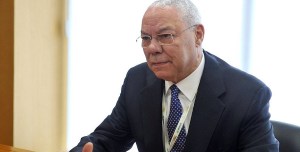 Powell
19 Jul 2016: In an email to his son Michael, Powell wrote:
that the current DIA director had told him Flynn had been fired because he was: “abusive with staff, didn’t listen, worked against policy, bad management, etc.” In closing he continued, “He has been and continues to be a right-wing nutty.
Powell’s son remarked that it was “disgraceful” to watch Flynn leading chants at the Republican convention for Democratic presidential nominee Hillary Clinton to be “locked up.” Powell Snr. replied, “Pattern of behavior which is why he was fired. Real question is how he got that far in the Army.”
Flynn didn’t quite match Powell insult-for-insult, but he did hit the former Secretary of State for his role in the lead-up to the Iraq war, stating, “Colin Powell, he’s an amazing guy, amazing service, but he’s actually, you know, as a footnote in history, he’s going to be always struggling for his credibility because of the statement that he made to the United Nations that brought us into the war in Iraq.”
 Powell & Hillary
10 Aug 2016: The latest fallout from Colin Powell’s hacked emails pits General Against General
Much of the attention regarding leaked messages focused on Powell’s swipes at Hillary Clinton and Donald Trump, but he also repeatedly disparaged retired Lt. Gen. Michael Flynn, Trump’s military adviser.
The former Secretary of State and Chairman of the Joint Chiefs of Staff, called Flynn “an unchained jerk and “right-wing nutty.” Flynn shot back with some not-so-friendly fire of his own. “I’ve actually been called worse things by my little sister,” Flynn said on Fox News.
A prominent adviser to and surrogate for Trump, Flynn was rumoured to have been in consideration as a running mate and also received a high-profile speaking slot at the Republican National Convention in July.
Previously, he served as Director of the Defence Intelligence Agency (DIA) under President Obama……….. retiring a year earlier than anticipated in August 2014 after becoming an outspoken critic of the president’s counter-terrorism policies.
Powell admitted in a 10 Aug 2016 email to a Washington Post reporter that he never “knew or served with Flynn,” but he still sounded off on the Trump adviser saying, “talking to people in the know, his real problem was poor leadership and management, senior staff were in incipient revolt.” He continued, “He was never over the top in his comments, but he is unchained.”

21 Aug 2016: Colin Powell emailed former Clinton administration aide Marybel Batjer
Powell wrote “Most folks up here detest Trump and won’t vote for him, but dislike her intensely at the same time. Ah, well the country will decide.”
He continued “Trump just looks stupid trying to appeal to blacks and Latinos.” In a second e-mail, he blasted the birther movement, which Trump stoked by questioning where President Obama was born, writing “The whole birther movement was racist,”
Trump lashed back in a tweet, writing, “I was never a fan of Colin Powell after his weak understanding of weapons of mass destruction in Iraq = disaster. We can do much better!”
 Powell,Jeffrey Leeds & wife
23 Aug 2016: Colin Powell Blasts Hillary Clinton
Colin Powell blasted the controversy over the private e-mail server in the basement of Clinton’s home, in an e-mail to Harlan Ullman, a former naval officer who is now a government security consultant. “Dumb.
She should have done a ‘Full Monty’ [disclose everything] at the beginning. She was using e-mail when she took over.
They put the personal system in the basement a few months later,” adding that she then tried to give herself cover by saying he, too, had used private e-mail while in office. “She didn’t need any advice or OK from me; she was already doing it.
I gave her written guidance on why and how I had been doing it,” he wrote. “I warned her staff three times over the past two years not to try to connect it to me.
I am not sure Hillary even knew or understood what was going on in the basement.” Powell didn’t spare Donald Trump either, calling him “a national disgrace” and an “international pariah.”

21 Sep 2016: Countering the Obama “war” on for profit schools and expanding the business
Leaked Emails reveal that Jeffrey Leeds asked Powell, beyond publicly lending his reputation to Leeds’ firm and investments, to help him make connections for his education properties.
In one exchange, Leeds asked Powell for help luring former Microsoft CEO Bill Gates into for-profit education ventures, writing in April 2015, “My guys met with some Gates people this week who are signaling strongly that they will be investing, for the first time, in private equity funds in the education space.
Would you consider calling Bill and letting him know about us and your relationship to us?”
The previous year, Leeds sought a Powell connection in a Central Asian dictatorship: “Question for you: did you or do you know people in Kazakhstan? One of our companies (INTO) is working on a large contract with leading business people in that country to facilitate their sending students to the UK and US.
Would you know senior political and business leaders? The daughter of the former head of security is involved.”
Leeds’ employment of Powell was not unusual.
Many of the largest for-profit colleges have retained well-connected lobbyists and esteemed former government officials….from Trent Lott to Dick Gephardt, Marc Morial to Bob Dole…….as they sought to expand business, prevent accountability measures, and soften bad publicity.
These respected figures have seemed all too happy to oblige, in exchange for fees, notwithstanding the mounting accusations that the patron schools have engaged in widespread fraud.
As a private company, Leeds Equity Partners is not required to disclose how much it has paid Powell for his services.
But the emails reveal multiple financial arrangements between Jeffrey Leeds and Powell.
In a message to his son, former chairman of the Federal Communications Commission (FCC) turned lobbyist for the cable industry, Powell noted that he was in negotiations to be paid an additional salary “in the ball park” of $100,000 by one of Leeds’ leadership training academies. “Don’t know if I ever mentioned that I am on a nice monthly retainer with Leeds Equity,”
Powell added to the message. “I chair Jeffrey’s advisory committee over all his holdings and have an equity position in one.”
Full story here: https://www.republicreport.org/2016/leaked-powell-emails-detail-ties-to-key-for-profit-college-investor/

21 Sep 2016: Diploma Factories – An Ex-Student Speaks Out
For anyone interested in the threat posed by for-profit colleges and universities it is the purpose of this reference to illuminate both the history, and the present state, of these parasitic marketing based sales organizations.
A graduate of a public state University, I received a full scholarship to a well-known for-profit for “graduate studies” through a professional organization.
After four courses, I knew I had to quit.
The quality of the education was so poor as to be non-existent.
Many of my classmates (matriculating from the for-profits’ undergrad programs) were woefully underprepared for the rigors of a “real school”, yet they found a watered-down curriculum based largely on “team projects” to mitigate their academic weaknesses.
I would go so far as to say that at least 5% were functionally illiterate.
No matter: no entrance exams or undergraduate GPA requirements here.
Even at no cost, the education would not be worth it.
I can only imagine many hundreds of thousands of students paying full price (around 2 to 3 times state university tuition) for a piece of paper that will yield little in the marketplace.
 Donald Trump Jnr
21 Sep 2016: Stealing America’s Future: How For Profit Colleges Scam Taxpayers and Ruin Students’ Lives: Author: David Halpern
Seven of America’s ten biggest for-profit colleges, which collectively received about £6billion in taxpayer money last year, have in recent months and years been under investigation or sued by law enforcement agencies for deceptive practices.
Yet these companies continue to market themselves as affordable places to build successful careers, and they continue to enroll new students and deposit their federal grants and loan checks.
But the public are become increasingly aware that many of the for profit colleges, the career training schools that bombard TV, websites, and city buses with slick ads promising high-paying careers are a bad deal for students, and that some are simply scams.
These schools have been caught luring students…. veterans, single mothers, and others struggling to get ahead with false claims about the cost of programs and the value of degrees, and then leaving them unemployed and buried in debt.
The for profit college industry has been taking more than £25 billion annually.
A key reason why such predatory for-profit colleges have been able to continue receiving billions annually in taxpayer dollars while ruining the financial futures of students across the country is that national power players…….. politicians, lawyers, academic leaders, celebrities……….. have been willing to vouch for these companies, serving as their paid lobbyists, board members, investors, and endorsers.
Yet again, Washington has created a monster, one so big that it can work its will on the political system even after the facts have heavily discredited it.
Full story here: https://www.republicreport.org/wp-content/uploads/2016/01/D-Halperin-Stealing-Americas-Future-ebook.pdf
17 Oct 2016: The Link Campus University (LCU) in Rome & Stephan Roh
The strategy adopted by the Link Campus University (LCU) in preparation for internationalization and a place on the stock market is to enter into long term agreements with with leading international universities and an international strategic partner.
The location for the campus is a 30 year concession on an area of four hectares with a Renaissance building, (the prestigious Castle San Pio V) The goal – said Pasquale Russo, General Manager of the Link Campus – is to achieve, within the first year the first international campus in Rome and three thousand students from around the world.
A major partner is the Lomonosov University of Moscow , one of the most prestigious Russian universities.
The agreement between the two universities, aimed at the development of scientific and educational cooperation between Russian and Italian universities, provides for the opening in Rome of the ” Centre for Science and Education Lomonosov.” The agreement with the Lomonosov University of Moscow is only the first.
It is expected that other partnerships will include UK and US Universities before the end of 2016.
A new strategic partner, Drake Global Ltd, a UK investment company registered in the British Virgin Islands Islands, LEI registration: 5493001X7J4I7BVSUS81 evaluated the management company at 50 million euro and acquired 5%. The percentage sharing will increase to 49% by April 2017.
The President of the R & B Investment Group, Stephan Claus Roh and owner of Drake Global Ltd said: “We have embraced the idea that Rome could finally have an international campus and we did believe that in Italy it is possible to operate profitably.
For the future, we will also strive to obtain stock exchange listing.
The goal is to help export the Italian training model in the world, Interacting with other cultures.
Rome will be the first step, but the intent is to open the Link Campus University other locations around the world, from Hong Kong.” (http://linkinternational.eu/)
There are now 25 international partnerships between Link Campus, in Rome and other universities. Of the 25, seven are Russian:
Lomonosov Moscow State University
Kuban State University of Physical Education, Sport and Tourism
Kaliningrad State Technical University
Sholokhov Moscow State University for Humanities
Ural State University of Economics
Baikal State University of Economics and Law
Saint Petersburg State University of Services and Economics
LSE Enterprise
Princess Sumaya University of Technology (Amman, Jordan)
Nyenrode Businesss Universiteit (Holland)
Campus Mare Nostrum, University of Murcia and Cartagena (Spain)
London Academy of Diplomacy (UK)
University of Haifa (Israel)
Mediterranean University of Albania (Albania)
Beirut Arab University (Lebanon)
El Colegio Mayor de Nuestra Señora del Rosario (Colombia)
University of East Anglia (UK)
The John D. Calandra Italian American Institute, Queens College (USA)
Koblenz- Landau University (Germania)
International Institute of Management IMI –Nova (Moldova)
Technická Univerzita v Kosiciach – Kosice (SK)
Universität Koblenz – Landau (DE)
Uniwersytet Marii Curie-Sklodowskiej w Lublinie – UMCS – Lublin (PL)
St. Kliment Ohridski – Sofia (BG)
Universidade do Algarve – Faro (PT)

28 Oct 2016: Leeds Equity Associates VI Parallel, L.P Formed in New York:
Partners: Robert Bernstein: Christopher Mairs: Eric Geveda: Scott Van-Hoy: Carter Harned: Peter Lyons: Leeds Equity Associates VI Parallel, L.P.: Address: P.O. Box 309: Ugland House: Grand Cayman Islands: ZIP/PostalCode KY1-1104 Grand Cayman: https://www.sec.gov/Archives/edgar/data/1688884/000168888416000001/xslFormDX01/primary_doc.xml
Rob Bernstein is Senior Managing Director and Co-Founder of Leeds Equity.
He has over 20 years of experience investing in private equity transactions in the knowledge industries.
Prior to co-founding Leeds Equity, he spent six years with Lazard Frères & Co., holding various positions within the mergers and acquisitions department in both New York and Chicago.
He serves as a director of Campus Management, Covenant Review, iModules and Project Management Academy.
He previously served as a board member of Datamark, Ex Libris, Miller Heiman and Nobel Learning Communities, among others.
He graduated from the University of Pennsylvania’s Wharton School with a B.S. in Economics with a concentration in Finance.
http://www.leedsequity.com/people/investment-professionals/robert-a-bernstein
INTO is a private company that’s currently 75% owned by ‘entrepreneur’Andrew Colin and 25% by a US private equity fund called Leeds Equity Partners.
Jeffrey Leeds, the fund’s founder, is now a director at INTO.
Leeds Equity Partners also part own the massive US for-profit company Education Management Corporation, currently being sued and investigated by a number of US state and federal agencies in connection with poor performance.
INTO has joint ventures with Exeter, Newcastle, UEA, Glasgow Caledonian, City and Queen’s University Belfast.
The ventures are 50:50 owned by INTO and their partner universities.
That means that profits – and losses– are borne equally by both partners.
 Donald Trump Jnr
12 Dec 2016. Secret Meetings and Dirty Money,
Luke Harding, the Guardian reporter and former Moscow bureau chief, met former MI6 officer Christopher Steele in a London pub to discuss President-elect Donald Trump’s Russia connections.
What transpired was an explosive exposé that laid out the Trump administration’s ties to Moscow, and Russia’s decades-in-the-making political game to upend American democracy.
A month later, Steele’s now-famous dossier sparked possibly the biggest scandal of the modern era.
The names of the Americans alleged to be involved……….Paul Manafort, Michael Flynn, Jared Kushner, George Papadopoulos, Carter Page are now well known……..but a light is also focused on on powerful Russian figures like Aras Agalarov, Natalia Veselnitskaya, and Sergey Kislyak, whose motivations and instructions may have been coming from the highest echelons of the Kremlin.
 Michael Flynn
15 May 2017: If you can’t launder Russian money, then launder the Russian
Moscow-on-the-Mediterranean has blossomed as Russians and their money flock to the tiny Island outpost to become European citizens in less than six months in exchange for investing £1.7m in Cyprus property or £2.3m in government bonds or companies.
The exodus of the rich from Russia began after the government streamlined its money-for-passports program to help Cyprus recover from the 2013 collapse of its banking system and the ensuing recession.
Since then, the nation has issued about 2,000 passports. About half have gone to Russians, according to consultants who guide clients through the process.
The impact has been profound, sparking about £3.5bn of foreign investment last year……….equivalent to almost a quarter of the island’s annual economic output.
The sale of EU citizenship has raised concern among anti-corruption advocates, who say the practice opens gaping gateways into the 28-nation bloc.
The European Parliament passed a nonbinding resolution in 2014 that declared: “EU citizenship should never become a tradable commodity.”
During the debate at the Strasbourg-based legislature, the Rumanian delegation protested that European passports would give visa-free travel to cash-rich Chinese and Russians providing opportunity for gangsters and oligarchs to gain citizenship simply by having a bank account.
In the case of Cyprus, fact follows reason. They were right.
One reason Russians have loaded up on passports is that Cypriot citizenship helps them avoid the prying eyes of their government and pay lower taxes.
It also may make it easier to move money, because banks see them as benign locals rather than potentially suspicious foreigners.
“The biggest reason for Russian businessmen moving their money to Cyprus or other offshore places is the fear of losing it.
Russia is unstable politically, and a rich Russian can see all his money confiscated and himself put in jail one morning,” said Svetlana Ledyaeva, an assistant professor of economics at Aalto University in Finland, who has written about Russian offshore investment.
Some Russians actively cultivate the I’m-a-local impression by hiring sham employees for the investment vehicles they set up on the island, making it look as if they have a physical presence there, according to an American accountant who lives in Limassol.
She says she serves as an employee for dozens of such entities.
A Russian, issued with his passport after buying two villas is now transferring his Dutch company to Cyprus to take advantage of a deal that came with his new citizenship: tax-exempt investment income for 17 years.
And because he claims tax residency in Cyprus, local authorities don’t have to report his investment earnings to Moscow.
Did this mean the rich Russian had actually moved to Cyprus? Not exactly.
While tax residency requires spending 183 days a year in Cyprus, it’s hard to enforce that requirement.
EU citizens simply flash their passports on arrival and departure and are waved through customs without a stamp.
Nobody really knows when he’s there or for how long.
The resurgence of Russian money in Cyprus has become important on the world stage because it keeps popping up in news about links between Trump’s team and Russia.
Former campaign manager Paul Manafort used Cypriot bank accounts to receive money from Russian tycoon Oleg Deripaska and Ukrainian clients, according to court records and former executives at the bank where the accounts were kept.
Manafort and Deripaska have said the accounts were opened for legitimate business transactions.
But Cyprus’s passport popularity may become the revival’s undoing.
Some advisers who help foreigners get citizenship are starting to worry that the swelling number of new Cypriots will cause the EU to pressure the country to make the citizenship process harder.
If that happens, Russians looking to hide their riches might have to shop around again for new nationalities. (The Independent)

14 Jun 2017: Trump Dismantling Rules Constraining Predatory For Profit Colleges Abusers
The U.S. Department of Education under Secretary Betsy DeVos this week began the process of dismantling the rules issued under President Obama to constrain the predatory abuses of for-profit colleges.
At the end of the troubling first day of what’s called negotiated rulemaking, members of the public were given an opportunity to speak.
I was the only person to get up to speak. I said this: “The proceeding is blocking a regulation that was carefully considered and carefully crafted to protect students and taxpayers from predatory college abuses.
What the Department now is doing is a bad idea, and I have submitted public comments explaining why I believe that.
But that’s the Washington DC perspective on what’s going on here…..injury to a rule.
From the perspective of those hard working Americans who have been defrauded and abused by for-profit colleges…..veterans, single mothers, immigrants, the forgotten Americans whom President Trump promised to fight for……this proceeding, and this Department’s failure to act on 99,000 pending applications for relief, is about something much more urgent.
Almost all the students seeking relief attended for-profit colleges.
Many were left with useless credits and degrees from high-priced, low-quality programs.
They were deceived into enrolling and left without the careers or salaries they were promised.
Many nonetheless faithfully pay down their student loans every month, even if that leaves them with little money for rent, food, clothes for their children.
This proceeding, and the delay in acting on claims, is causing immense hardship and heartbreak for those Americans.
My colleagues and I know these men and women. They’re good people. All they wanted was a chance to pursue their dreams and make better lives for their families.
They’re not asking, as Secretary DeVos recently suggested, for “free money”; only to have some of their debts cancelled, so they have some chance for a future.
But instead of standing with them, Secretary DeVos and this Department are now standing with the people who have caused the harm, the people who have pocketed billions and required taxpayer bailout after taxpayer bailout.
There is no sound public policy rationale for delaying and rewriting the borrower defence rule.
The rule would quickly start saving money for taxpayers, by pushing the Department to remove from federal aid those predatory schools that produce widespread loan defaults.
But the issue papers prepared by the Department for this meeting reveal its determination to cancel legitimate protections for students and taxpayers.
I know and respect some owners and executives of for-profit schools. Some really do want the best for their students. The industry has many good teachers.
Some owners expressed legitimate concerns during past rule makings.
But over eight years of the last administration, the Department took those concerns into consideration, and I believe we ended up with rules and policies that are more than fair to schools, rules that penalize bad actors while rewarding colleges that actually help students train for careers.
This process today is, instead, about the corruption of our system.
It’s about the blatant desire of some for-profit colleges, which are associated with political appointees, donors, and friends of this administration, to go back to the recent bad old days, when they could act with impunity…deceiving and abusing students in order to maximize profits.
Their misconduct, which has led to scores of federal and state law enforcement actions, and is still very much ongoing, has been a national scandal. And this proceeding extends and embodies that scandal.
State attorneys general…Republicans and Democrats…will continue to fight against for-profit college fraud.
Responsible Members of Congress, media outlets, and advocates for students and veterans will continue to expose abuses, and more prospective students will get the truth about bad actors in this industry, even if your Department continues to weaken enforcement efforts, relax oversight of accreditors, approve sham conversions to non-profit status, and gut accountability rules.
The Department will be on the wrong side of history, the wrong side of justice, and the wrong side of our people.
Keep the existing borrower rule. Help these students.” https://www.republicreport.org/2017/confirmed-trump-trashing-rules-to-protect-students-from-predatory-colleges/
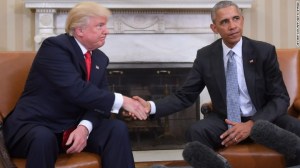 Trump & Obama
27 Jul 2017: Papadopoulos Arrested by the FBI
In late January 2017, FBI officials interviewed Papadopoulos about his interactions with Russian officials.
Papadopoulos initially claimed there had been none.
When questioned about his relationship with Mifsud he told investigators he first met Mifsud over a year previous and well before he joined the Trump team.
Papadopoulos downplayed Mifsud’s Kremlin ties, calling the man “a nothing” and “just a guy bigging up connections or something.”
Papadopoulos also minimized his interactions with the woman he had described as “Putin’s niece,” telling FBI investigators that he had no relationship with her, other than sending emails that amounted to “hi, how are you?”
But it transpired his assertions were untrue.
He was aware he had been catfished but maintained a relationship with her.
Papadopoulos knowingly connected with the Kremlin-linked professor after he joined the Trump team and had met Olga Vinogradova in person, and Skyped with her multiple times.
FBI officials interviewed Papadopoulos again in February 2017.
The following day, he deleted his Facebook account, where he had been communicating with the Mifsud and Ivan Timofeev, Programme Director of the Valdai Club Foundation Council and created a new account, scrubbed of all the old messages.
Days later, Papadopoulos ditched his phone and started using a new number.
He was arrested on 27 July 2017, in Dulles International Airport.
His arrest, was kept secret, providing opportunity for Papadopoulos to cooperate with Robert Mueller’s ongoing probe of alleged Russian efforts to undermine the 2016 election and alleged ties between Trump Tower and the Kremlin.
Papadopolous struck a deal with special prosecutor Robert Mueller investigating the possible influence of Russia in the 2016 presidential campaign.
The FBI affidavit for Papadopolous’ plea deal indicated that London-based, Professor of Diplomacy, Professor Mifsud had been instrumental in arranging connections between Papadopoulos and supposedly Kremlin-tied Russians – one of whom had allegedly pretended to be Vladimir Putin’s niece.
The full FBI Affidavit: https://static01.nyt.com/packages/pdf/politics/2017/statement_of_the_offense.filed_.pdf
https://static01.nyt.com/packages/pdf/politics/2017/statement_of_the_offense.filed_.pdf
The White House Response: Sarah Huckabee Sanders, the White House press secretary, described Papadopolous as a low-level campaigner: “a volunteer on a council that met once” whose attempts to interest the campaign in a Moscow meeting were greeted with disinterest.
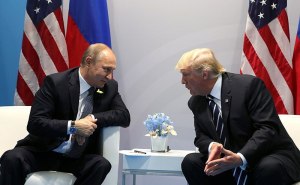 Putin & Trump
30 Jul 2017: The Fall of George Papadopoulos – The Trump Adviser Who May Kill Trump’s Presidency
The most remarkable thing about George Papadopoulos, the former Trump campaign aide who pleaded guilty to lying to the FBI about his contacts with Russians during the course of the 2016 campaign, is that he managed to get to this point at all.
Former high school classmates failed to recall him.
College professors said he was a below-average student.
Peers in Washington, D.C., described him as unremarkable, and many senior colleagues on Donald Trump’s presidential campaign thought he was a hanger-on.
And yet Papadopoulos found himself squarely in the middle of the most remarkable political scandal of a generation.
A nonentity who rose to unfathomable heights through self-promotion and opportunistic timing.
Only this particular bit character may now bring down a president.
01 Aug 2017: The Mysterious Work of the Maltese Professor Identified in the FBI’s Russia Probe
Joseph Mifsud is an enigma.
The Maltese academic admitted that he is the mysterious professor at the center of Trump campaign advisor George Papadopoulos’s attempts to arrange a meeting between Donald Trump and Russian president Vladimir Putin.
He insists he has a “clear conscience” and fervently denies Papdopolous’s claim that he knew the “Russians had obtained ‘dirt’ on then-candidate Clinton.”
Mifsud said that he’d had “absolutely no contact with the Russian government,” and reiterated that, “I do not know anybody from the Russian government…I am an academic.”
But hold on, that’s not quite true. Mifsud has had contact with multiple Russian officials.
He met the Russian ambassador to the UK, greeted a counsellor from the Russian embassy, invited a former Russian senator to his academy, and was listed at a conference as having advised the Russian government on “international education issues.”
3 Nov 2017: Cyprus Gave Manafort’s Bank Records to Mueller Team, Sources Say
Authorities in Cyprus handed over bank and company records to U.S.
investigators late last week related to former Trump campaign chairman Paul Manafort and his business partner Rick Gates, just before they were indicted in the U.S., according to people familiar with the probe.
The Cypriot government was responding to a June 7 request from U.S.
investigators for records related to Manafort, Gates and companies they set up in Cyprus and the Seychelles, the people said.
The pair of U.S. consultants had at least 15 accounts on the island with Bank of Cyprus and a bank it took over in 2013, Cyprus Popular Bank, one of the people said.
Only a small part of the request from the investigative team headed by U.S. Special Counsel Robert Mueller hasn’t been answered yet, the people said.
A Bank of Cyprus spokesman declined to comment.
Manafort and Gates, his former right-hand man, are accused of hiding their work as agents of Ukraine, laundering millions of dollars and concealing foreign accounts.
They pleaded not guilty, and a judge placed them under house arrest. (Bloomberg)
 Manafort & Gates
10 Nov 2017: Papadopoulos and the Tory Party
We now know that Papadopoulos is connected to a number of Tory MPs, the first of whom was Tobias Ellwood, MP a senior minister at the Foreign Office when Papadopoulos met him at the UN in September 2016, in the run-up to the Presidential Election.
Papadopoulos’ network expanded further through his relationship with the Maltese Professor Joseph Mifsud who met with … Alok Sharma, MP, at the time a Foreign Office minister for Asia.
And when Mifsud attended Sharma’s constituency dinner in October 2017, who should be there, but London’s formerly very occasional Mayor Alexander Boris de Pfeffel Johnson.
Mifsud is reported to have bragged that he’d be “meeting Boris Johnson for dinner Re: Brexit”.
Bozza claimed he didn’t know Mifsud and had no recollection of having met him.
 Boris Johnson
11 Nov 2017: Boris Johnson did meet Joseph Mifsud
It is now confirmed that Boris Johnson met Joseph Mifsud.…the mysterious “professor” who acted as go-between in the Trump/Russia affair…..at a Conservative Party fundraising dinner in Reading, last month. Alok Sharma, who was a Foreign Office minister until June this year, admitted to having met Mifsud “a couple of times” and to having “briefly greeted” Mifsud at the fundraising dinner, which was held on 19 October in Sharma’s parliamentary constituency.
But he said he did not introduce Mifsud to Boris Johnson.
A Foreign Office source said: “The foreign secretary has not knowingly met this person, planned to meet this person, or indeed ever heard of this person.”
The photograph was also posted, on 14 March 2016 to the Facebook page of student, Olga Polonskaia, a 30yo Russian woman from St Petersburg named as a contact person that had met with Professor Mifsud and George Papadopoulos a foreign policy adviser to the Trump election campaign,
However, a photograph posted by Conservative supporter Prasenjit Kumar Singh to his facebook page was released to the press showing Johnson and Mifsud together at the dinner.
Singh previously described Maltese-born Mifsud as one of his “good old friends”.
In July, he posted a photo of himself and Mifsud in Albania, after a dinner with the Albanian Deputy Prime Minister and an Albanian MP.
The caption said: “Good old friends having dinner in Albania. In presence of Albanian Deputy Prime Minister, another Member of Parliament and Maltese Diplomat Professor Mifsud.”
Another photo posted to Facebook by Singh in July 2017 pictured him with British prime minister Theresa May “at a private lunch party”.
Singh, who currently runs a company called London School of Executive Training Limited, had previously been embroiled in controversy over the status of various private colleges in which he was involved.
One dispute in 2004 centred around a “graduation ceremony” attended by Michael Ancram, Conservative shadow foreign secretary at the time.
In 2009 another of Singh’s business ventures, Halifax College (UK) Limited, made donations to the Conservative party in Reading West amounting to £5,000.
At the time, Reading West was a marginal constituency held by Labour.
The following year, Alok Sharma captured it for the Conservatives.
Singh has previously described Maltese-born Mifsud as one of his “good old friends”.
On Facebook in July, he posted a photo of himself and Mifsud in Albania, after a dinner with the Albanian deputy prime minister and an Albanian MP.
Intriguingly, Singh also became a Facebook friend of Olga Polonskaya, the mysterious Russian woman who in March last year attended a meeting with Mifsud and Trump “adviser” George Papadopoulos posing as a niece of President Putin.
When Singh posted the photo of himself, Johnson and Mifsud on Facebook, Polonskaya “liked” it.
Singh holds the rare distinction of having met Polonskaya face to face…..twice.
He said, he initially met her at Link Campus University in Rome (also visited by Papadopoulos) where Mifsud held an academic post adding that he met her again at a shopping centre in London,: “about two and a half months ago I was with my family and we were going to the Westfield shopping centre and I said: ‘Yes, come and meet me there.’
She was going to translate my website……for the London Executive School…….from English into Russian so I could try and attract more Russian students. She did that: I just haven’t put it up yet.”
Sadly, it appears that Singh and Polonskaya are no longer Facebook friends.
Since coming under the spotlight Singh has been busy purging his internet footprint to remove things that might interest investigators.
A few days ago the list of governors disappeared from the website of his executive training school and a check on his Facebook page this morning shows that he has deleted photos that included Mifsud, plus a photo of himself with prime minister Theresa May.
Chris Bryant MP, the vice chair of the all-party parliamentary Russia group, said: “It’s all distinctly fishy.
Boris Johnson’s relationship with the truth right now seems distinctly casual.
We asked him about Russian interference in Brexit in the foreign affairs committee last week and he categorically denied he had seen a shred of evidence.
I just thought ‘blimey’. Even as a junior minister in the foreign office, Russian stuff came across my desk every single day.” (Guardian)
 Dr Prasenjit Kumar Singh & Mrs May
12 Nov 2017: The History of Dr Prasenjit Kumar Singh’s Educational Enterprises
Albert College Limited: 39 Welbeck Street, W1G 8DR London (18 October 2005-13 January 2012). Compulsory Wound up: Court Order.
In 2007, London University complained that Albert College was offering its students some of the university’s external courses, but had not asked for up-to-date study materials and had never put forward any candidates for examination.
Northumbria University also complained that Albert College was advertising the university’s distance-learning law course in its prospectus without the right to do so and threatened legal action.
Halifax College (UK) Limited: 31 August 2004 – 13 January 2012 (declared insolvent) Compulsory Wound up.
Established in 2004 as the British arm of Halifax University in Wyoming whose degree courses were not accredited by the US Department of Education.
The British branch attempted to describe itself as a university but the government intervened to stop it.
This caused some embarrassment for the Conservative party (which was in opposition at the time) because one of the party’s grandees, Michael Ancram, had performed the opening ceremony.
Although Halifax College ended up insolvent, in 2009 it made donations to the Conservative party in Reading West amounting to £5,000.
At the time, Reading West was a marginal constituency held by Labour. The following year, Alok Sharma captured it for the Conservatives.
Preston International College London Ltd: (16 Mar 2004-18 Apr 2005)
Preston University Ajman now has more than thousand students in its various programs.
In the UK, it has invited MPs such as Shadow Secretary of State for Foreign and Commonwealth affairs Michael Ancram and former Miss World Yukta Mukhi to dish out degrees during a graduation ceremony in the recent past.
It is operating the “Halifax University” enterprise in the UK as well.
With more than 50 campuses worldwide, Preston “University” is fooling thousands of students by claiming that they are obtaining an “American” degree……..I don’t know how its owners can sleep at night.
Don’t they ever consider that they are playing on the gullibility of these students? But one thing is for sure: They are making a heap of money.
Regardless of what they might counterclaim, the quoted materials on this blog are self explanatory.
Preston cannot claim that the information on this blog is false.
Halifax Educational Research Ltd: 1 Darris Close, Hayes, Middlesex, UB4 9RX. ( 26 May 2010) Wound up.
Birmingham College UK LLP: (16/03/04-18/04/05): Wound up.
Techno School of Business & Engineering Ltd: 1 Darris Close, Hayes, Middlesex, UB4 9RX. (26 May 2010) Wound up.
Narsingha Private Limited, Ground Floor, The Glass Centre, Brierley Hill, DY5 3EP. (06 August 2014-05 September 2014) Wound up.
Swiss College of Management Ltd. Berne, CH-036.3.054.566-8, Morgenstrasse 148, 3018 Berne, Aktiengesellschaft (10 Jul 2012-15 Oct 2015) Liquidated:
The Company aims to provide students and graduates with scientific and professional courses in business administration and management: President and Founder: Prasenjit Kumar Singh,
London School Of Executive Training Ltd, 1 Darris Close, Hayes, UB4 9RX: Prasenjit Kumar Singh, Director, ( 22 August 2016- Active)

12 Nov 2017: The London School of Executive Training (LSET)
(LSET) is a dynamic institution located in the heart of London with a “world-renowned” teaching faculty….or so its website says.
Part of its mission “is to drive global transformation.”
The school aims to attract “business leaders, bureaucrats, politicians, lawyers” and others for short courses lasting one to four weeks.
A one-week course costs £1,500 which includes some sightseeing and, for the better-off students, “helicopter hire is available”.
A photo on LSET’s website shows a substantial stone-and brick building which casual observers might assume to be the school.
The website doesn’t give its exact location but a few checks on Google show that the building is Hamilton House in Bloomsbury, best known as the headquarters of the National Union of Teachers.
However, Hamilton House also has spare rooms that can be hired for meetings…….which appears to be where LSET fits in.
LSET is the latest in a series of academic or fringe-academic institutions with links to Joseph Mifsud, the now-vanished professor at the centre of the Trump/Russia affair.
In 2014 LSET told inspectors it was “working in partnership” with the London Academy of Diplomacy where Mifsud was director until the academy’s recent closure.
The owner of LSET is Prasenjit Kumar Singh, a donor to the British Conservative party who, described Mifsud as one of his “good old friends”. That in itself might not be significant…...Mifsud appears to have been a virtuoso networker…..but Singh was also a Facebook friend of Olga Polonskaya, the mysterious Russian woman who in March last year attended a meeting with Mifsud and Trump “adviser” George Papadopoulos posing as a niece of President Putin.
Last month, Mifsud and Signh both attended a Conservative party fundraising dinner where they were photographed with foreign secretary Boris Johnson.
Singh posted the photo on Facebook, where it was “liked” by Ms Polonskaya.
LSET was inspected in 2014 by the British Accreditation Council which gave it a broadly favourable report while noting that at the time it had a total of only five students.
Before launching LSET in December 2013, Singh was involved in a succession of failed educational businesses: listed as governors are:
Prem Sharma, OBE FRSA – Chairman Board of Governors: The father of Alok Sharma, Conservative MP for Reading West, he has held senior positions within the Conservative Party for decades.
K.V. Rajan: Chairperson LSET Advisory Council – Asia Pacific: previously Indian Foreign Service. Held senior diplomatic assignments, including the rank of Ambassador, in many countries
Peter Sage: Adjunct Professor of George Washington University, (teaches yoga): Member: Ananda Marga Movement. Training College. http://petersage.info/bio/
Peter Bowyer: Founder: UK Learning Academy. Offers qualifications in management and other related areas. http://www.uklearningservicesltd.co.uk
Iain Dewar: Self employed, education management professional. Iain Dewar Training Caledonian University Glasgow.
Charles Chatterjee: Studied law at the University of Cambridge and the University of London. A barrister for over 20 years. Currently, Senior Associate Fellow of Warwick University, Associate Fellow of the Institute of Advanced Legal Studies, visiting academic, London Diplomatic Academy (the recently-closed institution where the recently-disappeared Joseph Mifsud was director).
Marie Haughey, MBE: Owner, Work Permit Experts Ltd: Employed over 40 years in the Civil Service. Long service, with the UK Border Agency in Ireland. Finished service as the Assistant Director of the agency.
Second career: Work Permit Experts Ltd. Specialist in all areas of United Kingdom immigration casework (except asylum) and expert in corporate immigration compliance matters.
Our consultants are lawyers and former employees of The Home Office (and other Government Departments) having detailed knowledge and experience of policy, practice and procedure in The Home Office.
We represent both individual and corporate clients, presenting applications and making representations to The Home Office in the most effective and professional manner.
We care deeply about the services we provide and will use our considerable combined knowledge, experience and expertise in UK and EEA Immigration law, UK Citizenship law and UK business immigration compliance regulatory requirements to provide relevant, encompassing and practical advice.
David Webb: Retd. Superintendent Commander of Police: David Webb worked in the police force for more than 25 years. He joined Hertfordshire Constabulary and transferred to the West Midlands Police before retiring as Superintendent Commander of Police in Birmingham. He pioneered Community Policing and is the author of “Policing the Rainbow,” which promotes the philosophy and practice of policing a multi-racial society.
 Alok Sharma MP
20 Nov 2017: The London Centre of International Law Practice (LCILP)
The LCILP is a curious law firm.
A former employee said that: “there was a lot of secrecy going on about what they do.”
After several months there, the same person said, “I hardly know what kind of business they do.”
The source described the firm, which was founded in 2014, as constantly in search of, and seemingly never obtaining, big contracts.
Mifsud’s role at LCILP was to bring in potential clients—ideally governments whom the company could advise on international law, the former employee said.
Papadopoulos and LCILP director Nagi Idris are friends on Facebook.
Idris is a British national, originally from Sudan, and has been director of 18 companies at various times since 2001, according to Companies House filings.
A reporter visited LCILP’s headquarters inside a handsome Georgian building and found that the office amounted to four people working in an undecorated backroom, all of whom declined to comment.
LCILP has paid rent in a series of highly prestigious locations in London’s legal district, despite ending 2016 with debts of £329,000….a considerable deficit for a company with just a handful of employees.
Shortly after rumors about Mifsud’s connection to Russia and the Trump campaign began circulating on 30 October 2017, his profile was removed from the website, along with those of all other members of staff.
Courtney Barklem, a human rights lawyer who had planned to do pro bono work for the firm but never found time, described Mifsud as “great.”
And the idea that Milsud would have tried to facilitate contacts with Russian officials is “not that far-fetched since just about everyone he dealt with was a foreign ambassador of this country or that country.”
 Singh & May
21 Nov 2017: Trump/Russia Affair – The Mysterious ‘Professor’ and His 37,000 shares in INTO
Joseph Mifsud, the Maltese “professor” who liaised between the Russians and Trump adviser George Papadopoulos, had fingers in many pies…….so many that it’s difficult to be sure what his real job was.
When he went into hiding earlier this month, Mifsud was a “professorial teaching fellow” (whatever that means) at the University of Stirling, had a vaguely-defined role at Link Campus University in Italy and was a “board adviser” at the London Centre of International Law and Practice Limited (LCILP).
According to a document released by the US Department of Justice, Mifsud and Papadopoulos first came into contact during a three-month period early in 2016 when Papadopoulos was also working at LCILP.
In addition, Mifsud was director of the London Academy of Diplomacy for several years before it was quietly shut down in 2016, in circumstances which have yet to be explained.
Now, however, yet another of his many roles has come to light.
In 2013, Mifsud was reported to be working as “consultant” for a company called INTO University Partnerships.
But his involvement with INTO may go further than that: company records currently show someone named “J Mifsud” as owning 37,000 shares in the business [see “confirmation statement”, 27 July 2017]. (al-bab.com)
 Michael Flynn
01 Dec 2017: What Michael Flynn’s Guilty Plea Means in Mueller’s Russian Enquiry
Michael T. Flynn, President Trump’s former national security adviser, was charged and pleaded guilty on Friday to making false statements.
Flynn said he had agreed to cooperate with Robert S. Mueller III, the special counsel, in his broader investigation into Russia’s interference in the 2016 election. The single charge Flynn admitted to:
On or about January 24, 2017, defendant MICHAEL T. FLYNN did wilfully and knowingly make materially false, fictitious, and fraudulent statements and representations in a matter within the jurisdiction of the executive branch of the Government of the United States, to wit, the defendant falsely stated and represented to agents of the Federal Bureau of Investigation, in Washington, D.C.
Mueller is charging Flynn with a single count of lying to the F.B.I. during a Jan. 24 interview, under a plea agreement in which he could serve up to six months in prison and pay a fine of $500 to $9,500.
What is most notable here is all the other offences from which Flynn escaped charges.
Those other potential charges were the leverage that Mueller successfully used to pressure Flynn to flip and cooperate in exchange for leniency.
It had been clear for months that Flynn faced serious legal jeopardy on a range of issues, including work that his lobbying firm performed for Turkey without registering as agents of a foreign power.
Earlier this year, Flynn belatedly filed a foreign Agent’s Registration Act disclosure with the Justice Department.
But even though Mueller has obtained an indictment against Paul Manafort Jr., Mr. Trump’s former campaign chairman, in part for violating that same law, he did not charge. Flynn under it.
Moreover, a court filing mentions that Flynn made several false statements in his belated foreign-agent registration, such as “omitting that officials from the Republic of Turkey provided supervision and direction over the Turkey project.”
But Flynn faced no separate charges based on those lies. Each potential false statement charge could have carried up to five years in prison.
Notably, the filings do not mention other conduct by Flynn that has also attracted legal scrutiny.
For example, he is also said to have left contacts with Russian officials off his application for a security clearance and again failed to disclose them in response to questions by officials processing that application, which could have resulted in separate false statement charges.
Since the plea agreement only immunizes the conduct it mentions from further prosecution, it is not clear why such other issues were omitted.
On or about 22 Dec 2016 a very senior member of the Presidential Transition Team (PTT) directed Flynn to contact officials from foreign governments, including Russia, to learn where each government stood on the resolution resolution condemning Israel for building settlements in Palestinian territory and to influence those governments to delay the UN vote or defeat the resolution.
After-note: On 28 Dec 2016, within the “Presidential Transition Period” outgoing President Obama, without discussion or briefing of with President Elect Trump, or any definitive evidence supporting his allegations, signed an executive order imposing sanctions on Russia for interfering in the US presidential election. The act was without precedence and clearly a “spoiler” designed to cause problems for the new administration.
On or about Dec 29 2016 Flynn called a senior official of the (PTT) who was with colleagues in Florida to discuss what, if anything, to communicate to the Russian Ambassador about the US Sanctions.
In doing so he did nothing wrong since the matter was being handled within the (PTT) period.
So there it is. Months of hot air and nothing, zilch on the record linking President Trump to any wrongdoing. But this needs to be cleared up.

02 Dec 2017: The New Republican tax bill punishes American families who use public schools
Most American families rely on this system…less than 10% of households send their kids to private school, and that percentage has dropped significantly in recent years for middle and lower class families.
That’s because they’re expensive…private school tuition in the US averages $10,000 per year per student, and can go as high as $76,000 a year, and costs have been rising rapidly.
Meanwhile, the bill expands the use of “529 plans” to include private schools.
These savings plans were designed to encourage families to save for college, and work in part because they’re tax free…..income placed into them and spent on tuition is not subject to any federal tax.
The new Grand Old Party (GOP) bill expands these plans to include elementary and high schools, which means tuition payments towards private schools are now deductible from taxable income.
That means that the ”school tuition” that parents of public school kids are paying, in the form of state and local taxes, isn’t deductible from their federal taxes, and public schools themselves will have less money to spend on kids.
But rich families who can afford private school get a brand new tax break. That’s a win for the 10%.
An Introduction to 529 Plans:A 529 plan is a tax-advantaged savings plan designed to encourage saving for future college costs.
529 plans, legally known as “qualified tuition plans,” are sponsored by states, state agencies, or educational institutions and are authorized by Section 529 of the Internal Revenue Code.
There are two types of 529 plans: pre-paid tuition plans and college savings plans.
All fifty states and the District of Columbia sponsor at least one type of 529 plan.
In addition, a group of private colleges and universities sponsor a pre-paid tuition plan.
03 Dec 2017: Rohmir (Uk) Ltd, incorporated 29 May 2009: 58 Maddox Street, London, W1S 1AY: Founder and only Director Dr Stephan Roh
(https://www.facebook.com/Rohmir)
Stephan Roh, (now Baron of Inchdrewer) having recently purchased 16th Century Inchdrewer Castle near Banff in late 2013 for £400,000. is married to Olga Shahovskaya, b1970.
Olga, who hails from a Russian noble family was raised in Moscow.
Aged just sixteen she began a study of foreign languages…at the University of Moscow.
In January 1990, she fled to Switzerland.
She studied German, psychology and literature at the University of Bern. In 2007, she launched ROHMIR.
The name of the label is made up of Roh, the surname of her husband, and Mir, meaning “peace” in Russian.
Olga designs, produces and sells ready-to-wear clothing and fashion accessories for women.
She designed her first collection in 2009.
Clothes are sold in luxury boutiques in Monaco, Paris, London, Berlin, Hong Kong, St. Moritz and Zurich.
The couple have three children.
Olga recently revealed she has been dressing Prime Minister, Theresa May for over three years and said she was pleased to have been given the opportunity to change her style.
One of the most striking Rohmir pieces in the PM’s wardrobe is a burnt orange, knee-length tweed coat she wore with black-patent boots to meet the Queen at an official event last year.
Olga said: “She shows that politicians don’t just have to wear black and grey – she is willing to wear bold and bright colours and patterns and accessorise.
She likes a feminine, elegant look that is streamlined.
She dares to wear what she likes and doesn’t feel the need to look like everyone else.
She doesn’t have anyone who tells her what she has to wear…which is great.
I think her skills as a politician speak for themself but that her clothes help her stand out and be visible.
She has her own, strong style. Even when the dress code is dark and business-like, she wears it glam, adding some details.
 Olga Roh
04 Dec 2017: The London Academy of Diplomacy
Mifsud was listed as both a director and honorary director at the Academy but his role and the function of the Academy is unclear.
Indeed, an enquiry on Loughborough University London asked whether Mifsud was employed at its Academy of Diplomacy and International Governance and was told there was no record of him in the university’s files.
The Academy, closed in the Autumn of 2016, has at various points, over the year’s also been associated with the University of East Anglia.
Most recently a Stirling University spokesman confirmed Mifsud is employed as a professorial teaching fellow, since May 2017.
But no-one can recall ever being taught by him.
The University magazine The Brig is investigating the scandal and it’s published articles reveal a catalogue of intrigue worthy of a James Bond movie.

(https://twitter.com/WendySiegelman
(https://twitter.com/lhfang/status/775846049009197057/photo/1
(https://twitter.com/lhfang/status/775846548991115269/photo/1
(https://twitter.com/realDonaldTrump/status/776269061823074304
(https://twitter.com/brian_whit?lang=en
(https://www.youtube.com/watch?time_continue=5&v=pT3C03YLBDU
(https://www.youtube.com/watch?v=spk5WeN3T0I Olga Roth BBC Interview
(https://www.youtube.com/channel/UCByr1l-_enuA937kWqxHGiw
(http://www.directorstats.co.uk/director/rupert-soames
(http://www.dailymail.co.uk/news/article-3593784/David-Cameron-s-EU-sham-exposed-Leaked-letter-reveals-PM-hatched-anti-Brexit-plot-telling-voters-campaign-leave.html
(http://www.telegraph.co.uk/finance/newsbysector/supportservices/10669120/Aggreko-boss-Rupert-Soames-asked-for-Serco-job.html
(http://www.abeldanger.org/paradise-papers-massive-new-leak-exposes-tax-haven-secrets-links-wilbur-ross-to-russia
(http://www.abeldanger.org/2686-cameron-assassins-death-bet-club-serco-8a-zulu-triggers-soames-77-bombs
(https://pagesix.com/2012/07/24/georgica-blowout
(http://www.zerohedge.com/news/2017-11-07/leaked-secret-israeli-cable-confirms-israeli-saudi-coordination-lebanon
(http://www.llnyc.com/42110-board-approved-who-are-the-distinguished-residents-of-river-house
(http://www.foxnews.com/politics/2016/09/15/general-vs-general-powell-flynn-feud-over-hacked-email-slams.html
(https://lobelog.com/powell-acknowledges-israeli-nukes
(https://www.nytimes.com/2017/03/17/business/education-for-profit-robert-eitel.html?_r=0
(http://www.nytimes.com/2012/03/18/fashion/weddings/elizabeth-marshall-jeffrey-leeds-weddings.html
(https://www.nytimes.com/2017/11/21/world/europe/nhs-brexit-eu-migrants.html
(https://theintercept.com/2016/09/13/in-leaked-emails-iraq-war-architect-expressed-relief-that-brexit-distracted-from-u-k-war-inquiry/?
(https://www.republicreport.org/2016/leaked-powell-emails-detail-ties-to-key-for-profit-college-investor
(https://www.republicreport.org/2017/with-collegeamerica-trial-underway-someone-just-posted-an-unhinged-attack-on-colorados-attorney-general
(https://www.republicreport.org/2016/friends-in-high-places-who-endorses-americas-troubled-for-profit-colleges
(https://www.republicreport.org/2014/law-enforcement-for-profit-colleges
(http://www.leedsequity.com
(http://mondoweiss.net/2016/09/powell-censorship-israeli
(http://secgems.com/c/0001245798/leeds-jeffrey-t
(https://www.realpage.com
(https://www.opensecrets.org/news/issues/for-profit-education
(https://www.insidehighered.com/news/2017/06/15/education-department-hit-pause-two-primary-obama-regulations-aimed-profits?
(https://s3.amazonaws.com/public-inspection.federalregister.gov/2017-12555.pdf
(https://www.washingtonpost.com/news/grade-point/wp/2017/01/24/betsy-devoss-ethics-review-raises-further-questions-for-democrats-and-watchdogs/?
(https://assets.documentcloud.org/documents/3863632/Trump-University-ca9-Opening-20170612.pdf
(https://www.ucu.org.uk/media/6247/INTO-Why-you-should-be-worried-about-a-joint-venture-between-York-and-INTO-Mar-14/pdf/ucu_yorkinto_mar14.pdf
(http://www.elgazette.com/news/item/107-into-the-money.html
(https://medium.com/@Brian_Whit/the-george-papadopoulos-file-a-timeline-5c699c3aae4b
(https://medium.com/@Brian_Whit/the-trump-russia-affair-and-an-odd-company-in-london-9437e0343db2
(https://medium.com/@wsiegelman/rosneft-flowchart-559ac95ae7f
(https://medium.com/@wsiegelman/scl-companies-shareholders-e65a4f394158
(https://brignews.com/2017/10/31/professor-at-heart-of-trump-russia-scandal-is-from-university-of-stirling
(https://brignews.com/2017/11/04/what-we-know-so-far-about-joseph-mifsud
(https://brignews.com/2017/11/12/revealed-stirling-universitys-ties-to-academy-run-by-russia-inquiry-professor
(https://www.theguardian.com/politics/2017/nov/04/boris-johnson-brexit-russia-trump
(https://www.sec.gov/reportspubs/investor-publications/investorpubsintro529htm.html
(https://qz.com/1145239/gop-tax-bill-2017-the-senate-republican-bill-punishes-american-families-for-using-public-schools
(http://theprestonuniversityfraud.blogspot.co.uk/
(https://www.yelp.co.uk/biz/work-permit-experts-wapping
(http://www.allaboutshipping.co.uk/2015/05/04/cyprus-looks-to-offshore-energy-prospects-as-game-changer/
(http://www.dailyrecord.co.uk/news/uk-world-news/meet-russian-fashion-designer-whos-4564823
(https://www.youtube.com/watch?v=May9S7gg6Ao
(http://www.ilsenergy.com
(http://www.ilconsultants.com/ils_partners.html
(https://theferret.scot/academic-implicated-fbi-probe-told-stirling-university-met-putin/
(https://www.stir.ac.uk/alumni/graduatestories/denisemifsud/
(https://www.nytimes.com/2017/12/01/us/politics/michael-flynn-guilty-plea-what-it-means.html
(https://www.nytimes.com/interactive/2017/12/01/us/trump-associates-russia-election.html
(https://www.nytimes.com/2017/03/16/us/politics/michael-flynn-russia-paid-trip.html
(https://www.washingtonpost.com/world/national-security/national-security-adviser-flynn-discussed-sanctions-with-russian-ambassador-despite-denials-officials-say
(https://www.nytimes.com/2017/05/25/us/politics/michael-flynn-russia.html?action=click&contentCollection=Politics&module=RelatedCoverage®ion=Marginalia&pgtype=article
(https://www.nytimes.com/2017/12/04/us/politics/manafort-russia-special-counsel-investigation.html?
Conclusion:
President Obama was enraged with Colin Powell and his supporters who assisted by powerful lobbyists, destroyed his plans to introduce tough legislation tightening rules curtailing opportunities for expanding “for profit” private education universities, colleges and similar outlets. It would be for President Clinton to recover the lost ground. Obama, would not be thwarted in his endeavours and plotted with the British Government to undermine the Trump campaign. It didn’t evolve as he had hoped!!






















 Eddie Davenport & Girlfriend in 33 Portland Place




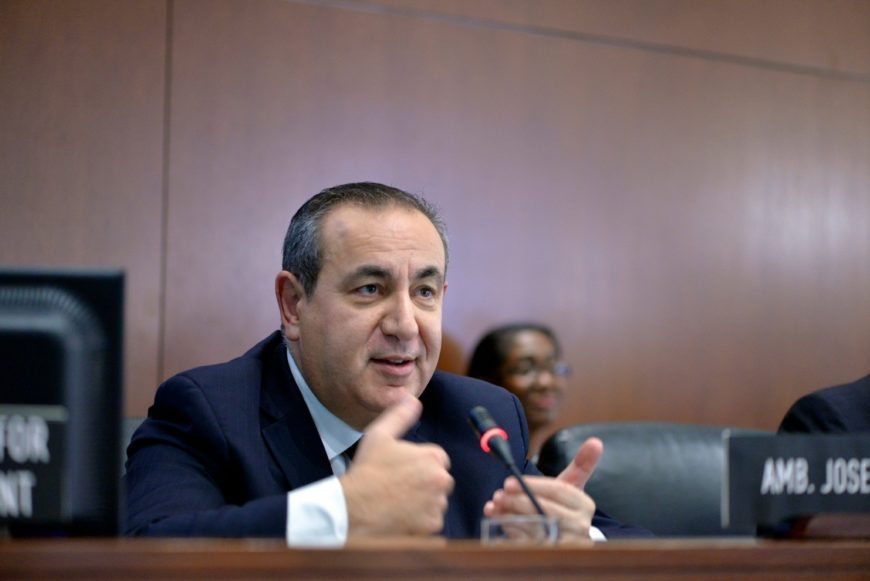


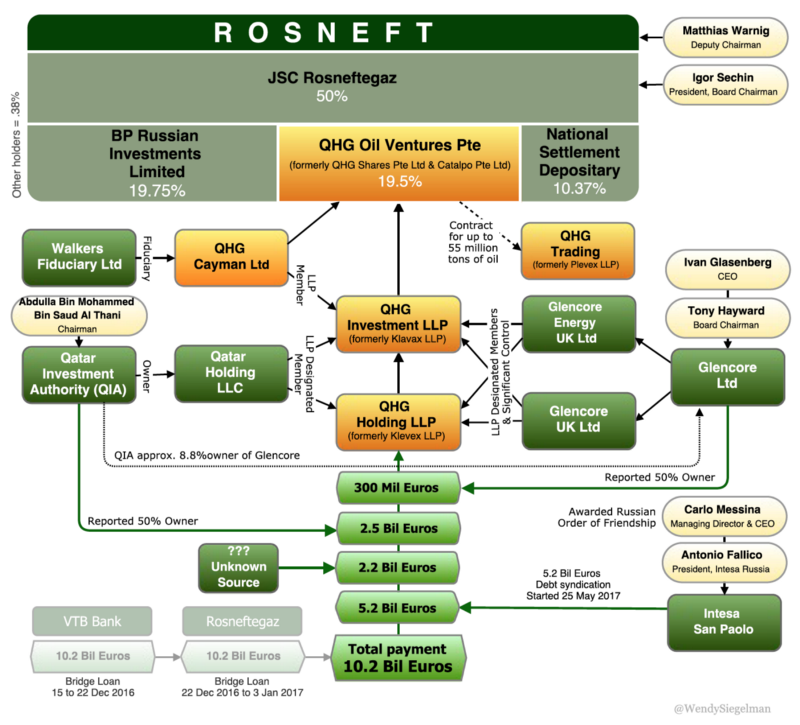

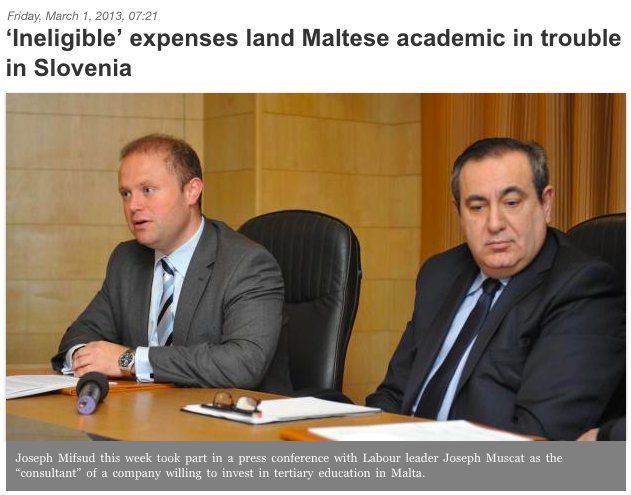
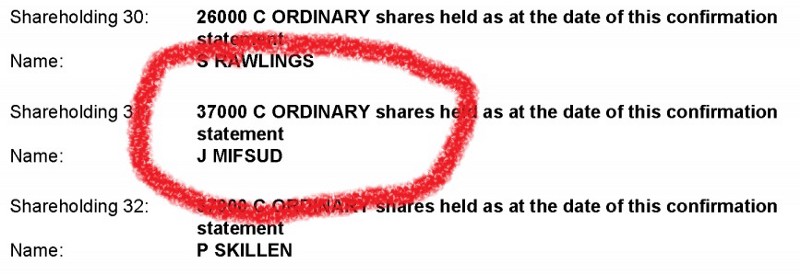


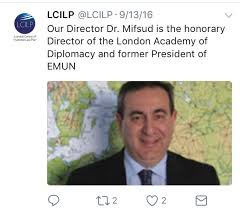
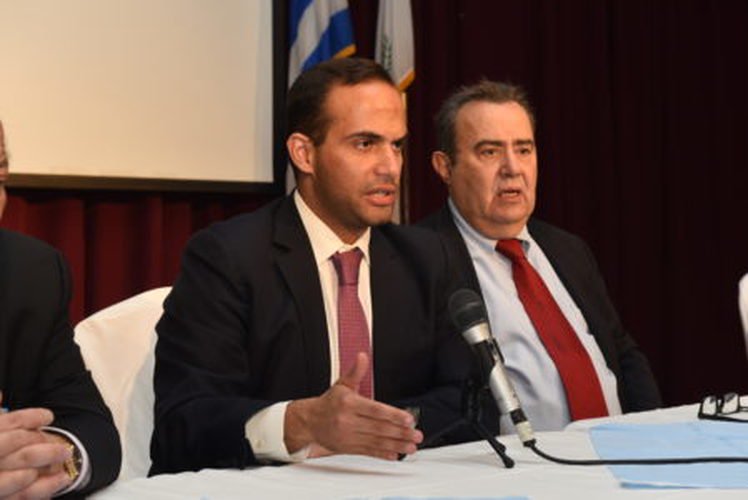


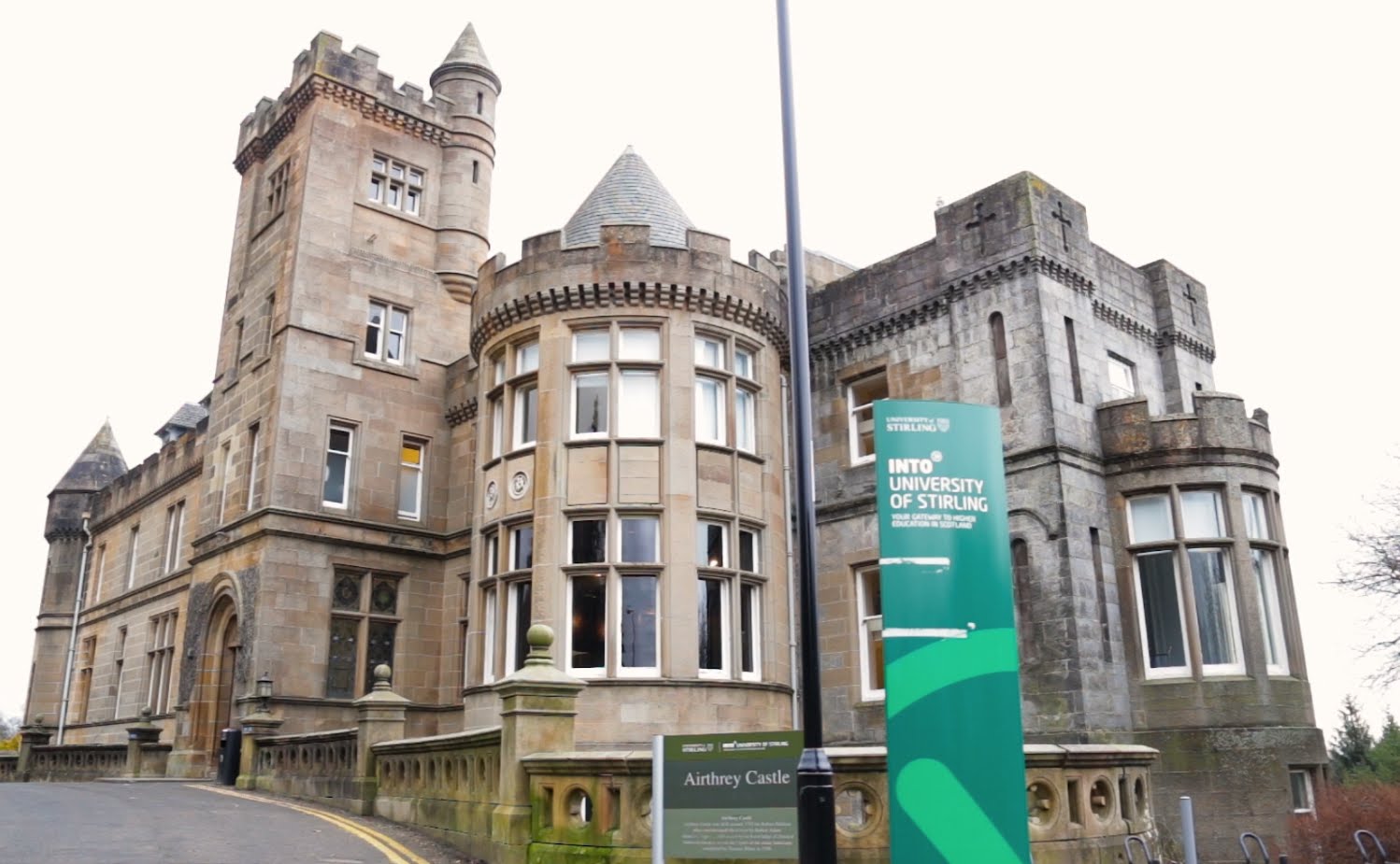
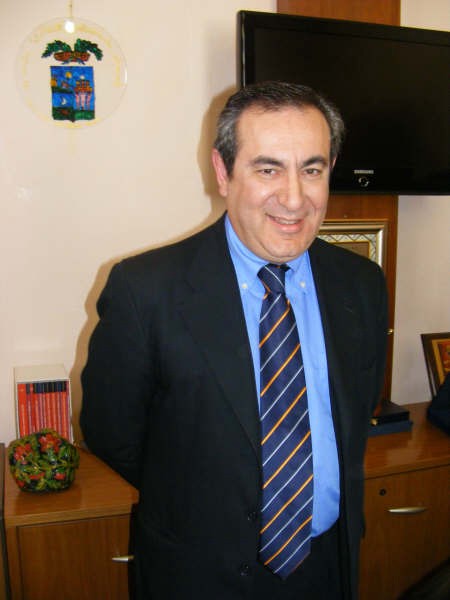
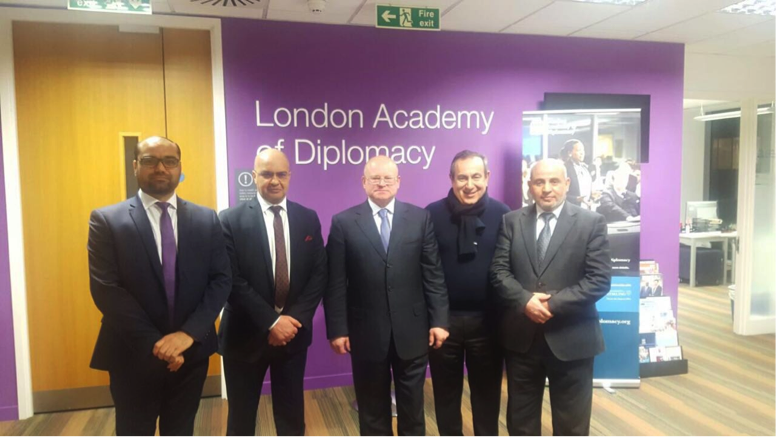
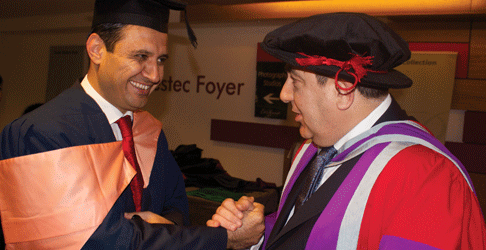

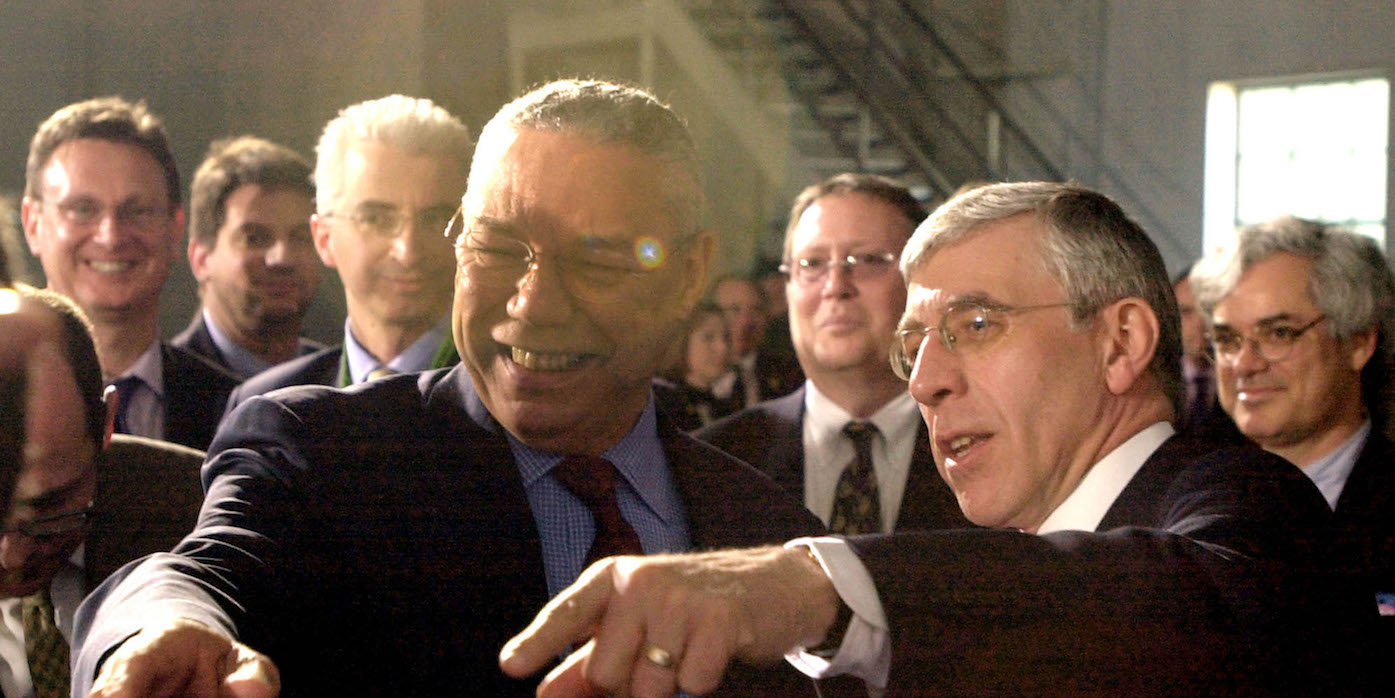



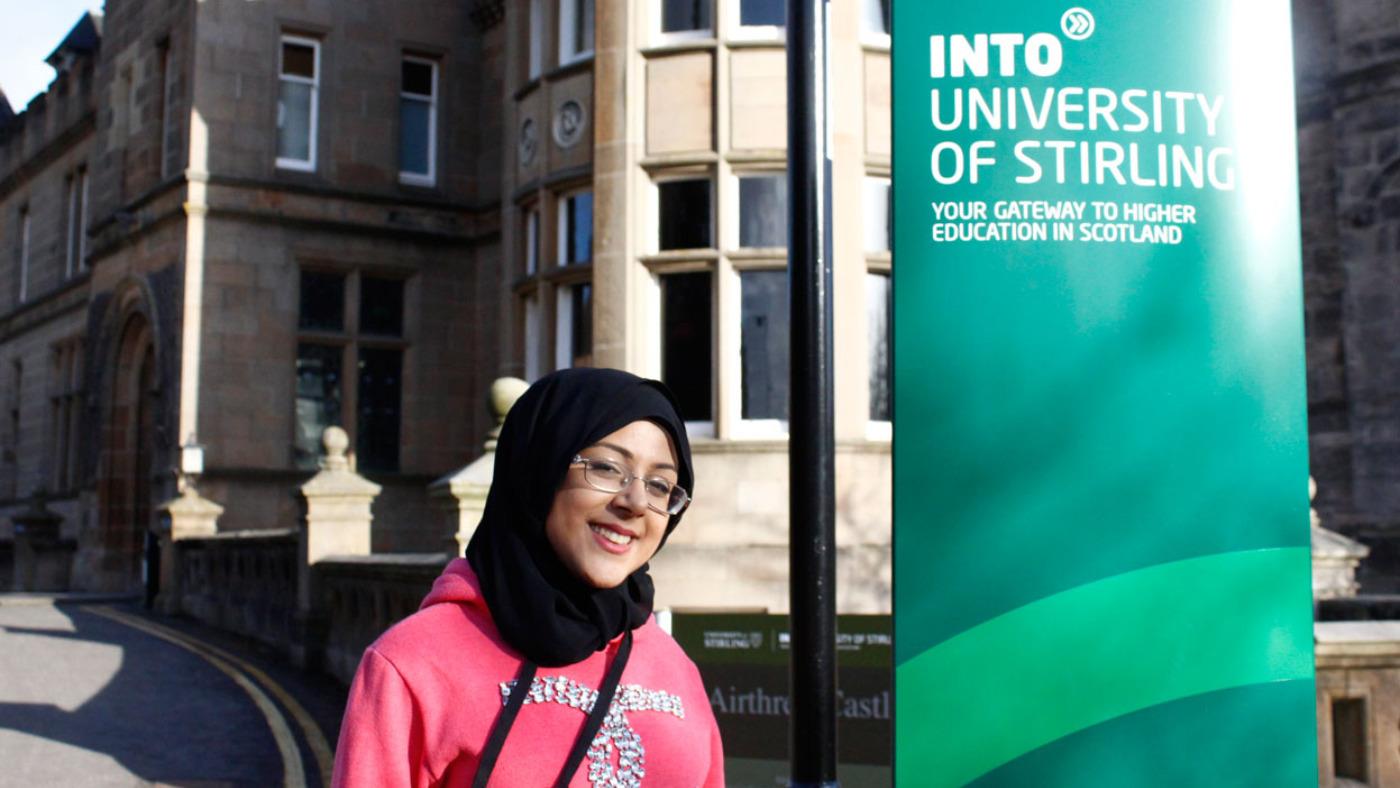


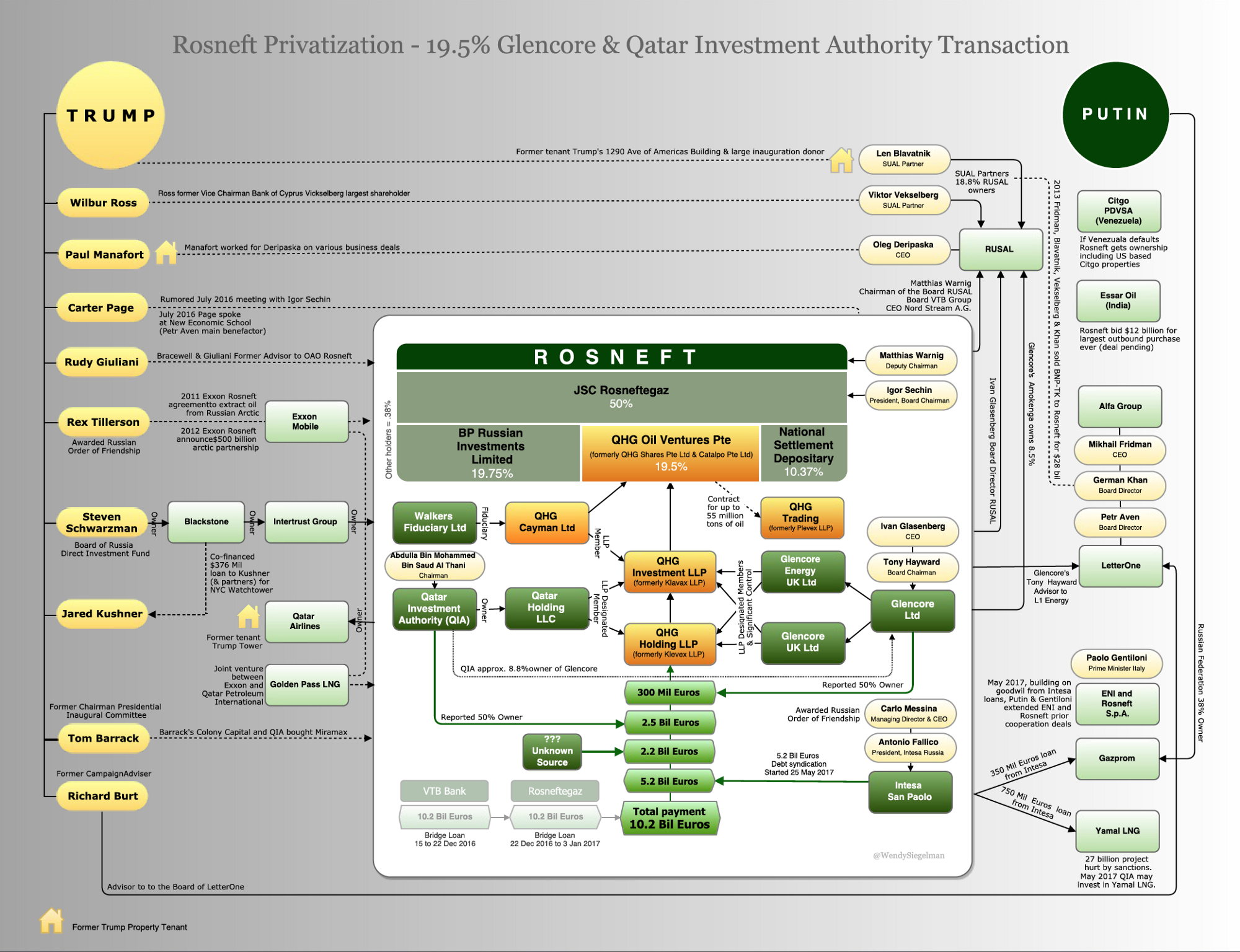

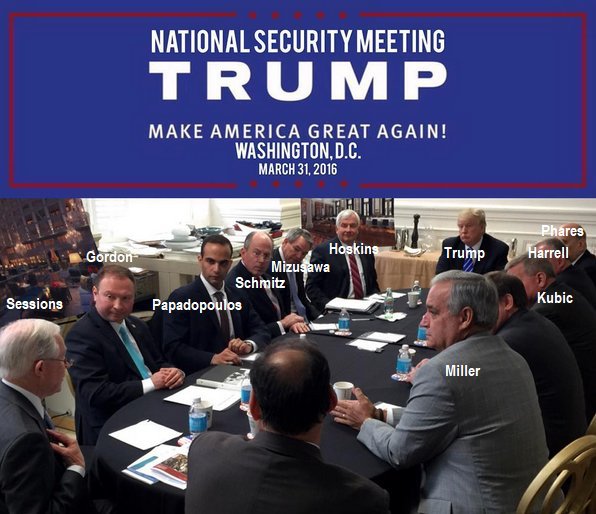
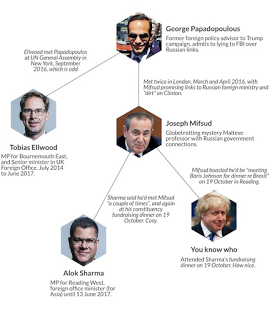


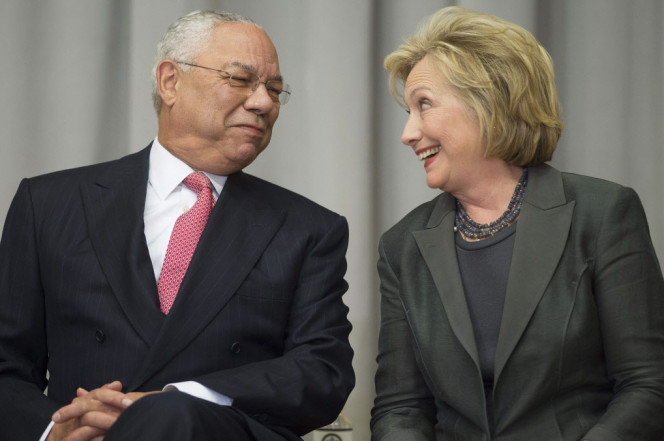




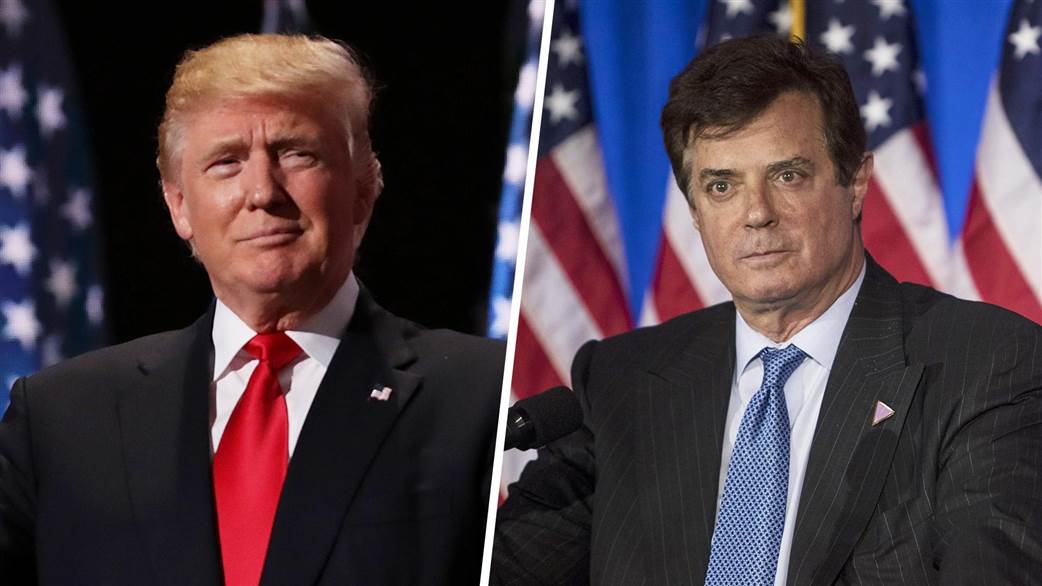

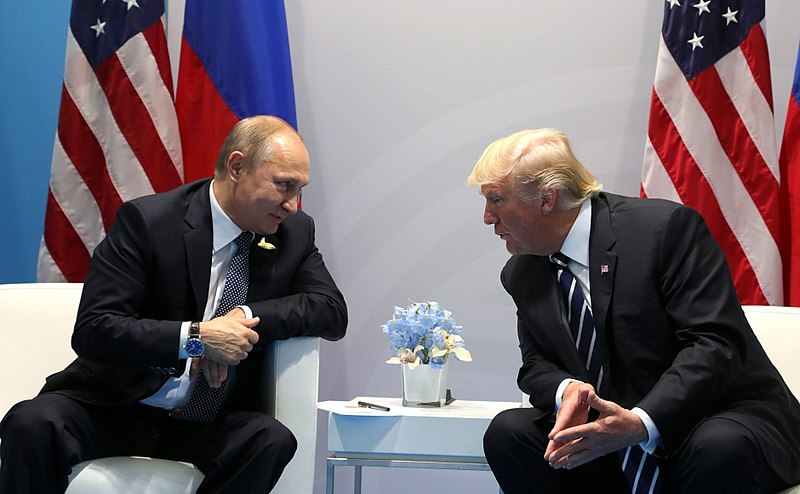

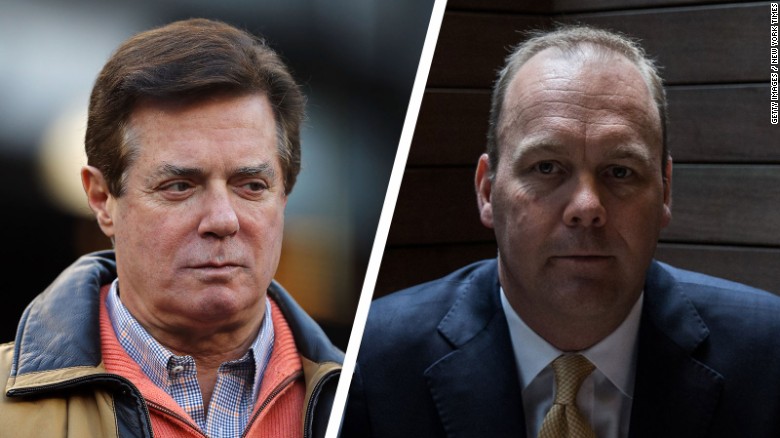 Manafort & Gates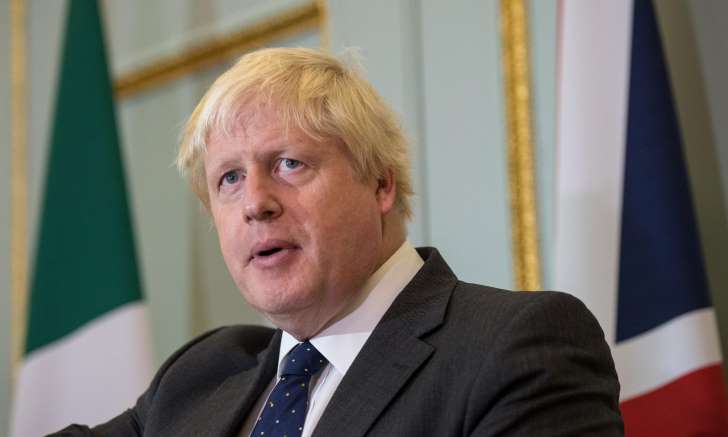











 caltonjock