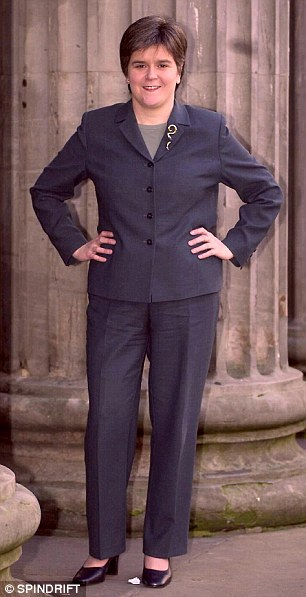
Her demeanour, dress sense and confrontational behaviour was evident in her student days and her aborted legal career and lifestyle before politics.
But Nicola Sturgeon claimed she earned her nickname because she tried to emulate male politicians aggressive and adversarial practices at the start of her parliamentary career.
She claimed she was surrounded by “middle-aged white men” and behaved in a way about conforming and fitting in. That was also reflected in how she dressed.
Her belief was that fitting in with the behaviour of men required females to become adversarial and aggressive in pursuit of winning their arguments since assertive, aggressive, and adversarial male politicians are seen as strong leaders.
But her recurring failure to gain a seat as an MSP by popular vote was a worry for the Party leadership and Angus Robertson finally persuaded her to abandon her long held feminist principles and abandon her “nippy sweety” behaviour.
Sturgeon, the fashion icon and Scotland’s first lady in waiting was relaunched at the start of the Scottish Independence campaign in early 2014
The makeover and extensive coaching designed to improve her delivery of policies to the public and parliament must have cost the Party many millions with a new expensive outfit being produced every day and many Scots believed the massively hyped transformation was real and would deliver change and were happy to clinb on-board the “Sturgeon for Independence” bandwagon.
The period 2014-2023 exposed the disgusting scale of the Robertson/Sturgeon “ponzie scheme” and Unionist media outlets are actively participating in the continued cover-up of the abuse of the Scottish electorate.
Michael McElhinney’s journal: FOI release: Information requested:
Please could you provide the following information in regards to the diary/journal of Scottish Government civil servant Michael McElhinney which it was reported was provided to Police Scotland in February 2019 and returned to the Scottish Government on 1st May 2020:
Q: Who had access to this diary/journal before February 2019?
A: The author of the notebook, Scottish Government HR and Police Scotland had access to the notebook before February. What is referred to as a ‘diary/journal’ is more accurately described as a notebook containing work notes.
Follow up: The Scottish Government HR would include Leslie Evans, Judith Mackinnon & Nicola Richards amongst others.
23 September 2018: Police Scotland response: You have been advised by the SG that the diary/journal was provided to Police Scotland on 15 November 2018. I can confirm that on 15 November 2018, the SG provided Police Scotland with redacted photocopies of the diary/journal and not the physical diary/journal. I maintain our position that we did not come into possession of the government-issued diary/journal of the SG civil servant Michael McElhinney until February 2019.
Q: Who provided this diary/journal to Police Scotland in February 2019?
A: The notebook was handed to the police by Scottish Government HR as part of the “OP Diem”, criminal investigation. Please note that this took place on 15 November 2018 and not in February 2019 as specified in your request.
Follow up: But this response is at odds with that of Police Scotland’s statement that the diary/journal was provided to Police Scotland in February 2019.
23 September 2023: Police Scotland response: To be of some assistance and in order to be as transparent as possible I can confirm that prior to Police Scotland being provided with redacted photocopies of the diary/journal on 15th November 2018, Police Scotland had been afforded access to/sight of the diary/journal by Scottish Government on 7th September 2018. In relation to your additional questions, I can confirm that as part of its investigation, Police Scotland sought to speak with officials and staff at the Scottish Government. The existence of the diary came to light during the course of those investigations. Police Scotland then sought access to the diary/journal.
Comment on Police Scotland revelation: So the Police had sight of the diary/journal on 7 September 2018. Why did they not take possession of it at that time? Was it to allow time for the SG to redact much of the content? Which they deferred requesting from the SG until 15 November 2018 and were only provided with heavily redacted photocopies. That the actual diary was not in the hands of Police Scotland until 13 February 2019? makes no sense. Custody of the diary should have been enacted by Police Scotland investigators on 7 September 2018.
Q: Given that it was a diary/journal allegedly containing information on historical incidents relevant to the Police investigation why was it not provided to the Police much earlier? In late August 2018 for example?
A: Having conducted appropriate and proportionate searches, the Scottish Government holds no recorded information within the scope of your request. As noted above, the notebook was provided to Police Scotland at their request on 15 November 2018.
Follow-up: “Op Diem” commenced on 14 September 2018 but the police did not request the diary until 15 November 2018 (3 months elapsed). Begs questions? Who told the police there was a diary? Why was it not passed to Police Scotland by HR at the start of the investigation? Why is there no record of the diary in the personal diaries of any of the HR team members?
Q: When the diary/journal was returned to the Scottish Government on 1st May 2020 who had access to it?
A: It was returned by Police Scotland on 1st May 2020 to the author of the notebook.
Q: Where is this diary/journal now?
A: The Scottish Government does not have the information you have requested. Although photocopies of some pages were retained, the notebook itself is no longer held by the Scottish Government.
Follow-up: Photocopies of some of the pages were retained yet the Scottish Government does not know where the actual diary/journal/notebook is now.
Q: How could ‘journalists’ David Clegg and Kieran Andrews have obtained this diary/journal from the Scottish Government as they mention in their book BREAK-UP?
A: Having conducted appropriate and proportionate searches, the Scottish Government holds no recorded information within the scope of your request.
Follow up: Stock answer from the Scottish Government. We don’t know guv!!! But assuming safeguards were in place the information could only have been made available to the journalists by the author or a very senior member of the HR team.
Q: Can an ordinary member of the general public obtain access to the contents of the diary either with or without suitable redactions?
A: I have interpreted this part of your request as a request for information in the notebook referred to. The Scottish Government does not have the information you have requested. This is because, as noted above, the notebook is no longer held by the Scottish Government. But in relation to photocopies of pages that are held by the Scottish Government, we are unable to provide the information that you have requested because an exemption under section 26(c) of FOISA (prohibitions on disclosure: contempt of court) applies to that information. The exemption applies because disclosure of any of the information in this part of your request would be likely to lead to the identification of individuals and so would breach orders made under the Contempt of Court Act 1981 and accordingly the information requested is exempt from disclosure This exemption is not subject to the ‘public interest test’, so we are not required to consider if the public interest in disclosing the information outweighs the public interest in applying for the exemption.
I have noted that you refer to the possibility of suitable redactions being made. However, I have concluded that it would not be possible to redact the information requested in such a way as to ensure that there would be no realistic prospect of identifying a complainer. In determining whether there is a realistic prospect of identification, account may be taken of information already in the public domain. Given this information, I consider that there is a realistic prospect that third parties could seek to combine the information that you have requested with other readily accessible information and thereby identify individuals.
Follow up: Contrary to the views of the SG, David Clegg & Kieran Andrews acted in contempt of court in publishing information from the diary/journal in their book, together with extracts from the Leslie Evans Decision Report. It is illogical that the Scottish Government has taken no legal action against the book authors.
Q: Has Michael McElhinney kept a diary/journal for every year he has been in the Scottish Government?
A: Civil Service managers regularly keep a notebook for work notes. This is common practice across the SG.
Follow up: The diaries should be secured in the government archives for at least 6 years which is common practice.
Q: If Michael McElhinney kept a diary/journal for every year then why is only one diary/journal ever referenced?
A: Having conducted appropriate and proportionate searches, the Scottish Government holds no recorded information within the scope of your request but as noted above, the Scottish Government provided the notebook to Police Scotland at their request.
Follow up: An unacceptable response. Diaries/Journals of senior managers are archived in compliance with SG policy.
Q: Was the diary/journal of Michael McElhinney created solely to cover alleged incidents involving staff?
A: The answer to your question is no.
Follow up: Diaries/journals exclusively cover a year from April to March. The information provided to the police contained details of incidents from a number of years and would be recorded in a number of diaries. Provision to Police Scotland of a single diary/journal encompassing all of the incidents indicates that the so-called diary/journal may have been compiled from memory by the author, possibly with the assistance of colleagues, after the Civil Service investigation had been referred to a judicial review in the last week of August 2018.
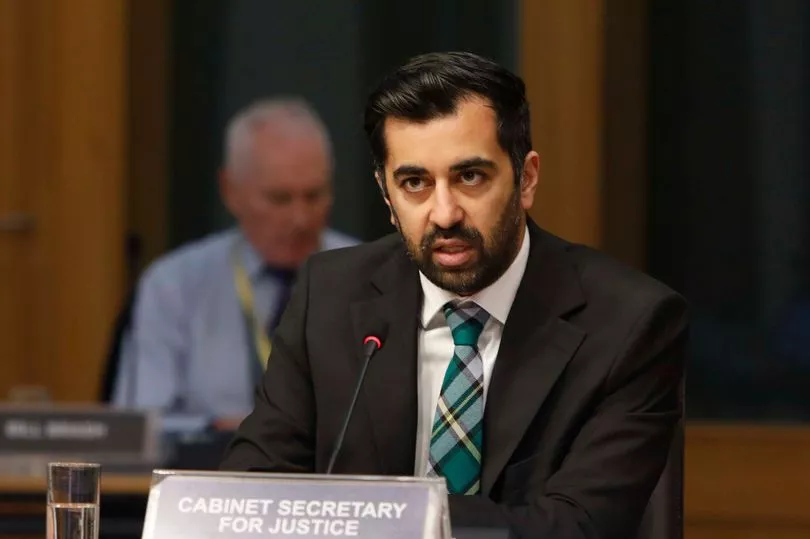
Humza Yousaf’s Hate Crime and Public Order (Scotland) Act is to be implemented in early 2024.
Police Scotland has set up a dedicated hate crime unit to enforce the controversial new laws coming into force early next year. The legislation consolidates existing law and extends protection for vulnerable groups with a new offence of “stirring up hatred”.
Under the Act, offences are considered “aggravated” – which could influence sentencing – if they involve prejudice on the basis of age, disability, race, religion, sexual orientation, transgender identity or variations in sex characteristics.
Critics fear a disproportionate amount of police time will be diverted into policing toxic gender culture wars, with an over-emphasis on “pursuing hurtful words but not violent conduct”.
They claim the new laws will also have a “chilling effect” on free speech and warn that campaigners supporting women’s rights may find themselves facing accusations of transphobia.
Helen Joyce, director of advocacy with human rights group Sex Matters, said:
“The establishment of a new, dedicated hate crime unit at Police Scotland sends a sinister message to those who advocate for women’s and children’s rights. Humza Yousaf’s dangerous hate crime law erodes free speech and has already been delayed due to difficulties facing the police.”
Former Scottish Justice Minister Kenny MacAskill said:
“Police Scotland are in danger of taking their eye off the ball. All new legislation requires training for officers. But the establishment of a unit when it should be part of the day job gets things out of kilter. The main hate crime has always been and remains misogyny and domestic violence. Sectarianism and racism also remain scars on our society. The danger here is that the focus moves onto those who have been most vocal in demanding action even when statistics and all the evidence show it to be very small indeed. Nobody denies that hate offences against transgender should be prosecuted but there’s a clear danger that a unit such as this reacts to those siren voices seeking to find it under every stone or seeing it in every social media post. Maybe resources should continue to address domestic violence and the other curses that blight our land, not seek new vogues for a demanding few.” (The Express)
The London-controlled Labour Party in Scotland really is a dead parrot – Scotland needs to form Its Own Labour Party – fully supporting Scottish independence – no time for dithering –get it done now.
Angela Bretherton for Scottish Labour replied:
Stop spreading bitterness and divisiveness get off the internet and help people.
Calton jock replied:
No bitterness on my part. Only sadness that the party I supported for many years has lost its way. London officials should have no say in the running or policies of Scottish Labour.
Angela Bretherton for Scottish Labour replied:
They have very little say. We have our own sec but we do work together because that’s the whole point of democratic socialism. I’ve missed the point. Nationalists dominate but that doesn’t mean they are right. Poverty doesn’t recognise borders, and neither does climate change.
Calton Jock replied:
Read the blog post. Alex Rowley was correct 20 years ago and he was removed by London-based officers of the party.
We need to at least discuss the policy of independence.
The Labour Party in England will do what it always does over the next few years.
Many nights of the long knives and ever widening rifts between Momentum and the Blairites.
Scottish labour need not go down that road. At the very least absolute autonomy as proposed by Alex Salmond in 1999 and oft repeated since.
Angela Bretherton for Scottish Labour replied:
That’s kind of missing the point though isn’t it but yeah i suppose if you want to get on the independence vote then yeah that’s the way to go.
Calton Jock replied:
Thank you for getting back to me. I wish you every success in the future. Hopefully as a member of a truly autonomous Scottish labour Party. I attended meetings addressed by Manny Shinwell so that gives my age away.
Angela Bretherton for Scottish Labour replied:
Oh I lived here in Scotland for 32 years but the anti English brigade have just been given a green light don’t feel welcome here any longer pastures new.
Calton Jock replied:
I lived in Catterick for 10 years and for another 10 years I lived in Devon.
I always felt welcome and never ever expeienced any anti-Scots behaviour.
I do not expect any Anti-English sentiment to surface in Scotland. Most likely anti Westminster.
Angela Bretherton for Scottish Labour replied:
Well it did the last referendum and it did at the hustings it’s there and it was a terrible time not just for me but my Scottish kids who are grown up now so I believe it will unfortunately.
Calton Jock replied:
But the behaviour of the Con/Dem government , the Better Together lot and the Unionist media was absolutley appalling and Blair McDougall freely admitted that instructions to his ever increasing team of English based activists was to campaign with all the dirt they could muster no matter the truth of anything.
I wrote extensively on my blog about the abhorrent behaviour of London based civil servants who freely admitted they had breached the strict code of the service that forbids any civil servant from participating in politics.
Angela Bretherton for Scottish Labour replied:
Yes it was I am not disputing that it’s just happened. not a fan of britnat either it’s all wrong.
Calton Jock replied:
I enjoyed our discussion this evening and I do hope you will take time to read some of my blogs.
The Labour Party in Scotland really does need to find a way of relating exclusively to Scots and I also hope you extend your residence here.
It is after all is said and done your country by adoption. Best wishes Calton Jock
Labour will reverse the financial damage caused to WASPI women. We will compensate those women affected by state pension age changes. This means 6,800 women in Perth & North Perthshire will be £15,400 on average better off after 5 years. No longer a commitment





 caltonjock