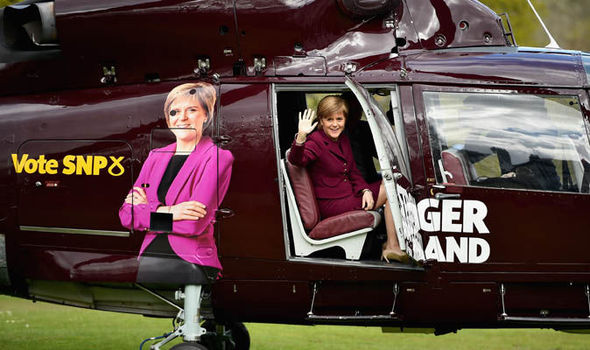
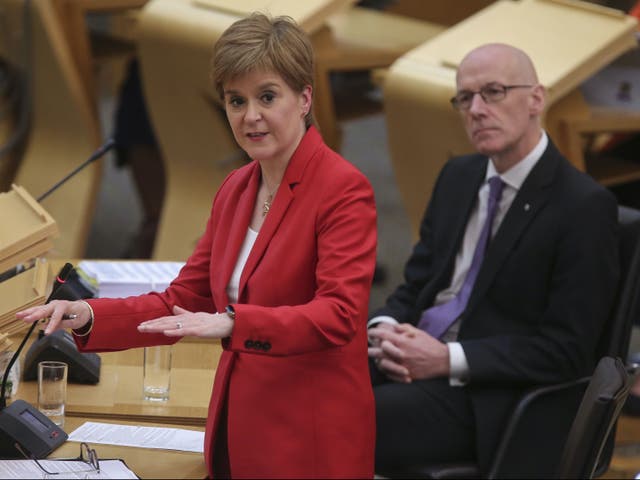
Nicola Sturgeon’s family has roots in the North East of England, highlighting the close-knit relationship the area has with its neighbours north of the border. But will the region benefit from the rise of Scotland’s first minister and the SNP or will it be overshadowed?
Arthur Street, Ryhope, Sunderland, was once home to Sturgeon’s great-grandfather, shipwright Joseph Mills. His daughter Margaret married Robert Sturgeon, a gardener from Ayr, in 1943. She went on to become the grandmother of the SNP leader and the family eventually moved back to the south west of Scotland, where the now-first minister was born in 1970.
Sunderland, like many parts of Scotland, is steeped in industrial heritage, and Nicola Sturgeon’s family roots in the north east of England simply reinforces the idea that these two parts of the UK share many cultural and historical ties.
But the rise of the Scottish National Party north of the border has left many in the North East and Cumbria questioning the region’s future relationship with Scotland. “The North East shares a lot in common with Scotland and there’s a common cause to be made with our neighbours,” says Jonathan Blackie, a visiting professor at Northumberland University. “But given the current political situation it’s difficult to see how we can thrive by working together, when there are so many things pulling us apart.” The new political situation that he refers to is to the SNP now having 56 MPs at Westminster.
David Cameron has also said he will devolve more powers to the Scottish Parliament as recommended by the Smith Commission, which makes those living on the border nervous. “Nicola Sturgeon has played a blinder, she’s put Scotland in a position where it can’t get loose,” says Rob Johnston, the chief executive of the Cumbria Chamber of Commerce. “It’s not the number of SNP MPs, it’s the fact that Scotland is now speaking with one voice. “They can attract money and investment north of the border and that presents a real challenge for Cumbria.”
In the Scottish Independence referendum 67% of people in the Scottish Borders constituency voted to maintain the Union, making it an area that many thought the SNP would find hard to break through in at the general election.
The Berwickshire, Roxburgh and Selkirk constituency MSP, which sits North of Northumberland said: “I actually think there are many parallels between what I want for the South of Scotland to what people in the North of England want. They want their voices to be heard and they want powers to make a difference to their region. If I can build a distinctive voice for the South of Scotland, people in the North of England should support that, and in fact work with me because they will also feel the benefits.”
To the south of Calum Kerr’s constituency sits Northumberland, the English county with the highest number of castles, a lasting testament to the fractious historical relationship that the north of England has had with its Scottish neighbours. The differences on the border are no longer territorial, but the rise of the SNP is certainly creating new political and economic tensions. (BBC 2015)
Comment: Innuendo appears innocuous and the underlying intent needs only to be implied to be effective but for the life of me I cannot fathom the purpose of the article. Perhaps others can.
Sep 2014: The Independence referendum – Promises Promises
Alex Salmond’s diligence in the previous parliament had been rewarded with the Party gaining an overall majority in the 2011 election and in 2012 he signed an agreement with British Prime Minister Cameron to hold an independence referendum in 2014. In the weeks leading up to the poll he inspired the pro-independence cause, steadily eroding a significant lead held by the Unionist Party’s.
In August 2014 he emerged as the clear winner of a televised debate with Labour politician Alistair Darling, the leader of “Better Together,” the multiparty campaign committed to preserving Scotland’s place in the United Kingdom. In polls held shortly after the debate, 51% of those expressing an opinion favoured independence the first time since polling on the matter began that the pro-independence camp had registered a lead.
Cameron response was to promise Scottish “self rule” (published illegally in the Daily Record in the “purdah” perod as “the Vow”) which was then given major “air time” on the BBC over the final 3 days of the campaign and other news outlets’.
Purdah, which started on 21 August should have prevented the UK government from announcing the proposed new legislation as a means of gaining advantage over the “Yes” campaign. For those who might not be aware of the legislation the term means:
“Veil on government”, and refers to the pre-election campaign period and provides restrictions on how the government may act, how the Civil Service behaves and the use of government resources during that time. Like many aspects the UK’s unwritten constitution government, is a mix of convention, precedent, code of conduct and statutory requirement.
The unprecedented “pledge to the nation” brokered by former prime minister Gordon Brown and Scottish Labour, was signed by the three political leaders at Westminster offering their version of the future governance of Scotland, alternative to independence. It gave assurance to Scots wavering about complete separation confidence that, if the a “no” vote would still result in major changes and Scotland would be given a much more control over its future. It proved to be the deal of the century for the Unionists who won over many older voters who were worried sick that their would be massive reductions in their old age pensions which was only one of the many lies foisted on Scots and boasted about after the referendum by the “Better Together” campaign promises. And the delivery? Well that’s another story!!! “Not a lot” as Paul Daniels used to Quip
There were three guarantees
New powers for the Scottish Parliament. Holyrood will be strengthened with extensive new powers, on a timetable beginning on September 19, with legislation in 2015. The Scottish Parliament will be a permanent and irreversible part of the British constitution.
The guarantee of fairness to Scotland. The guarantee that the modern purpose of the Union is to ensure opportunity and security by pooling and sharing our resources equitably for our defence, prosperity and the social and economic welfare of every citizen, including through UK pensions and UK funding of healthcare.
The power to spend more on the NHS if that is Scottish people’s will. The guarantee that with the continued Barnett allocation, based on need and with the power to raise its own funds, the final decisions on spending on public services in Scotland, including on the NHS, will be made by the Scottish Parliament. The Scottish Parliament will have the last word on how much is spent on health. It will have the power to keep the NHS in public hands and the capacity to protect it.
Nov 2014: Cheated of victory by the illegal treachery of the reincarnation of a few Daniel Defoe’s at the “Daily Record” the hurt was very painful for Alex Salmond and he stood down handing control of the Party to the ambitious but, untried Nicola Sturgeon anticipating there would be much for her to do to take Scotland forward equipped with the “self rule” powers assured by “the Vow”.
But, true to form as predicted by Scottish nationalists who had campaigned day and night for nearly a year, Westminster renaged on the promises made in “the Vow” an outcome of the consequence of inept negotiating by Sweeney, (who retained his job as Finance, Employment and Sustainable Growth, adding the title Deputy First Minister to his CV) and his SNP team who allowed themselves to be set-up as the lesser particpants in a significant minority with Unionist political Partys’.
May 2015: In the General Election Unionist party’s were just about wiped out in Scotland. Voters were scunnered with the Westminster cabal who failed to deliver the undertakings contained in “The Vow”. Quite the reverse in a number of cases in some areas devolved powers had been taken back to Westminster.
It was expected that Nicola Sturgeon would announce that the Scottish electorate had given her Party a manadate to declare independence. But she and her close colleagues lacked the political courage or backbone to do so. This was the time Scotland badly needed a leader but Alex Salmond was out to pasture. Another opportuity for a declaration of independence missed. And the reason for accepting the status-qou became apparent early on in the new parliament when Sturgeon took her cohort of 56 MP’s to Westminster and posed with them for numerous photographs outside the House of Commonsbefore sending them into school for indoctrination to the ways and means of the Unionist political systems and etiquette, including, no clapping or name calling. By declaring her acceptance of a continuance of the Unionist political system she finally exposed herself as a “Gradualist”. Independence was placed on the “things to do when we are not busy” list. And she would be busy selling herself to the political mandarins of the USA.
31 May 2015: Sturgeon’ European and World tour
Sturgeon’s profile was greatly enhanced during the general election campaign due to her appearances on the UK wide televised leaders debates and burgeoned further with the election’s near complete destruction of the Unionist party’s in Scotland. Many media outlets hailed her as the new Angela Merkel.
A European tour was completed by Sturgeon in the first four weeks of the new parliament. Her programme included an address to the European Parliament in Brussels in which she emphasised the difference between the Scottish and UK governments’ positions on Europe. She went on to deliver a speech to the European Policy Centre, highlighting the benefits that EU membership brought to Scotland’s economy through trade and by the 171,000 people born elsewhere in the European Union but living and working in Scotland.
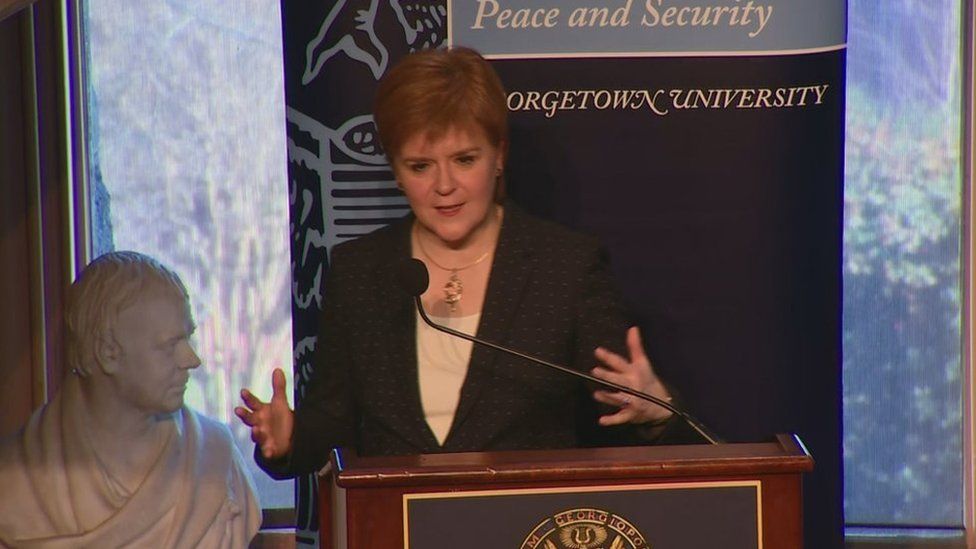
Her elevation to worldwide political stardom continued when she was invited to tour the USA and Canada. Her schedule in Canada included trade and cultural engagements in Ottawa and Toronto. In the USA it extended to include television appearances on talk shows and meetings in Washington DC, New York, New Jersey and other venues, with influential business leaders who had expressed interest in investing in an independent scotland as well as meetings with financial leaders of the the World Bank, IMF and an address to the Council for Foreign Relations.
9 May 2017: Sturgeon off to the USA on another jaunt
The visit was promoted as a bid to gain investment for Scotland but it transpired this was a smokescreen for other purposes since the investment claimed to have been achieved was brokered by a Scottish Quango well before the visit.
She confined her visit to meeting with representatives from America’s liberal heartlands, including, “the face of the anti-Trump movement in American State politics” California Governor Gerry Brown, with whom she signed a climate change agreement. While on the West coast she told journalists that if or when she met President Trump she would “bend his ear” and register her disagreement with his policies. A statement that endeared her to the Californians’ but alienated many Republicans’.
Her confidence boosted by success in the West she attended and addressed a meeting at the United Nations and followed this up with a speech at the “Women in the World” event in New York, The organisers billed Sturgeon as “The Queen of Scots”. The founder of the organisation went further and equated Sturgeon to former Secretary of State Mrs Clinton, the star attraction at the event. She also captioned a photograph of herself together with Sturgeon and Clinton “Backstage @womenintheworld with @HillaryClinton and First Minister @NicolaSturgeon two women I admire most anywhere”. A caption to a second photograph of Sturgeon and Clinton said “Snapshot of a real power couple.” The messiah had landed.!!!! WOKE agenda implementation on return to Scotland
20 May 2016: The Scottish General Elections returned yet another SNP minority government. Sturgeon decided to freshen-up her leadership team with the addition of new faces and Swinney, who publicly claimed he had asked for a new challenge, was removed from his comfort zone to the post of Education Secretary where he remained until 2021. In 2021 the Scottish Elections saw the SNP returned to power, again with a minority government. Sturgeon, unhappy with his performance in the Education brief, moved Swinney to the newly created post of Covid Recovery Secretary.
About Swinney and education
22 May 2016: Swinney says controversial named person legislation will be introduced
Swinney’s proposal was to appoint a “named person” who would monitor the wellbeing of each and every child in Scotland, from birth to the age of 18. The intention was for this person to be a single point of contact if a child or their parents wanted information, support or advice, and for other services if they had concerns about the child’s wellbeing. The named person would generally be a senior teacher, health visitor or midwife, depending on the age of the child. The government said this was “a good policy to support the wellbeing of children and young people”.
Swinney said the legislation making health visitors or senior teachers the point of contact for every child in Scotland was well-supported despite heavy criticism from political opponents. He said: “What I hear from teachers is that they are interested in the educational performance and the health and wellbeing of the young people. “The health and wellbeing of the children is at the heart of the named person discussion. What the named person is about is making sure whenever a child or young person need support and assistance, they have a very direct route on how to get that.
Opponents of the scheme argued that it was a “Big Brother” style “snooper’s charter”, which would undermine parents and breach privacy. And the protest came to a head in July 2016, when judges of the UK Supreme Court said the provisions breached rights to privacy and a family life under the European Convention on Human Rights, so were “not within the legislative competency of the Scottish Parliament”. Swinney and the SNP battled on for a time but eventually backed down and abandoned the legislation.
22 Sep 2016: Plans to bring in more secondary school tests scrapped.
Scots Education Secretary John Swinney was forced to axe his proposals for mandatory assessments to ease the workload on teachers. The EIS teaching union said it was a “victory for common sense”. Pupils’ grades will now be more focused on final exams and course work that is marked externally. EIS general secretary said the decision would be welcomed by pupils and teachers, who had been under increased pressure since the new National qualifications were introduced in 2014.
22 Nov 2018: Public opinion is that Education Secretary Swinney is the class dunce and should be made to wear a dunce’s cap with a large capital “D” on the front of it for the way he has treated teachers. Swinney was forced to bin his “flagship” Education Bill but pushed ahead with the hated P1 tests and the Named Person legislation meanwhile, Already overworked teachers are, underpaid and expected to do even more.
14 Dec 2018: Council scrap controversial primary one tests.
Fife Council became the first local authority in Scotland to end mandatory P1 national testing. Schools are expected to revert to the Performance Indicators in Primary Schools (PIPS) system previously used. The move was welcomed by opposition MSP’s from all parties. Teachers claimed some P1 youngsters have been left crying and distressed by “unnecessary and cruel” national testing.
7 Aug 2019: Pass rates for Highers dip for 4th year in a row
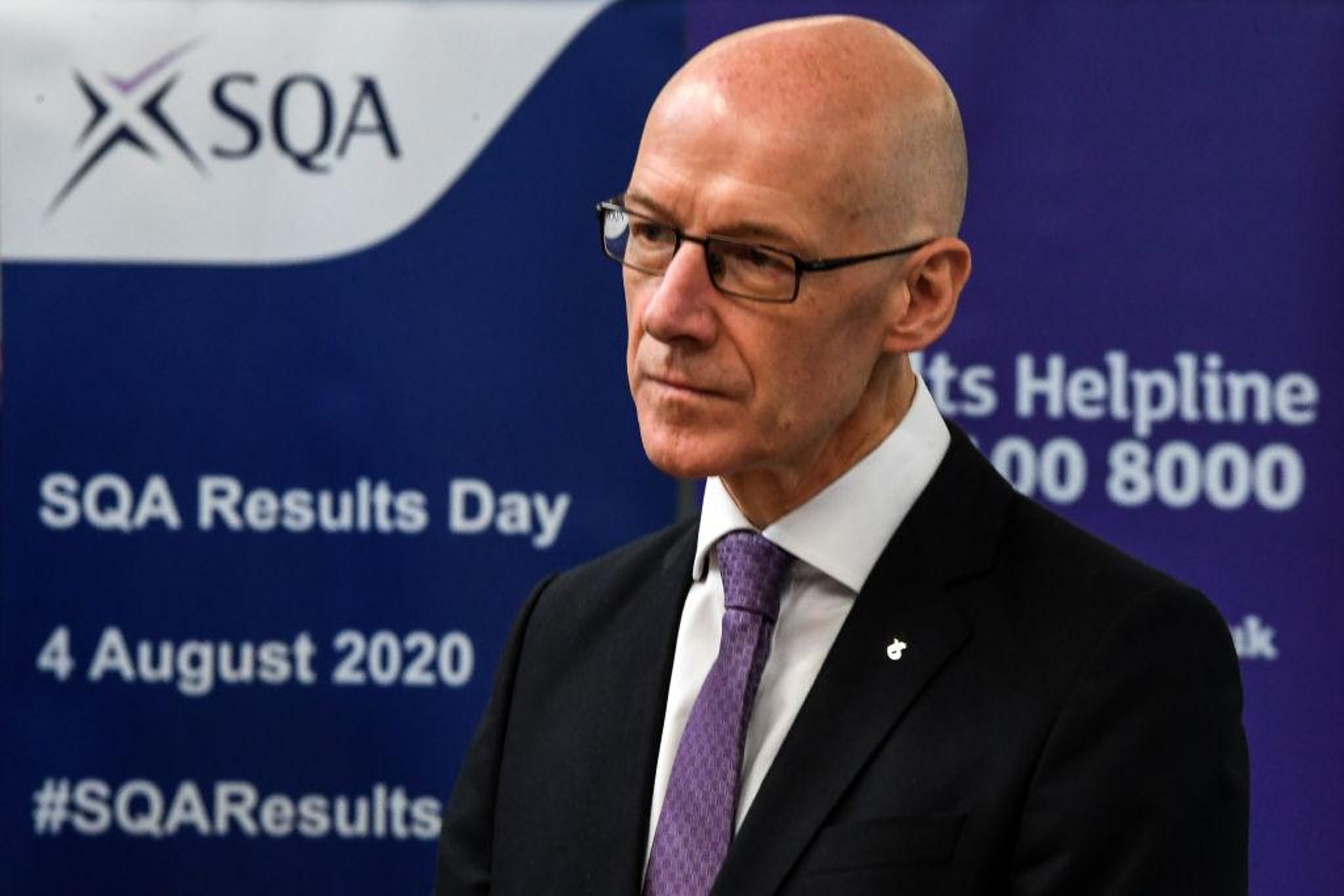
Exam pass rates have fallen at every level except National 5, according to this year’s Scottish Qualifications Authority (SQA) results. Year-on-year pass rates are down at National 2 by 2.6%, National 3 by 3.6%, National 4 by 2.6%, highers by 2% and advanced higher by 1.1%. Highers attainment has fallen for four consecutive years but Education Secretary John Swinney defended the results, arguing if pass rates rose regularly “people would rightly question the robustness of our assessment system”.
8 Aug 2019: Exam changes ‘cost young Scots a million qualifications’.
A respected academic believes a million qualifications have been “lost” since the introduction of the new exams. Professor Jim Scott said studies suggest “complex curricular structures” slow the progress of S1 to S4 pupils and deprive them of opportunities. And he said middle ranking pupils are being inappropriately fitted into top-level classes, which contributes to the declining success rate at National 5. Swinney said: “Scotland enjoys a credible assessment system and like all high-performing education systems, year on year variation in results is expected. “Curriculum for Excellence gives pupils the broad skills and knowledge to succeed in life.”
10 Oct 2019: The National Parent Forum of Scotland (NPFS) conducted an online meeting to discuss matters arising from Swinney’s new curriculum for Scottish children.
Right from the start parents expressed anger at Swinney’s addition, of a new relationship, sexual health and parenthood programme to the curriculum, without discussion and agreement. The programme provides graphic descriptions of what is being taught to kids and a father said:
“Right from the beginning of primary school they are teaching that sex is assigned at birth and gender is a subjective factor. I think that is a very dangerous and confusing message for young people. Masturbation is being positively promoted in schools. Children as young as 6yo are getting compulsory sex education lessons on ‘self-stimulation’ and touching themselves.”
NPFS chair Joanna Murphy reminded the father that the session was being streamed online. To which the father replied:
“If what I am raising is not suitable for discussion among a group of adults how can it possibly be suitable to talk about in schools? The curriculum features links to video content directing older pupils to erogenous zones in the anus. And one lesson plan explains that in some cultures male masturbation is seen as a waste of semen, which is supposed to be about creating life. And transgender life is introduced between P5 and P7. One lesson plan encourages kids to be whatever kind of girl or boy they want to be, free from stereotypes and gender-biased expectations”.
Swinney interjected:
“A lot of care has been taken to ensure that the contents of the material are truly age appropriate. That involved extensive dialogue with a number of organisations eg “Stonewall” whose confidence I have wanted to make sure are in place around these materials. It is promoting nothing. It is equipping young people with a knowledge and an understanding of what they can make their judgments about as responsible citizens. It simply deals with the world as it is and makes sure that young people will be equipped to handle that. I understand that there will be parental opinion that will not like this, and that should be a source of dialogue with schools to resolve that issue. I repeat my commendation for the materials . . . I don’t think we should allow our young people to be able, without context, to see things and experience things in our society that we have not properly equipped them for.”
21 May 2020: Covid and the excess deaths of elderly people in care homes
12 Aug 2020: Swinney, forced to declare a massive U-turn over the recent SQA grading controversy.
After widespread public outrage at the “postcode lottery”, and a menagerie of rightly angry student protests and activism, Swinney was forced to announce that more than 120 000 students are to have their exam results reassessed, with downgradings overturned.
He said: “We now accept that the risk of undermining the value of qualifications is outweighed by a concern that young people, particularly from working-class backgrounds, may lose faith in education. Pupils whose teacher estimates were upgraded by the qualifications authorities are to retain their results”.
Swinney apologised to Scottish students for the failed system, insisting his u-turn was not an attempt to quell calls for resignation. But informed opinion voiced the view that the u-turn was driven by his regard to the 2021 General Election election in which young voters might well have exacted revenge had matters not been addressed.
13 Aug 2020 exams fiasco caused by Swinney’s spectacular mismanagement.
Swinney faced a vote of no confidence over his exams fiasco volteface which resulted in a markedly increased pass rate compared to previous years. Opposition MSP’s listed his shortcomings including teacher shortages, the scrapping of his flagship Education Bill, his failure to close the attainment gap and the current exams controversy.
5 Apr 2021: Education mismanagement and political catastrophe
The previous year’s exams chaos saw Swinney come close to losing his job. The epic fail meant pupils in more deprived areas of Scotland were unfairly marked down – a situation which was ultimately reversed with teachers given the job of deciding grades. Pupils and parents were assured lessons would be learned but it appears the new way of working just moved a problem. Pupils in 2021 are facing a postcode lottery when it comes to their final grade. Some schools are allowing continuous assessment via coursework to decide the mark while others are arranging what are effectively individual exams. Parents are rightly worried – again – that their children are being unfairly treated, discriminated against and not being given a fair chance. This is another scandal in the making. But it’s one that everyone can see coming. The Scottish Government needs to take heed of the warnings and concerns of those on the frontline and stop this impending train wreck. The future prospects of Scotland’s young people is at stake. They can’t go another year with the fear, uncertainty and worry about their grades.
14 May 2021: Education Secretary, Swinney under the cosh
Swinney faced questions about mounting concerns over reports of stress on pupils who had been told exams were cancelled, but who now faced weeks of daily assessments. An MSP wrote to Swinney saying:
“The alternative arrangements imposed by the SQA for this year’s exams are clearly and indisputably causing harm to young people and their teachers. Few would have thought it possible to see a system do more damage than last year. But reports from constituents make it clear that there is every likelihood this year’s arrangements could be worse, in terms of equality, fairness and mental health. Pupils who were told exams were off are now finding lots of them crammed into a short period of time, at short notice. One reported that a pupil has 40 assessments in eight weeks, which averages at one a day for eight weeks. A constituent described this as “the worst outcome that could ever possibly have happened”. Teachers and pupils are exhausted. I’m told many are unable to sleep because of stress, and that anxiety is on the increase”.
Whitehall mandarins, Unionist politicians and their Luddite supporters will tell you it will be a long and torturous process over many years and it must be this way because the relationship Scotland has with the rest of the UK is too complex to untangle in a shorter period.
But if Czechoslovakia could be split up in six months in 1992, why should the process of establishing an independent Scotland be such a hardship?
The Velvet Revolution
World War I lasted four years, World War II lasted six. So is it easier to conquer then lose an entire continent than to separate two jurisdictions peacefully?
Czechoslovakia, not only transformed from a socialist republic and a Soviet satellite to liberal democracy, but it also successfully split peacefully into two nations.
The pivotal elections that took place in 1992 saw an even split of voters in both of the constituent parts of Czechoslovakia. Tension arose and the leaders of both constituent regions agreed the federation should be split. An agreement was signed on 26th August 1992.
By 13th November 1992, a law had been enacted as to how the federal assets were going to be divided and twelve days later, an act was passed that set the dissolution date on 31st December 1992.
Complex matters such as the continuity of government, continuity of laws, arrangements for courts and so on were all swiftly determined by December 1992.
A new Czech Constitution was passed on 16th December 1992.
Czechoslovakia was dissolved at midnight on 31 December 1992.
When the people woke up on 01 January 1993, they had new nationalities.
Within a mere six months, a comprehensive settlement had been agreed and activated.
Immobile assets were distributed to the country where they sat, mobile assets and assets abroad were distributed according to the rough population ratio
Amendments to international treaties signed by Czechoslovakia were negotiated and signed very quickly by both new republics, confirming the continuation of such treaties.
In 1996, the two countries signed a protocol specifying the distribution of duties enshrined by treaties signed as Czechoslovakia.
All of this happened whilst Czechoslovakia and its constituent countries were undergoing a massive economic transformation.
Czechoslovakia was privatizing on an unprecedented scale and at an unprecedented pace.
In a way, it was like Brexit and the UK’s 1980s privatizations combined, only a lot more complicated.
Whereas the 1980s UK privatized two companies a year, the early 1990s Czechoslovakia privatized two companies an hour.
Taken together, these companies’ accounting value was a big share of GDP. The voucher privatization alone (there were other methods of privatization) privatized companies worth one-third of Czechoslovak GDP.
And let us not forget the fact that Czechoslovakia was also a currency union.
The original idea was that the currency would continue after the separation, but the Czechoslovak koruna outlived Czechoslovakia by a mere six weeks.
All of this was taking place at the exact same time the republics were being separated. Where there is a will, there is a way.
Two things made this possible:
The leaders’ insistence that it must happen fast before organized business interests and/or government could mount a successful defence of the status quo.
Then the fact that the two newly-created governments, for all the tension between them, successfully worked together to apply current or previous arrangements in good faith.
Wherever questions or differences arose, they sought an amicable solution where none of the parties would score a win for their side but rather one where future cooperation would be maintained.
Nobody was proposing divorce bills or ridiculous notions of planes not flying, trucks stuck at the border, licenses not being recognized, or one country continuing to have jurisdiction over the other for the next 100 years.
Time and good faith were of the essence.
If Czechs and Slovaks were able to separate in six months, surely Westminster and Holyrood can find a way to extract one the other in a similar time period?
Credit this article (paraphrased a wee bit here and there) to Martin Pánek, Director of the Prague-based Liberal Institute.
He was born on in Edinburgh on 13 April 1964. He attended the University of Edinburgh, where he graduated with an MA Honours degree in politics in 1986.
Personal life
He married work colleague Lorna in 1991. They had two children. The marriage ended in 1998 (annulled in 2000) after he discovered she was cheating on him with a married school-teacher. She retained the family home and the children and he moved into rented accomodation nearby.
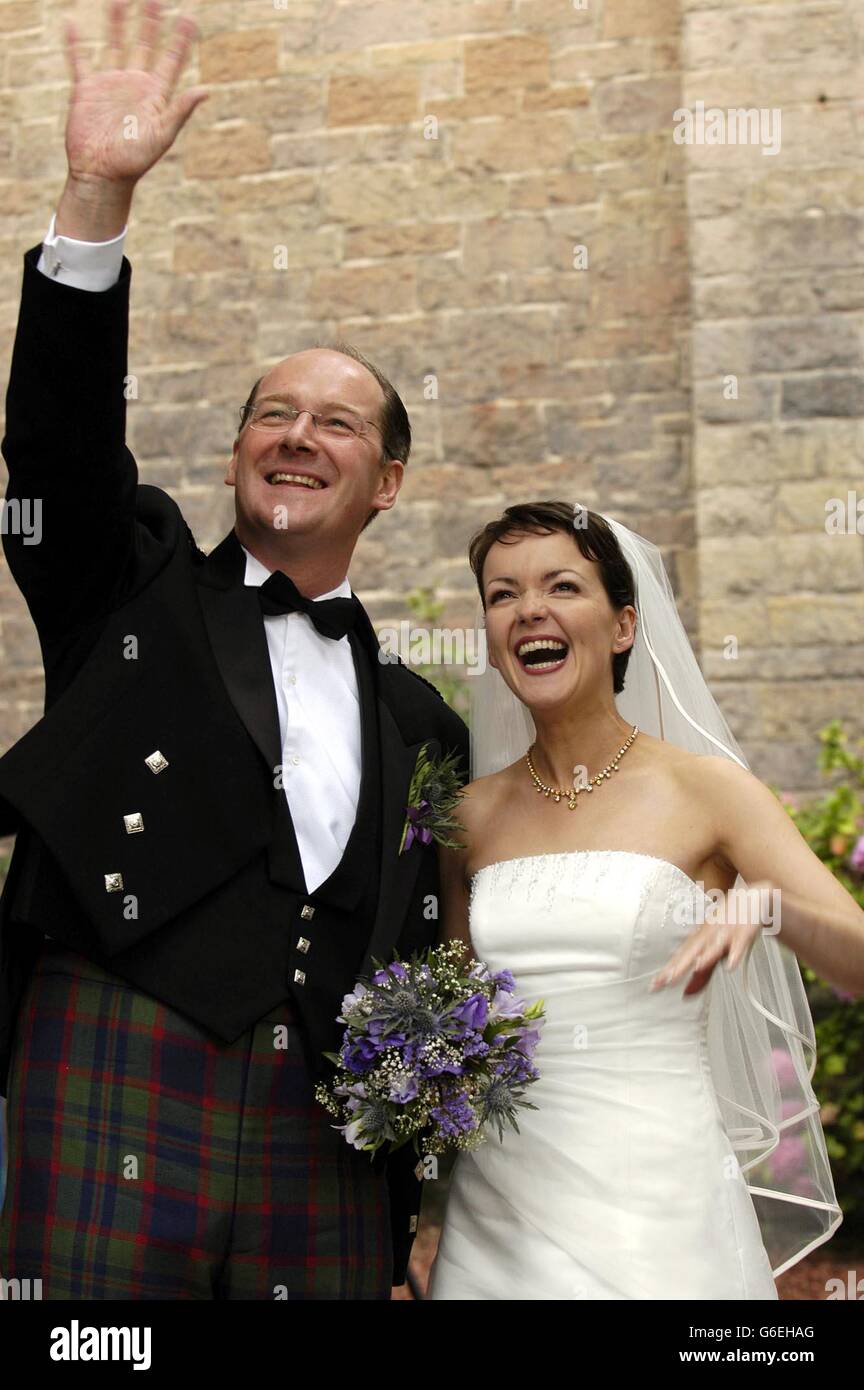
In July 2003, he married BBC journalist Elizabeth Quigley. The wedding was was overshadowed by his decision to have his first marriage annulled by the Roman Catholic authorities. He was a “practising member of the Church of Scotland”, but his wife to be was a Roman Catholic and the only way for them to marry in a Roman Catholic church was for him to obtain an annulment of his first marriage – a declaration that it had no legal existence and any children he might have with his new wife, would be brought up as Catholics.
Employment
Swinney was a research officer for the Scottish Coal Project (1987–1988), a senior management consultant with Development Options (1988–1992), and a strategic planning principal with Scottish Amicable (1992–1997).
Early Party and political Career 1979-1997
He joined the SNP aged only 15 and was an active member of the youth wing, progressing over the years to the post of Assistant National Secretary then, in 1986, at the early age of 22, National Secretary until 1992, when he was promoted to the post of Vice Convenor, then Senior Vice Convenor (Deputy Party Leader) holding the position until 1997. He was elected as Member of Parliament (MP) in 1997, for the Tayside North constituency, and in 1999 he became an MSP for the same area in the Scottish Parliament. He gave up the “dual mandate” as a Westminster MP at the 2001 general election in order reducing his time away from home. He supported Margaret Ewing in her 1990 bid to become SNP leader, but transferred his allegiance to Alex Salmond who won it.
2000 to date: The Holyrood years – MSP Tayside North 1999-2011)-MSP Perthshire North
Alex Salmond resigned the Party leadership in 2000 and Swinney was elected Leader in the ensuing election. His leadership was ineffectual, with the Party losing an MP in 2001 and a disastrous loss of 27 MSPs in 2003 despite all the political advantages being with the party. His role as leader was challenged in 2003, but he was stubborn and held on to office only to be forced to step down following a disappointing 2004 European Parliament election in which the Party lost further ground.
16 Jun 2002: Swinney’s Chief of Staff departs
Stuart Borrowman walked out because of savage in-fighting just eight months after becoming the party’s top official. His decision to quit came as senior members of the party fought a bloody battle for re-selection as candidates for the Holyrood elections. Borrowman was one of Swinney’s vital strategists and was in charge of parliamentary staff and the Holyrood group budget and was the key to building an effective opposition to the Labour-led Executive.
The run-up to the series of Nationalist hustings was a bruising internal battle with spin and smear campaigns being waged against some of the most senior MSPs in the party. Informed sources advised that Party members, fed up with the dithering gradualists wished to appoint fundamentalist candidates and senior MSPs could end up well down the list – endangering their Holyrood seats.
Aug 2003: Swinney’s Leadership challenged
West of Scotland List MSP, Campbell Martin became the first MSP to publicly back Bill Wilson in his leadership challenge and Swinney’s supporters feared his breaking ranks might spark an open revolt amongst the other 27 MSP’s. Speaking to the press Martin exposed deep divisions in the SNP saying his position reflected growing grassroots opposition to Swinney’s lack of commitment to independence. He said:
“The SNP is supposed to be the party of independence but under the current leader we have started to walk away from our core belief. Instead, we have argued to be allowed to form the Scottish Executive and manage devolution within the United Kingdom. I am sure the leadership of the party still believes in independence, it’s just that, to them, it has become an eventual aim that would be nice if it happened but no longer the main priority”.
Martin claimed Swinney was losing support of large swathes of the SNP because of the “New Labourisation” of the party and that he had surrounded himself with a clique of MSPs and unelected advisers who were shifting the party to the right. He continued saying:
“The clique that surrounds Swinney believes that if you are not with them, then you are against them and you are fair game to be attacked – even if your “crime” is nothing more than simply disagreeing with them. In the years of his leadership a number of SNP MSPs have complained about their treatment by the clique around the leader”.
Although Dr Bill Wilson stood little chance of winning, it was the hope of Swinney’s critics that a “stalking horse” bid would provoke a serious challenge to a leader whose standing with Party members had been damaged further by the loss of 8 MSP’s in the last election. Critics blamed the losses on the Swinney’s style and his lack of charisma. But Swinney’s dictatorial style of leadership had alienated a number of MSP’s including former MSP, Dorothy-Grace Elder and legendary SNP, figure Margo McDonald both of whom had resigned from the Party. A senior Party activist commented: “This shows the widespread frustration among the grass roots. This was Labour’s worst election performance, but we could not capitalise on it – in fact we lost eight seats. And to add insult to injury, we had John Swinney and others claiming that it was a good campaign.”
10 Sep 2003: Swinney wins leadership battle
In a result marked by a low turnout and many abstentions an unhappy membership confirmed Swinney as Party Leader. Speaking just after the result was announced a relieved Swinney said: “This has been an uncomfortable summer for the SNP. But we have emerged stronger. I have made it clear that I have listened to members concerns and I will continue to listen. But the row between the gradualist side of the party and those who are in favour of an independence referendum, and the fundamentalist wing, who want all or nothing, should now end. The door is shut on these arguments”.
MSP Campbell Martin, the most prominent of Dr Wilson’s supporters, said: “John will be pleased with the result. But he must now look over his shoulder. Bill took almost 20 per cent of the vote which means Swiiney is effectively on probation until next year’s conference. Any danger to his leadership could now surface from people within his own leadership clique, who could now see an opportunity for themselves.”
21 Sep 2003: Swinney talks to other Party leaders about an independence referendum
Swinney hoped the prospect of a referendum would quell rebellion in the Party after he discussed his proposals with the Green Party and other independence supporting MSP’s But Senior SNP figures, who believe victory at the ballot box is all that is needed for independence, say that Swinney’s failure to grasp the nettle of independence by fudging the issue only confused voters. One senior fundamentalist said: “What we want is independence not indecision”.
Swinney commented: “the choice for the SNP now is to follow a route into government and deliver independence through a referendum, or go into the political wilderness as we did in the 1980s, and that wasn’t a nice place for us. I’m prepared to talk to any political Party who supports independence”.
But a senior party figure questioned the wisdom of his plans to build such a coalition, saying: “This smacks of desperation. Swinney wants to reform the party believing a referendum on independence is the way forward. But to announce a week before the leadership vote that he wants to do that along with the Greens and SSP makes us look like a fantasy party. If this is a ploy to silence the fundamentalists it won’t work. All it does is show that we don’t have full confidence in winning a majority in the Scottish Parliament”.
27 Jun 2004: Swinney blames Alex Salmond for his downfall.
Furious Swinney bowed out from the Party leadership with an angry swipe at internal back-stabbing in the SNP. In a veiled attack on the fundamentalists he said: “You know who they are, I know who they are. Let’s make sure they don’t corrode the SNP and thwart our campaign for independence. The small and vocal minority must understand this – our leader is democratically elected and once elected should be supported by every single member.”
The distancing between Swinney and Sturgeon came after Sturgeon and Roseanna Cunningham locked horns over over their ages. Sturgeon, 33, said that she would “relatively have youth on my side”. But Cunningham, 51, fired back that her remarks were “cheeky” and “a tad ageist”. The bitching convinced Swinney to back Cunningham in the leadership contest. He had thought Sturgeon to be his ally but was “raging” to hear that she had been briefing against him. He told friends he blamed Alex Salmond, the man he replaced, for turning Sturgeon and much of the party against him.
He later visited Cunningham at her home and told her he would be backing her bid for the leadership. His support would tip the balance in Cunningham’s favour and she would be almost certain to lead Scotland’s official opposition. A senior Party member said: “As the knives came out, Swinney was astonished to hear Sturgeon was briefing against him. He thought it a poor show after everything he’d done for her. He’s been destroyed by back-stabbing and is convinced Alex Salmond orchestrated a whispering campaign against him. It’s one member one vote and his move will gift 1,000 votes to Roseanna out of the 8,000 up for grabs. That will swing it for her and Sturgeon has only got herself to blame. She was Alex Salmond’s star girl then Swinney took her under his wing when he took over. Now he finds out that she’s been stitching him up at what he thinks is Alex Salmond’s instruction.
2004: Alex Salmond returns to the role of Party leader in the 2004 leadership contest.
2007: The Party went on to win the highest number of seats, (just short of a majority) in the Scottish Parliament in the 2007 election and he was appointed First Minister. As the head of a minority administration, however, he was unable to secure the approval of Scotland’s Parliament for a referendum on independence.
Salmond, who studied economics at the University of St. Andrews and had worked as an economist for the Royal Bank of Scotland Salmond emphasized his priority would be issues such as as sustainable economic growth, fairer taxes, education, and environmental awareness and he quickly implemented a number of popular measures, such as freezing council tax rates. He also maintained a close watch over Swinney whom he appointed Cabinet Secretary for Finance, Employment and Sustainable Growth. A post in which he served until 2014.
2011: Alex Salmond’s diligence in the previous parliament was rewarded with the Party gaining an overall majority in the 2011 election and in 2012 he signed an agreement with British Prime Minister Cameron to hold an independence referendum in 2014.
In the weeks leading up to the referendum, he inspired the pro-independence cause, steadily eroding a significant lead held by the Unionist Party’s. In August 2014 he emerged as the clear winner of a televised debate with Labour politician Alistair Darling, the leader of “Better Together,” the multiparty campaign committed to preserving Scotland’s place in the United Kingdom.
In polls held shortly after the debate, 51 percent of those expressing an opinion favoured independence. This marked the first time since polling on the matter began that the pro-independence camp had registered a lead, and Cameron response was to promise through “the Vow” (published in the Daily Record illegally, within the pugatory period) greater autonomy for Scotland.
On September 18, 2014, Scots went to the polls in unprecedented numbers, with turnout approaching 85 percent, and 55 percent voted to reject independence.
In his concession speech, Salmond declared that Scotland had “decided not, at this stage, to become an independent country,” a statement that raised the possibility of another referendum on the matter at some point in the future.
The day after the referendum, he announced that he would resign as first minister and SNP leader, a move that became official at the SNP’s national conference in November 2014, when he was replaced by Nicola Sturgeon.
Nov 2014: Sturgeon succeeded Alex Salmond. Swinney retained his job as Finance, Employment and Sustainable Growth adding the title Deputy First Minister to his CV.
May 2016: Sturgeon decided to freshen-up her government with the addition of new faces and Swinney, who publicly claimed he had asked for a new challenge, was removed from his comfort zone to the post of Education Secretary where he remained until 2021.
2021: Scottish Elections saw the SNP returned to power. Sturgeon, unhappy with Swinney’s performance in the Education brief, removed him from office to a new post as Covid Recovery Secretary.
Honest John under the cosh 2000-2021 – Notable events Swinney would prefer not to be recorded on his CV. But I will include them anyway.
19 Aug 2011: Scottish Finance Secretary makes a profit at taxpayers’ expense
Swinney, the Cabinet Secretary for Finance, Employment and Sustainable Growth in the Scottish Government, has made a large profit on his taxpayer-funded apartment. The two-storey terraced property was recently sold for £430,000, after being bought for £355,000 in December 2003, while he was Leader of the SNP. After capital gains tax, his total profit was around £57,000. But between the purchase and the sale, Swinney claimed more than £60,000 of taxpayers’ money to pay for the interest on his RBS mortgage. Swinney is overseeing the implication of the UK chancellor’s austerity spending cuts and a public sector pay freeze, but saw no problem in claiming this huge sum of money from taxpayers. It should not be forgotten that Swinney already earns a six-figure taxpayer-funded salary, which makes his claims and profit another kick in the teeth for hard-working families. The way politicians are able to make a profit from taxpayer-funded homes is a scandal. (taxpayers alliance)
For those seeking sources I gleaned most of the content from Scottish newspapers and other columnistsDependant on response it is my intention to publish Part 2 of this article which will include further events of note.







 caltonjock